Predicting core-level X-ray photoemission spectra of oxide surfaces from first principles -- a case study for SnO₂
Pith reviewed 2026-06-28 09:01 UTC · model grok-4.3
The pith
First-principles Z+1 calculations predict XPS spectra of SnO2 surfaces that match experimental results for reduced and oxygen-exposed cases.
A machine-rendered reading of the paper's core claim, the machinery that carries it, and where it could break.
Core claim
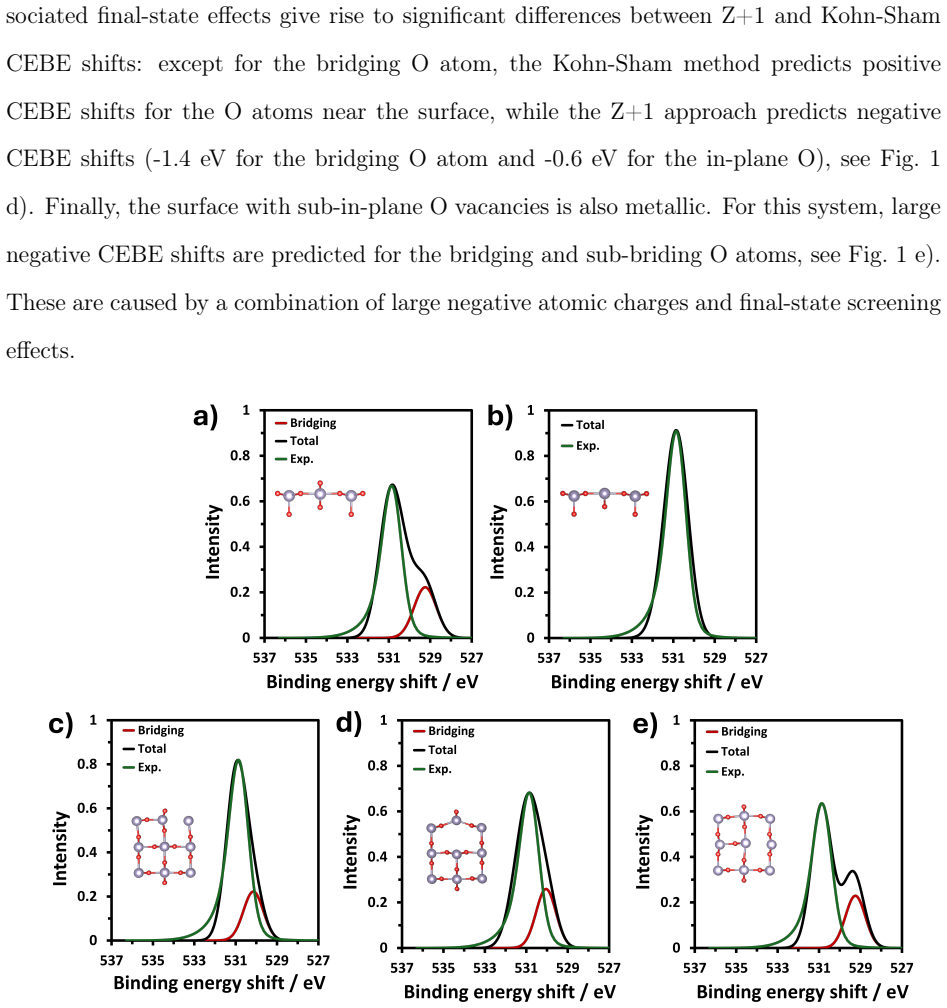
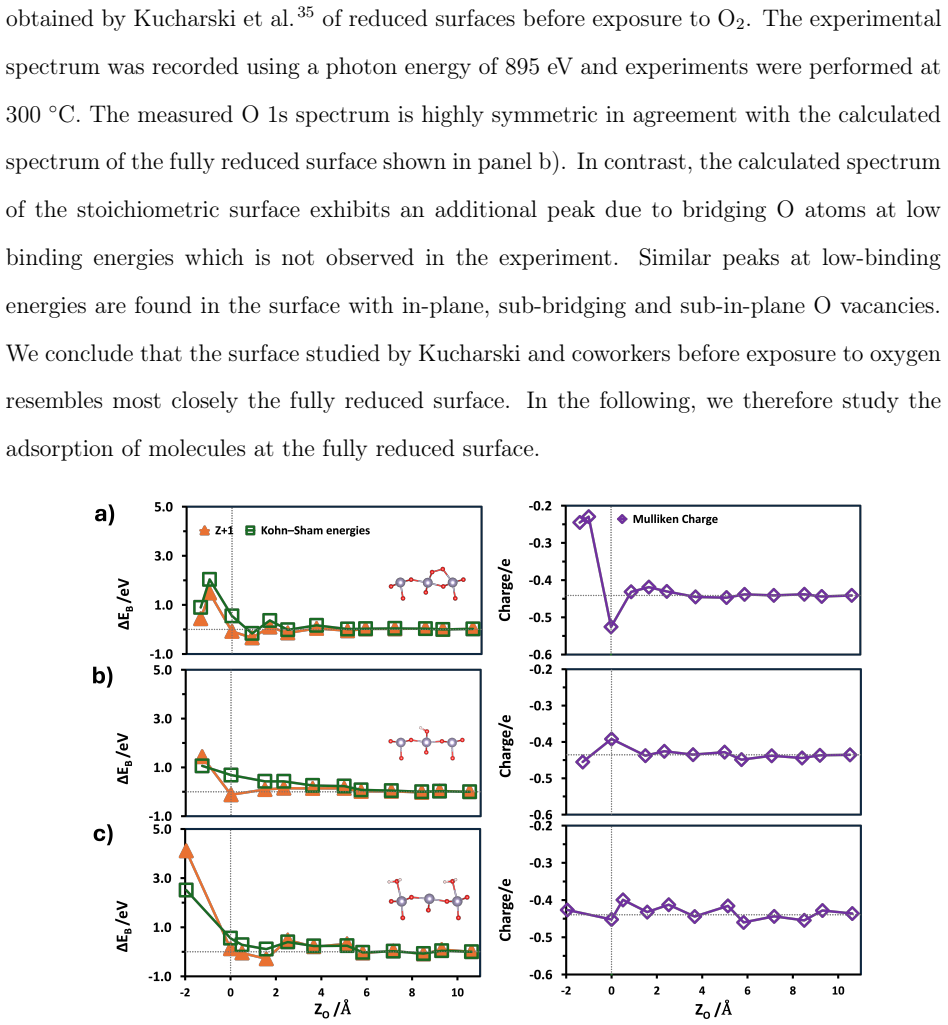
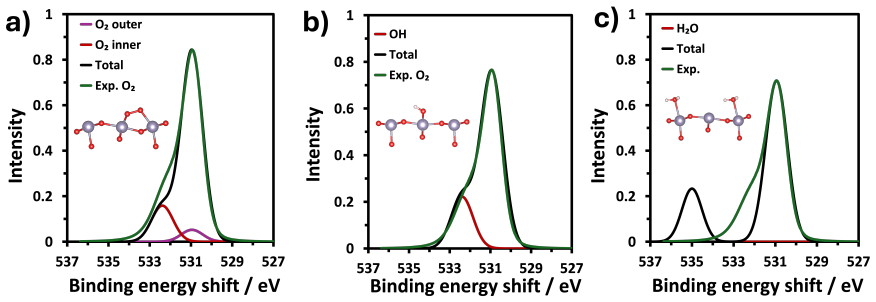
Using the Z+1 method to compute core-level binding energies, the fully reduced SnO2 (110) surface produces a highly symmetric O 1s XPS peak in agreement with measurements, whereas the stoichiometric surface shows an extra low-binding-energy feature from bridging oxygens, and adsorbates on the reduced surface add high-binding-energy features; these calculated spectra match experimental data for oxygen-exposed reduced surfaces.
What carries the argument
The Z+1 method for approximating core-electron binding energies by total-energy differences after substituting the core-excited atom with the next element.
If this is right
- The method enables direct comparison of computed spectra to experimental XPS data without empirical energy shifts.
- Different surface models produce identifiable spectral signatures that can distinguish vacancies from adsorbates.
- The approach is general and applicable to other oxide surfaces beyond SnO2.
- Predicted spectra for reduced surfaces with oxygen exposure align with observed experimental results.
Where Pith is reading between the lines
- Similar calculations on other oxides could help assign peaks in their XPS spectra to specific surface structures.
- By modeling mixtures of different terminations, the method might allow estimation of surface composition from measured spectra.
- Extending the models to include more complex reconstructions or defects could address overlapping features in real samples.
Load-bearing premise
The Z+1 approximation with the chosen surface models and calculation setup yields binding energy shifts that match the chemical environments seen in experiments without any fitting parameters.
What would settle it
An XPS measurement on a fully reduced SnO2 surface that displays an asymmetric O 1s peak shape instead of the predicted symmetric one would contradict the central result.
Figures
read the original abstract
X-ray photoemission spectroscopy (XPS) is a powerful technique to gain insight into the chemical properties of oxide surfaces. However, the interpretation of XPS spectra is notoriously difficult as realistic surfaces contain different terminations, reconstructions, adsorbates and defects all of which leave (potentially overlapping) spectroscopic fingerprints. To address this challenge, we present a first-principles approach based on the Z+1 method that allows us to predict XPS spectra of oxide surfaces which can directly be compared to experimental measurements. We present results for different SnO$_2$ (110) surfaces: the stoichiometric surface, surfaces with different types of vacancies (one of which is the fully reduced surface) and also the fully reduced surface with adsorbed OH and O$_2$ molecules. For these systems, we calculate the O 1s core-electron binding energies of all oxygen atoms and then use this to predict the XPS spectrum. We find that the fully reduced surface gives rise to a highly symmetric peak shape in agreement with recent XPS measurements. In contrast, the spectrum of the stoichiometric surface exhibits an additional feature at low binding energies caused by the bridging oxygen atoms at the surface. For the reduced surface with OH and O$_2$ adsorbates, the spectrum exhibits additional features at higher binding energies. The predicted spectra are in good agreement with experimental results obtained for reduced surfaces that have been exposed to oxygen gas. The presented method is general and can be straightforwardly applied to other surfaces.
Editorial analysis
A structured set of objections, weighed in public.
Referee Report
Summary. The manuscript presents a first-principles approach based on the Z+1 core-hole approximation to predict O 1s XPS spectra for SnO2 (110) surfaces, including the stoichiometric termination, surfaces with oxygen vacancies (notably the fully reduced case), and the reduced surface with OH and O2 adsorbates. Core-electron binding energies are computed for all oxygen atoms in the models and used to construct simulated spectra; the authors report that the fully reduced surface produces a highly symmetric peak shape matching recent experiments, while the stoichiometric surface shows an additional low-binding-energy feature and adsorbate-covered surfaces show high-binding-energy features, with overall good agreement to oxygen-exposed reduced surfaces.
Significance. If the Z+1 DFT predictions yield faithful relative binding-energy shifts that match experiment without empirical alignment, the work would supply a practical computational route to deconvolute overlapping contributions in XPS spectra of defective oxide surfaces. This would be valuable for materials such as SnO2 in gas sensing and catalysis, where surface terminations and defects dominate the chemistry. The generality of the method across multiple surface models is a clear strength.
major comments (3)
- [Abstract] Abstract: the central claim that the predicted spectra are 'in good agreement' with experimental results for reduced surfaces exposed to oxygen gas supplies no quantitative binding-energy values, peak-position differences, mean absolute deviations, or error estimates, so the degree of agreement cannot be evaluated rigorously.
- [Abstract] Abstract: the statement that the spectra 'can directly be compared to experimental measurements' does not indicate whether a rigid shift or scaling was applied to the raw Z+1 eigenvalues; if any global offset was required, the direct-predictivity assertion is undermined.
- [Methods] The manuscript provides no convergence tests (slab thickness, vacuum spacing, k-point density) or functional benchmarks (GGA vs. hybrid) for the O 1s shifts, leaving the reliability of the reported chemical-environment differences unestablished.
minor comments (1)
- [Abstract] The abstract refers to 'recent XPS measurements' without a citation; the appropriate experimental reference should be supplied.
Simulated Author's Rebuttal
We thank the referee for the constructive comments, which help clarify the presentation of our results. We address each major comment below and will revise the manuscript accordingly where appropriate.
read point-by-point responses
-
Referee: [Abstract] Abstract: the central claim that the predicted spectra are 'in good agreement' with experimental results for reduced surfaces exposed to oxygen gas supplies no quantitative binding-energy values, peak-position differences, mean absolute deviations, or error estimates, so the degree of agreement cannot be evaluated rigorously.
Authors: We agree that quantitative metrics would allow readers to assess the agreement more rigorously. In the revised manuscript we will augment the abstract with specific values, including the computed and experimental peak maxima for the fully reduced surface, the binding-energy difference between the main peak and the low-binding-energy shoulder on the stoichiometric surface, and the mean absolute deviation between the simulated and measured spectra for the oxygen-exposed reduced surface. revision: yes
-
Referee: [Abstract] Abstract: the statement that the spectra 'can directly be compared to experimental measurements' does not indicate whether a rigid shift or scaling was applied to the raw Z+1 eigenvalues; if any global offset was required, the direct-predictivity assertion is undermined.
Authors: No rigid shift or scaling was applied to the raw Z+1 eigenvalues; the absolute core-electron binding energies obtained from the calculations were used directly to construct the spectra. We will make this explicit in both the abstract and the methods section of the revised manuscript to remove any ambiguity. revision: yes
-
Referee: [Methods] The manuscript provides no convergence tests (slab thickness, vacuum spacing, k-point density) or functional benchmarks (GGA vs. hybrid) for the O 1s shifts, leaving the reliability of the reported chemical-environment differences unestablished.
Authors: We acknowledge that explicit convergence tests and functional comparisons for the O 1s shifts were omitted. In the revised manuscript we will add a dedicated subsection (or supplementary note) reporting the dependence of the O 1s binding-energy differences on slab thickness (tested up to 7 layers), vacuum spacing (up to 20 Å), k-point sampling, and a comparison between PBE and HSE06 results for a representative subset of oxygen sites. revision: yes
Circularity Check
No significant circularity; standard Z+1 DFT calculations compared directly to independent experiments
full rationale
The paper applies the established Z+1 core-hole approximation within standard DFT to compute O 1s binding energies across SnO2 (110) surface models (stoichiometric, vacancy-containing, reduced with adsorbates) and constructs predicted XPS spectra from these values. These predictions are compared to external experimental spectra without any parameter fitting to the target data, self-referential definitions, or load-bearing self-citations. No equations reduce the output spectra to fitted inputs by construction, and the method is presented as a general first-principles approach relying on external benchmarks for validation.
Axiom & Free-Parameter Ledger
axioms (2)
- domain assumption The Z+1 approximation accurately captures core-level binding energy shifts arising from different oxygen chemical environments on SnO2 surfaces.
- domain assumption Density functional theory total-energy differences yield reliable core-electron binding energies when the Z+1 substitution is used.
Reference graph
Works this paper leans on
-
[1]
Chavali and Maria P
Murthy S. Chavali and Maria P. Nikolova , title =. SN Applied Sciences , volume =. 2019 , publisher =
2019
-
[2]
Wachs , title =
Israel E. Wachs , title =. Catalysis Today , volume =. 2005 , publisher =
2005
-
[3]
Advanced Materials , volume =
Jian Jiang and Yuanyuan Li and Jinping Liu and Xintang Huang and Changzhou Yuan and Xiong Wen (David) Lou , title =. Advanced Materials , volume =. 2012 , publisher =
2012
-
[4]
Sensors , volume =
Metal Oxide Nanostructures and Their Gas Sensing Properties: A Review , author =. Sensors , volume =. 2012 , publisher =
2012
-
[5]
Sensors , year =
Chengxiang Wang and Longwei Yin and Luyuan Zhang and Dong Xiang and Rui Gao , title =. Sensors , year =
-
[6]
SnO _2 sensors: current status and future prospects , journal =. 1995 , issn =. doi:https://doi.org/10.1016/0925-4005(94)01546-T , author =
-
[7]
Progress in Materials Science , volume =
SnO _2 : A comprehensive review on structures and gas sensors , author =. Progress in Materials Science , volume =. 2014 , publisher =
2014
-
[8]
Fresenius Journal of Analytical Chemistry , volume =
Nicolae Barsan and Markus Schweizer-Berberich and Wolfgang Göpel , title =. Fresenius Journal of Analytical Chemistry , volume =. 1999 , publisher =
1999
-
[9]
Transparent Conducting Oxides , volume =. MRS Bulletin , author =. 2000 , pages =. doi:10.1557/mrs2000.256 , number =
-
[10]
New n-Type Transparent Conducting Oxides , volume =. MRS Bulletin , author =. 2000 , pages =. doi:10.1557/mrs2000.149 , number =
-
[11]
Transparent Conducting Oxides for Photovoltaics , volume =. MRS Bulletin , author =. 2007 , pages =. doi:10.1557/mrs2007.29 , number =
-
[12]
SnO _2 : Investigation of optical, structural, and electrical properties of transparent conductive oxide thin films prepared by nebulized spray pyrolysis for photovoltaic applications , journal =. 2022 , issn =. doi:https://doi.org/10.1016/j.inoche.2022.109968 , url =
-
[13]
Structural, photocatalytic, biological and catalytic properties of SnO _2 /TiO _2 nanoparticles , journal =. 2018 , issn =. doi:https://doi.org/10.1016/j.ceramint.2018.01.005 , url =
-
[14]
Computational design and experimental validation of monometallic-doped SnO _2 catalysts for selective catalytic oxidation of ammonia , journal =. 2024 , issn =. doi:https://doi.org/10.1016/j.apcatb.2023.123256 , url =
-
[15]
Insight into the improvement effect of the Ce doping into the SnO _2 catalyst for the catalytic combustion of methane , journal =. 2015 , issn =. doi:https://doi.org/10.1016/j.apcatb.2015.04.042 , url =
-
[16]
small , volume =
SnO _2 -based nanomaterials: synthesis and application in lithium-ion batteries , author =. small , volume =. 2013 , publisher =
2013
-
[17]
ANGEWANDTE CHEMIE-INTERNATIONAL EDITION IN ENGLISH- , volume=
Preparation and electrochemical properties of SnO _2 nanowires for application in lithium-ion batteries , author=. ANGEWANDTE CHEMIE-INTERNATIONAL EDITION IN ENGLISH- , volume=. 2007 , publisher=
2007
-
[18]
Materials Today , volume=
SnO _2 and TiO _2 nanosheets for lithium-ion batteries , author=. Materials Today , volume=. 2012 , publisher=
2012
-
[19]
Electrochemistry Communications , volume=
Investigations on SnO _2 --TiO _2 composite photoelectrodes for corrosion protection , author=. Electrochemistry Communications , volume=. 2003 , publisher=
2003
-
[20]
Solar Energy Materials and Solar Cells , volume=
Electrochemical corrosion of SnO _2 : F transparent conducting layers in thin-film photovoltaic modules , author=. Solar Energy Materials and Solar Cells , volume=. 2003 , publisher=
2003
-
[21]
ChemPhysChem , volume=
Interplay between O _2 and SnO _2 : oxygen ionosorption and spectroscopic evidence for adsorbed oxygen , author=. ChemPhysChem , volume=. 2006 , publisher =
2006
-
[22]
Catalysis today , volume=
Infrared studies on SnO _2 and Pd/SnO _2 , author=. Catalysis today , volume=. 2001 , publisher=
2001
-
[23]
ACS applied materials & interfaces , volume=
SnO _2 nanoslab as NO _2 sensor: identification of the NO _2 sensing mechanism on a SnO2 surface , author=. ACS applied materials & interfaces , volume=. 2014 , publisher=
2014
-
[24]
Sensors and Actuators B: Chemical , volume=
H _2 selective gas sensor based on SnO2 , author=. Sensors and Actuators B: Chemical , volume=. 1998 , publisher=
1998
-
[25]
Ab initio molecular simulations with numeric atom-centered orbitals , journal =. 2009 , issn =. doi:https://doi.org/10.1016/j.cpc.2009.06.022 , url =
-
[26]
Generalized Gradient Approximation Made Simple , author =. Phys. Rev. Lett. , volume =. 1996 , month =. doi:10.1103/PhysRevLett.77.3865 , url =
-
[27]
van Lenthe, E. and Baerends, E. J. and Snijders, J. G. , title =. The Journal of Chemical Physics , volume =. 1994 , month =. doi:10.1063/1.467943 , url =
-
[28]
Chemosensors , year =
Stefan Kucharski and Christopher Blackman , title =. Chemosensors , year =
-
[29]
Beale and Christopher Blackman , title =
Stefan Kucharski and Michael Vorochta and Lesia Piliai and Andrew M. Beale and Christopher Blackman , title =. ACS Sensors , year =. doi:10.1021/acssensors.4c03047 , publisher =
-
[30]
G. M. Bancroft and H. W. Nesbitt and R. Ho and D. M. Shaw and J. S. Tse and M. C. Biesinger , title =. Physical Review B , volume =. 2009 , publisher =
2009
-
[31]
Marcus Annegarn and Juhan Matthias Kahk and Johannes Lischner , title =. J. Chem. Theory Comput. , year =
-
[32]
Matthias Kahk and Johannes Lischner , title =
J. Matthias Kahk and Johannes Lischner , title =. Phys. Chem. Chem. Phys. , year =
-
[33]
Matthias Kahk and Johannes Lischner , title =
J. Matthias Kahk and Johannes Lischner , title =. Faraday Discuss. , year =
-
[34]
Matthias Kahk and others , title =
J. Matthias Kahk and others , title =. J. Phys. Chem. Lett. , year =
-
[35]
Matthias Kahk and Johannes Lischner , title =
J. Matthias Kahk and Johannes Lischner , title =. J. Chem. Theory Comput. , year =
-
[36]
Matthias Kahk and Johannes Lischner , title =
J. Matthias Kahk and Johannes Lischner , title =. Phys. Rev. Mater. , year =
-
[37]
Physical Review B , volume =
Christoph Freysoldt and Jörg Neugebauer , title =. Physical Review B , volume =. 2018 , publisher =
2018
-
[38]
Delesma and Maxime Van den Bossche and Henrik Grönbeck and Patrizia Calaminici and Andreas M
Francisco A. Delesma and Maxime Van den Bossche and Henrik Grönbeck and Patrizia Calaminici and Andreas M. Köster and Lars G. M. Pettersson , title =. ChemPhysChem , year =. doi:10.1002/cphc.201701135 , publisher =
-
[39]
Journal of Electron Spectroscopy and Related Phenomena , volume=
Core-level binding energy shifts as a tool to study surface processes on LaAlO3/SrTiO3 , author=. Journal of Electron Spectroscopy and Related Phenomena , volume=. 2017 , publisher=
2017
-
[40]
M. Kwoka and L. Ottaviano and M. Passacantando and S. Santucci and G. Czempik and J. Szuber , keywords =. XPS study of the surface chemistry of L-CVD SnO _2 thin films after oxidation , journal =. 2005 , note =. doi:https://doi.org/10.1016/j.tsf.2005.04.014 , url =
-
[41]
Bandgap tuning and XPS study of SnO _2 quantum dots , journal =
Bathula Babu and I. Bandgap tuning and XPS study of SnO _2 quantum dots , journal =. 2018 , issn =. doi:https://doi.org/10.1016/j.matlet.2018.03.107 , url =
-
[42]
Funda Aksoy Akgul and Cebrail Gumus and Ali O. Er and Ashraf H. Farha and Guvenc Akgul and Yuksel Ufuktepe and Zhi Liu , keywords =. Structural and electronic properties of SnO _2 , journal =. 2013 , issn =. doi:https://doi.org/10.1016/j.jallcom.2013.05.057 , url =
-
[43]
M. Vorokhta and I. Khalakhan and M. Vondráček and D. Tomeček and M. Vorokhta and E. Marešová and J. Nováková and J. Vlček and P. Fitl and M. Novotný and P. Hozák and J. Lančok and M. Vrňata and I. Matolínová and V. Matolín , keywords =. Investigation of gas sensing mechanism of SnO _2 based chemiresistor using near ambient pressure XPS , journal =. 2018 ,...
-
[44]
Chemical Science , volume=
Direct in situ spectroscopic evidence of the crucial role played by surface oxygen vacancies in the O _2 -sensing mechanism of SnO _2 , author=. Chemical Science , volume=. 2022 , publisher=
2022
-
[45]
ACS Sensors , volume =
Blackman, Christopher , title =. ACS Sensors , volume =. 2021 , doi =
2021
-
[46]
G. Korotcenkov and B.K. Cho , keywords =. Metal oxide composites in conductometric gas sensors: Achievements and challenges , journal =. 2017 , issn =. doi:https://doi.org/10.1016/j.snb.2016.12.117 , url =
-
[47]
Jay and Vetelino, John F
Reghu, Aravind and LeGore, L. Jay and Vetelino, John F. and Lad, Robert J. and Frederick, Brian G. , title =. The Journal of Physical Chemistry C , volume =. 2018 , doi =
2018
-
[48]
Investigations of the bulk defect chemistry of polycrystalline Tin(IV) oxide , journal =. 1988 , issn =. doi:https://doi.org/10.1016/0022-4596(88)90032-1 , url =
-
[49]
EPR and DRS evidence for NO _2 sensing in Al-doped ZnO , journal =. 2008 , issn =. doi:https://doi.org/10.1016/j.snb.2007.10.055 , url =
-
[50]
Development of high sensitivity ethanol gas sensor based on Co-doped SnO _2 nanoparticles by microwave irradiation technique , journal =. 2013 , issn =. doi:https://doi.org/10.1016/j.cap.2013.05.016 , url =
-
[51]
Li, Wenyu and Qiao, Zirui and Liu, Zhifang , title =. J. Mater. Chem. A , year =
-
[52]
Denki Kagaku oyobi Kogyo Butsuri Kagaku , volume=
Temperature Programmed Desorption Study on Mechanism of Long-Term Deterioration of SnO _2 Gas Sensor , author=. Denki Kagaku oyobi Kogyo Butsuri Kagaku , volume=. 1990 , doi=
1990
-
[53]
The Journal of Physical Chemistry , volume =
Egashira, Makoto and Nakashima, Masayo and Kawasumi, Shohachi and Selyama, Tetsuro , title =. The Journal of Physical Chemistry , volume =. 1981 , doi =
1981
-
[54]
A novel method in the gas identification by using WO _3 gas sensor based on the temperature-programmed technique , journal =. 2015 , issn =. doi:https://doi.org/10.1016/j.snb.2014.09.063 , url =
-
[55]
Nanomaterials , VOLUME =
Wang, Chunlan and Guo, Gangying and Zhu, Changjun and Li, Yuqing and Jin, Yebo and Zou, Bingsuo and He, Han and Wang, Aolin , TITLE =. Nanomaterials , VOLUME =. 2022 , NUMBER =
2022
-
[56]
Chuvenkova, O. A. and Domashevskaya, E. P. and Ryabtsev, S. V. and Kuryatkov, V. N. and Trubina, S. V. , title =. Physics of the Solid State , volume =. 2015 , doi =
2015
-
[57]
and Kawabe, T
Tabata, K. and Kawabe, T. and Yamaguchi, Y. and Suzuki, E. and Nagasawa, Y. , title =. Catalysis Surveys from Asia , volume =. 2003 , doi =
2003
-
[58]
STM observation of SnO _2 (110) thermal-treated under oxidative condition , journal =. 2006 , note =. doi:https://doi.org/10.1016/j.snb.2006.04.081 , url =
-
[59]
Energetics and structure of stoichiometric SnO _2 surfaces studied by first-principles calculations , journal =. 2000 , issn =. doi:https://doi.org/10.1016/S0039-6028(00)00612-9 , url =
-
[60]
First-principles study of the interaction of oxygen with the SnO _2 (110) surface , journal =. 2001 , issn =. doi:https://doi.org/10.1016/S0039-6028(01)01372-3 , url =
-
[61]
Reconstructions of strongly reduced SnO _2 (110) studied by first-principles methods , journal =. 2002 , issn =. doi:https://doi.org/10.1016/S0039-6028(02)01725-9 , url =
-
[62]
and Malyi, Oleksandr I
Sopiha, Kostiantyn V. and Malyi, Oleksandr I. and Persson, Clas and Wu, Ping , title =. ACS Applied Materials & Interfaces , volume =. 2021 , doi =
2021
-
[63]
Paul S Bagus and Francesc Illas and Gianfranco Pacchioni and Fulvio Parmigiani , keywords =. Mechanisms responsible for chemical shifts of core-level binding energies and their relationship to chemical bonding , journal =. 1999 , issn =. doi:https://doi.org/10.1016/S0368-2048(99)00048-1 , url =
-
[64]
, title =
Lee, Chengteh and Yang, Weitao and Parr, Robert G. , title =. Physical Review B , volume =. 1988 , doi =
1988
-
[65]
, title =
Becke, Axel D. , title =. The Journal of Chemical Physics , volume =. 1993 , doi =
1993
-
[66]
Hicham Idriss , abstract =. On the wrong assignment of the XPS O1s signal at 531–532eV attributed to oxygen vacancies in photo- and electro-catalysts for water splitting and other materials applications , journal =. 2021 , issn =. doi:https://doi.org/10.1016/j.susc.2021.121894 , url =
-
[67]
International Journal of Quantum Chemistry , volume=
Unraveling Surface Chemistry of SnO2 Through Formation of Charged Oxygen Species and Oxygen Vacancies , author=. International Journal of Quantum Chemistry , volume=. 2025 , publisher=
2025
-
[68]
Easton, Christopher D. and Morgan, David J. , title =. Journal of Vacuum Science & Technology A , volume =. 2025 , month =. doi:10.1116/6.0004686 , url =
-
[69]
and Liu, Yun , title =
Frankcombe, Terry J. and Liu, Yun , title =. Chemistry of Materials , volume =. 2023 , doi =
2023
-
[70]
The Journal of Chemical Physics , volume =
Li, Jin and Nolan, Michael and Detavernier, Christophe , title =. The Journal of Chemical Physics , volume =. 2023 , month =. doi:10.1063/5.0154926 , url =
discussion (0)
Sign in with ORCID, Apple, or X to comment. Anyone can read and Pith papers without signing in.