Automated Repair of Requirements for Cyber-Physical Systems in Simulink Requirements Tables
Pith reviewed 2026-06-28 08:42 UTC · model grok-4.3
The pith
A framework repairs misaligned CPS requirements by analyzing execution data in Simulink tables.
A machine-rendered reading of the paper's core claim, the machinery that carries it, and where it could break.
Core claim
By using traces collected from system executions, the framework can automatically repair declarative requirements expressed in the Simulink Requirements Tables language so that they once again hold for the current implementation of a cyber-physical system.
What carries the argument
A framework that evaluates declarative requirements over time-based real-valued signals and generates repairs from execution data.
If this is right
- The repaired requirements restore compliance between the stated requirements and the updated system.
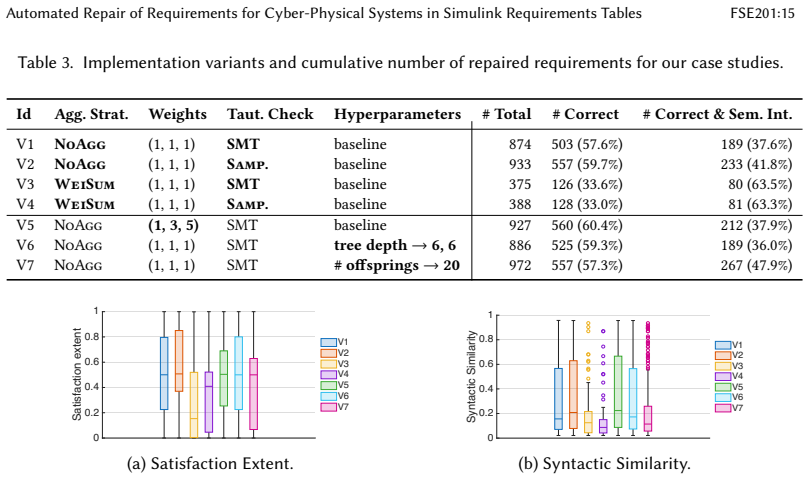
- Seven variants of the framework succeed on six real-world case studies that cover twelve requirements.
- The repairs are both formally correct with respect to the traces and judged useful in practice.
- The method applies directly to requirements written as tables over continuous-time signals.
Where Pith is reading between the lines
- The same data-driven repair idea could be tried on requirement languages used outside Simulink.
- Embedding the repair step inside a continuous-integration loop might keep requirements current with each code change.
- Pairing requirement repair with existing program-repair tools could address misalignment from both directions.
Load-bearing premise
Execution traces collected from the running system accurately indicate whether the stated requirements hold over the observed signals.
What would settle it
A set of traces on which the framework produces a repair that domain experts later judge as failing to capture the intended requirement behavior.
Figures

read the original abstract
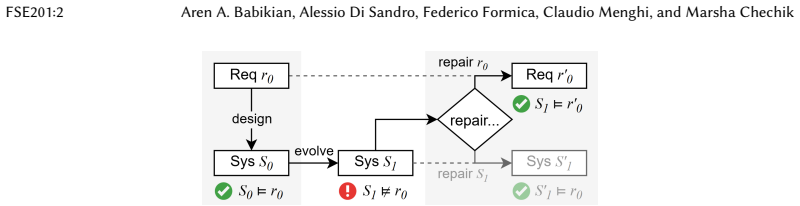
The development of complex software systems, e.g., cyber-physical systems (CPSs), involves continuous evolution of both system implementations and their requirements. These two artifacts often proceed independently, creating a risk of misalignment. For example, a system may be updated due to implementation-level concerns, yielding a new version that no longer satisfies its original requirements. Traditional compliance recovery techniques, e.g., automated program repair, address this problem by modifying the system while assuming that requirements are correct. However, faulty, outdated or inadequate requirements are a well-documented challenge in practice, motivating the complementary task of requirement repair. In this paper, we propose a framework that leverages system execution data to repair misaligned CPS requirements, thereby restoring requirement-to-system compliance. Our approach evaluates the correctness of declarative requirements over time-based, real-valued signals expressed using the MATLAB Simulink Requirements Tables language. We evaluate seven variants of our framework on six real-world case studies covering 12 requirements. Results confirm the effectiveness of the proposed framework in producing correct and useful repaired requirements.
Editorial analysis
A structured set of objections, weighed in public.
Referee Report
Summary. The paper proposes a framework that uses system execution data to repair misaligned declarative requirements for cyber-physical systems expressed in the Simulink Requirements Tables language. It evaluates seven variants of the approach on six real-world case studies covering 12 requirements and claims that the results confirm the framework's effectiveness in producing correct and useful repaired requirements.
Significance. If the evaluation is shown to be non-circular and the correctness metric is demonstrated to have sound semantics for time-based signals, the work would address a practical problem in CPS development where requirements and implementations evolve independently. The focus on requirement repair (as opposed to program repair) is a useful complement to existing techniques.
major comments (2)
- [Abstract] Abstract: The abstract asserts positive results from seven variants on six case studies but supplies no evaluation metrics, baselines, or details on how correctness of repaired requirements was measured, preventing assessment of whether the data supports the claim.
- [Evaluation] Evaluation section: The framework extracts candidate repairs from execution traces and scores them for correctness on traces; without an independent oracle, held-out validation set, or domain-expert judgment separate from the synthesis data, it is unclear whether the scoring distinguishes intended behavior from incidental trace properties or avoids overfitting.
minor comments (1)
- [Abstract] Abstract: Consider adding one sentence summarizing the correctness metric and any baseline comparisons used.
Simulated Author's Rebuttal
We thank the referee for the constructive feedback and for recognizing the practical relevance of requirement repair as a complement to program repair in CPS development. We address the two major comments point by point below.
read point-by-point responses
-
Referee: [Abstract] Abstract: The abstract asserts positive results from seven variants on six case studies but supplies no evaluation metrics, baselines, or details on how correctness of repaired requirements was measured, preventing assessment of whether the data supports the claim.
Authors: We agree that the abstract, constrained by length, omits specific metrics, baselines, and measurement details. These are reported in the Evaluation section, where we describe the seven variants, the 12 requirements across six case studies, and correctness as the degree to which a repaired requirement is satisfied by the execution traces. To improve standalone readability, we will revise the abstract to include a concise statement of the primary metrics and the trace-based correctness criterion. revision: yes
-
Referee: [Evaluation] Evaluation section: The framework extracts candidate repairs from execution traces and scores them for correctness on traces; without an independent oracle, held-out validation set, or domain-expert judgment separate from the synthesis data, it is unclear whether the scoring distinguishes intended behavior from incidental trace properties or avoids overfitting.
Authors: This concern about evaluation circularity is valid. The framework is explicitly designed to restore alignment between requirements and observed system behavior; therefore the same traces are used both to generate candidates and to score them. We evaluated seven variants on 12 requirements from six real-world case studies to demonstrate robustness across different repair strategies. However, the current study does not include a held-out validation set or separate domain-expert judgment. We will revise the Evaluation section to explicitly discuss this limitation, the risk that repairs may capture incidental trace properties, and how the multi-variant design provides some mitigation. revision: partial
Circularity Check
No circularity detected in claimed results or evaluation
full rationale
The paper presents an empirical framework for requirement repair evaluated on six real-world case studies with 12 requirements. No equations, derivations, or self-referential definitions appear in the abstract or described approach. The central claim of effectiveness rests on case-study outcomes rather than any reduction of predictions to fitted inputs or self-citations. The evaluation uses execution traces for both repair and correctness assessment, but this is standard for trace-driven synthesis techniques and does not constitute a by-construction equivalence or load-bearing self-reference. The work is self-contained against external benchmarks.
Axiom & Free-Parameter Ledger
Reference graph
Works this paper leans on
-
[1]
Alessandro Abate, Matthias Althoff, Lei Bu, Gidon Ernst, Goran Frehse, Luca Geretti, Taylor T Johnson, Claudio Menghi, Stefan Mitsch, Stefan Schupp, et al. 2023. The ARCH-COMP friendly verification competition for continuous and hybrid systems. InInternational TOOLympics Challenge. Springer Nature Switzerland Cham, 1–37
2023
-
[2]
Ankit Agrawal and Jane Cleland-Huang. 2023. Leveraging Traceability to Integrate Safety Analysis Artifacts into the Software Development Process. In2023 IEEE 31st International Requirements Engineering Conference Workshops (REW). 475–478. doi:10.1109/REW57809.2023.00089
-
[3]
Alchourrón, Peter Gärdenfors, and David Makinson
Carlos E. Alchourrón, Peter Gärdenfors, and David Makinson. 1985. On the Logic of Theory Change: Partial Meet Contraction and Revision Functions.The Journal of Symbolic Logic50, 2 (1985), 510–530
1985
-
[4]
Nicholas Annable, Mehrnoosh Askarpour, Thomas Chiang, Sahar Kokaly, Mark Lawford, Richard F. Paige, Ramesh Sethu, and Alan Wassyng. 2024. Comprehensive Change Impact Analysis Applied to Advanced Automotive Systems. InComputer Safety, Reliability, and Security. Springer Nature Switzerland, Cham, 134–149. doi:10.1007/978-3-031- 68606-1_9
-
[5]
Gabriel Araujo, Ricardo Caldas, Federico Formica, Genaína Rodrigues, Patrizio Pelliccione, and Claudio Menghi. 2024. Search-Based Trace Diagnostic. arXiv:2406.17268 [cs] doi:10.48550/arXiv.2406.17268
-
[6]
Aitor Arrieta, Pablo Valle, and Shaukat Ali. 2024. Search-Based Automated Program Repair of CPS Controllers Modeled in Simulink-Stateflow. arXiv:2404.04688 [cs] doi:10.48550/arXiv.2404.04688
-
[7]
Babikian, Alessio Di Sandro, Federico Formica, Claudio Menghi, and Marsha Chechik
Aren A. Babikian, Alessio Di Sandro, Federico Formica, Claudio Menghi, and Marsha Chechik. 2026. Automated Repair of Requirements for Cyber-Physical Systems in Simulink Requirements Tables: Replication Package. doi:10.5281/zeno do.19488528
-
[8]
Raja Ben Abdessalem, Annibale Panichella, Shiva Nejati, Lionel C. Briand, and Thomas Stifter. 2020. Automated Repair of Feature Interaction Failures in Automated Driving Systems. InProceedings of the 29th ACM SIGSOFT International Symposium on Software Testing and Analysis (ISSTA 2020). Association for Computing Machinery, New York, NY, USA, 88–100. doi:1...
-
[9]
Elizabeth Bjarnason, Per Runeson, Markus Borg, Michael Unterkalmsteiner, Emelie Engström, Björn Regnell, Giedre Sabaliauskaite, Annabella Loconsole, Tony Gorschek, and Robert Feldt. 2014. Challenges and Practices in Aligning Requirements with Verification and Validation: A Case Study of Six Companies.Empirical Software Engineering19, 6 (2014), 1809–1855
2014
-
[10]
Chaima Boufaied, Claudio Menghi, Domenico Bianculli, Lionel Briand, and Yago Isasi Parache. 2021. Trace-Checking Signal-Based Temporal Properties: A Model-Driven Approach. InProceedings of the 35th IEEE/ACM International Conference on Automated Software Engineering(New York, NY, USA, 2021-01-27)(ASE ’20). Association for Computing Machinery, 1004–1015. do...
-
[11]
Chaima Boufaied, Claudio Menghi, Domenico Bianculli, and Lionel C. Briand. 2023. Trace Diagnostics for Signal-Based Temporal Properties.IEEE Transactions on Software Engineering49, 5 (2023), 3131–3154. doi:10.1109/TSE.2023.3242588
-
[12]
Peter Braun, Manfred Broy, Frank Houdek, Matthias Kirchmayr, Mark Müller, Birgit Penzenstadler, Klaus Pohl, and Thorsten Weyer. 2014. Guiding Requirements Engineering for Software-Intensive Embedded Systems in the Automotive Industry.Computer Science - Research and Development29, 1 (2014), 21–43
2014
-
[13]
Titus Buckworth, Dalal Alrajeh, Jeff Kramer, and Sebastian Uchitel. 2023. Adapting Specifications for Reactive Controllers. In2023 IEEE/ACM 18th Symposium on Software Engineering for Adaptive and Self-Managing Systems (SEAMS). 1–12. doi:10.1109/SEAMS59076.2023.00012
-
[14]
Cavezza, Dalal Alrajeh, and András György
Davide G. Cavezza, Dalal Alrajeh, and András György. 2020. Minimal Assumptions Refinement for Realizable Specifications. InProceedings of the 8th International Conference on Formal Methods in Software Engineering(New York, NY, USA)(FormaliSE ’20). Association for Computing Machinery, 66–76. doi:10.1145/3372020.3391557
-
[15]
Cobleigh, Dimitra Giannakopoulou, and Corina S
Jamieson M. Cobleigh, Dimitra Giannakopoulou, and Corina S. Păsăreanu. 2003. Learning Assumptions for Composi- tional Verification. InTools and Algorithms for the Construction and Analysis of Systems. Springer, Berlin, Heidelberg, 331–346. doi:10.1007/3-540-36577-X_24
-
[16]
Leonardo de Moura and Nikolaj Bjørner. 2008. Z3: An Efficient SMT Solver. InTools and Algorithms for the Construction and Analysis of Systems. Springer, Berlin, Heidelberg, 337–340. doi:10.1007/978-3-540-78800-3_24
-
[17]
K. Deb, A. Pratap, S. Agarwal, and T. Meyarivan. 2002. A Fast and Elitist Multiobjective Genetic Algorithm: NSGA-II. IEEE Transactions on Evolutionary Computation6, 2 (April 2002), 182–197. doi:10.1109/4235.996017
-
[18]
Favio DeMarco, Jifeng Xuan, Daniel Le Berre, and Martin Monperrus. 2014. Automatic Repair of Buggy If Conditions and Missing Preconditions with SMT. InProceedings of the 6th International Workshop on Constraints in Software Testing, Verification, and Analysis (CSTV A 2014). Association for Computing Machinery, New York, NY, USA, 30–39. doi:10.1145/2593735.2593740
-
[19]
Thomas Durieux and Martin Monperrus. 2016. DynaMoth: Dynamic Code Synthesis for Automatic Program Repair. In Proceedings of the 11th International Workshop on Automation of Software Test (AST ’16). Association for Computing Machinery, New York, NY, USA, 85–91. doi:10.1145/2896921.2896931 Proc. ACM Softw. Eng., Vol. 3, No. FSE, Article FSE201. Publication ...
-
[20]
Gidon Ernst, Paolo Arcaini, Ismail Bennani, Aniruddh Chandratre, Alexandre Donzé, Georgios Fainekos, Goran Frehse, Khouloud Gaaloul, Jun Inoue, Tanmay Khandait, Logan Mathesen, Claudio Menghi, Giulia Pedrielli, Marc Pouzet, Masaki Waga, Shakiba Yaghoubi, Yoriyuki Yamagata, and Zhenya Zhang. 2021. ARCH-COMP 2021 Category Report: Falsification with Validati...
-
[21]
Gidon Ernst, Paolo Arcaini, Ismail Bennani, Alexandre Donze, Georgios Fainekos, Goran Frehse, Logan Mathesen, Claudio Menghi, Giulia Pedrielli, Marc Pouzet, Shakiba Yaghoubi, Yoriyuki Yamagata, and Zhenya Zhang. 2020. ARCH- COMP 2020 Category Report: Falsification. InARCH20. 7th International Workshop on Applied Verification of Continuous and Hybrid Syste...
-
[22]
Gidon Ernst, Paolo Arcaini, Georgios Fainekos, Federico Formica, Jun Inoue, Tanmay Khandait, Mohammad Mahdi Mahboob, Claudio Menghi, Giulia Pedrielli, Masaki Waga, Yoriyuki Yamagata, and Zhenya Zhang. 2022. ARCH-COMP 2022 Category Report: Falsification with Ubounded Resources. InProceedings of 9th International Workshop on Applied Verification of Continuo...
-
[23]
Ernst, Jake Cockrell, William G
Michael D. Ernst, Jake Cockrell, William G. Griswold, and David Notkin. 1999. Dynamically Discovering Likely Program Invariants to Support Program Evolution. InProceedings of the 21st International Conference on Software Engineering (ICSE ’99). Association for Computing Machinery, New York, NY, USA, 213–224. doi:10.1145/302405.302467
-
[24]
Georgios Fainekos, Bardh Hoxha, and Sriram Sankaranarayanan. 2019. Robustness of specifications and its applications to falsification, parameter mining, and runtime monitoring with S-TaLiRo. InInternational Conference on Runtime Verification. Springer, 27–47
2019
-
[25]
Federico Formica, Tony Fan, Akshay Rajhans, Vera Pantelic, Mark Lawford, and Claudio Menghi. 2024. Simulation- Based Testing of Simulink Models With Test Sequence and Test Assessment Blocks.IEEE Transactions on Software Engineering50, 2 (Feb. 2024), 239–257. doi:10.1109/TSE.2023.3343753
-
[26]
Federico Formica, Chris George, Shayda Rahmatyan, Vera Pantelic, Mark Lawford, Angelo Gargantini, and Claudio Menghi. 2025. Search-Based Testing of Simulink Models with Requirements Tables. arXiv:2501.05412 [cs] doi:10.48550 /arXiv.2501.05412
arXiv 2025
-
[27]
Félix-Antoine Fortin, François-Michel De Rainville, Marc-André Gardner, Marc Parizeau, and Christian Gagné. 2012. DEAP: Evolutionary Algorithms Made Easy.Journal of Machine Learning Research13 (jul 2012), 2171–2175
2012
-
[28]
Kolovos, Nicholas Matragkas, and Richard F
M¯artin, š Francis, Dimitrios S. Kolovos, Nicholas Matragkas, and Richard F. Paige. 2013. Adding Spreadsheets to the MDE Toolkit. InModel-Driven Engineering Languages and Systems(Berlin, Heidelberg). Springer, 35–51
2013
-
[29]
Briand, and Yago Isasi Parache
Khouloud Gaaloul, Claudio Menghi, Shiva Nejati, Lionel C. Briand, and Yago Isasi Parache. 2022. Combining Genetic Programming and Model Checking to Generate Environment Assumptions.IEEE Transactions on Software Engineering 48, 9 (Sept. 2022), 3664–3685. doi:10.1109/TSE.2021.3101818
-
[30]
Khouloud Gaaloul, Claudio Menghi, Shiva Nejati, Lionel C Briand, and David Wolfe. 2020. Mining assumptions for software components using machine learning. InProceedings of the 28th ACM Joint Meeting on European Software Engineering Conference and Symposium on the Foundations of Software Engineering. 159–171
2020
-
[31]
Usman Gohar, Michael C. Hunter, Myra B. Cohen, and Robyn R. Lutz. 2025.A Taxonomy of Real-World Defeaters in Safety Assurance Cases. arXiv:2502.00238 [cs] doi:10.48550/arXiv.2502.00238
-
[32]
John Hatcliff, Alan Wassyng, Tim Kelly, Cyrille Comar, and Paul Jones. 2014. Certifiably Safe Software-Dependent Systems: Challenges and Directions. InFuture of Software Engineering Proceedings(New York, NY, USA)(FOSE 2014). Association for Computing Machinery, 182–200
2014
-
[33]
Tim Henderson. [n. d.].ZSS Python library. https://zhang-shasha.readthedocs.io/en/latest/ v1.2.0
-
[35]
Bardh Hoxha, Houssam Abbas, and Georgios Fainekos. 2015. Benchmarks for Temporal Logic Requirements for Automotive Systems. InARCH14-15. International Workshop on Applied veRification for Continuous and Hybrid Systems (EPiC Series in Computing). EasyChair, 25–30. doi:10.29007/xwrs
-
[36]
Jinru Hua, Mengshi Zhang, Kaiyuan Wang, and Sarfraz Khurshid. 2018. Towards Practical Program Repair with On-Demand Candidate Generation. InProceedings of the 40th International Conference on Software Engineering (ICSE ’18). Association for Computing Machinery, New York, NY, USA, 12–23. doi:10.1145/3180155.3180245
-
[37]
2004.Logic in Computer Science: Modelling and reasoning about systems
Michael Huth and Mark Ryan. 2004.Logic in Computer Science: Modelling and reasoning about systems. Cambridge university press
2004
-
[38]
Jiajun Jiang, Yingfei Xiong, Hongyu Zhang, Qing Gao, and Xiangqun Chen. 2018. Shaping Program Repair Space with Existing Patches and Similar Code. InProceedings of the 27th ACM SIGSOFT International Symposium on Software Testing and Analysis (ISSTA 2018). Association for Computing Machinery, New York, NY, USA, 298–309. doi:10.1145/32 13846.3213871 Proc. A...
work page doi:10.1145/32 2018
-
[39]
Xiaoqing Jin, Jyotirmoy V Deshmukh, James Kapinski, Koichi Ueda, and Ken Butts. 2014. Powertrain control verification benchmark. InInternational conference on Hybrid systems: computation and control. ACM, 253–262
2014
-
[40]
Tanmay Khandait, Federico Formica, Paolo Arcaini, Surdeep Chotaliya, Georgios Fainekos, Abdelrahman Hekal, Atanu Kundu, Ethan Lew, Michele Loreti, Claudio Menghi, Laura Nenzi, Giulia Pedrielli, Jarkko Peltomäki, Ivan Porres, Rajarshi Ray, Valentin Soloviev, Ennio Visconti, Masaki Waga, and Zhenya Zhang. 2024. ARCH-COMP 2024 Category Report: Falsification....
-
[42]
Sahar Kokaly, Rick Salay, Marsha Chechik, Mark Lawford, and Tom Maibaum. 2017. Safety Case Impact Assessment in Automotive Software Systems: An Improved Model-Based Approach. InComputer Safety, Reliability, and Security. Springer International Publishing, Cham, 69–85. doi:10.1007/978-3-319-66266-4_5
-
[43]
Le, Duc-Hiep Chu, David Lo, Claire Le Goues, and Willem Visser
Xuan-Bach D. Le, Duc-Hiep Chu, David Lo, Claire Le Goues, and Willem Visser. 2017. S3: Syntax- and Semantic-Guided Repair Synthesis via Programming by Examples. InProceedings of the 2017 11th Joint Meeting on Foundations of Software Engineering. ACM, Paderborn Germany, 593–604. doi:10.1145/3106237.3106309
-
[44]
Claire Le Goues, ThanhVu Nguyen, Stephanie Forrest, and Westley Weimer. 2012. GenProg: A Generic Method for Automatic Software Repair.IEEE Transactions on Software Engineering38, 1 (Jan. 2012), 54–72. doi:10.1109/TSE.2011.104
-
[45]
Bo Lin, Shangwen Wang, Ming Wen, Liqian Chen, and Xiaoguang Mao. 2024. One Size Does Not Fit All: Multi- granularity Patch Generation for Better Automated Program Repair. InProceedings of the 33rd ACM SIGSOFT Interna- tional Symposium on Software Testing and Analysis (ISSTA 2024). Association for Computing Machinery, New York, NY, USA, 1554–1566. doi:10.1...
-
[46]
AVATAR : Fixing Semantic Bugs with Fix Patterns of Static Analysis Violations
Kui Liu, Anil Koyuncu, Dongsun Kim, and Tegawendé F. Bisyandé. 2019. AVATAR : Fixing Semantic Bugs with Fix Patterns of Static Analysis Violations. arXiv:1812.07270 [cs] doi:10.48550/arXiv.1812.07270
work page internal anchor Pith review Pith/arXiv arXiv doi:10.48550/arxiv.1812.07270 2019
-
[47]
Xuliang Liu and Hao Zhong. 2018. Mining Stackoverflow for Program Repair. In2018 IEEE 25th International Conference on Software Analysis, Evolution and Reengineering (SANER). 118–129. doi:10.1109/SANER.2018.8330202
-
[48]
Dipeeka Luitel, Shiva Nejati, and Mehrdad Sabetzadeh. 2024. Requirements-Driven Slicing of Simulink Models using LLMs. In2024 IEEE 32nd International Requirements Engineering Conference Workshops (REW). 72–82. doi:10.1109/RE W61692.2024.00014
work page doi:10.1109/re 2024
-
[49]
Oded Maler and Dejan Nickovic. 2004. Monitoring temporal properties of continuous signals. InInternational symposium on formal techniques in real-time and fault-tolerant systems. Springer, 152–166
2004
-
[50]
Shahar Maoz, Jan Oliver Ringert, and Rafi Shalom. 2019. Symbolic Repairs for GR(1) Specifications. In2019 IEEE/ACM 41st International Conference on Software Engineering (ICSE). 1016–1026
2019
-
[51]
Martins and Tony Gorschek
Luiz Eduardo G. Martins and Tony Gorschek. 2016. Requirements Engineering for Safety-Critical Systems: A Systematic Literature Review.Information and Software Technology75 (2016), 71–89
2016
-
[52]
MathWorks. 2022. Simulink ®. Release R2022b. https://www.mathworks.com/products/simulink.html
2022
-
[53]
Anastasia Mavridou, Hamza Bourbouh, Dimitra Giannakopoulou, Thomas Pressburger, Mohammad Hejase, Pierre-Loic Garoche, and Johann Schumann. 2020. The ten lockheed martin cyber-physical challenges: formalized, analyzed, and explained. InInternational Requirements Engineering Conference. IEEE, 300–310
2020
-
[54]
Sergey Mechtaev, Jooyong Yi, and Abhik Roychoudhury. 2015. DirectFix: Looking for Simple Program Repairs. In Proceedings of the 37th International Conference on Software Engineering - Volume 1 (ICSE ’15). IEEE Press, Florence, Italy, 448–458
2015
-
[55]
Claudio Menghi, Paolo Arcaini, Walstan Baptista, Gidon Ernst, Georgios Fainekos, Federico Formica, Sauvik Gon, Tanmay Khandait, Atanu Kundu, Giulia Pedrielli, Jarkko Peltomäki, Ivan Porres, Rajarshi Ray, Masaki Waga, and Zhenya Zhang. 2023. ARCH-COMP23 Category Report: Falsification. InProceedings of 10th International Workshop on Applied Verification of ...
-
[57]
Claudio Menghi, Eugene Balai, Darren Valovcin, Christoph Sticksel, and Akshay Rajhans. 2025. Completeness and Consistency of Tabular Requirements: An SMT-Based Verification Approach.IEEE Transactions on Software Engineering 51, 2 (2025), 595–620. doi:10.1109/TSE.2025.3530820
-
[58]
Claudio Menghi, Shiva Nejati, Lionel Briand, and Yago Isasi Parache. 2020. Approximation-Refinement Testing of Compute-Intensive Cyber-Physical Models: An Approach Based on System Identification. InInternational Conference on Software Engineering. IEEE/ACM, 372–384. Proc. ACM Softw. Eng., Vol. 3, No. FSE, Article FSE201. Publication date: July 2026. FSE20...
2020
-
[59]
Claudio Menghi, Enrico Viganò, Domenico Bianculli, and Lionel C. Briand. 2021. Trace-Checking CPS Properties: Bridging the Cyber-Physical Gap. In2021 IEEE/ACM 43rd International Conference on Software Engineering (ICSE). 847–859. doi:10.1109/ICSE43902.2021.00082
-
[60]
Facundo Molina, Juan Manuel Copia, and Alessandra Gorla. 2024. Improving Patch Correctness Analysis via Random Testing and Large Language Models. In2024 IEEE Conference on Software Testing, Verification and Validation (ICST). 317–328. doi:10.1109/ICST60714.2024.00036
-
[61]
Kai Pan, Sunghun Kim, and E. James Whitehead. 2009. Toward an Understanding of Bug Fix Patterns.Empirical Softw. Engg.14, 3 (June 2009), 286–315. doi:10.1007/s10664-008-9077-5
-
[62]
2015.The Interpretation and Evaluation of Assurance Cases
John Rushby. 2015.The Interpretation and Evaluation of Assurance Cases. Technical Report SRI-CSL-15-01. Computer Science Laboratory, SRI International, Menlo Park, CA. Available at http://www.csl.sri.com/users/rushby/papers/sri- csl-15-1-assurance-cases.pdf
2015
-
[63]
Saha, Yingjun Lyu, Hiroaki Yoshida, and Mukul R
Ripon K. Saha, Yingjun Lyu, Hiroaki Yoshida, and Mukul R. Prasad. 2017. ELIXIR: Effective Object Oriented Program Repair. InProceedings of the 32nd IEEE/ACM International Conference on Automated Software Engineering (ASE ’17). IEEE Press, Urbana-Champaign, IL, USA, 648–659
2017
-
[64]
1989.Automatic Text Processing: The Transformation, Analysis, and Retrieval of Information by Computer
Gerard Salton. 1989.Automatic Text Processing: The Transformation, Analysis, and Retrieval of Information by Computer. Addison-Wesley Longman Publishing Co., Inc
1989
-
[65]
Stephan Schneider, Jan Wollersheim, Helmut Krcmar, and Ali Sunyaev. 2018. How Do Requirements Evolve over Time? A Case Study Investigating the Role of Context and Experiences in the Evolution of Enterprise Software Requirements. Journal of Information Technology33, 2 (2018), 151–170. doi:10.1057/s41265-016-0001-y
-
[66]
Nikhil Kumar Singh and Indranil Saha. 2020. Specification-Guided Automated Debugging of CPS Models.IEEE Transactions on Computer-Aided Design of Integrated Circuits and Systems39, 11 (Nov. 2020), 4142–4153. doi:10.1109/ TCAD.2020.3012862
arXiv 2020
-
[67]
Uusitalo, Marko Komssi, Marjo Kauppinen, and Alan M
Eero J. Uusitalo, Marko Komssi, Marjo Kauppinen, and Alan M. Davis. 2008. Linking Requirements and Testing in Practice. In2008 16th IEEE International Requirements Engineering Conference. 265–270. doi:10.1109/RE.2008.30
-
[68]
Pablo Valle, Aitor Arrieta, and Maite Arratibel. 2023. Automated Misconfiguration Repair of Configurable Cyber- Physical Systems with Search: An Industrial Case Study on Elevator Dispatching Algorithms. In2023 IEEE/ACM 45th International Conference on Software Engineering: Software Engineering in Practice (ICSE-SEIP). 396–408. doi:10.1109/IC SE-SEIP58684....
work page doi:10.1109/ic 2023
-
[69]
Pablo Valle, Aitor Arrieta, Liping Han, Shaukat Ali, and Tao Yue. 2025. Defining and generating multi-level and uncertainty-wise test oracles for cyber-physical systems.Software and Systems Modeling24, 3 (2025), 679–704. doi:10.1007/s10270-025-01271-8
-
[70]
Ming Wen, Junjie Chen, Rongxin Wu, Dan Hao, and Shing-Chi Cheung. 2018. Context-Aware Patch Generation for Better Automated Program Repair. In2018 IEEE/ACM 40th International Conference on Software Engineering (ICSE). 1–11. doi:10.1145/3180155.3180233
-
[71]
Chunqiu Steven Xia and Lingming Zhang. 2024. Automated Program Repair via Conversation: Fixing 162 out of 337 Bugs for $0.42 Each Using ChatGPT. InProceedings of the 33rd ACM SIGSOFT International Symposium on Software Testing and Analysis (ISSTA 2024). Association for Computing Machinery, New York, NY, USA, 819–831. doi:10.1145/3650212.3680323
-
[72]
Jifeng Xuan, Matias Martinez, Favio DeMarco, Maxime Clément, Sebastian Lamelas Marcote, Thomas Durieux, Daniel Le Berre, and Martin Monperrus. 2017. Nopol: Automatic Repair of Conditional Statement Bugs in Java Programs. IEEE Transactions on Software Engineering43, 1 (Jan. 2017), 34–55. doi:10.1109/TSE.2016.2560811
-
[73]
Boyang Yang, Haoye Tian, Weiguo Pian, Haoran Yu, Haitao Wang, Jacques Klein, Tegawendé F. Bissyandé, and Shunfu Jin. 2024. CREF: An LLM-Based Conversational Software Repair Framework for Programming Tutors. InProceedings of the 33rd ACM SIGSOFT International Symposium on Software Testing and Analysis (ISSTA 2024). Association for Computing Machinery, New ...
-
[74]
Xin Yin, Chao Ni, Shaohua Wang, Zhenhao Li, Limin Zeng, and Xiaohu Yang. 2024. ThinkRepair: Self-Directed Automated Program Repair. InProceedings of the 33rd ACM SIGSOFT International Symposium on Software Testing and Analysis (ISSTA 2024). Association for Computing Machinery, New York, NY, USA, 1274–1286. doi:10.1145/3650212.36 80359
-
[75]
Jialu Zhang, José Pablo Cambronero, Sumit Gulwani, Vu Le, Ruzica Piskac, Gustavo Soares, and Gust Verbruggen. 2024. PyDex: Repairing Bugs in Introductory Python Assignments Using LLMs.Proc. ACM Program. Lang.8, OOPSLA1 (April 2024), 133:1100–133:1124. doi:10.1145/3649850
-
[76]
Kaizhong Zhang and Dennis Shasha. 1989. Simple Fast Algorithms for the Editing Distance between Trees and Related Problems.SIAM J. Comput.18, 6 (1989), 1245–1262. doi:10.1137/0218082 Received 2026-02-25; accepted 2026-03-24 Proc. ACM Softw. Eng., Vol. 3, No. FSE, Article FSE201. Publication date: July 2026
discussion (0)
Sign in with ORCID, Apple, or X to comment. Anyone can read and Pith papers without signing in.