Axial dispersion in dilute solutions of linear and branched polymers in parallel-plate and expansion-contraction microchannels
Pith reviewed 2026-06-28 08:01 UTC · model grok-4.3
The pith
Dispersion coefficients of linear, comb and star polymers in microchannels collapse onto a master curve versus Péclet number after confinement corrections.
A machine-rendered reading of the paper's core claim, the machinery that carries it, and where it could break.
Core claim
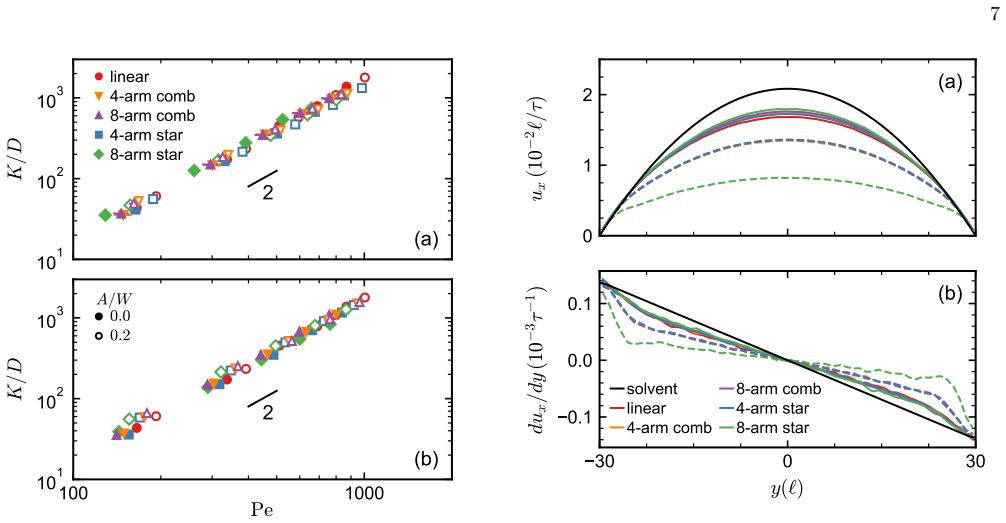
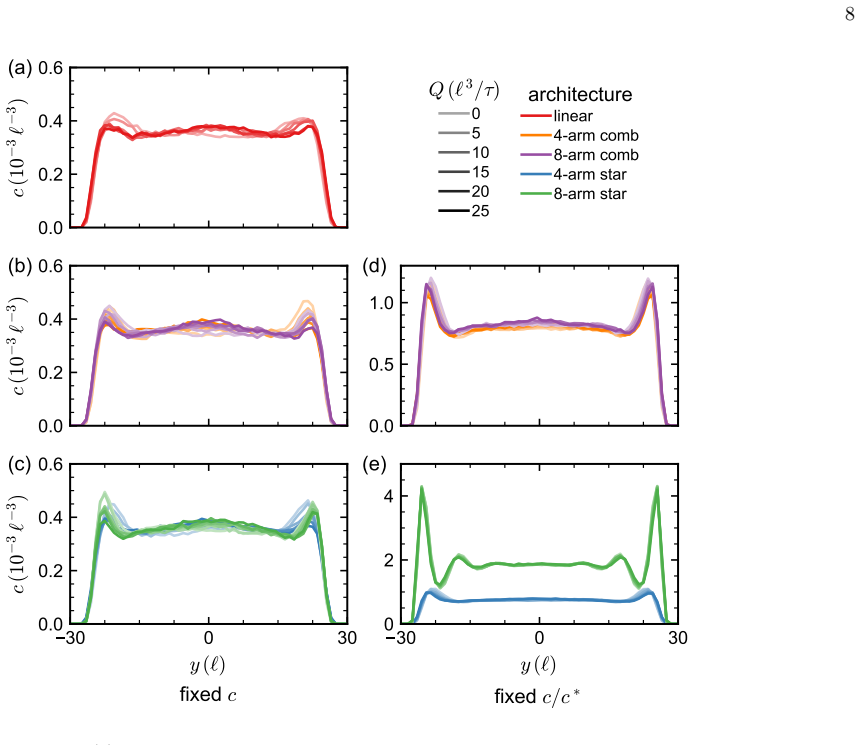
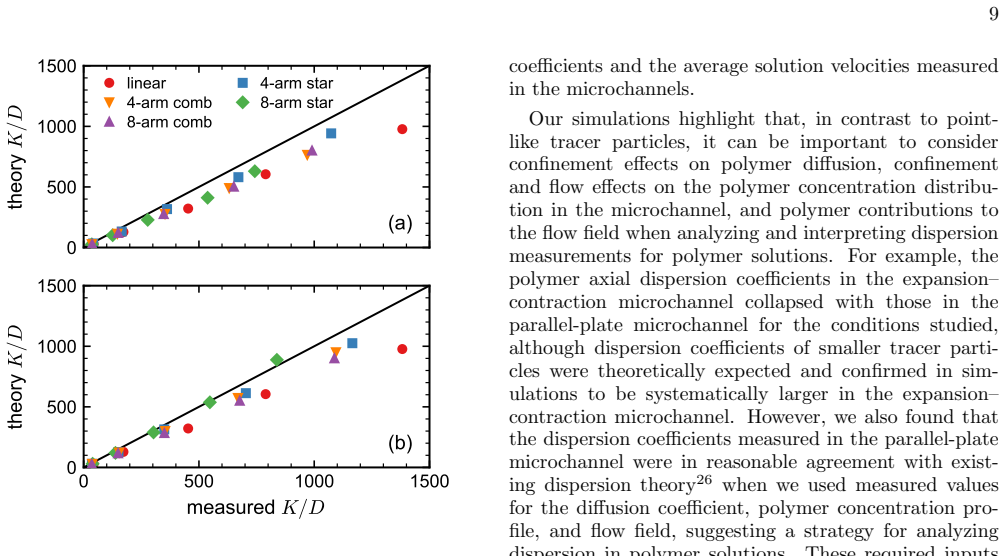
The dispersion coefficients collapse as a function of the Péclet number after accounting for confinement effects on the polymer diffusion coefficient and polymer contributions to the flow field, and the dispersion coefficients in the parallel-plate microchannel can be reasonably predicted using a theory that accounts for inhomogeneous distribution of the polymers in the microchannel.
What carries the argument
Péclet-number scaling that incorporates confinement-adjusted polymer diffusion and flow contributions, together with a theory for the inhomogeneous polymer distribution across the channel.
If this is right
- Dispersion in parallel-plate channels is predictable from the inhomogeneous-distribution theory once the Péclet number is formed with the corrected diffusion coefficient.
- Architecture and concentration effects on dispersion are absorbed into the Péclet scaling after the same confinement corrections are applied.
- The same corrections allow data from both channel geometries to be compared on a common curve.
- Polymer contributions to the local flow field must be retained in the Péclet construction for the collapse to hold.
Where Pith is reading between the lines
- The collapse may allow channel designers to tune dispersion by geometry alone once the Péclet correction is known.
- If the inhomogeneous-distribution theory extends to the expansion-contraction geometry, dispersion control could be achieved without changing polymer architecture.
- The result suggests that real microfluidic experiments at low concentration should test the same Péclet construction to check transferability from simulation.
Load-bearing premise
The multiparticle collision dynamics simulations accurately reproduce hydrodynamic interactions and polymer conformations in dilute solution without artifacts from the collision rule or channel discretization.
What would settle it
An experiment measuring axial dispersion of the same polymers in parallel-plate microchannels that fails to produce collapse onto the predicted curve when plotted against the appropriately corrected Péclet number.
Figures
read the original abstract
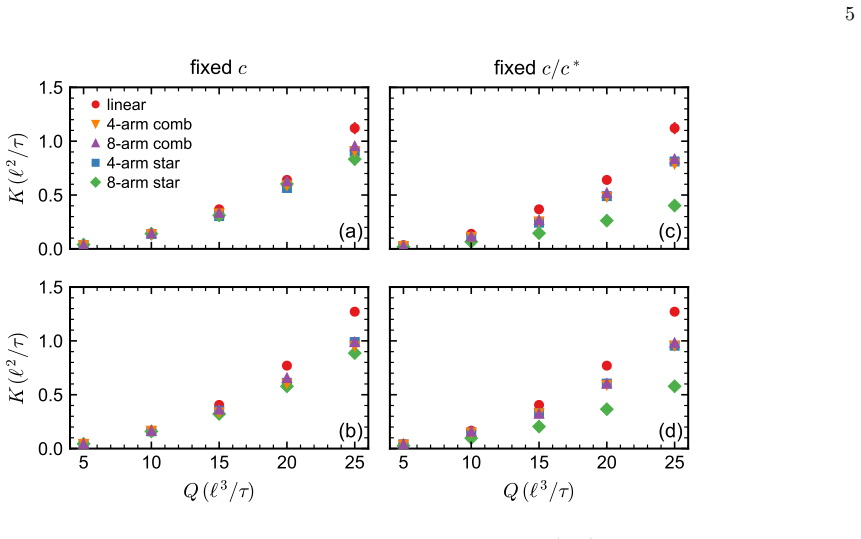
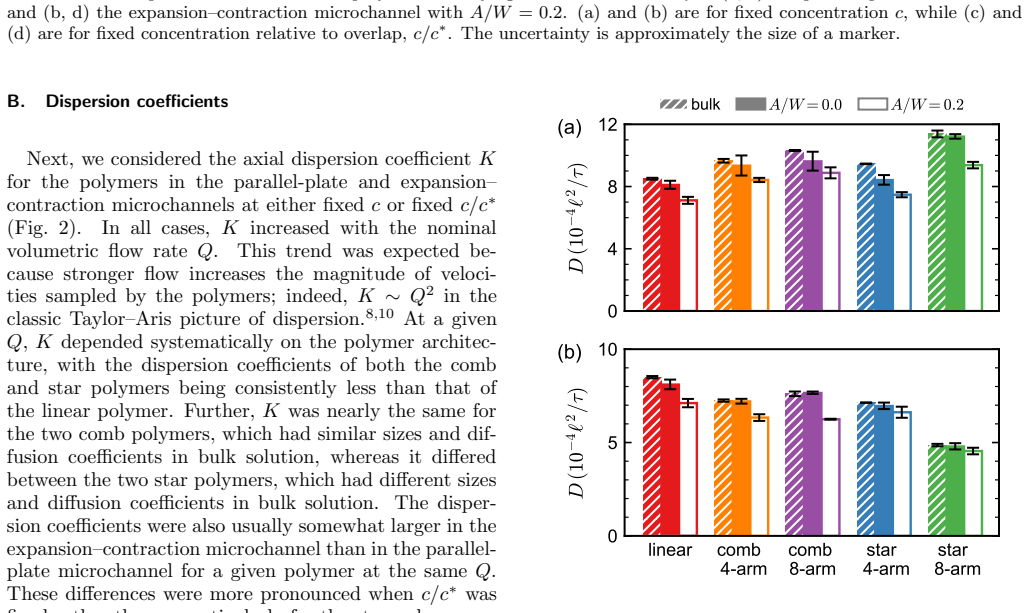
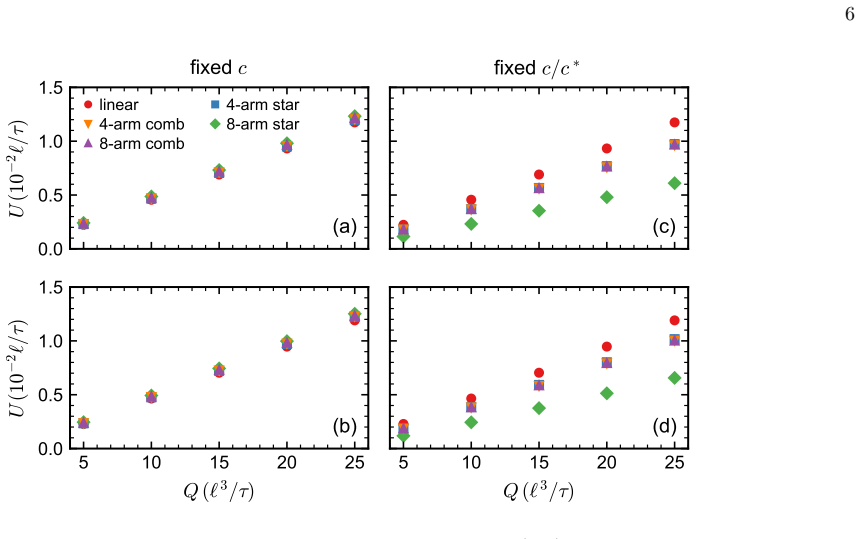
The axial dispersion of polymers in microchannels depends on an interplay between microchannel geometry, polymer architecture, and hydrodynamics. Here, we investigate the axial dispersion of linear, comb, and star polymers in parallel-plate and sinusoidal expansion-contraction microchannels at dilute concentrations using multiparticle collision dynamics simulations. The polymers all contain the same number of monomers but differ in their architecture, and their concentration is fixed at either one value that is dilute for all polymers or the same value relative to the overlap concentration for each polymer. The dispersion coefficients measured at a nominal solvent volumetric flow rate are found to depend on both architecture and concentration. We show that the dispersion coefficients collapse as a function of the P\'eclet number after accounting for confinement effects on the polymer diffusion coefficient and polymer contributions to the flow field, and the dispersion coefficients in the parallel-plate microchannel can be reasonably predicted using a theory that accounts for inhomogeneous distribution of the polymers in the microchannel.
Editorial analysis
A structured set of objections, weighed in public.
Referee Report
Summary. The manuscript uses multiparticle collision dynamics (MPCD) simulations to examine axial dispersion of linear, comb, and star polymers (same monomer number, dilute concentrations) in parallel-plate and sinusoidal expansion-contraction microchannels. Dispersion coefficients depend on architecture and concentration at fixed volumetric flow rate, but are reported to collapse versus Péclet number after corrections for confinement effects on polymer diffusion and polymer contributions to the flow field. Parallel-plate results are compared to a theory incorporating inhomogeneous polymer distribution.
Significance. If the MPCD results are robust and the corrections independent, the reported collapse across architectures and the theory comparison for the parallel-plate geometry would provide a useful framework for predicting polymer transport in confined flows, with relevance to microfluidics and soft-matter hydrodynamics. The inclusion of branched polymers is a positive feature.
major comments (2)
- [Methods] Methods: The central claims rest on dispersion coefficients extracted from MPCD trajectories. The manuscript must demonstrate that the chosen collision-cell size, time step, and wall discretization do not introduce systematic bias in the solvent flow field or effective diffusion under the stated confinement; without such validation (e.g., comparison of simulated diffusion coefficients to known confined-polymer results), the reported collapse versus Péclet number cannot be assessed for artifacts.
- [Results] Results: The corrections applied to obtain the Péclet number (confinement-adjusted diffusion coefficient and polymer flow contributions) must be shown to be derived independently of the dispersion data themselves. Explicit tabulation of the correction factors for each architecture and concentration, together with their derivation, is required to confirm that the collapse is not partly by construction.
minor comments (1)
- [Abstract] The abstract states that parallel-plate data are 'reasonably predicted' by theory; the main text should quantify the level of agreement (e.g., mean relative deviation or comparison with error bars) rather than relying on qualitative description.
Simulated Author's Rebuttal
We thank the referee for their thorough review and constructive comments on our manuscript. We address each major comment below and will revise the manuscript accordingly to strengthen the presentation of our results.
read point-by-point responses
-
Referee: [Methods] Methods: The central claims rest on dispersion coefficients extracted from MPCD trajectories. The manuscript must demonstrate that the chosen collision-cell size, time step, and wall discretization do not introduce systematic bias in the solvent flow field or effective diffusion under the stated confinement; without such validation (e.g., comparison of simulated diffusion coefficients to known confined-polymer results), the reported collapse versus Péclet number cannot be assessed for artifacts.
Authors: We agree that explicit validation of the MPCD parameters is necessary to rule out artifacts. In the revised manuscript we will add a dedicated subsection in Methods that reports additional test simulations: (i) solvent flow profiles compared against the analytical Poiseuille solution at the chosen collision-cell size and time step, and (ii) long-time diffusion coefficients of the polymers under the same confinement, benchmarked against available theoretical predictions and prior simulation literature for confined linear and branched chains. These checks will be performed at the same wall discretization used in the production runs. revision: yes
-
Referee: [Results] Results: The corrections applied to obtain the Péclet number (confinement-adjusted diffusion coefficient and polymer flow contributions) must be shown to be derived independently of the dispersion data themselves. Explicit tabulation of the correction factors for each architecture and concentration, together with their derivation, is required to confirm that the collapse is not partly by construction.
Authors: The corrections are obtained from separate equilibrium and steady-flow simulations that do not involve the axial-dispersion measurements. To make this transparent we will insert a new table (and accompanying text) that lists, for every architecture and concentration: the measured confined diffusion coefficient D_conf, the bulk-to-confined ratio, the polymer-induced correction to the volumetric flow rate, and the resulting effective Péclet number. Derivations of each factor, including the formulas used and the independent data sets from which they were computed, will be provided in the main text and expanded in the supplementary information. revision: yes
Circularity Check
No circularity: dispersion coefficients from independent MPCD simulations compared to external theory
full rationale
The paper extracts dispersion coefficients directly from MPCD trajectories in two channel geometries, applies standard corrections for confinement on diffusion and flow contributions (computed from the same trajectories or known formulas), observes collapse versus Peclet number, and compares the parallel-plate results to a pre-existing theory for inhomogeneous polymer distribution. None of these steps reduce by construction to a fit or self-citation of the target result; the simulations and theory comparison remain independent of the reported collapse. No self-definitional, fitted-input, or load-bearing self-citation patterns appear in the derivation chain.
Axiom & Free-Parameter Ledger
Reference graph
Works this paper leans on
-
[1]
Practice and Experience in Advanced Research Computing 2023: Computing for the Common Good , location =
ACCESS: Advancing Innovation: NSF's Advanced Cyberinfrastructure Coordination Ecosystem: Services & Support , author =. Practice and Experience in Advanced Research Computing 2023: Computing for the Common Good , location =
2023
-
[2]
Analytical Chemistry , volume = 78, number = 2, pages =
Hydrodynamic Dispersion in Shallow Microchannels: the Effect of Cross-Sectional Shape , author =. Analytical Chemistry , volume = 78, number = 2, pages =
-
[3]
Physical Review E , publisher =
Effective description of Taylor dispersion in strongly corrugated channels , author =. Physical Review E , publisher =
-
[4]
Alizadeh, A. and Nieto de Castro, C. A. and Wakeham, W. A. , year = 1980, journal =. The theory of the. doi:10.1007/BF00517126 , issn =
-
[5]
Computer Simulation of Liquids , author =
-
[6]
Physics of Fluids , volume = 31, number = 6, pages =
Laminar dispersion at low and high Peclet numbers in a sinusoidal microtube: Point-size versus finite-size particles , author =. Physics of Fluids , volume = 31, number = 6, pages =. doi:10.1063/1.5096971 , issn =
-
[7]
Proceedings of the Royal Society of London
On the dispersion of a solute in a fluid flowing through a tube , author =. Proceedings of the Royal Society of London. A. Mathematical and Physical Sciences , volume = 235, number = 1200, pages =. doi:10.1098/rspa.1956.0065 , issn =
-
[8]
Chemical Engineering Science , volume = 134, pages =
Taylor--Aris dispersion induced by axial variation in velocity profile in patterned microchannels , author =. Chemical Engineering Science , volume = 134, pages =. doi:10.1016/j.ces.2015.04.052 , issn =
-
[9]
Physics of Fluids , volume = 21, number = 5, pages =
Solute dispersion in channels with periodically varying apertures , author =. Physics of Fluids , volume = 21, number = 5, pages =. doi:10.1063/1.3131982 , issn =
-
[10]
Journal of Fluid Mechanics , volume = 12, number = 1, pages =
Effect of finite boundaries on the Stokes resistance of an arbitrary particle , author =. Journal of Fluid Mechanics , volume = 12, number = 1, pages =
-
[11]
Dispersion resulting from flow through spatially periodic porous media , author =. Philosophical Transactions of the Royal Society of London, Series A: Mathematical and Physical Sciences , volume = 297, number = 1430, pages =. doi:10.1098/rsta.1980.0205 , issn =
-
[12]
Journal of Colloid and Interface Science , volume = 58, number = 2, pages =
The constrained brownian movement of spherical particles in cylindrical pores of comparable radius: Models of the diffusive and convective transport of solute molecules in membranes and porous media , author =. Journal of Colloid and Interface Science , volume = 58, number = 2, pages =. doi:10.1016/0021-9797(77)90147-3 , issn =
-
[13]
Branched Polymers II , publisher =
Solution Properties of Branched Macromolecules , author =. Branched Polymers II , publisher =
-
[14]
Journal of Fluid Mechanics , volume = 976, pages =
Taylor dispersion in arbitrarily shaped axisymmetric channels , author =. Journal of Fluid Mechanics , volume = 976, pages =
-
[15]
Journal of Physics: Condensed Matter , volume = 23, number = 18, pages = 184117, doi =
Semiflexible polymer conformation, distribution and migration in microcapillary flows , author =. Journal of Physics: Condensed Matter , volume = 23, number = 18, pages = 184117, doi =
-
[16]
Physical Review E , publisher =
Conformation and dynamics of single DNA molecules in parallel-plate slit microchannels , author =. Physical Review E , publisher =
-
[17]
Analytical Chemistry , volume = 82, number = 5, pages =
Determination of Individual Diffusion Coefficients in Evolving Binary Mixtures by Taylor Dispersion Analysis: Application to the Monitoring of Polymer Reaction , author =. Analytical Chemistry , volume = 82, number = 5, pages =
-
[18]
Lab on a Chip , publisher =
Characterizing dispersion in microfluidic channels , author =. Lab on a Chip , publisher =
-
[19]
Physics of Fluids , volume = 19, number = 1, pages =
Mixing and spreading in stratified flow , author =. Physics of Fluids , volume = 19, number = 1, pages =. doi:10.1063/1.2427089 , issn =
-
[20]
Physical Review E , publisher =
Anisotropic diffusion of spherical particles in closely confining microchannels , author =. Physical Review E , publisher =
-
[21]
Macromolecules , volume = 41, number = 20, pages =
Diffusion of DNA in Nanoslits , author =. Macromolecules , volume = 41, number = 20, pages =
-
[22]
Physical Review Fluids , publisher =
Axial dispersion of Brownian colloids in microfluidic channels , author =. Physical Review Fluids , publisher =
-
[23]
The Journal of Physical Chemistry , volume = 96, number = 10, pages =
Diffusion of macromolecules in narrow capillaries , author =. The Journal of Physical Chemistry , volume = 96, number = 10, pages =
-
[24]
Langmuir , volume = 26, number = 22, pages =
Anisotropic and Hindered Diffusion of Colloidal Particles in a Closed Cylinder , author =. Langmuir , volume = 26, number = 22, pages =
-
[25]
Journal of Fluid Mechanics , volume = 204, pages =
On the foundations of generalized Taylor dispersion theory , author =. Journal of Fluid Mechanics , volume = 204, pages =
-
[26]
Advanced Computer Simulation Approaches for Soft Matter Sciences III , publisher =
Multi-Particle Collision Dynamics: A Particle-Based Mesoscale Simulation Approach to the Hydrodynamics of Complex Fluids , author =. Advanced Computer Simulation Approaches for Soft Matter Sciences III , publisher =. doi:10.1007/978-3-540-87706-6_1 , editor =
-
[27]
AIChE Journal , volume = 31, number = 2, pages =
Taylor-aris dispersion arising from flow in a sinusoidal tube , author =. AIChE Journal , volume = 31, number = 2, pages =
-
[28]
Computational Materials Science , volume = 173, pages = 109363, doi =
HOOMD-blue: A Python package for high-performance molecular dynamics and hard particle Monte Carlo simulations , author =. Computational Materials Science , volume = 173, pages = 109363, doi =
-
[29]
Current Opinion in Chemical Engineering , volume = 23, pages =
Modeling hydrodynamic interactions in soft materials with multiparticle collision dynamics , author =. Current Opinion in Chemical Engineering , volume = 23, pages =
-
[30]
Physical Review E , publisher =
Thermostat for nonequilibrium multiparticle-collision-dynamics simulations , author =. Physical Review E , publisher =
-
[31]
Analytical and Bioanalytical Chemistry , volume = 405, number = 16, pages =
Size and charge characterization of polymeric drug delivery systems by Taylor dispersion analysis and capillary electrophoresis , author =. Analytical and Bioanalytical Chemistry , volume = 405, number = 16, pages =
-
[32]
Physical Review E , volume = 63, pages =
Stochastic rotation dynamics: A Galilean-invariant mesoscopic model for fluid flow , author =. Physical Review E , volume = 63, pages =
-
[33]
Journal of Colloid and Interface Science , volume = 263, number = 1, pages =
Effective velocity and effective dispersion coefficient for finite-sized particles flowing in a uniform fracture , author =. Journal of Colloid and Interface Science , volume = 263, number = 1, pages =. doi:10.1016/S0021-9797(03)00254-6 , issn =
-
[34]
Advances in Chemical Physics , publisher =
Multiparticle Collision Dynamics: Simulation of Complex Systems on Mesoscales , author =. Advances in Chemical Physics , publisher =. doi:10.1002/9780470371572.ch2 , isbn = 9780470371572, keywords =
-
[35]
Physical Review Letters , publisher =
Crossover from Rouse to Reptation Dynamics: A Molecular-Dynamics Simulation , author =. Physical Review Letters , publisher =. doi:10.1103/PhysRevLett.61.566 , issue = 5, numpages =
-
[36]
Transport in Porous Media , volume = 26, number = 1, pages =
Stokes Flow in a Slowly Varying Two-Dimensional Periodic Pore , author =. Transport in Porous Media , volume = 26, number = 1, pages =
-
[37]
Europhysics Letters , volume = 56, number = 3, pages =
Multi-particle collision dynamics: Flow around a circular and a square cylinder , author =. Europhysics Letters , volume = 56, number = 3, pages =
-
[38]
Macromolecules , volume = 43, number = 13, pages =
Transport of Star-Branched Polymers in Nanoscale Pipe Channels Simulated with Dissipative Particle Dynamics Simulation , author =. Macromolecules , volume = 43, number = 13, pages =
-
[39]
Physical Review E , publisher =
Direct measurements of constrained Brownian motion of an isolated sphere between two walls , author =. Physical Review E , publisher =. doi:10.1103/PhysRevE.62.3909 , issue = 3, numpages =
-
[40]
Macromolecules , volume = 53, number = 22, pages =
Role of Functionality in Cross-Stream Migration, Structures, and Dynamics of Star Polymers in Poiseuille Flow , author =. Macromolecules , volume = 53, number = 22, pages =
-
[41]
Analytical and Bioanalytical Chemistry , volume = 379, number = 3, pages =
Microfluidic mixing , author =. Analytical and Bioanalytical Chemistry , volume = 379, number = 3, pages =. doi:10.1007/s00216-004-2630-1 , issn =
-
[42]
ACS Omega , volume = 8, number = 12, pages =
Conformation of a Comb-like Chain in Solution: Effect of Backbone Rigidity , author =. ACS Omega , volume = 8, number = 12, pages =
-
[43]
Journal of Chemical Physics , volume = 110, number = 17, pages =
Mesoscopic model for solvent dynamics , author =. Journal of Chemical Physics , volume = 110, number = 17, pages =
-
[44]
Europhysics Letters , volume = 52, number = 2, pages = 231, doi =
Dynamics of short polymer chains in solution , author =. Europhysics Letters , volume = 52, number = 2, pages = 231, doi =
-
[45]
Physical Review Letters , volume = 74, number = 7, pages =
Optical Measurements of Frequency-Dependent Linear Viscoelastic Moduli of Complex Fluids , author =. Physical Review Letters , volume = 74, number = 7, pages =
-
[46]
Physical Review Letters , publisher =
Cross-Stream Migration of Flexible Molecules in a Nanochannel , author =. Physical Review Letters , publisher =
-
[47]
The Journal of Chemical Physics , volume = 123, number = 14, pages = 144905, doi =
Dynamics of polymers in a particle-based mesoscopic solvent , author =. The Journal of Chemical Physics , volume = 123, number = 14, pages = 144905, doi =
-
[48]
The Journal of Chemical Physics , volume = 163, number = 19, pages = 194907, doi =
Mesoscale particle-based simulations of flow in expansion–contraction microchannels at low Reynolds number , author =. The Journal of Chemical Physics , volume = 163, number = 19, pages = 194907, doi =
-
[49]
Macromolecules , volume = 43, number = 3, pages =
Branched Polymers under Shear , author =. Macromolecules , volume = 43, number = 3, pages =
-
[50]
Polymers , volume = 10, number = 6, pages = 599, doi =
Flow Behavior of Chain and Star Polymers and Their Mixtures , author =. Polymers , volume = 10, number = 6, pages = 599, doi =
-
[51]
ACS Macro Letters , volume = 6, number = 12, pages =
Topology-Sensitive Microfluidic Filter for Polymers of Varying Stiffness , author =. ACS Macro Letters , volume = 6, number = 12, pages =
-
[52]
Physical Review Letters , publisher =
Biopolymer Filtration in Corrugated Nanochannels , author =. Physical Review Letters , publisher =
-
[53]
Korean Journal of Chemical Engineering , volume = 3, number = 2, pages =
Dispersion of Flexible Polymer Chains in Confined Geometries , author =. Korean Journal of Chemical Engineering , volume = 3, number = 2, pages =. doi:10.1007/BF02705027 , issn =
-
[54]
Physical Review E , publisher =
Dynamic regimes of fluids simulated by multiparticle-collision dynamics , author =. Physical Review E , publisher =
-
[55]
Physical Review Letters , volume = 96, pages = 188302, doi =
Star Polymers in Shear Flow , author =. Physical Review Letters , volume = 96, pages = 188302, doi =
-
[56]
The European Physical Journal E , volume = 23, pages =
Hydrodynamic screening of star polymers in shear flow , author =. The European Physical Journal E , volume = 23, pages =
-
[57]
SIAM Journal on Applied Mathematics , volume = 57, number = 5, pages =
Taylor Dispersion in Curved Channels , author =. SIAM Journal on Applied Mathematics , volume = 57, number = 5, pages =
-
[58]
Journal of the American Chemical Society , volume = 70, number = 8, pages =
Synthesis of Multichain Polymers and Investigation of their Viscosities1 , author =. Journal of the American Chemical Society , volume = 70, number = 8, pages =
-
[59]
AIChE Journal , volume = 35, number = 8, pages =
Axial dispersion of submicron particles in capillary hydrodynamic fractionation , author =. AIChE Journal , volume = 35, number = 8, pages =
-
[60]
Reviews of Modern Physics , publisher =
Microfluidics: Fluid physics at the nanoliter scale , author =. Reviews of Modern Physics , publisher =. doi:10.1103/RevModPhys.77.977 , issue = 3, numpages =
-
[61]
Annual Review of Fluid Mechanics , publisher =
Engineering Flows in Small Devices: Microfluidics Toward a Lab-on-a-Chip , author =. Annual Review of Fluid Mechanics , publisher =. doi:10.1146/annurev.fluid.36.050802.122124 , issn =
-
[62]
Proceedings of the Royal Society of London
Dispersion of soluble matter in solvent flowing slowly through a tube , author =. Proceedings of the Royal Society of London. A. Mathematical and Physical Sciences , volume = 219, number = 1137, pages =. doi:10.1098/rspa.1953.0139 , issn =
-
[63]
Proceedings of the Royal Society of London
Conditions under which dispersion of a solute in a stream of solvent can be used to measure molecular diffusion , author =. Proceedings of the Royal Society of London. A. Mathematical and Physical Sciences , volume = 225, number = 1163, pages =. doi:10.1098/rspa.1954.0216 , issn =
-
[64]
Journal of Fluid Mechanics , volume = 1025, pages =
Taylor dispersion analysis in a viscoelastic fluid through arbitrarily shaped axisymmetric channels , author =. Journal of Fluid Mechanics , volume = 1025, pages =
-
[65]
AIChE Journal , volume = 41, number = 7, pages =
Taylor dispersion in a polymer solution flowing in a capillary tube , author =. AIChE Journal , volume = 41, number = 7, pages =
-
[66]
and Haberland, Matt and Reddy, Tyler and Cournapeau, David and Burovski, Evgeni and Peterson, Pearu and Weckesser, Warren and Bright, Jonathan and van der Walt, St
Virtanen, Pauli and Gommers, Ralf and Oliphant, Travis E. and Haberland, Matt and Reddy, Tyler and Cournapeau, David and Burovski, Evgeni and Peterson, Pearu and Weckesser, Warren and Bright, Jonathan and van der Walt, St. Nature Methods , volume = 17, number = 3, pages =
-
[67]
Macromolecules , publisher =
Behaviors of a Polymer Chain in Channels: From Zimm to Rouse Dynamics , author =. Macromolecules , publisher =
-
[68]
Role of Repulsive Forces in Determining the Equilibrium Structure of Simple Liquids , author =. The Journal of Chemical Physics , volume = 54, number = 12, pages =. doi:10.1063/1.1674820 , issn =
-
[69]
Macromolecules , volume = 52, number = 11, pages =
Hydrodynamics and Filtering of Knotted Ring Polymers in Nanochannels , author =. Macromolecules , volume = 52, number = 11, pages =
-
[70]
Macromolecules , volume = 52, number = 20, pages =
Spatial Demixing of Ring and Chain Polymers in Pressure-Driven Flow , author =. Macromolecules , volume = 52, number = 20, pages =
-
[71]
Journal of Physics: Condensed Matter , volume = 22, number = 10, pages = 104106, doi =
Fluid--solid boundary conditions for multiparticle collision dynamics , author =. Journal of Physics: Condensed Matter , volume = 22, number = 10, pages = 104106, doi =
-
[72]
Chinese Journal of Polymer Science , volume = 38, number = 4, pages =
Role of Hydrodynamic Interactions in the Deformation of Star Polymers in Poiseuille Flow , author =. Chinese Journal of Polymer Science , volume = 38, number = 4, pages =
-
[73]
The Journal of Chemical Physics , volume = 17, number = 12, pages =
The Dimensions of Chain Molecules Containing Branches and Rings , author =. The Journal of Chemical Physics , volume = 17, number = 12, pages =. doi:10.1063/1.1747157 , issn =
discussion (0)
Sign in with ORCID, Apple, or X to comment. Anyone can read and Pith papers without signing in.