Fast single-atom preparation in optical tweezers via Rydberg blockade
Pith reviewed 2026-06-28 07:15 UTC · model grok-4.3
The pith
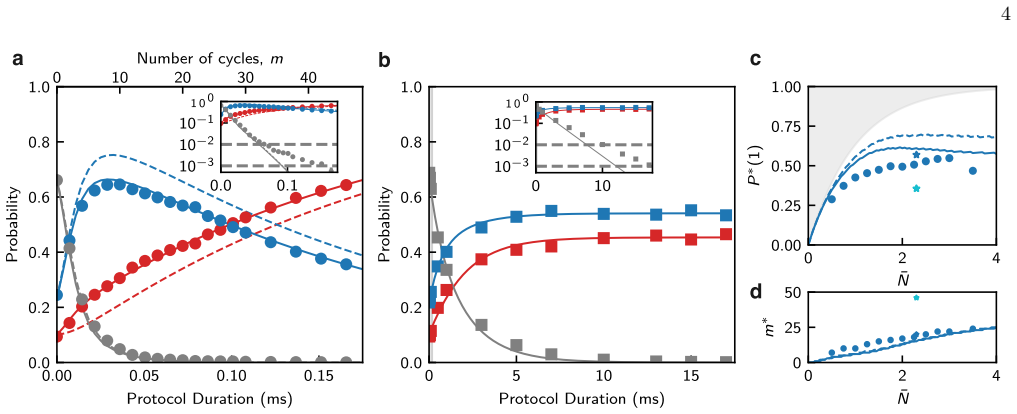
Rydberg blockade and autoionization remove excess atoms from optical tweezers in 65 microseconds while retaining single atoms at 58 percent occupancy.
A machine-rendered reading of the paper's core claim, the machinery that carries it, and where it could break.
Core claim
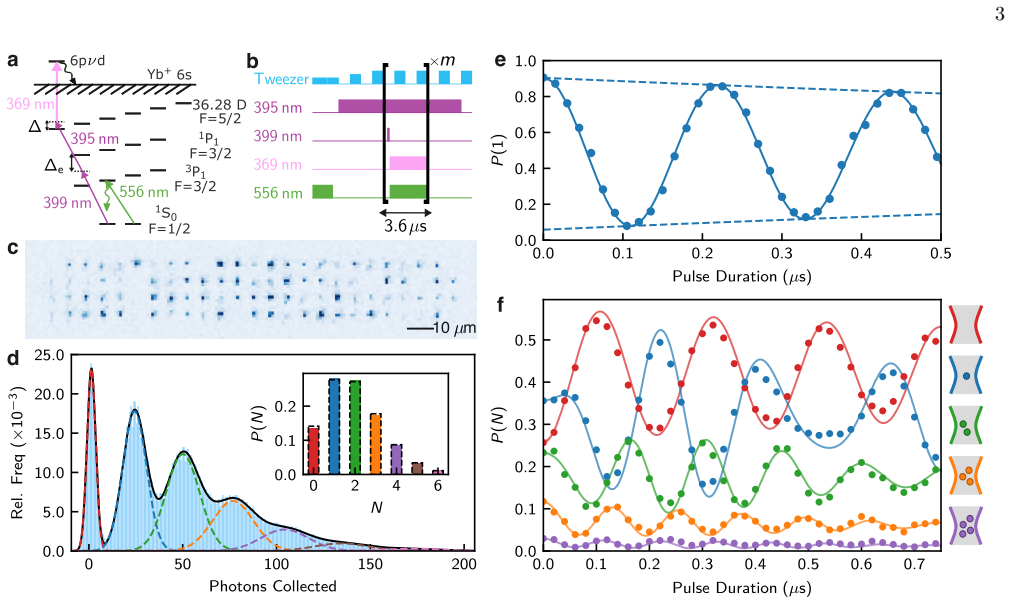
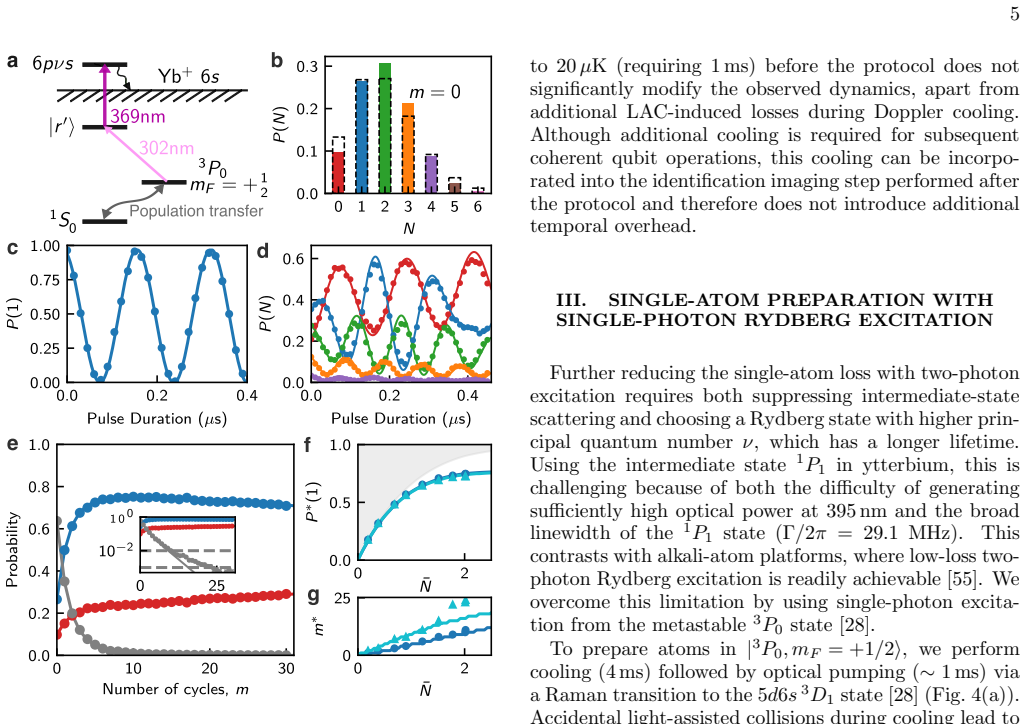
With two-photon Rydberg excitation from the ground state, multi-atom probability is reduced to 1 percent in 64.8 microseconds while retaining single atoms in 58.2(2) percent of the tweezers, matching the filling fraction obtained with light-assisted collisions under identical conditions but more than two orders of magnitude faster. Single-photon excitation from the metastable state yields 74.8(3) percent single-atom filling with lower single-atom loss, at the expense of additional overhead to reach that state. The final filling fraction remains limited by an unexplained two-body loss mechanism.
What carries the argument
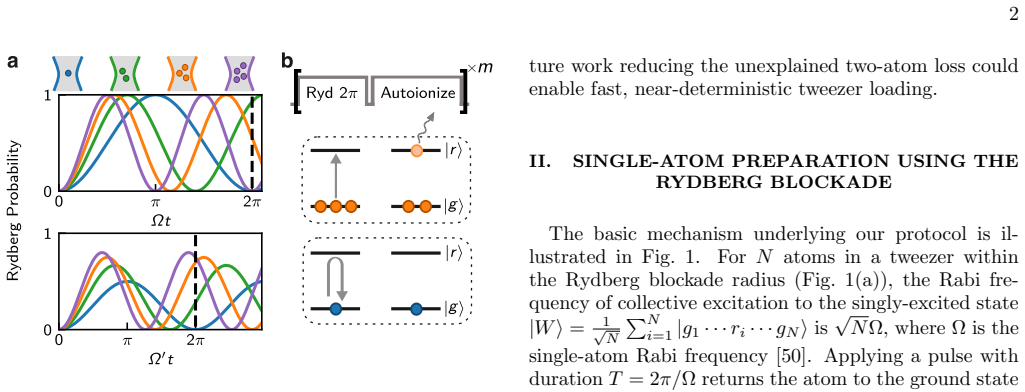
Intra-tweezer Rydberg blockade combined with autoionization for selective removal of one atom from multiply occupied tweezers.
If this is right
- Replenishment cycles for continuously loaded tweezer arrays shorten from milliseconds to tens of microseconds.
- Neutral-atom processors gain the ability to run deeper circuits before coherence limits are reached.
- Single-atom preparation reaches performance comparable to light-assisted collisions without relying on slow collisional dynamics.
- Excitation from the metastable state trades preparation time for a higher 74.8 percent filling fraction.
Where Pith is reading between the lines
- If the two-body loss channel is identified and suppressed, the method could approach deterministic single-atom loading on microsecond timescales.
- The blockade step may be combined with existing Rydberg-mediated entangling gates to reduce total overhead in a full quantum processor cycle.
- Testing the protocol across different atomic species would reveal whether the loss mechanism is species-specific or general.
Load-bearing premise
The Rydberg excitation plus autoionization step removes exactly one atom from each multiply occupied tweezer without creating additional uncontrolled loss channels that would lower the measured single-atom fractions.
What would settle it
Repeating the protocol and recording the final atom-number histogram would falsify the claim if multi-atom probability stays above a few percent or single-atom occupancy falls substantially below 58 percent after 65 microseconds.
Figures
read the original abstract
Continuously replenished optical tweezer arrays will unlock unlimited-depth quantum circuits with neutral atom qubits. A key bottleneck limiting the cycle time of these systems is removing atoms from tweezers initially loaded with more than one atom. In the conventional technique of light-assisted collisions, slow collisional dynamics limit the timescale for removing excess atoms to several milliseconds. Here, we propose and demonstrate a scheme for selectively removing one atom at a time from multiply occupied tweezers on a microsecond timescale, using intra-tweezer Rydberg blockade and autoionization. We demonstrate the protocol in $^{171}$Yb in two complementary regimes. With two-photon Rydberg excitation from the ground state, we reduce multi-atom probability to 1% in 64.8 $\mu$s, while retaining single atoms in 58.2(2)% of the tweezers, which is comparable to the filling fraction achieved with light-assisted collisions under the same experimental conditions, but over two orders of magnitude faster. With single-photon excitation from the metastable state $^3P_0$, reduced single-atom loss enables a higher filling fraction of 74.8(3)%, at the cost of additional temporal overhead to prepare the atoms in $^3P_0$. The final filling fraction is limited by an unexplained two-body loss mechanism, which, if solved, could enable fast, quasi-deterministic loading.
Editorial analysis
A structured set of objections, weighed in public.
Referee Report
Summary. The manuscript reports an experimental demonstration of fast single-atom preparation in optical tweezers using intra-tweezer Rydberg blockade and autoionization in 171Yb atoms. With two-photon excitation from the ground state, multi-atom probability is reduced to 1% in 64.8 μs while retaining single atoms in 58.2(2)% of tweezers, comparable to light-assisted collisions under matched conditions but over two orders of magnitude faster. Single-photon excitation from the metastable 3P0 state yields 74.8(3)% filling fraction. The final filling fraction is limited by an unexplained two-body loss mechanism.
Significance. If the result holds, this provides a substantial advance for neutral-atom quantum processors by reducing atom-array preparation cycle times from milliseconds to microseconds, enabling higher repetition rates for continuously replenished arrays. The direct side-by-side comparison to the conventional light-assisted collision method under identical conditions, together with concrete numbers and uncertainties in two complementary excitation regimes, strengthens the central claim of a practical speedup.
major comments (1)
- [Abstract, final paragraph] Abstract, final paragraph: the filling fraction is stated to be limited by an unexplained two-body loss mechanism. This directly impacts the central claim of selective, clean removal of one atom from multiply occupied tweezers without introducing new loss channels, because the reported 58.2(2)% and 74.8(3)% single-atom fractions already incorporate this loss; without characterization of its origin (e.g., dependence on Rabi frequency, detuning, or intra-tweezer density), the comparability to light-assisted collisions and the assertion of controlled preparation remain provisional.
Simulated Author's Rebuttal
We thank the referee for their positive evaluation and recommendation for minor revision. We address the single major comment below.
read point-by-point responses
-
Referee: [Abstract, final paragraph] Abstract, final paragraph: the filling fraction is stated to be limited by an unexplained two-body loss mechanism. This directly impacts the central claim of selective, clean removal of one atom from multiply occupied tweezers without introducing new loss channels, because the reported 58.2(2)% and 74.8(3)% single-atom fractions already incorporate this loss; without characterization of its origin (e.g., dependence on Rabi frequency, detuning, or intra-tweezer density), the comparability to light-assisted collisions and the assertion of controlled preparation remain provisional.
Authors: We acknowledge that the two-body loss channel remains uncharacterized in the present work. The manuscript already states this limitation explicitly and notes that solving it could enable quasi-deterministic loading. The central result, however, is the demonstration of selective multi-atom removal on a 64.8 μs timescale via intra-tweezer Rydberg blockade, reducing the multi-atom probability to 1 % while achieving filling fractions comparable to light-assisted collisions performed under identical conditions. The side-by-side comparison therefore already incorporates all loss channels present in each protocol. The preparation remains controlled in the sense that excess atoms are removed with high selectivity on a microsecond scale; the additional loss affects the absolute filling fraction but does not invalidate the reported speedup or the direct experimental comparison. revision: no
- Characterization of the origin of the observed two-body loss (e.g., dependence on Rabi frequency, detuning, or density)
Circularity Check
No circularity: direct experimental measurements with no derivation chain
full rationale
This is a purely experimental demonstration paper. The central results (multi-atom probability reduced to 1% in 64.8 μs, single-atom retention of 58.2(2)% or 74.8(3)%) are reported as directly measured outcomes under the described protocol. No equations, predictions, or first-principles derivations are presented that could reduce to fitted inputs, self-definitions, or self-citation chains. The mention of an 'unexplained two-body loss mechanism' is an empirical observation, not a load-bearing theoretical step. The protocol's assumptions are stated explicitly and the filling fractions are benchmarked against light-assisted collisions under identical conditions, keeping the work self-contained against external benchmarks.
Axiom & Free-Parameter Ledger
axioms (2)
- domain assumption Rydberg blockade prevents simultaneous excitation of two atoms within the same tweezer
- domain assumption Autoionization ejects the Rydberg atom from the trap
Reference graph
Works this paper leans on
-
[1]
The sign ∆ e∆r <0 is chosen 7 FIG
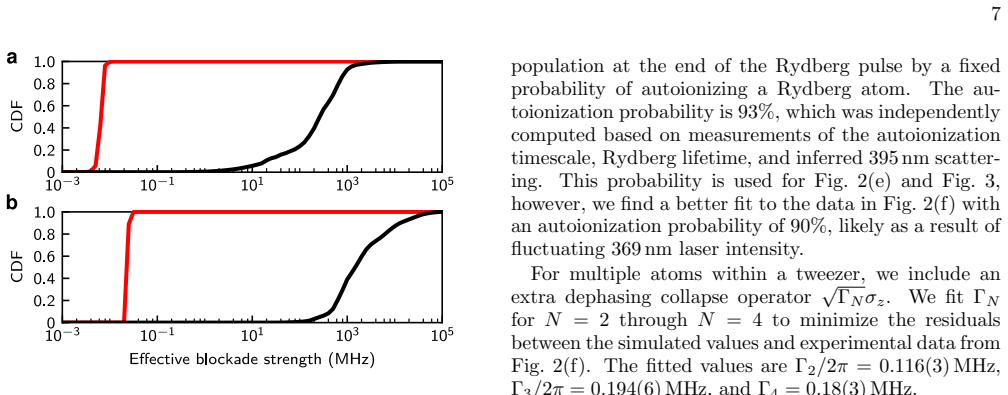
Experimental details To excite ground state atoms to the Rydberg state|r⟩, we use a two-photon excitation with typical Rabi fre- quencies of Ω399/2π= 130 MHz (beam powerP= 2 mW, beam waistw 0 = 500µm) and Ω 395/2π= 70 MHz (P= 280 mW,w 0 = 50µm), and an intermediate state detun- ing of ∆ e =−1020 MHz. The sign ∆ e∆r <0 is chosen 7 FIG. 5. Cumulative distri...
-
[2]
For multiple atoms within a tweezer, we ac- count for the Rydberg blockade with aV /2π= 100 MHz interaction energy for pairs of atoms in the Rydberg state
Simulation details For the two-photon Rydberg excitations from 1S0, we model the Rabi oscillations and protocol with master- equation-based simulations with collapse operators to ac- count for intermediate state scattering and finite Ryd- berg lifetime. For multiple atoms within a tweezer, we ac- count for the Rydberg blockade with aV /2π= 100 MHz interac...
-
[3]
Experimental details In order to limit atom losses during the preparation and readout of 3P0, it is necessary to cool the atoms using gray-molasses cooling detailed in Ref. [23]. The atomic temperature of the 3P0 atoms when the proto- col is performed is 9µK. Light-assisted collisions during the cooling process result in a sub-Poissonian distribution of t...
-
[4]
The population evolutions are consistent with an additionalN→N−2 loss channel
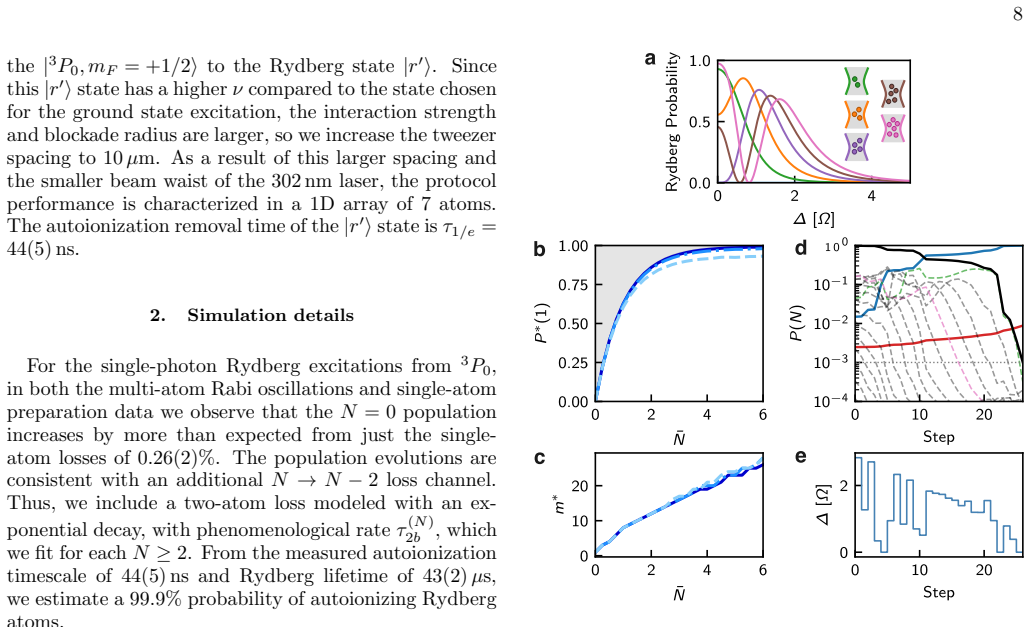
Simulation details For the single-photon Rydberg excitations from 3P0, in both the multi-atom Rabi oscillations and single-atom preparation data we observe that theN= 0 population increases by more than expected from just the single- atom losses of 0.26(2)%. The population evolutions are consistent with an additionalN→N−2 loss channel. Thus, we include a ...
-
[5]
Bluvstein, S
D. Bluvstein, S. J. Evered, A. A. Geim, S. H. Li, H. Zhou, T. Manovitz, S. Ebadi, M. Cain, M. Kali- nowski, D. Hangleiter, J. P. Bonilla Ataides, N. Maskara, I. Cong, X. Gao, P. Sales Rodriguez, T. Karolyshyn, G. Semeghini, M. J. Gullans, M. Greiner, V. Vuleti´ c, and M. D. Lukin, Logical quantum processor based on reconfigurable atom arrays, Nature626, 58 (2024)
2024
-
[6]
B. W. Reichardt, A. Paetznick, D. Aasen, I. Basov, J. M. Bello-Rivas, P. Bonderson, R. Chao, W. van Dam, M. B. Hastings, R. V. Mishmash, A. Paz, M. P. da Silva, A. Sundaram, K. M. Svore, A. Vaschillo, Z. Wang, M. Zanner, W. B. Cairncross, C.-A. Chen, D. Crow, H. Kim, J. M. Kindem, J. King, M. McDonald, M. A. Norcia, A. Ryou, M. Stone, L. Wadleigh, K. Barn...
-
[7]
M. J. Bedalov, M. Blakely, P. D. Buttler, C. Carna- han, F. T. Chong, W. C. Chung, D. C. Cole, P. Goipo- ria, P. Gokhale, B. Heim, G. T. Hickman, E. B. Jones, R. A. Jones, P. Khalate, J.-S. Kim, K. W. Kuper, M. T. Lichtman, S. Lee, D. Mason, N. A. Neff-Mallon, T. W. Noel, V. Omole, A. G. Radnaev, R. Rines, M. Saffman, E. Shabtai, M. H. Teo, B. Thotakura, ...
-
[8]
B. Zhang, G. Liu, G. Bornet, S. P. Horvath, P. Peng, S. Ma, S. Huang, S. Puri, and J. D. Thompson, Leverag- ing erasure errors in logical qubits with metastable 171Yb atoms, arXiv:2506.13724
-
[9]
P. Mathiot, E. Garnaoui, A.-U. Leriche, E. Philip, B. Al- brecht, C. Briosne-Fr´ ejaville, L. Cardarelli, A. Cornil- lot, G. Cournez, L. Couturier, J. D. Hond, R. E. Kous- saifi, T. Eritzpokoff, F. Fasola, A. A. Gentile, C. Gyurik, C. Hamot, L. Henriet, G. Herc´ e, M. Kaicher, L. Lass- abli` ere, F.-M. L. R´ egent, E. Leroux, Y. Machu, H. Ma- mann, L. Ort...
-
[10]
Labuhn, D
H. Labuhn, D. Barredo, S. Ravets, S. De L´ es´ eleuc, T. Macr` ı, T. Lahaye, and A. Browaeys, Tunable two- dimensional arrays of single Rydberg atoms for realizing quantum Ising models, Nature534, 667 (2016)
2016
-
[11]
Bernien, S
H. Bernien, S. Schwartz, A. Keesling, H. Levine, A. Om- ran, H. Pichler, S. Choi, A. S. Zibrov, M. Endres, M. Greiner, V. Vuleti´ c, and M. D. Lukin, Probing many- body dynamics on a 51-atom quantum simulator, Nature 551, 579 (2017)
2017
-
[12]
Browaeys and T
A. Browaeys and T. Lahaye, Many-body physics with individually controlled Rydberg atoms, Nat. Phys.16, 132 (2020)
2020
-
[13]
Ebadi, T
S. Ebadi, T. T. Wang, H. Levine, A. Keesling, G. Se- meghini, A. Omran, D. Bluvstein, R. Samajdar, H. Pich- ler, W. W. Ho, S. Choi, S. Sachdev, M. Greiner, V. Vuleti´ c, and M. D. Lukin, Quantum phases of matter on a 256-atom programmable quantum simulator, Nature 595, 227 (2021)
2021
-
[14]
Scholl, M
P. Scholl, M. Schuler, H. J. Williams, A. A. Eberharter, D. Barredo, K.-N. Schymik, V. Lienhard, L.-P. Henry, T. C. Lang, T. Lahaye, A. M. L¨ auchli, and A. Browaeys, Quantum simulation of 2D antiferromagnets with hun- dreds of Rydberg atoms, Nature595, 233 (2021)
2021
-
[15]
J. Choi, A. L. Shaw, I. S. Madjarov, X. Xie, R. Finkel- stein, J. P. Covey, J. S. Cotler, D. K. Mark, H.-Y. Huang, A. Kale, H. Pichler, F. G. S. L. Brand˜ ao, S. Choi, and M. Endres, Preparing random states and benchmarking with many-body quantum chaos, Nature613, 468 (2023)
2023
-
[16]
A. Cao, W. J. Eckner, T. Lukin Yelin, A. W. Young, S. Jandura, L. Yan, K. Kim, G. Pupillo, J. Ye, N. Dark- wah Oppong, and A. M. Kaufman, Multi-qubit gates and Schr¨ odinger cat states in an optical clock, Nature634, 315 (2024)
2024
-
[17]
A. L. Shaw, R. Finkelstein, R. B.-S. Tsai, P. Scholl, T. H. Yoon, J. Choi, and M. Endres, Multi-ensemble metrology by programming local rotations with atom movements, Nat. Phys.20, 195 (2024)
2024
-
[18]
Schlosser, G
N. Schlosser, G. Reymond, I. Protsenko, and P. Grangier, Sub-poissonian loading of single atoms in a microscopic dipole trap, Nature411, 1024 (2001)
2001
-
[19]
Schlosser, G
N. Schlosser, G. Reymond, and P. Grangier, Collisional Blockade in Microscopic Optical Dipole Traps, Phys. Rev. Lett.89, 023005 (2002)
2002
-
[20]
Barredo, S
D. Barredo, S. de L´ es´ eleuc, V. Lienhard, T. Lahaye, and A. Browaeys, An atom-by-atom assembler of defect-free arbitrary two-dimensional atomic arrays, Science354, 1021 (2016)
2016
-
[21]
Endres, H
M. Endres, H. Bernien, A. Keesling, H. Levine, E. R. Anschuetz, A. Krajenbrink, C. Senko, V. Vuletic, M. Greiner, and M. D. Lukin, Atom-by-atom assembly of defect-free one-dimensional cold atom arrays, Science 354, 1024 (2016)
2016
-
[22]
H. Kim, W. Lee, H.-g. Lee, H. Jo, Y. Song, and J. Ahn, In situ single-atom array synthesis using dynamic holo- graphic optical tweezers, Nat. Commun.7, 13317 (2016)
2016
-
[23]
Pause, T
L. Pause, T. Preuschoff, D. Sch¨ affner, M. Schlosser, and G. Birkl, Reservoir-based deterministic loading of single- atom tweezer arrays, Phys. Rev. Res.5, L032009 (2023)
2023
-
[24]
M. A. Norcia, H. Kim, W. B. Cairncross, M. Stone, 10 A. Ryou, M. Jaffe, M. O. Brown, K. Barnes, P. Battaglino, T. C. Bohdanowicz, A. Brown, K. Cas- sella, C.-A. Chen, R. Coxe, D. Crow, J. Epstein, C. Griger, E. Halperin, F. Hummel, A. M. W. Jones, J. M. Kindem, J. King, K. Kotru, J. Lauigan, M. Li, M. Lu, E. Megidish, J. Marjanovic, M. Mc- Donald, T. Mitt...
2024
-
[25]
Gyger, M
F. Gyger, M. Ammenwerth, R. Tao, H. Timme, S. Sni- girev, I. Bloch, and J. Zeiher, Continuous operation of large-scale atom arrays in optical lattices, Phys. Rev. Res. 6, 033104 (2024)
2024
-
[26]
J. A. Muniz, D. Crow, H. Kim, J. M. Kindem, W. B. Cairncross, A. Ryou, T. C. Bohdanowicz, C.-A. Chen, Y. Ji, A. M. W. Jones, E. Megidish, C. Nishiguchi, M. Ur- banek, L. Wadleigh, T. Wilkason, D. Aasen, K. Barnes, J. M. Bello-Rivas, I. Bloomfield, G. Booth, A. Brown, M. O. Brown, K. Cassella, G. Cowan, J. Epstein, M. Feld- kamp, C. Griger, Y. Hassan, A. H...
2025
-
[27]
Y. Li, Y. Bao, M. Peper, C. Li, and J. D. Thompson, Fast, continuous and coherent atom replacement in a neutral atom qubit array, arXiv:2506.15633
-
[28]
N.-C. Chiu, E. C. Trapp, J. Guo, M. H. Abobeih, L. M. Stewart, S. Hollerith, P. L. Stroganov, M. Kalinowski, A. A. Geim, S. J. Evered, S. H. Li, X. Lyu, L. M. Peters, D. Bluvstein, T. T. Wang, M. Greiner, V. Vuleti´ c, and M. D. Lukin, Continuous operation of a coherent 3,000- qubit system, Nature646, 1075 (2025)
2025
-
[29]
J. W. Lis, A. Senoo, W. F. McGrew, F. R¨ onchen, A. Jenkins, and A. M. Kaufman, Midcircuit Operations Using theomgArchitecture in Neutral Atom Arrays, Phys. Rev. X13, 041035 (2023)
2023
-
[30]
Muzi Falconi, R
A. Muzi Falconi, R. Panza, S. Sbernardori, R. Forti, R. Klemt, O. Abdel Karim, M. Marinelli, and F. Scazza, Microsecond-Scale High-Survival and Number-Resolved Detection of Ytterbium Atom Arrays, Phys. Rev. Lett. 135, 203402 (2025)
2025
-
[31]
A. L. Shaw, A. Soper, D. Shadmany, A. Kumar, L. Palm, D.-Y. Koh, V. Kaxiras, L. Taneja, M. Jaffe, D. I. Schus- ter, and J. Simon, A cavity-array microscope for parallel single-atom interfacing, Nature , 1 (2026)
2026
-
[32]
S. Ma, G. Liu, P. Peng, B. Zhang, S. Jandura, J. Claes, A. P. Burgers, G. Pupillo, S. Puri, and J. D. Thompson, High-Fidelity Gates and Mid-Circuit Erasure Conversion in an Atomic Qubit, Nature622, 279 (2023)
2023
-
[33]
Scholl, A
P. Scholl, A. L. Shaw, R. B.-S. Tsai, R. Finkelstein, J. Choi, and M. Endres, Erasure conversion in a high- fidelity Rydberg quantum simulator, Nature622, 273 (2023)
2023
-
[34]
Lin, H.-S
R. Lin, H.-S. Zhong, Y. Li, Z.-R. Zhao, L.-T. Zheng, T.-R. Hu, H.-M. Wu, Z. Wu, W.-J. Ma, Y. Gao, Y.-K. Zhu, Z.-F. Su, W.-L. Ouyang, Y.-C. Zhang, J. Rui, M.- C. Chen, C.-Y. Lu, and J.-W. Pan, AI-Enabled Parallel Assembly of Thousands of Defect-Free Neutral Atom Ar- rays, Phys. Rev. Lett.135, 060602 (2025)
2025
-
[35]
S. Wang, W. Zhang, T. Zhang, S. Mei, Y. Wang, J. Hu, and W. Chen, Accelerating the Assembly of Defect-Free Atomic Arrays with Maximum Parallelisms, Phys. Rev. Appl.19, 054032 (2023)
2023
-
[36]
W. Tian, W. J. Wee, A. Qu, B. J. M. Lim, P. R. Datla, V. P. W. Koh, and H. Loh, Parallel Assembly of Arbitrary Defect-Free Atom Arrays with a Multitweezer Algorithm, Phys. Rev. Appl.19, 034048 (2023)
2023
-
[37]
X. Wei, Z. Li, A. V. Karve, A. L. Shaw, D. I. Schuster, and J. Simon, A 10 Megahertz Spatial Light Modulator, arXiv:2601.08906
- [38]
-
[39]
Fuhrmanek, R
A. Fuhrmanek, R. Bourgain, Y. R. P. Sortais, and A. Browaeys, Light-assisted collisions between a few cold atoms in a microscopic dipole trap, Phys. Rev. A85, 062708 (2012)
2012
-
[40]
S. K. Pampel, M. Marinelli, M. O. Brown, J. P. D’Incao, and C. A. Regal, Quantifying Light-Assisted Collisions in Optical Tweezers across the Hyperfine Spectrum, Phys. Rev. Lett.134, 013202 (2025)
2025
-
[41]
D. S. Gr¨ un, L. B. Giacomelli, A. Tashchilina, R. Donofrio, F. Borchers, T. Bland, M. J. Mark, and F. Ferlaino, Light-assisted collisions in tweezer-trapped lanthanides, Phys. Rev. Res.8, 023067 (2026)
2026
-
[42]
Gr¨ unzweig, A
T. Gr¨ unzweig, A. Hilliard, M. McGovern, and M. Ander- sen, Near-deterministic preparation of a single atom in an optical microtrap, Nat. Phys.6, 951 (2010)
2010
-
[43]
B. J. Lester, N. Luick, A. M. Kaufman, C. M. Reynolds, and C. A. Regal, Rapid production of uniformly filled arrays of neutral atoms, Phys. Rev. Lett.115, 073003 (2015)
2015
-
[44]
M. O. Brown, T. Thiele, C. Kiehl, T.-W. Hsu, and C. A. Regal, Gray-Molasses Optical-Tweezer Loading: Controlling Collisions for Scaling Atom-Array Assembly, Phys. Rev. X9, 011057 (2019)
2019
-
[45]
Jenkins, J
A. Jenkins, J. W. Lis, A. Senoo, W. F. McGrew, and A. M. Kaufman, Ytterbium Nuclear-Spin Qubits in an Optical Tweezer Array, Phys. Rev. X12, 021027 (2022)
2022
-
[46]
J. Zhu, C. Chen, L. Zhou, X. Xie, C. Jiang, Z. Ding, F. Wu, F. Yang, G. Wang, Q. Gong, P. Zhang, S. Zhang, and P. Peng, High-efficiency loading of 2,400 Ytterbium atoms in optical tweezer arrays, arXiv:2512.19795
-
[47]
M. T. DePue, C. McCormick, S. L. Winoto, S. Oliver, and D. S. Weiss, Unity Occupation of Sites in a 3D Op- tical Lattice, Phys. Rev. Lett.82, 2262 (1999)
1999
-
[48]
Vetsch, S
E. Vetsch, S. T. Dawkins, R. Mitsch, D. Reitz, P. Schneeweiss, and A. Rauschenbeutel, Nanofiber-Based Optical Trapping of Cold Neutral Atoms, IEEE J. Sel. Top. Quantum Electron.18, 1763 (2012)
2012
-
[49]
Saffman and T
M. Saffman and T. G. Walker, Creating single-atom and single-photon sources from entangled atomic ensembles, Phys. Rev. A66, 065403 (2002)
2002
-
[50]
Ebert, A
M. Ebert, A. Gill, M. Gibbons, X. Zhang, M. Saffman, and T. G. Walker, Atomic Fock State Preparation Using Rydberg Blockade, Phys. Rev. Lett.112, 043602 (2014). 11
2014
-
[51]
Ebert, M
M. Ebert, M. Kwon, T. G. Walker, and M. Saffman, Coherence and Rydberg Blockade of Atomic Ensemble Qubits, Phys. Rev. Lett.115, 093601 (2015)
2015
-
[52]
A. Gaj, A. T. Krupp, J. B. Balewski, R. L¨ ow, S. Hof- ferberth, and T. Pfau, From molecular spectra to a den- sity shift in dense Rydberg gases, Nat. Commun.5, 4546 (2014)
2014
-
[53]
Derevianko, P
A. Derevianko, P. K´ om´ ar, T. Topcu, R. M. Kroeze, and M. D. Lukin, Effects of molecular resonances on Rydberg blockade, Phys. Rev. A92, 063419 (2015)
2015
-
[54]
M. D. Lukin, M. Fleischhauer, R. Cote, L. M. Duan, D. Jaksch, J. I. Cirac, and P. Zoller, Dipole blockade and quantum information processing in mesoscopic atomic ensembles, Phys. Rev. Lett.87, 037901 (2001)
2001
-
[55]
I. S. Madjarov, J. P. Covey, A. L. Shaw, J. Choi, A. Kale, A. Cooper, H. Pichler, V. Schkolnik, J. R. Williams, and M. Endres, High-fidelity entanglement and detection of alkaline-earth Rydberg atoms, Nat. Phys.16, 857 (2020)
2020
-
[56]
A. P. Burgers, S. Ma, S. Saskin, J. Wilson, M. A. Alarc´ on, C. H. Greene, and J. D. Thompson, Controlling Rydberg Excitations Using Ion-Core Transitions in Alkaline-Earth Atom-Tweezer Arrays, PRX Quantum3, 020326 (2022)
2022
-
[57]
A. Cao, T. L. Yelin, W. J. Eckner, N. D. Oppong, and A. M. Kaufman, Autoionization-Enhanced Rydberg Dressing by Fast Contaminant Removal, Phys. Rev. Lett. 134, 133201 (2025)
2025
-
[58]
T. Legrand, X. Wang, M. Simi´ c, F. Pausewang, W. Alt, E. Uru˜ nuela, M. T. Eiles, and S. Hofferberth, Reveal- ing Electron-Ytterbium Interactions through Rydberg Molecular Spectroscopy, arXiv:2512.20609
-
[59]
S. J. Evered, D. Bluvstein, M. Kalinowski, S. Ebadi, T. Manovitz, H. Zhou, S. H. Li, A. A. Geim, T. T. Wang, N. Maskara, H. Levine, G. Semeghini, M. Greiner, V. Vuleti´ c, and M. D. Lukin, High-fidelity parallel entan- gling gates on a neutral-atom quantum computer, Nature 622, 268 (2023)
2023
-
[60]
G. Liu, G. Bornet, D. Kurdak, M. Xiao, C. Li, B. Zhang, and J. D. Thompson, High-fidelity gates leveraging low- rank Hessian optimization, Manuscript in prep
-
[61]
Schlagm¨ uller, T
M. Schlagm¨ uller, T. C. Liebisch, F. Engel, K. S. Klein- bach, F. B¨ ottcher, U. Hermann, K. M. Westphal, A. Gaj, R. L¨ ow, S. Hofferberth, T. Pfau, J. P´ erez-R´ ıos, and C. H. Greene, Ultracold Chemical Reactions of a Single Ry- dberg Atom in a Dense Gas, Phys. Rev. X6, 031020 (2016)
2016
-
[62]
Geppert, M
P. Geppert, M. Alth¨ on, D. Fichtner, and H. Ott, Diffusive-like redistribution in state-changing collisions between Rydberg atoms and ground state atoms, Nat. Commun.12, 3900 (2021)
2021
-
[63]
R. M. Potvliege and C. S. Adams, Photo-ionization in far- off-resonance optical lattices, New J. Phys.8, 163 (2006)
2006
-
[64]
Pillet, W
P. Pillet, W. W. Smith, R. Kachru, N. H. Tran, and T. F. Gallagher, Microwave Ionization of Na Rydberg Levels, Phys. Rev. Lett.50, 1042 (1983)
1983
-
[65]
T. F. Gallagher, L. M. Humphrey, W. E. Cooke, R. M. Hill, and S. A. Edelstein, Field ionization of highly ex- cited states of sodium, Phys. Rev. A16, 1098 (1977)
1977
discussion (0)
Sign in with ORCID, Apple, or X to comment. Anyone can read and Pith papers without signing in.