Correcting Neural Operator Spectral Bias via Diffusion Posterior Sampling with Sparse Observations
Pith reviewed 2026-06-28 11:08 UTC · model grok-4.3
The pith
Frequency-dependent guidance in diffusion posterior sampling eliminates neural operator spectral bias.
A machine-rendered reading of the paper's core claim, the machinery that carries it, and where it could break.
Core claim
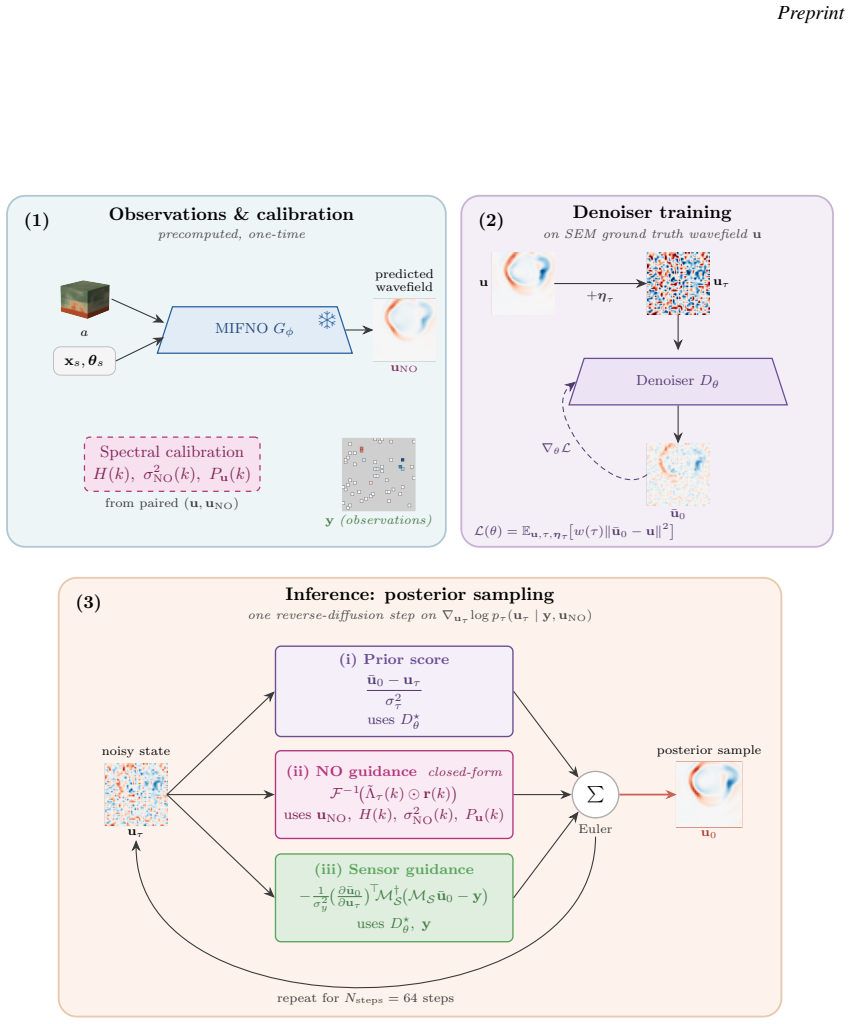
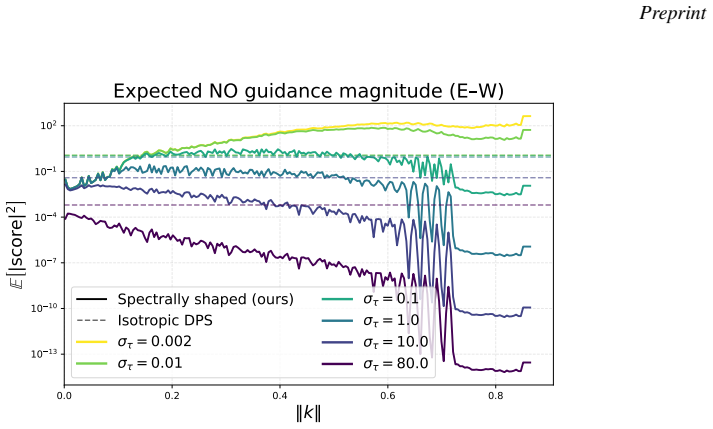
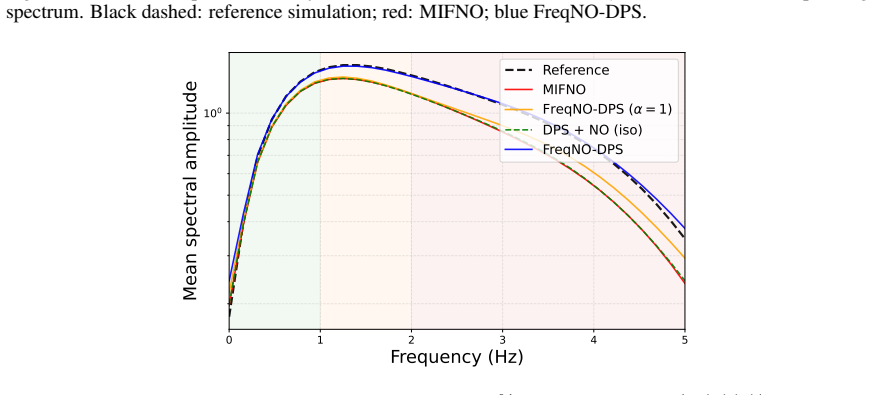
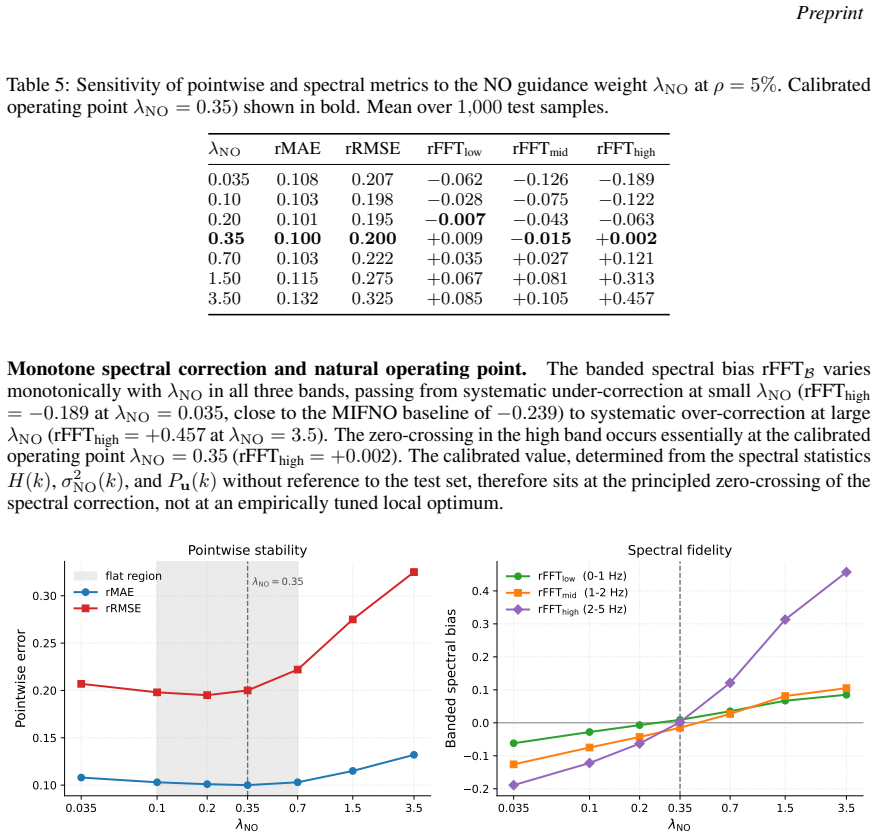
Treating neural operator predictions as auxiliary observations inside diffusion posterior sampling and applying a spectrally shaped guidance score that weights the surrogate according to its per-frequency accuracy removes the operator's inherent high-frequency attenuation, yielding near-zero spectral bias across all bands even at 2% sensor coverage.
What carries the argument
Spectrally shaped guidance score that weights the neural operator surrogate by its frequency-dependent accuracy, justified by approximate spectral diagonality of the residual.
If this is right
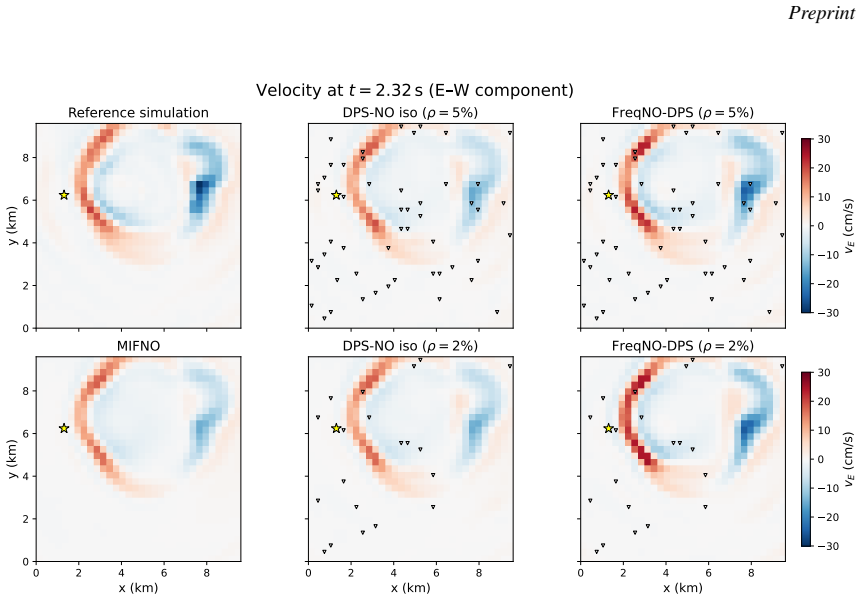
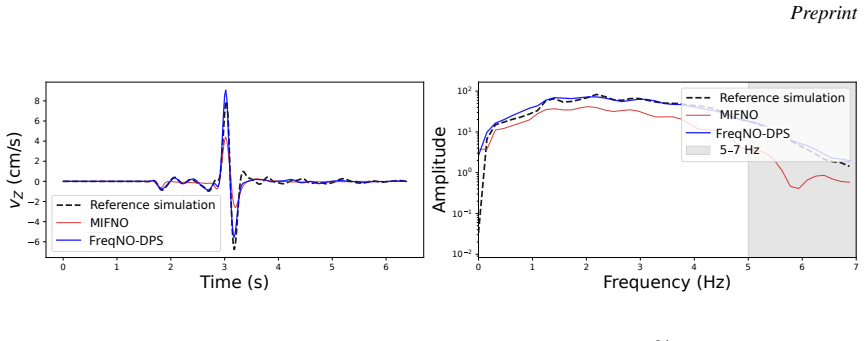
- Near-zero spectral bias is achieved across all frequency bands on 3D elastic wavefield prediction at 5% and 2% sensor coverage.
- Isotropic guidance improves pointwise accuracy but carries the surrogate's spectral bias into the posterior nearly intact.
- The closed-form guidance requires no denoiser backpropagation and needs only paired surrogate/reference data.
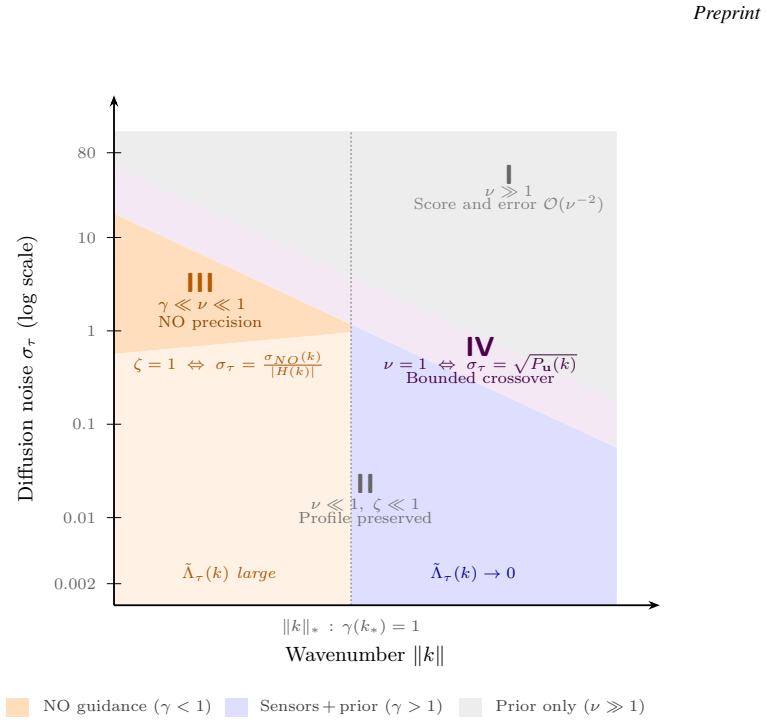
- The guidance's frequency dependence remains valid under a distribution-free error bound across the frequency-diffusion-time plane.
Where Pith is reading between the lines
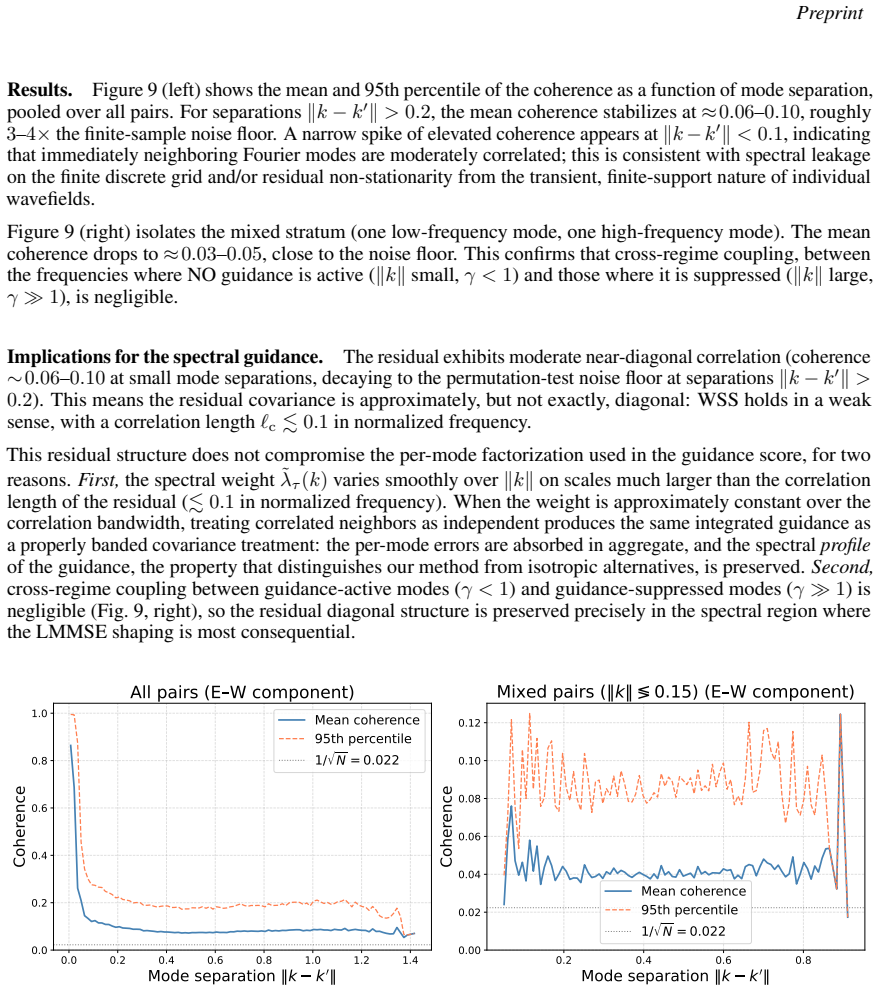
- The provided coherence diagnostic offers a practical check for whether a new surrogate satisfies the spectral-diagonality premise before applying the method.
- The same weighting idea could be tested on other biased surrogates whenever sparse point measurements exist, even outside wave problems.
- If the diagonality holds only approximately, the method may still reduce but not fully eliminate bias in regimes with very high sensor sparsity.
Load-bearing premise
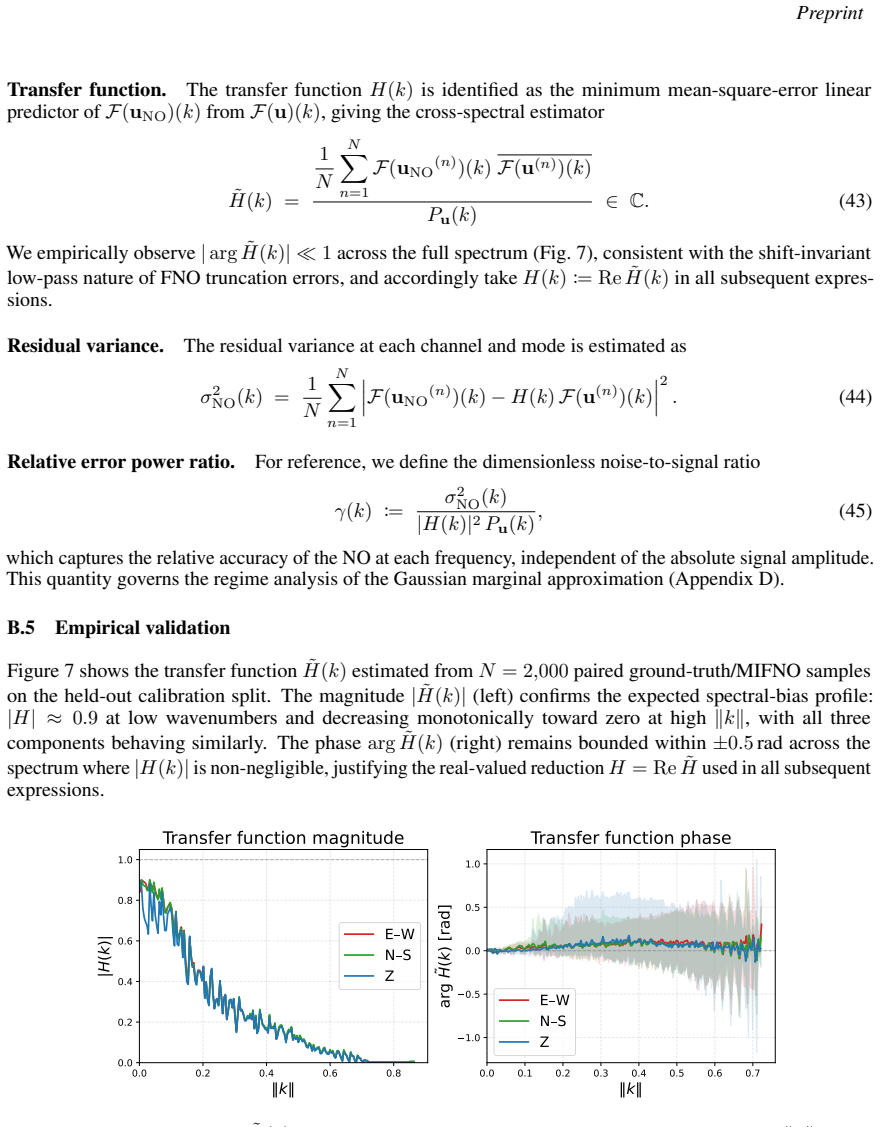
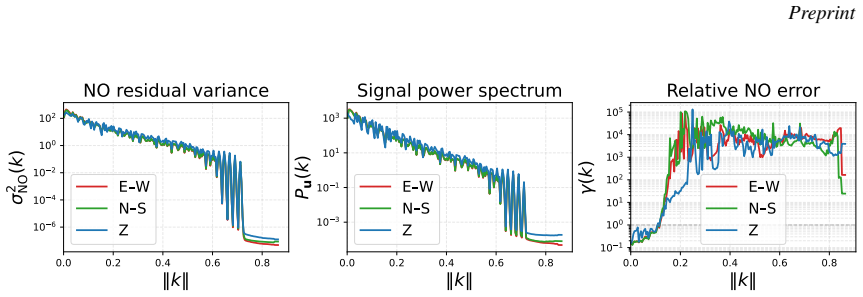
The residual between the neural operator and the true solution is approximately diagonal in the frequency domain.
What would settle it
A dataset in which the coherence diagnostic shows strong off-diagonal residual terms yet the frequency-weighted guidance still produces flat spectral error would falsify the necessity of the diagonality assumption.
Figures
read the original abstract
Neural operator surrogates (NO) approximate PDE solutions orders of magnitude faster than numerical solvers, but suffer from spectral bias: high-frequency content is systematically attenuated, limiting reliability where fine-scale structure matters. Sparse sensor measurements of the field are often available too, offering pointwise accuracy without spectral distortion but covering only a small fraction of the domain. We address this by treating NO predictions as auxiliary observations in a diffusion posterior sampling framework. Our method, FreqNO-DPS (https://github.com/niccoloperrone/FreqNO-DPS), combines an unconditional score-based diffusion prior, trained on high-fidelity simulations, with diffusion posterior sampling (DPS) conditioned on sparse observations and guided by a frozen neural operator. Naive integration reintroduces the surrogate's spectral bias; we resolve this with a closed-form, spectrally shaped guidance score that weights the surrogate by its frequency-dependent accuracy and needs no denoiser backpropagation. A distribution-free analysis bounds the approximation error across the frequency-diffusion-time plane and shows the guidance's frequency dependence is preserved regardless of distributional assumptions. On 3D elastic wavefield prediction at 5% and 2% sensor coverage, the method reaches near-zero spectral bias across all bands, where both the surrogate and sensor-only DPS show systematic high-frequency attenuation. Isotropic guidance, the natural baseline, improves pointwise accuracy but carries the bias into the posterior nearly intact, confirming that frequency-dependent calibration is essential, not merely beneficial. The framework needs only paired surrogate/reference data and exploits no problem-specific structure beyond the residual's approximate spectral diagonality, verifiable for new surrogates via the coherence diagnostic we provide.
Editorial analysis
A structured set of objections, weighed in public.
Referee Report
Summary. The paper proposes FreqNO-DPS, which embeds a frozen neural operator surrogate as an auxiliary observation within diffusion posterior sampling (DPS) conditioned on sparse pointwise sensor data. A closed-form spectrally shaped guidance score is derived by weighting the surrogate according to its frequency-dependent accuracy, justified by approximate spectral diagonality of the residual; this is claimed to be the sole problem-specific structure and is accompanied by a distribution-free error bound across the frequency-diffusion-time plane. Experiments on 3D elastic wavefield prediction at 5% and 2% sensor coverage report near-zero spectral bias across bands, contrasting with systematic high-frequency attenuation in both the raw surrogate and sensor-only DPS; isotropic guidance is shown to preserve the bias.
Significance. If the distribution-free bounds and the spectral-diagonality assumption hold under the reported conditions, the work offers a practical route to mitigate spectral bias in neural operators for high-dimensional PDEs without retraining or problem-specific tuning beyond a verifiable diagnostic. Explicit credit is due for releasing reproducible code (https://github.com/niccoloperrone/FreqNO-DPS) and for supplying the coherence diagnostic that allows independent verification of the key assumption for new surrogates.
major comments (1)
- [Abstract / guidance derivation] Abstract and guidance derivation: the closed-form spectrally shaped guidance score is derived under the assumption that the residual is approximately spectrally diagonal, which is invoked to justify frequency-dependent weighting without denoiser back-propagation. The paper states this is verifiable via the coherence diagnostic and is the only problem-specific structure used; however, no explicit confirmation is provided that diagonality holds at high frequencies for the 3D elastic wavefield residuals (where wave-propagation physics may induce off-diagonal correlations). If diagonality fails, the frequency-dependent correction cannot be guaranteed to eliminate the surrogate's high-frequency attenuation, directly undermining the central claim of near-zero spectral bias at 2–5% coverage.
minor comments (1)
- [Abstract] The abstract refers to 'paired surrogate/reference data' but does not specify the exact training split or reference solver used for the 3D elastic experiments; adding a brief statement on data provenance would improve reproducibility.
Simulated Author's Rebuttal
We thank the referee for the careful review and constructive feedback. The major comment concerns the need for explicit verification of the spectral diagonality assumption at high frequencies for the 3D elastic case. We address this below and will strengthen the manuscript accordingly.
read point-by-point responses
-
Referee: [Abstract / guidance derivation] Abstract and guidance derivation: the closed-form spectrally shaped guidance score is derived under the assumption that the residual is approximately spectrally diagonal, which is invoked to justify frequency-dependent weighting without denoiser back-propagation. The paper states this is verifiable via the coherence diagnostic and is the only problem-specific structure used; however, no explicit confirmation is provided that diagonality holds at high frequencies for the 3D elastic wavefield residuals (where wave-propagation physics may induce off-diagonal correlations). If diagonality fails, the frequency-dependent correction cannot be guaranteed to eliminate the surrogate's high-frequency attenuation, directly undermining the central claim of near-zero spectral bias at 2–5% coverage.
Authors: We thank the referee for this observation. The manuscript introduces the coherence diagnostic precisely to allow verification of the approximate spectral diagonality assumption and states that it is the sole problem-specific element used. While the experimental success (near-zero bias at 2–5% coverage) is consistent with the assumption holding, we agree that an explicit high-frequency confirmation for the 3D elastic residuals was not separately highlighted. In the revision we will add a dedicated panel (or subsection) displaying the coherence matrices or off-diagonal norms for the elastic surrogate across frequency bands, including the highest frequencies. This will directly confirm that off-diagonal correlations remain small, justifying the closed-form frequency-dependent guidance without back-propagation. The distribution-free error bound across the frequency–diffusion-time plane is independent of the diagonality assumption and continues to hold. We therefore view the addition as a clarification that strengthens rather than alters the central claims. revision: yes
Circularity Check
No significant circularity; closed-form guidance derivation is independent of target results
full rationale
The paper presents a closed-form spectrally shaped guidance score derived from frequency-dependent surrogate accuracy, supported by a distribution-free error bound across the frequency-diffusion-time plane. The only problem-specific element invoked is the residual's approximate spectral diagonality, which is explicitly positioned as verifiable via a provided coherence diagnostic rather than assumed or fitted from the 3D elastic experiments. No equations reduce the guidance, bounds, or near-zero spectral bias claim to fitted parameters from the target data, self-citations, or self-definitional loops. The method is described as requiring only paired surrogate/reference data for the prior, with the frequency-dependent correction preserved regardless of distributional assumptions. This structure keeps the central derivation self-contained against external benchmarks.
Axiom & Free-Parameter Ledger
Reference graph
Works this paper leans on
-
[1]
Guiding diffusion models to reconstruct flow fields from sparse data
Marc Amorós-Trepat, Luis Medrano-Navarro, Qiang Liu, Luca Guastoni, and Nils Thuerey. Guiding diffusion models to reconstruct flow fields from sparse data. (arXiv:2510.19971), October
-
[2]
doi: 10.48550/arXiv. 2510.19971. URLhttp://arxiv.org/abs/2510.19971. arXiv:2510.19971 [physics]. Jan-Hendrik Bastek, WaiChing Sun, and Dennis M Kochmann. Physics-informed diffusion models.arXiv preprint arXiv:2403.14404,
work page internal anchor Pith review doi:10.48550/arxiv
-
[3]
Shuhao Cao, Francesco Brarda, Ruipeng Li, and Yuanzhe Xi. Spectral-refiner: Fine-tuning of accurate spatiotemporal neural operator for turbulent flows.arXiv preprint arXiv:2405.17211,
-
[4]
Diffusion Posterior Sampling for General Noisy Inverse Problems
Hyungjin Chung, Jeongsol Kim, Michael T Mccann, Marc L Klasky, and Jong Chul Ye. Diffusion posterior sampling for general noisy inverse problems.arXiv preprint arXiv:2209.14687,
work page internal anchor Pith review Pith/arXiv arXiv
-
[5]
Spectral bias in physics-informed and operator learning: Analysis and mitigation guidelines
Siavash Khodakarami, Vivek Oommen, Nazanin Ahmadi Daryakenari, Maxim Beekenkamp, and George Em Karniadakis. Spectral bias in physics-informed and operator learning: Analysis and mitigation guidelines. arXiv preprint arXiv:2602.19265,
-
[6]
Fourier Neural Operator for Parametric Partial Differential Equations
Zongyi Li, Nikola Kovachki, Kamyar Azizzadenesheli, Burigede Liu, Kaushik Bhattacharya, Andrew Stuart, and Anima Anandkumar. Fourier neural operator for parametric partial differential equations.arXiv preprint arXiv:2010.08895,
work page internal anchor Pith review Pith/arXiv arXiv 2010
-
[7]
Thomas YL Lin, Jiachen Yao, Lufang Chiang, Julius Berner, and Anima Anandkumar. Decoupled diffusion sampling for inverse problems on function spaces.arXiv preprint arXiv:2601.23280,
-
[8]
Pde-refiner: Achieving accurate long rollouts with neural pde solvers, 2023.URL https://arxiv
Phillip Lippe, S Veeling Bastiaan, Paris Perdikaris, Richard E Turner, and Johannes Brandstetter. Pde-refiner: Achieving accurate long rollouts with neural pde solvers, 2023.URL https://arxiv. org/abs/2308.05732,
-
[9]
Roberto Molinaro, Samuel Lanthaler, Bogdan Raoni´c, Tobias Rohner, Victor Armegioiu, Stephan Simonis, Dana Grund, Yannick Ramic, Zhong Yi Wan, Fei Sha, et al. Generative ai for fast and accurate statistical computation of fluids.arXiv preprint arXiv:2409.18359,
-
[10]
Vivek Oommen, Aniruddha Bora, Zhen Zhang, and George Em Karniadakis. Integrating neural operators with diffusion models improves spectral representation in turbulence modeling.arXiv preprint arXiv:2409.08477,
-
[11]
Niccolò Perrone, Fanny Lehmann, Hugo Gabrielidis, Stefania Fresca, and Filippo Gatti. Integrating fourier neural operators with diffusion models to improve spectral representation of synthetic earthquake ground motion response.arXiv preprint arXiv:2504.00757,
-
[12]
19 Preprint Shaoxiang Qin, Fuyuan Lyu, Wenhui Peng, Dingyang Geng, Ju Wang, Xing Tang, Sylvie Leroyer, Naiping Gao, Xue Liu, and Liangzhu Leon Wang. Toward a better understanding of fourier neural operators from a spectral perspective.arXiv preprint arXiv:2404.07200,
-
[13]
Score-Based Generative Modeling through Stochastic Differential Equations
Yang Song, Jascha Sohl-Dickstein, Diederik P Kingma, Abhishek Kumar, Stefano Ermon, and Ben Poole. Score-based generative modeling through stochastic differential equations.arXiv preprint arXiv:2011.13456,
work page internal anchor Pith review Pith/arXiv arXiv 2011
-
[14]
doi: 10.3390/geosciences12030112
ISSN 2076-3263. doi: 10.3390/geosciences12030112. URL https://www.mdpi.com/2076-3263/12/3/112. Alasdair Tran, Alexander Mathews, Lexing Xie, and Cheng Soon Ong. Factorized fourier neural operators. arXiv preprint arXiv:2111.13802,
-
[15]
Zhi-Qin John Xu, Yaoyu Zhang, Tao Luo, Yanyang Xiao, and Zheng Ma. Frequency principle: Fourier analysis sheds light on deep neural networks.arXiv preprint arXiv:1901.06523,
-
[16]
Jiachen Yao, Abbas Mammadov, Julius Berner, Gavin Kerrigan, Jong Chul Ye, Kamyar Azizzadenesheli, and Anima Anandkumar. Guided diffusion sampling on function spaces with applications to pdes.arXiv preprint arXiv:2505.17004,
-
[17]
Zhilin You, Zhenli Xu, and Wei Cai. Mscalefno: Multi-scale fourier neural operator learning for oscillatory function spaces.arXiv preprint arXiv:2412.20183,
-
[18]
Yicheng Zou, Samuel Lanthaler, and Hossein Salahshoor. A probabilistic framework for solving high-frequency helmholtz equations via diffusion models.arXiv preprint arXiv:2602.04082,
-
[19]
Computing the required second-order statistics, Var[Y] =P u +σ 2 τ and Cov[X, Y] =P u (by independence ofXandˆη τ ), yields: ˆXL(k) =α(k)Y(k), α(k) := Pu(k) σ2τ +P u(k) .(51) The coefficient α(k) contracts the noisy observation toward zero (the prior mean) with strength determined by the noise-to-signal ratioσ 2 τ /Pu(k). The associated LMMSE error is: σ2...
1995
-
[20]
Score magnitude:E[|s approx|2] =hα 2/λτ =O(ν −2)→0
+O(ν −1). Score magnitude:E[|s approx|2] =hα 2/λτ =O(ν −2)→0. Score error: E[|ϵ|2]≤ 2(∆post + ∆prior) σ4τ ≤ 4P σ4τ = 4 P ν2 →0.(77) D.4.2 Regime II (ν≪1,ζ≪1) Asymptotics:α→1,λ τ →σ 2 NO,E[|s approx|2] =O(1/(P γ)),σ 2 L,Y Z ≈σ 2 L whenζ≪1. Absolute score error: E[|ϵ|2]≤ 2(σ2 L,Y Z +σ 2 L) σ4τ ≈ 4σ2 L σ4τ = 4 P ν .(78) Relative score error:E[|ϵ| 2]/E[|sappr...
2024
-
[21]
Training uses Adam with peak learning rate 3×10 −4 and weight decay 0.01, run for 430,000 steps with a total batch size of 32 (4 per GPU ×8 NVIDIA A100 80 GB GPUs)
The model is trained under the variance- exploding (VE) diffusion scheme with an exponential noise schedule spanning σmin = 0.002 to σmax = 80, using EDM-style weighting [Karras et al., 2022] and log-uniform noise sampling. Training uses Adam with peak learning rate 3×10 −4 and weight decay 0.01, run for 430,000 steps with a total batch size of 32 (4 per ...
2022
-
[22]
No spatial regularity or optimization of the sensor layout is imposed. G.6 Sampling configuration Posterior samples are generated by solving the probability-flow ODE using the explicit Euler integrator with 64 time steps following the EDM noise decay schedule [Karras et al., 2022]. A final denoising step is applied at the terminal noise level. We observed...
2022
discussion (0)
Sign in with ORCID, Apple, or X to comment. Anyone can read and Pith papers without signing in.