Analyzing the Evolution of Structural Communities within Microservice Architecture
Pith reviewed 2026-06-28 09:27 UTC · model grok-4.3
The pith
Temporal community detection on microservice dependency networks shows stable division into two business-process groups across releases.
A machine-rendered reading of the paper's core claim, the machinery that carries it, and where it could break.
Core claim
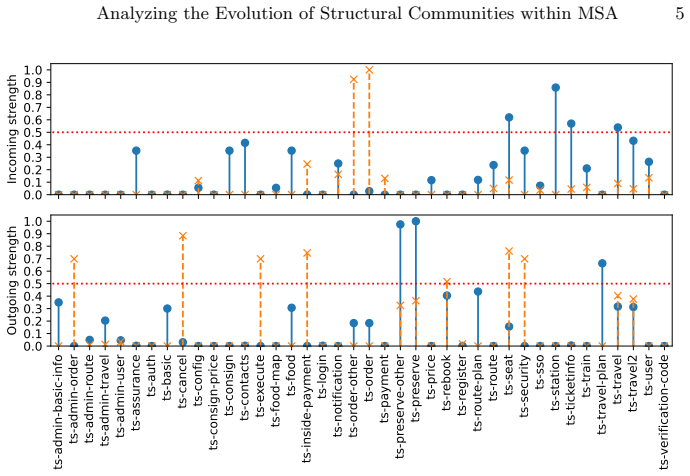
Applying a temporal community detection algorithm to the evolving dependency networks of six consecutive releases of the train-ticket microservice benchmark produces a stable partition of services into two communities that align with two business processes. Several services belong to more than one community, and services inside the same community exhibit both incoming and outgoing connections. The membership strength metric returned by the algorithm supplies a fine-grained, time-resolved measure of community affiliation.
What carries the argument
Temporal community detection algorithm run on successive microservice dependency networks, returning communities plus a membership strength score for each service.
If this is right
- The architecture maintains a stable separation into two communities aligned with distinct business processes.
- Multi-community membership can be used as an indicator of possible unclear division of responsibilities.
- Mixed incoming and outgoing connections inside a community can flag unoptimized communication patterns.
- Membership strength values enable quantitative comparison of community cohesion across releases.
Where Pith is reading between the lines
- The same temporal detection pipeline could be rerun on other open microservice benchmarks to test whether two-community splits recur.
- Thresholds on membership strength could be turned into automated alerts for monitoring live deployments.
- Pairing the detected communities with source-code ownership data might reveal whether multi-membership services are maintained by separate teams.
Load-bearing premise
The communities returned by the algorithm correspond to meaningful business processes and that services belonging to several communities or showing mixed link directions inside one community reliably indicate architectural degradation.
What would settle it
A direct mapping of the two detected communities against the documented business processes of the train-ticket system that shows the communities do not correspond to those processes.
Figures
read the original abstract
In recent years, the detection of anti-patterns in microservice architecture has gained traction, particularly to identify instances of Microservice Architectural Degradation. In such tasks, the microservice architecture is often modeled as a network of microservice dependencies. Recent works have explored how to assess the evolution of such architectural networks by considering the architecture of consecutive releases of the project. Particular anti-patterns related to the structure of the service network include Wrong cuts and Knot services. Community detection is a way to identify groups of services in a network that strongly depend on each other. If such groups cannot be mapped to business processes in the system, or if the same service belongs to multiple communities, this could indicate architectural degradation due to an inappropriate division of responsibilities or unoptimized communication. Temporal community detection methods have been proposed to analyze community structure that evolves in time. We performed temporal community detection within the microservice architecture of six releases of the train-ticket benchmark and analyzed the composition of the discovered communities and their activities over time. We observed a stable architecture with a clear separation of services into two communities, which we could identify with two business processes performed by the system. We found services belonging to several communities, as well as services within the same community with both incoming and outgoing connections. The membership strength metric provided by the leveraged algorithm enables fine-grained assessment of the microservice communities.
Editorial analysis
A structured set of objections, weighed in public.
Referee Report
Summary. The manuscript applies temporal community detection to the microservice dependency network extracted from six releases of the Train-Ticket benchmark. It reports a stable partitioning into two communities that the authors map to two distinct business processes performed by the system, notes the presence of services belonging to multiple communities as well as services with both incoming and outgoing connections within the same community, and highlights the membership-strength metric supplied by the algorithm as enabling finer-grained assessment of architectural structure and potential degradation.
Significance. If the community-to-business-process mapping can be independently validated and the observations supported by quantitative metrics and baselines, the approach could offer a useful observational tool for tracking structural evolution and identifying Wrong-cut or Knot-service anti-patterns in microservice systems. The application of temporal methods to a public benchmark is a constructive step, but the current absence of validation, metrics, or comparison against null models substantially limits the strength of the central interpretive claims.
major comments (3)
- [Abstract] Abstract: The assertion that the two detected communities 'could be identified with two business processes' is presented without any described validation procedure (e.g., service labels from requirements documents, developer annotations, or quantitative overlap metrics with known process boundaries). This unvalidated mapping is load-bearing for the subsequent claim that multi-community membership or mixed-direction links indicate architectural degradation rather than intentional design.
- [Abstract] Abstract / Methods (implied): No quantitative metrics (modularity, stability indices, error bars), baseline comparisons, algorithm parameters, or data-preprocessing steps for constructing the dependency network are reported. The central claim of 'stable architecture' therefore rests on unshown analysis steps, preventing assessment of robustness or reproducibility.
- [Abstract] Abstract: The study examines only six releases of a single benchmark. Any conclusion about temporal stability or the reliability of multi-membership as a degradation signal inherits the same unvalidated mapping and lacks generalization evidence.
Simulated Author's Rebuttal
We thank the referee for their thorough review and constructive criticism. We address each of the major comments below, indicating the revisions we plan to make to improve the manuscript.
read point-by-point responses
-
Referee: [Abstract] Abstract: The assertion that the two detected communities 'could be identified with two business processes' is presented without any described validation procedure (e.g., service labels from requirements documents, developer annotations, or quantitative overlap metrics with known process boundaries). This unvalidated mapping is load-bearing for the subsequent claim that multi-community membership or mixed-direction links indicate architectural degradation rather than intentional design.
Authors: The mapping relies on the authors' knowledge of the Train-Ticket benchmark's architecture as described in its public repository and papers. Services were aligned to processes such as 'order management' and 'user services' based on their documented functionalities. We will revise the paper to include an explicit description of this mapping procedure, citing the benchmark documentation and providing a table of community assignments with process labels. This addresses the validation concern directly. We will also clarify that the observations on multi-community services are presented as potential signals rather than confirmed degradation. revision: yes
-
Referee: [Abstract] Abstract / Methods (implied): No quantitative metrics (modularity, stability indices, error bars), baseline comparisons, algorithm parameters, or data-preprocessing steps for constructing the dependency network are reported. The central claim of 'stable architecture' therefore rests on unshown analysis steps, preventing assessment of robustness or reproducibility.
Authors: We agree that these details are essential for reproducibility. The manuscript describes the overall approach but we will expand the Methods section to report the specific temporal community detection algorithm and its parameters, the exact steps for building the dependency network from each release (including any filtering or weighting), and quantitative results such as modularity scores and a stability index across the six releases. Additionally, we will include a baseline comparison using a randomized network model to contextualize the observed stability. These changes will be reflected in an updated abstract. revision: yes
-
Referee: [Abstract] Abstract: The study examines only six releases of a single benchmark. Any conclusion about temporal stability or the reliability of multi-membership as a degradation signal inherits the same unvalidated mapping and lacks generalization evidence.
Authors: The paper is intended as an exploratory case study on a widely used benchmark system. We will revise the abstract, introduction, and conclusion to emphasize the limitations of the single-benchmark scope and to avoid overgeneralization. The temporal stability claim is specific to the observed evolution in these six releases, which we will support with quantitative metrics in the revision. Future work on other systems is suggested. revision: partial
Circularity Check
No circularity: purely observational application of existing algorithms with no derivations or fitted predictions
full rationale
The paper applies temporal community detection to dependency networks extracted from six releases of the train-ticket benchmark and reports empirical observations about community stability, multi-membership, and link directions. No equations, parameter fitting, predictions, or uniqueness theorems are presented. The interpretive step mapping communities to business processes is an unvalidated assertion but does not constitute a derivation that reduces to the inputs by construction, self-citation load-bearing, or any of the enumerated circular patterns. The analysis is self-contained as an observational report without load-bearing circular steps.
Axiom & Free-Parameter Ledger
axioms (1)
- domain assumption Temporal community detection algorithms can produce groupings that correspond to business processes in microservice systems
Reference graph
Works this paper leans on
-
[1]
Abufouda, M., Abukwaik, H.: On using network science in mining developers col- laboration in software engineering: A systematic literature review. International Journal of Data Mining & Knowledge Management Process (IJDKP)7(5/6), 17– 34 (November 2017).https://doi.org/10.5121/ijdkp.2017.7601
-
[2]
In: 2022 IEEE International Conference on Service- Oriented System Engineering (SOSE)
Al Maruf, A., Bakhtin, A., Cerny, T., Taibi, D.: Using microservice telemetry data for system dynamic analysis. In: 2022 IEEE International Conference on Service- Oriented System Engineering (SOSE). pp. 29–38 (2022).https://doi.org/10.1 109/SOSE55356.2022.00010 8 Bakhtin et al
arXiv 2022
-
[3]
In: 2025 IEEE International Conference on Service-Oriented System Engineering (SOSE)
Bakhtin, A., Esposito, M., Lenarduzzi, V., Taibi, D.: Leveraging network methods for hub-like microservice detection. In: 2025 IEEE International Conference on Service-Oriented System Engineering (SOSE). pp. 27–38 (2025).https://doi.or g/10.1109/SOSE67019.2025.00008
-
[4]
In: 2025 IEEE 22nd International Con- ference on Software Architecture (ICSA)
Bakhtin, A., Esposito, M., Lenarduzzi, V., Taibi, D.: Network centrality as a new perspective on microservice architecture. In: 2025 IEEE 22nd International Con- ference on Software Architecture (ICSA). pp. 72–83 (2025).https://doi.org/10 .1109/ICSA65012.2025.00017
arXiv 2025
-
[5]
Bakhtin, A., Esposito, M., Lenarduzzi, V., Taibi, D.: Centrality change prone- ness: An early indicator of microservice architectural degradation. In: Software Architecture. pp. 243–259. Springer Nature Switzerland, Cham (2026).https: //doi.org/10.1007/978-3-032-02138-0_16
-
[6]
Bakhtin, A., Li, X., Taibi, D.: Temporal community detection in developer collab- oration networks of microservice projects. In: Software Architecture. pp. 174–182. Springer (2024).https://doi.org/10.1007/978-3-031-70797-1_11
-
[7]
Journal of Chemometrics17(5), 274–286 (2003)
Bro, R., Kiers, H.A.L.: A new efficient method for determining the number of components in parafac models. Journal of Chemometrics17(5), 274–286 (2003). https://doi.org/10.1002/cem.801
-
[8]
Journal of Systems and Software206, 111829 (2023).https://doi.org/10.1016/ j.jss.2023.111829
Cerny, T., Abdelfattah, A.S., Al Maruf, A., Janes, A., Taibi, D.: Catalog and detection techniques of microservice anti-patterns and bad smells: A tertiary study. Journal of Systems and Software206, 111829 (2023).https://doi.org/10.1016/ j.jss.2023.111829
arXiv 2023
-
[9]
Gaidels, E., Kirikova, M.: Service dependency graph analysis in microservice architecture. In: Perspectives in Business Informatics Research: 19th Interna- tional Conference on Business Informatics Research, BIR 2020, Vienna, Austria, September 21–23, 2020, Proceedings 19. pp. 128–139. Springer (2020).https: //doi.org/10.1007/978-3-030-61140-8_9
-
[10]
PloS one9(1), e86028 (2014).https://doi.org/10.1371/journal.pone.0086028
Gauvin, L., Panisson, A., Cattuto, C.: Detecting the community structure and ac- tivity patterns of temporal networks: a non-negative tensor factorization approach. PloS one9(1), e86028 (2014).https://doi.org/10.1371/journal.pone.0086028
-
[11]
In: Aiello, M., Deng, S., Murillo, J.M., Georgievski, I., Benatal- lah, B., Wang, Z
Genfer, P., Zdun, U.: Using guided community detection to improve existing mi- croservice designs. In: Aiello, M., Deng, S., Murillo, J.M., Georgievski, I., Benatal- lah, B., Wang, Z. (eds.) Service-Oriented Computing. pp. 205–220. Springer Nature Singapore, Singapore (2026).https://doi.org/10.1007/978-981-95-5012-8_15
-
[12]
Holme, P., Saram¨ aki, J.: Temporal networks. Physics reports519(3), 97–125 (2012).https://doi.org/10.1016/j.physrep.2012.03.001
-
[13]
In: Companion of the 15th ACM/SPEC International Conference on Performance Engineering
Khodabandeh, G., Ezaz, A., Ezzati-Jivan, N.: Network analysis of microservices: A case study on alibaba production clusters. In: Companion of the 15th ACM/SPEC International Conference on Performance Engineering. pp. 67–71 (2024).https: //doi.org/10.1145/3629527.3651842
-
[14]
Journal of Systems and Soft- ware202, 111722 (2023).https://doi.org/10.1016/j.jss.2023.111722
Schneider, S., Scandariato, R.: Automatic extraction of security-rich dataflow dia- grams for microservice applications written in java. Journal of Systems and Soft- ware202, 111722 (2023).https://doi.org/10.1016/j.jss.2023.111722
-
[15]
Springer Berlin Heidelberg, Berlin, Heidelberg (2024).https://doi.org/10.1007/978-3-662-69306-3
Wohlin, C., Runeson, P., H¨ ost, M., Ohlsson, M.C., Regnell, B., Wessl´ en, A.: Ex- perimentation in Software Engineering (2024 edition). Springer Berlin Heidelberg, Berlin, Heidelberg (2024).https://doi.org/10.1007/978-3-662-69306-3
-
[16]
In: Proceedings of the 40th International Conference on Software Engineering: Companion Proceeedings
Zhou, X., Peng, X., Xie, T., Sun, J., Xu, C., Ji, C., Zhao, W.: Benchmarking microservice systems for software engineering research. In: Proceedings of the 40th International Conference on Software Engineering: Companion Proceeedings. p. 323–324. ICSE ’18, Association for Computing Machinery (2018).https://doi. org/10.1145/3183440.3194991
discussion (0)
Sign in with ORCID, Apple, or X to comment. Anyone can read and Pith papers without signing in.