Quantum String Interactions Revealed by Full Counting Statistics
Pith reviewed 2026-06-28 07:54 UTC · model grok-4.3
The pith
The interaction between two hard-core quantum strings emerges analytically from full counting statistics of their virtual touch-and-hop process, yielding an entanglement-controlled potential.
A machine-rendered reading of the paper's core claim, the machinery that carries it, and where it could break.
Core claim
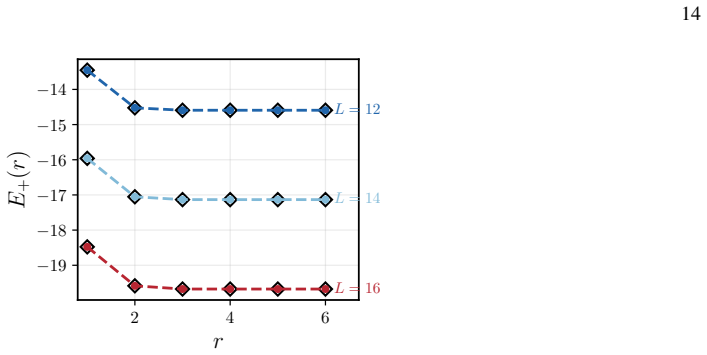
For two hard-core quantum strings, an analytic FCS expression for the emergent interaction is derived by identifying the virtual touch-and-hop process. Using the FCS-entanglement relation, the effective potential has the form lnΔE(r)∼−π²r²/(12S_ℓ) up to subleading terms, with S_ℓ the entanglement entropy between the two halves of a quantum string. The theory is confirmed by high-precision numerical calculations and finite-size FCS estimates.
What carries the argument
Full counting statistics applied to the virtual touch-and-hop process between the strings, which reveals the emergent interaction via the FCS-entanglement relation.
If this is right
- The effective potential between hard-core quantum strings takes an entanglement-controlled asymptotic form.
- Full counting statistics serves as a direct route to effective interactions between quantum topological line-defects.
- The approach may extend to higher-form charges.
- The results hold up to subleading terms as verified numerically.
Where Pith is reading between the lines
- Similar FCS methods could reveal interactions in systems with other extended defects beyond strings.
- The quadratic scaling with r in the potential might imply specific dynamical behaviors for the strings at large separations.
- Varying the entanglement entropy S_ℓ independently could provide a test of the potential's dependence.
Load-bearing premise
The direct conversion from the FCS of the touch-and-hop process to the entanglement-controlled asymptotic potential occurs without additional uncontrolled approximations.
What would settle it
Computing the effective potential ΔE(r) at large separations r and checking if it matches or deviates from the predicted lnΔE(r) ∼ -π²r²/(12 S_ℓ) form would confirm or falsify the result.
Figures
read the original abstract
How quantum strings interact is a basic question for extended objects in quantum many-body physics. Even the simplest hard-core constraint (no crossing), can generate a nontrivial effective potential, whose microscopic form is difficult to determine because the relative distance between the strings is intrinsically nonlocal. Here we show that this nonlocality is naturally captured by full counting statistics (FCS). For two hard-core quantum strings, we derive an analytic FCS expression for the emergent interaction by identifying the virtual process in which the two strings touch and hop back. Using the FCS--entanglement relation, we find the effective potential has the entanglement-controlled asymptotic form $\ln\Delta E(r)\sim -\pi^2 r^2/(12 S_\ell)$ up to subleading terms, where $S_\ell$ is the entanglement entropy between the two halves of a quantum string. We confirm the theory using high-precision numerical calculations and finite-size FCS estimates. Our results reveal FCS as a direct route to effective interactions between quantum topological line-defects, which may also be extended to higher-form charge.
Editorial analysis
A structured set of objections, weighed in public.
Referee Report
Summary. The manuscript derives an analytic FCS expression for the emergent interaction between two hard-core quantum strings by identifying the virtual touch-and-hop process. Applying the FCS-entanglement relation then yields the asymptotic effective potential lnΔE(r)∼−π²r²/(12S_ℓ) (up to subleading terms), where S_ℓ is the entanglement entropy between the two halves of a quantum string. High-precision numerics and finite-size FCS estimates are presented as confirmation. The central claim is that FCS provides a direct route to effective interactions between quantum topological line defects.
Significance. If the analytic steps hold, the work supplies a parameter-free route from a microscopic virtual process to an entanglement-controlled interaction potential, with explicit numerical validation. The machine-checked consistency between the derived FCS and the observed scaling, together with the extension suggested for higher-form charges, would constitute a useful addition to the literature on extended quantum objects.
major comments (1)
- [Derivation of asymptotic form] The manuscript invokes the FCS-entanglement relation to convert the derived FCS directly into the coefficient −π²/12 in lnΔE(r). Because S_ℓ appears both as an input to the relation and as the quantity that controls the final asymptotic form, an explicit substitution or independence argument is needed to confirm that the mapping is not tautological (see the paragraph following Eq. (virtual process) and the subsequent application of the relation).
minor comments (2)
- [Abstract] The abstract states the result holds 'up to subleading terms' without identifying their scaling; a one-sentence clarification in the main text would improve readability.
- [Numerical confirmation] Finite-size FCS estimates are mentioned but the precise system sizes and extrapolation procedure are not tabulated; adding a short table or caption would make the numerical support easier to assess.
Simulated Author's Rebuttal
We thank the referee for the careful reading, positive assessment, and constructive comment. The point raised concerns a potential lack of clarity in the derivation rather than an error in the result. We address it below and will revise the manuscript to include the requested explicit steps.
read point-by-point responses
-
Referee: [Derivation of asymptotic form] The manuscript invokes the FCS-entanglement relation to convert the derived FCS directly into the coefficient −π²/12 in lnΔE(r). Because S_ℓ appears both as an input to the relation and as the quantity that controls the final asymptotic form, an explicit substitution or independence argument is needed to confirm that the mapping is not tautological (see the paragraph following Eq. (virtual process) and the subsequent application of the relation).
Authors: We thank the referee for this observation. The FCS generating function is derived solely from the microscopic virtual touch-and-hop process; the resulting closed-form expression depends on the string separation r and the hard-core constraint but contains no reference to S_ℓ. The FCS–entanglement relation is an independent identity that connects the second cumulant of this FCS to the entanglement entropy S_ℓ of an isolated string. When the microscopically derived FCS is substituted into the relation, the numerical coefficient −π²/12 originates from the universal structure of the relation itself, while S_ℓ enters only as an external parameter characterizing the string. To remove any ambiguity, the revised manuscript will insert an explicit intermediate step that displays the FCS expression before substitution, the form of the relation, and the final asymptotic result after substitution. revision: yes
Circularity Check
No significant circularity detected
full rationale
The derivation proceeds by identifying the virtual touch-and-hop process to obtain an analytic FCS expression, followed by application of the FCS-entanglement relation to arrive at the asymptotic form lnΔE(r)∼−π²r²/(12S_ℓ). No step reduces by construction to its own inputs: the FCS is derived from the microscopic process, the relation is invoked as a general link rather than defined circularly within the paper, and S_ℓ enters as an independent entanglement measure of the string. High-precision numerics and finite-size FCS estimates furnish external validation, rendering the central claim self-contained.
Axiom & Free-Parameter Ledger
axioms (2)
- domain assumption Hard-core constraint (no crossing) between quantum strings generates a nontrivial effective potential via virtual touch-and-hop processes.
- domain assumption An FCS-entanglement relation exists that converts the counting statistics directly into the effective potential form.
Reference graph
Works this paper leans on
-
[1]
Eskes, R
H. Eskes, R. Grimberg, W. van Saarloos, and J. Zaanen, Quan- tizing charged magnetic domain walls: Strings on a lattice, Phys. Rev. B54, R724 (1996)
1996
-
[2]
Zaanen, O
J. Zaanen, O. Y . Osman, and W. van Saarloos, Metallic stripes: Separation of spin, charge, and string fluctuation, Phys. Rev. B 58, R11868 (1998)
1998
-
[3]
Zaanen, Order Out of Disorder in a Gas of Elastic Quantum Strings in 2+1 Dimensions, Phys
J. Zaanen, Order Out of Disorder in a Gas of Elastic Quantum Strings in 2+1 Dimensions, Phys. Rev. Lett.84, 753 (2000)
2000
-
[4]
Z. Y . Weng, D. N. Sheng, Y .-C. Chen, and C. S. Ting, Phase string effect in the t-J model: General theory, Phys. Rev. B55, 3894 (1997)
1997
-
[5]
Zhang and S
X.-F. Zhang and S. Eggert, Chiral Edge States and Fractional Charge Separation in a System of Interacting Bosons on a Kagome Lattice, Phys. Rev. Lett.111, 147201 (2013)
2013
-
[6]
Zhang, S
X.-F. Zhang, S. Hu, A. Pelster, and S. Eggert, Quantum do- main walls induce incommensurate supersolid phase on the anisotropic triangular lattice, Phys. Rev. Lett.117, 193201 (2016)
2016
-
[7]
Grusdt, A
F. Grusdt, A. Bohrdt, and E. Demler, Microscopic spinon- chargon theory of magnetic polarons in thet-Jmodel, Phys. Rev. B99, 224422 (2019)
2019
-
[8]
C. S. Chiu, G. Ji, A. Bohrdt, M. Xu, M. Knap, E. Demler, F. Grusdt, M. Greiner, and D. Greif, String patterns in the doped Hubbard model, Science365, 251 (2019)
2019
-
[9]
Koepsell, J
J. Koepsell, J. Vijayan, P. Sompet, F. Grusdt, T. A. Hilker, E. Demler, G. Salomon, I. Bloch, and C. Gross, Imaging mag- netic polarons in the doped Fermi–Hubbard model, Nature572, 358 (2019)
2019
-
[10]
Ho, Imaging the Holon string of the Hubbard model, PNAS117, 26141 (2020)
T.-L. Ho, Imaging the Holon string of the Hubbard model, PNAS117, 26141 (2020)
2020
-
[11]
Z. Zhou, C. Liu, D.-X. Liu, Z. Yan, Y . Chen, and X.-F. Zhang, Quantum tricriticality of incommensurate phase induced by quantum strings in frustrated Ising magnetism, SciPost Phys. 14, 037 (2023)
2023
-
[12]
Wang and T.-L
C.-Y . Wang and T.-L. Ho, Interference of holon strings in 2D Hubbard model, J. Phys.: Condens. Matter36, 175402 (2024)
2024
-
[13]
D.-X. Liu, Z. Xiong, Y . Xu, and X.-F. Zhang, Deconfined quan- tum phase transition on the kagome lattice: Distinct velocities of spinon and string excitations, Phys. Rev. B109, L140404 (2024)
2024
-
[14]
Xiong, Y
Z. Xiong, Y . Xu, and X.-F. Zhang, Dynamics in the planar py- rochlore lattice: Flat band, domain wall, and anomaly, Chinese Physics Letters42, 057301 (2025)
2025
-
[15]
Wang, S.-J
J.-L. Wang, S.-J. Hu, and X.-F. Zhang, Quantum colored strings in the hole-dopedt−J z model, Phys. Rev. B111, 205121 (2025)
2025
-
[16]
M. B. Hindmarsh and T. W. B. Kibble, Cosmic strings, Rep. Prog. Phys.58, 477 (1995)
1995
-
[17]
T. W. B. Kibble, Topology of cosmic domains and strings, J. Phys. A: Math. Gen.9, 1387 (1976)
1976
-
[18]
Athenodorou, B
A. Athenodorou, B. Bringoltz, and M. Teper, Closed flux tubes and their string description in D=3+1 SU(N) gauge theories, J. High Energ. Phys.2011(2), 30
2011
-
[19]
Kogut and L
J. Kogut and L. Susskind, Hamiltonian formulation of Wilson’s lattice gauge theories, Phys. Rev. D11, 395 (1975)
1975
-
[20]
Lüscher, K
M. Lüscher, K. Symanzik, and P. Weisz, Anomalies of the free loop wave equation in the WKB approximation, Nuclear Physics B173, 365 (1980)
1980
-
[21]
Lüscher, Symmetry-breaking aspects of the roughening transition in gauge theories, Nuclear Physics B180, 317 (1981)
M. Lüscher, Symmetry-breaking aspects of the roughening transition in gauge theories, Nuclear Physics B180, 317 (1981)
1981
-
[22]
K. G. Wilson, Confinement of quarks, Phys. Rev. D10, 2445 (1974)
1974
-
[23]
M. B. Green, J. H. Schwarz, and E. Witten,Superstring Theory: 25th Anniversary Edition: V olume 1: Introduction, Cambridge Monographs on Mathematical Physics, V ol. 1 (Cambridge Uni- versity Press, Cambridge, 2012). 6
2012
-
[24]
Polchinski,String Theory: V olume 1: An Introduction to the Bosonic String, Cambridge Monographs on Mathemati- cal Physics, V ol
J. Polchinski,String Theory: V olume 1: An Introduction to the Bosonic String, Cambridge Monographs on Mathemati- cal Physics, V ol. 1 (Cambridge University Press, Cambridge, 1998)
1998
-
[25]
Orland, Rokhsar-Kivelson model of quantum dimers as a gas of free fermionic strings, Phys
P. Orland, Rokhsar-Kivelson model of quantum dimers as a gas of free fermionic strings, Phys. Rev. B49, 3423 (1994)
1994
-
[26]
Jiang and T
Y . Jiang and T. Emig, String Picture for a Model of Frustrated Quantum Magnets and Dimers, Phys. Rev. Lett.94, 110604 (2005)
2005
-
[27]
Herzog-Arbeitman, S
J. Herzog-Arbeitman, S. Mantilla, and I. Sodemann, Solving the quantum dimer and six-vertex models one electric field line at a time, Phys. Rev. B99, 245108 (2019)
2019
-
[28]
S. I. Mukhin, W. van Saarloos, and J. Zaanen, Gas of elastic quantum strings in 2+1 dimensions: Finite temperatures, Phys. Rev. B64, 115105 (2001)
2001
-
[29]
Nishiyama, Quantum-fluctuation-induced collisions and sub- sequent excitation gap of an elastic string between walls, Phys
Y . Nishiyama, Quantum-fluctuation-induced collisions and sub- sequent excitation gap of an elastic string between walls, Phys. Rev. B66, 184501 (2002)
2002
-
[30]
Orland and J
P. Orland and J. Xiao, Asymptotic freedom of elastic strings and barriers, Phys. Rev. B72, 052503 (2005)
2005
-
[31]
González-Cuadra, M
D. González-Cuadra, M. Hamdan, T. V . Zache, B. Braver- man, M. Kornja ˇca, A. Lukin, S. H. Cantú, F. Liu, S.-T. Wang, A. Keesling, M. D. Lukin, P. Zoller, and A. Bylinskii, Observa- tion of string breaking on a (2+1)D Rydberg quantum simula- tor, Nature642, 321 (2025)
2025
-
[32]
T. A. Cochran, B. Jobst, E. Rosenberg, Y . D. Lensky, G. Gyawali, N. Eassa, M. Will, A. Szasz, D. Abanin, R. Acharya, L. Aghababaie Beni, T. I. Andersen, M. Ansmann, F. Arute, K. Arya, A. Asfaw, J. Atalaya, R. Babbush, B. Bal- lard, J. C. Bardin, A. Bengtsson, A. Bilmes, A. Bourassa, J. Bo- vaird, M. Broughton, D. A. Browne, B. Buchea, B. B. Buckley, T. B...
2025
-
[33]
Muschik, M
C. Muschik, M. Heyl, E. Martinez, T. Monz, P. Schindler, B. V ogell, M. Dalmonte, P. Hauke, R. Blatt, and P. Zoller, U(1) Wilson lattice gauge theories in digital quantum simula- tors, New J. Phys.19, 103020 (2017)
2017
-
[34]
F. M. Surace, P. P. Mazza, G. Giudici, A. Lerose, A. Gambassi, and M. Dalmonte, Lattice Gauge Theories and String Dynam- ics in Rydberg Atom Quantum Simulators, Phys. Rev. X10, 021041 (2020)
2020
-
[35]
Xu and X.-F
W. Xu and X.-F. Zhang, Interplay of unidirectional quantum strings in a kagome Rydberg atom array, Phys. Rev. B113, L020408 (2026)
2026
-
[36]
R. Haghshenas, E. Chertkov, M. Mills, W. Kadow, S.-H. Lin, Y . H. Chen, C. Cade, I. Niesen, T. Beguši´c, M. S. Rudolph, and et al., Digital quantum magnetism on a trapped-ion quantum computer, Nature (London)653, 56 (2026), arXiv:2503.20870 [quant-ph]
Pith/arXiv arXiv 2026
-
[37]
McGreevy, Generalized symmetries in condensed matter, An- nual Review of Condensed Matter Physics14, 57 (2023)
J. McGreevy, Generalized symmetries in condensed matter, An- nual Review of Condensed Matter Physics14, 57 (2023)
2023
-
[38]
Iqbal and J
N. Iqbal and J. McGreevy, Mean string field theory: Landau- Ginzburg theory for 1-form symmetries, SciPost Phys.13, 114 (2022)
2022
-
[39]
L. P. Kadanoffand H. Ceva, Determination of an Operator Al- gebra for the Two-Dimensional Ising Model, Phys. Rev. B3, 3918 (1971)
1971
-
[40]
Fradkin, Disorder Operators and Their Descendants, J Stat Phys167, 427 (2017)
E. Fradkin, Disorder Operators and Their Descendants, J Stat Phys167, 427 (2017)
2017
-
[41]
Belzig and Yu
W. Belzig and Yu. V . Nazarov, Full Current Statistics in Dif- fusive Normal-Superconductor Structures, Phys. Rev. Lett.87, 067006 (2001)
2001
-
[42]
R. W. Cherng and E. Demler, Quantum noise analysis of spin systems realized with cold atoms, New J. Phys.9, 7 (2007)
2007
-
[43]
L. S. Levitov and M. Reznikov, Counting statistics of tunneling current, Phys. Rev. B70, 115305 (2004)
2004
-
[44]
Shelankov and J
A. Shelankov and J. Rammer, Charge transfer counting statis- tics revisited, EPL63, 485 (2003)
2003
-
[45]
A. G. Abanov and D. A. Ivanov, Allowed Charge Transfers be- tween Coherent Conductors Driven by a Time-Dependent Scat- terer, Phys. Rev. Lett.100, 086602 (2008)
2008
-
[46]
Klich, G
I. Klich, G. Refael, and A. Silva, Measuring entanglement en- tropies in many-body systems, Phys. Rev. A74, 032306 (2006)
2006
-
[47]
Barratt, U
F. Barratt, U. Agrawal, S. Gopalakrishnan, D. A. Huse, R. Vasseur, and A. C. Potter, Field Theory of Charge Sharp- ening in Symmetric Monitored Quantum Circuits, Phys. Rev. Lett.129, 120604 (2022)
2022
-
[48]
Bertini, P
B. Bertini, P. Calabrese, M. Collura, K. Klobas, and C. Ry- lands, Nonequilibrium Full Counting Statistics and Symmetry- Resolved Entanglement from Space-Time Duality, Phys. Rev. Lett.131, 140401 (2023)
2023
-
[49]
Kitagawa, A
T. Kitagawa, A. Imambekov, J. Schmiedmayer, and E. Demler, The dynamics and prethermalization of one-dimensional quan- tum systems probed through the full distributions of quantum noise, New J. Phys.13, 073018 (2011)
2011
-
[50]
Calabrese, M
P. Calabrese, M. Mintchev, and E. Vicari, Exact relations be- tween particle fluctuations and entanglement in Fermi gases, EPL98, 20003 (2012)
2012
-
[51]
Klich and L
I. Klich and L. Levitov, Many-Body Entanglement: A New Ap- plication of the Full Counting Statistics, AIP Conf. Proc.1134, 36 (2009)
2009
-
[52]
K. Schönhammer, Full counting statistics for noninteracting fermions: Exact results and the Levitov-Lesovik formula, Phys. Rev. B75, 10.1103/PhysRevB.75.205329 (2007)
-
[53]
Schönhammer, Full counting statistics for noninteracting fermions: Exact finite-temperature results and generalized 7 long-time approximation, J
K. Schönhammer, Full counting statistics for noninteracting fermions: Exact finite-temperature results and generalized 7 long-time approximation, J. Phys.: Condens. Matter21, 495306 (2009)
2009
-
[54]
Eisler and Z
V . Eisler and Z. Rácz, Full Counting Statistics in a Propagating Quantum Front and Random Matrix Spectra, Phys. Rev. Lett. 110, 060602 (2013)
2013
-
[55]
Eisler, Universality in the Full Counting Statistics of Trapped Fermions, Phys
V . Eisler, Universality in the Full Counting Statistics of Trapped Fermions, Phys. Rev. Lett.111, 080402 (2013)
2013
-
[56]
D. A. Ivanov and A. G. Abanov, Characterizing correlations with full counting statistics: Classical Ising and quantumXY spin chains, Phys. Rev. E87, 022114 (2013)
2013
-
[57]
Klich, A note on the full counting statistics of paired fermions, J
I. Klich, A note on the full counting statistics of paired fermions, J. Stat. Mech.2014, P11006 (2014)
2014
-
[58]
G. C. Levine, M. J. Bantegui, and J. A. Burg, Full counting statistics in a disordered free fermion system, Phys. Rev. B86, 174202 (2012)
2012
-
[59]
L. S. Levitov, H. Lee, and G. B. Lesovik, Electron count- ing statistics and coherent states of electric current, Journal of Mathematical Physics37, 4845 (1996)
1996
-
[60]
E. McCulloch, J. De Nardis, S. Gopalakrishnan, and R. Vasseur, Full Counting Statistics of Charge in Chaotic Many- body Quantum Systems (2023), arXiv:2302.01355 [cond-mat, physics:quant-ph]
arXiv 2023
-
[61]
Oshima and Y
H. Oshima and Y . Fuji, Charge fluctuation and charge-resolved entanglement in a monitored quantum circuit withU(1) sym- metry, Phys. Rev. B107, 014308 (2023)
2023
-
[62]
Klich and L
I. Klich and L. Levitov, Quantum Noise as an Entanglement Meter, Phys. Rev. Lett.102, 100502 (2009)
2009
-
[63]
H. F. Song, S. Rachel, C. Flindt, I. Klich, N. Laflorencie, and K. Le Hur, Bipartite fluctuations as a probe of many-body en- tanglement, Phys. Rev. B85, 035409 (2012)
2012
-
[64]
H. F. Song, C. Flindt, S. Rachel, I. Klich, and K. Le Hur, En- tanglement entropy from charge statistics: Exact relations for noninteracting many-body systems, Phys. Rev. B83, 161408 (2011)
2011
-
[65]
H. F. Song, S. Rachel, and K. Le Hur, General relation between entanglement and fluctuations in one dimension, Phys. Rev. B 82, 012405 (2010)
2010
-
[66]
Süsstrunk and D
R. Süsstrunk and D. A. Ivanov, Free fermions on a line: Asymp- totics of the entanglement entropy and entanglement spectrum from full counting statistics, EPL100, 60009 (2013)
2013
-
[67]
Y .-C. Wang, M. Cheng, and Z. Y . Meng, Scaling of the disorder operator at (2+1)dU(1) quantum criticality, Phys. Rev. B104, L081109 (2021)
2021
-
[68]
J. Zhao, Z. Yan, M. Cheng, and Z. Y . Meng, Higher-form sym- metry breaking at Ising transitions, Phys. Rev. Res.3, 033024 (2021)
2021
-
[69]
Wu, C.-M
X.-C. Wu, C.-M. Jian, and C. Xu, Universal features of higher- form symmetries at phase transitions, SciPost Physics11, 033 (2021)
2021
-
[70]
X.-C. Wu, W. Ji, and C. Xu, Categorical symmetries at critical- ity, J. Stat. Mech.2021, 073101 (2021)
2021
-
[71]
Z. H. Liu, W. Jiang, B.-B. Chen, J. Rong, M. Cheng, K. Sun, Z. Y . Meng, and F. F. Assaad, Fermion Disorder Operator at Gross-Neveu and Deconfined Quantum Criticalities, Phys. Rev. Lett.130, 266501 (2023)
2023
-
[72]
Y .-C. Wang, N. Ma, M. Cheng, and Z. Y . Meng, Scaling of the disorder operator at deconfined quantum criticality, SciPost Physics13, 123 (2022)
2022
-
[73]
Tirrito, A
E. Tirrito, A. Santini, R. Fazio, and M. Collura, Full counting statistics as probe of measurement-induced transitions in the quantum Ising chain, SciPost Physics15, 096 (2023)
2023
-
[74]
Wang, T.-G
C.-Y . Wang, T.-G. Zhou, Y .-N. Zhou, and P. Zhang, Distin- guishing Quantum Phases through Cusps in Full Counting Statistics, Phys. Rev. Lett.133, 083402 (2024)
2024
-
[75]
L. K. Joshi, F. Ares, M. K. Joshi, C. F. Roos, and P. Calabrese, Measuring Full Counting Statistics in a Trapped-Ion Quantum Simulator, Phys. Rev. Lett.135, 160601 (2025)
2025
-
[76]
L. Mao, H. Zhai, and F. Yang, Probing the Topology of Fermionic Gaussian Mixed States with U(1) symmetry by Full Counting Statistics, Chinese Phys. Lett.42, 067401 (2025)
2025
-
[77]
Y . Zang, Y . Gu, and S. Jiang, Detecting Quantum Anomalies in Open Systems, Phys. Rev. Lett.133, 106503 (2024)
2024
-
[78]
V . Bach, J. Fröhlich, and I. M. Sigal, Quantum Electrodynamics of Confined Nonrelativistic Particles, Advances in Mathematics 137, 299 (1998)
1998
-
[79]
Feshbach, Unified theory of nuclear reactions, Annals of Physics5, 357 (1958)
H. Feshbach, Unified theory of nuclear reactions, Annals of Physics5, 357 (1958)
1958
-
[80]
S. J. Gustafson and I. M. Sigal,Mathematical Concepts of Quantum Mechanics, Universitext (Springer International Pub- lishing, 2020)
2020
discussion (0)
Sign in with ORCID, Apple, or X to comment. Anyone can read and Pith papers without signing in.