Probing pairing symmetries through quasiparticle interference in chiral Bloch bands
Pith reviewed 2026-06-28 07:52 UTC · model grok-4.3
The pith
Quasiparticle interference patterns around impurities distinguish pairing states in chiral Bloch band superconductors.
A machine-rendered reading of the paper's core claim, the machinery that carries it, and where it could break.
Core claim
The spatial dependence of the local spectral function around impurities can be used to distinguish between different candidate pairing states, both with zero and finite center-of-mass momentum, because the non-trivial quantum geometry of the Bloch states affects the interference pattern even in the normal state and then combines with the momentum-dependent phase of the order parameter in the superconducting state.
What carries the argument
Quasiparticle interference of Bogoliubov quasiparticles that inherit the quantum geometry of the underlying chiral Bloch bands.
If this is right
- The local spectral function already carries sublattice-dependent signatures above the superconducting transition.
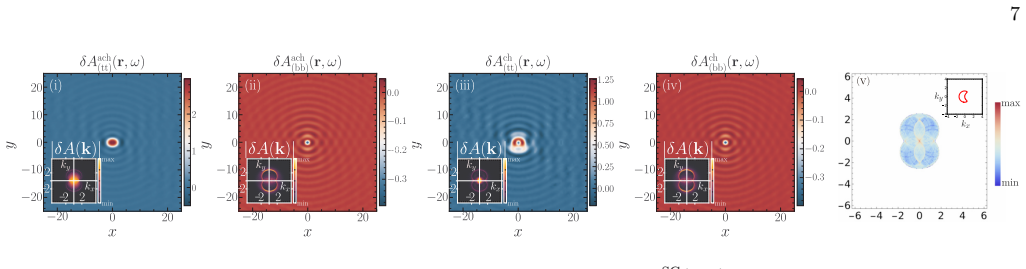
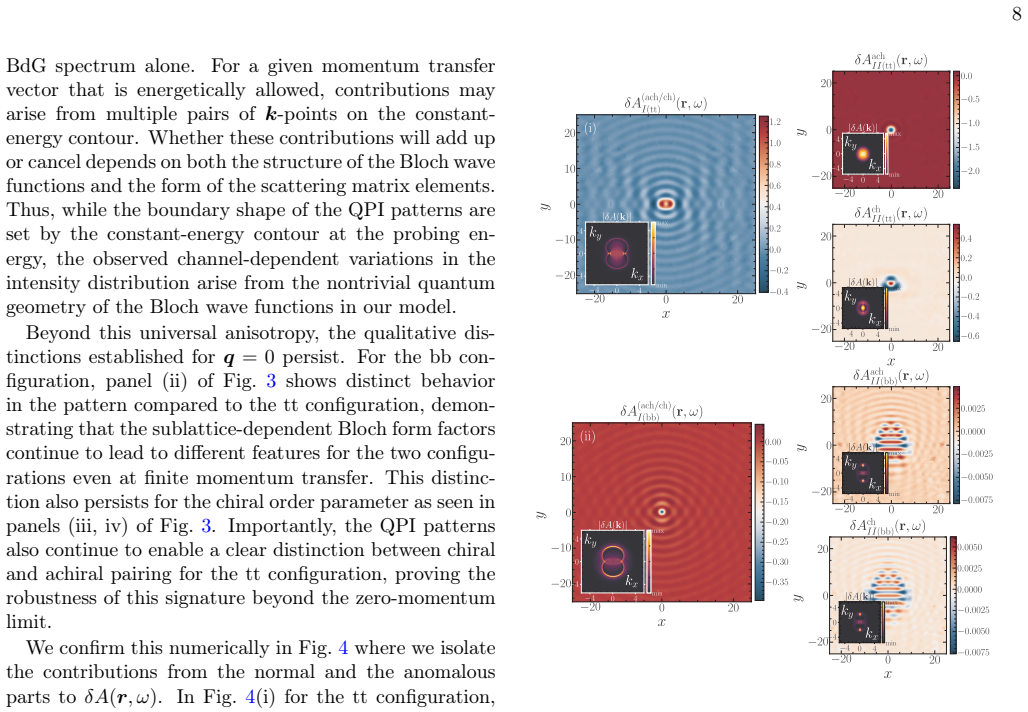
- Finite center-of-mass momentum pairings generate interference patterns distinct from those of zero-momentum pairings.
- QPI measurements therefore provide a real-space probe of pairing symmetry in chiral-band materials.
- Experimental analysis of impurity-induced patterns must incorporate the interplay between band geometry and gap phase.
Where Pith is reading between the lines
- The same QPI approach could be tested in other platforms where normal-state bands carry nontrivial quantum geometry.
- Site-resolved spectroscopy on different sublattices would directly test the predicted normal-state asymmetry.
- Signatures of finite-momentum pairing may help identify candidate Fulde-Ferrell-Larkin-Ovchinnikov states in multilayer van-der-Waals superconductors.
Load-bearing premise
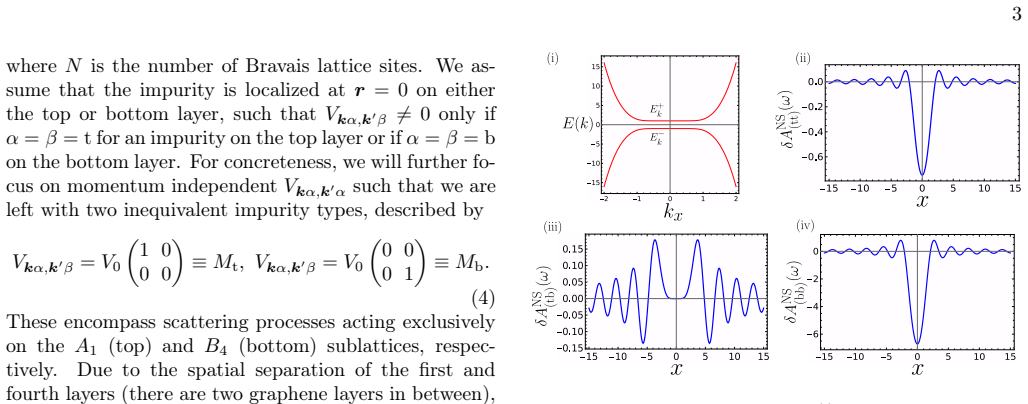
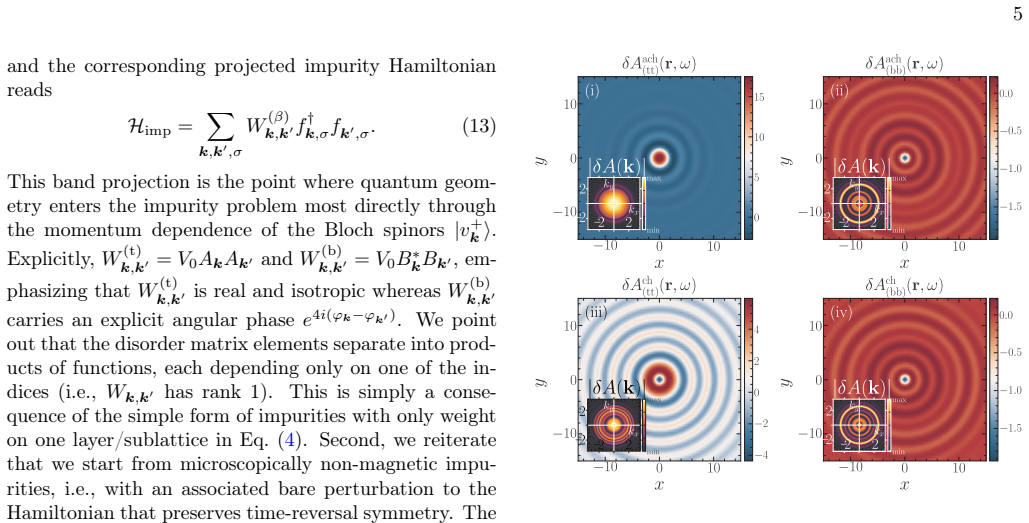
The non-trivial quantum geometry of the Bloch states crucially affects the interference pattern even in the normal state, inducing significant sublattice dependence.
What would settle it
If measured normal-state QPI patterns show no detectable sublattice asymmetry, or if calculated superconducting patterns fail to separate zero-momentum from finite-momentum pairings, the proposed diagnostic would not hold.
Figures
read the original abstract
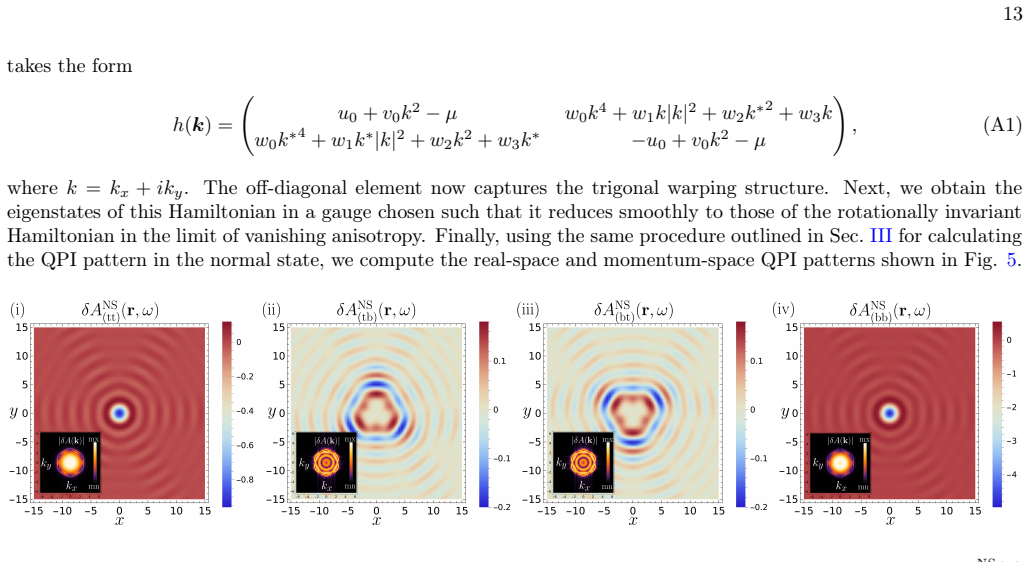
Recent experiments in van der Waals multi-layer systems have demonstrated that superconductivity can emerge from symmetry-reduced, chiral normal states. We here provide a theory for quasiparticle interference (QPI) of superconductors with chiral Bloch bands. Our analysis reveals how the non-trivial quantum geometry of the Bloch states crucially affects the interference pattern even in the normal state, inducing significant sublattice dependence. In the superconducting state, the behavior becomes more complex due to the interplay of the quantum geometry of the Bogoliubov quasiparticles with the momentum-dependent phase of the order parameter. We reveal how the spatial dependence of the local spectral function around impurities can be used to distinguish between different candidate pairing states, both with zero and finite center-of-mass momentum. Our work thus provides guidance to interpreting QPI patterns in materials with chiral bands, which may be useful when probing the rich physics of pairing in such systems.
Editorial analysis
A structured set of objections, weighed in public.
Referee Report
Summary. The manuscript develops a theoretical framework for quasiparticle interference (QPI) in superconductors emerging from chiral Bloch bands in van der Waals multilayers. It argues that the quantum geometry of the normal-state Bloch states produces sublattice-dependent interference even without superconductivity, while in the paired state the geometry of Bogoliubov quasiparticles combines with the momentum-dependent phase of the order parameter to generate distinct spatial patterns in the local spectral function around impurities. These patterns are proposed to distinguish candidate pairing states with both zero and finite center-of-mass momentum.
Significance. If the central derivations hold, the work supplies a concrete diagnostic for pairing symmetry in a class of materials where conventional probes are limited. The explicit inclusion of quantum-geometry effects in both normal and superconducting states, together with the treatment of finite-momentum pairing, addresses a timely experimental need and could guide interpretation of STM data on chiral-band superconductors.
minor comments (2)
- The abstract states qualitative conclusions; the main text should supply at least one explicit model Hamiltonian (with band parameters) and the corresponding expression for the impurity-induced local spectral function to make the claimed distinction between pairing states reproducible.
- Figure captions and axis labels should explicitly indicate whether the plotted quantities are for the normal or superconducting state and whether the impurity potential is on-site or sublattice-selective.
Simulated Author's Rebuttal
We thank the referee for their positive assessment of our manuscript, including the recognition of its timely relevance to QPI diagnostics in chiral-band superconductors, and for recommending minor revision.
Circularity Check
No significant circularity detected
full rationale
The paper presents a theoretical framework analyzing how quantum geometry of chiral Bloch states affects QPI patterns in the normal and superconducting states, with the central claim that spatial dependence of the local spectral function around impurities can distinguish pairing symmetries (zero or finite momentum). No load-bearing steps reduce by construction to inputs: there are no self-definitional relations, no fitted parameters presented as predictions, no uniqueness theorems imported from self-citations, and no ansatzes smuggled via prior work. The derivation chain is self-contained, relying on standard quantum-geometric and Bogoliubov-de Gennes formalism applied to the problem, consistent with the low circularity assessment in the provided reader context.
Axiom & Free-Parameter Ledger
Reference graph
Works this paper leans on
-
[1]
Scanning tunneling mi- croscopy,
G. Binnig and H. Rohrer, “Scanning tunneling mi- croscopy,” Surf. Sci.126, 236 (1983)
1983
-
[2]
Scanning tunneling microscopy—from birth to adolescence,
G. Binnig and H. Rohrer, “Scanning tunneling microscopy—from birth to adolescence,” Rev. Mod. Phys.59, 615 (1987)
1987
-
[3]
Probing topological quantum matter with scanning tunnelling microscopy,
J.-X. Yin, S. H. Pan, and M. Zahid Hasan, “Probing topological quantum matter with scanning tunnelling microscopy,” Nat. Rev. Phys.3, 249 (2021)
2021
-
[4]
Imag- ing standing waves in a two-dimensional electron gas,
M. F. Crommie, C. P. Lutz, and D. M. Eigler, “Imag- ing standing waves in a two-dimensional electron gas,” Nature363, 524 (1993)
1993
-
[5]
Influ- ence of gap extrema on the tunneling conductance near an impurity in an anisotropic superconductor,
J. M. Byers, M. E. Flatté, and D. J. Scalapino, “Influ- ence of gap extrema on the tunneling conductance near an impurity in an anisotropic superconductor,” Phys. Rev. Lett.71, 3363 (1993)
1993
-
[6]
Imaging Quasi- particle Interference in Bi2Sr2CaCu2O8+δ,
J. E. Hoffman, K. McElroy, D.-H. Lee, K. M. Lang, H. Eisaki, S. Uchida, and J. C. Davis, “Imaging Quasi- particle Interference in Bi2Sr2CaCu2O8+δ,” Science 297, 1148 (2002)
2002
-
[7]
Relating atomic-scale electronic phenom- ena to wave-like quasiparticle states in superconducting Bi2Sr2CaCu2O8+δ,
K. McElroy, R. W. Simmonds, J. E. Hoffman, D.- H. Lee, J. Orenstein, H. Eisaki, S. Uchida, and J. C. Davis, “Relating atomic-scale electronic phenom- ena to wave-like quasiparticle states in superconducting Bi2Sr2CaCu2O8+δ,” Nature422, 592 (2003)
2003
-
[8]
Quasiparticle interference studies of quantum materials,
N. Avraham, J. Reiner, A. Kumar-Nayak, N. Morali, R. Batabyal, B. Yan, and H. Beidenkopf, “Quasiparticle interference studies of quantum materials,” Advanced Materials30, 1707628 (2018)
2018
-
[9]
Quasiparticle scattering in- terference in high-temperature superconductors,
Q.-H. Wang and D.-H. Lee, “Quasiparticle scattering in- terference in high-temperature superconductors,” Phys. Rev. B67, 020511 (2003)
2003
-
[10]
Probing the unconven- tional superconducting state of lifeas by quasiparticle interference,
T. Hänke, S. Sykora, R. Schlegel, D. Baumann, L. Harnagea, S. Wurmehl, M. Daghofer, B. Büchner, J. van den Brink, and C. Hess, “Probing the unconven- tional superconducting state of lifeas by quasiparticle interference,” Phys. Rev. Lett.108, 127001 (2012)
2012
-
[11]
Impurity- induced states in conventional and unconventional su- perconductors,
A. V. Balatsky, I. Vekhter, and J.-X. Zhu, “Impurity- induced states in conventional and unconventional su- perconductors,” Rev. Mod. Phys.78, 373 (2006)
2006
-
[12]
Anisotropic Energy Gaps of Iron-Based Superconductivity from Intraband Quasiparticle Inter- ference in LiFeAs,
M. P. Allan, A. W. Rost, A. P. Mackenzie, Y. Xie, J. C. Davis, K. Kihou, C. H. Lee, A. Iyo, H. Eisaki, and T.- M. Chuang, “Anisotropic Energy Gaps of Iron-Based Superconductivity from Intraband Quasiparticle Inter- ference in LiFeAs,” Science336, 563 (2012)
2012
-
[13]
ImagingCooperpairingofheavyfermionsinCeCoIn5,
M. P. Allan, F. Massee, D. K. Morr, J. Van Dyke, A. W. Rost, A. P. Mackenzie, C. Petrovic, and J. C. Davis, “ImagingCooperpairingofheavyfermionsinCeCoIn5,” Nature Phys9, 468 (2013)
2013
-
[14]
Dis- covery of orbital-selective Cooper pairing in FeSe,
P. O. Sprau, A. Kostin, A. Kreisel, A. E. Böh- mer, V. Taufour, P. C. Canfield, S. Mukherjee, P. J. Hirschfeld, B. M. Andersen, and J. C. S. Davis, “Dis- covery of orbital-selective Cooper pairing in FeSe,” Sci- ence357, 75 (2017)
2017
-
[15]
Highly anisotropic supercon- ducting gap near the nematic quantum critical point of fese1−xsx,
P. K. Nag, K. Scott, V. S. de Carvalho, J. K. By- land, X. Yang, M. Walker, A. G. Greenberg, P. Klavins, E. Miranda, A. Gozar, V. Taufour, R. M. Fernandes, and E. H. da Silva Neto, “Highly anisotropic supercon- ducting gap near the nematic quantum critical point of fese1−xsx,” Nature Physics21, 89 (2025)
2025
-
[16]
Odd-parity quasiparticle interfer- ence in the superconductive surface state of ute2,
S. Wang, K. Zhussupbekov, J. P. Carroll, B. Hu, X. Liu, E. Pangburn, A. Crepieux, C. Pepin, C. Broyles, S. Ran, N. P. Butch, S. Saha, J. Paglione, C. Bena, J. C. S. Davis, and Q. Gu, “Odd-parity quasiparticle interfer- ence in the superconductive surface state of ute2,” Na- ture Physics21, 1555–1562 (2025)
2025
-
[17]
Nonreciprocal impurity scattering as a probe for pairing symmetries in kagome superconductors
H.-M. Jiang, H. Du, and S.-L. Yu, “Nonreciprocal impurity scattering as a probe for pairing symmetries in kagome superconductors,” (2026), arXiv:2605.16943 [cond-mat.supr-con]
work page internal anchor Pith review Pith/arXiv arXiv 2026
-
[18]
Proximity- driven ferromagnetism and superconductivity in the tri- angular rashba-hubbard model,
M. Biderang, M.-H. Zare, and J. Sirker, “Proximity- driven ferromagnetism and superconductivity in the tri- angular rashba-hubbard model,” Phys. Rev. B105, 064504 (2022)
2022
-
[19]
Robust determination of the superconducting gap sign structure via quasiparticle interference,
P.J.Hirschfeld, D.Altenfeld, I.Eremin, andI.I.Mazin, 10 “Robust determination of the superconducting gap sign structure via quasiparticle interference,” Phys. Rev. B 92, 184513 (2015)
2015
-
[20]
Full t-matrix approach to quasiparticle interference in non-centrosymmetric su- perconductors,
A. Akbari and P. Thalmeier, “Full t-matrix approach to quasiparticle interference in non-centrosymmetric su- perconductors,” The European Physical Journal B86, 495 (2013)
2013
-
[21]
Microscopic fingerprint of chiral supercon- ductivity,
X. Wu, X. Hao, Z. Chen, Y. Cai, M. Wu, C. Chen, K. Wang, F. Ming, S. Johnston, R.-X. Zhang, and H. H. Weitering, “Microscopic fingerprint of chiral supercon- ductivity,” Phys. Rev. X16, 011026 (2026)
2026
-
[22]
Quasiparticle interference of spin-triplet su- perconductors: Application toute 2,
H. Christiansen, B. M. Andersen, P. J. Hirschfeld, and A. Kreisel, “Quasiparticle interference of spin-triplet su- perconductors: Application toute 2,” Phys. Rev. Lett. 135, 216001 (2025)
2025
-
[23]
Quasiparticle interference in LiFeAs: Signature of inelastic tunneling through spin fluctuations
S. Chi, C. A. Marques, W. N. Hardy, R. Liang, P. Dosanjh, D. A. Bonn, S. A. Burke, and P. Wahl, “Quasiparticle interference in lifeas: Signature of in- elastic tunneling through spin fluctuations,” (2025), arXiv:2508.11755 [cond-mat.supr-con]
work page internal anchor Pith review Pith/arXiv arXiv 2025
-
[24]
Quasiparticle Inter- ference, Quasiparticle Interactions, and the Origin of the Charge Density Wave in $2H\text{\ensuremath{- }}{\mathrm{NbSe}}_{2}$,
C. J. Arguello, E. P. Rosenthal, E. F. Andrade, W. Jin, P. C. Yeh, N. Zaki, S. Jia, R. J. Cava, R. M. Fernandes, A. J. Millis, T. Valla, R. M. Os- good, and A. N. Pasupathy, “Quasiparticle Inter- ference, Quasiparticle Interactions, and the Origin of the Charge Density Wave in $2H\text{\ensuremath{- }}{\mathrm{NbSe}}_{2}$,” Phys. Rev. Lett.114, 037001 (2015)
2015
-
[25]
Low-energy electronic structure in the unconventional charge-ordered state of ScV6Sn6,
A. K. Kundu, X. Huang, E. Seewald, E. Ritz, S. Pakhira, S. Zhang, D. Sun, S. Turkel, S. Shabani, T. Yilmaz, E. Vescovo, C. R. Dean, D. C. Johnston, T. Valla, T. Birol, D. N. Basov, R. M. Fernandes, and A. N. Pasupathy, “Low-energy electronic structure in the unconventional charge-ordered state of ScV6Sn6,” Nat Commun15, 5008 (2024)
2024
-
[26]
Crystal-symmetry-paired spin–valley locking in a lay- ered room-temperature metallic altermagnet candi- date,
F. Zhang, X. Cheng, Z. Yin, C. Liu, L. Deng, Y. Qiao, Z. Shi, S. Zhang, J. Lin, Z. Liu, M. Ye, Y. Huang, X. Meng, C. Zhang, T. Okuda, K. Shimada, S. Cui, Y. Zhao, G.-H. Cao, S. Qiao, J. Liu, and C. Chen, “Crystal-symmetry-paired spin–valley locking in a lay- ered room-temperature metallic altermagnet candi- date,” Nat. Phys.21, 760 (2025)
2025
-
[27]
Local signatures of alter- magnetism,
J. Gondolf, A. Kreisel, M. Roig, Y. Yu, D. F. Agter- berg, and B. M. Andersen, “Local signatures of alter- magnetism,” Phys. Rev. B111, 174436 (2025)
2025
-
[28]
Quasiparticle in- terference in altermagnets,
H.-R. Hu, X. Wan, and W. Chen, “Quasiparticle in- terference in altermagnets,” Phys. Rev. B111, 035132 (2025)
2025
-
[29]
Impurity-induced friedel oscillations in altermagnets andp-wave magnets,
P. Sukhachov and J. Linder, “Impurity-induced friedel oscillations in altermagnets andp-wave magnets,” Phys. Rev. B110, 205114 (2024)
2024
-
[30]
E. Petermann, K. Mæland, and B. Trauzettel, “Spin- resolved quasiparticle interference patterns on alter- magnets via non-spin-resolved scanning tunneling mi- croscopy,” Physical Review B112(2025), 10.1103/sg3g- crcz
-
[31]
Quasiparticle chirality in epitaxial graphene probed at the nanometer scale,
I. Brihuega, P. Mallet, C. Bena, S. Bose, C. Michaelis, L. Vitali, F. Varchon, L. Magaud, K. Kern, and J. Y. Veuillen, “Quasiparticle chirality in epitaxial graphene probed at the nanometer scale,” Phys. Rev. Lett.101, 206802 (2008)
2008
-
[32]
Topological surface states protected from backscattering by chiral spin texture,
P. Roushan, J. Seo, C. V. Parker, Y. S. Hor, D. Hsieh, D. Qian, A. Richardella, M. Z. Hasan, R. J. Cava, and A. Yazdani, “Topological surface states protected from backscattering by chiral spin texture,” Nature460, 1106 (2009)
2009
-
[33]
Measuring the berry phase of graphene from wavefront dislocations in friedel oscillations,
C.Dutreix, H.González-Herrero, I.Brihuega, M.I.Kat- snelson, C. Chapelier, and V. T. Renard, “Measuring the berry phase of graphene from wavefront dislocations in friedel oscillations,” Nature574, 219 (2019)
2019
-
[34]
Superconductivity in monolayer and few- layer graphene. iii. impurity-induced subgap states and quasiparticle interference patterns,
E. Pangburn, L. Haurie, A. Crépieux, O. A. Awoga, N. Sedlmayr, A. M. Black-Schaffer, C. Pépin, and C. Bena, “Superconductivity in monolayer and few- layer graphene. iii. impurity-induced subgap states and quasiparticle interference patterns,” Phys. Rev. B108, 134516 (2023)
2023
-
[35]
Effects of Electron Form Factor on Quasiparticle Interference in Twisted Bilayer Graphene
D. H. M. Nguyen, F. Guinea, and D. Bercioux, “Glimpsing at electron’s form factor through quasipar- ticle interference in twisted bilayer graphene,” (2025), arXiv:2509.11223 [cond-mat.mes-hall]
work page internal anchor Pith review Pith/arXiv arXiv 2025
-
[36]
Quasiparticle interfer- ence in unconventional 2d systems,
L. Chen, P. Cheng, and K. Wu, “Quasiparticle interfer- ence in unconventional 2d systems,” Journal of Physics: Condensed Matter29, 103001 (2017)
2017
-
[37]
Drumhead surface states and their signatures in quasiparticle scattering interfer- ence,
M. Biderang, A. Leonhardt, N. Raghuvanshi, A. P. Schnyder, and A. Akbari, “Drumhead surface states and their signatures in quasiparticle scattering interfer- ence,” Phys. Rev. B98, 075115 (2018)
2018
-
[38]
Visualizing weakly bound surface Fermi arcs and their correspondence to bulk Weyl fermions,
R. Batabyal, N. Morali, N. Avraham, Y. Sun, M. Schmidt, C. Felser, A. Stern, B. Yan, and H. Bei- denkopf, “Visualizing weakly bound surface Fermi arcs and their correspondence to bulk Weyl fermions,” Sci- ence Advances2, e1600709 (2016)
2016
-
[39]
Quasiparticle interference of the Fermi arcs and surface-bulk connec- tivity of a Weyl semimetal,
H. Inoue, A. Gyenis, Z. Wang, J. Li, S. W. Oh, S. Jiang, N. Ni, B. A. Bernevig, and A. Yazdani, “Quasiparticle interference of the Fermi arcs and surface-bulk connec- tivity of a Weyl semimetal,” Science351, 1184 (2016)
2016
-
[40]
Quasiparticle interference ontype-i andtype-iiweylsemimetalsurfaces: areview,
H. Zheng and M. Z. Hasan, “Quasiparticle interference ontype-i andtype-iiweylsemimetalsurfaces: areview,” Advances in Physics: X3, 1466661 (2018)
2018
-
[41]
Quasiparticle interference evidence of the topologi- cal fermi arc states in chiral fermionic semimetal cosi,
Q.-Q. Yuan, L. Zhou, Z.-C. Rao, S. Tian, W.-M. Zhao, C.-L. Xue, Y. Liu, T. Zhang, C.-Y. Tang, Z.-Q. Shi, Z.- Y. Jia, H. Weng, H. Ding, Y.-J. Sun, H. Lei, and S.-C. Li, “Quasiparticle interference evidence of the topologi- cal fermi arc states in chiral fermionic semimetal cosi,” Science Advances5, eaaw9485 (2019)
2019
-
[42]
Wave-vector power spectrum of the local tunneling density of states: Ripples in a d-wave sea,
L. Capriotti, D. J. Scalapino, and R. D. Sedgewick, “Wave-vector power spectrum of the local tunneling density of states: Ripples in a d-wave sea,” Phys. Rev. B68, 014508 (2003)
2003
-
[43]
Theory of quasiparti- cle interference patterns in the pseudogap phase of the cuprate superconductors,
T. Pereg-Barnea and M. Franz, “Theory of quasiparti- cle interference patterns in the pseudogap phase of the cuprate superconductors,” Phys. Rev. B68, 180506(R) (2003)
2003
-
[44]
Energy-dependent modula- tions in the local density of states of the cuprate super- conductors,
D. Zhang and C. S. Ting, “Energy-dependent modula- tions in the local density of states of the cuprate super- conductors,” Phys. Rev. B67, 100506(R) (2003)
2003
-
[45]
Quantum interfer- ence between multiple impurities in anisotropic super- conductors,
B. M. Andersen and P. Hedegård, “Quantum interfer- ence between multiple impurities in anisotropic super- conductors,” Phys. Rev. B67, 172505 (2003)
2003
-
[46]
Fourier transform spectroscopy ofd-wave quasiparticles in the presence of atomic scale 11 pairing disorder,
T. S. Nunner, W. Chen, B. M. Andersen, A. Melikyan, and P. J. Hirschfeld, “Fourier transform spectroscopy ofd-wave quasiparticles in the presence of atomic scale 11 pairing disorder,” Phys. Rev. B73, 104511 (2006)
2006
-
[47]
Quasiparticle interference and the interplay be- tween superconductivity and density wave order in the cuprates,
E. A. Nowadnick, B. Moritz, and T. P. Dev- ereaux, “Quasiparticle interference and the interplay be- tween superconductivity and density wave order in the cuprates,” Phys. Rev. B86, 134509 (2012)
2012
-
[48]
Power spectrum of many impurities in a d-wave superconduc- tor,
L. Zhu, W. A. Atkinson, and P. J. Hirschfeld, “Power spectrum of many impurities in a d-wave superconduc- tor,” Phys. Rev. B69, 060503(R) (2004)
2004
-
[49]
Interpretation of scanning tunneling quasiparticle interference and impurity states in cuprates,
A. Kreisel, P. Choubey, T. Berlijn, W. Ku, B. M. An- dersen, and P. J. Hirschfeld, “Interpretation of scanning tunneling quasiparticle interference and impurity states in cuprates,” Phys. Rev. Lett.114, 217002 (2015)
2015
-
[50]
Quantum Geometry in Quantum Materials,
J. Yu, B. A. Bernevig, R. Queiroz, E. Rossi, P. Törmä, and B.-J. Yang, “Quantum Geometry in Quantum Materials,” arXiv e-prints , arXiv:2501.00098 (2024), arXiv:2501.00098 [cond-mat.mes-hall]
-
[51]
Trigonal warping and berry’s phasenπin abc-stacked multilayer graphene,
M. Koshino and E. McCann, “Trigonal warping and berry’s phasenπin abc-stacked multilayer graphene,” Phys. Rev. B80, 165409 (2009)
2009
-
[52]
Interlayer screening effect in graphene multilayers with aba and abc stacking,
M. Koshino, “Interlayer screening effect in graphene multilayers with aba and abc stacking,” Physical Re- view B—Condensed Matter and Materials Physics81, 125304 (2010)
2010
-
[53]
Band structure ofabc-stacked graphene trilayers,
F. Zhang, B. Sahu, H. Min, and A. H. MacDon- ald, “Band structure ofabc-stacked graphene trilayers,” Phys. Rev. B82, 035409 (2010)
2010
-
[54]
Pseudospin magnetism in graphene,
H. Min, G. Borghi, M. Polini, and A. H. MacDon- ald, “Pseudospin magnetism in graphene,” Physical Re- view B—Condensed Matter and Materials Physics77, 041407 (2008)
2008
-
[55]
Parity and valley de- generacy in multilayer graphene,
M. Koshino and E. McCann, “Parity and valley de- generacy in multilayer graphene,” Physical Review B—Condensed Matter and Materials Physics81, 115315 (2010)
2010
-
[56]
Ex- change interaction, disorder, and stacking faults in rhombohedral graphene multilayers,
J. H. Muten, A. J. Copeland, and E. McCann, “Ex- change interaction, disorder, and stacking faults in rhombohedral graphene multilayers,” Physical Review B104, 035404 (2021)
2021
-
[57]
Quantum geometric kohn- luttinger superconductivity,
G. Shavit and J. Alicea, “Quantum geometric kohn- luttinger superconductivity,” Phys. Rev. Lett.134, 176001 (2025)
2025
-
[58]
Enhanced kohn-luttinger topo- logicalsuperconductivityinbandswithnontrivialgeom- etry,
A. Jahin and S.-Z. Lin, “Enhanced kohn-luttinger topo- logicalsuperconductivityinbandswithnontrivialgeom- etry,” (2025), arXiv:2411.09664 [cond-mat.supr-con]
-
[59]
B. A. Bernevig and Y. H. Kwan, ““Berry Trash- can” Model of Interacting Electrons in Rhombohedral Graphene,” arXiv e-prints (2025), arXiv:2503.09692 [cond-mat.str-el]
-
[60]
High-harmonic generation in systems with chiral Bloch states: application to rhombohedral graphene
J. O. de Almeida, W. J. M. Kort-Kamp, and M. S. Scheurer, “High-harmonic generation in systems with chiral bloch states: application to rhombohedral graphene,” (2026), arXiv:2604.11984 [cond-mat.mes- hall]
work page internal anchor Pith review Pith/arXiv arXiv 2026
-
[61]
Superconductivity in rhombohedral tri- layer graphene,
H. Zhou, T. Xie, T. Taniguchi, K. Watanabe, and A. F. Young, “Superconductivity in rhombohedral tri- layer graphene,” Nature598, 434 (2021)
2021
-
[62]
Half- and quarter-metals in rhombohedral trilayer graphene,
H. Zhou, T. Xie, A. Ghazaryan, T. Holder, J. R. Ehrets, E. M. Spanton, T. Taniguchi, K. Watanabe, E. Berg, M. Serbyn, and A. F. Young, “Half- and quarter-metals in rhombohedral trilayer graphene,” Nature598, 429 (2021)
2021
-
[63]
Superconductivity and correlated phases in non-twisted bilayer and trilayer graphene,
P. A. Pantaleón, A. Jimeno-Pozo, H. Sainz-Cruz, V. Phong, T. Cea, and F. Guinea, “Superconductivity and correlated phases in non-twisted bilayer and trilayer graphene,” Nature Reviews Physics5, 304 (2023)
2023
-
[64]
Acoustic-phonon-mediated superconductivity in rhom- bohedral trilayer graphene,
Y.-Z. Chou, F. Wu, J. D. Sau, and S. Das Sarma, “Acoustic-phonon-mediated superconductivity in rhom- bohedral trilayer graphene,” Phys. Rev. Lett.127, 187001 (2021)
2021
-
[65]
Unconventional superconductivity in systems with an- nular fermi surfaces: Application to rhombohedral tri- layer graphene,
A. Ghazaryan, T. Holder, M. Serbyn, and E. Berg, “Unconventional superconductivity in systems with an- nular fermi surfaces: Application to rhombohedral tri- layer graphene,” Phys. Rev. Lett.127, 247001 (2021)
2021
-
[66]
Kohn-luttinger super- conductivity and intervalley coherence in rhombohedral trilayer graphene,
Y.-Z. You and A. Vishwanath, “Kohn-luttinger super- conductivity and intervalley coherence in rhombohedral trilayer graphene,” Phys. Rev. B105, 134524 (2022)
2022
-
[67]
Metals, fractional metals, and superconductivity in rhombohedral trilayer graphene,
A. L. Szabó and B. Roy, “Metals, fractional metals, and superconductivity in rhombohedral trilayer graphene,” Phys. Rev. B105, L081407 (2022)
2022
-
[68]
Inter-valley coherent order and isospin fluctuation mediated superconductivity in rhombohedral trilayer graphene,
S. Chatterjee, T. Wang, E. Berg, and M. P. Zale- tel, “Inter-valley coherent order and isospin fluctuation mediated superconductivity in rhombohedral trilayer graphene,” Nature Communications13, 6013 (2022)
2022
-
[69]
Multilayer graphenes as a platform for interaction- driven physics and topological superconductivity,
A. Ghazaryan, T. Holder, E. Berg, and M. Serbyn, “Multilayer graphenes as a platform for interaction- driven physics and topological superconductivity,” Phys. Rev. B107, 104502 (2023)
2023
-
[70]
Superconductivity from elec- tronic interactions and spin-orbit enhancement in bi- layerandtrilayergraphene,
A. Jimeno-Pozo, H. Sainz-Cruz, T. Cea, P. A. Pan- taleón, and F. Guinea, “Superconductivity from elec- tronic interactions and spin-orbit enhancement in bi- layerandtrilayergraphene,” Phys.Rev.B107,L161106 (2023)
2023
-
[71]
Functional renormalization group study of superconductivity in rhombohedral trilayer graphene,
W.Qin, C.Huang, T.Wolf, N.Wei, I.Blinov, andA.H. MacDonald, “Functional renormalization group study of superconductivity in rhombohedral trilayer graphene,” Phys. Rev. Lett.130, 146001 (2023)
2023
-
[72]
Charge fluctu- ations, phonons, and superconductivity in multilayer graphene,
Z. Li, X. Kuang, A. Jimeno-Pozo, H. Sainz-Cruz, Z. Zhan, S. Yuan, and F. Guinea, “Charge fluctu- ations, phonons, and superconductivity in multilayer graphene,” Phys. Rev. B108, 045404 (2023)
2023
-
[73]
Supercon- ductivity near spin and valley orders in graphene mul- tilayers,
Z. Dong, L. Levitov, and A. V. Chubukov, “Supercon- ductivity near spin and valley orders in graphene mul- tilayers,” Phys. Rev. B108, 134503 (2023)
2023
-
[74]
Super- conductivity from spin-canting fluctuations in rhombo- hedral graphene,
Z. Dong, É. Lantagne-Hurtubise, and J. Alicea, “Super- conductivity from spin-canting fluctuations in rhombo- hedral graphene,” (2024), arXiv:2406.17036
-
[75]
Signatures of chiral super- conductivity in rhombohedral graphene,
T. Han, Z. Lu, Z. Hadjri, L. Shi, Z. Wu, W. Xu, Y. Yao, A. A. Cotten, O. Sharifi Sedeh, H. Weldeye- sus, J. Yang, J. Seo, S. Ye, M. Zhou, H. Liu, G. Shi, Z. Hua, K. Watanabe, T. Taniguchi, P. Xiong, D. M. Zumbühl, L. Fu, and L. Ju, “Signatures of chiral super- conductivity in rhombohedral graphene,” Nature643, 654 (2025)
2025
-
[76]
Stripe Order in the Metallic and Superconducting Phases of Rhombohedral Hexalayer Graphene
E.Morissette, P.Qin, H.-T.Wu, N.J.Zhang, K.Watan- abe, T. Taniguchi, and J. I. A. Li, “Superconductiv- ity, Anomalous Hall Effect, and Stripe Order in Rhom- bohedral Hexalayer Graphene,” arXiv e-prints (2025), arXiv:2504.05129 [cond-mat.mes-hall]
work page internal anchor Pith review Pith/arXiv arXiv 2025
-
[77]
Intraval- ley spin-polarized superconductivity in rhombohedral tetralayer graphene,
Y.-Z. Chou, J. Zhu, and S. Das Sarma, “Intraval- ley spin-polarized superconductivity in rhombohedral tetralayer graphene,” Phys. Rev. B111, 174523 (2025)
2025
-
[78]
Chiral and 12 topological superconductivity in isospin polarized mul- tilayer graphene,
M. Geier, M. Davydova, and L. Fu, “Chiral and 12 topological superconductivity in isospin polarized mul- tilayer graphene,” Nature Communications17(2026), arXiv:2409.13829 [cond-mat.supr-con]
-
[79]
How pair- ing mechanism dictates topology in valley-polarized superconductors with Berry curvature,
J. May-Mann, T. Helbig, and T. Devakul, “How pair- ing mechanism dictates topology in valley-polarized superconductors with Berry curvature,” (2025), arXiv:2503.05697
-
[80]
Chiral Finite-Momentum Super- conductivity in the Tetralayer Graphene,
Q. Qin and C. Wu, “Chiral Finite-Momentum Super- conductivity in the Tetralayer Graphene,” Chin. Phys. Lett.43, 030708 (2026)
2026
discussion (0)
Sign in with ORCID, Apple, or X to comment. Anyone can read and Pith papers without signing in.