A cryogenic gas target for high-intensity radioactive ion beam production at HIRFL-RIBLL
Pith reviewed 2026-06-30 10:55 UTC · model grok-4.3
The pith
A cryogenic gas target at RIBLL produces 7Be, 16N, and 15O beams with 85-99% purity at intensities up to 1.02 million particles per second.
A machine-rendered reading of the paper's core claim, the machinery that carries it, and where it could break.
Core claim
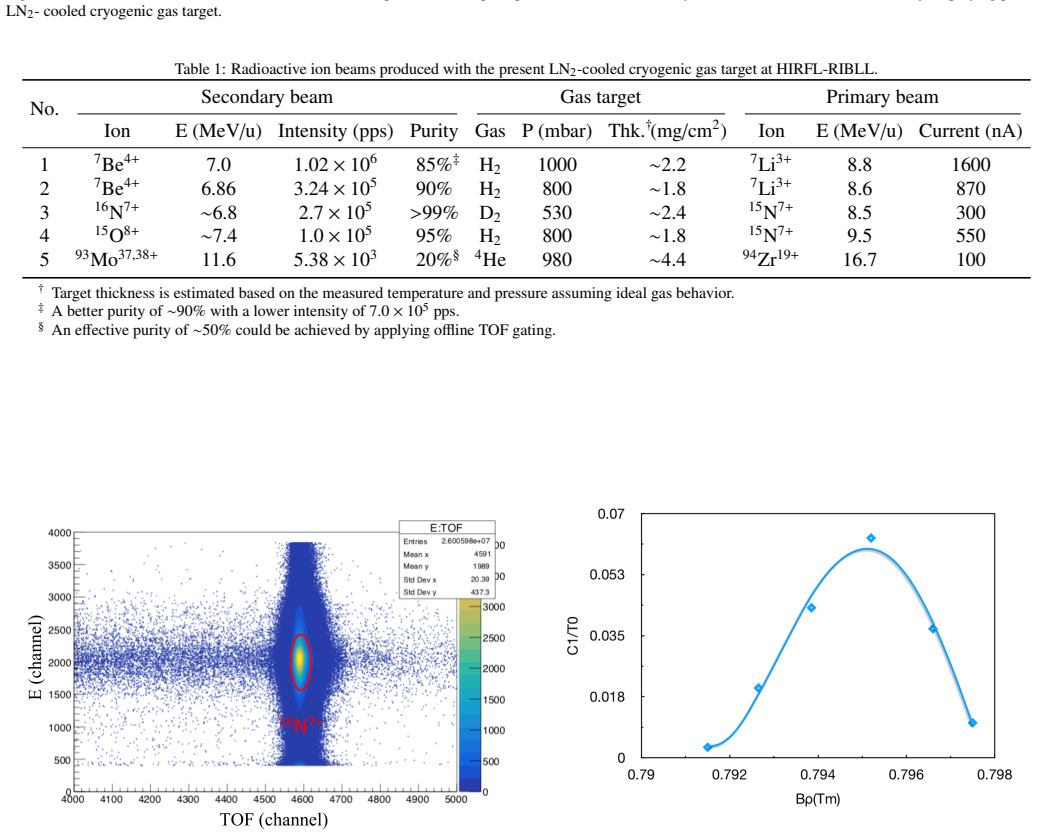
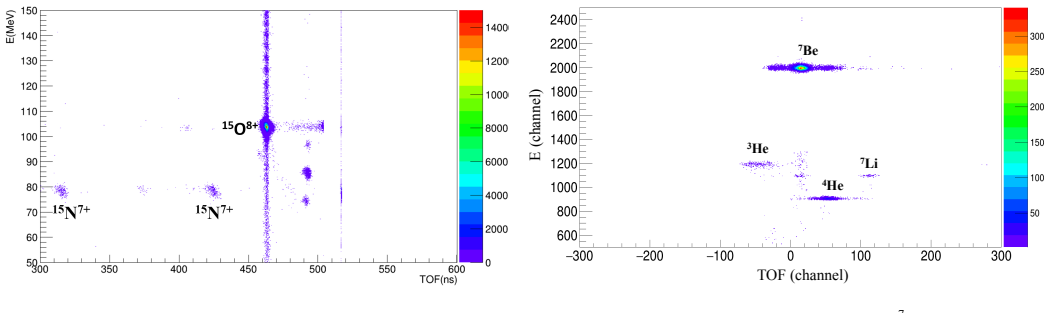
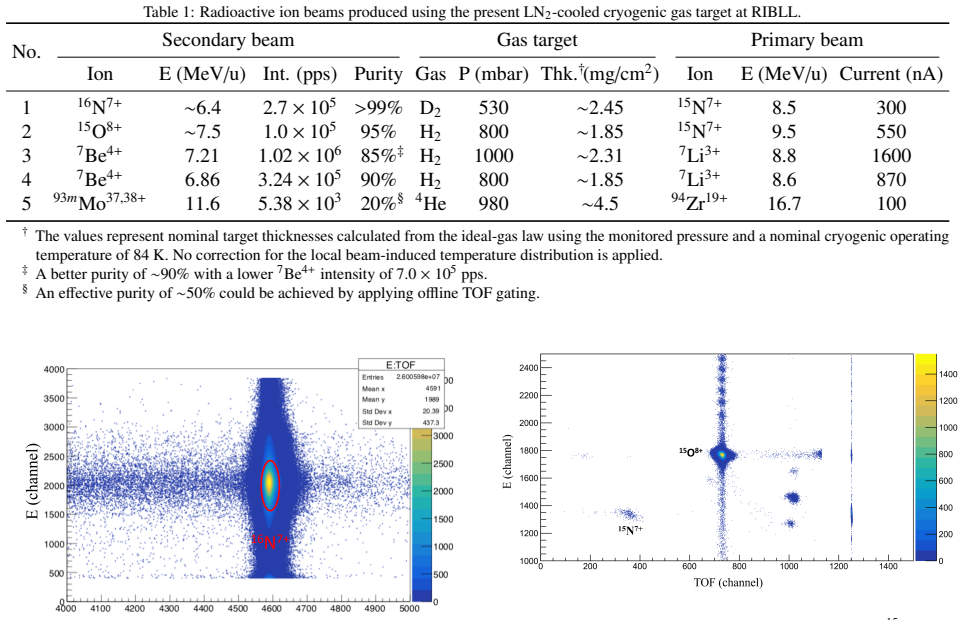
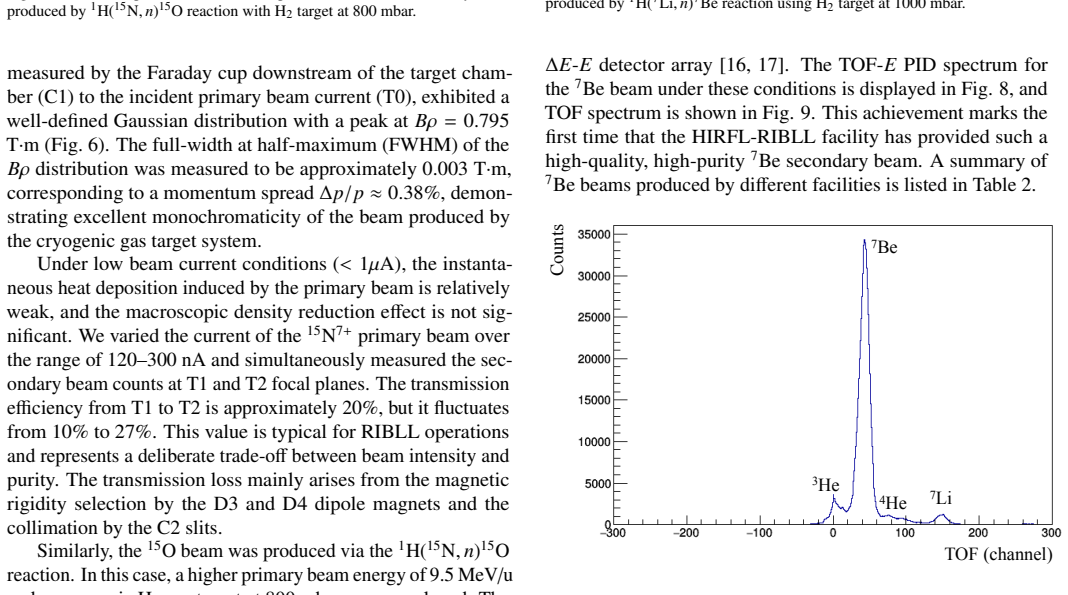
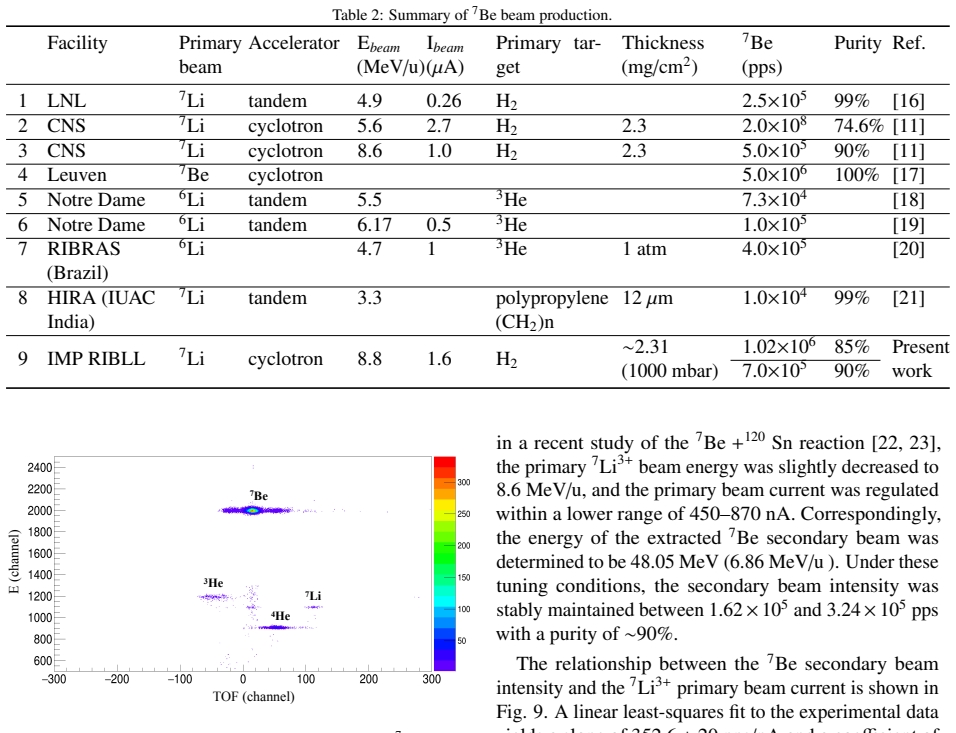
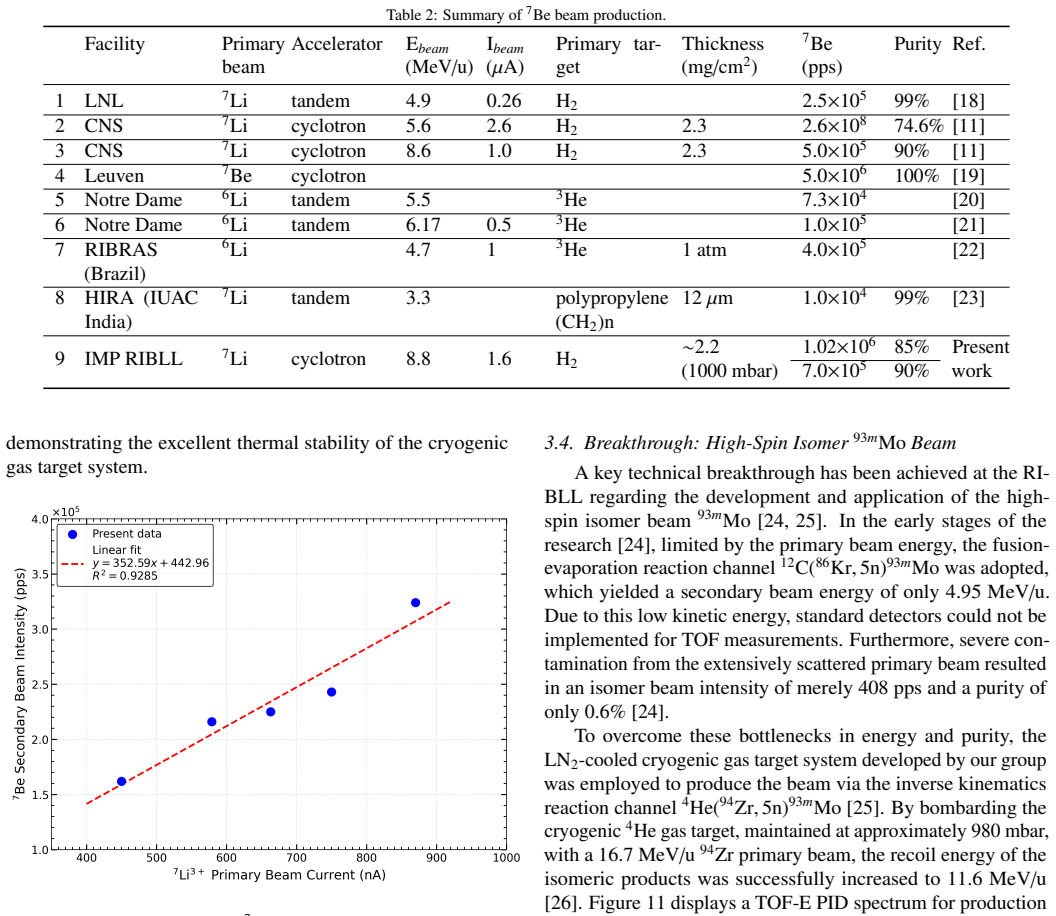
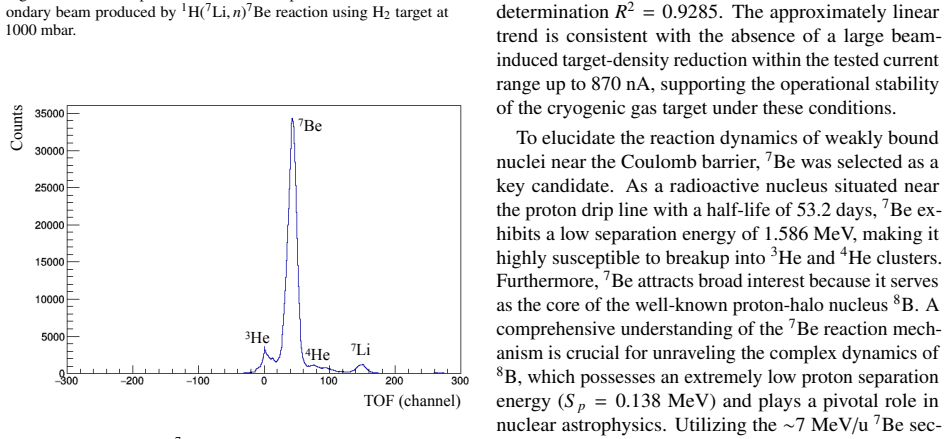
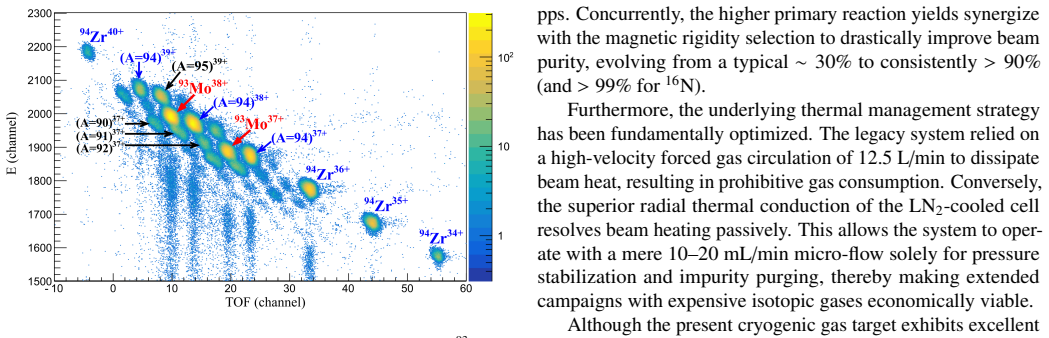
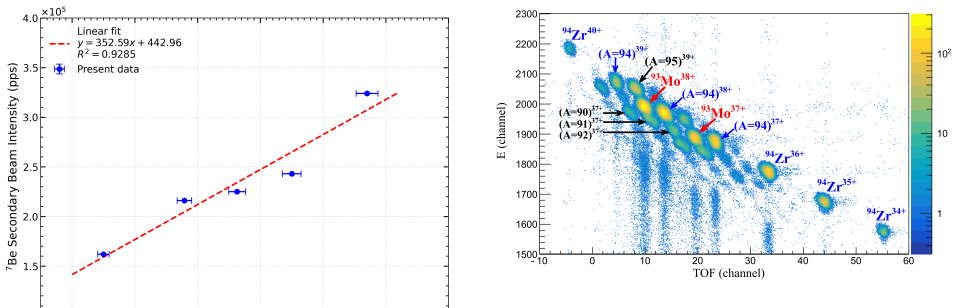
The cryogenic gas target system was used to produce 7Be, 16N, and 15O RIBs via the 1H(7Li,7Be)n, 2H(15N,16N)p, and 1H(15N,15O)n reactions, yielding purities of 85%, 99%, and 95%, with intensities of 1.02×10^6, 2.7×10^5, and 1.0×10^5 pps, respectively. A 93mMo isomer beam was also produced with intensity of 5.38×10^3 pps and purity of 20%. This establishes a robust platform at RIBLL for low- and medium-energy nuclear astrophysics and reaction studies.
What carries the argument
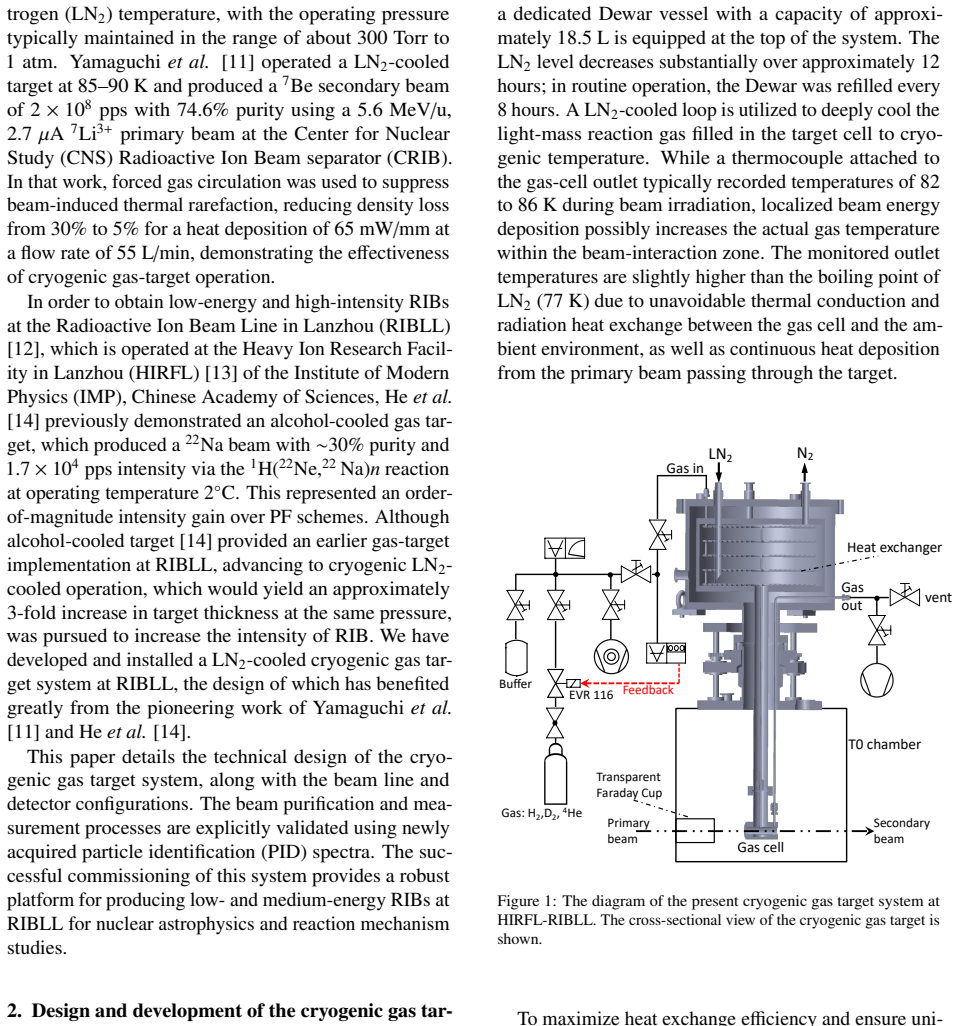
The liquid-nitrogen-cooled cryogenic gas target cell that maintains outlet temperatures of 82-86 K and pressures up to 1000 mbar for inverse kinematics reactions.
Load-bearing premise
The gas cell can maintain the reported temperatures of 82-86 K and pressures up to 1000 mbar stably during continuous beam irradiation without safety issues or beam degradation.
What would settle it
A test run where the outlet temperature rises above 86 K or the beam intensity drops significantly due to target instability under irradiation would challenge the claim of robust performance.
Figures
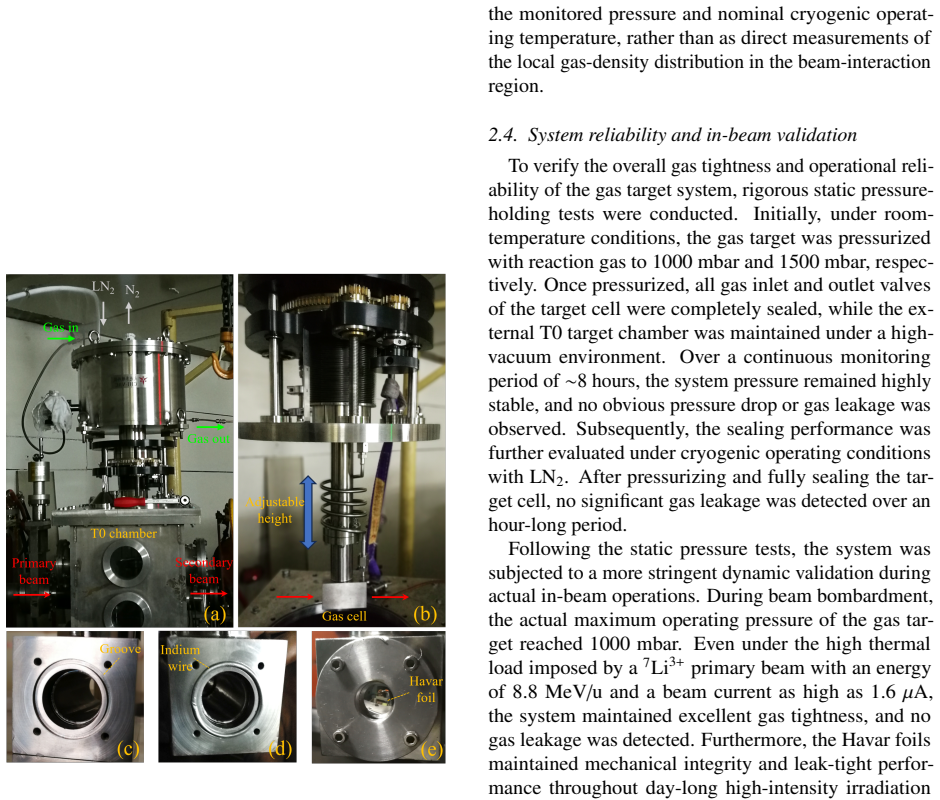
read the original abstract
A liquid-nitrogen-cooled cryogenic gas target system has been developed and installed for radioactive ion beam (RIB) production at the Radioactive Ion Beam Line in Lanzhou (RIBLL). Light-element gases ($\mathrm{H}_2$, $\mathrm{D}_2$, and $^4\mathrm{He}$) filled in the target cell were cooled to cryogenic temperatures, with the gas-cell outlet temperature typically monitored at 82--86 K during beam irradiation and operating pressures up to 1000 mbar. The system was used to produce $^{7}\mathrm{Be}$, $^{16}\mathrm{N}$, and $^{15}\mathrm{O}$ RIBs via the $^{1}\mathrm{H}(^{7}\mathrm{Li}, ^{7}\mathrm{Be})n$, $^{2}\mathrm{H}(^{15}\mathrm{N}, ^{16}\mathrm{N})p$, and $^{1}\mathrm{H}(^{15}\mathrm{N}, ^{15}\mathrm{O})n$ inverse kinematics reactions, yielding purities of 85\%, 99\%, and 95\%, with intensities of $1.02\times10^{6}$, $2.7\times10^{5}$, and $1.0\times10^{5}$ pps, respectively. A $^{93m}\mathrm{Mo}$ isomer beam was also produced via the $\mathrm{^4He(^{94}Zr,} 5n)^{93m}\mathrm{Mo}$ reaction, achieving an intensity of $5.38\times10^{3}$ pps and a purity of 20\% (which can be further improved to $\sim$50\% with offline time-of-flight gating). By delivering a broader range of high-intensity secondary RIBs, this setup establishes a robust platform at RIBLL for low- and medium-energy nuclear astrophysics and reaction studies.
Editorial analysis
A structured set of objections, weighed in public.
Referee Report
Summary. The manuscript describes the design, construction, and installation of a liquid-nitrogen-cooled cryogenic gas target system at the RIBLL facility. It reports operation with H2, D2, and 4He gases at outlet temperatures of 82-86 K and pressures up to 1000 mbar, and presents measured performance in producing 7Be, 16N, 15O, and 93mMo radioactive ion beams via specified inverse-kinematics reactions, including concrete intensities (e.g., 1.02×10^6 pps for 7Be) and purities (e.g., 85% for 7Be).
Significance. If the reported beam properties hold under sustained operation, the work establishes a practical cryogenic target platform at RIBLL that expands access to higher-intensity light-element RIBs for low- and medium-energy nuclear astrophysics and reaction studies. The strength lies in the concrete measured intensities and purities obtained from actual beam runs rather than simulations alone.
major comments (2)
- [Abstract / performance results] Abstract and performance section: The central claim that the system provides a 'robust platform' rests on stable cryogenic operation (82-86 K outlet temperature, up to 1000 mbar) during continuous beam irradiation, yet the text only states that temperatures were 'typically monitored' in this range without time-series data, beam-current dependence, pressure stability measurements, or indication of duration under load. This quantitative verification is load-bearing for the reported RIB intensities and purities.
- [Abstract] Abstract: The reported intensities and purities (e.g., 1.02×10^6 pps at 85% for 7Be) are presented without error bars, statistical uncertainties, or details on how beam properties were measured and normalized, which is required to assess the reliability of the performance claims.
minor comments (1)
- The manuscript would benefit from a dedicated methods subsection detailing the beam diagnostics, target cell geometry, and temperature/pressure monitoring instrumentation.
Simulated Author's Rebuttal
We thank the referee for the constructive comments. We address each major point below and indicate where revisions will be made to the manuscript.
read point-by-point responses
-
Referee: [Abstract / performance results] Abstract and performance section: The central claim that the system provides a 'robust platform' rests on stable cryogenic operation (82-86 K outlet temperature, up to 1000 mbar) during continuous beam irradiation, yet the text only states that temperatures were 'typically monitored' in this range without time-series data, beam-current dependence, pressure stability measurements, or indication of duration under load. This quantitative verification is load-bearing for the reported RIB intensities and purities.
Authors: We acknowledge that the manuscript lacks explicit time-series data, beam-current dependence plots, or pressure stability measurements. The outlet temperature was continuously monitored during all production runs and remained in the 82-86 K range, with each run lasting several hours under beam load. Detailed time-series logs suitable for publication were not recorded. We will revise the performance section to include a clearer description of the monitoring protocol and typical run durations based on experimental notes. revision: partial
-
Referee: [Abstract] Abstract: The reported intensities and purities (e.g., 1.02×10^6 pps at 85% for 7Be) are presented without error bars, statistical uncertainties, or details on how beam properties were measured and normalized, which is required to assess the reliability of the performance claims.
Authors: The reported values are the measured intensities and purities from the specific inverse-kinematics runs described in the performance section, obtained using silicon detectors and time-of-flight identification. We will revise the abstract and results to explicitly reference the measurement methods already detailed in the methods section and add a note on the approximate uncertainties (typically 10-20% from beam current integration). revision: yes
- Detailed time-series data, beam-current dependence, and pressure stability measurements under sustained beam load were not recorded during the experiments and therefore cannot be added.
Circularity Check
No circularity: descriptive hardware report with direct measurements
full rationale
The paper is a technical description of a cryogenic gas target system's construction, installation, and measured performance at RIBLL. It reports observed gas-cell temperatures (82-86 K), operating pressures (up to 1000 mbar), and resulting RIB intensities/purities from listed inverse-kinematics reactions, without any equations, fitted parameters, predictions, or derivation chains. No self-citations, ansatzes, or uniqueness theorems are invoked as load-bearing steps. All claims rest on direct experimental reporting, rendering the work self-contained against external benchmarks with no reduction of outputs to inputs by construction.
Axiom & Free-Parameter Ledger
Reference graph
Works this paper leans on
-
[1]
H. Geissel, C. Scheidenberger, G. Münzenberg, Radioactive beams produced by projectile frag- mentation: Physics and instrumentation, Reports on Progress in Physics 68 (6) (2005) 1221–1288. doi:10.1088/0034-4885/68/6/R02
-
[2]
B. A. Brown, Nuclear structure with ra- dioactive beams, Annual Review of Nu- clear and Particle Science 58 (2008) 1–34. doi:10.1146/annurev.nucl.58.020807.111851
-
[3]
M. B. Tsang, Y . Zhang, P. Danielewicz, M. Fami- ano, Z. Li, W. G. Lynch, A. W. Steiner, Isospin physics with radioactive beams, Progress in Par- ticle and Nuclear Physics 66 (2) (2011) 239–275. doi:10.1016/j.ppnp.2011.01.004
-
[4]
Iliadis, Nuclear Physics of Stars, Wiley-VCH, Weinheim, 2007
C. Iliadis, Nuclear Physics of Stars, Wiley-VCH, Weinheim, 2007
2007
-
[5]
H. Schatz, K. E. Rehm, X-ray binaries, Nuclear Physics A 777 (2006) 601–622. doi:10.1016/j.nuclphysa.2006.05.005
-
[6]
J. Glorius, C. G. Bruno, Low-energy nuclear re- actions with stored ions: a new era of astrophys- ical experiments at heavy ion storage rings, The European Physical Journal A 59 (4) (2023) 81. doi:10.1140/epja/s10050-023-00997-7
-
[7]
T. Nilsson, A. C. Shotter, Exotic nuclei and radioac- tive beams, Nature 402 (6761) (1999) 609–615. doi:10.1038/45131
-
[8]
W. N. Lennard, D. R. Phillips, J. A. Jackman, En- ergy straggling of heavy ions at low energy, Nu- clear Instruments and Methods in Physics Research B 195 (1-2) (2002) 39–50. doi:10.1016/S0168- 583X(02)00804-8. 10
-
[9]
R. E. Tribble, R. H. Burch, C. A. Gagliardi, MARS: A momentum achromat recoil spectrometer, Nu- clear Instruments and Methods in Physics Research Section A: Accelerators, Spectrometers, Detectors and Associated Equipment 285 (3) (1989) 441–446. doi:10.1016/0168-9002(89)90764-0
-
[10]
P. D. Shidling, R. S. Behling, B. Fenker, J. C. Hardy, V . E. Iacob, M. Mehlman, H. I. Park, B. T. Roeder, D. Melconian, High-precision half-life measure- ment of the β+ decay of 21Na, Phys. Rev. C 98 (2018) 015502. doi:10.1103/PhysRevC.98.015502
-
[11]
Yamaguchi, Y
H. Yamaguchi, Y . Wakabayashi, G. Amadio, S. Hayakawa, H. Fujikawa, S. Kubono, J. He, A. Kim, D. Binh, Development of a cryogenic gas target system for intense radioisotope beam produc- tion at crib, Nuclear Instruments and Methods in Physics Research Section A: Accelerators, Spec- trometers, Detectors and Associated Equipment 589 (2) (2008) 150–156
2008
-
[12]
W. L. Zhan, Z. Y . Guo, Radioactive ion beam line in lanzhou, Nuclear Physics Review 16 (4) (1999) 218–223. doi:10.11804/NuclPhysRev.16.04.218
-
[13]
Xia, W.-L
J.-W. Xia, W.-L. Zhan, B.-W. Wei, Y . Yuan, M. Song, W. Zhang, X. Yang, P. Yuan, D. Gao, H. Zhao, et al., The heavy ion cooler-storage-ring project (hirfl-csr) at lanzhou, Nuclear Instruments and Methods in Physics Research Section A: Accel- erators, Spectrometers, Detectors and Associated Equipment 488 (1-2) (2002) 11–25
2002
-
[14]
J. He, S. Xu, P. Ma, J. Wang, Y . Yang, J. Ma, L. Zhang, L. Li, X. Yu, S. Jin, et al., A new low-energy radioactive beam line for nuclear as- trophysics studies in china, Nuclear Instruments and Methods in Physics Research Section A: Accel- erators, Spectrometers, Detectors and Associated Equipment 680 (2012) 43–47
2012
-
[15]
Ma, C.-g
P. Ma, C.-g. Lu, J.-s. Wang, L.-m. Duan, P. Geng, S.-w. P. Tang, W. Lu, B. Mei, X.-s. Yan, Z.-g. Hu, X.-y. Zhang, Y .-y. Yang, Z.-y. Li, J.-x. Zhang, Im- provement of position readout method of ppac for study on resonant properties in 17F + p, Atomic Energy Science and Technology 45 (3) (2011) 356–
2011
-
[16]
doi:10.7538/yzk.2011.45.03.0356
-
[17]
Mazzocco, D
M. Mazzocco, D. Torresi, D. Pierroutsakou, N. Kee- ley, L. Acosta, A. Boiano, C. Boiano, T. Glodariu, A. Guglielmetti, M. La Commara, et al., Direct and compound-nucleus reaction mechanisms in the be 7+ni 58 system at near-barrier energies, Physical Review C 92 (2) (2015) 024615
2015
-
[18]
Raabe, C
R. Raabe, C. Angulo, J. Charvet, C. Jouanne, L. Nalpas, P. Figuera, D. Pierroutsakou, M. Ro- moli, J. Sida, Fusion and direct reactions around the barrier for the systems be 7, 9, li 7+u 238, Physical Review C 74 (4) (2006) 044606
2006
-
[19]
Aguilera, E
E. Aguilera, E. Martinez-Quiroz, D. Lizcano, A. Gómez-Camacho, J. Kolata, L. Lamm, V . Guimarães, R. Lichtenthäler, O. Camargo, F. Becchetti, et al., Reaction cross sections for b 8, be 7, and li 6+ni 58 near the coulomb bar- rier: Proton-halo effects, Physical Review C 79 (2) (2009) 021601
2009
-
[20]
H. Amro, F. Becchetti, Y . Chen, H. Jiang, M. Ojaruega, M. Golobish, H. Griffin, J. Kolata, B. Skorodumov, G. Peaslee, et al., 7 be-induced α-transfer reaction on 12 c, The European Physical Journal Special Topics 150 (1) (2007) 1–4
2007
-
[21]
J. C. Zamora, V . Guimaraes, A. Barioni, A. Lepine- Szily, R. Lichtenthäler, P. de Faria, D. Mendes Jr, L. R. Gasques, J. M. B. Shorto, V . Scarduelli, et al., 7, 9, 10 be elastic scattering and total reaction cross sections on a 12 c target, Physical Review C 84 (3) (2011) 034611
2011
-
[22]
Kalita, S
K. Kalita, S. Verma, R. Singh, J. Das, A. Jhingan, N. Madhavan, S. Nath, T. Varughese, P. Sugathan, V . Parkar, et al., Elastic scattering and fusion cross sections for be 7, li 7+al 27 systems, Physical Review C 73 (2) (2006) 024609
2006
-
[23]
Chang, L
C. Chang, L. Yang, C. Lin, Y . Yang, P. Wen, T. Luo, J. Ma, S. Xu, K. Wang, F. Duan, N. Ma, H. Jia, F. Yang, D. Huang, M. Zhang, G. Yang, Y . Yang, T. Mo, Quasielastic scattering study for the 7be+120sn system at the energy near the coulomb barrier, Nuclear Physics Review 40 (3) (2023) 356–
2023
-
[24]
doi:10.11804/NuclPhysRev.40.2023005
-
[25]
C. Chang, L. Yang, C. Lin, N. Ma, H. Jia, P. Wen, F. Yang, T. Luo, C. Yin, Z. Huang, H. Duan, S. Zhu, Current research status and experimental progress on the reaction mechanism of proton drip-line nu- cleus 7be in the near-barrier energy region, Chi- nese Science Bulletin 70 (20) (2025) 3251–3261. doi:10.1360/TB-2024-0956
-
[26]
S. Guo, B. Ding, X. Zhou, Y . Wu, J. Wang, S. Xu, Y . Fang, C. Petrache, E. Lawrie, Y . Qiang, et al., Probing mo 93 m isomer depletion with an isomer 11 beam, Physical Review Letters 128 (24) (2022) 242502
2022
-
[27]
B. Ding, C. Jia, S. Guo, X. Zhou, Y . Wu, F. Zeng, J. Wang, Y . Qiang, S. Xu, Y . Fang, et al., Isomer depletion of mo 93 m triggered by inelastic nuclear scattering rather than nuclear excitation by electron capture, Physical Review Letters 136 (5) (2026) 052502
2026
-
[28]
J. Ma, S. Guo, B. Ding, Y . Yang, S. Xu, K. Wang, J. Wang, Y . Fang, Y . Qiang, C. Jia, F. Duan, Z. Bai, G. Yang, X. Zhou, Development of high-spin isomer beams at the radioactive ion beam line in lanzhou, posted 25 April 2026 (2026). arXiv:202605.00044. URL https://chinaxiv.org/abs/202605.00044v1
work page internal anchor Pith review Pith/arXiv arXiv 2026
-
[29]
J. F. Ziegler, M. Ziegler, J. Biersack, Srim – the stopping and range of ions in matter (2010), Nu- clear Instruments and Methods in Physics Re- search Section B: Beam Interactions with Ma- terials and Atoms 268 (11) (2010) 1818–1823. doi:https://doi.org/10.1016/j.nimb.2010.02.091
-
[30]
J. C. Yang, J. W. Xia, G. Q. Xiao, et al., High intensity heavy ion accelerator facility (hiaf) in china, Nuclear Instruments and Meth- ods in Physics Research B 317 (2013) 263–265. doi:10.1016/j.nimb.2013.08.046
-
[31]
J. Yang, L. Mao, J. Xia, et al., Construc- tion progress and terminal beam performance of the high intensity heavy ion accelerator fa- cility (hiaf), Nuclear Physics Review 41 (2) (2023) 137–148, in Chinese with English abstract. doi:10.11804/NuclPhysRev.41.2023CNPC81. 12
discussion (0)
Sign in with ORCID, Apple, or X to comment. Anyone can read and Pith papers without signing in.