Plateau That Never Comes: When Efficiency Claims in Datacenters and AI Become Greenwashing
Pith reviewed 2026-06-28 07:45 UTC · model grok-4.3
The pith
Efficiency improvements in datacenters and AI do not establish sustainability if absolute energy, water, and material burdens continue to rise.
A machine-rendered reading of the paper's core claim, the machinery that carries it, and where it could break.
Core claim
Sustainable-growth narratives in AI and datacenters function as greenwashing when efficiency improvements are used to claim sustainability even though absolute energy, water, material, and public health burdens keep increasing. The paper develops five tests (metric, boundary, reinvestment, burden shifting, governance) and applies them to major industry reporting and literature claims, finding that most establish only local or relative gains while leaving rebound effects, lifecycle impacts, and enforceable limits unaddressed. It positions digital sufficiency as a burden-of-proof requirement: advocates of expansion must demonstrate that it reduces rather than redistributes or defers absolute b
What carries the argument
A rebound-informed diagnostic framework of five tests (metric, boundary, reinvestment, burden shifting, and governance) that checks whether efficiency-based sustainability claims demonstrate falling absolute burdens.
If this is right
- Major AI firms justify continued datacenter expansion mainly through efficiency and clean-energy procurement rather than absolute reductions.
- Many plateau claims in the literature establish only local or relative improvements and leave rebound, lifecycle, and limit questions unresolved.
- Digital sufficiency becomes the required standard: expansion advocates must prove net reductions in absolute burdens.
- Governance should shift the burden of proof to those proposing new capacity rather than accepting efficiency narratives at face value.
Where Pith is reading between the lines
- Regulators could require public reporting of absolute resource metrics before approving large datacenter projects.
- The same five-test approach could be applied to efficiency claims in other high-growth sectors such as cloud services or cryptocurrency mining.
- Empirical studies could test whether specific efficiency thresholds in AI training correlate with measurable drops in total system burdens.
Load-bearing premise
The five tests are sufficient and appropriate to determine whether efficiency-based sustainability claims constitute greenwashing.
What would settle it
Data showing that global absolute electricity consumption, water use, and material throughput for datacenters and AI workloads are declining year-over-year even as capacity expands.
Figures
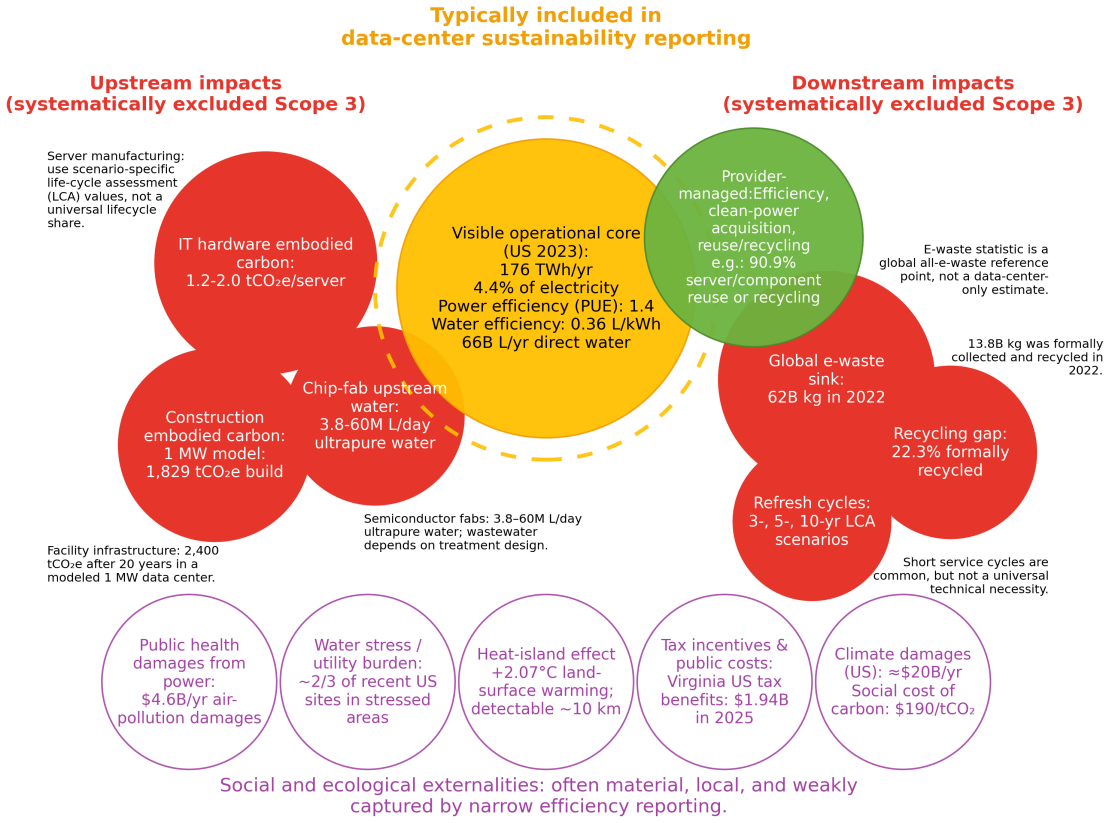
read the original abstract
Datacenter expansion under generative AI is increasingly framed as compatible with sustainability because of efficiency gains, cleaner electricity procurement, and improved facility design. Yet these claims often do not show that absolute electricity, water, material, waste, and community-facing burdens are falling. This Perspective addresses that evidentiary gap. Rather than asking whether efficiency gains are real, we ask when such gains are being enlarged into claims of system-wide sustainability to justify continued expansion. We develop a rebound-informed diagnostic framework for evaluating AI and datacenter sustainability narratives across five tests: metric, boundary, reinvestment, burden shifting, and governance. Applied to major AI industry sustainability reporting, the framework shows that firms largely justify continued expansion through efficiency improvements and clean-energy procurement, rather than by demonstrating reductions in absolute resource use. Applied to plateau claims in the literature, we show that many claims establish local or relative improvements while leaving energy rebound, lifecycle burdens, and enforceable limits unresolved. We argue that these sustainable-growth narratives begin to function as greenwashing when they use efficiency improvements to claim sustainability even as absolute energy, water, material, and public health burdens continue to increase. We conclude by positioning digital sufficiency as a burden-of-proof framework for governance: those advocating further datacenter expansion must show that it reduces, rather than merely redistributes or defers, absolute burdens across the full system.
Editorial analysis
A structured set of objections, weighed in public.
Referee Report
Summary. The paper claims that efficiency gains in datacenters and AI are frequently enlarged into system-wide sustainability claims to justify expansion, even as absolute burdens in energy, water, materials, and public health continue to rise. It develops a rebound-informed diagnostic framework with five tests (metric, boundary, reinvestment, burden shifting, governance), applies the framework to major AI industry sustainability reports and to plateau claims in the literature, and concludes that many such narratives function as greenwashing; it ends by positioning digital sufficiency as a burden-of-proof standard for governance.
Significance. If the framework is accepted as a useful evaluative lens, the perspective contributes a structured way to distinguish relative efficiency improvements from absolute sustainability in a high-growth sector. It explicitly credits the importance of rebound effects, lifecycle burdens, and enforceable limits, and its application to real industry reporting provides concrete illustrations that could inform regulatory and corporate accountability discussions.
major comments (1)
- [Framework development] Framework development (as described in the abstract and the section introducing the five tests): the tests are presented as a diagnostic tool for identifying greenwashing without derivation from prior empirical studies on rebound effects or greenwashing detection, and without validation showing they reliably distinguish misleading claims; this assumption is load-bearing for the central claim that application of the tests demonstrates greenwashing in industry reporting and literature.
Simulated Author's Rebuttal
We thank the referee for the constructive review and for highlighting the need to clarify the basis of the proposed framework. We address the single major comment below.
read point-by-point responses
-
Referee: [Framework development] Framework development (as described in the abstract and the section introducing the five tests): the tests are presented as a diagnostic tool for identifying greenwashing without derivation from prior empirical studies on rebound effects or greenwashing detection, and without validation showing they reliably distinguish misleading claims; this assumption is load-bearing for the central claim that application of the tests demonstrates greenwashing in industry reporting and literature.
Authors: The five tests are synthesized directly from the rebound-effects literature, including both theoretical foundations (Jevons paradox and its extensions) and empirical studies documenting how efficiency gains in energy, materials, and water are frequently offset by increased consumption, reinvestment, or burden shifting across system boundaries. The metric, boundary, reinvestment, burden-shifting, and governance tests apply these established rebound mechanisms to the specific evidentiary requirements of AI/datacenter sustainability narratives. As a Perspective article, the manuscript does not claim to deliver a new, statistically validated classifier; it offers a diagnostic lens whose utility is illustrated through application to existing industry reports and literature claims. We will revise the framework section to (a) add explicit citations tracing each test to prior rebound studies and (b) state clearly that the framework functions as a conceptual checklist rather than an empirically calibrated detection instrument. This addresses the load-bearing concern without altering the central argument that efficiency-based sustainability claims require demonstration of absolute burden reductions. revision: partial
Circularity Check
No circularity: framework proposed as new evaluative tool without reduction to inputs or self-citations
full rationale
The paper develops and applies a five-test diagnostic framework (metric, boundary, reinvestment, burden shifting, governance) to evaluate sustainability claims. No equations, fitted parameters, or self-citation chains are present in the abstract or described structure. The framework is introduced explicitly as developed for this analysis rather than derived from its own outputs or prior author work. The central argument—that efficiency claims become greenwashing when absolute burdens rise—rests on application of the tests to external reports and literature, not on any reduction of the tests themselves to the paper's conclusions. This matches the default expectation of a self-contained conceptual perspective with no load-bearing circular steps.
Axiom & Free-Parameter Ledger
Reference graph
Works this paper leans on
-
[1]
Shehabi, A.et al.2024 united states data center energy usage report. Tech. Rep., Lawrence Berkeley National Laboratory (2024)
2024
-
[2]
& Vanderbauwhede, W
Wadenstein, M. & Vanderbauwhede, W. Life cycle analysis for emissions of scientific computing centres.The European Physical Journal C85, 913 (2025)
2025
-
[3]
Alissa, H.et al.Using life cycle assessment to drive innovation for sustainable cool clouds.Nature641, 331–338 (2025)
2025
-
[4]
& Kim, S
Kim, D., Lee, H., Jeon, J. & Kim, S. High recovery design of reverse osmosis process with high permeate water quality and low wastewater discharge for ultra-pure water production.Desalination592, 118149 (2024)
2024
-
[5]
2025 environmental sustainability report (2025)
Microsoft. 2025 environmental sustainability report (2025). URLhttps://cdn-dynmedia-1.microsoft.com/i s/content/microsoftcorp/microsoft/msc/documents/presentations/CSR/2025-Microsoft-Environmental -Sustainability-Report-PDF.pdf. Accessed 2026-03-16
2025
-
[6]
P.et al.Global e-waste monitor 2024 (2024)
Bald´ e, C. P.et al.Global e-waste monitor 2024 (2024). URLhttps://www.itu.int/en/ITU-D/Environment/D ocuments/Publications/2025/d-gen-e_waste.01-2024-pdf-e.pdf
2024
-
[7]
& Goldsmith, I
Walker, C. & Goldsmith, I. From energy use to air quality, the many ways data centers affect us communities (2026). URLhttps://www.wri.org/insights/us-data-center-growth-impacts
2026
-
[8]
Virginia tax exemptions for data centers
Virginia Department of Taxation & Virginia Economic Development Partnership. Virginia tax exemptions for data centers. Tech. Rep., Commonwealth of Virginia (2026). URLhttps://rga.lis.virginia.gov/Published /2026/RD40
2026
-
[9]
arXiv preprint arXiv:2603.20897(2026)
Marinoni, A.et al.The data heat island effect: quantifying the impact of ai data centers in a warming world. arXiv preprint arXiv:2603.20897(2026)
Pith/arXiv arXiv 2026
-
[10]
Muller, N. Z. Measuring the impact of data centers in the united states economy: Monetary damage from air pollution and greenhouse gas emissions. Working Paper 35100, National Bureau of Economic Research (2026). URLhttps://www.nber.org/papers/w35100. 11
2026
-
[11]
Guidi, G.et al.Environmental burden of united states data centers in the artificial intelligence era.arXiv preprint arXiv:2411.09786(2024)
arXiv 2024
-
[12]
Data centres and data transmission networks (2023)
International Energy Agency. Data centres and data transmission networks (2023). URLhttps://www.iea.or g/energy-system/buildings/data-centres-and-data-transmission-networks. Accessed: 2025-11-28
2023
-
[13]
World energy outlook 2024 (2024)
International Energy Agency. World energy outlook 2024 (2024). URLhttps://www.iea.org/reports/worl d-energy-outlook-2024. Accessed: 2025-11-28
2024
-
[14]
Bhardwaj, E., Alexander, R. & Becker, C. Limits to AI growth: The ecological and social consequences of scaling.arXiv preprint arXiv:2501.17980(2025). URLhttps://arxiv.org/abs/2501.17980
arXiv 2025
-
[15]
& Coroam˘ a, V
Kamiya, G. & Coroam˘ a, V. C. Data centre energy use: Critical review of models and results. Tech. Rep., EDNA – IEA 4E TCP (2025)
2025
-
[16]
Patterson, D.et al.The carbon footprint of machine learning training will plateau, then shrink.Computer55, 18–28 (2022)
2022
-
[17]
& Hern´ andez-Orallo, J
Desislavov, R., Mart´ ınez-Plumed, F. & Hern´ andez-Orallo, J. Trends in AI inference energy consumption: Beyond the performance-vs-parameter laws of deep learning.Sustainable Computing: Informatics and Systems38, 100857 (2023)
2023
-
[18]
Energy and AI
International Energy Agency. Energy and AI. Tech. Rep., International Energy Agency, Paris (2025). URL https://www.iea.org/reports/energy-and-ai. Accessed 2026-03-21
2025
-
[19]
Rethinking concerns about AI’s energy use
Castro, D. Rethinking concerns about AI’s energy use. Tech. Rep., Center for Data Innovation (2024). URL https://www2.datainnovation.org/2024-ai-energy-use.pdf. Accessed 2026-03-16
2024
-
[20]
Weak versus strong sustainability: exploring the limits of two opposing paradigms
Neumayer, E. Weak versus strong sustainability: exploring the limits of two opposing paradigms. InWeak versus strong sustainability(Edward Elgar Publishing, 2010)
2010
-
[21]
Hype, Sustainability, and the Price of the Bigger-is-Better Paradigm in AI,
Luccioni, A. S., Strubell, E. & Crawford, K. From efficiency gains to rebound effects: The problem of jevons’ paradox in AI’s polarized environmental debate. InProceedings of the 2025 ACM Conference on Fairness, Accountability, and Transparency, FAccT ’25, 76–88 (ACM, New York, NY, USA, 2025). URLhttps://doi.or g/10.1145/3715275.3732007
-
[22]
Bremer, C., Knowles, B. & Friday, A. Of ironies and agency: Energy professionals’ views on digital interventions and their users. InCHI ’25: Proceedings of the 2025 CHI Conference on Human Factors in Computing Systems, 1–14 (ACM, New York, NY, USA, 2025). URLhttps://doi.org/10.1145/3706598.3713754
-
[23]
URLhttps://doi.org/10.1145/ 3608115
Bremer, C.et al.How viable are energy savings in smart homes? a call to embrace rebound effects in sustainable HCI.ACM Journal on Computing and Sustainable Societies1, 1–24 (2023). URLhttps://doi.org/10.1145/ 3608115
2023
-
[24]
Google 2025 environmental report
Google. Google 2025 environmental report. Environmental Report, Google (2025). URLhttps://sustainabi lity.google/reports/google-2025-environmental-report/. See pp. 15 and 20; accessed 2026-03-16
2025
-
[25]
2024 amazon sustainability report (2025)
Amazon. 2024 amazon sustainability report (2025). URLhttps://sustainability.aboutamazon.com/2024-a mazon-sustainability-report.pdf. Includes AWS data-centre energy, cooling, and water efficiency disclosures; accessed 2026-03-16
2024
-
[26]
2024 sustainability report (2024)
Meta. 2024 sustainability report (2024). URLhttps://sustainability.atmeta.com/wp-content/uploads/2 024/08/Meta-2024-Sustainability-Report.pdf. Accessed 2026-03-16
2024
-
[27]
2024 corporate sustainability report
Equinix. 2024 corporate sustainability report. Sustainability Report, Equinix (2025). URLhttps://www.eq uinix.com/resources/infopapers/2024-corporate-sustainability-report. Covers Equinix sustainability performance for calendar year 2024; accessed 2026-03-16
2024
-
[28]
Equinix named a leader in the idc marketscape: Worldwide datacenter services sustainability 2025– 2026 vendor assessment (2025)
Equinix. Equinix named a leader in the idc marketscape: Worldwide datacenter services sustainability 2025– 2026 vendor assessment (2025). URLhttps://investor.equinix.com/news-events/press-releases/deta il/1093/equinix-named-a-leader-in-the-idc-marketscape-worldwide. Press release with 2024 PUE and renewable-energy disclosures; accessed 2026-03-16
2025
-
[29]
Koomey, J. G. Growth in data center electricity use 2005 to 2010. Tech. Rep., Analytics Press, Oakland, CA (2011). 12
2005
-
[30]
Shehabi, A.et al.United states data center energy usage report. Tech. Rep. LBNL-1005775, Lawrence Berkeley National Laboratory (2016)
2016
-
[31]
Digitalisation and energy (2017)
International Energy Agency. Digitalisation and energy (2017). URLhttps://www.iea.org/reports/digita lisation-and-energy. Accessed 2026-03-16
2017
-
[32]
& Koomey, J
Masanet, E., Shehabi, A., Lei, N., Smith, S. & Koomey, J. Recalibrating global data center energy-use estimates. Science367, 984–986 (2020)
2020
-
[33]
United States Data Center Energy Usage Report
ScienceDaily. Data centers continue to proliferate while their energy use plateaus, study finds (2016). URL https://www.sciencedaily.com/releases/2016/06/160627161222.htm. Public-facing coverage of the Lawrence Berkeley National Laboratory report “United States Data Center Energy Usage Report”
2016
-
[34]
Recalibrating global data center energy-use estimates
McMahon, J. Data centers aren’t devouring the planet’s electricity—yet (2020). URLhttps://www.wired.co m/story/data-centers-not-devouring-planet-electricity-yet/. Public-facing coverage of Masanet et al. (2020), “Recalibrating global data center energy-use estimates”
2020
-
[35]
Environmental science & policy112, 236–244 (2020)
Vad´ en, T.et al.Decoupling for ecological sustainability: A categorisation and review of research literature. Environmental science & policy112, 236–244 (2020)
2020
-
[36]
& Spangenberg, J
Parrique, T., Barth, J., Briens, F., Kuokkanen, A. & Spangenberg, J. Evidence and arguments against green growth as a sole strategy for sustainability.European Environmental Bureau(2019)
2019
-
[37]
Haberl, H.et al.A systematic review of the evidence on decoupling of gdp, resource use and ghg emissions, part ii: synthesizing the insights.Environmental research letters15, 065003 (2020)
2020
-
[38]
& Mitchell, M
Luccioni, S., Trevelin, B. & Mitchell, M. The environmental impacts of ai - primer (2024). URLhttps: //huggingface.co/blog/sasha/ai-environment-primer
2024
-
[39]
URLhttp://arxiv.org/abs/22 02.05924
Sevilla, J.et al.Compute trends across three eras of machine learning (2022). URLhttp://arxiv.org/abs/22 02.05924
2022
-
[40]
Luccioni, S., Jernite, Y. & Strubell, E. Power hungry processing: Watts driving the cost of ai deployment? InProceedings of the 2024 ACM Conference on Fairness, Accountability, and Transparency, FAccT ’24, 85–99 (Association for Computing Machinery, New York, NY, USA, 2024). URLhttps://dl.acm.org/doi/10.1145 /3630106.3658542
arXiv 2024
-
[41]
URLhttps://arxiv.org/abs/ 2407.12504
Shao, Y.et al.Case2code: Scalable synthetic data for code generation (2024). URLhttps://arxiv.org/abs/ 2407.12504
arXiv 2024
-
[42]
Deepseek-V3 technical report.arXiv preprint arXiv:2412.19437(2024)
DeepSeek-AI. Deepseek-V3 technical report.arXiv preprint arXiv:2412.19437(2024)
Pith/arXiv arXiv 2024
-
[43]
& Zanette, A
Arora, D. & Zanette, A. Training language models to reason efficiently.Advances in Neural Information Processing Systems38, 60770–60808 (2026)
2026
-
[44]
& Maudet, N
Beignon, A., Thibault, T. & Maudet, N. Imposing ai: Deceptive design patterns against sustainability. Computing within LimitsEleventh W orkshop on Computing Within Limits(2025). URLhttps: //computingwithinlimits.org/2025/papers/limits2025-beigon-imposing-ai.pdf
2025
-
[45]
Sam altman says chatgpt has hit 800m weekly active users (2025)
Bellan, R. Sam altman says chatgpt has hit 800m weekly active users (2025). URLhttps://techcrunch.com /2025/10/06/sam-altman-says-chatgpt-has-hit-800m-weekly-active-users/
2025
-
[46]
& Lange, S
Santarius, T., Pohl, J. & Lange, S. Digital sufficiency: Conceptual considerations for ICTs on a finite planet. Annals of Telecommunications78, 277–295 (2023)
2023
-
[47]
Freitag, C.et al.The real climate and transformative impact of ICT: A critique of estimates, trends, and regulations.Patterns2, 100340 (2021)
2021
-
[48]
URLhttps://drops.dagstuhl.de/entities/document/10.423 0/DagMan.11.1.1
Knowles, B.et al.Climate Change: What is Computing’s Responsibility? (Dagstuhl Perspectives Workshop 25122).Dagstuhl Manifestos11, 1–18 (2025). URLhttps://drops.dagstuhl.de/entities/document/10.423 0/DagMan.11.1.1
2025
-
[49]
& Pierson, J.-M
Madon, M. & Pierson, J.-M. Integrating pre-cooling of data center operated with renewable energies. 332–341 (2020). 13
2020
-
[50]
& Aebischer, B.ICT Innovations for Sustainability, vol
Hilty, L. & Aebischer, B.ICT Innovations for Sustainability, vol. 310 (2015)
2015
-
[51]
& Easterbrook, S
Gujral, H., Bremer, C., Perera, D. & Easterbrook, S. Design for digital sufficiency: Understanding user prefer- ences for more sustainable data centers.ACM Journal on Computing and Sustainable Societies3, 1–31 (2025)
2025
-
[52]
Credit guidance: How we achieve degrowth (2024)
Hickel, J. Credit guidance: How we achieve degrowth (2024). URLhttps://www.jasonhickel.org/blog/202 4/8/20/credit-guidance-how-we-achieve-degrowth. Accessed 2026-05-14
2024
-
[53]
Narechania, T. N. & Sitaraman, G. An antimonopoly approach to governing artificial intelligence.Yale L. & Pol’y Rev.43, 95 (2024)
2024
-
[54]
& Vipra, J
Korinek, A. & Vipra, J. Concentrating intelligence: scaling and market structure in artificial intelligence. Economic Policy40, 225–256 (2025). 14 A Supplementary tables Table A.1: AI industry sustainability reporting frames continued expansion as manageable, not bounded, and cleaner growth. Columns show the dominant framing, how each of the five tests fa...
2025
discussion (0)
Sign in with ORCID, Apple, or X to comment. Anyone can read and Pith papers without signing in.