High-density, high-mobility ultrathin spin-polarized two-dimensional electron gas at the polar/polar LaVO₃/KTaO₃ interface: Insights from first-principles calculations
Pith reviewed 2026-06-28 08:44 UTC · model grok-4.3
The pith
Polar discontinuity at the LaVO3/KTaO3 interface drives formation of a high-density spin-polarized 2DEG with smaller effective mass than LaAlO3/SrTiO3.
A machine-rendered reading of the paper's core claim, the machinery that carries it, and where it could break.
Core claim
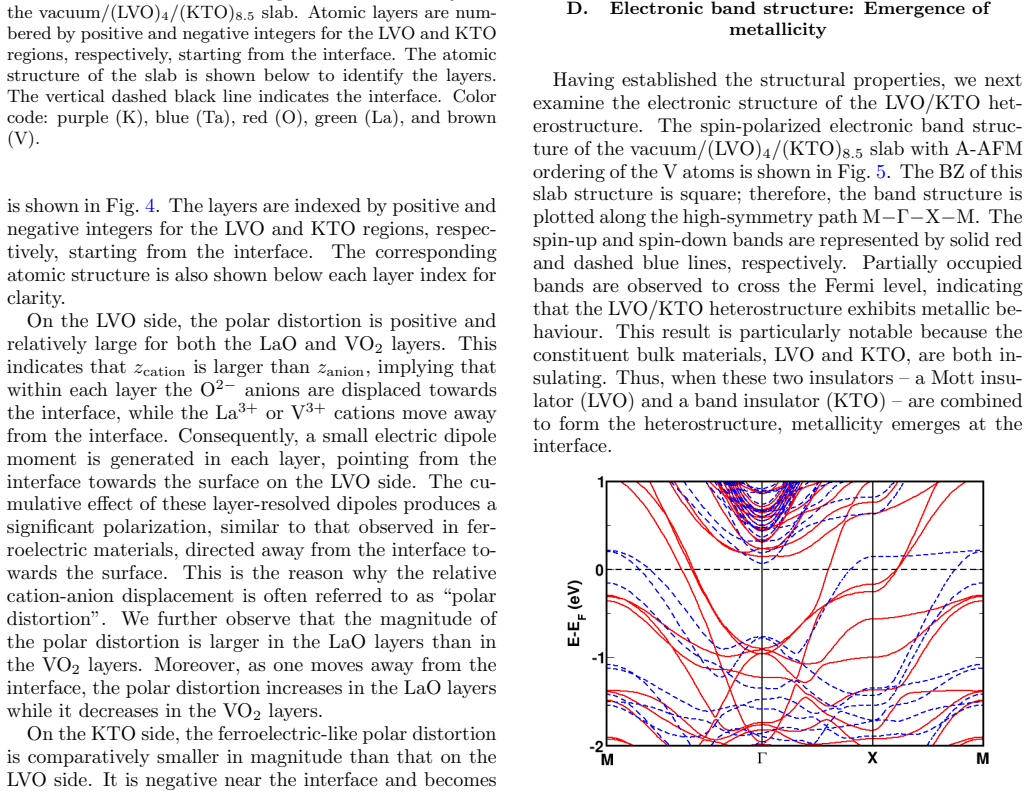
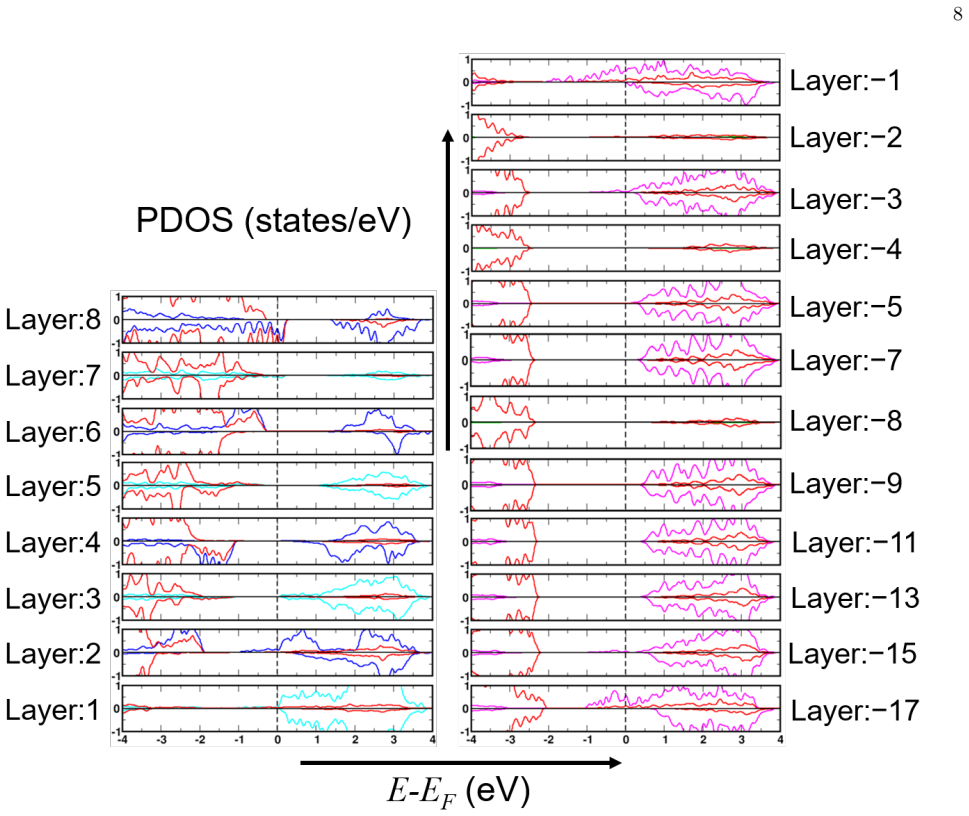
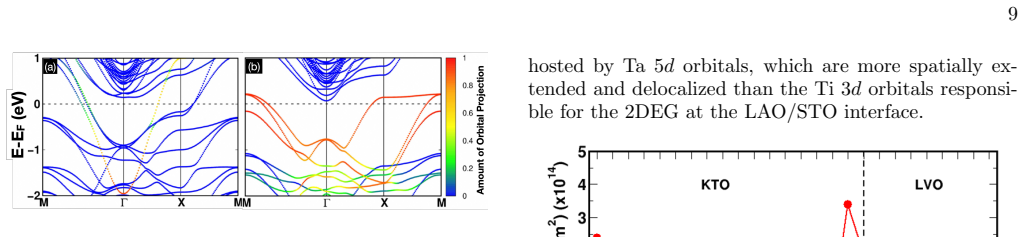
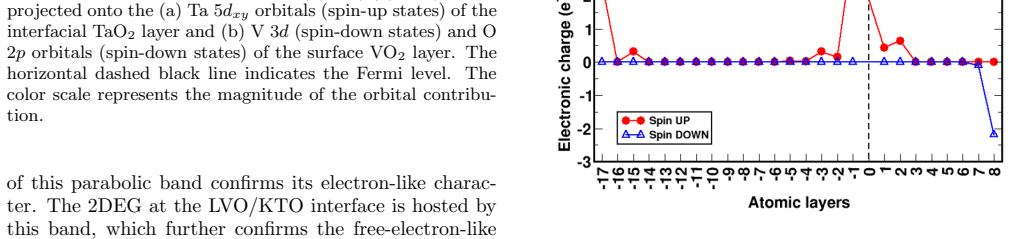
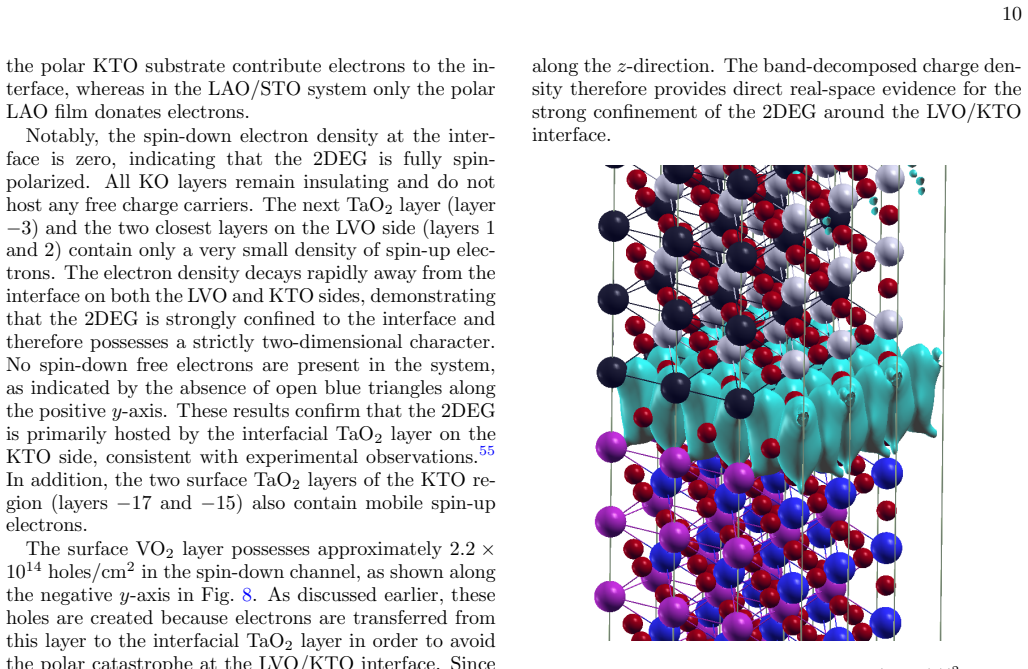
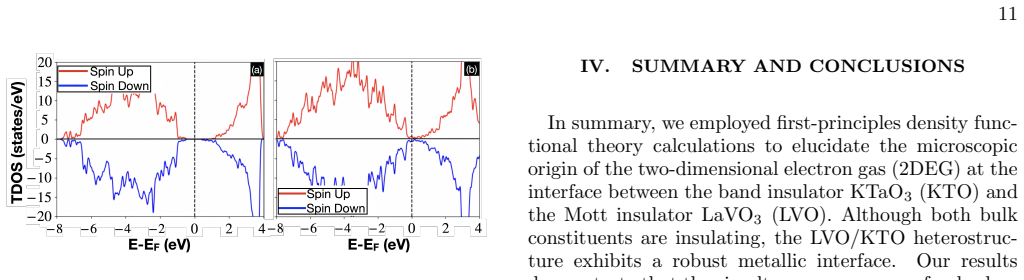
Although both LaVO3 and KTaO3 are insulating in bulk, the heterostructure develops robust interfacial metallicity through electronic reconstruction driven by polar discontinuity. Electrons move from the outer surfaces to the interface, producing hole accumulation in the surface VO2 layer and electron accumulation in the interfacial TaO2 layer. The resulting 2DEG is highly confined, spin-polarized, and formed by interfacial Ta 5d_xy orbitals; the spin-up parabolic band shows an exceptionally small effective mass and the interfacial electron density reaches nearly an order of magnitude higher value than in LaAlO3/SrTiO3.
What carries the argument
Electronic reconstruction from polar discontinuity, which transfers charge to stabilize a confined 2DEG localized in interfacial Ta 5d_xy orbitals.
If this is right
- The 2DEG remains spin-polarized and confined to the interfacial plane.
- Carrier mobility should exceed that of the LaAlO3/SrTiO3 interface because of the reduced effective mass.
- The higher electron density enables denser charge accumulation for oxide-based quantum devices.
- The same polar/polar construction can be used to engineer other correlated interfaces with tailored spin and transport properties.
Where Pith is reading between the lines
- Similar polar/polar combinations involving other 5d transition-metal oxides may also produce low-mass 2DEGs without requiring external doping.
- Varying the LaVO3 film thickness could tune the balance between surface hole accumulation and interface electron density, offering an experimental knob for mobility optimization.
- The spin polarization identified here suggests the interface could host spin-filtering or spin-orbit effects that are absent or weaker in non-polar analogs.
Load-bearing premise
Standard density functional theory without Hubbard U corrections or hybrid functionals correctly captures the electronic reconstruction, orbital character, and effective masses even though one constituent is a Mott insulator.
What would settle it
Measurement showing that the interfacial electron density is not substantially higher than in LaAlO3/SrTiO3 or that the effective mass of the spin-up band is not smaller would falsify the central claim.
Figures
read the original abstract
The emergence of high-mobility two-dimensional electron gases (2DEGs) at oxide interfaces provides a fertile platform for exploring emergent quantum phenomena and next-generation oxide electronics. Here, using first-principles density functional theory (DFT) calculations, we investigate the microscopic origin of the 2DEG formed at the interface between the band insulator KTaO$_3$ (KTO) and the Mott insulator LaVO$_3$ (LVO). Although both constituents are insulating in bulk, the LVO/KTO heterostructure develops robust metallicity at the interface, consistent with experimental observations. Our calculations show that this metallic state originates from an electronic reconstruction driven by the polar discontinuity across the interface. To avoid the polar catastrophe on both the polar LVO film and the polar KTO substrate, electrons are transferred from the outer surfaces toward the interface, leading to hole accumulation in the surface VO$_2$ layer and electron accumulation in the interfacial TaO$_2$ layer. This charge redistribution stabilizes a highly confined and spin-polarized 2DEG localized at the interface. The electronic states forming the 2DEG are predominantly derived from interfacial Ta $5d_{xy}$ orbitals, confining carrier motion to the interfacial plane. Remarkably, the spin-up parabolic band hosting the 2DEG exhibits an exceptionally small effective mass, substantially lower than that of the prototypical LaAlO$_3$/SrTiO$_3$ interface, indicating the potential for enhanced carrier mobility. Furthermore, the calculated interfacial electron density is nearly an order of magnitude larger than that of LaAlO$_3$/SrTiO$_3$, consistent with experiment. These findings identify the LVO/KTO heterostructure as a promising platform for realizing high-density, high-mobility spin-polarized 2DEGs and for engineering correlated oxide interfaces for quantum electronic applications.
Editorial analysis
A structured set of objections, weighed in public.
Referee Report
Summary. The manuscript reports first-principles DFT calculations on the polar/polar LaVO3/KTaO3 interface, claiming that polar discontinuity drives electronic reconstruction that produces a highly confined, spin-polarized 2DEG localized on interfacial Ta 5d_xy states. The work reports an exceptionally small effective mass for the spin-up parabolic band and an interfacial electron density nearly an order of magnitude higher than the LaAlO3/SrTiO3 benchmark, both stated to be consistent with experiment.
Significance. If the central claims hold, the identification of a high-density, high-mobility, spin-polarized 2DEG at this interface would establish LVO/KTO as a distinct platform for correlated-oxide quantum electronics beyond the canonical LAO/STO system.
major comments (2)
- [Computational Methods] Computational Methods: The exchange-correlation functional and any Hubbard U corrections applied to the V 3d states of the Mott insulator LaVO3 are not specified. Standard semi-local functionals commonly yield a metallic or weakly gapped state for bulk LaVO3, directly affecting the polar-discontinuity-driven charge transfer, the resulting n_s, orbital character, and effective-mass values that underpin the headline claims.
- [Results] Results section: No numerical values, convergence data, error estimates, or direct comparison plots are supplied for the reported effective mass, interfacial electron density, or spin polarization, preventing quantitative assessment of the stated order-of-magnitude improvement over LaAlO3/SrTiO3.
minor comments (1)
- [Abstract] The abstract states consistency with experiment but supplies no specific experimental references or quantitative metrics for that consistency.
Simulated Author's Rebuttal
We thank the referee for the constructive comments on our manuscript. We address each major point below and will revise the manuscript accordingly to improve clarity and completeness.
read point-by-point responses
-
Referee: [Computational Methods] Computational Methods: The exchange-correlation functional and any Hubbard U corrections applied to the V 3d states of the Mott insulator LaVO3 are not specified. Standard semi-local functionals commonly yield a metallic or weakly gapped state for bulk LaVO3, directly affecting the polar-discontinuity-driven charge transfer, the resulting n_s, orbital character, and effective-mass values that underpin the headline claims.
Authors: We agree that explicit specification of the exchange-correlation functional and Hubbard U parameters is necessary for reproducibility and to confirm the correct insulating character of bulk LaVO3. In the revised manuscript, we will add these details to the Computational Methods section, including the specific functional employed and the U value applied to V 3d states to open the Mott gap. revision: yes
-
Referee: [Results] Results section: No numerical values, convergence data, error estimates, or direct comparison plots are supplied for the reported effective mass, interfacial electron density, or spin polarization, preventing quantitative assessment of the stated order-of-magnitude improvement over LaAlO3/SrTiO3.
Authors: We acknowledge that the absence of explicit numerical values, convergence tests, and direct comparisons limits quantitative evaluation. In the revision, we will incorporate the calculated numerical values for effective mass, interfacial electron density, and spin polarization into the Results section, along with convergence data and a comparative plot versus the LaAlO3/SrTiO3 interface (to be placed in the main text or supplementary information). revision: yes
Circularity Check
No circularity: first-principles DFT outputs are independent of target observables
full rationale
The paper reports direct DFT results for electronic reconstruction, orbital character, effective mass, and carrier density at the LVO/KTO interface. No parameters are fitted to the reported n_s or m* values, no self-citations are invoked to justify uniqueness or ansatzes, and no equations reduce the predictions to the inputs by construction. The derivation chain consists of standard DFT applied to a slab model; any concerns about functional choice for LaVO3 pertain to accuracy, not circularity.
Axiom & Free-Parameter Ledger
axioms (1)
- domain assumption Density functional theory (without additional corrections) accurately describes the electronic reconstruction and orbital-projected bands at the polar LVO/KTO interface.
Reference graph
Works this paper leans on
-
[1]
Tokura and H
Y. Tokura and H. Y. Hwang, Complex oxides on fire, Nat. Mater.7, 694 (2008)
2008
-
[2]
Reiner, F
J. Reiner, F. Walker, and C. Ahn, Atomically engineered oxide interfaces, Science323, 1018 (2009)
2009
-
[3]
Dagotto, Complexity in strongly correlated electronic systems, Science309, 257 (2005)
E. Dagotto, Complexity in strongly correlated electronic systems, Science309, 257 (2005)
2005
-
[4]
H. Y. Hwang, Y. Iwasa, M. Kawasaki, B. Keimer, N. Na- gaosa, and Y. Tokura, Emergent phenomena at oxide in- terfaces, Nat. Mater.11, 103 (2012)
2012
-
[5]
J. G. Bednorz and K. A. M¨ uller, Perovskite-type ox- ides—The new approach to high-T c superconductivity, Rev. of Mod. Phys.60, 585 (1988)
1988
-
[6]
Kobayashi, T
K.-I. Kobayashi, T. Kimura, H. Sawada, K. Terakura, and Y. Tokura, Room-temperature magnetoresistance in an oxide material with an ordered double-perovskite structure, Nature395, 677 (1998)
1998
-
[7]
J. Wang, J. Neaton, H. Zheng, V. Nagarajan, S. Ogale, B. Liu, D. Viehland, V. Vaithyanathan, D. Schlom, U. Waghmare,et al., Epitaxial BiFeO 3 multiferroic thin film heterostructures, Science299, 1719 (2003)
2003
-
[8]
Brinkman, M
A. Brinkman, M. Huijben, M. Van Zalk, J. Huijben, U. Zeitler, J. Maan, W. G. van der Wiel, G. Rijnders, D. H. Blank, and H. Hilgenkamp, Magnetic effects at the interface between non-magnetic oxides, Nat. Mater.6, 493 (2007)
2007
-
[9]
C. Liu, X. Yan, D. Jin, Y. Ma, H.-W. Hsiao, Y. Lin, T. M. Bretz-Sullivan, X. Zhou, J. Pearson, B. Fisher,et al., Two-dimensional superconductivity and anisotropic transport at KTaO 3(111) interfaces, Science 371, 716 (2021)
2021
-
[10]
J. A. Bert, B. Kalisky, C. Bell, M. Kim, Y. Hikita, H. Y. Hwang, and K. A. Moler, Direct imaging of the coex- istence of ferromagnetism and superconductivity at the LaAlO3/SrTiO3 interface, Nat. Phys.7, 767 (2011)
2011
-
[11]
M. C. Tarun, F. A. Selim, and M. D. McCluskey, Persis- tent photoconductivity in strontium titanate, Phys. Rev. Lett.111, 187403 (2013)
2013
-
[12]
Y. Lei, Y. Li, Y. Chen, Y. Xie, Y. Chen, S. Wang, J. Wang, B. Shen, N. Pryds, H. Hwang,et al., Visible- light-enhanced gating effect at the LaAlO 3/SrTiO3 in- terface, Nat. Commun.5, 5554 (2014)
2014
-
[13]
Matsubara, K
Y. Matsubara, K. Takahashi, M. Bahramy, Y. Kozuka, D. Maryenko, J. Falson, A. Tsukazaki, Y. Tokura, and M. Kawasaki, Observation of the quantum Hall effect in δ-doped SrTiO 3, Nat. Commun.7, 11631 (2016)
2016
-
[14]
Thiel, G
S. Thiel, G. Hammerl, A. Schmehl, C. W. Schneider, and J. Mannhart, Tunable quasi-two-dimensional elec- tron gases in oxide heterostructures, Science313, 1942 (2006)
1942
-
[15]
F¨ org, C
B. F¨ org, C. Richter, and J. Mannhart, Field-effect de- vices utilizing LaAlO 3-SrTiO3 interfaces, Appl. Phys. Lett.100, 053506 (2012)
2012
-
[16]
Reyren, S
N. Reyren, S. Thiel, A. review, L. F. Kourkoutis, G. Hammerl, C. Richter, C. W. Schneider, T. Kopp, A.-S. Ruetschi, D. Jaccard,et al., Superconducting interfaces between insulating oxides, Science317, 1196 (2007)
2007
-
[17]
Caviglia, S
A. Caviglia, S. Gariglio, N. Reyren, D. Jaccard, T. Schneider, M. Gabay, S. Thiel, G. Hammerl, J. Mannhart, and J.-M. Triscone, Electric field control of the LaAlO3/SrTiO3 interface ground state, Nature456, 624 (2008)
2008
-
[18]
Caviglia, M
A. Caviglia, M. Gabay, S. Gariglio, N. Reyren, C. Can- cellieri, and J.-M. Triscone, Tunable Rashba spin-orbit interaction at oxide interfaces, Phys. Rev. Lett.104, 126803 (2010)
2010
-
[19]
Caviglia, S
A. Caviglia, S. Gariglio, C. Cancellieri, B. Sac´ ep´ e, A. Fete, N. Reyren, M. Gabay, A. Morpurgo, and J.-M. Triscone, Two-dimensional quantum oscillations of the conductance at LaAlO 3/SrTiO3 interfaces, Phys. Rev. Lett.105, 236802 (2010)
2010
-
[20]
Y. Chen, J. Zhao, J. Sun, N. Pryds, and B. Shen, Resis- tance switching at the interface of LaAlO3/SrTiO3, Appl. Phys. Lett.97, 123102 (2010)
2010
-
[21]
S. J. Allen, B. Jalan, S. Lee, D. G. Ouellette, G. Khalsa, J. Jaroszynski, S. Stemmer, and A. H. MacDonald, Conduction-band edge and Shubnikov–de Haas effect in low-electron-density SrTiO 3, Phys. Rev. B.88, 045114 (2013)
2013
-
[22]
Wadehra, R
N. Wadehra, R. Tomar, R. M. Varma, R. Gopal, Y. Singh, S. Dattagupta, and S. Chakraverty, Planar hall effect and anisotropic magnetoresistance in polar-polar interface of LaVO 3-KTaO3 with strong spin-orbit cou- pling, Nat. Commun.11, 874 (2020)
2020
-
[23]
H. M. Christen and G. Eres, Recent advances in pulsed- laser deposition of complex oxides, Journal of Physics: Condensed Matter20, 264005 (2008)
2008
-
[24]
Ohtomo and H
A. Ohtomo and H. Hwang, A high-mobility electron gas at the LaAlO 3/SrTiO3 heterointerface, Nature427, 423 (2004)
2004
-
[25]
Nakagawa, H
N. Nakagawa, H. Y. Hwang, and D. A. Muller, Why some interfaces cannot be sharp, Nat. Mater.5, 204 (2006)
2006
-
[26]
Z. S. Popovi´ c, S. Satpathy, and R. M. Martin, Origin of the two-dimensional electron gas carrier density at the LaAlO 3 on SrTiO 3 interface, Phys. Rev. Lett.101, 256801 (2008)
2008
-
[27]
Basletic, J.-L
M. Basletic, J.-L. Maurice, C. Carr´ et´ ero, G. Herranz, O. Copie, M. Bibes, ´E. Jacquet, K. Bouzehouane, S. Fusil, and A. Barth´ el´ emy, Mapping the spatial distri- bution of charge carriers in LaAlO 3/SrTiO3 heterostruc- tures, Nat. Mater.7, 621 (2008)
2008
-
[28]
J. Heber, Enter the oxides: thin films of oxygen-bearing compounds could have myriad practical applications, finds Joerg Heber, if a few problems can be overcome, 13 Nature459, 28 (2009)
2009
-
[29]
Ramesh and D
R. Ramesh and D. G. Schlom, Whither oxide electron- ics?, MRS Bulletin33, 1006 (2008)
2008
-
[30]
C. Cen, S. Thiel, J. Mannhart, and J. Levy, Oxide nano- electronics on demand, Science323, 1026 (2009)
2009
-
[31]
Eisenstein, K
J. Eisenstein, K. Cooper, L. Pfeiffer, and K. West, In- sulating and fractional quantum hall states in the first excited landau level, Physical Review Letters88, 076801 (2002)
2002
-
[32]
Umansky, M
V. Umansky, M. Heiblum, Y. Levinson, J. Smet, J. N¨ ubler, and M. Dolev, Mbe growth of ultra-low dis- order 2DEG with mobility exceeding 35×106 cm 2/V s, Journal of Crystal Growth311, 1658 (2009)
2009
-
[33]
Stemmer and S
S. Stemmer and S. James Allen, Two-dimensional elec- tron gases at complex oxide interfaces, Annu. Rev. Mater. Res.44, 151 (2014)
2014
-
[34]
Zhong, P
Z. Zhong, P. Xu, and P. J. Kelly, Polarity-induced oxygen vacancies at LaAlO3/SrTiO3 interfaces, Phys. Rev. B82, 165127 (2010)
2010
-
[35]
Y. Li, S. N. Phattalung, S. Limpijumnong, J. Kim, and J. Yu, Formation of oxygen vacancies and charge carriers induced in the n-type interface of a LaAlO 3 overlayer on SrTiO3(001), Phys. Rev. B84, 245307 (2011)
2011
-
[36]
Bristowe, P
N. Bristowe, P. Littlewood, and E. Artacho, Surface defects and conduction in polar oxide heterostructures, Phys. Rev. B83, 205405 (2011)
2011
-
[37]
Willmott, S
P. Willmott, S. Pauli, R. Herger, C. Schlep¨ utz, D. Mar- toccia, B. Patterson, B. Delley, R. Clarke, D. Kumah, C. Cionca,et al., Structural basis for the conducting in- terface between LaAlO 3 and SrTiO 3, Phys. Rev. Lett. 99, 155502 (2007)
2007
-
[38]
S. A. Chambers, M. H. Engelhard, V. Shutthanandan, Z. Zhu, T. C. Droubay, L. Qiao, P. Sushko, T. Feng, H. D. Lee, T. Gustafsson,et al., Instability, intermixing and electronic structure at the epitaxial LaAlO3/SrTiO3(001) heterojunction, Surf. Sci. Rep.65, 317 (2010)
2010
-
[39]
Yamamoto, C
R. Yamamoto, C. Bell, Y. Hikita, H. Y. Hwang, H. Naka- mura, T. Kimura, and Y. Wakabayashi, Structural com- parison of n-type and p-type LaAlO 3/SrTiO3 interfaces, Phys. Rev. Lett.107, 036104 (2011)
2011
-
[40]
Y. Chen, F. Trier, T. Kasama, D. V. Christensen, N. Bovet, Z. I. Balogh, H. Li, K. T. S. Thyd´ en, W. Zhang, S. Yazdi,et al., Creation of high mobility two-dimensional electron gases via strain induced polar- ization at an otherwise nonpolar complex oxide interface, Nano Lett.15, 1849 (2015)
2015
-
[41]
Nazir, J
S. Nazir, J. Cheng, and K. Yang, Creating two- dimensional electron gas in nonpolar/nonpolar oxide in- terface via polarization discontinuity: First-principles analysis of CaZrO 3/SrTiO3 heterostructure, ACS Appl. Mater. Interfaces.8, 390 (2016)
2016
-
[42]
Y. Wang, W. Tang, J. Cheng, M. Behtash, and K. Yang, Creating two-dimensional electron gas in polar/polar perovskite oxide heterostructures: first-principles charac- terization of LaAlO 3/A+B5+O3, ACS Appl. Mater. In- terfaces.8, 13659 (2016)
2016
-
[43]
L. Fang, C. Chen, Y. Yang, Y. Wu, T. Hu, G. Zhao, Q. Zhu, and W. Ren, First-principles studies of a two- dimensional electron gas at the interface of polar/polar LaAlO3/KNbO3 superlattices, Phys. Chem. Chem. Phys. 21, 8046 (2019)
2019
-
[44]
K. Zou, S. Ismail-Beigi, K. Kisslinger, X. Shen, D. Su, F. Walker, and C. Ahn, LaTiO 3/KTaO3 interfaces: A new two-dimensional electron gas system, APL Mater. 3, 036104 (2015)
2015
-
[45]
Y. Xie, Y. Hikita, C. Bell, and H. Y. Hwang, Control of electronic conduction at an oxide heterointerface using surface polar adsorbates, Nat. Commun.2, 494 (2011)
2011
-
[46]
Pallecchi, M
I. Pallecchi, M. Codda, E. G. d’Agliano, D. Marr´ e, A. Re- view, N. Reyren, S. Gariglio, and J.-M. Triscone, Seebeck effect in the conducting LaAlO 3/SrTiO3 interface, Phys. Rev. B.81, 085414 (2010)
2010
-
[47]
Filippetti, P
A. Filippetti, P. Delugas, M. Verstraete, I. Pallecchi, A. Gadaleta, D. Marr´ e, D. Li, S. Gariglio, and V. Fioren- tini, Thermopower in oxide heterostructures: The impor- tance of being multiple-band conductors, Phys. Rev. B. 86, 195301 (2012)
2012
-
[48]
Assmann, P
E. Assmann, P. Blaha, R. Laskowski, K. Held, S. Okamoto, and G. Sangiovanni, Oxide heterostructures for efficient solar cells, Phys. Rev. Lett.110, 078701 (2013)
2013
-
[49]
Liang, L
H. Liang, L. Cheng, X. Zhai, N. Pan, H. Guo, J. Zhao, H. Zhang, L. Li, X. Zhang, X. Wang,et al., Giant photo- voltaic effects driven by residual polar field within unit- cell-scale LaAlO 3 films on SrTiO 3, Sci. Rep.3, 1975 (2013)
1975
-
[50]
Irvin, Y
P. Irvin, Y. Ma, D. F. Bogorin, C. Cen, C. W. Bark, C. M. Folkman, C.-B. Eom, and J. Levy, Rewritable nanoscale oxide photodetector, Nat. Photon.4, 849 (2010)
2010
-
[51]
Tebano, E
A. Tebano, E. Fabbri, D. Pergolesi, G. Balestrino, and E. Traversa, Room-temperature giant persistent pho- toconductivity in SrTiO 3/LaAlO3 heterostructures, Acs Nano6, 1278 (2012)
2012
-
[52]
Rastogi, A
A. Rastogi, A. Kushwaha, T. Shiyani, A. Gangawar, and R. Budhani, Electrically tunable optical switching of a mott insulator–band insulator interface, Adv. Mater.22, 4448 (2010)
2010
-
[53]
Lu, Z.-M
H.-L. Lu, Z.-M. Liao, L. Zhang, W.-T. Yuan, Y. Wang, X.-M. Ma, and D.-P. Yu, Reversible insulator-metal tran- sition of LaAlO 3/SrTiO3 interface for nonvolatile mem- ory, Sci. Rep.3, 2870 (2013)
2013
- [54]
-
[55]
Wadehra and S
N. Wadehra and S. Chakraverty, Electrostatic memory in KTaO3, Appl. Phys. Lett.114(2019)
2019
-
[56]
Goyal, N
S. Goyal, N. Wadehra, and S. Chakraverty, Tuning the electrical state of 2DEG at LaVO3 - KTaO3 interface: ef- fect of light and electrostatic gate, Adv. Mater. Interfaces 7, 2000646 (2020)
2020
-
[57]
Giannozzi, S
P. Giannozzi, S. Baroni, N. Bonini, M. Calandra, R. Car, C. Cavazzoni, D. Ceresoli, G. L. Chiarotti, M. Cococ- cioni, I. Dabo, A. D. Corso, S. de Gironcoli, S. Fabris, G. Fratesi, R. Gebauer, U. Gerstmann, C. Gougoussis, A. Kokalj, M. Lazzeri, L. Martin-Samos, N. Marzari, F. Mauri, R. Mazzarello, S. Paolini, A. Pasquarello, L. Paulatto, C. Sbraccia, S. Sc...
2009
-
[58]
Vanderbilt, Soft self-consistent pseudopotentials in a generalized eigenvalue formalism, Phys
D. Vanderbilt, Soft self-consistent pseudopotentials in a generalized eigenvalue formalism, Phys. Rev. B41, 7892 (1990). 14
1990
-
[59]
J. P. Perdew, K. Burke, and M. Ernzerhof, Generalized gradient approximation made simple, Phys. Rev. Lett. 77, 3865 (1996)
1996
-
[60]
Cococcioni and S
M. Cococcioni and S. De Gironcoli, Linear response ap- proach to the calculation of the effective interaction pa- rameters in the LDA +Umethod, Phys. Rev. B.71, 035105 (2005)
2005
-
[61]
Liechtenstein, V
A. Liechtenstein, V. I. Anisimov, and J. Zaanen, Density- functional theory and strong interactions: Orbital order- ing in mott-hubbard insulators, Physical Review B52, R5467 (1995)
1995
-
[62]
L. Wang, Y. Li, A. Bera, C. Ma, F. Jin, K. Yuan, W. Yin, A. David, W. Chen, W. Wu,et al., Device performance of the mott insulator LaVO 3 as a photovoltaic material, Physical Review Applied3, 064015 (2015)
2015
-
[63]
V. R. Cooper, Enhanced carrier mobilities in two- dimensional electron gases at III-III/IV oxide het- erostructure interfaces, Physical Review B—Condensed Matter and Materials Physics85, 235109 (2012)
2012
-
[64]
H. J. Monkhorst and J. D. Pack, Special points for Brillouin-zone integrations, Phys. Rev. B13, 5188 (1976)
1976
-
[65]
Marzari, D
N. Marzari, D. Vanderbilt, A. De Vita, and M. C. Payne, Thermal contraction and disordering of the Al(110) sur- face, Phys. Rev. Lett.82, 3296 (1999)
1999
-
[66]
S. Y. Park, A. Kumar, and K. M. Rabe, Charge-order- induced ferroelectricity in LaVO 3/SrVO3 superlattices, Physical review letters118, 087602 (2017)
2017
-
[67]
Bordet, C
P. Bordet, C. Chaillout, M. Marezio, Q. Huang, A. San- toro, S. Cheong, H. Takagi, C. Oglesby, and B. Batlogg, Structural aspects of the crystallographic-magnetic tran- sition in LaVO 3 around 140 K, Journal of solid state chemistry106, 253 (1993)
1993
-
[68]
Bouafia, S
H. Bouafia, S. Hiadsi, B. Abidri, A. Akriche, L. Ghalouci, and B. Sahli, Structural, elastic, electronic and ther- modynamic properties of KTaO 3 and NaTaO3: Ab ini- tio investigations, Computational materials science75, 1 (2013)
2013
-
[69]
Wemple, Some transport properties of oxygen-deficient single-crystal potassium tantalate (KTaO3), Physical Re- view137, A1575 (1965)
S. Wemple, Some transport properties of oxygen-deficient single-crystal potassium tantalate (KTaO3), Physical Re- view137, A1575 (1965)
1965
-
[70]
Rechav, Y
B. Rechav, Y. Yacoby, E. Stern, J. Rehr, and M. Newville, Order disorder elements in antiferrodis- tortive phase transitions, Physica B: Condensed Matter 208, 325 (1995)
1995
-
[71]
De Raychaudhury, E
M. De Raychaudhury, E. Pavarini, and O. Andersen, Or- bital fluctuations in the different phases of LaVO 3 and YVO3, Physical review letters99, 126402 (2007)
2007
-
[72]
Kumari, S
S. Kumari, S. Paul, and S. Raj, Electronic structure of RVO3 (R = La and Y): Effect of electron (U) and ex- change (J) correlations, Solid State Commun.268, 20 (2017)
2017
-
[73]
Jellison Jr, I
G. Jellison Jr, I. Paulauskas, L. Boatner, and D. Singh, Optical functions of KTaO 3 as determined by spectro- scopic ellipsometry and comparison with band structure calculations, Phys. Rev. B.74, 155130 (2006)
2006
-
[74]
Kakkar and C
S. Kakkar and C. Bera, Rashba spin splitting in two- dimensional electron gas in polar-polar perovskite oxide heterostructure LaVO 3/KTaO3: A DFT investigation, Physica E: Low-dimensional Systems and Nanostructures 144, 115394 (2022)
2022
-
[75]
Okamoto, A
S. Okamoto, A. J. Millis, and N. A. Spaldin, Lattice re- laxation in oxide heterostructures: LaTiO 3/SrTiO3 su- perlattices, Physical review letters97, 056802 (2006)
2006
-
[76]
S. Ryu, H. Zhou, T. Paudel, J. Irwin, J. Podkaminer, C. Bark, D. Lee, T. Kim, D. Fong, M. Rzchowski, et al., In-situ probing of coupled atomic restructuring and metallicity of oxide heterointerfaces induced by po- lar adsorbates, Applied Physics Letters111(2017)
2017
-
[77]
T. R. Paudel and E. Y. Tsymbal, Prediction of a mobile two-dimensional electron gas at the LaScO3/BaSnO3(001) interface, Physical Review B 96, 245423 (2017)
2017
-
[78]
Patel, N
S. Patel, N. Mohanta, S. Nandy, S. D. Mahanti, and A. Taraphder, Layer-dependent electronic struc- tures and magnetic ground states of polar-polar LaVO3/KTaO3(001) heterostructures, Physical Review B110, 054402 (2024)
2024
-
[79]
Zhong, A
Z. Zhong, A. T´ oth, and K. Held, Theory of spin-orbit coupling at LaAlO 3/SrTiO3 interfaces and SrTiO 3 sur- faces, Physical Review B—Condensed Matter and Mate- rials Physics87, 161102 (2013)
2013
-
[80]
Behtash, S
M. Behtash, S. Nazir, Y. Wang, and K. Yang, Po- larization effects on the interfacial conductivity in LaAlO3/SrTiO3 heterostructures: A first-principles study, Physical Chemistry Chemical Physics18, 6831 (2016)
2016
discussion (0)
Sign in with ORCID, Apple, or X to comment. Anyone can read and Pith papers without signing in.