The Y Dwarf Companion to the White Dwarf WD 0806-66: Resolving the Discrepancy Between Atmospheric and Evolutionary Models
Pith reviewed 2026-06-28 07:56 UTC · model grok-4.3
The pith
Atmospheric models now match evolutionary models for the Y dwarf companion to WD 0806-66, giving temperature 357 K, radius 1.08 RJup and mass 7 MJup.
A machine-rendered reading of the paper's core claim, the machinery that carries it, and where it could break.
Core claim
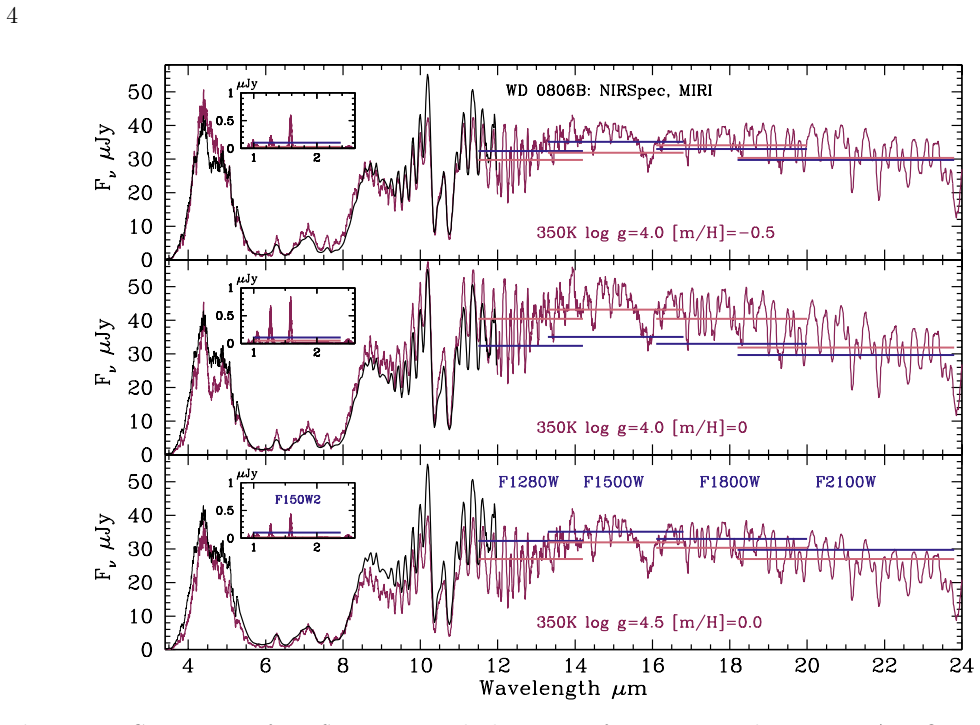
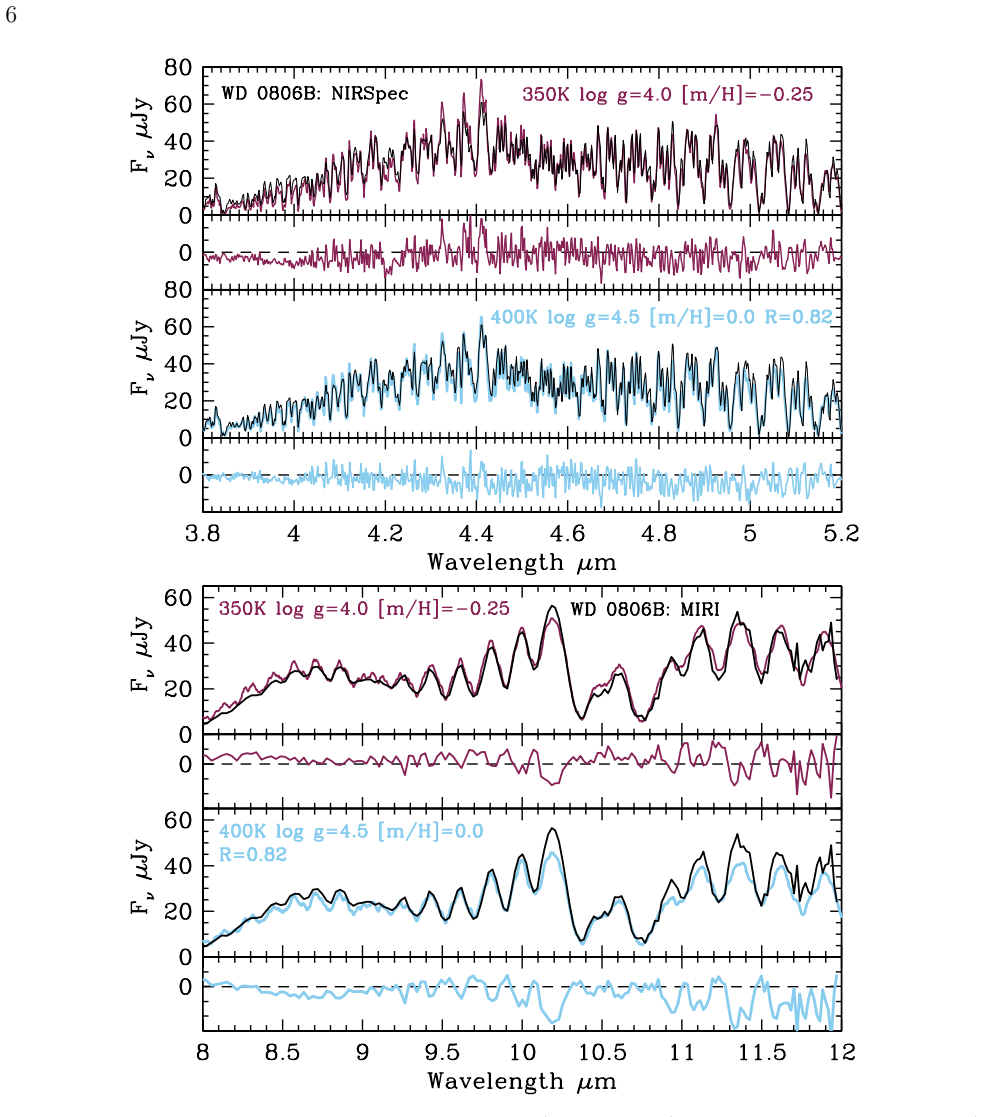
We find a good fit across the entire observed spectral energy distribution, except at the shortest near-infrared wavelengths, with atmospheric parameters consistent with evolutionary models. We find the Y dwarf to be slightly metal-poor, with an effective temperature of 357 +/- 3 K, a radius of 1.08 +/- 0.02 R_Jupiter, and a mass of 7 +/- 1 M_Jupiter.
What carries the argument
Comparison of the combined NIRSpec and MIRI dataset to synthetic spectra generated by ATMO 2020++ atmospheric models
If this is right
- The derived temperature, radius and mass are consistent with evolutionary model calculations at the white dwarf age.
- The Y dwarf is slightly metal-poor.
- The system age is updated to 1.6 +0.6 -0.4 Gyr.
- The Y dwarf luminosity is confirmed from the new spectral fit.
Where Pith is reading between the lines
- The short-wavelength near-infrared mismatch may point to missing opacity sources that future model updates could address.
- If the same models work for other field Y dwarfs, their temperatures and masses can be trusted even without a known age anchor.
- The result supplies a rare test case where both atmospheric and evolutionary models can be checked against the same object.
Load-bearing premise
The ATMO 2020++ atmospheric models correctly capture the dominant physics and opacities in the Y dwarf atmosphere.
What would settle it
An independent mass or radius measurement from astrometry or radial velocity that lies outside 7 +/- 1 MJup or 1.08 +/- 0.02 RJup would show the parameters are not consistent with the evolutionary models.
Figures
read the original abstract
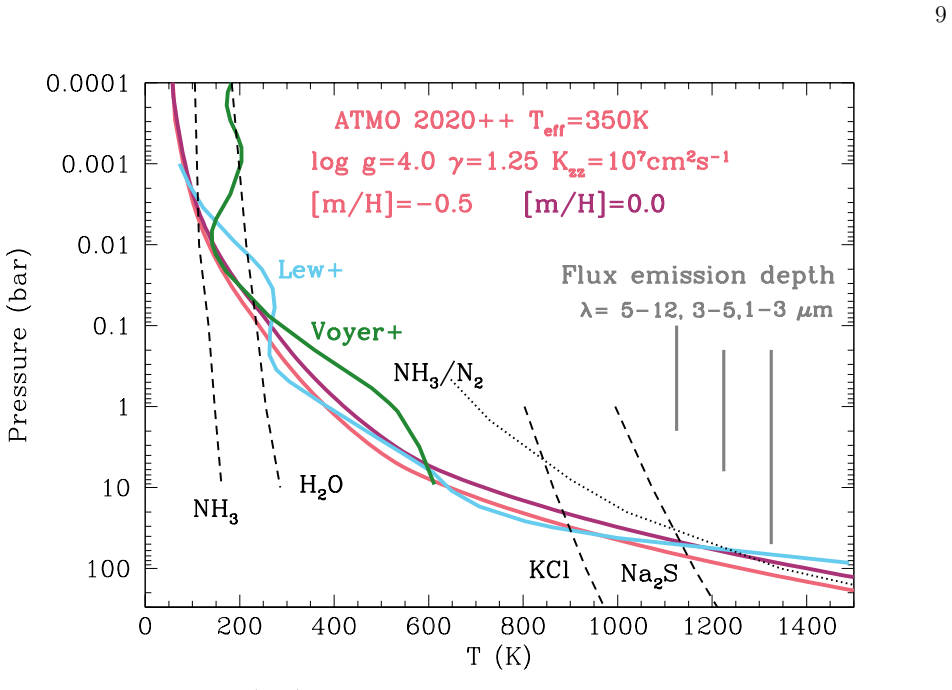
James Webb Space Telescope near- and mid-infrared spectroscopy has been published by Voyer et al. (2025) and Lew et al. (2026) for the Y dwarf which is a distant companion to the white dwarf WD 0806-661 (Luhman et al. 2011). This target is important because the distance and the age of the system are well constrained by the primary star. Voyer et al. perform a retrieval analysis of the longer wavelength MIRI data, and Lew et al. perform retrieval and forward model grid analyses of the NIRSpec data. These studies produce different results, and both are discrepant with evolutionary model calculations based on the age of the system and the luminosity of the Y dwarf. Here we confirm the luminosity of the Y dwarf, and update the age of the system to 1.6 +0.6 -0.4 Gyr. We compare the combined NIRSpec and MIRI dataset to synthetic spectra generated by ATMO 2020++ atmospheric models. We find a good fit across the entire observed spectral energy distribution, except at the shortest near-infrared wavelengths, with atmospheric parameters consistent with evolutionary models. We find the Y dwarf to be slightly metal-poor, with an effective temperature of 357 +/- 3 K, a radius of 1.08 +/- 0.02 R_Jupiter, and a mass of 7 +/- 1 M_Jupiter.
Editorial analysis
A structured set of objections, weighed in public.
Referee Report
Summary. The paper analyzes combined JWST NIRSpec and MIRI spectroscopy of the Y dwarf companion to white dwarf WD 0806-661. Using the ATMO 2020++ forward-model grid, the authors derive Teff = 357 ± 3 K, radius = 1.08 ± 0.02 R_Jup, mass = 7 ± 1 M_Jup and slightly sub-solar metallicity. These parameters provide a good fit to the full SED except at the shortest NIR wavelengths and are reported to be consistent with evolutionary models at the independently determined system age of 1.6 +0.6/-0.4 Gyr, thereby resolving prior discrepancies between atmospheric retrievals and evolutionary tracks.
Significance. If the central result holds, the work supplies a rare benchmark Y dwarf with a well-constrained age and distance, allowing direct tests of both atmospheric and evolutionary models at the lowest temperatures. The use of an independent white-dwarf age anchor and the joint NIRSpec+MIRI coverage are notable strengths that could calibrate model grids for future Y-dwarf studies.
major comments (1)
- [Abstract and spectral fitting section] Abstract and §3 (spectral fitting): the manuscript flags a visibly poorer match at the shortest NIR wavelengths but provides no quantitative test (e.g., χ² contribution per band, fit excluding λ < 1.2 μm, or comparison to an alternate grid) of whether this region biases the reported Teff, radius, or [M/H]. Because the shortest NIR data are sensitive to the same H2O/CH4 features that set Teff, any systematic offset here directly affects the claimed consistency with the 1.6 Gyr evolutionary track.
minor comments (2)
- [Age determination] The age update to 1.6 +0.6/-0.4 Gyr is stated without a dedicated methods subsection showing the white-dwarf cooling-track calculation or the adopted initial-final mass relation.
- [Results table] Table of best-fit parameters should include the reduced χ² and the number of degrees of freedom for the full SED fit to allow readers to judge overall goodness-of-fit.
Simulated Author's Rebuttal
We thank the referee for their positive assessment of the work's significance and for the constructive comment on the spectral fitting analysis. We address the major comment point by point below.
read point-by-point responses
-
Referee: [Abstract and spectral fitting section] Abstract and §3 (spectral fitting): the manuscript flags a visibly poorer match at the shortest NIR wavelengths but provides no quantitative test (e.g., χ² contribution per band, fit excluding λ < 1.2 μm, or comparison to an alternate grid) of whether this region biases the reported Teff, radius, or [M/H]. Because the shortest NIR data are sensitive to the same H2O/CH4 features that set Teff, any systematic offset here directly affects the claimed consistency with the 1.6 Gyr evolutionary track.
Authors: We agree that a quantitative assessment of the short-wavelength NIR region's influence is warranted to strengthen the robustness of the derived parameters. In the revised manuscript we will add: (i) the per-band χ² contributions for the full fit, (ii) the results of a refit excluding all data shortward of 1.2 μm, and (iii) a direct comparison of the resulting Teff, radius, and [M/H] values. These additions will explicitly test whether the noted mismatch biases the atmospheric parameters or the claimed consistency with the 1.6 Gyr evolutionary track. revision: yes
Circularity Check
No significant circularity; derivation is a standard model fit to data followed by external consistency check
full rationale
The paper fits the ATMO 2020++ grid directly to the observed NIRSpec+MIRI SED to extract Teff, radius and [M/H], then compares the resulting parameters against evolutionary tracks evaluated at an age independently constrained by the white-dwarf primary. This is a conventional forward-model validation step whose outcome is not forced by construction from the inputs. No self-definitional loop, fitted-input-renamed-as-prediction, or load-bearing self-citation chain appears; the poorer short-wavelength fit is noted but does not alter the logical structure of the test. The derivation therefore remains self-contained against the supplied observables and external age anchor.
Axiom & Free-Parameter Ledger
free parameters (4)
- effective temperature =
357 K
- radius =
1.08 R_Jup
- mass =
7 M_Jup
- metallicity =
slightly metal-poor
axioms (2)
- domain assumption System age of 1.6 +0.6 -0.4 Gyr derived from white dwarf primary cooling
- domain assumption Luminosity of the Y dwarf correctly measured from distance and photometry
Reference graph
Works this paper leans on
-
[1]
Waldmann, I. P., & Tinetti, G. 2022, ApJ, 932, 123, doi: 10.3847/1538-4357/ac6dcd
-
[2]
2026, AJ, 171, 357, doi: 10.3847/1538-3881/ae650d
Albert, L., Poulsen, S., Le Bourdais, ´E., et al. 2026, AJ, 171, 357, doi: 10.3847/1538-3881/ae650d
-
[3]
Fortney, J. J. 2019, ApJ, 878, 70, doi: 10.3847/1538-4357/ab1b51
-
[4]
Bowler, B. P., Blunt, S. C., & Nielsen, E. L. 2020, AJ, 159, 63, doi: 10.3847/1538-3881/ab5b11
-
[5]
Cushing, M. C., Kirkpatrick, J. D., Gelino, C. R., et al. 2011, ApJ, 743, 50, doi: 10.1088/0004-637X/743/1/50
-
[6]
El-Badry, K., Rix, H.-W., & Weisz, D. R. 2018, ApJL, 860, L17, doi: 10.3847/2041-8213/aaca9c Gaia Collaboration. 2020, VizieR Online Data Catalog: Gaia EDR3 (Gaia Collaboration, 2020), VizieR On-line Data Catalog: I/350. Originally published in: 2021A&A...649A...1G, doi: 10.26093/cds/vizier.1350
-
[7]
J., Van Zandt, J., Petigura, E
Gilbert, G. J., Van Zandt, J., Petigura, E. A., et al. 2026, AJ, 171, 67, doi: 10.3847/1538-3881/ae1fd7
-
[8]
Imig, J., Price, C., Holtzman, J. A., et al. 2023, ApJ, 954, 124, doi: 10.3847/1538-4357/ace9b8
-
[9]
Kirkpatrick, J. D., Gelino, C. R., Faherty, J. K., et al. 2021, ApJS, 253, 7, doi: 10.3847/1538-4365/abd107 K¨ uhnle, H., Patapis, P., Molli` ere, P., et al. 2025, A&A, 695, A224, doi: 10.1051/0004-6361/202452547 11
-
[10]
Leggett, S. K., Phillips, M. W., & Tremblin, P. 2025, ApJ, 991, 193, doi: 10.3847/1538-4357/adf21f
-
[11]
Leggett, S. K., & Tremblin, P. 2023, ApJ, 959, 86, doi: 10.3847/1538-4357/acfdad —. 2024, Research Notes of the American Astronomical Society, 8, 13, doi: 10.3847/2515-5172/ad1b61 —. 2025, ApJ, 979, 145, doi: 10.3847/1538-4357/ad8fa6
-
[12]
Leggett, S. K., Tremblin, P., Phillips, M. W., et al. 2021, ApJ, 918, 11, doi: 10.3847/1538-4357/ac0cfe
-
[13]
Lew, B. W. P., Roellig, T., Batalha, N. E., et al. 2026, AJ, 171, 227, doi: 10.3847/1538-3881/ae4747
-
[14]
1999, ApJ, 519, 793, doi: 10.1086/307387
Lodders, K. 1999, ApJ, 519, 793, doi: 10.1086/307387
-
[15]
Luhman, K. L. 2014, ApJL, 786, L18, doi: 10.1088/2041-8205/786/2/L18
-
[16]
Luhman, K. L., Burgasser, A. J., & Bochanski, J. J. 2011, ApJL, 730, L9, doi: 10.1088/2041-8205/730/1/L9
-
[17]
L., Tremblin, P., Alves de Oliveira, C., et al
Luhman, K. L., Tremblin, P., Alves de Oliveira, C., et al. 2024, AJ, 167, 5, doi: 10.3847/1538-3881/ad0b72
-
[18]
Luyten, W. J. 1949, ApJ, 109, 528, doi: 10.1086/145156
-
[19]
2015, Annual Review of Astronomy and Astrophysics, 53, 279, doi: 10.1146/annurev-astro-082214-122522
Marley, M., & Robinson, T. 2015, Annual Review of Astronomy and Astrophysics, 53, 279, doi: 10.1146/annurev-astro-082214-122522
-
[20]
S., Saumon, D., Visscher, C., et al
Marley, M. S., Saumon, D., Visscher, C., et al. 2021, ApJ, 920, 85, doi: 10.3847/1538-4357/ac141d
-
[21]
Meisner, A. M., Leggett, S. K., Logsdon, S. E., et al. 2023, AJ, 166, 57, doi: 10.3847/1538-3881/acdb68
-
[22]
Morley, C. V., Fortney, J. J., Marley, M. S., et al. 2012, ApJ, 756, 172, doi: 10.1088/0004-637X/756/2/172
-
[23]
Morley, C. V., Marley, M. S., Fortney, J. J., et al. 2014, ApJ, 787, 78, doi: 10.1088/0004-637X/787/1/78
-
[24]
2012, A&A, 541, A41, doi: 10.1051/0004-6361/201117749
Mowlavi, N., Eggenberger, P., Meynet, G., et al. 2012, A&A, 541, A41, doi: 10.1051/0004-6361/201117749
-
[25]
Mukherjee, S., Fortney, J. J., Morley, C. V., et al. 2024, ApJ, 963, 73, doi: 10.3847/1538-4357/ad18c2
-
[26]
Nguyen, C. T., Costa, G., Girardi, L., et al. 2022, A&A, 665, A126, doi: 10.1051/0004-6361/202244166 O’Brien, M. W., Tremblay, P.-E., Gentile Fusillo, N. P., et al. 2023, MNRAS, 518, 3055, doi: 10.1093/mnras/stac3303 O’Brien, M. W., Tremblay, P.-E., Klein, B. L., et al. 2024, MNRAS, 527, 8687, doi: 10.1093/mnras/stad3773
-
[27]
Showman, A. P., & Kaspi, Y. 2013, ApJ, 776, 85, doi: 10.1088/0004-637X/776/2/85
-
[28]
Tan, X., & Showman, A. P. 2017, ApJ, 835, 186, doi: 10.3847/1538-4357/835/2/186 —. 2021, MNRAS, 502, 678, doi: 10.1093/mnras/stab060
-
[29]
Tremblin, P., Amundsen, D. S., Mourier, P., et al. 2015, ApJL, 804, L17, doi: 10.1088/2041-8205/804/1/L17
-
[30]
Tremblin, P., Padioleau, T., Phillips, M. W., et al. 2019, ApJ, 876, 144, doi: 10.3847/1538-4357/ab05db
-
[31]
2025, ApJL, 982, L38, doi: 10.3847/2041-8213/adbd46
Voyer, M., Changeat, Q., Lagage, P.-O., et al. 2025, ApJL, 982, L38, doi: 10.3847/2041-8213/adbd46
discussion (0)
Sign in with ORCID, Apple, or X to comment. Anyone can read and Pith papers without signing in.