All-Sky Ultra-Narrowband Spectral Imaging with the OVRO-LWA: Technosignature Constraints and Axion-Like Particle Prospects
Pith reviewed 2026-06-28 04:47 UTC · model grok-4.3
The pith
No technosignatures detected after all-sky search for ultra-narrowband signals at 50-86 MHz
A machine-rendered reading of the paper's core claim, the machinery that carries it, and where it could break.
Core claim
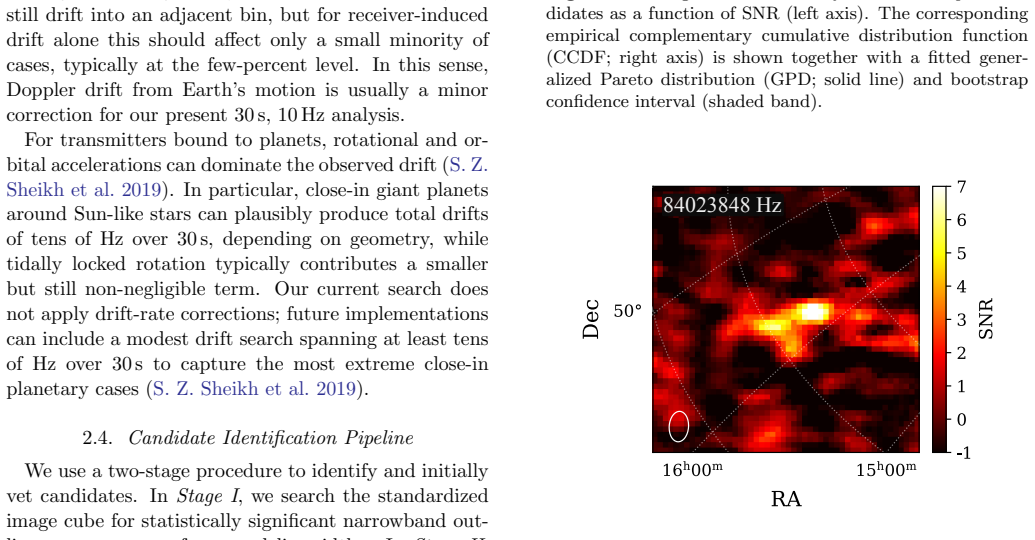
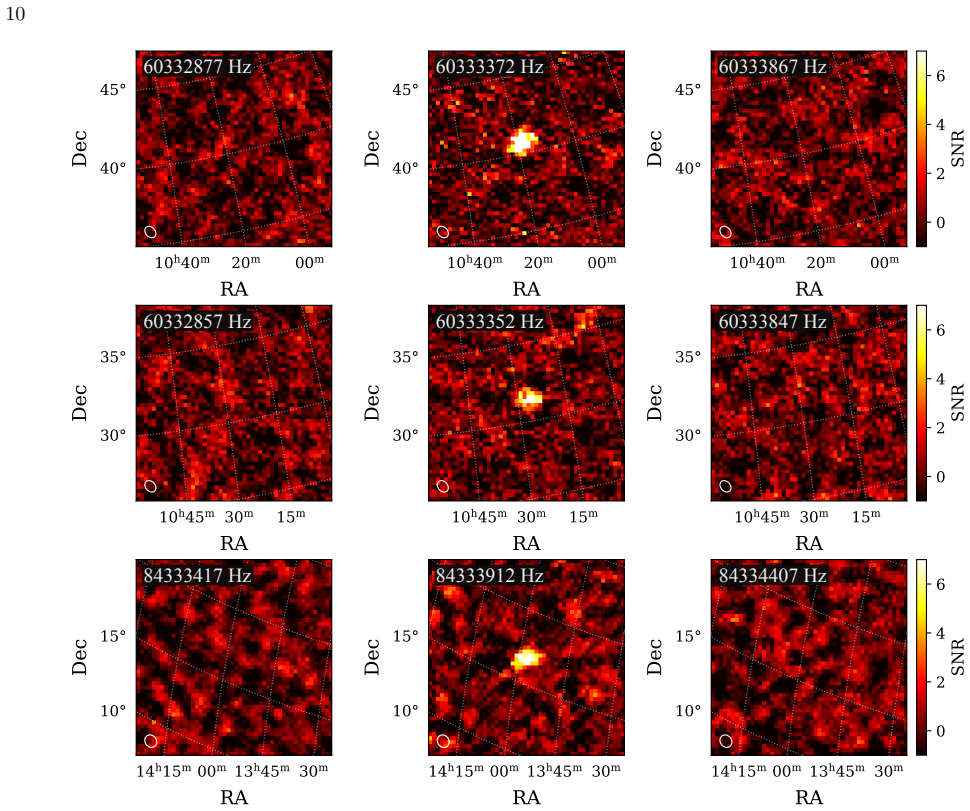
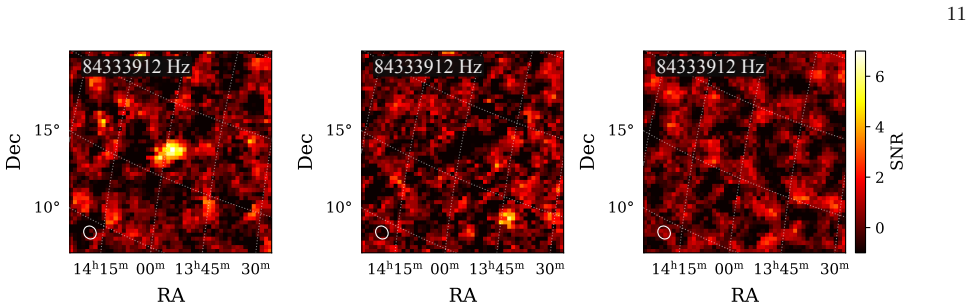
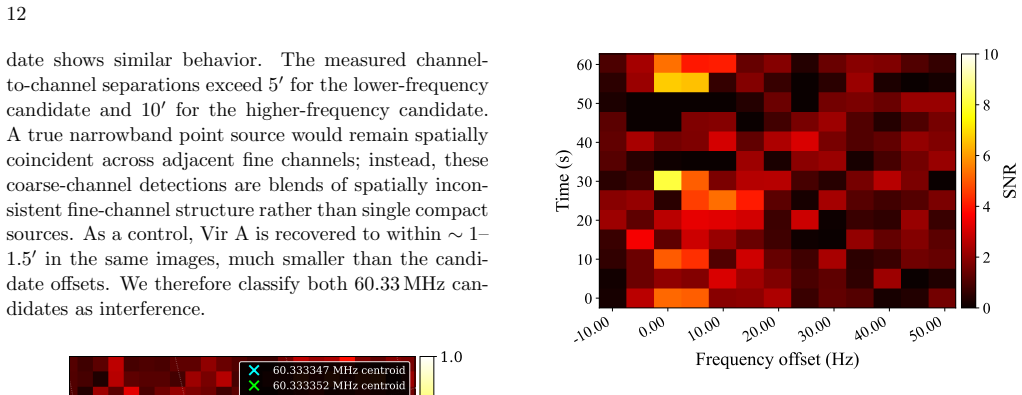
After generating and analyzing more than 3 x 10^6 all-sky images for narrowband signals between 50 and 86 MHz, the search identifies no extraterrestrial technosignatures. Three candidates with signal-to-noise ratios above 10 sigma are re-imaged with finer temporal and spectral resolution and resolved as inconsistent with compact celestial narrowband emitters. The achieved sensitivity is approximately 100 Jy per channel across the visible hemisphere, yielding 10 sigma EIRP upper limits of 10^14 W at 10 pc and 10^18 W at 1 kpc for unresolved emitters. The approach demonstrates simultaneous coverage of millions of stellar systems and establishes a framework for stacked searches toward neutron-s
What carries the argument
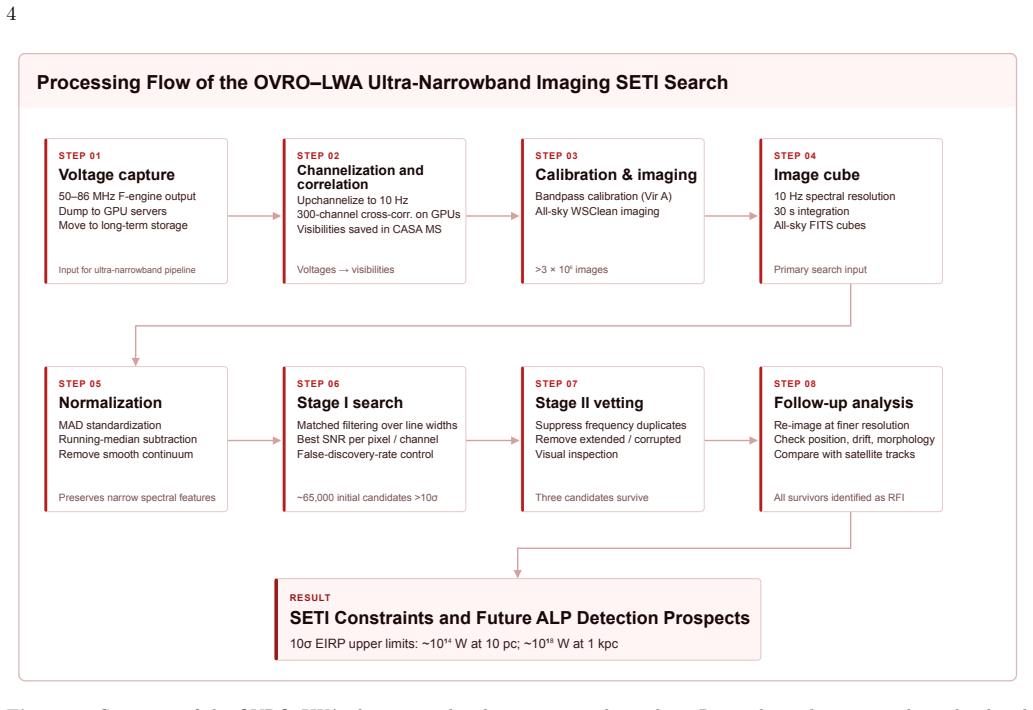
Offline GPU pipeline that upchannelizes raw voltage data to approximately 10 Hz frequency resolution, generates all-sky images for each fine channel, and applies multi-kernel matched filtering with empirical noise standardization and false-discovery-rate control, followed by quality cuts and re-imaging of candidates.
If this is right
- No extraterrestrial technosignatures are present above the search threshold in the surveyed 50-86 MHz band.
- EIRP upper limits of 10^14 W at 10 pc constrain potential transmitter powers for unresolved sources within the local stellar neighborhood.
- The all-sky imaging approach enables simultaneous constraints on technosignatures from millions of stellar systems in a single epoch.
- The method provides a scalable framework for deeper integrations and stacked searches toward specific targets such as neutron stars.
Where Pith is reading between the lines
- Stacking multiple epochs of data with the same pipeline could lower effective detection thresholds for fainter or intermittent signals.
- Cross-referencing surviving candidates with multi-wavelength catalogs could help isolate any future signals from natural astrophysical sources.
- The wide instantaneous field of view could be used to derive statistical upper limits on the sky density of narrowband emitters.
- Applying the pipeline to pointed observations of individual neutron stars could produce quantitative constraints on axion-like particle conversion if signals appear.
Load-bearing premise
The quality cuts that remove extended sources, corrupted images, and obvious RFI, combined with the re-imaging analysis, correctly classify all candidates as non-celestial without excluding genuine compact narrowband emitters from space.
What would settle it
A narrowband signal that persists as compact and point-like after re-imaging at finer temporal and spectral resolution, appears at the same sky position across epochs, and passes all quality cuts would falsify the no-detection claim.
Figures
read the original abstract
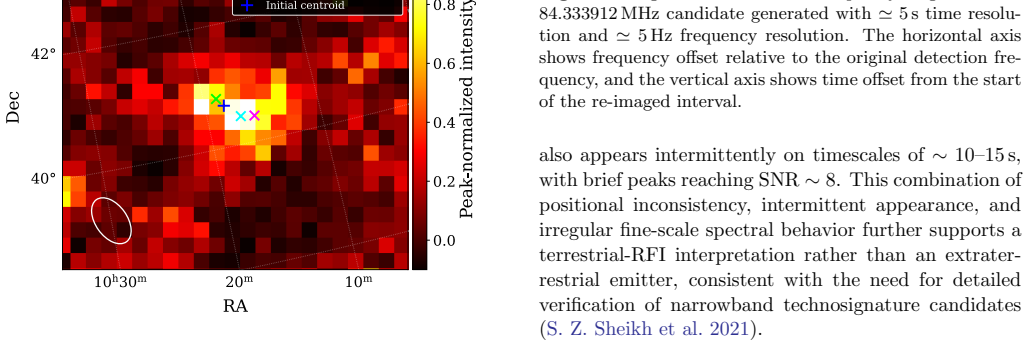
We present an imaging-domain search for technosignatures at decametric wavelengths with the OVRO-LWA, targeting ultra-narrowband continuous-wave signals between 50 and 86 MHz. We implement an offline GPU pipeline that processes raw voltage data with upchannelization to approximately 10 Hz frequency resolution, producing all-sky images for each fine channel and totaling more than 3 x 10^6 images for a single 30 s epoch. Candidate selection is performed using multi-kernel matched filtering across frequency, empirical noise standardization, and false-discovery-rate control. After applying quality cuts that remove extended sources, corrupted images, and obvious RFI, three narrowband candidates with signal-to-noise ratios above 10 sigma were selected for detailed analysis. By re-imaging these candidates with finer temporal and spectral resolution, we resolved their structure and found them to be inconsistent with compact celestial narrowband emitters. Consequently, we report no detection of extraterrestrial technosignatures. The representative sensitivity of the search is ~100 Jy per channel across the entire visible hemisphere. For an unresolved emitter, this corresponds to 10 sigma equivalent isotropic radiated power (EIRP) limits of about 10^14 W at a distance of 10 pc and 10^18 W at 1 kpc. The wide field of view and ultra-fine spectral resolution of this approach enable simultaneous probing of technosignature signals from millions of stellar systems. This method further establishes a scalable framework for deeper integrations and stacked searches toward neutron-star targets relevant to axion-like particle (ALP) line conversion.
Editorial analysis
A structured set of objections, weighed in public.
Referee Report
Summary. The paper reports an all-sky search for ultra-narrowband continuous-wave technosignatures between 50 and 86 MHz using the OVRO-LWA. An offline GPU pipeline performs upchannelization to ~10 Hz resolution, generates >3×10^6 all-sky images per 30 s epoch, applies multi-kernel matched filtering with empirical noise standardization and FDR control for candidate selection, imposes quality cuts to remove extended sources, corrupted images, and obvious RFI, identifies three >10σ candidates, and rejects them after finer temporal/spectral re-imaging as inconsistent with compact celestial emitters. The work concludes with no detections, a representative sensitivity of ~100 Jy per channel, and corresponding 10σ EIRP limits of ~10^14 W at 10 pc and ~10^18 W at 1 kpc for unresolved sources, while noting scalability for ALP line-conversion searches toward neutron stars.
Significance. If the pipeline, candidate rejection, and sensitivity claims hold, the result supplies a statistically controlled null detection over the entire visible hemisphere at decametric wavelengths and demonstrates a scalable wide-field approach capable of simultaneously constraining millions of stellar systems. The explicit use of matched filtering plus FDR control and the re-imaging verification step provide concrete methodological strengths that support the reported EIRP limits and open a practical path for deeper stacked integrations and targeted ALP searches.
minor comments (2)
- [Abstract] The abstract states that the three candidates were resolved as inconsistent with compact celestial narrowband emitters after re-imaging, but does not quantify the exact temporal and spectral resolutions used in the re-imaging step or the precise morphological criteria applied; adding these numbers would strengthen the claim that genuine compact signals would have been retained.
- [Abstract] The representative sensitivity of ~100 Jy per channel is quoted without an accompanying equation or brief derivation showing how it is obtained from the noise properties after matched filtering; a short parenthetical or footnote would clarify whether this is an average, median, or worst-case value across the band.
Simulated Author's Rebuttal
We thank the referee for their positive assessment of the manuscript and the recommendation to accept. The summary accurately captures the search methodology, candidate handling, and reported limits.
Circularity Check
No circularity: direct observational pipeline with no derivation chain
full rationale
The manuscript presents a direct observational search for narrowband signals using raw voltage data processed through an offline GPU pipeline for upchannelization, all-sky imaging, multi-kernel matched filtering, FDR control, quality cuts, and re-imaging of candidates. No equations, fitted parameters, or mathematical derivations appear in the provided text; the null result and sensitivity limits follow from empirical data processing steps without reduction to self-defined inputs or self-citations. The analysis is self-contained against external telescope data benchmarks.
Axiom & Free-Parameter Ledger
axioms (1)
- domain assumption Technosignature signals, if present, would appear as ultra-narrowband continuous-wave emissions distinguishable from RFI by spatial and spectral structure
Reference graph
Works this paper leans on
-
[1]
2024, Nature Communications, 15, 915, doi: 10.1038/s41467-024-45033-4
An, H., Chen, X., Ge, S., Liu, J., & Luo, Y. 2024, Nature Communications, 15, 915, doi: 10.1038/s41467-024-45033-4
-
[2]
Anderson, M. M., Hallinan, G., Eastwood, M. W., et al. 2018, ApJ, 864, 22, doi: 10.3847/1538-4357/aad2d7
-
[3]
Anderson, M. M., Hallinan, G., Eastwood, M. W., et al. 2019, ApJ, 886, 123, doi: 10.3847/1538-4357/ab4f87
-
[4]
A., Garbrecht, B., McDonald, J., & Srinivasan, S
Battye, R. A., Garbrecht, B., McDonald, J., & Srinivasan, S. 2021, Journal of High Energy Physics, 2021, 105, doi: 10.1007/JHEP09(2021)105
-
[5]
Journal of the Royal Statistical Society Series B: Statistical Methodology , author =
Benjamini, Y., & Hochberg, Y. 1995, Journal of the Royal Statistical Society, Series B, 57, 289, doi: 10.1111/j.2517-6161.1995.tb02031.x
-
[6]
Lorimer, D. R. 2004, ApJ, 605, 759, doi: 10.1086/382680 Bhupal Dev, P. S., Ferrer, F., & Okawa, T. 2024, JCAP, 2024, 045, doi: 10.1088/1475-7516/2024/04/045
-
[7]
Brzycki, B., Siemion, A. P. V., de Pater, I., et al. 2024, AJ, 168, 284, doi: 10.3847/1538-3881/ad7e18
-
[8]
Caputo, A., Regis, M., Taoso, M., & Witte, S. J. 2019, JCAP, 2019, 027, doi: 10.1088/1475-7516/2019/03/027 CASA Team, Bean, B., Bhatnagar, S., et al. 2022, PASP, 134, 114501, doi: 10.1088/1538-3873/ac9642
-
[9]
2012, Nature, 481, 167, doi: 10.1038/nature10684
Cassan, A., Kubas, D., Beaulieu, J.-P., et al. 2012, Nature, 481, 167, doi: 10.1038/nature10684
-
[10]
Chadha-Day, F., Ellis, J., & Marsh, D. J. E. 2022, Science Advances, 8, eabj3618, doi: 10.1126/sciadv.abj3618
-
[11]
2025, ApJL, 990, L50, doi: 10.3847/2041-8213/adfa71 16
Chen, X., Chen, B., Yu, S., et al. 2025, ApJL, 990, L50, doi: 10.3847/2041-8213/adfa71 16
-
[12]
Chhabra, S., Gary, D. E., Hallinan, G., et al. 2021, ApJ, 906, 132, doi: 10.3847/1538-4357/abc94b
-
[13]
Accelerating Radio Astronomy Cross-Correlation with Graphics Processing Units
Clark, M. A., La Plante, P. C., & Greenhill, L. J. 2011, arXiv e-prints, arXiv:1107.4264, doi: 10.48550/arXiv.1107.4264
work page internal anchor Pith review Pith/arXiv arXiv doi:10.48550/arxiv.1107.4264 2011
-
[14]
1959, Nature, 184, 844, doi: 10.1038/184844a0
Cocconi, G., & Morrison, P. 1959, Nature, 184, 844, doi: 10.1038/184844a0
-
[15]
Cordes, J. M., Lazio, J. W., & Sagan, C. 1997, ApJ, 487, 782, doi: 10.1086/304620
-
[16]
W.D.CottonandF.Yusef-Zadeh.ApJS,227(1):10,Nov.2016
Cordes, J. M., & Lazio, T. J. 1991, ApJ, 376, 123, doi: 10.1086/170261
-
[17]
Cordes, J. M., Ocker, S. K., & Chatterjee, S. 2022, ApJ, 931, 88, doi: 10.3847/1538-4357/ac6873
-
[18]
Cordes, J. M., & Rickett, B. J. 1998, ApJ, 507, 846, doi: 10.1086/306358
-
[19]
Cranmer, M. D., Barsdell, B. R., Price, D. C., et al. 2017, Journal of Astronomical Instrumentation, 6, 1750007, doi: 10.1142/S2251171717500076
-
[20]
Czech, D., Isaacson, H., Pearce, L., et al. 2021, PASP, 133, 064502, doi: 10.1088/1538-3873/abf329
-
[21]
2025, ApJ, 993, 82, doi: 10.3847/1538-4357/adfbe9
Davis, I., Hallinan, G., Saini, N., et al. 2025, ApJ, 993, 82, doi: 10.3847/1538-4357/adfbe9
-
[22]
Drake, F. D. 1961, Physics Today, 14, 40, doi: 10.1063/1.3057500
-
[23]
Eastwood, M. W., Anderson, M. M., Monroe, R. M., et al. 2018, AJ, 156, 32, doi: 10.3847/1538-3881/aac721
-
[24]
Eastwood, M. W., Anderson, M. M., Monroe, R. M., et al. 2019, AJ, 158, 84, doi: 10.3847/1538-3881/ab2629
-
[25]
W., de Gasperin, F., & Rafferty, D
Edler, H. W., de Gasperin, F., & Rafferty, D. 2021, A&A, 652, A37, doi: 10.1051/0004-6361/202140465
-
[26]
E., Siemion, A., Foster, G., et al
Enriquez, J. E., Siemion, A., Foster, G., et al. 2017, ApJ, 849, 104, doi: 10.3847/1538-4357/aa8d1b Gaia Collaboration, Smart, R. L., Sarro, L. M., et al. 2021a, A&A, 649, A6, doi: 10.1051/0004-6361/202039498 Gaia Collaboration, Brown, A. G. A., Vallenari, A., et al. 2021b, A&A, 649, A1, doi: 10.1051/0004-6361/202039657
-
[27]
Gajjar, V., & Brown, G. C. 2026, ApJ, 999, 210, doi: 10.3847/1538-4357/ae3d33
-
[28]
2021, MNRAS, 506, 5802, doi: 10.1093/mnras/stab1671
Garsden, H., Greenhill, L., Bernardi, G., et al. 2021, MNRAS, 506, 5802, doi: 10.1093/mnras/stab1671
-
[29]
Lindner, A., & van Bibber, K. A. 2015, Annual Review of Nuclear and Particle Science, 65, 485, doi: 10.1146/annurev-nucl-102014-022120
-
[30]
2024, in American Astronomical Society Meeting Abstracts, Vol
Hallinan, G., Ravi, V., Bouman, K., et al. 2024, in American Astronomical Society Meeting Abstracts, Vol. 243, American Astronomical Society Meeting Abstracts #243, 237.05
2024
-
[31]
The DSA-2000 -- A Radio Survey Camera
Hallinan, G., Ravi, V., Weinreb, S., et al. 2019, in Bulletin of the American Astronomical Society, Vol. 51, 255, doi: 10.48550/arXiv.1907.07648
work page internal anchor Pith review Pith/arXiv arXiv doi:10.48550/arxiv.1907.07648 2019
-
[32]
Harp, G. R. 2005, Radio Science, 40, RS5S18, doi: 10.1029/2004RS003133
-
[33]
Harp, G. R., Richards, J., Tarter, J. C., et al. 2016, AJ, 152, 181, doi: 10.3847/0004-6256/152/6/181
-
[34]
Henry, T. J., Jao, W.-C., Winters, J. G., et al. 2018, AJ, 155, 265, doi: 10.3847/1538-3881/aac262
-
[35]
Hook, A., Kahn, Y., Safdi, B. R., & Sun, Z. 2018, PhRvL, 121, 241102, doi: 10.1103/PhysRevLett.121.241102
-
[36]
2023, MNRAS, 521, 5786, doi: 10.1093/mnras/stad785
Hou, K.-C., Hallinan, G., & Keshet, U. 2023, MNRAS, 521, 5786, doi: 10.1093/mnras/stad785
-
[37]
J., Bassa, C., et al
Hut, B., Baldovin, C. J., Bassa, C., et al. 2024, in Society of Photo-Optical Instrumentation Engineers (SPIE) Conference Series, Vol. 13096, Ground-based and Airborne Instrumentation for Astronomy X, ed. J. J
2024
-
[38]
Bryant, K. Motohara, & J. R. D. Vernet, 130962G, doi: 10.1117/12.3018926
-
[39]
T., van der Tol, S., Cotton, W
Intema, H. T., van der Tol, S., Cotton, W. D., et al. 2009, A&A, 501, 1185, doi: 10.1051/0004-6361/200811094
-
[40]
Irastorza, I. G., & Redondo, J. 2018, Progress in Particle and Nuclear Physics, 102, 89, doi: 10.1016/j.ppnp.2018.05.003
-
[41]
Johnson, O. A., Gajjar, V., Keane, E. F., et al. 2023, AJ, 166, 193, doi: 10.3847/1538-3881/acf9f5
-
[42]
2025, ApJ, 985, 265, doi: 10.3847/1538-4357/add014
Kosogorov, N., Hallinan, G., Law, C., et al. 2025, ApJ, 985, 265, doi: 10.3847/1538-4357/add014
-
[43]
2026, ApJ, 997, 311, doi: 10.3847/1538-4357/ae2ea3
Kosogorov, N., Hallinan, G., Law, C., et al. 2026, ApJ, 997, 311, doi: 10.3847/1538-4357/ae2ea3
-
[44]
Lam, M. T., McLaughlin, M. A., Cordes, J. M., Chatterjee, S., & Lazio, T. J. W. 2018, ApJ, 861, 12, doi: 10.3847/1538-4357/aac48d
-
[45]
Leroy, M., Chianese, M., Edwards, T. D. P., & Weniger, C. 2020, PhRvD, 101, 123003, doi: 10.1103/PhysRevD.101.123003
-
[46]
2020, Research in Astronomy and Astrophysics, 20, 078, doi: 10.1088/1674-4527/20/5/78
Li, D., Gajjar, V., Wang, P., et al. 2020, Research in Astronomy and Astrophysics, 20, 078, doi: 10.1088/1674-4527/20/5/78
-
[47]
2007, JCAP, 2007, 020, doi: 10.1088/1475-7516/2007/01/020
Loeb, A., & Zaldarriaga, M. 2007, JCAP, 2007, 020, doi: 10.1088/1475-7516/2007/01/020
-
[48]
X., Croft, S., Lintott, C., & Siemion, A
Ma, P. X., Croft, S., Lintott, C., & Siemion, A. P. V. 2024, RAS Techniques and Instruments, 3, 33, doi: 10.1093/rasti/rzad056
-
[49]
Margot, J.-L., Li, M. G., Pinchuk, P., et al. 2023, AJ, 166, 206, doi: 10.3847/1538-3881/acfda4
-
[50]
Marsh, D. J. E. 2016, PhR, 643, 1, doi: 10.1016/j.physrep.2016.06.005
-
[51]
Mezger, P. G., & Henderson, A. P. 1967, ApJ, 147, 471, doi: 10.1086/149030 17
-
[52]
J., Baum, S., Lawson, M., & Marsh, M
Millar, A. J., Baum, S., Lawson, M., & Marsh, M. C. D. 2021, JCAP, 2021, 013, doi: 10.1088/1475-7516/2021/11/013
-
[53]
2025a, ApJ, 992, 143, doi: 10.3847/1538-4357/ae061f
Mondal, S., Chen, B., Chen, X., et al. 2025a, ApJ, 992, 143, doi: 10.3847/1538-4357/ae061f
-
[54]
2025b, ApJ, 994, 254, doi: 10.3847/1538-4357/ae113b
Mondal, S., Chen, B., Yu, S., et al. 2025b, ApJ, 994, 254, doi: 10.3847/1538-4357/ae113b
-
[55]
Monroe, R., Romero Wolf, A., Hallinan, G., et al. 2020, Nuclear Instruments and Methods in Physics Research A, 953, 163086, doi: 10.1016/j.nima.2019.163086 NASA Technosignatures Workshop Participants. 2018, arXiv e-prints, arXiv:1812.08681, doi: 10.48550/arXiv.1812.08681
-
[56]
Ocker, S. K., & Cordes, J. M. 2026, ApJ, 1002, 3, doi: 10.3847/1538-4357/ae5825
-
[57]
R., McKinley, B., Hurley-Walker, N., et al
Offringa, A. R., McKinley, B., Hurley-Walker, N., et al. 2014, MNRAS, 444, 606, doi: 10.1093/mnras/stu1368
-
[58]
Perley, R. A., & Butler, B. J. 2017, ApJS, 230, 7, doi: 10.3847/1538-4365/aa6df9
-
[59]
Petigura, E. A., Howard, A. W., & Marcy, G. W. 2013, Proceedings of the National Academy of Science, 110, 19273, doi: 10.1073/pnas.1319909110
-
[60]
2022, in 37th International Cosmic Ray Conference, 204, doi: 10.22323/1.395.0204
Hallinan, G. 2022, in 37th International Cosmic Ray Conference, 204, doi: 10.22323/1.395.0204
-
[61]
A., Romero-Wolf, A., Hallinan, G., et al
Plant, K. A., Romero-Wolf, A., Hallinan, G., et al. 2026, arXiv e-prints, arXiv:2603.13205, doi: 10.48550/arXiv.2603.13205
-
[62]
Price, D. C., Enriquez, J. E., Brzycki, B., et al. 2020, AJ, 159, 86, doi: 10.3847/1538-3881/ab65f1
-
[63]
Reardon, D. J., Coles, W. A., Hobbs, G., et al. 2019, MNRAS, 485, 4389, doi: 10.1093/mnras/stz643
-
[64]
Reid, M. J., Schneps, M. H., Moran, J. M., et al. 1988, ApJ, 330, 809, doi: 10.1086/166514
-
[65]
2019, Skyfield: High precision research-grade positions for planets and Earth satellites generator,, Astrophysics Source Code Library, record ascl:1907.024 http://ascl.net/1907.024
Rhodes, B. 2019, Skyfield: High precision research-grade positions for planets and Earth satellites generator,, Astrophysics Source Code Library, record ascl:1907.024 http://ascl.net/1907.024
2019
-
[66]
Rickett, B. J. 1990, ARA&A, 28, 561, doi: 10.1146/annurev.aa.28.090190.003021
-
[67]
Rioja, M. J., & Dodson, R. 2020, A&A Rv, 28, 6, doi: 10.1007/s00159-020-00126-z
-
[68]
Safdi, B. R., Sun, Z., & Chen, A. Y. 2019, PhRvD, 99, 123021, doi: 10.1103/PhysRevD.99.123021
-
[69]
Sheikh, S. Z. 2020, International Journal of Astrobiology, 19, 237, doi: 10.1017/S1473550419000284
-
[70]
Sheikh, S. Z. 2021, PhD thesis, Pennsylvania State University
2021
-
[71]
Sheikh, S. Z., Wright, J. T., Siemion, A., & Enriquez, J. E. 2019, ApJ, 884, 14, doi: 10.3847/1538-4357/ab3fa8
-
[72]
Sheikh, S. Z., Smith, S., Price, D. C., et al. 2021, Nature Astronomy, 5, 1153, doi: 10.1038/s41550-021-01508-8
-
[73]
2001, Annual Review of Astronomy and Astrophysics, 39, 511, doi: 10.1146/annurev.astro.39.1.511
Tarter, J. 2001, ARA&A, 39, 511, doi: 10.1146/annurev.astro.39.1.511
-
[74]
Taylor, G. B., Ellingson, S. W., Kassim, N. E., et al. 2012, Journal of Astronomical Instrumentation, 1, 1250004, doi: 10.1142/S2251171712500043
-
[75]
Thompson, A. R., Moran, J. M., & Swenson, Jr., G. W. 2017, Interferometry and Synthesis in Radio Astronomy, 3rd Edition, doi: 10.1007/978-3-319-44431-4
-
[76]
J., Tremblay, C., Walsh, A., & Urquhart, R
Tingay, S. J., Tremblay, C., Walsh, A., & Urquhart, R. 2016, ApJL, 827, L22, doi: 10.3847/2041-8205/827/2/L22
-
[77]
Tingay, S. J., Tremblay, C. D., & Croft, S. 2018a, ApJ, 856, 31, doi: 10.3847/1538-4357/aab363
-
[78]
Tingay, S. J., Kaplan, D. L., Lenc, E., et al. 2018b, ApJ, 857, 11, doi: 10.3847/1538-4357/aab359
-
[79]
Tremblay, C. D., Price, D. C., & Tingay, S. J. 2022, PASA, 39, e008, doi: 10.1017/pasa.2022.5
-
[80]
Tremblay, C. D., & Tingay, S. J. 2020, PASA, 37, e035, doi: 10.1017/pasa.2020.27
discussion (0)
Sign in with ORCID, Apple, or X to comment. Anyone can read and Pith papers without signing in.