Quaternion Dirac--Coulomb--Breit Integral Transformation for Relativistic Four-Component Correlated Electronic Structure Theory
Pith reviewed 2026-06-28 04:27 UTC · model grok-4.3
The pith
A quaternion-based direct transformation scheme enables efficient inclusion of Dirac-Coulomb-Breit integrals in four-component relativistic calculations.
A machine-rendered reading of the paper's core claim, the machinery that carries it, and where it could break.
Core claim
The paper claims that operating on scalar AO integrals with quaternion density-based contractions and direct Cauchy-Schwarz screening produces a transformation whose practical scaling, memory footprint, and parallel efficiency make routine inclusion of full Dirac-Coulomb-Breit integrals feasible in large-scale four-component correlated work.
What carries the argument
Quaternion representation of the integrals combined with direct Cauchy-Schwarz screening, which performs density-based contractions on scalar AO integrals to exploit locality.
If this is right
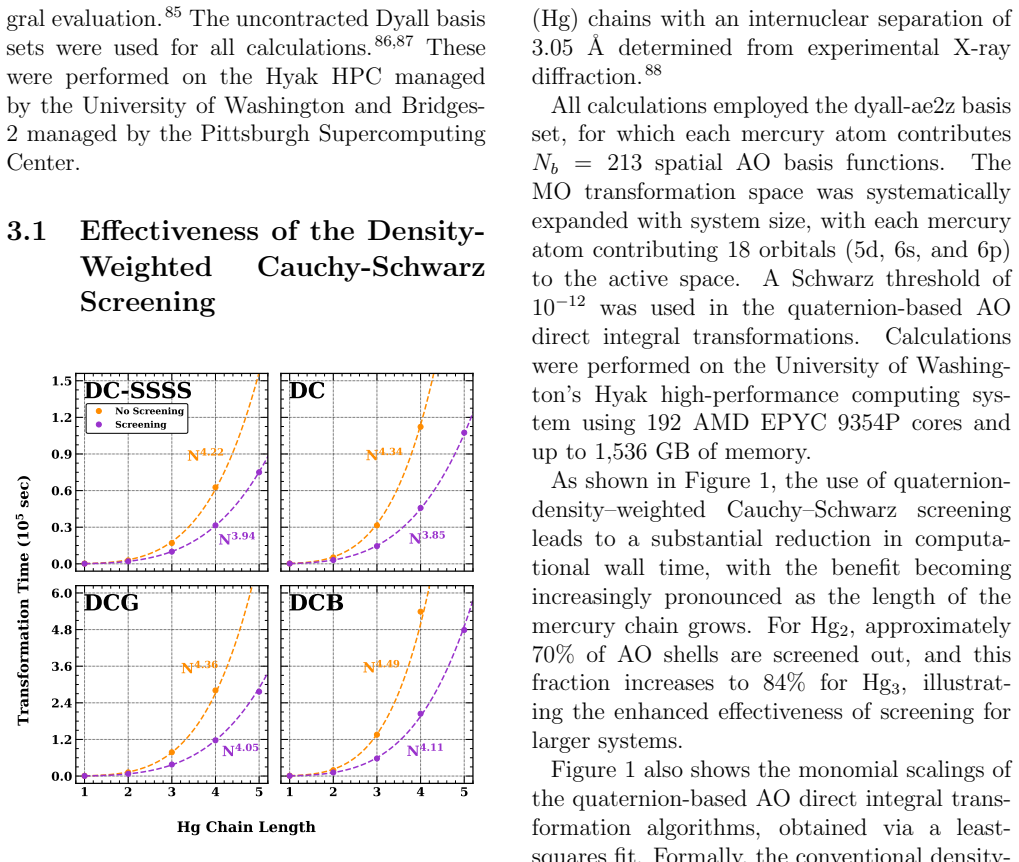
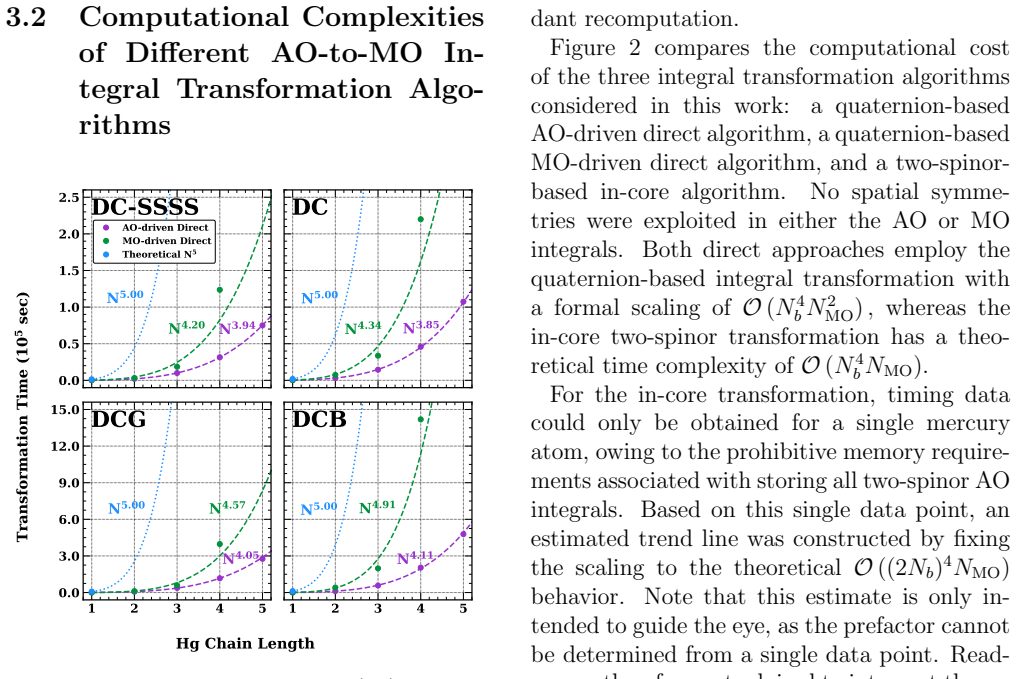
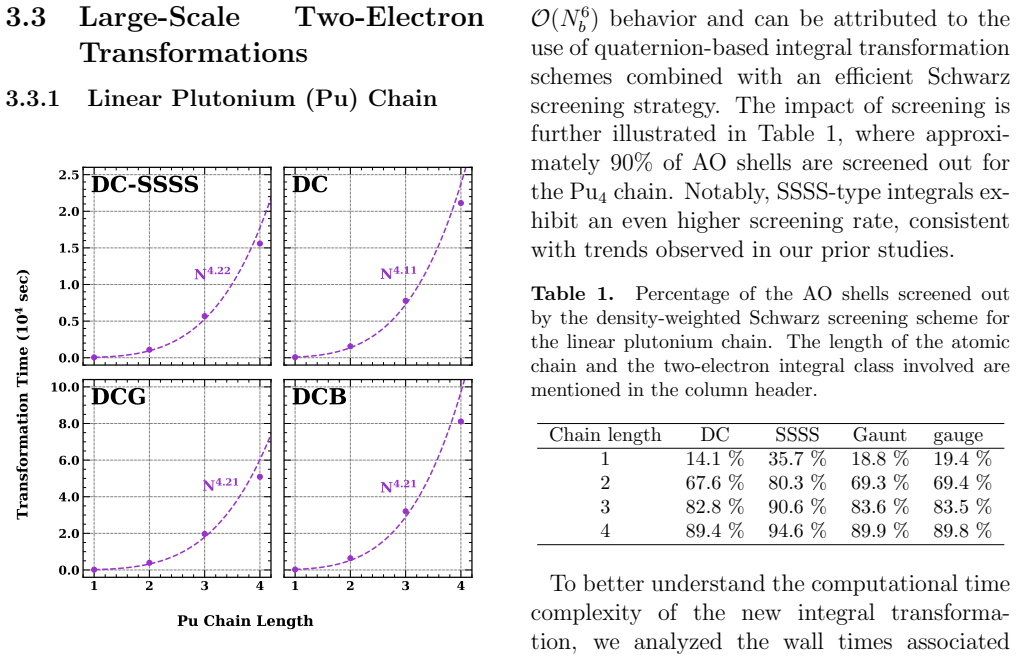
- The transformation step exhibits substantially lower practical computational scaling.
- Memory requirements are reduced because the method remains AO-driven and screened.
- The algorithm supports high parallel efficiency across distributed nodes.
- Routine use of Dirac-Coulomb-Breit integrals becomes possible inside large-scale four-component correlated calculations.
Where Pith is reading between the lines
- The same screening logic could be applied to other relativistic two-electron operators beyond the Breit term.
- Reduced transformation cost may allow direct comparison of four-component results against experiment for molecules containing fifth-row or heavier elements.
- The parallel structure suggests straightforward porting to GPU or distributed-memory architectures for systems with hundreds of atoms.
Load-bearing premise
The quaternion representation combined with direct Cauchy-Schwarz screening preserves numerical accuracy and completeness while exploiting locality.
What would settle it
Numerical agreement of total energies or correlation energies to within 10^-6 hartree between the screened quaternion transformation and a conventional unscreened transformation on a 50-atom test molecule, accompanied by measured reductions in memory and wall time.
Figures
read the original abstract
High-accuracy correlated four-component relativistic electronic structure methods are typically formulated in terms of integrals over molecular orbital (MO). Consequently, an efficient and scalable strategy is required to deal with the complexity of transforming relativistic two-electron integrals from the atomic orbital (AO) to the MO basis. The transformation bottleneck is particularly acute for approaches that include Breit interaction integrals, whose computational and memory demands further exacerbate the transformation cost. To overcome this challenge, we develop a quaternion-based, AO-driven direct integral transformation scheme. The method operates on scalar AO integrals and combines quaternion density-based contractions with direct Cauchy-Schwarz screening to systematically exploit integral locality. As a result, the proposed framework substantially lowers the practical computational scaling and provides an efficient, memory-conscious, and highly parallelizable pathway for the routine inclusion of relativistic Dirac-Coulomb-Breit integrals in large-scale four-component correlated calculations.
Editorial analysis
A structured set of objections, weighed in public.
Referee Report
Summary. The manuscript develops a quaternion-based, AO-driven direct integral transformation for relativistic four-component methods that incorporates Dirac-Coulomb-Breit integrals. It employs quaternion density contractions combined with direct Cauchy-Schwarz screening to exploit locality and reduce the cost of the AO-to-MO transformation step.
Significance. If the numerical accuracy and scaling claims are validated, the approach would address a significant computational bottleneck, enabling routine inclusion of Breit interactions in large-scale four-component correlated calculations. The work builds on standard quaternion algebra and screening techniques without introducing fitted parameters.
major comments (2)
- [Abstract] Abstract: the central claim that the framework 'substantially lowers the practical computational scaling' is presented without any benchmarks, error analysis, scaling plots, or derivation details. This leaves the load-bearing assertion of improved efficiency and preserved completeness unsupported by evidence in the manuscript.
- [Abstract] Abstract (method description): the assertion that 'direct Cauchy-Schwarz screening' preserves numerical accuracy and completeness for quaternion four-component integrals does not address the non-commutative multiplication or differing norm properties relative to the real-valued case. No adjusted threshold derivation or error-bound proof is referenced, making the completeness guarantee an unverified extrapolation.
Simulated Author's Rebuttal
We thank the referee for their constructive comments on our manuscript. We address each major comment below, clarifying the supporting material present in the full text and indicating where revisions will strengthen the presentation.
read point-by-point responses
-
Referee: [Abstract] Abstract: the central claim that the framework 'substantially lowers the practical computational scaling' is presented without any benchmarks, error analysis, scaling plots, or derivation details. This leaves the load-bearing assertion of improved efficiency and preserved completeness unsupported by evidence in the manuscript.
Authors: The abstract is a concise summary; the full manuscript contains the requested evidence. Section 4 presents timing benchmarks and scaling plots (Figures 4–6) for systems up to several hundred basis functions, Table 3 reports error analysis relative to conventional transformation, and Section 3 derives the AO-driven quaternion contraction and screening algorithm. These results support the practical scaling reduction. We will add a parenthetical reference to these sections in the revised abstract for clarity. revision: partial
-
Referee: [Abstract] Abstract (method description): the assertion that 'direct Cauchy-Schwarz screening' preserves numerical accuracy and completeness for quaternion four-component integrals does not address the non-commutative multiplication or differing norm properties relative to the real-valued case. No adjusted threshold derivation or error-bound proof is referenced, making the completeness guarantee an unverified extrapolation.
Authors: Section 3.3 derives the screening explicitly for quaternion integrals. Because the quaternion norm satisfies |q1 q2| = |q1| |q2|, the standard Cauchy–Schwarz bound carries over without modification; non-commutativity does not affect the norm inequality used for screening. The error analysis and threshold choice are given in Equations (18)–(21). To make this explicit in the abstract-level description, we will insert a brief clarifying sentence referencing the quaternion-norm derivation. revision: yes
Circularity Check
No circularity: algorithmic construction from standard properties
full rationale
The paper describes an algorithmic method for AO-to-MO integral transformation that combines quaternion algebra with direct Cauchy-Schwarz screening. No equations or claims reduce by construction to their own inputs; there are no fitted parameters renamed as predictions, no self-definitional loops, and no load-bearing self-citations that substitute for independent derivation. The contribution is a direct implementation of known quaternion multiplication rules and screening bounds applied to four-component integrals, which is self-contained against external mathematical facts and does not rely on the target result to justify itself.
Axiom & Free-Parameter Ledger
axioms (2)
- domain assumption Quaternion algebra can faithfully represent the four-component structure of Dirac-Coulomb-Breit integrals when operating on scalar AO integrals.
- domain assumption Direct Cauchy-Schwarz screening can be applied during the transformation without introducing unacceptable numerical errors.
Reference graph
Works this paper leans on
-
[1]
No- pair Relativistic Quantum Chemistry
(3) Chantler, C. T.; Nguyen, T. V. B.; Lowe, J. A.; Grant, I. P. Conver- gence of the Breit Interaction in Self- consistent and Configuration-interaction Approaches.Phys. Rev. A2014,90, 062504. (4) Kozio l, K.; Gim´ enez, C. A.; Au- car, G. A. Breit Corrections to Individual Atomic and Molecular Orbital Energies. J. Chem. Phys.2018,148, 044113. (5) Sun, S...
2018
-
[2]
Ideas of Relativistic Quantum Chemistry.Mol
(64) Liu, W. Ideas of Relativistic Quantum Chemistry.Mol. Phys.2010,108, 1679–
2010
-
[3]
F.; Zhang, T.; Li, X
15 (66) Sun, S.; Stetina, T. F.; Zhang, T.; Li, X. InRare Earth Elements and Ac- tinides: Progress in Computational Sci- ence Applications; Penchoff, D. A., Win- dus, T. L., C., P. C., Eds.; American Chemical Society, 2021; Vol. 1388; Chap- ter Chapter 10 - On the Finite Nuclear Effect and Gaussian Basis Set for Four- Component Dirac Hartree-Fock Calcula-...
2021
-
[4]
(68) Saue, T.; Jensen, H. J. A. Quater- nion Symmetry in Relativistic Molecular Calculations: The Dirac–Hartree–Fock Method.J. Chem. Phys.1999,111, 6211–6222. (69) Visscher, L. The Dirac Equation in Quantum Chemistry: Strategies to Over- come the Current Computational Prob- lems.J. Comput. Chem.2002,23, 759–
1999
-
[5]
d.; Visscher, L
(70) Jong, G. d.; Visscher, L. Using the lo- cality of the small-component density in molecular Dirac-Hartree-Fock calcula- tions.Theor. Chem. Acc.2002,107, 304 –
2002
-
[6]
(71) Whitten, J. L. Coulombic Potential En- ergy Integrals and Approximations.J. Chem. Phys.1973,58, 4496–4501. (72) Surj´ an, P. R.; Kert´ esz, M.; Karpfen, A.; Koller, J. c. v. Ab Initio Numerical Stud- ies on Density-matrix Asymptotics in Ex- tended Systems.Phys. Rev. B1983,27, 7583–7588. (73) Gill, P. M.; Johnson, B. G.; Pople, J. A. A Simple Yet Powe...
1973
-
[7]
E.; Lu, L.; Hu, H.; Shu- milov, K
(82) Hoyer, C. E.; Lu, L.; Hu, H.; Shu- milov, K. D.; Sun, S.; Knecht, S.; Li, X. Correlated Dirac–Coulomb–Breit Mul- ticonfigurational Self-Consistent-Field Methods.J. Chem. Phys.2023,158, 044101. (83) Sun, Q.; Zhang, X.; Banerjee, S.; Bao, P.; Barbry, M.; Blunt, N. S.; Bog- danov, N. A.; Booth, G. H.; Chen, J.; Cui, Z.-H.; Eriksen, J. J.; Gao, Y.; Guo, ...
2023
-
[8]
(86) Dyall, K. G. Relativistic Double-zeta, Triple-zeta, and Quadruple-zeta Basis Sets for the 5d Elements Hf–hg.Theor. Chem. Acc.2004,112, 403–409. (87) Dyall, K. G. Relativistic Double-zeta, Triple-zeta, and Quadruple-zeta Basis Sets for the Actinides Ac–lr.Theor. Chem. Acc.2007,117, 491–500. (88) Halder, N. C.; Metzger, R. J.; Wagner, C. N. J. Atomic D...
2004
-
[9]
F.; Ray, A
(89) Archibong, E. F.; Ray, A. K. Possible Existence of the Plutonium Dimer.Phys. Rev. A1999,60, 5105–5107. (90) Dyall, K. G. Relativistic and nonrela- tivistic finite nucleus optimized triple- zeta basis sets for the 4p, 5p and 6p el- ements.Theor. Chem. Acc.2002,108, 335–340. (91) Ishida, T.; Murayama, T.; Taketoshi, A.; Haruta, M. Importance of Size an...
2002
-
[10]
Advances of Gold Nanoclusters for Bioimaging
(94) Zhang, C.; Gao, X.; Chen, W.; He, M.; Yu, Y.; Gao, G.; Sun, T. Advances of Gold Nanoclusters for Bioimaging. iScience2022,25, 105022. (95) Liao, C.; Zhu, M.; Jiang, D.-e.; Li, X. Manifestation of the Interplay between Spin–Orbit and Jahn–Teller Effects in Au25 Superatom UV-Vis Fingerprint Spectra.Chem. Sci.2023,14, 4666–
2023
-
[11]
S.; Krishnamurty, S.; Pal, S
(96) De, H. S.; Krishnamurty, S.; Pal, S. Den- sity Functional Investigation of Relativis- tic Effects on the Structure and Reactiv- 17 ity of Tetrahedral Gold Clusters.J. Phys. Chem. C2009,113, 7101–7106. (97) Weigend, F.; Ahlrichs, R. Balanced basis sets of split valence, triple zeta valence and quadruple zeta valence quality for H to Rn: Design and ass...
2005
-
[12]
G.; Bannwarth, C
(101) Grimme, S.; Hansen, A.; Branden- burg, J. G.; Bannwarth, C. Dispersion- Corrected Mean-Field Electronic Struc- ture Methods.Chem. Rev.2016,116, 5105–5154. (102) Frisch, M. J.; Trucks, G. W.; Schlegel, H. B.; Scuseria, G. E.; Robb, M. A.; Cheeseman, J. R.; Scalmani, G.; Barone, V.; Peters- son, G. A.; Nakatsuji, H.; Li, X.; Car- icato, M.; Marenich, ...
2016
discussion (0)
Sign in with ORCID, Apple, or X to comment. Anyone can read and Pith papers without signing in.