PureLight: Learning Complex Luminaires with Light Tracing
Pith reviewed 2026-06-28 03:51 UTC · model grok-4.3
The pith
A normalizing flow on light tracing paths learns complex luminaire radiance and distills it to an MLP for low-sample direct illumination.
A machine-rendered reading of the paper's core claim, the machinery that carries it, and where it could break.
Core claim
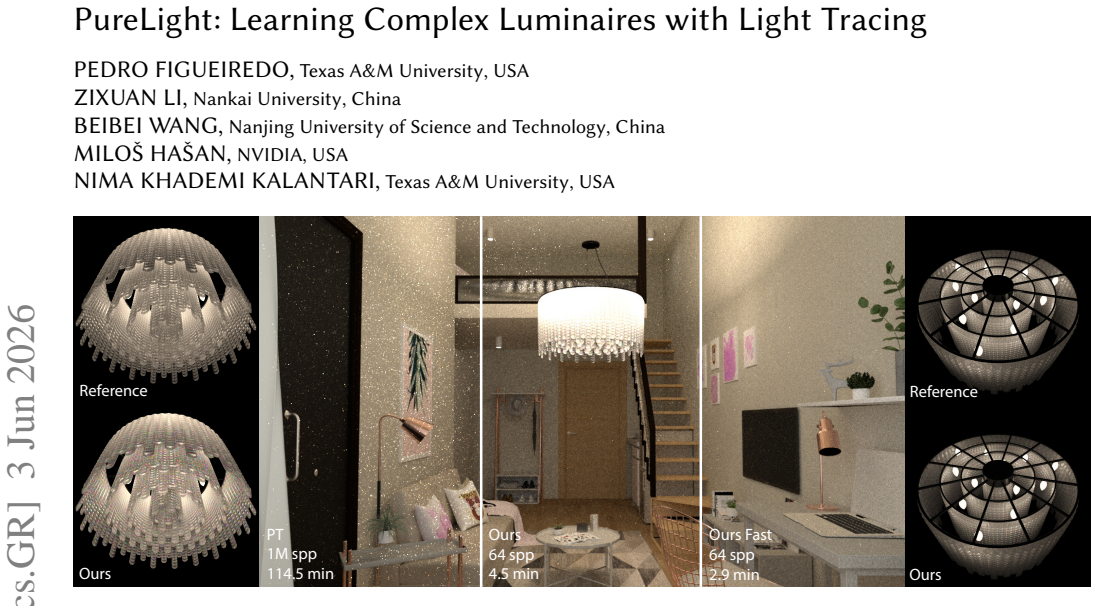
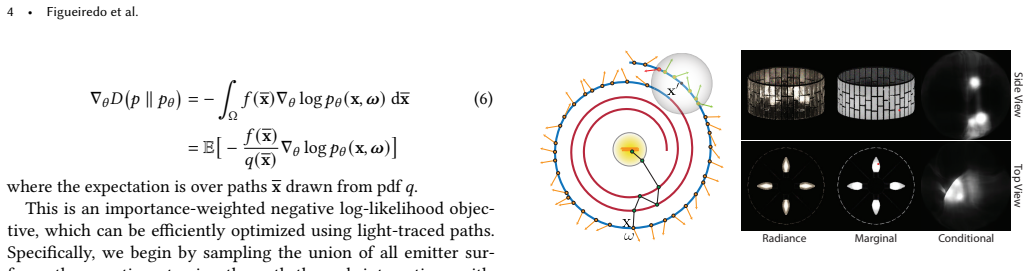
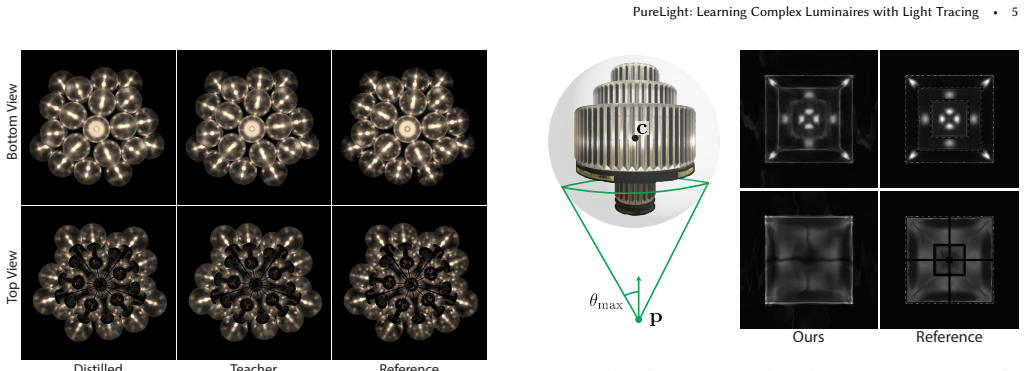
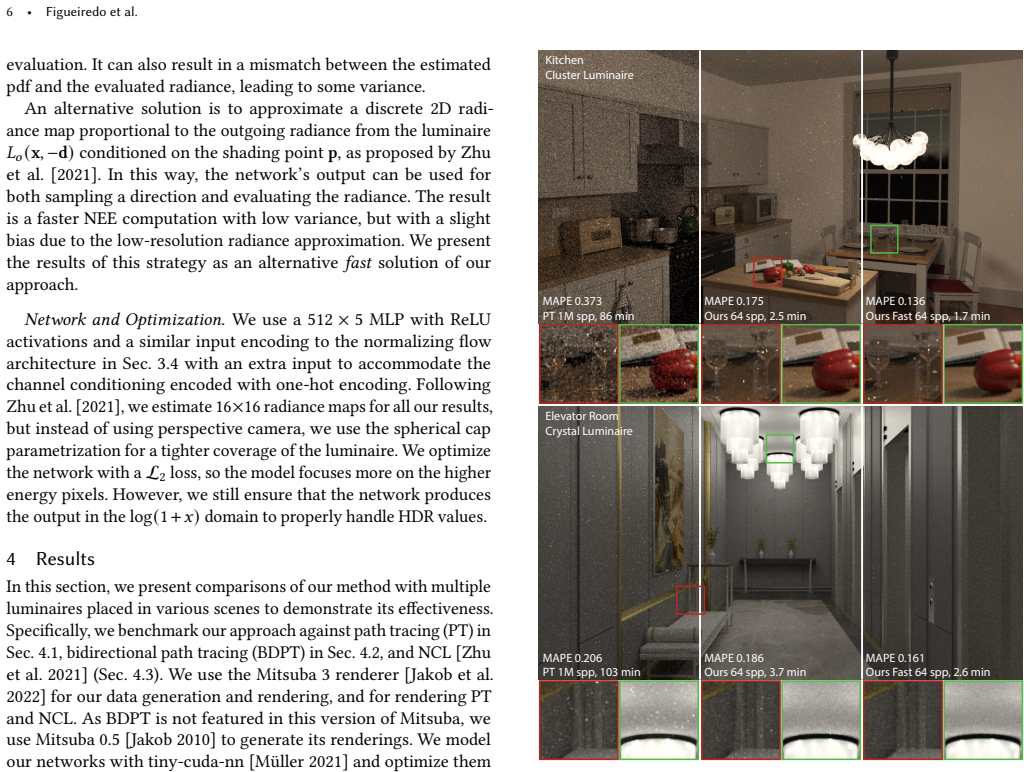
We use light tracing to construct paths from emitters to the exit surfaces and formulate appearance estimation as a distribution learning problem. Specifically, we model the probability density function (pdf) of outgoing radiance on the exit surfaces using a large normalizing flow network, and recover the outgoing radiance as the product of the estimated pdf and flux. To enable efficient inference, we distill the learned appearance into a lightweight MLP that directly estimates radiance on the exit surfaces. We additionally train a sampling network for effective direct illumination computation from the luminaire, and a blending network to composite the luminaire into the scene. Our formulati
What carries the argument
normalizing flow network that models the pdf of outgoing radiance on exit surfaces from light tracing paths, then distilled into an MLP for radiance estimation
If this is right
- Challenging luminaires with enclosed specular layers become practical to render inside arbitrary scenes without custom integrators.
- Direct illumination from the luminaire can be evaluated with far fewer samples than required by conventional path tracing.
- The appearance model separates from the rest of the scene, allowing reuse across different environments.
- The learned sampling network provides effective importance sampling directions for the luminaire's contribution.
Where Pith is reading between the lines
- The same light-tracing-plus-distillation pipeline could be applied to other non-standard light sources whose emission is hard to model analytically.
- Measured physical luminaires could be incorporated into renderers by replacing simulated light tracing with captured path data.
- Overall path-tracing budgets in production scenes might drop if every complex light source is replaced by such a distilled model.
- The method's success would motivate similar distribution-learning approaches for other rendering integrals that currently suffer from high variance.
Load-bearing premise
That a normalizing flow can accurately capture the probability density of outgoing radiance on exit surfaces for luminaires with complex internal light transport, and that distillation to an MLP preserves sufficient fidelity for direct illumination.
What would settle it
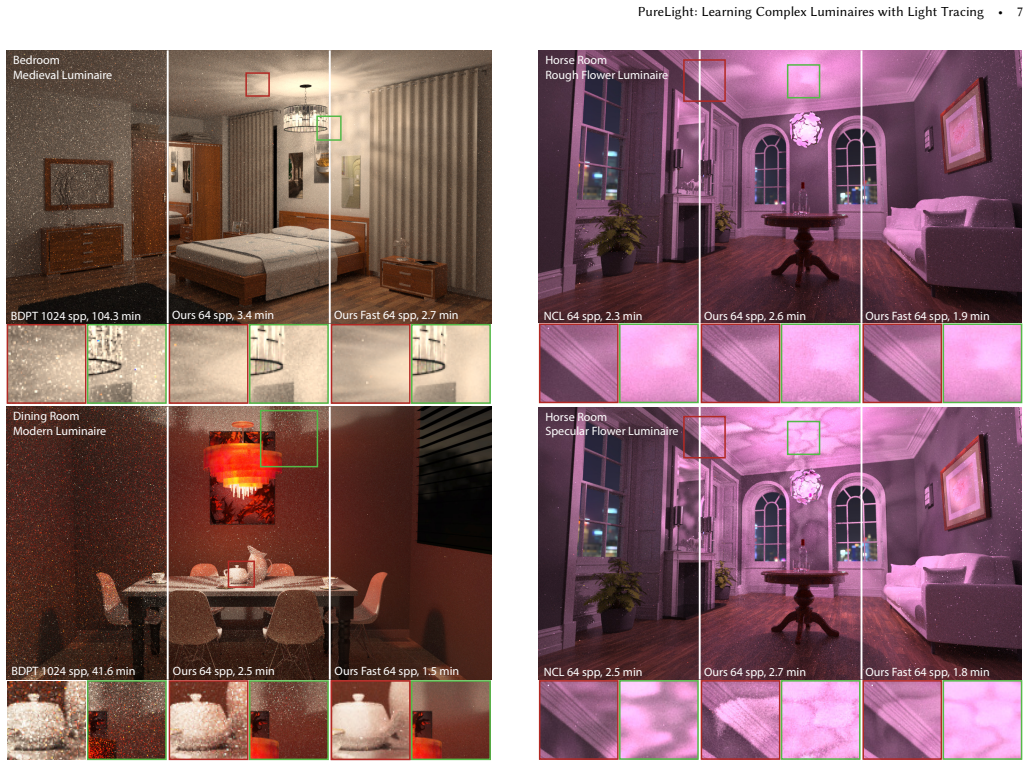
Side-by-side comparison of a scene lit by a complex luminaire rendered at low sample counts with the distilled MLP against a high-sample-count reference image from bidirectional path tracing; visible discrepancies in the illumination pattern would falsify the claim.
Figures
read the original abstract
We propose a neural formulation for estimating the appearance of complex luminaires. We focus on challenging luminaires with complex light transport (e.g., small emitters enclosed by multiple specular layers) that are difficult for (bidirectional) path tracing. To this end, we use light tracing to construct paths from emitters to the exit surfaces and formulate appearance estimation as a distribution learning problem. Specifically, we model the probability density function (pdf) of outgoing radiance on the exit surfaces using a large normalizing flow network, and recover the outgoing radiance as the product of the estimated pdf and flux. To enable efficient inference, we distill the learned appearance into a lightweight MLP that directly estimates radiance on the exit surfaces. We additionally train a sampling network for effective direct illumination computation from the luminaire, and a blending network to composite the luminaire into the scene. Our formulation makes it feasible to render challenging luminaires using low sample counts in arbitrary scenes.
Editorial analysis
A structured set of objections, weighed in public.
Referee Report
Summary. The paper proposes PureLight, a neural approach for modeling the appearance of complex luminaires (e.g., small emitters inside multiple specular layers) that are hard for path tracing. Light tracing generates paths to exit surfaces; a large normalizing flow learns the PDF of outgoing radiance there, with radiance recovered as PDF times flux. This is distilled into a lightweight MLP for direct radiance queries, supplemented by a sampling network for direct illumination and a blending network for scene compositing, enabling low-sample rendering in arbitrary scenes.
Significance. If the flow accurately captures the radiance distribution and distillation preserves fidelity, the method would provide a practical solution for efficient direct illumination from previously intractable luminaires, reducing the sample counts needed in production rendering pipelines.
major comments (2)
- [Abstract] Abstract: the claim that the formulation 'makes it feasible to render challenging luminaires using low sample counts in arbitrary scenes' is load-bearing for the contribution, yet the manuscript supplies no quantitative error metrics, flow convergence behavior, or direct comparisons of MLP output versus the original flow versus ground-truth path tracing; without these, the accuracy of the PDF model and the fidelity of distillation cannot be assessed.
- [Method (distribution learning)] The skeptic concern on normalizing-flow accuracy for multi-modal radiance PDFs is not addressed by any reported experiments; if the flow fails to capture the distribution for luminaires with multiple specular layers, the subsequent MLP distillation and low-sample rendering claims do not follow.
minor comments (2)
- Provide implementation details on the normalizing flow architecture, training loss, number of samples used for light tracing, and how the flux term is computed and combined with the learned PDF.
- Clarify the exact input/output interfaces of the sampling network and blending network, including any conditioning on scene geometry or view direction.
Simulated Author's Rebuttal
We thank the referee for the thoughtful comments highlighting the need for stronger quantitative validation. We address each major comment below and will incorporate the requested evidence into the revised manuscript.
read point-by-point responses
-
Referee: [Abstract] Abstract: the claim that the formulation 'makes it feasible to render challenging luminaires using low sample counts in arbitrary scenes' is load-bearing for the contribution, yet the manuscript supplies no quantitative error metrics, flow convergence behavior, or direct comparisons of MLP output versus the original flow versus ground-truth path tracing; without these, the accuracy of the PDF model and the fidelity of distillation cannot be assessed.
Authors: We agree that quantitative support is necessary to substantiate the abstract claim. While the manuscript includes visual comparisons and rendering results demonstrating low-sample performance, it lacks explicit numerical metrics. In revision we will add: (1) relative L2 and PSNR error tables comparing the distilled MLP radiance against both the normalizing flow and ground-truth light-traced references across multiple luminaires; (2) training curves showing flow convergence (negative log-likelihood and KL divergence vs. iterations); and (3) direct side-by-side error maps for MLP vs. flow vs. path tracing. These additions will be placed in a new quantitative evaluation subsection. revision: yes
-
Referee: [Method (distribution learning)] The skeptic concern on normalizing-flow accuracy for multi-modal radiance PDFs is not addressed by any reported experiments; if the flow fails to capture the distribution for luminaires with multiple specular layers, the subsequent MLP distillation and low-sample rendering claims do not follow.
Authors: We acknowledge that the manuscript does not contain dedicated ablation or diagnostic experiments isolating the flow's multi-modal modeling capacity. Normalizing flows are in principle well-suited to multi-modal densities, and our results with multi-layer specular luminaires show plausible low-variance direct illumination; however, explicit validation is warranted. In the revision we will add experiments that (a) compare the learned flow PDF against binned ground-truth radiance histograms on exit surfaces for luminaires with 2–4 specular layers, (b) report effective sample size and variance reduction statistics when using the flow for importance sampling, and (c) include failure-case visualizations if any modes are missed. These will directly test whether the flow captures the target distributions before distillation. revision: yes
Circularity Check
No circularity: training flow on light-traced paths and distilling to MLP is standard supervised learning
full rationale
The derivation consists of generating training data via light tracing from emitters to exit surfaces, fitting a normalizing flow to the resulting radiance PDF, recovering radiance as pdf times flux, and distilling the model into an MLP plus auxiliary networks. This is an empirical pipeline of data generation followed by supervised model fitting; none of the enumerated circular patterns (self-definitional equations, fitted inputs renamed as predictions, load-bearing self-citations, or ansatz smuggling) appear. The final claim of low-sample rendering feasibility is an empirical assertion outside the derivation chain itself and does not reduce to the inputs by construction.
Axiom & Free-Parameter Ledger
Reference graph
Works this paper leans on
-
[1]
Journal of the Illuminating Engineering Society27 (07 1998), 67–79
Making Near-Field Photometry Practical. Journal of the Illuminating Engineering Society27 (07 1998), 67–79. Jorge Condor and Adrián Jarabo
1998
-
[2]
InEurographics Symposium on Rendering, Abhijeet Ghosh and Li-Yi Wei (Eds.)
A Learned Radiance-Field Representation for Complex Luminaires. InEurographics Symposium on Rendering, Abhijeet Ghosh and Li-Yi Wei (Eds.). The Eurographics Association. doi:10.2312/sr.20221155 Honghao Dong, Guoping Wang, and Sheng Li
-
[3]
InACM SIGGRAPH 2023 Conference Proceedings (SIGGRAPH ’23)
Neural Parametric Mixtures for Path Guiding. InACM SIGGRAPH 2023 Conference Proceedings (SIGGRAPH ’23). Association for Computing Machinery, New York, NY, USA, Article 29, 10 pages. Conor Durkan, Artur Bekasov, Iain Murray, and George Papamakarios. 2019.Neural spline flows. Curran Associates Inc., Red Hook, NY, USA. Pedro Figueiredo, Qihao He, Steve Bako,...
-
[4]
Npga: Neural parametric gaussian avatars
BSDF importance sampling using a diffusion model. InSIGGRAPH Asia 2024 Conference Papers(Tokyo, Japan)(SA ’24). Association for Computing Machinery, New York, NY, USA, Article 83, 11 pages. doi:10.1145/3680528.3687684 Iliyan Georgiev, Jaroslav Křivánek, Tomáš Davidovič, and Philipp Slusallek
-
[5]
Light transport simulation with vertex connection and merging.ACM Trans. Graph.31, 6, Article 192 (Nov. 2012), 10 pages. doi:10.1145/2366145.2366211 Toshiya Hachisuka, Shinji Ogaki, and Henrik Wann Jensen
-
[6]
Progressive photon mapping.ACM Trans. Graph.27, 5, Article 130 (Dec. 2008), 8 pages. doi:10.1145/ 1409060.1409083 Wolfgang Heidrich, Jan Kautz, P. Slusallek, and Hans-Peter Seidel
arXiv 2008
-
[7]
ACM Trans
Online Neural Path Guiding with Normalized Anisotropic Spherical Gaussians. ACM Trans. Graph.43, 3, Article 26 (April 2024), 18 pages. Wenzel Jakob
2024
-
[8]
InRendering Techniques ’95, Patrick M
Importance Driven Path Tracing using the Photon Map. InRendering Techniques ’95, Patrick M. Hanrahan and Werner Purgathofer (Eds.). Springer Vienna, Vienna, 326–335. James T. Kajiya. 1986a. The Rendering Equation.SIGGRAPH Comput. Graph.20, 4 (aug 1986), 143–150. James T. Kajiya. 1986b. The rendering equation. 20, 4 (aug 1986), 143–150. S. Kniep, S. Häring...
1986
-
[9]
Efficient and Accurate Rendering of Complex Light Sources.Computer Graphics Forum28, 4 (2009), 1073–1081. doi:10.1111/j.1467- 8659.2009.01484.x arXiv:https://onlinelibrary.wiley.com/doi/pdf/10.1111/j.1467- 8659.2009.01484.x Zixuan Li, Zixiong Wang, Jian Yang, Miloš Hašan, and Beibei Wang
-
[10]
Albert Mas, Ignacio Martín, and Gustavo Patow
Pure- Sample: Neural Materials Learned by Sampling Microgeometry.arXiv preprint arXiv:2508.07240(2026). Albert Mas, Ignacio Martín, and Gustavo Patow
Pith/arXiv arXiv 2026
-
[11]
Compression and Importance Sampling of Near-Field Light Sources.Comput. Graph. Forum27 (12 2008), 2013–
2008
-
[12]
NeRF: Representing Scenes as Neural Radiance Fields for View Synthesis. InECCV. Thomas Müller. 2021.tiny-cuda-nn. https://github.com/NVlabs/tiny-cuda-nn Thomas Müller, Alex Evans, Christoph Schied, and Alexander Keller
2021
-
[13]
Instant neural graphics primitives with a multiresolution hash encoding.ACM Trans. Graph. 41, 4, Article 102 (jul 2022), 15 pages. Thomas Müller, Brian Mcwilliams, Fabrice Rousselle, Markus Gross, and Jan Novák. 2019a. Neural Importance Sampling.ACM Trans. Graph.38, 5, Article 145 (oct 2019), 19 pages. Thomas Müller, Brian Mcwilliams, Fabrice Rousselle, M...
2022
-
[14]
On Near-Field Photometry.Journal of the Illuminating Engineering Society16, 2 (1987), 129–136. Adam Paszke, Sam Gross, Francisco Massa, Adam Lerer, James Bradbury, Gregory Chanan, Trevor Killeen, Zeming Lin, Natalia Gimelshein, Luca Antiga, Alban Des- maison, Andreas Köpf, Edward Yang, Zach DeVito, Martin Raison, Alykhan Tejani, Sasank Chilamkurthy, Benoi...
-
[15]
Complex luminaires: Illumination and appearance rendering.ACM Trans. Graph. 34, 3 (2015), 1–15. Liwen Wu, Sai Bi, Zexiang Xu, Hao Tan, Kai Zhang, Fujun Luan, Haolin Lu, and Ravi Ramamoorthi
2015
-
[16]
Neural BRDF Importance Sampling by Reparameterization. InProceedings of the Special Interest Group on Computer Graphics and Interactive Techniques Conference Conference Papers (SIGGRAPH Conference Papers ’25). As- sociation for Computing Machinery, New York, NY, USA, Article 163, 11 pages. doi:10.1145/3721238.3730679 Bing Xu, Liwen Wu, Miloš Hašan, Fujun ...
-
[17]
InACM SIGGRAPH 2023 Conference Proceedings
NeuSample: Importance sampling for neural materials. InACM SIGGRAPH 2023 Conference Proceedings. doi:10.1145/3588432.3591524 Quan Zheng and Matthias Zwicker
-
[18]
Junqiu Zhu, Yaoyi Bai, Zilin Xu, Steve Bako, Edgar Velázquez-Armendáriz, Lu Wang, Pradeep Sen, Miloš Hašan, and Ling-Qi Yan
Learning to Importance Sample in Primary Sample Space.Computer Graphics Forum38, 2 (2019), 169–179. Junqiu Zhu, Yaoyi Bai, Zilin Xu, Steve Bako, Edgar Velázquez-Armendáriz, Lu Wang, Pradeep Sen, Miloš Hašan, and Ling-Qi Yan
2019
-
[19]
Graph.40, 4, Article 57 (July 2021), 12 pages
Neural complex luminaires: representation and rendering.ACM Trans. Graph.40, 4, Article 57 (July 2021), 12 pages
2021
discussion (0)
Sign in with ORCID, Apple, or X to comment. Anyone can read and Pith papers without signing in.