Photon shot-noise-limited Rydberg-EIT electrometry
Pith reviewed 2026-06-28 03:35 UTC · model grok-4.3
The pith
Rydberg electrometry in rubidium reaches photon shot-noise limited sensitivity of 12.5 nV cm^{-1} Hz^{-1/2} at 37 GHz.
A machine-rendered reading of the paper's core claim, the machinery that carries it, and where it could break.
Core claim
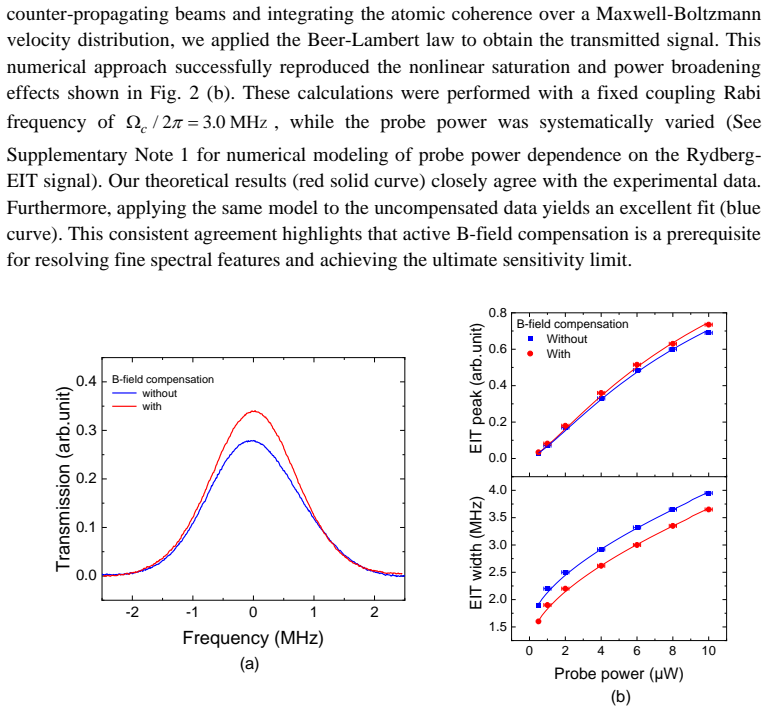
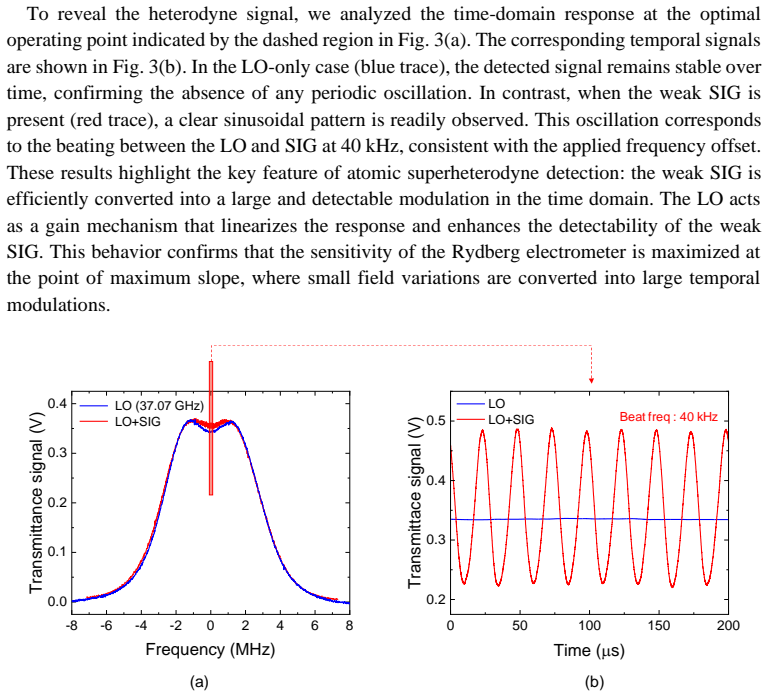
By engineering atomic coherence through control of residual magnetic fields and laser frequency noise, we achieve the Rydberg electromagnetically induced transparency (EIT) with the narrow linewidth of 1.6 MHz, yielding an enhanced spectral slope for high-sensitivity Rydberg-EIT electrometry. Under optimized superheterodyne detection conditions, we obtain an electric-field sensitivity of 12.5(8) nV cm^{-1} Hz^{-1/2} at 37 GHz, in close agreement with the calculated PSN limit.
What carries the argument
The 1.6 MHz Rydberg EIT linewidth obtained by minimizing residual magnetic fields and laser frequency noise, which directly increases the slope of the transmission signal used for electric-field measurement.
If this is right
- Rydberg-EIT electrometry can operate at the photon-shot-noise limit once residual magnetic and laser-frequency noise are controlled.
- Superheterodyne detection combined with the narrow EIT feature directly converts the improved slope into the reported field sensitivity.
- The demonstrated match between measured and calculated PSN values establishes a concrete performance benchmark for vapor-cell Rydberg sensors at 37 GHz.
- The same coherence-engineering approach supplies a practical route toward quantum-noise-limited operation in similar atomic electrometers.
Where Pith is reading between the lines
- The same linewidth-narrowing methods could be tested at other microwave frequencies to check whether the PSN limit remains reachable.
- Integration of the vapor cell with compact laser systems might allow portable versions of the sensor while preserving the reported sensitivity.
- Further suppression of the linewidth below 1.6 MHz would be expected to improve sensitivity proportionally if photon-shot noise continues to dominate.
Load-bearing premise
Residual magnetic fields and laser frequency noise are the dominant sources of spectral broadening, and suppressing them is enough to reach the 1.6 MHz linewidth without other technical noises limiting the slope.
What would settle it
A repeated measurement that yields sensitivity significantly worse than the calculated PSN value while still showing the 1.6 MHz linewidth would falsify the claim that the system is operating near the photon-shot-noise limit.
Figures

read the original abstract
Rydberg-atom electrometry is a core technique in the development of highly sensitive quantum electric-field sensors. Its sensitivity based on atom-photon interaction is typically limited by photon shot-noise (PSN) and spectral broadenings. Here, we experimentally demonstrate a near PSN-limited Rydberg electrometry from a 85Rb atomic vapor cell. By engineering atomic coherence through control of residual magnetic fields and laser frequency noise, we achieve the Rydberg electromagnetically induced transparency (EIT) with the narrow linewidth of 1.6 MHz, yielding an enhanced spectral slope for high-sensitivity Rydberg-EIT electrometry. Under optimized superheterodyne detection conditions, we obtain an electric-field sensitivity of 12.5(8) nV cm^-1 Hz^-1/2 at 37 GHz, in close agreement with the calculated PSN limit. These results provide direct experimental evidence of the high-sensitive quantum electrometry and establish a practical route toward quantum-noise-limited Rydberg electrometry.
Editorial analysis
A structured set of objections, weighed in public.
Referee Report
Summary. The manuscript reports an experimental demonstration of near photon shot-noise (PSN)-limited Rydberg-EIT electrometry in an 85Rb vapor cell at 37 GHz. By controlling residual magnetic fields and laser frequency noise to narrow the EIT linewidth to 1.6 MHz, the authors achieve an electric-field sensitivity of 12.5(8) nV cm^{-1} Hz^{-1/2} under optimized superheterodyne detection, stated to be in close agreement with the calculated PSN limit.
Significance. If the result holds, the work provides direct experimental evidence that Rydberg-EIT electrometry can approach the fundamental PSN limit, which would be significant for the development of quantum electric-field sensors. The reporting of sensitivity with uncertainty and explicit comparison to a calculated limit is a positive feature.
major comments (1)
- [Abstract] Abstract: the central claim that the measured sensitivity matches the PSN limit because the 1.6 MHz linewidth was achieved solely by residual magnetic-field and laser-frequency control requires a quantitative noise budget or independent verification that the observed spectral slope equals the ideal PSN prediction. Without this, other sources (e.g., intensity noise, collisions, or detection noise) could coincidentally produce the reported agreement.
minor comments (1)
- [Abstract] Abstract: the derivation of the calculated PSN limit and any data exclusion criteria are not described, which hinders immediate assessment of the agreement.
Simulated Author's Rebuttal
We thank the referee for their positive evaluation of the work's significance and for the constructive comment on the abstract. We address the point below and will revise the manuscript accordingly.
read point-by-point responses
-
Referee: [Abstract] Abstract: the central claim that the measured sensitivity matches the PSN limit because the 1.6 MHz linewidth was achieved solely by residual magnetic-field and laser-frequency control requires a quantitative noise budget or independent verification that the observed spectral slope equals the ideal PSN prediction. Without this, other sources (e.g., intensity noise, collisions, or detection noise) could coincidentally produce the reported agreement.
Authors: We appreciate the referee's request for stronger substantiation. The PSN limit in the manuscript is computed from the measured EIT linewidth (which sets the spectral slope), the probe photon flux, and the superheterodyne demodulation parameters, as derived in the main text and supplementary information; the experimental value 12.5(8) nV cm^{-1} Hz^{-1/2} lies within uncertainty of this prediction. To directly address the concern that other noise sources might coincidentally yield the same result, we will add a dedicated noise-budget subsection in the revised manuscript. This section will quantify residual magnetic-field broadening, laser-frequency and intensity noise, and collisional contributions from independent auxiliary measurements, showing each lies at least an order of magnitude below the PSN floor under the reported conditions. We will also revise the abstract to state that the agreement is with the calculated PSN limit given the achieved linewidth, rather than implying the linewidth control alone proves PSN dominance. revision: yes
Circularity Check
No significant circularity in derivation chain
full rationale
The paper reports a measured experimental sensitivity of 12.5(8) nV cm^-1 Hz^-1/2 that is compared to an independently calculated photon shot-noise limit derived from the observed 1.6 MHz EIT linewidth and standard detection parameters. No step reduces the reported sensitivity or the PSN prediction to a fitted parameter by the paper's own equations; the agreement is presented as an experimental verification against theory rather than a self-referential construction. The central claim rests on direct measurement and control of magnetic fields and laser noise to achieve the linewidth, with no load-bearing self-citations or ansatz smuggling identified in the provided claims.
Axiom & Free-Parameter Ledger
Reference graph
Works this paper leans on
-
[1]
Microwave electrometry with Ry dberg atoms in a vapour cell using bright atomic resonances,
J. A. Sedlacek, A. Schwet tmann, H. Kübler et al., "Microwave electrometry with Ry dberg atoms in a vapour cell using bright atomic resonances," Nature Physics 8, 819– 824 (2012)
2012
-
[2]
Shaffer, and H
J. Shaffer, and H. Kübler, A read-out enhancement for microwave electric field sensi ng with Rydberg atoms (SPIE, 2018)
2018
-
[3]
Sensitivity extension of atom -based amplitude-mod ulation microwave electrometry via high Rydberg states,
M. Cai, S. You, S. Zhang et al., "Sensitivity extension of atom -based amplitude-mod ulation microwave electrometry via high Rydberg states," Applied Physics Letters 12 2 (2023)
2023
-
[4]
Q uantum Sensors of Electric Fiel ds Based on Highly Excited Rydberg Atoms,
I. I. Ryabtsev, V. M. Entin, D. B. Tretyakov et al., "Q uantum Sensors of Electric Fiel ds Based on Highly Excited Rydberg Atoms," Radiophysics and Quantum Electronic s 67, 1–12 (2024)
2024
-
[5]
Approaching the standard quantum limit of a Rydberg-atom microwave electrometer,
H.-T. Tu, K.-Y. Liao, H.-L. Wang et al., "Approaching the standard quantum limit of a Rydberg-atom microwave electrometer," Science Advances 10, eads0683 (2024)
2024
-
[6]
Atomic superheterodyne receiver based on microwave - dressed Rydberg spectroscopy,
M. Jing, Y. Hu, J. Ma et al., "Atomic superheterodyne receiver based on microwave - dressed Rydberg spectroscopy," Nature Physics 16, 911–915 (2020)
2020
-
[7]
Rydberg Atom Electric Field Sen sors for Communications and Sensing,
C. T. Fancher, D. R. Scherer, M. C. S. John et al., "Rydberg Atom Electric Field Sen sors for Communications and Sensing," IEEE Transactions on Quantum Engineering 2, 1–13 (2021)
2021
-
[8]
Microwave electrometry via electromagneti cally induced absorption in cold Rydberg atoms,
K.-Y. Liao, H.-T. Tu, S.-Z. Yang et al., "Microwave electrometry via electromagneti cally induced absorption in cold Rydberg atoms," Physical Review A 101, 053432 (2 020)
-
[9]
Rydberg atom electric field sensing for metrology, communication and hybrid quantum systems,
H. Zhang, Y. Ma, K. Liao et al., "Rydberg atom electric field sensing for metrology, communication and hybrid quantum systems," Science Bulletin 69, 1515–1535 (202 4)
-
[10]
Continuously tunable radio frequency electrometry with Rydberg atoms,
J. Hu, H. Li, R. Song et al., "Continuously tunable radio frequency electrometry with Rydberg atoms," Applied Physics Letters 121 (2022)
2022
-
[11]
Quant um sensing of microwave electric fields bas ed on Rydberg atoms,
J. Yuan, W. Yang, M. Jing et al., "Quant um sensing of microwave electric fields bas ed on Rydberg atoms," Reports on Progress in Physics 86, 106001 (2023)
2023
-
[12]
Atom based RF electric field sensing,
H. Fan, S. Kumar, J. Sedlacek et al., "Atom based RF electric field sensing," Journal of Physics B: Atomic, Molecular and Optical Physics 48, 202001 (2015)
2015
-
[13]
Electric Field Measurement and Application Based o n Rydberg Atoms,
B. Liu, L. Zhang, Z. Liu et al., "Electric Field Measurement and Application Based o n Rydberg Atoms," Electromagnetic Science 1, 1–16 (2023)
2023
-
[14]
Rydberg atom -based s ensors for radio -frequency electric field metrology, sensing, and communications,
M. T. Simons, A. B. Artusio-Glimpse, A. K. Robinson et al., "Rydberg atom -based s ensors for radio -frequency electric field metrology, sensing, and communications," Measurement: Sensors 18, 100273 (2021)
2021
-
[15]
Electric field metrology for SI tr aceability: Systematic measurement uncertainties in electromagnetically induced tran sparency in atomic vapor,
C. L. Holloway, M. T. Simons, J. A. Gordon et al ., "Electric field metrology for SI tr aceability: Systematic measurement uncertainties in electromagnetically induced tran sparency in atomic vapor," Journal of Applied Physics 121 (2017)
2017
-
[16]
A Self -Calibrated SI-Traceable Rydb erg Atom-Based Radio Frequency Electric Field Probe and Measurement Instrument,
D. A. Anderson, R. E. Sapiro, and G. Raithel, "A Self -Calibrated SI-Traceable Rydb erg Atom-Based Radio Frequency Electric Field Probe and Measurement Instrument, " IEEE Transactions on Antennas and Propagation 69, 5931–5941 (2021)
2021
-
[17]
Atom-Based RF Electric Field M etrology: From Self-Calibrated Measurements to Subwavelength and Near -Field Ima ging,
C. L. Holloway, M. T. Simons, J. A. Gordon et al., "Atom-Based RF Electric Field M etrology: From Self-Calibrated Measurements to Subwavelength and Near -Field Ima ging," IEEE Transactions on Electromagnetic Compatibility 59, 717–728 (2017)
2017
-
[18]
Broadband Rydberg Atom -Based El ectric-Field Probe for SI -Traceable, Self-Calibrated Measurements,
C. L. Holloway, J. A. Gordon, S. Jefferts et al., "Broadband Rydberg Atom -Based El ectric-Field Probe for SI -Traceable, Self-Calibrated Measurements," IEEE Transacti ons on Antennas and Propagation 62, 6169–6182 (2014)
2014
-
[19]
Radio frequency electric field -enhanced sensing based on the Rydberg atom -based superheterodyne receiver,
W. Yang, M. Jing, H. Zhang et al., "Radio frequency electric field -enhanced sensing based on the Rydberg atom -based superheterodyne receiver," Opt. Lett. 49, 2938–29 41 (2024)
2024
-
[20]
Highly Sensitive Measurement of a Megahertz rf Electric Field with a Rydberg -Atom Sensor,
B. Liu, L.-H. Zhang, Z.-K. Liu et al., "Highly Sensitive Measurement of a Megahertz rf Electric Field with a Rydberg -Atom Sensor," Physical Review Applied 18, 01404 5 (2022)
2022
-
[21]
Weak electric-field detection with sub-1 Hz resolution at radio frequencies using a Rydberg atom -based mixer,
J. A. Gordon, M. T. Simons, A. H. Haddab et al., "Weak electric-field detection with sub-1 Hz resolution at radio frequencies using a Rydberg atom -based mixer," AIP A dvances 9 (2019)
2019
-
[22]
High -angular-momentum Rydber g states in a room-temperature vapor cell for dc electric-field sensing,
A. Duspayev, R. Cardman, D. A. Anderson et al., "High -angular-momentum Rydber g states in a room-temperature vapor cell for dc electric-field sensing," Physical Revi ew Research 6, 023138 (2024)
2024
-
[23]
Rydberg Atomic Quantum Receivers for Class ical Wireless Communication and Sensing,
T. Gong, A. Chandra, C. Yuen et al., "Rydberg Atomic Quantum Receivers for Class ical Wireless Communication and Sensing," IEEE Wireless Communications 32, 90– 100 (2025)
2025
-
[24]
Rydberg atom-based fiel d sensing enhancement using a split-ring resonator,
C. L. Holloway, N. Prajapati, A. B. Artusio-Glimpse et al., "Rydberg atom-based fiel d sensing enhancement using a split-ring resonator," Applied Physics Letters 120 (20 22)
-
[25]
Electric-field metrology of a terahertz f requency comb using Rydberg atoms,
W. Krokosz, J. Nowosielski, B. Kasza et al., "Electric-field metrology of a terahertz f requency comb using Rydberg atoms," Optica 12, 1854–1864 (2025)
2025
-
[26]
A High -Efficiency Fiber-Coupled Rydberg-Atom In tegrated Probe and Its Imaging Applications,
R. Mao, Y. Lin, K. Yang et al., "A High -Efficiency Fiber-Coupled Rydberg-Atom In tegrated Probe and Its Imaging Applications," IEEE Antennas and Wireless Propagat ion Letters 22, 352–356 (2023)
2023
-
[27]
Sensitivity enhancement of far -detuned RF field sensi ng based on Rydberg atoms dressed by a near-resonant RF field,
J. Yao, Q. An, Y. Zhou et al., "Sensitivity enhancement of far -detuned RF field sensi ng based on Rydberg atoms dressed by a near-resonant RF field," Opt. Lett. 47, 5256 –5259 (2022)
2022
-
[28]
Atom-Based Sensing of Weak Radio Frequency Electric Fields Using Homodyne Readout,
S. Kumar, H. Fan, H. Kübler et al., "Atom-Based Sensing of Weak Radio Frequency Electric Fields Using Homodyne Readout," Scientific Reports 7, 42981 (2017)
2017
-
[29]
Real-time near-field terahertz imaging with atomic optical fluorescence,
C. G. Wade, N. Šibalić, N. R. de Melo et al., "Real-time near-field terahertz imaging with atomic optical fluorescence," Nature Photonics 11, 40–43 (2017)
2017
-
[30]
Using frequency detuning to imp rove the sensitivity of electric field measurements via electromagnetically induced tr ansparency and Autler-Townes splitting in Rydberg atoms,
M. T. Simons, J. A. Gordon, C. L. Holloway et al., "Using frequency detuning to imp rove the sensitivity of electric field measurements via electromagnetically induced tr ansparency and Autler-Townes splitting in Rydberg atoms," Applied Physics Letters 108 (2016)
2016
-
[31]
Rydberg -Atom-Based Electrometry Us ing a Self-Heterodyne Frequency-Comb Readout and Preparation Scheme,
K. Dixon, K. Nickerson, D. W. Booth et al., "Rydberg -Atom-Based Electrometry Us ing a Self-Heterodyne Frequency-Comb Readout and Preparation Scheme," Physical Review Applied 19, 034078 (2023)
2023
-
[32]
Continuous radio -freq uency electric-field detection through adjacent Rydberg resonance tuning,
M. T. Simons, A. B . Artusio-Glimpse, C. L. Holloway et al., "Continuous radio -freq uency electric-field detection through adjacent Rydberg resonance tuning," Physical Review A 104, 032824 (2021)
2021
-
[33]
Sub -wavelength imaging and field mapping via electromagnetically induced transparency and Autler -Townes split ting in Rydberg atoms,
C. L. Holloway, J. A. Gordon, A. Schwarzkopf et al., "Sub -wavelength imaging and field mapping via electromagnetically induced transparency and Autler -Townes split ting in Rydberg atoms," Applied Physics Letters 104 (2014)
2014
-
[34]
Distinction of electromagnetically induced transparency and Autler-Towners splitting in a Rydberg-involved ladder-type cold atom system,
Z. Ji, Y. Jiao, Y. Xue et al., "Distinction of electromagnetically induced transparency and Autler-Towners splitting in a Rydberg-involved ladder-type cold atom system," Opt. Express 29, 11406–11415 (2021)
2021
-
[35]
Rydberg electromagnetically induced transparency and Autler–Townes splitting in a weak radio-frequency electric field*,
L. Hao, Y. Xue, J. Fan et al., "Rydberg electromagnetically induced transparency and Autler–Townes splitting in a weak radio-frequency electric field*," Chinese Physics B 28, 053202 (2019)
2019
-
[36]
Microwave dressing of Rydber g dark states,
M. Tanasittikosol, J. D. Pritchard, D. Maxwell et al., "Microwave dressing of Rydber g dark states," Journal of Physics B: Atomic, Molecular and Optical Physics 44, 1840 20 (2011)
2011
-
[37]
Crossover from electromagnetically induced transparency to Autler–Townes splitting in open ladder systems with Doppler broadening,
C. Tan, and G. Huang, "Crossover from electromagnetically induced transparency to Autler–Townes splitting in open ladder systems with Doppler broadening," J. Opt. Soc. Am. B 31, 704–715 (2014)
2014
-
[38]
Microwave-induced three-photon coherence of Rydberg atomic states,
H. M. Kwak, T. Jeong, Y.-S. Lee et al., "Microwave-induced three-photon coherence of Rydberg atomic states," Optics Communications 380, 168–173 (2016)
2016
-
[39]
Atomic spectra in a six -level scheme for electromagnetically induced transparency and Autler -Townes splitt ing in Rydberg atoms,
A. K. Robinson, A. B. Artusio-Glimpse, M. T. Simons et al., "Atomic spectra in a six -level scheme for electromagnetically induced transparency and Autler -Townes splitt ing in Rydberg atoms," Physical Review A 103, 023704 (2021)
2021
-
[40]
Nonlinearity of Microwave Electric Field Coupled Ry dberg Electromagnetically Induced Transparency and Autler -Townes Splitting,
L. Hao, Y. Xue, J. Fan et al., "Nonlinearity of Microwave Electric Field Coupled Ry dberg Electromagnetically Induced Transparency and Autler -Townes Splitting," App lied Sciences 9, 1720 (2019)
2019
-
[41]
Transition from electromagnetically induced transpar ency to Autler–Townes splitting in cold cesium atoms,
L. Hao, Y. Jiao, Y. Xue et al., "Transition from electromagnetically induced transpar ency to Autler–Townes splitting in cold cesium atoms," New Journal of Physics 20, 073024 (2018)
2018
-
[42]
Rydberg -atom-based digital communication using a c ontinuously tunable radio-frequency carrier,
Z. Song, H. Liu, X. Liu et al., "Rydberg -atom-based digital communication using a c ontinuously tunable radio-frequency carrier," Opt. Express 27, 8848–8857 (2019)
2019
-
[43]
Distinction between double electromagn etically induced transparency and double Autler –Townes splitting in RF-driven four- level ladder 87Rb atomic vapor,
H. S. Rawat, S. K. Dubey, and V. N. Ojha, "Distinction between double electromagn etically induced transparency and double Autler –Townes splitting in RF-driven four- level ladder 87Rb atomic vapor," Journal of Physics B: Atomic, Molecular and Optic al Physics 51, 155401 (2018)
2018
-
[44]
Microwave electrometry with Rydberg atoms in a vapor cell using microwave amplitude modulation,
J.-H. Hao, F.-D. Jia, Y. Cui et al., "Microwave electrometry with Rydberg atoms in a vapor cell using microwave amplitude modulation," Chinese Physics B 33, 050702 (2024)
2024
-
[45]
High -Sensitivity Rydberg Atom-Based Field Sensin g Enhancement Using Miniaturized Resonator,
A. Zhou, Y. Lin, R. Mao et al., "High -Sensitivity Rydberg Atom-Based Field Sensin g Enhancement Using Miniaturized Resonator," IEEE Transactions on Antennas and Propagation 73, 10948–10952 (2025)
2025
-
[46]
Local oscillator port integrated resonator for Rydber g atom-based electric field measurement enhancement,
B. Wu, D. Liao, Z. Ding et al., "Local oscillator port integrated resonator for Rydber g atom-based electric field measurement enhancement," EPJ Quantum Technology 1 1, 22 (2024)
2024
-
[47]
Enhancement of electromagnetical ly induced transparency based Rydberg-atom electrometry through population repum ping,
N. Prajapati, A. K. Robinson, S. Berweger et al., "Enhancement of electromagnetical ly induced transparency based Rydberg-atom electrometry through population repum ping," Applied Physics Letters 119 (2021)
2021
-
[48]
Sensitivity Improvement and Deter mination of Rydber g Atom-Based Microwave Sensor,
M. Cai, Z. Xu, S. You et al., "Sensitivity Improvement and Deter mination of Rydber g Atom-Based Microwave Sensor," Photonics 9, 250 (2022)
2022
-
[49]
Local oscillator port embedded field enhancement re sonator for Rydberg atomic heterodyne technique,
K. Yang, R. Mao, L. He et al., "Local oscillator port embedded field enhancement re sonator for Rydberg atomic heterodyne technique," EPJ Quantum Technology 10, 23 (2023)
2023
-
[50]
Quantum weak measurement amplifies dispersion sig nal of Rydberg atomic system,
Y. Jiang, J. Wu, M. Shi et al., "Quantum weak measurement amplifies dispersion sig nal of Rydberg atomic system," Communications Physics 8, 144 (2025)
2025
-
[51]
Assessment of Rydberg atoms for wid eband electric field sensing,
D. H. Meyer, Z. A. Castillo, K. C. Cox et al., "Assessment of Rydberg atoms for wid eband electric field sensing," Journal of Physics B: Atomic, Molecular and Optical P hysics 53, 034001 (2020)
2020
-
[52]
High sensitivity measurement of ULF, VLF, and LF fields with a Rydberg-atom sensor,
M. Lei, and M. Shi, "High sensitivity measurement of ULF, VLF, and LF fields with a Rydberg-atom sensor," Opt. Lett. 49, 5547–5550 (2024)
2024
-
[53]
Rydberg-atom-based radio-frequency sen sors: amplitude-regime sensing,
M. Schmidt, S. Bohaichuk, V. Venu et al., "Rydberg-atom-based radio-frequency sen sors: amplitude-regime sensing," Opt. Express 32, 27768–27791 (2024)
2024
-
[54]
Sensitivity of Rydberg microwave electrometry limite d by laser frequency noise,
B. Yang, Y. Yan, X. Li et al., "Sensitivity of Rydberg microwave electrometry limite d by laser frequency noise," Physical Review A 109, 032609 (2024)
2024
-
[55]
Sensitivity comparison of two-photon vs three-photon Rydberg electrometry,
N. Prajapati, N. Bhusal, A. P. Rotunno et al., "Sensitivity comparison of two-photon vs three-photon Rydberg electrometry," Journal of Applied Physics 134 (2023)
2023
-
[56]
Optimizing the Rydberg EIT spectrum in a ther mal vapor,
H.-J. Su, J.-Y. Liou, I. C. Lin et al., "Optimizing the Rydberg EIT spectrum in a ther mal vapor," Opt. Express 30, 1499–1510 (2022)
2022
-
[57]
Resonant Structures for Se nsitivity Enhancement of Rydberg-Atom Microwave Receivers,
G. Sandidge, G. Santamaria-Botello, E. Bottomley et al., "Resonant Structures for Se nsitivity Enhancement of Rydberg-Atom Microwave Receivers," IEEE Transactions on Microwave Theory and Techniques 72, 2057–2066 (2024)
2057
-
[58]
Rydberg -atom based radio-frequency electromet ry using frequency modulation spectroscopy in room temperature vapor cells,
S. Kumar, H. Fan, H. Kübler et al., "Rydberg -atom based radio-frequency electromet ry using frequency modulation spectroscopy in room temperature vapor cells," Opt. Express 25, 8625–8637 (2017)
2017
-
[59]
Origins of Rydberg-Atom Electrom eter Transient Response and Its Impact on Radio-Frequency Pulse Sensing,
S. M. Bohaichuk, D. Booth, K. Nickerson et al., "Origins of Rydberg-Atom Electrom eter Transient Response and Its Impact on Radio-Frequency Pulse Sensing," Physical Review Applied 18, 034030 (2022)
2022
-
[60]
Three -photon Rydberg-atom-based radio -frequency sensing scheme with narrow linewidth,
S. M. Bohaichuk, F. Ripka, V. Venu et al., "Three -photon Rydberg-atom-based radio -frequency sensing scheme with narrow linewidth," Physical Review Applied 20, L0 61004 (2023)
2023
-
[61]
Quantum Shot Noise Limit in a Rydber g RF Receiver Compared to Thermal Noise Limit in a Conventional Receiver,
L. W. Bussey, F. A. Burton, K. Bongs et al., "Quantum Shot Noise Limit in a Rydber g RF Receiver Compared to Thermal Noise Limit in a Conventional Receiver," IEEE Sensors Letters 6, 1–4 (2022)
2022
-
[62]
IEEE Standard for Calibration of Electromagnetic Field Sensors and Probes (Exclud ing Antennas) from 9 kHz to 40 GHz,
"IEEE Standard for Calibration of Electromagnetic Field Sensors and Probes (Exclud ing Antennas) from 9 kHz to 40 GHz," IEEE Std 1309-2013 (Revision of IEEE Std 1 309-2005), 1–111 (2013)
2013
-
[63]
Rubidium 85 D Line Data,
D. Steck, "Rubidium 85 D Line Data," (2008)
2008
discussion (0)
Sign in with ORCID, Apple, or X to comment. Anyone can read and Pith papers without signing in.