Real Part Emergence in Purely Imaginary Quasinormal Modes in Perturbed de Sitter Braneworlds
Pith reviewed 2026-06-28 05:34 UTC · model grok-4.3
The pith
Perturbations on thick de Sitter branes turn purely imaginary quasinormal modes into complex modes with a real frequency part.
A machine-rendered reading of the paper's core claim, the machinery that carries it, and where it could break.
Core claim
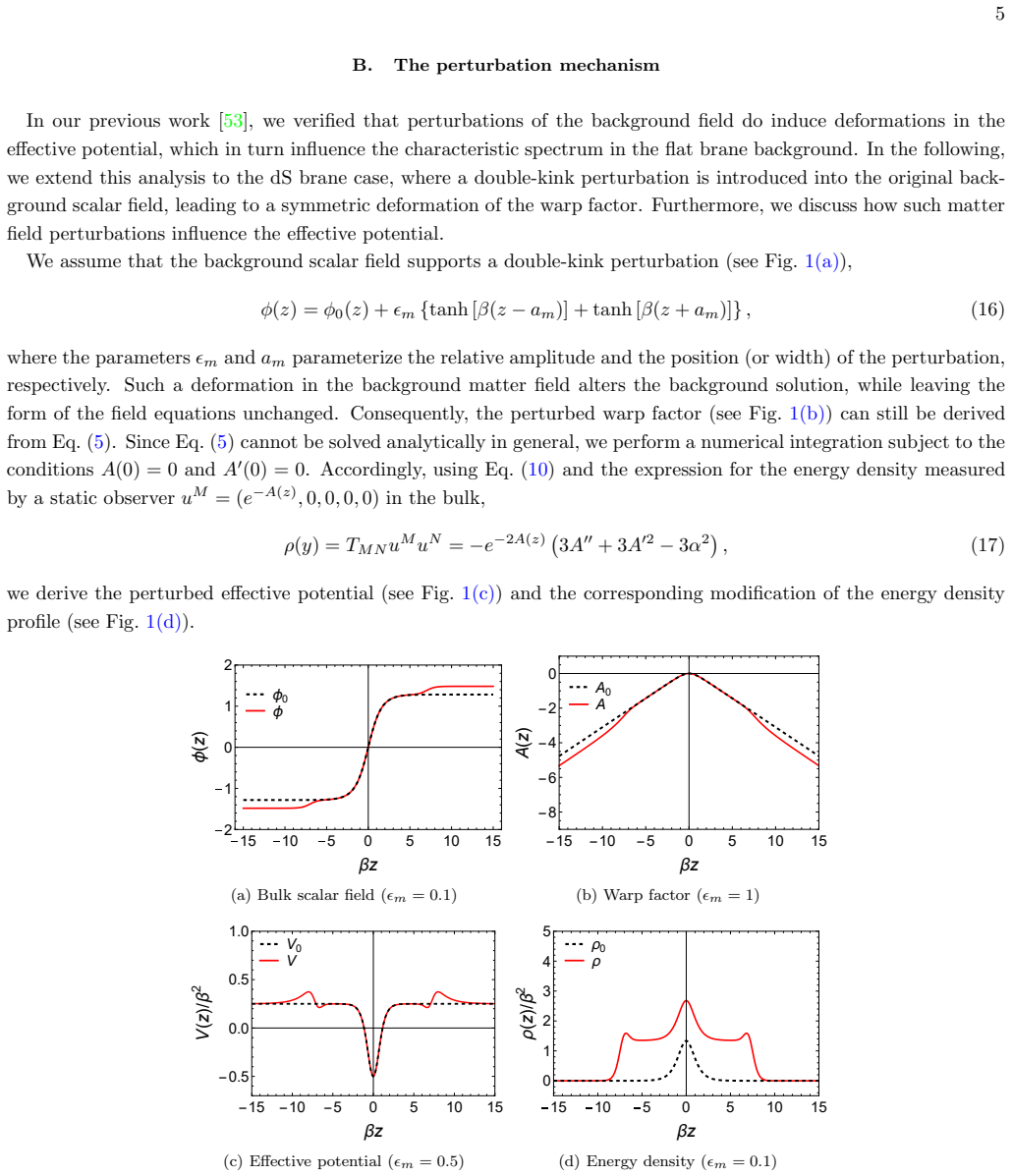
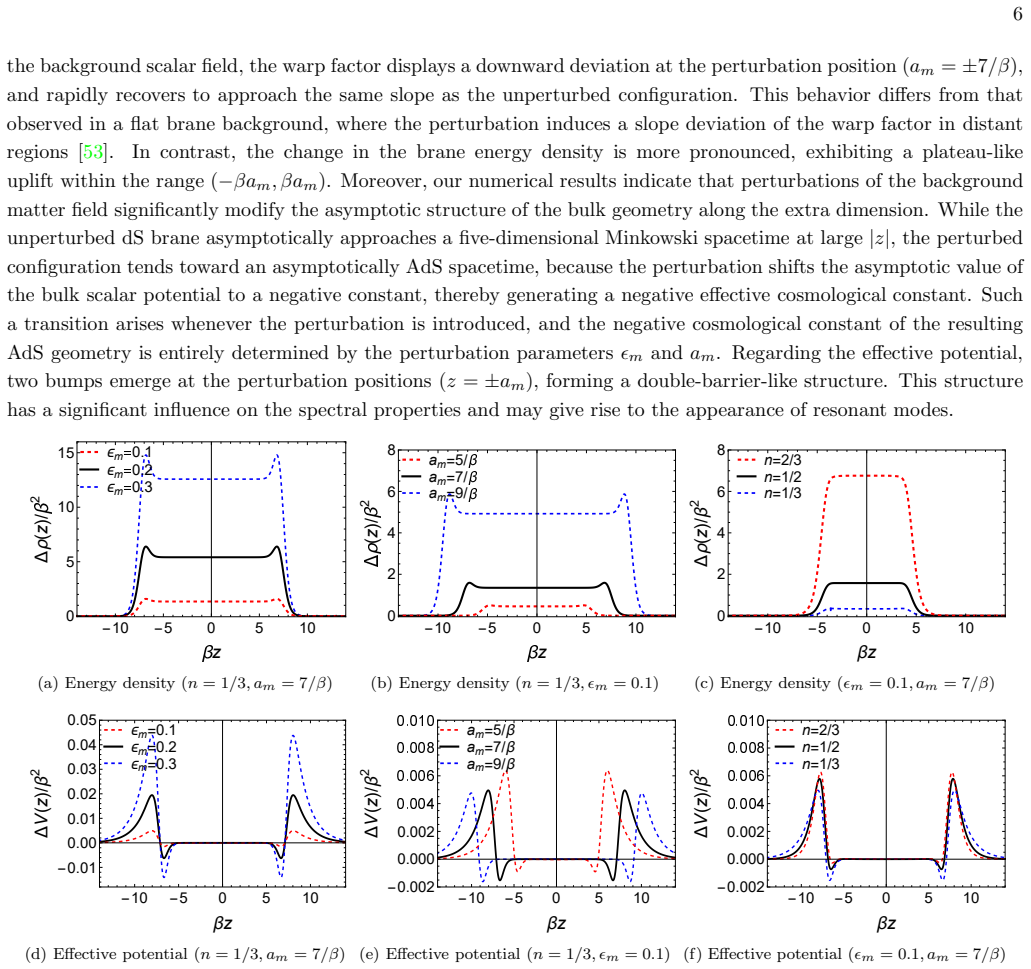
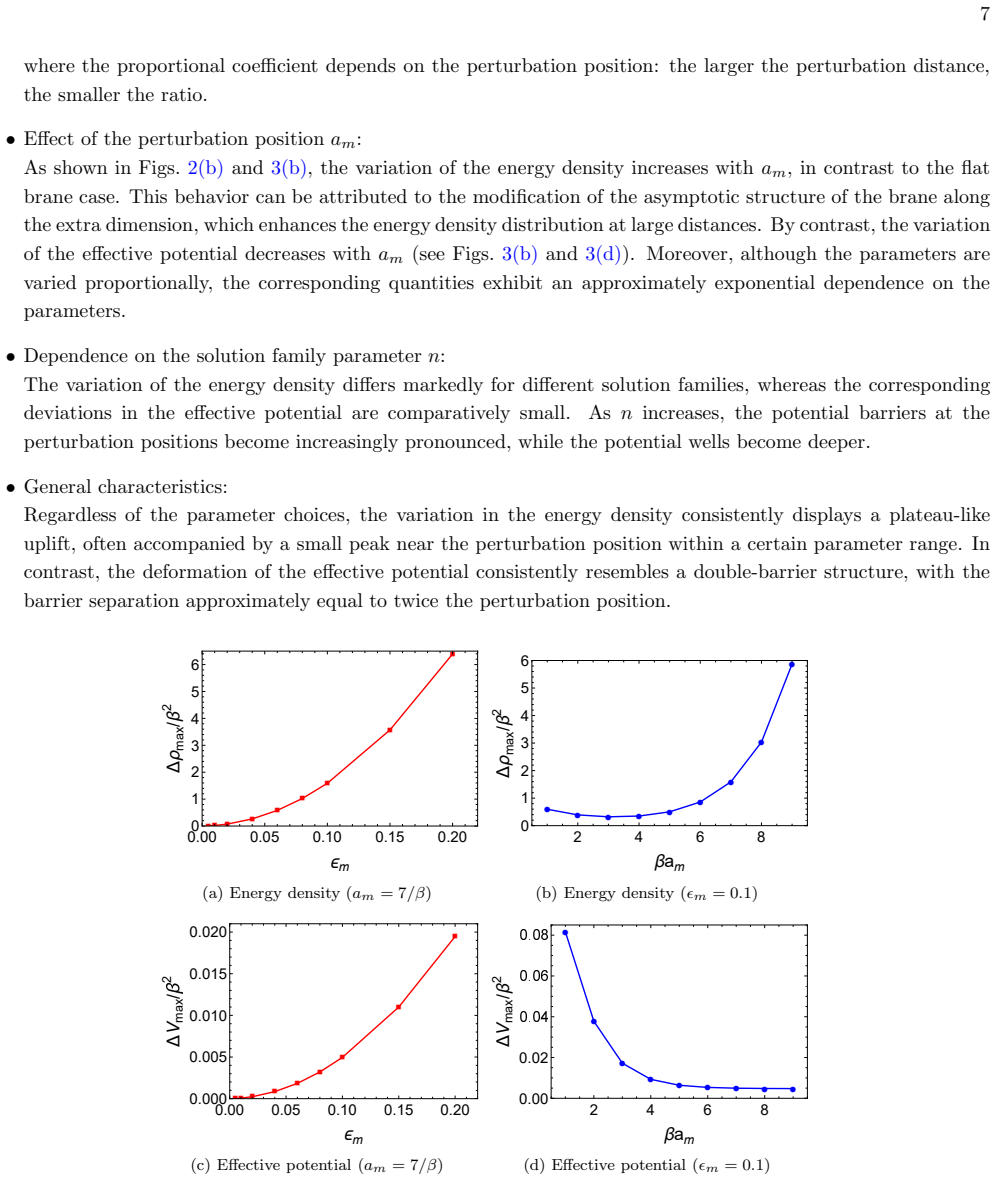
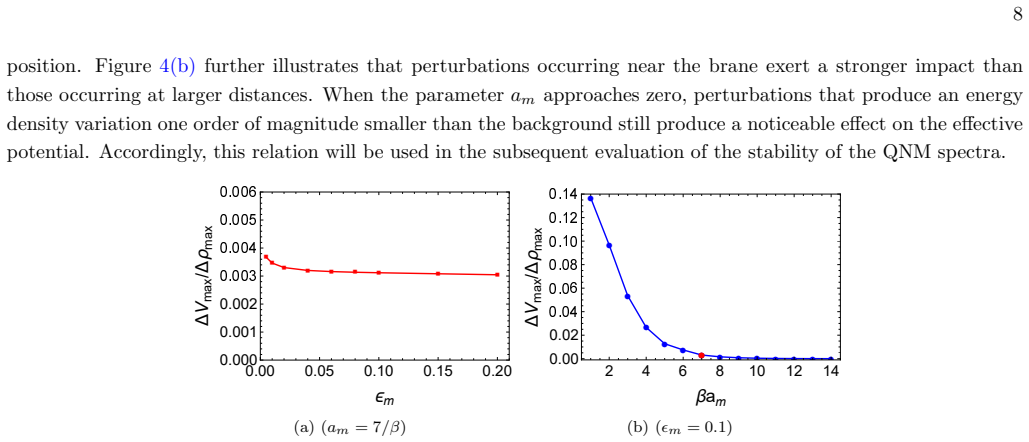
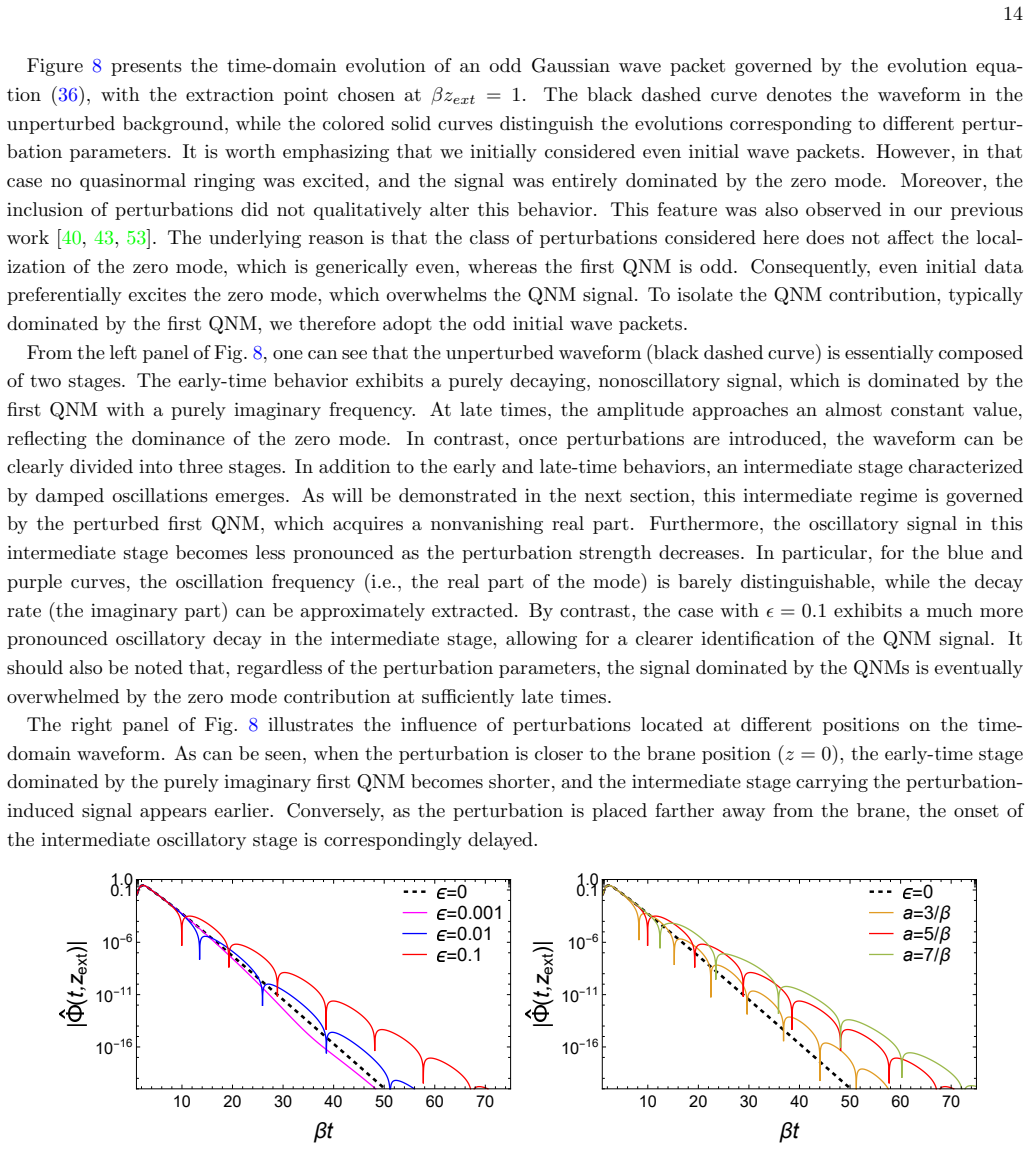
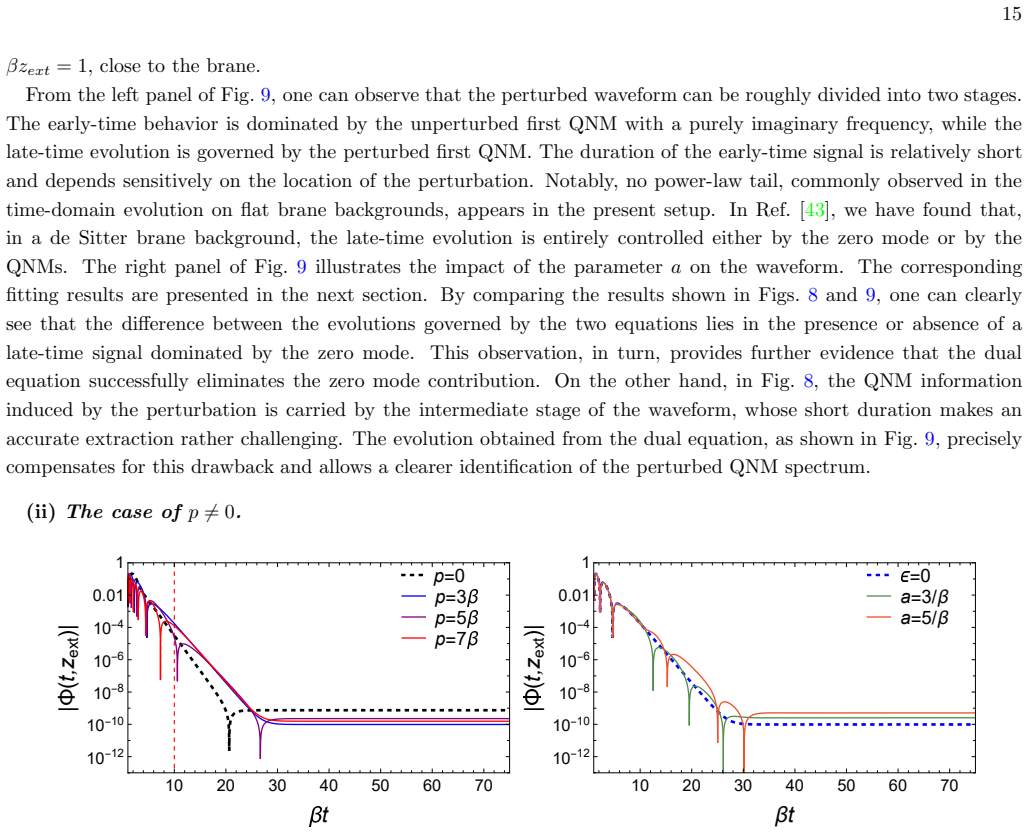
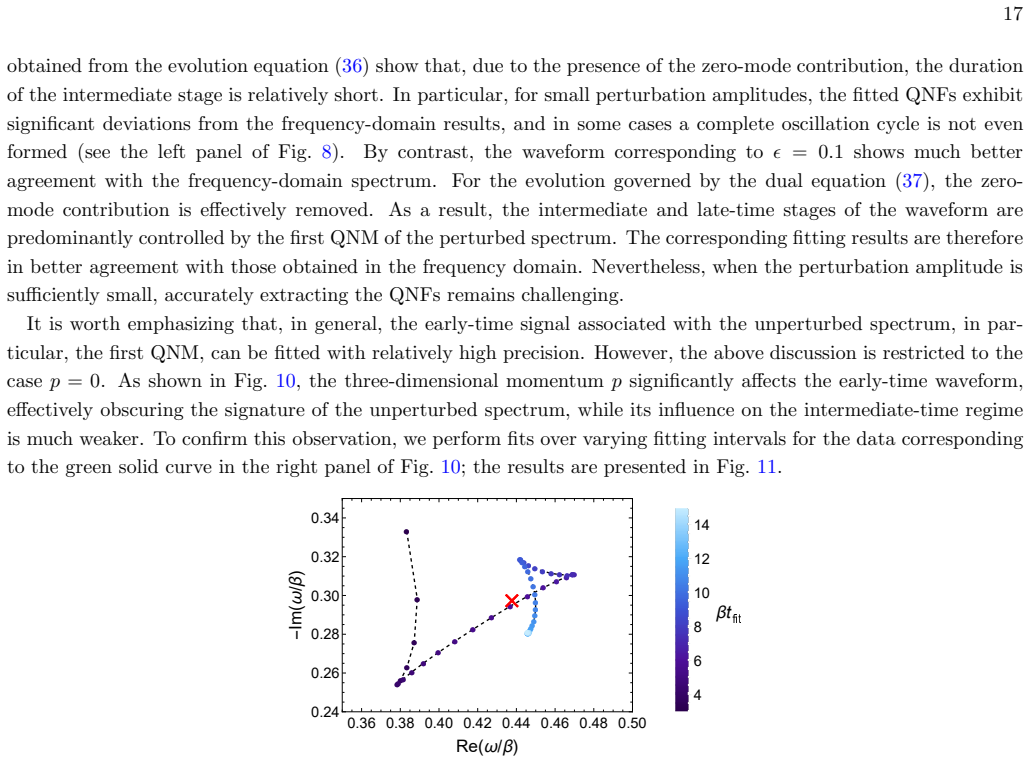
In the unperturbed thick de Sitter brane, gravitational quasinormal modes have purely imaginary frequencies, corresponding to non-oscillatory decay. Perturbations on the brane cause these modes to develop a real frequency component that depends on the perturbation parameters, transforming them into complex modes. In the time domain this produces transient oscillatory signatures in the intermediate stage of the waveform, whose fitted frequencies match those of the first newly induced mode, while the late-time waveform remains dominated by the zero mode.
What carries the argument
the perturbation-induced shift of quasinormal frequencies from purely imaginary to complex values on the de Sitter brane
If this is right
- Time-domain signals develop transient oscillations in the intermediate stage.
- Fitted frequencies of those oscillations match the first newly induced quasinormal mode.
- Late-time waveforms remain dominated by the zero mode.
- The induced oscillations are more likely to be detectable because early-time signals are more observable.
- This behavior may affect extraction of the cosmological constant on the brane from gravitational signals.
Where Pith is reading between the lines
- The same real-part emergence could appear under perturbations in other braneworld geometries with different backgrounds.
- Searches for intermediate oscillatory features in gravitational-wave data might indirectly constrain extra-dimensional models.
- The dependence of the real part on perturbation parameters suggests that stronger perturbations produce larger real frequencies, offering a route to parameter estimation from signals.
Load-bearing premise
The unperturbed thick de Sitter brane has purely imaginary quasinormal frequencies that can be systematically shifted by perturbations to produce a real part.
What would settle it
A numerical computation of the quasinormal spectrum or time-domain evolution for any specific perturbation on the de Sitter brane that finds the modes remain purely imaginary with no intermediate oscillations would falsify the reported real-part emergence.
Figures
read the original abstract
For braneworlds with infinite extra dimensions, an analysis of the stability of the characteristic spectrum is essential for understanding their dynamical properties. In this study, we investigate the stability of the gravitational perturbation spectrum in a thick de Sitter brane. Unlike the flat brane case, the de Sitter brane features purely imaginary quasinormal frequencies, corresponding to time-domain signals that decay without oscillation. Our results demonstrate that, upon introducing perturbations on the brane, the originally purely imaginary modes develop a nonvanishing real part that depends on the perturbation parameters, thereby becoming complex-frequency modes with both real and imaginary components. In the time domain, this behavior manifests as transient oscillatory signatures in the intermediate stage of the signal, whose fitted frequencies are consistent with those of the first newly induced quasinormal mode, while the late-time waveform remains dominated by the zero mode. As early-time signals are more readily observable, such perturbation-induced oscillations are more likely to be detectable and may have an impact on the extraction of the cosmological constant on the brane from gravitational signals.
Editorial analysis
A structured set of objections, weighed in public.
Referee Report
Summary. The manuscript investigates the gravitational perturbation spectrum in thick de Sitter braneworlds with infinite extra dimensions. It claims that the unperturbed quasinormal modes (QNMs) are purely imaginary, leading to non-oscillatory decaying signals. Introducing perturbations on the brane causes these modes to develop a non-vanishing real part dependent on perturbation parameters, resulting in complex QN frequencies. In the time domain, this manifests as transient oscillations in the intermediate stage, consistent with the first induced QNM, while late-time is dominated by the zero mode. The authors suggest implications for detectability and cosmological constant extraction from gravitational signals.
Significance. If substantiated, the finding that perturbations can induce real parts in originally purely imaginary QNMs in de Sitter braneworlds highlights a mechanism for generating oscillatory signatures in gravitational perturbations. This could have implications for the stability analysis and observational signatures in braneworld models, particularly since early-time signals are more observable. The paper provides a potential link between perturbation parameters and the emergence of complex modes.
major comments (2)
- Abstract: The abstract states the outcome but supplies no derivation steps, numerical methods, error estimates, or explicit perturbation implementation, preventing verification that the mathematics supports the claim as stated.
- The assumption that the thick de Sitter brane possesses purely imaginary quasinormal frequencies in the unperturbed case (abstract, paragraph 3) requires explicit demonstration via the mode equation or reference to a specific prior result with the relevant dispersion relation to confirm it is not dependent on unstated choices in the model setup.
minor comments (1)
- The dependence of the new real part on unspecified perturbation parameters leaves open the possibility that the reported effect is tied to choices made in the model setup.
Simulated Author's Rebuttal
We thank the referee for the careful review and constructive comments. We address each major comment point by point below. The manuscript already contains the relevant derivations and demonstrations in the main text, but we agree that targeted clarifications will strengthen the presentation.
read point-by-point responses
-
Referee: Abstract: The abstract states the outcome but supplies no derivation steps, numerical methods, error estimates, or explicit perturbation implementation, preventing verification that the mathematics supports the claim as stated.
Authors: Abstracts are intentionally concise and omit detailed derivations, methods, and error estimates, which appear in the body of the paper (numerical solution of the perturbed mode equation and perturbation implementation are described in Sections 3 and 4). We will revise the abstract to include a brief clause referencing the numerical approach used. revision: yes
-
Referee: The assumption that the thick de Sitter brane possesses purely imaginary quasinormal frequencies in the unperturbed case (abstract, paragraph 3) requires explicit demonstration via the mode equation or reference to a specific prior result with the relevant dispersion relation to confirm it is not dependent on unstated choices in the model setup.
Authors: Section 2 derives the unperturbed mode equation explicitly and shows that its solutions are purely imaginary frequencies via the resulting dispersion relation; this follows directly from the de Sitter thick-brane background and is independent of unstated choices. We will add an explicit cross-reference to this derivation (or the relevant prior result) in the revised abstract and introduction. revision: yes
Circularity Check
No significant circularity; derivation self-contained against external benchmarks
full rationale
The paper's central claim—that perturbations on a thick de Sitter brane induce a nonzero real part in originally purely imaginary quasinormal modes—is presented as a numerical or analytic result from the perturbed mode equations, with the unperturbed spectrum taken as an input assumption rather than derived from the perturbation itself. No self-definitional loop, fitted parameter renamed as prediction, or load-bearing self-citation chain is exhibited in the abstract or stated claims; the dependence on perturbation parameters is an output of the model, not a tautology. The derivation therefore remains independent of its target result and receives the default non-circularity finding.
Axiom & Free-Parameter Ledger
axioms (1)
- domain assumption Thick de Sitter brane possesses purely imaginary quasinormal frequencies corresponding to non-oscillatory decay in the unperturbed case.
Reference graph
Works this paper leans on
-
[1]
001 0.0247498 -0.368233 0.0967193 -0.542292 0.122729 -0.459683
-
[2]
01 0.191071 -0.411263 0.252136 -0.336975 0.242234 -0.341501
-
[3]
Talent Scientific Fund of Lanzhou University
1 0.321139 -0.131438 0.326107 -0.153556 0.326274 -0.153405 TABLE I: Comparison between the first QNF extracted through t he time-domain fitting results and the frequency-domain results with and without the perturbation for p = 0. We first investigate the fitting results of the time-domain waveform s in the case p = 0, as summarized in Table I. For the unpertu...
2025
-
[4]
Polchinski, Dirichlet Branes and Ramond-Ramond charges , Phys
J. Polchinski, Dirichlet Branes and Ramond-Ramond charges , Phys. Rev. Lett. 75, 4724 (1995), [ arXiv:hep-th/9510017]
Pith/arXiv arXiv 1995
-
[5]
N. Arkani-Hamed, S. Dimopoulos, and G. R. Dvali, The Hierarchy problem and new dimensions at a millimeter , Phys. Lett. B 429, 263 (1998), [ arXiv:hep-ph/9803315]
Pith/arXiv arXiv 1998
-
[6]
I. Antoniadis, N. Arkani-Hamed, S. Dimopoulos, and G. R. Dvali, New dimensions at a millimeter to a Fermi and superstrings at a TeV , Phys. Lett. B 436, 257 (1998), [ arXiv:hep-ph/9804398]
Pith/arXiv arXiv 1998
-
[7]
N. Kaloper and A. D. Linde, Inflation and large internal dimensions , Phys. Rev. D 59, 101303 (1999), [arXiv:hep-th/9811141]
Pith/arXiv arXiv 1999
-
[8]
L. Randall and R. Sundrum, A Large mass hierarchy from a small extra dimension , Phys. Rev. Lett. 83, 3370 (1999), [arXiv:hep-ph/9905221]
Pith/arXiv arXiv 1999
-
[9]
L. Randall and R. Sundrum, An Alternative to compactification , Phys. Rev. Lett. 83, 4690 (1999), [ arXiv:hep-th/9906064]
Pith/arXiv arXiv 1999
-
[10]
I. I. Kogan, S. Mouslopoulos, A. Papazoglou, G. G. Ross, a nd J. Santiago, A Three three-brane universe: New phenomenol- ogy for the new millennium? , Nucl. Phys. B 584, 313 (2000), [ arXiv:hep-ph/9912552]
Pith/arXiv arXiv 2000
-
[11]
Gremm, Thick domain walls and singular spaces , Phys
M. Gremm, Thick domain walls and singular spaces , Phys. Rev. D 62, 044017 (2000), [ arXiv:hep-th/0002040]
Pith/arXiv arXiv 2000
-
[12]
R. Gregory, V. A. Rubakov, and S. M. Sibiryakov, Opening up extra dimensions at ultra large scales , Phys. Rev. Lett. 84, 5928 (2000), [ arXiv:hep-th/0002072]
Pith/arXiv arXiv 2000
-
[13]
G. R. Dvali, G. Gabadadze, and M. Porrati, Metastable gravitons and infinite volume extra dimensions , Phys. Lett. B 484, 112 (2000), [ arXiv:hep-th/0002190]
Pith/arXiv arXiv 2000
-
[14]
Wang, Thick de Sitter 3 branes, dynamic black holes and localizati on of gravity , Phys
A. Wang, Thick de Sitter 3 branes, dynamic black holes and localizati on of gravity , Phys. Rev. D 66, 024024 (2002), [arXiv:hep-th/0201051]
Pith/arXiv arXiv 2002
-
[15]
V. Dzhunushaliev, V. Folomeev, and M. Minamitsuji, Thick brane solutions , Rept. Prog. Phys. 73, 066901 (2010), [arXiv:0904.1775]
Pith/arXiv arXiv 2010
-
[16]
R. Maartens and K. Koyama, Brane-World Gravity, Living Rev. Rel. 13, 5 (2010), [ arXiv:1004.3962]
Pith/arXiv arXiv 2010
-
[17]
Liu, Introduction to Extra Dimensions and Thick Braneworlds , [ arXiv:1707.08541]
Y.-X. Liu, Introduction to Extra Dimensions and Thick Braneworlds , [ arXiv:1707.08541]
-
[18]
D. V. Ahluwalia, J. M. H. da Silva, C. Y. Lee, Y.-X. Liu, S. H. Pereira, and M. M. Sorkhi, Mass dimension one fermions: Constructing darkness , Phys. Rept. 967, 1 (2022), [ arXiv:2205.04754]
arXiv 2022
-
[19]
Kaluza, Zum unit¨ atsproblem der physik , Sitzungsber
T. Kaluza, Zum unit¨ atsproblem der physik , Sitzungsber. Preuss. Akad. Wiss. Berlin (Math. Phys.) 1921, 966 (1921), [arXiv:1803.08616]
Pith/arXiv arXiv 1921
-
[20]
Kaluza, Quantentheorie und f¨ unfdimensionale Relativit¨ atstheorie, Z
T. Kaluza, Quantentheorie und f¨ unfdimensionale Relativit¨ atstheorie, Z. phys. 37, 895 (1926)
1926
-
[21]
J. M. Overduin and P. S. Wesson, Kaluza-Klein gravity, Phys. Rept. 283, 303 (1997), [ arXiv:gr-qc/9805018]. 20
Pith/arXiv arXiv 1997
-
[22]
Yang, B.-F
S.-Q. Yang, B.-F. Zhan, Q.-L. Wang, C.-G. Shao, L.-C. Tu , W.-H. Tan, and J. Luo, Test of the Gravitational Inverse Square Law at Millimeter Ranges , Phys. Rev. Lett. 108, 081101 (2012)
2012
-
[23]
Tan, S.-Q
W.-H. Tan, S.-Q. Yang, C.-G. Shao, J. Li, A.-B. Du, B.-F. Zhan, Q.-L. Wang, P.-S. Luo, L.-C. Tu, and J. Luo, New Test of the Gravitational Inverse-Square Law at the Submillimet er Range with Dual Modulation and Compensation , Phys. Rev. Lett. 116, 131101 (2016)
2016
-
[24]
Tan, A.-B
W.-H. Tan, A.-B. Du, W.-C. Dong, S.-Q. Yang, C.-G. Shao, S.-G. Guan, Q.-L. Wang, B.-F. Zhan, P.-S. Luo, and L.-C. Tu, et al. Improvement for Testing the Gravitational Inverse-S quare Law at the Submillimeter Range , Phys. Rev. Lett. 124, 051301 (2020)
2020
-
[25]
J. G. Lee, E. G. Adelberger, T. S. Cook, S. M. Fleischer, a nd B. R. Heckel, New Test of the Gravitational 1/r 2 Law at Separations down to 52 µ m, Phys. Rev. Lett. 124, 101101 (2020), [ arXiv:2002.11761 [hep-ex] ]
arXiv 2020
-
[26]
J. Ke, J. Luo, C. G. Shao, Y. J. Tan, W. H. Tan, and S. Q. Yang , Combined Test of the Gravitational Inverse-Square Law at the Centimeter Range , Phys. Rev. Lett. 126, 211101 (2021)
2021
-
[27]
C. Csaki, J. Erlich, and T. J. Hollowood, Quasilocalization of gravity by resonant modes , Phys. Rev. Lett. 84, 5932 (2000), [arXiv:hep-th/0002161]
Pith/arXiv arXiv 2000
-
[28]
I. H. Brevik, K. Ghoroku, S. D. Odintsov, and M. Yahiro, Localization of gravity on brane embedded in AdS(5) and dS(5 ), Phys. Rev. D 66, 064016 (2002), [ arXiv:hep-th/0204066]
Pith/arXiv arXiv 2002
-
[29]
C. Clarkson and S. S. Seahra, Braneworld resonances, Class. Quant. Grav. 22, 3653 (2005), [ arXiv:gr-qc/0505145]
Pith/arXiv arXiv 2005
-
[30]
A. Melfo, N. Pantoja, and J. D. Tempo, Fermion localization on thick branes , Phys. Rev. D 73, 044033 (2006), [arXiv:hep-th/0601161]
Pith/arXiv arXiv 2006
-
[31]
Y.-X. Liu, J. Yang, Z.-H. Zhao, C.-E. Fu, and Y.-S. Duan, Fermion Localization and Resonances on A de Sitter Thick Brane, Phys. Rev. D 80, 065019 (2009), [ arXiv:0904.1785]
Pith/arXiv arXiv 2009
-
[32]
Y.-X. Liu, H. Guo, C.-E. Fu, and J.-R. Ren, Localization of Matters on Anti-de Sitter Thick Branes , JHEP 02, 080 (2010), [arXiv:0907.4424]
Pith/arXiv arXiv 2010
-
[33]
Y.-X. Liu, Y. Zhong, Z.-H. Zhao, and H.-T. Li, Domain wall brane in squared curvature gravity , J. High Energy Phys. 06, 135 (2011), [ arXiv:1104.3188]
Pith/arXiv arXiv 2011
-
[34]
Y. Zhong and Y.-X. Liu, Linearization of a warped f (R) theory in the higher-order frame , Phys. Rev. D 95, 104060 (2017), [arXiv:1611.08237]
Pith/arXiv arXiv 2017
-
[35]
C.-C. Zhu, Q. Tan, Y.-P. Zhang, and Y.-X. Liu, Evolution of fermion resonance in thick brane , Commun. Theor. Phys. 76, 125403 (2024), [ arXiv:2304.04479]
arXiv 2024
-
[36]
C.-C. Zhu, J. Chen, W.-D. Guo, and Y.-X. Liu, Gravitational echoes from braneworlds , JHEP 01, 010 (2025), [arXiv:2406.16256]
arXiv 2025
-
[37]
S. S. Seahra, Ringing the Randall-Sundrum braneworld: Metastable gravi ty wave bound states , Phys. Rev. D 72, 066002 (2005), [ arXiv:hep-th/0501175]
Pith/arXiv arXiv 2005
-
[38]
S. S. Seahra, Metastable massive gravitons from an infinite extra dimensi on, Int. J. Mod. Phys. D 14, 2279 (2005), [arXiv:hep-th/0505196]
Pith/arXiv arXiv 2005
-
[39]
H. Chung, L. Randall, M. J. Rodriguez, and O. Varela, Quasinormal ringing on the brane , Class. Quant. Grav. 33, 245013 (2016), [ arXiv:1508.02611]
Pith/arXiv arXiv 2016
- [40]
- [41]
-
[42]
Q. Tan, Y. Zhong, and W.-D. Guo, Quasibound and quasinormal modes of a thick brane in Rastall gravity, JHEP 07, 252 (2024), [ arXiv:2404.11217]
arXiv 2024
- [43]
-
[44]
Q. Tan, S. Long, W. Deng, and J. Jing, Graviscalar quasinormal modes and asymptotic tails of a thi ck brane , Phys. Lett. B 868, 139667 (2025), [ arXiv:2409.06947]
arXiv 2025
-
[45]
Q. Tan, S. Long, W. Deng, and J. Jing, Quasinormal modes and echoes of a double braneworld , JHEP 02, 055 (2025), [arXiv:2410.06945]
arXiv 2025
- [46]
-
[47]
W. Deng, S. Long, Q. Tan, Z.-C. Chen, and J. Jing, Scalar-gravitational quasinormal modes and echoes in a five dimensional thick brane, [ arXiv:2508.20937]
-
[48]
Y.-P. E, C.-C. Zhu, and Y.-X. Liu, Quasinormal modes of thick branes in f (R) gravity, [ arXiv:2512.17208]
-
[49]
R. A. Konoplya and A. Zhidenko, Asymptotic tails of massive gravitons in light of pulsar tim ing array observations , Phys. Lett. B 853, 138685 (2024), [ arXiv:2307.01110]
arXiv 2024
-
[50]
G. Agazie et al. [NANOGrav], The NANOGrav 15 yr Data Set: Evidence for a Gravitational-wa ve Background, Astrophys. J. Lett. 951, L8 (2023), [ arXiv:2306.16213]
Pith/arXiv arXiv 2023
-
[51]
K. Koyama, Late time behavior of cosmological perturbations in a singl e brane model , JCAP 09, 010 (2004), [arXiv:astro-ph/0407263]
Pith/arXiv arXiv 2004
-
[52]
C. Caprini and D. G. Figueroa, Cosmological Backgrounds of Gravitational Waves , Class. Quant. Grav. 35, 163001 (2018), [arXiv:1801.04268]
Pith/arXiv arXiv 2018
-
[53]
A. Karch and L. Randall, Locally localized gravity, JHEP 05, 008 (2001), [ arXiv:hep-th/0011156]
Pith/arXiv arXiv 2001
-
[54]
V. I. Afonso, D. Bazeia, and L. Losano, First-order formalism for bent brane , Phys. Lett. B 634, 526 (2006), [arXiv:hep-th/0601069]
Pith/arXiv arXiv 2006
-
[55]
Y.-X. Liu, H. Guo, C.-E. Fu, and H.-T. Li, Localization of Bulk Matters on a Thick Anti-de Sitter Brane , Phys. Rev. D 84, 044033 (2011), [ arXiv:1101.4145]
Pith/arXiv arXiv 2011
-
[56]
H.-L. Jia, W.-D. Guo, Y.-P. Zhang, and Y.-X. Liu, Spectral Butterfly Effect and Resilient Ringdown in Thick Bran eworlds, [arXiv:2604.23364]
-
[57]
O. DeWolfe, D. Z. Freedman, S. S. Gubser, and A. Karch, Modeling the fifth-dimension with scalars and gravity , Phys. Rev. D 62, 046008 (2000), [ arXiv:hep-th/9909134]
Pith/arXiv arXiv 2000
-
[58]
Gremm, Four-dimensional gravity on a thick domain wall , Phys
M. Gremm, Four-dimensional gravity on a thick domain wall , Phys. Lett. B 478, 434 (2000), [ arXiv:hep-th/9912060]
Pith/arXiv arXiv 2000
-
[59]
C. Csaki, J. Erlich, T. J. Hollowood, and Y. Shirman, Universal aspects of gravity localized on thick branes , Nucl. Phys. B 581, 309 (2000), [ arXiv:hep-th/0001033]
Pith/arXiv arXiv 2000
-
[60]
Pani, Advanced Methods in Black-Hole Perturbation Theory , Int
P. Pani, Advanced Methods in Black-Hole Perturbation Theory , Int. J. Mod. Phys. A 28, 1340018 (2013), [arXiv:1305.6759]
Pith/arXiv arXiv 2013
-
[61]
S. Fortuna and I. Vega, Bernstein spectral method for quasinormal modes and other e igenvalue problems , Eur. Phys. J. C 83, 1170 (2023), [ arXiv:2003.06232]
arXiv 2023
-
[62]
J. L. Jaramillo, R. P. Macedo and L. A. Sheikh, Pseudospectrum and Black Hole Quasinormal Mode Instabilit y, Phys. Rev. X 11, 031003 (2021), [ arXiv:2004.06434]
Pith/arXiv arXiv 2021
-
[63]
Motohashi, Resonant Excitation of Quasinormal Modes of Black Holes , Phys
H. Motohashi, Resonant Excitation of Quasinormal Modes of Black Holes , Phys. Rev. Lett. 134, 141401 (2025), [arXiv:2407.15191]
arXiv 2025
-
[64]
J. P. Cavalcante, M. Richartz, and B. C. da Cunha, Exceptional Point and Hysteresis in Perturbations of Kerr B lack Holes , Phys. Rev. Lett. 133, 261401 (2024), [ arXiv:2407.20850]
arXiv 2024
-
[65]
Y. Yang, E. Berti, and N. Franchini, Black Hole Quasinormal Mode Resonances , Phys. Rev. Lett. 135, 201401 (2025), [arXiv:2504.06072]
arXiv 2025
-
[66]
R. Panosso Macedo, T. Katagiri, K. i. Kubota, and H. Moto hashi, Exceptional Points and Resonance in Black Hole Ringdown, [ arXiv:2512.02110]
-
[67]
L. B. Wu, L. Xie, L. M. Cao, M. F. Ji, and Y. S. Zhou, Quasinormal modes of Schwarzschild-de Sitter black holes i n semi-open systems, Sci. China Phys. Mech. Astron. 69, 240415 (2026), [ arXiv:2512.06903]
arXiv 2026
- [68]
discussion (0)
Sign in with ORCID, Apple, or X to comment. Anyone can read and Pith papers without signing in.