Atom Interferometry with Transverse Optical Modes
Pith reviewed 2026-06-28 03:27 UTC · model grok-4.3
The pith
Atom interferometers can use the helical phase profile of laser beams to sense rotations with sensitivity scaling linearly with orbital angular momentum.
A machine-rendered reading of the paper's core claim, the machinery that carries it, and where it could break.
Core claim
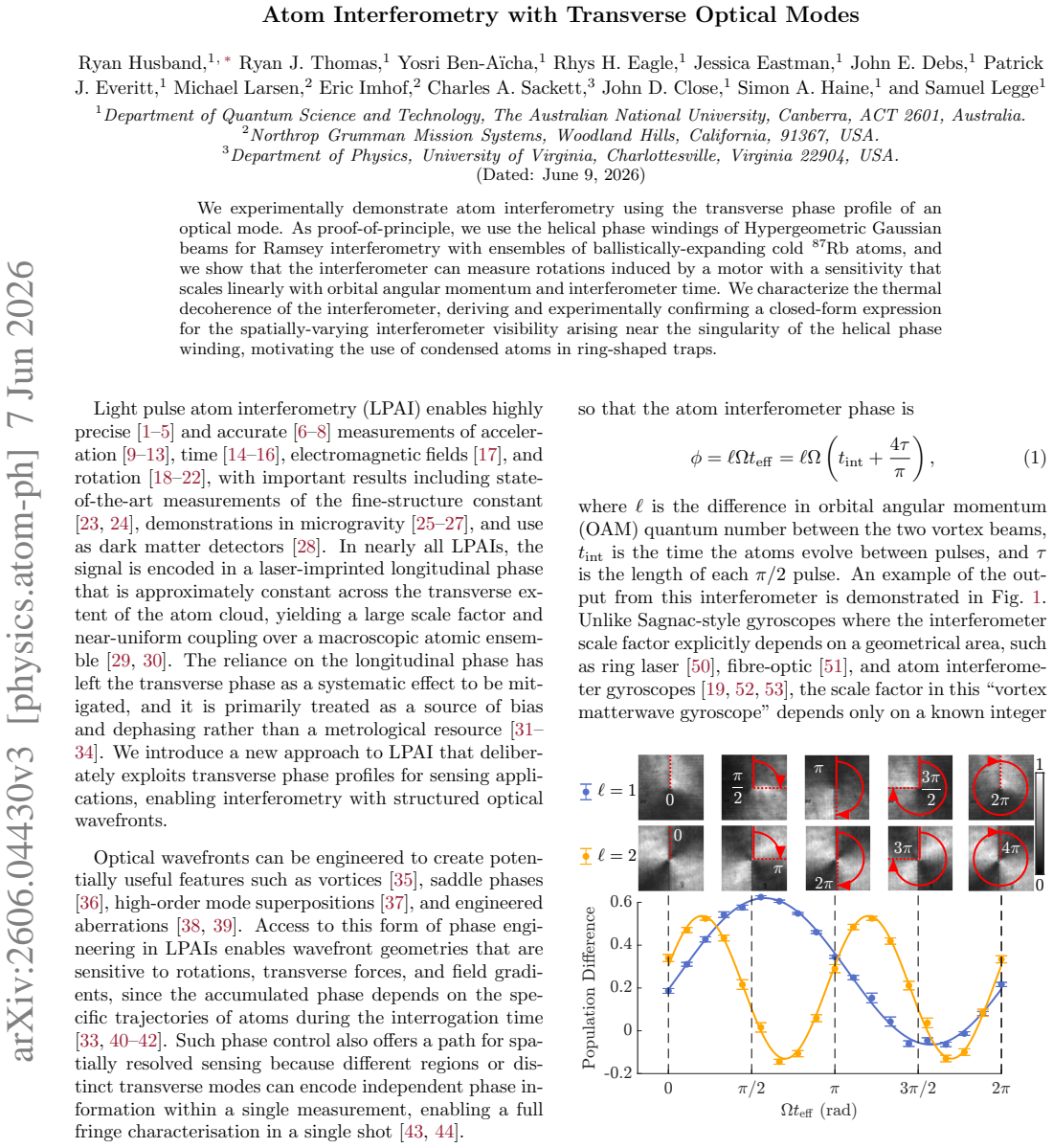
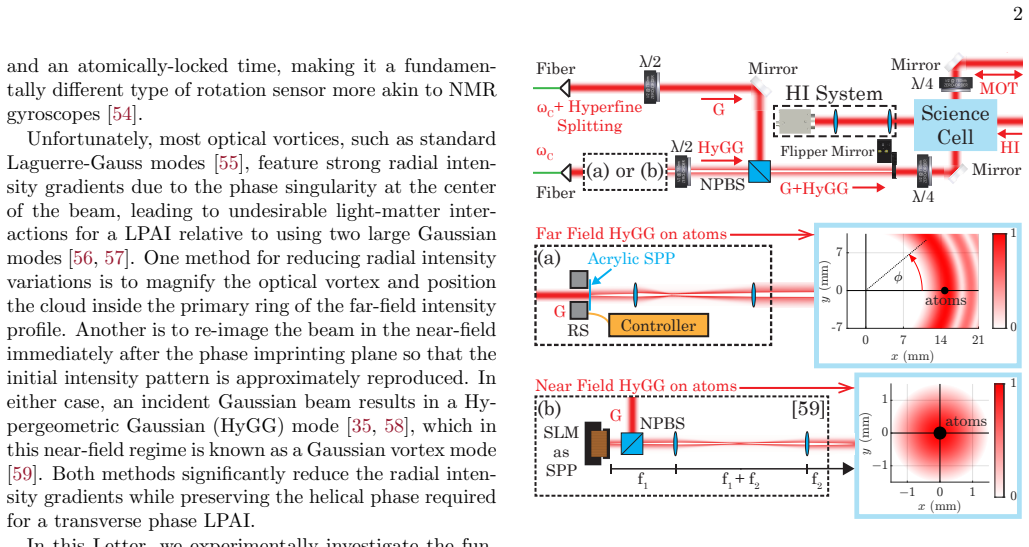
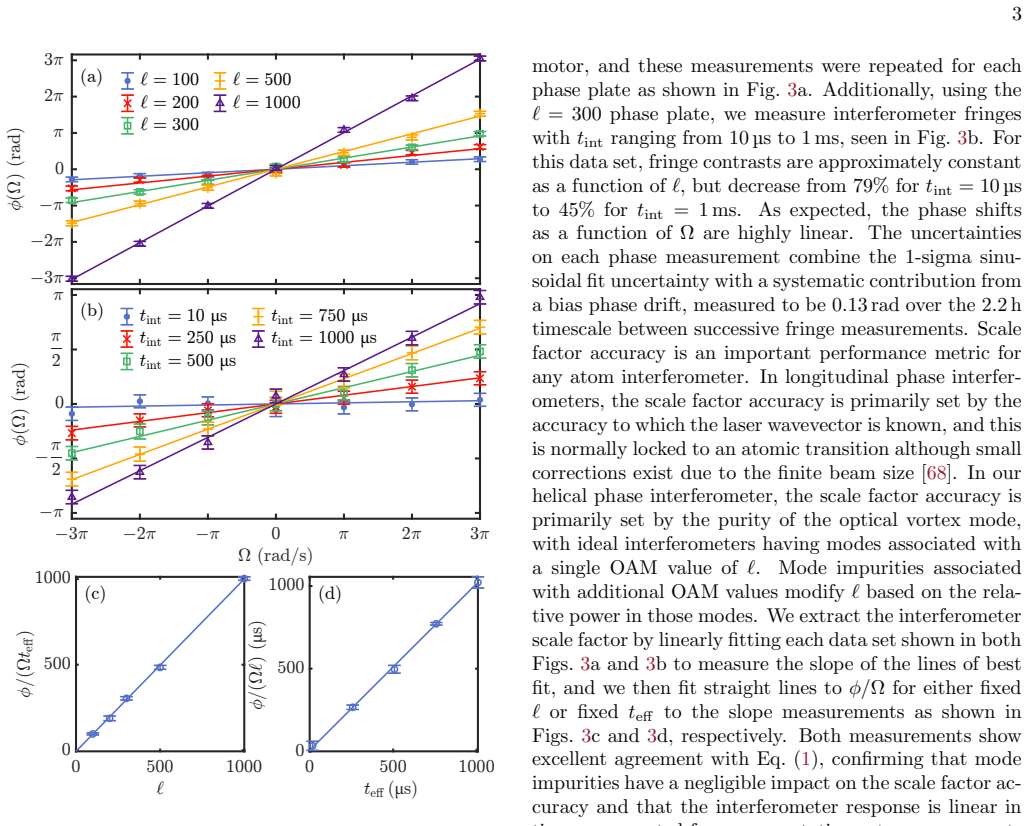
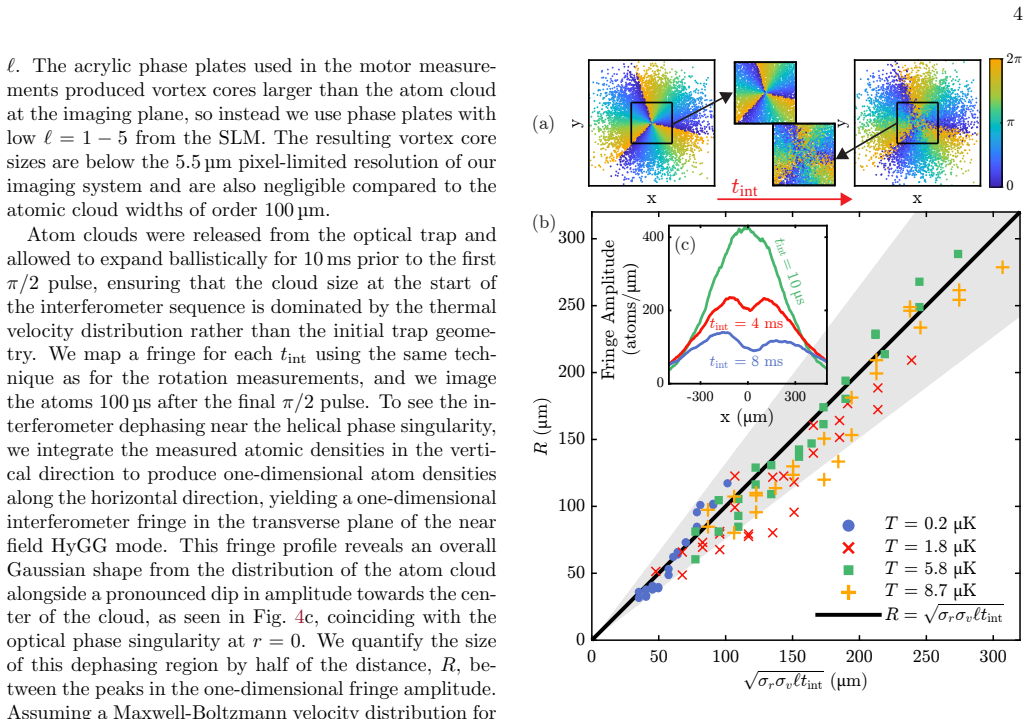
We experimentally demonstrate atom interferometry using the transverse phase profile of an optical mode. As proof-of-principle, we use the helical phase windings of Hypergeometric Gaussian beams for Ramsey interferometry with ensembles of ballistically-expanding cold Rb87 atoms, and we show that the interferometer can measure rotations induced by a motor with a sensitivity that scales linearly with orbital angular momentum and interferometer time. We characterize the thermal decoherence of the interferometer, deriving and experimentally confirming a closed-form expression for the spatially-varying interferometer visibility arising near the singularity of the helical phase winding, motivating
What carries the argument
The transverse helical phase profile of a Hypergeometric Gaussian beam, which imprints a spatially varying phase onto the atomic wave function during the Ramsey sequence and thereby encodes rotation in the interference pattern.
If this is right
- Rotation phase shift scales linearly with orbital angular momentum, allowing higher-order beams to increase sensitivity without changing atom number or interrogation time.
- Phase shift also scales linearly with interferometer duration, recovering the usual T^2 advantage of atom interferometers.
- Thermal velocity spread produces a spatially varying visibility that is exactly described by a closed-form function derived from the phase singularity.
- The derived visibility expression indicates that condensed atoms in ring-shaped traps would largely remove the thermal decoherence channel.
Where Pith is reading between the lines
- The same transverse-phase approach could be combined with existing large-momentum-transfer techniques to multiply sensitivity by both orbital angular momentum and recoil number.
- The visibility formula supplies a quantitative design rule for choosing beam waist and atom temperature in any phase-profile interferometer.
- Ring-trap implementations suggested by the authors would convert the demonstrated linear scaling into a practical gyroscope with reduced decoherence.
- The method may extend to other optical singularities, such as those carrying spin angular momentum, for simultaneous rotation and magnetic-field sensing.
Load-bearing premise
The helical phase profile imprints cleanly onto the atomic ensemble without significant distortion from beam propagation, misalignment, or optical aberrations during ballistic expansion.
What would settle it
A measurement in which rotation sensitivity fails to increase linearly with orbital angular momentum when higher-order beams are substituted, or in which the observed spatial visibility profile deviates from the derived closed-form expression near the singularity.
Figures
read the original abstract
We experimentally demonstrate atom interferometry using the transverse phase profile of an optical mode. As proof-of-principle, we use the helical phase windings of Hypergeometric Gaussian beams for Ramsey interferometry with ensembles of ballistically-expanding cold Rb87 atoms, and we show that the interferometer can measure rotations induced by a motor with a sensitivity that scales linearly with orbital angular momentum and interferometer time. We characterize the thermal decoherence of the interferometer, deriving and experimentally confirming a closed-form expression for the spatially-varying interferometer visibility arising near the singularity of the helical phase winding, motivating the use of condensed atoms in ring-shaped traps.
Editorial analysis
A structured set of objections, weighed in public.
Referee Report
Summary. The paper claims an experimental demonstration of atom interferometry via the transverse phase profile of Hypergeometric Gaussian beams in Ramsey interferometry on ballistically expanding cold Rb87 atoms. It reports rotation sensitivity that scales linearly with orbital angular momentum ℓ and interrogation time T, together with a derived closed-form expression for the spatially varying visibility near the helical phase singularity that is stated to be experimentally confirmed, motivating condensed-atom implementations in ring traps.
Significance. If the central claims hold, the work introduces a new degree of freedom (transverse optical phase structure) into atom interferometry for rotation sensing, with the ℓ-linear scaling offering a route to enhanced sensitivity without increasing T. The closed-form visibility expression supplies a concrete, falsifiable prediction for thermal decoherence near phase singularities and directly supports the paper's motivation for using condensed atoms. The experimental proof-of-principle itself is a positive feature.
major comments (2)
- [Abstract] Abstract and the visibility derivation: the linear scaling with ℓ and the closed-form visibility both presuppose that the helical phase profile is transferred to the atomic wave function with negligible distortion during the Raman pulses and ballistic expansion; no independent verification (e.g., direct phase imaging of the atomic cloud or a control measurement with a known non-ideal beam) is described, rendering both claims load-bearing on an untested assumption.
- [Results (visibility section)] The experimental confirmation of the visibility formula: because the formula is derived under the ideal-imprinting assumption, the reported agreement with data cannot by itself validate the imprinting step; an auxiliary measurement (for example, visibility far from the singularity or with a Gaussian beam of matched intensity) would be required to separate the two effects.
minor comments (1)
- [Abstract] The abstract refers to 'Hypergeometric Gaussian beams' without quoting the specific radial index p, beam waist, or propagation distance used; these parameters should be stated explicitly when the visibility formula is introduced.
Simulated Author's Rebuttal
We thank the referee for the detailed and constructive report. We respond to each major comment below, indicating where the manuscript will be revised for clarity while maintaining the integrity of the presented results.
read point-by-point responses
-
Referee: [Abstract] Abstract and the visibility derivation: the linear scaling with ℓ and the closed-form visibility both presuppose that the helical phase profile is transferred to the atomic wave function with negligible distortion during the Raman pulses and ballistic expansion; no independent verification (e.g., direct phase imaging of the atomic cloud or a control measurement with a known non-ideal beam) is described, rendering both claims load-bearing on an untested assumption.
Authors: The manuscript presents the observed linear scaling of rotation sensitivity with ℓ as direct experimental support for effective transfer of the helical phase, because this scaling is a specific signature of the imprinted orbital angular momentum and would not appear under significant distortion. The Raman pulse parameters (short duration relative to the beam waist) and subsequent free expansion are expected to preserve the transverse phase structure to high fidelity, as the atoms sample the optical field only briefly. We agree that an explicit discussion of this assumption strengthens the presentation. We will revise the abstract and add a dedicated paragraph in the methods section quantifying the expected phase fidelity from the pulse intensity and duration, without claiming new direct imaging data. revision: partial
-
Referee: [Results (visibility section)] The experimental confirmation of the visibility formula: because the formula is derived under the ideal-imprinting assumption, the reported agreement with data cannot by itself validate the imprinting step; an auxiliary measurement (for example, visibility far from the singularity or with a Gaussian beam of matched intensity) would be required to separate the two effects.
Authors: The visibility formula isolates the additional decoherence due to the phase singularity under the ideal-imprinting assumption. The data show visibility approaching unity at large radii, consistent with standard Ramsey interferometry. To separate the effects, we will incorporate an explicit comparison to ℓ=0 (Gaussian beam) data taken under matched conditions, demonstrating that the radial visibility variation is absent without the helical phase. This analysis uses existing datasets and will be added as a supplementary figure with accompanying text. revision: yes
Circularity Check
No circularity: experimental results and derived visibility expression are independent of inputs
full rationale
The paper presents an experimental demonstration of Ramsey interferometry with Hypergeometric Gaussian beams on expanding Rb87 atoms, reports linear scaling of rotation sensitivity with OAM and T, and derives a closed-form visibility expression near the phase singularity that is then experimentally confirmed. No equations, fits, or self-citations are shown reducing any claimed prediction or first-principles result to its own inputs by construction. The visibility derivation is presented as arising from the helical phase winding and thermal decoherence model; its experimental match is reported as separate validation rather than a tautology. Central claims rest on measured data and do not invoke load-bearing self-citations or ansatzes smuggled via prior work. This is a standard self-contained experimental result with no detectable circular steps.
Axiom & Free-Parameter Ledger
Reference graph
Works this paper leans on
-
[1]
Peters, K
A. Peters, K. Y. Chung, and S. Chu, Metrologia38, 25 (2001)
2001
-
[2]
P. A. Altin, M. T. Johnsson, V. Negnevitsky, G. R. Den- nis, R. P. Anderson, J. E. Debs, S. S. Szigeti, K. S. Hard- man, S. Bennetts, G. D. McDonald, L. D. Turner, J. D. Close, and N. P. Robins, New Journal of Physics15, 023009 (2013)
2013
-
[3]
G. Rosi, F. Sorrentino, L. Cacciapuoti, M. Prevedelli, and G. M. Tino, Nature510, 518 (2014)
2014
-
[4]
K. S. Hardman, P. J. Everitt, G. D. McDonald, P. Manju, P. B. Wigley, M. A. Sooriyabandara, C. C. N. Kuhn, J. E. Debs, J. D. Close, and N. P. Robins, Physical Review Letters117, 138501 (2016)
2016
-
[5]
Zhang, L.-L
T. Zhang, L.-L. Chen, Y.-B. Shu, W.-J. Xu, Y. Cheng, Q. Luo, Z.-K. Hu, and M.-K. Zhou, Physical Review Ap- plied20, 014067 (2023)
2023
-
[6]
Karcher, A
R. Karcher, A. Imanaliev, S. Merlet, and F. P. dos Santos, New Journal of Physics20, 113041 (2018)
2018
-
[7]
Geiger, A
R. Geiger, A. Landragin, S. Merlet, and F. Pereira Dos Santos, AVS Quantum Science2, 024702 (2020)
2020
-
[8]
Janvier, V
C. Janvier, V. M´ enoret, B. Desruelle, S. Merlet, A. Lan- dragin, and F. P. dos Santos, Physical Review A105, 022801 (2022)
2022
-
[9]
M. I. Evstifeev, Gyroscopy and Navigation8, 68 (2017)
2017
-
[10]
Bidel, N
Y. Bidel, N. Zahzam, C. Blanchard, A. Bonnin, M. Cadoret, A. Bresson, D. Rouxel, and M. F. Lequentrec-Lalancette, Nature Communications9, 627 (2018)
2018
-
[11]
Migliaccio, M
F. Migliaccio, M. Reguzzoni, K. Batsukh, G. M. Tino, G. Rosi, F. Sorrentino, C. Braitenberg, T. Pivetta, D. F. Barbolla, and S. Zoffoli, Surveys in Geophysics40, 1029 (2019)
2019
-
[12]
Bidel, N
Y. Bidel, N. Zahzam, A. Bresson, C. Blanchard, M. Cadoret, A. V. Olesen, and R. Forsberg, Journal of Geodesy94, 20 (2020)
2020
-
[13]
B. Wu, C. Zhang, K. Wang, B. Cheng, D. Zhu, R. Li, X. Wang, Q. Lin, Z. Qiao, and Y. Zhou, IEEE Sensors Journal23, 24292 (2023)
2023
-
[14]
C. J. Bord´ e, Metrologia39, 435 (2002)
2002
-
[15]
L. Hu, N. Poli, L. Salvi, and G. M. Tino, Physical Review Letters119, 263601 (2017)
2017
-
[16]
Roura, Quantum Science and Technology10, 025004 (2025)
A. Roura, Quantum Science and Technology10, 025004 (2025)
2025
-
[17]
C. R. Ekstrom, J. Schmiedmayer, M. S. Chapman, T. D. Hammond, and D. E. Pritchard, Physical Review A51, 3883 (1995)
1995
-
[18]
Gustavson, A
T. Gustavson, A. Landragin, and M. Kasevich, Classical and Quantum Gravity17, 2385 (2000)
2000
-
[19]
T. L. Gustavson, A. Landragin, and M. A. Kasevich, Classical and Quantum Gravity17, 2385 (2000)
2000
-
[20]
J. K. Stockton, K. Takase, and M. A. Kasevich, Physical Review Letters107, 133001 (2011)
2011
-
[21]
Gautier, M
R. Gautier, M. Guessoum, L. A. Sidorenkov, Q. Bou- ton, A. Landragin, and R. Geiger, Science Advances8, eabn8009 (2022)
2022
-
[22]
d’Armagnac de Castanet, C
Q. d’Armagnac de Castanet, C. Des Cognets, R. Ar- guel, S. Templier, V. Jarlaud, V. M´ enoret, B. Desruelle, P. Bouyer, and B. Battelier, Nature Communications15, 6406 (2024)
2024
-
[23]
R. H. Parker, C. Yu, W. Zhong, B. Estey, and H. M¨ uller, Science360, 191 (2018)
2018
-
[24]
Morel, Z
L. Morel, Z. Yao, P. Clad´ e, and S. Guellati-Kh´ elifa, Na- ture588, 61 (2020)
2020
-
[25]
Becker, M
D. Becker, M. D. Lachmann, S. T. Seidel,et al., Nature 562, 391 (2018)
2018
-
[26]
M¨ uller, O
F. M¨ uller, O. Carraz, P. Visser, and O. Witasse, Plane- tary and Space Science194, 105110 (2020)
2020
-
[27]
J. R. Williams, C. A. Sackett, H. Ahlers, D. C. Aveline, P. Boegel, S. Botsi, E. Charron, E. R. Elliott, N. Gaaloul, E. Giese, W. Herr, J. R. Kellogg, J. M. Kohel, N. E. Lay, M. Meister, G. M¨ uller, H. M¨ uller, K. Oudrhiri, L. Phillips, A. Pichery, E. M. Rasel, A. Roura, M. Sbros- cia, W. P. Schleich, C. Schneider, C. Schubert, B. Sen, R. J. Thompson, a...
2024
-
[28]
M. Abe, P. Adamson, M. Borcean, D. Bortoletto, K. Bridges, S. P. Carman, S. Chattopadhyay, J. Cole- man, N. M. Curfman, K. DeRose, T. Deshpande, S. Di- mopoulos, C. J. Foot, J. C. Frisch, B. E. Garber, S. Geer, V. Gibson, J. Glick, P. W. Graham, S. R. Hahn, R. Harnik, L. Hawkins, S. Hindley, J. M. Hogan, Y. Jiang, M. A. Kasevich, R. J. Kellett, M. Kiburg,...
2021
-
[29]
Kasevich and S
M. Kasevich and S. Chu, Physical Review Letters67, 181 (1991)
1991
-
[30]
Gauguet, T
A. Gauguet, T. E. Mehlst¨ aubler, T. L´ ev` eque, J. Le Gou¨ et, W. Chaibi, B. Canuel, A. Clairon, F. Pereira Dos Santos, and A. Landragin, Physical Review A78, 043615 (2008)
2008
-
[31]
Schkolnik, B
V. Schkolnik, B. Leykauf, M. Hauth, C. Freier, and A. Pe- ters, Applied Physics B120, 311 (2015)
2015
-
[32]
M.-k. Zhou, Q. Luo, L.-l. Chen, X.-c. Duan, and Z.-k. Hu, Physical Review A93, 043610 (2016)
2016
-
[33]
Le Gou¨ et, T
J. Le Gou¨ et, T. E. Mehlst¨ aubler, J. Kim, S. Merlet, A. Clairon, A. Landragin, and F. Pereira Dos Santos, Applied Physics B92, 133 (2008)
2008
-
[34]
A. D. Cronin, J. Schmiedmayer, and D. E. Pritchard, Reviews of Modern Physics81, 1051 (2009)
2009
-
[35]
M. A. Bandres and J. C. Guti´ errez-Vega, Opt. Lett.33, 177 (2008)
2008
-
[36]
Bernet, Journal of the Optical Society of America A 38, 1521 (2021)
S. Bernet, Journal of the Optical Society of America A 38, 1521 (2021)
2021
-
[37]
E. G. Abramochkin and V. G. Volostnikov, Journal of Optics A: Pure and Applied Optics6, S157 (2004)
2004
-
[38]
Forbes, M
A. Forbes, M. de Oliveira, and M. Dennis, Nature Pho- tonics15, 253 (2021)
2021
-
[39]
Allen, M
L. Allen, M. W. Beijersbergen, R. J. C. Spreeuw, and J. P. Woerdman, Physical Review A45, 8185 (1992)
1992
-
[40]
S. M. Dickerson, J. M. Hogan, A. Sugarbaker, D. M. S. Johnson, and M. A. Kasevich, Phys. Rev. Lett.111, 083001 (2013)
2013
-
[41]
G. W. Hoth, B. Pelle, S. Riedl, J. Kitching, and E. A. Donley, Applied Physics Letters109, 071113 (2016)
2016
-
[42]
Junca, J
J. Junca, J. Kitching, and W. McGehee, Phys. Rev. Lett. 136, 143402 (2026)
2026
-
[43]
Sugarbaker, S
A. Sugarbaker, S. M. Dickerson, J. M. Hogan, D. M. S. Johnson, and M. A. Kasevich, Physical Review Letters 111, 113002 (2013)
2013
-
[44]
Ben-A¨ ıcha, Z
Y. Ben-A¨ ıcha, Z. Mehdi, C. Freier, S. S. Szigeti, P. B. Wigley, L. O. Conlon, R. Husband, S. Legge, R. H. Eagle, J. J. Hope, N. P. Robins, J. D. Close, K. S. Hardman, S. A. Haine, and R. J. Thomas, Phys. Rev. Lett.133, 263403 (2024)
2024
-
[45]
X. Wang, Z. Nie, Y. Liang, J. Wang, T. Li, and B. Jia, Nanophotonics7, 1533 (2018)
2018
-
[46]
P. L. Halkyard, M. P. A. Jones, and S. A. Gardiner, Phys. Rev. A81, 061602 (2010)
2010
-
[47]
S. P. Nolan, J. Sabbatini, M. W. J. Bromley, M. J. Davis, and S. A. Haine, Phys. Rev. A93, 023616 (2016)
2016
-
[48]
S. A. Haine, Phys. Rev. Lett.116, 230404 (2016)
2016
-
[49]
S. A. Haine, New Journal of Physics20, 033009 (2018)
2018
-
[50]
W. W. Chow, J. Gea-Banacloche, L. M. Pedrotti, V. E. Sanders, W. Schleich, and M. O. Scully, Reviews of Mod- ern Physics57, 61 (1985)
1985
-
[51]
Vali and R
V. Vali and R. W. Shorthill, Applied Optics15, 1099 (1976)
1976
-
[52]
T. L. Gustavson, P. Bouyer, and M. A. Kasevich, Physi- cal Review Letters78, 2046 (1997)
2046
-
[53]
E. R. Moan, R. A. Horne, T. Arpornthip, Z. Luo, A. J. Fallon, S. J. Berl, and C. A. Sackett, Physical Review Letters124, 120403 (2020)
2020
-
[54]
Bevan, M
D. Bevan, M. Bulatowicz, P. Clark, J. Flicker, R. Griffith, M. Larsen, M. Luengo-Kovac, J. Pavell, A. Rothballer, D. Sakaida, E. Burke, J. Campero, B. Ehrsam, S. Es- trella, and G. Morrison, in2018 IEEE International Sym- posium on Inertial Sensors and Systems (INERTIAL) (2018)
2018
-
[55]
A. E. Siegman,Lasers(University Science Books Mill Valley, Calif, 1986)
1986
-
[56]
Mielec, M
N. Mielec, M. Altorio, R. Sapam, D. Horville, D. Holleville, L. A. Sidorenkov, A. Landragin, and R. Geiger, Applied Physics Letters113, 161108 (2018)
2018
-
[57]
J. C. Saywell, M. S. Carey, P. S. Light, S. S. Szigeti, A. R. Milne, K. S. Gill, M. L. Goh, V. S. Perunicic, N. M. Wilson, C. D. Macrae, A. Rischka, P. J. Everitt, N. P. Robins, R. P. Anderson, M. R. Hush, and M. J. Biercuk, Nature Communications14, 7626 (2023)
2023
-
[58]
Vallone, Opt
G. Vallone, Opt. Lett.40, 1717 (2015)
2015
-
[59]
Husband, J
R. Husband, J. K. Eastman, S. A. Haine, R. H. Eagle, J. D. Close, R. J. Thomas, and S. Legge, Journal of Op- tics (2026)
2026
-
[60]
C. C. N. Kuhn, G. D. McDonald, K. S. Hardman, S. Ben- netts, P. J. Everitt, P. A. Altin, J. E. Debs, J. D. Close, and N. P. Robins, New Journal of Physics16, 073035 (2014)
2014
-
[61]
P. J. Everitt, Non-linear interactions in single and dual component bose einstein condensates, Ph.D. thesis, The Australian National University (2020)
2020
-
[62]
R. J. Thomas, J. A. McMahon, Z. Mehdi, S. S. Szigeti, S. A. Haine, S. Legge, J. D. Close, and J. J. Hope, Phys. Rev. A112, L031302 (2025)
2025
-
[63]
Newport Corporation, Rgv100bl-s motorized rotation stage
-
[64]
Meadowlark Optics model ODPDM512, with a 512×512 pixel array and a pixel pitch of 15µm
-
[65]
Ullah, S
A. Ullah, S. Legge, J. D. Close, S. A. Haine, and R. J. Thomas, Appl. Opt.63, 8221 (2024)
2024
-
[66]
Donley, T
E. Donley, T. Heavner, F. Levi, M. Tataw, and S. Jefferts, Review of Scientific Instruments76(2005)
2005
-
[67]
Campbell, B
G. Campbell, B. Hage, B. Buchler, and P. K. Lam, Appl. Opt.51, 873 (2012)
2012
-
[68]
J. M. Cervantes, M. A. Maldonado, J. A. Franco- Villafa˜ ne, T. Roach, V. M. Valenzuela, and E. Gomez, OSA Continuum4, 1996 (2021)
1996
-
[69]
See Supplementary Material at [Link]
-
[70]
Henderson, C
K. Henderson, C. Ryu, C. MacCormick, and M. G. Boshier, New Journal of Physics11, 043030 (2009)
2009
-
[71]
T. A. Bell, J. A. P. Glidden, L. Humbert, M. W. J. Brom- ley, S. A. Haine, M. J. Davis, T. W. Neely, M. A. Baker, and H. Rubinsztein-Dunlop, New Journal of Physics18, 089501 (2016)
2016
-
[72]
Gauthier, I
G. Gauthier, I. Lenton, N. M. Parry, M. Baker, M. J. Davis, H. Rubinsztein-Dunlop, and T. W. Neely, Optica 3, 1136 (2016)
2016
-
[73]
C. W. Woffinden, A. J. Groszek, G. Gauthier, B. J. Mom- mers, M. W. J. Bromley, S. A. Haine, H. Rubinsztein- Dunlop, M. J. Davis, T. W. Neely, and M. Baker, SciPost Phys.15, 128 (2023)
2023
-
[74]
K. S. Hardman, P. J. Everitt, G. D. McDonald, P. Manju, P. B. Wigley, M. A. Sooriyabandara, C. C. N. Kuhn, J. E. Debs, J. D. Close, and N. P. Robins, Phys. Rev. Lett. 117, 138501 (2016)
2016
-
[75]
− r2 2 2σ2r(t2) − r2 2 ˙θ2 σ2 r(t2) 2σ2r σ2v − σ2 r(t2) 2σ2r σ2v ˙r− r2σ2 vt2 σ2r(t2) 2 +iℓ∆θ # d˙r d˙θ(18) ≈2πr 2 2 dr2 α ∞ZZ −∞ exp
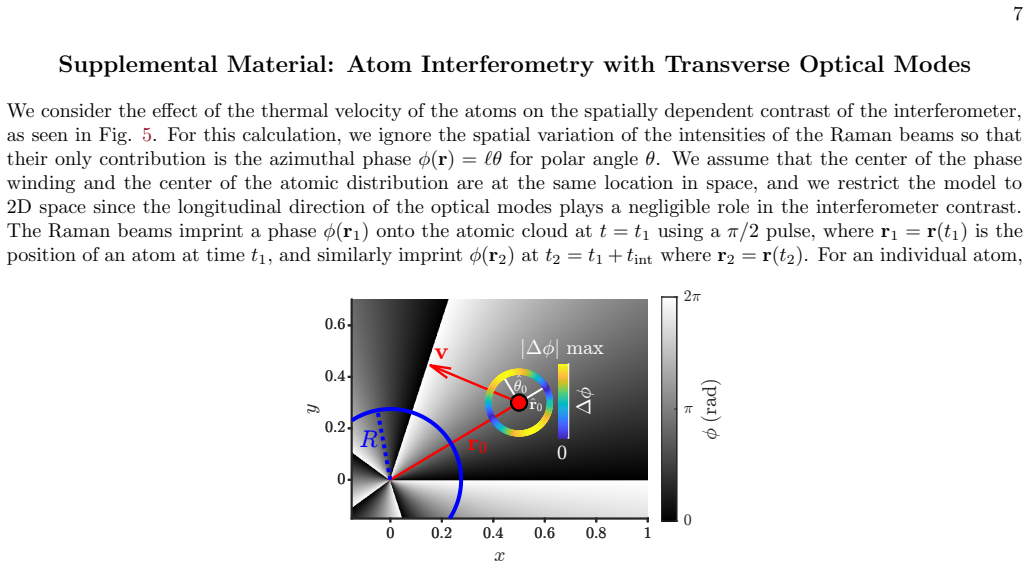
S. S. Szigeti, S. P. Nolan, J. D. Close, and S. A. Haine, Phys. Rev. Lett.125, 100402 (2020). 7 Supplemental Material: Atom Interferometry with Transverse Optical Modes We consider the effect of the thermal velocity of the atoms on the spatially dependent contrast of the interferometer, as seen in Fig. 5. For this calculation, we ignore the spatial variat...
2020
discussion (0)
Sign in with ORCID, Apple, or X to comment. Anyone can read and Pith papers without signing in.