Mechanical bistability and hysteresis in graphene-CNT hybrid systems: from atomistic simulations to macroscale structural responses
Pith reviewed 2026-06-28 05:46 UTC · model grok-4.3
The pith
Graphene-CNT hybrids switch between two stable layer configurations due to competing van der Waals attraction and elastic deformation.
A machine-rendered reading of the paper's core claim, the machinery that carries it, and where it could break.
Core claim
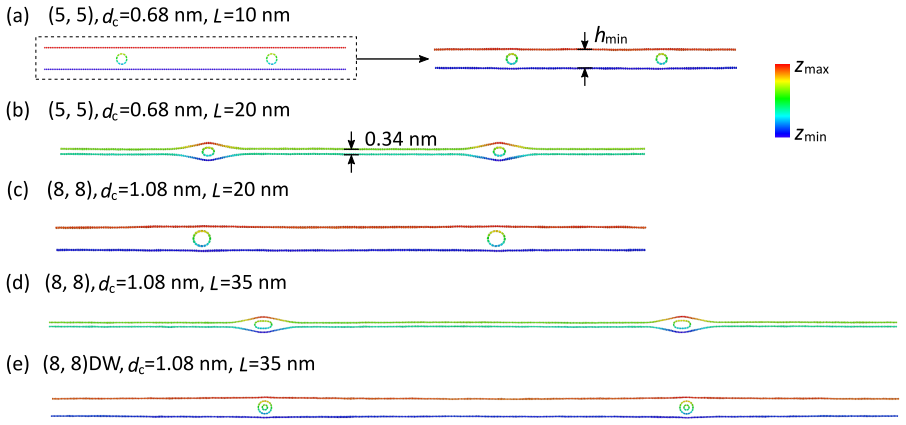
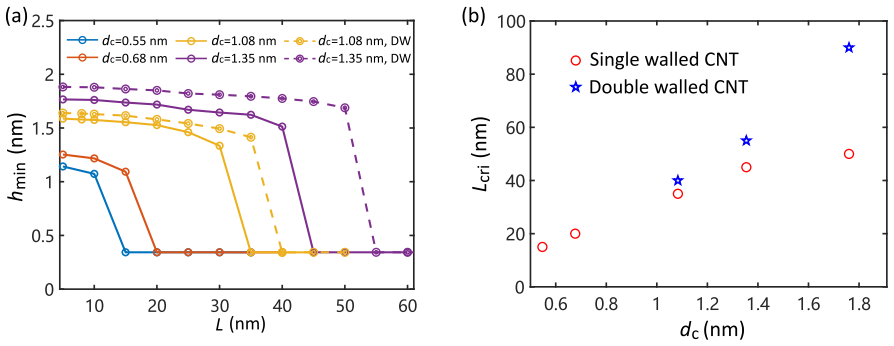
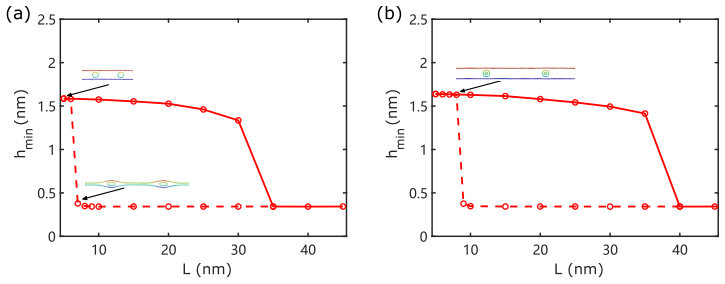
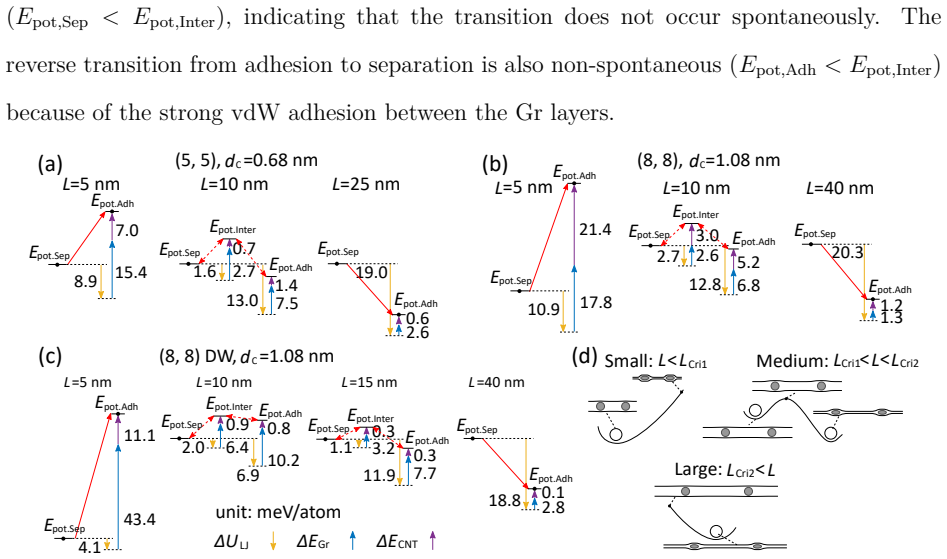
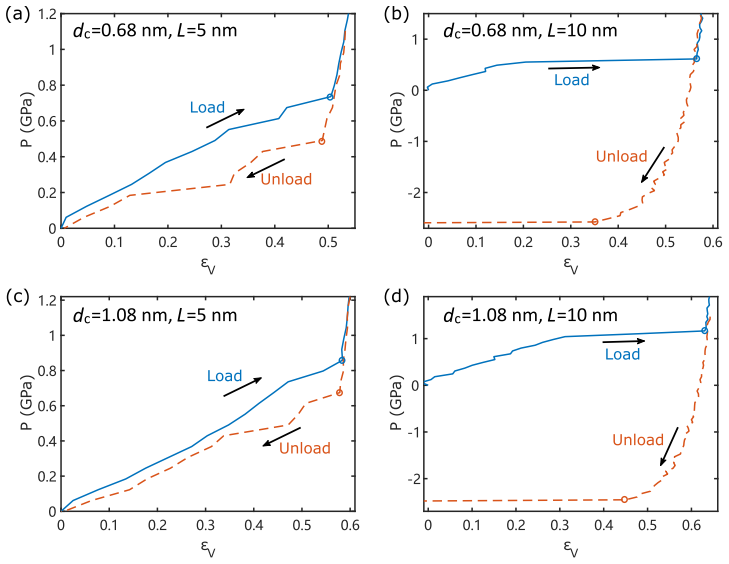
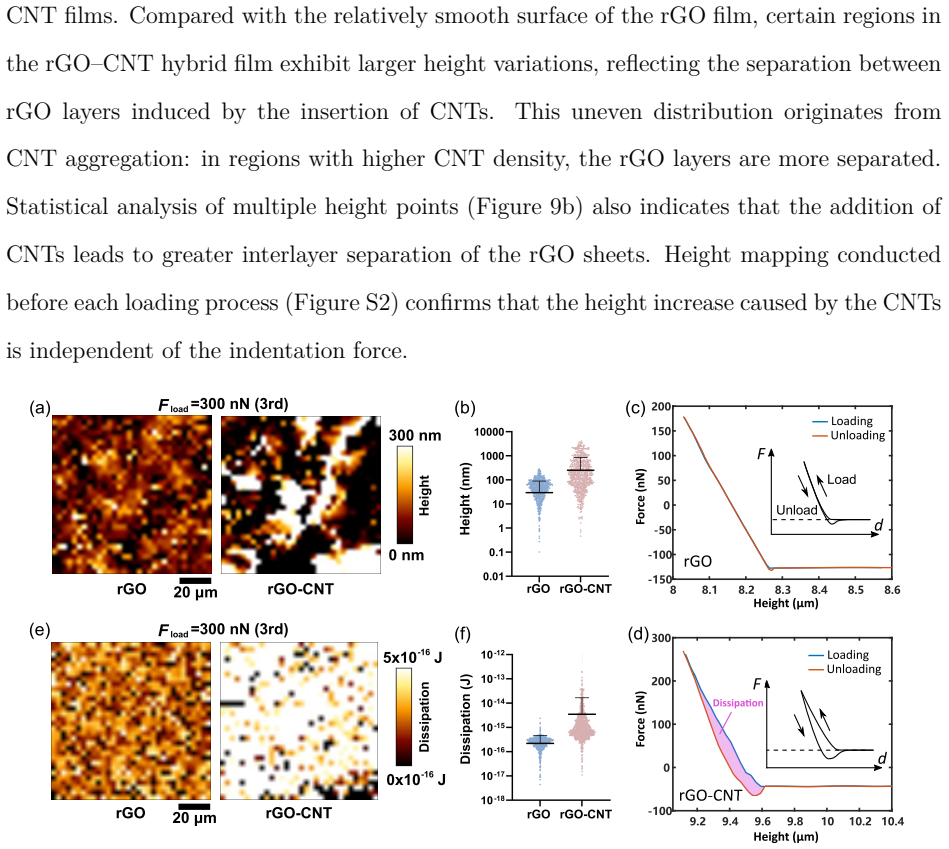
Under specific geometric conditions, stacked Gr-CNT structures exhibit mechanical bistability with two stable configurations (adhesion and separation of the Gr layers) that arise from the competition between interlayer van der Waals attraction and elastic deformation of Gr and CNTs; the resulting simulated loading-unloading curves display hysteresis and energy dissipation tied to these states, and nanoindentation on fabricated rGO-CNT films reproduces the same hysteresis and elevated dissipation relative to pure rGO.
What carries the argument
Competition between interlayer van der Waals attraction pulling graphene layers together and elastic deformation of the graphene sheets plus CNTs pushing them apart, which selects between adhered and separated stable states.
If this is right
- Loading-unloading paths diverge and dissipate energy precisely when the geometric parameters allow both adhered and separated minima.
- The macroscopic film measurements match the atomistic unit-cell behavior in both the presence and magnitude of hysteresis.
- Energy dissipation is higher in the hybrid films than in pure rGO because the bistable mechanism is active.
- Microstructure design can target specific intertube spacing and CNT dimensions to tune the bistability window.
Where Pith is reading between the lines
- If the same geometric competition governs other 2D-1D stacks, the bistability effect could appear in additional material combinations without new chemistry.
- Temperature or humidity changes that alter van der Waals strength would shift the boundary between adhered and separated regimes, providing a testable control knob.
- Embedding many such unit cells in a larger composite might produce macroscopic damping whose magnitude scales with the fraction of bistable cells.
Load-bearing premise
The nanotube spacing, diameter, and wall numbers chosen for the molecular dynamics unit cells match those present in the fabricated rGO-CNT films, so that the measured nanoindentation response directly reflects the modeled bistability.
What would settle it
Nanoindentation traces on the rGO-CNT films that show identical hysteresis area to pure rGO films, or molecular dynamics runs that never produce two distinct energy minima when intertube spacing and CNT diameter are varied across the experimental range, would falsify the claimed link.
Figures
read the original abstract
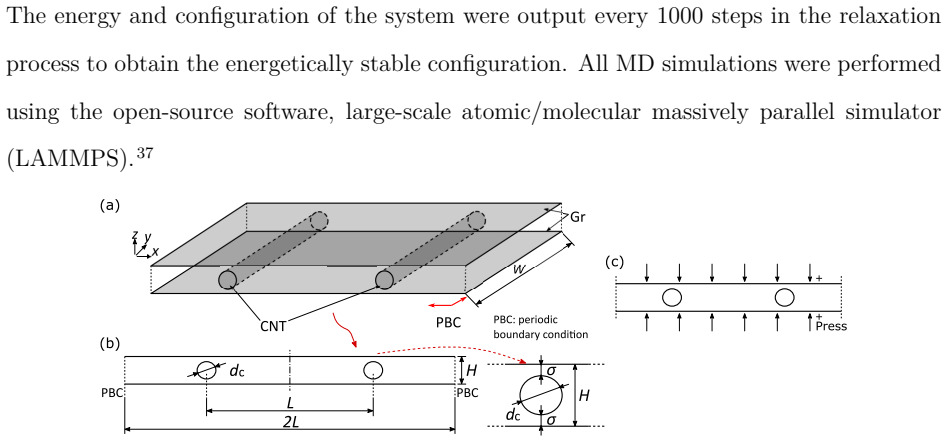
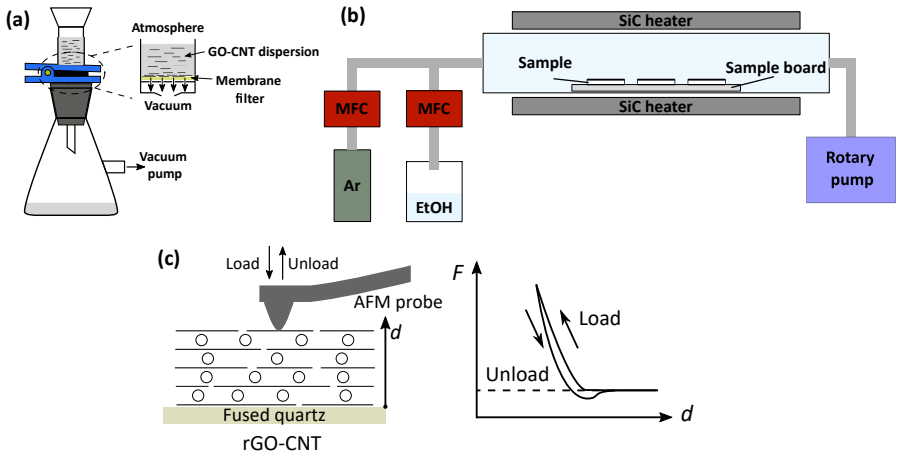
Hybrid systems composed of graphene (Gr) and carbon nanotubes (CNTs), such as films and aerogels, have attracted broad attention for applications in electronics, mechanics, energy, and environmental science. Since the microstructures of Gr-CNT hybrids strongly affect their properties, it is essential to establish mechanical principles that govern these structures. In this study, we investigated the structural stability and mechanical behavior of Gr-CNT hybrid systems by combining molecular dynamics (MD) simulations and nanoindentation experiments. MD simulations of stacked Gr-CNT structures, in which two Gr layers confine CNTs between them, identified the energetically stable configurations and their governing parameters, i.e., intertube spacing, CNT diameter, and wall number. Specifically, under certain conditions, the structures exhibit mechanical bistability with two stable configurations: adhesion and separation of the Gr layers, arising from the competition between interlayer van der Waals attraction and elastic deformation of Gr and CNTs. Simulated loading--unloading curves display hysteresis and energy dissipation related to the stable configurations. In addition, reduced graphene oxide (rGO)-CNT hybrid films were experimentally fabricated as macroscopic assemblies of the unit structures modeled in the simulations. Atomic force microscopy-based nanoindentation measurements on the rGO-CNT films exhibit clear hysteresis and higher dissipation energy compared with pure rGO, in good agreement with the simulation results. These results provide valuable insights into Gr-CNT hybrid systems and offer guidance for designing microstructures with enhanced properties for advanced applications.
Editorial analysis
A structured set of objections, weighed in public.
Referee Report
Summary. The paper claims that MD simulations of stacked Gr-CNT structures reveal mechanical bistability (adhesion vs. separation of Gr layers) under specific intertube spacing, CNT diameter, and wall-number conditions due to competition between van der Waals attraction and elastic deformation; the simulations produce loading-unloading hysteresis. It further claims that rGO-CNT hybrid films fabricated as macroscopic analogs exhibit nanoindentation hysteresis with higher dissipation than pure rGO, in qualitative agreement with the atomistic results.
Significance. If the atomistic bistability mechanism can be shown to dominate the macroscale dissipation, the work would provide a useful design principle for tuning hysteresis in carbon-based hybrids via microstructure. The dual simulation-experiment approach is a positive feature, but the current lack of quantitative linkage limits the strength of the conclusions.
major comments (2)
- [Experimental fabrication and nanoindentation results] The central claim of agreement between atomistic bistability and macroscale hysteresis rests on the unverified assumption that the specific intertube spacing, CNT diameter, and wall number used in the MD unit-cell models are realized in the fabricated rGO-CNT films. No TEM/SEM statistics or other structural characterization confirming these geometric parameters are reported, undermining attribution of the experimental dissipation to the modeled snap-through mechanism rather than rGO wrinkling or network rearrangement.
- [Discussion of simulation-experiment comparison] No scaling calculation is provided that converts the MD energy barrier per unit cell into the observed macroscale dissipation per indentation area. Without this or a quantitative matching metric (e.g., normalized loop area), the statement of 'good agreement' remains qualitative and does not establish that the simulated mechanism governs the film-scale response.
minor comments (2)
- [Methods] Methods section lacks details on error bars for nanoindentation data, number of indentation sites, and full simulation parameters (force-field choice, equilibration protocol).
- [Figures] Figure captions for loading-unloading curves should explicitly state the number of cycles and any averaging procedure.
Simulated Author's Rebuttal
We thank the referee for the constructive comments, which help clarify the linkage between the atomistic simulations and experimental results. We address each major comment below and will revise the manuscript to strengthen the presentation.
read point-by-point responses
-
Referee: [Experimental fabrication and nanoindentation results] The central claim of agreement between atomistic bistability and macroscale hysteresis rests on the unverified assumption that the specific intertube spacing, CNT diameter, and wall number used in the MD unit-cell models are realized in the fabricated rGO-CNT films. No TEM/SEM statistics or other structural characterization confirming these geometric parameters are reported, undermining attribution of the experimental dissipation to the modeled snap-through mechanism rather than rGO wrinkling or network rearrangement.
Authors: We agree that explicit structural characterization is needed to confirm that the geometric parameters in the MD models are representative of the fabricated films. The rGO-CNT films were synthesized as macroscopic analogs using conditions chosen to produce comparable CNT diameters, wall numbers, and spacings, but we did not report quantitative statistics in the original manuscript. In the revision, we will add SEM and TEM images with statistical distributions of these parameters from the experimental samples. We will also expand the discussion to consider alternative dissipation mechanisms such as rGO wrinkling and network rearrangement, while explaining why the observed increase in dissipation energy relative to pure rGO is consistent with the bistability mechanism identified in the simulations. revision: yes
-
Referee: [Discussion of simulation-experiment comparison] No scaling calculation is provided that converts the MD energy barrier per unit cell into the observed macroscale dissipation per indentation area. Without this or a quantitative matching metric (e.g., normalized loop area), the statement of 'good agreement' remains qualitative and does not establish that the simulated mechanism governs the film-scale response.
Authors: We accept that the comparison in the original manuscript was presented qualitatively. To provide a stronger quantitative link, the revised manuscript will include an order-of-magnitude scaling estimate that relates the MD energy dissipation per unit cell (from the loading-unloading hysteresis) to the experimental dissipation per indentation area. This will incorporate an estimate of the number of unit cells within the indented volume and a normalized loop-area metric to show that the atomistic mechanism can account for the observed macroscale energy dissipation. revision: yes
Circularity Check
No circularity; MD unit-cell modeling and macro-film experiments remain independent
full rationale
The derivation proceeds from explicit MD parameter sweeps (intertube spacing, CNT diameter, wall number) that locate bistable adhesion/separation states via direct energy minimization, followed by separate nanoindentation measurements on fabricated rGO-CNT films that report observed hysteresis. No equation reduces a reported quantity to a fitted parameter by construction, no self-citation supplies a load-bearing uniqueness theorem or ansatz, and the experimental hysteresis is presented only as qualitative agreement rather than a quantitative prediction derived from the MD energy barriers. The chain is therefore self-contained against external benchmarks.
Axiom & Free-Parameter Ledger
axioms (1)
- domain assumption Standard interatomic potentials and van der Waals interactions in MD simulations accurately capture the competition between adhesion and elastic deformation in graphene-CNT stacks.
Reference graph
Works this paper leans on
-
[1]
S.; Geim, A
Novoselov, K. S.; Geim, A. K.; Morozov, S. V.; Jiang, D.; Zhang, Y.; Dubonos, S. V.; Grigorieva, I. V.; Firsov, A. A. Electric field effect in atomically thin carbon films. Science 2004, 306, 666--669
2004
-
[2]
S.; Geim, A
Novoselov, K. S.; Geim, A. K.; Morozov, S. V.; Jiang, D.; Katsnelson, M. I.; Grigorieva, I. V.; Dubonos, S. V.; Firsov, A. A. Two-dimensional gas of massless Dirac fermions in graphene. Nature 2005, 438, 197--200
2005
-
[3]
Helical microtubules of graphitic carbon
Iijima, S. Helical microtubules of graphitic carbon. Nature 1991, 354, 56--58
1991
-
[4]
Single-shell carbon nanotubes of 1-nm diameter
Iijima, S.; Ichihashi, T. Single-shell carbon nanotubes of 1-nm diameter. Nature 1993, 363, 603--605
1993
-
[5]
L.; Guti \'e rrez, M
Nardecchia, S.; Carriazo, D.; Ferrer, M. L.; Guti \'e rrez, M. C.; del Monte, F. Three dimensional macroporous architectures and aerogels built of carbon nanotubes and/or graphene: synthesis and applications. Chemical Society Reviews 2013, 42, 794--830
2013
-
[6]
H.; Oh, Y.; Islam, M
Kim, K. H.; Oh, Y.; Islam, M. F. Graphene coating makes carbon nanotube aerogels superelastic and resistant to fatigue. Nature Nanotechnology 2012, 7, 562--566
2012
-
[7]
D.; Tong, L.; Abden, M
Afroze, J. D.; Tong, L.; Abden, M. J.; Yuan, Z.; Chen, Y. Hierarchical honeycomb graphene aerogels reinforced by carbon nanotubes with multifunctional mechanical and electrical properties. Carbon 2021, 175, 312--321
2021
-
[8]
Lightweight leaf-structured carbon nanotubes/graphene foam and the composites with polydimethylsiloxane for electromagnetic interference shielding
Liu, H.; Xu, Y.; Zhao, X.; Han, D.; Zhao, F.; Yang, Q. Lightweight leaf-structured carbon nanotubes/graphene foam and the composites with polydimethylsiloxane for electromagnetic interference shielding. Carbon 2022, 191, 183--194
2022
-
[9]
Shang, K.; Yang, T.; Guo, C.; Pu, X.; Zhang, Y.; Lu, X.; He, C.; Zhou, J.; Wu, L.; Yu, B. et al. Interfacial enhanced 1D –- 2D composite toward mechanically robust strain sensors. Advanced Materials Interfaces 2022, 9, 2201201
2022
-
[10]
N.; Magnuson, C
Kholmanov, I. N.; Magnuson, C. W.; Piner, R.; Kim, J.; Aliev, A. E.; Tan, C.; Kim, T. Y.; Zakhidov, A. A.; Sberveglieri, G.; Baughman, R. H. et al. Optical, electrical, and electromechanical properties of hybrid graphene/carbon nanotube films. Advanced Materials 2015, 27, 3053--3059
2015
-
[11]
Liu, Y.; Wang, F.; Wang, X.; Wang, X.; Flahaut, E.; Liu, X.; Li, Y.; Wang, X.; Xu, Y.; Shi, Y. et al. Planar carbon nanotube-graphene hybrid films for high-performance broadband photodetectors. Nature Communications 2015, 6, 8589
2015
-
[12]
A.; Laiho, P.; Zhang, Q.; Li, C.; Monazam, M
Liao, Y.; Mustonen, K.; Tulić, S.; Skákalová, V.; Khan, S. A.; Laiho, P.; Zhang, Q.; Li, C.; Monazam, M. R. A.; Kotakoski, J. et al. Enhanced tunneling in a hybrid of single-walled carbon nanotubes and graphene. ACS Nano 2019, 13, 11522--11529
2019
-
[13]
Geim, A. K. Graphene: status and prospects. Science 2009, 324, 1530--1534
2009
-
[14]
Vacancy-induced interfacial crosslinking in graphene/carbon nanotube composites and its influence on mechanical behaviors: A molecular dynamics simulation
Bao, H.; Zhao, Q.; Miao, Y.; Li, Y.; Liu, H.; Ma, F. Vacancy-induced interfacial crosslinking in graphene/carbon nanotube composites and its influence on mechanical behaviors: A molecular dynamics simulation. Carbon 2025, 232, 119768
2025
-
[15]
Graphene-carbon nanotube papers for energy conversion and storage under sunlight and heat
Mu, J.; Hou, C.; Wang, H.; Li, Y.; Zhang, Q. Graphene-carbon nanotube papers for energy conversion and storage under sunlight and heat. Carbon 2015, 95, 150--156
2015
-
[16]
Fabrication of highly reinforced and compressible graphene/carbon nanotube hybrid foams via a facile self-assembly process for application as strain sensors and beyond
Li, J.; Li, W.; Huang, W.; Zhang, G.; Sun, R.; Wong, C.-P. Fabrication of highly reinforced and compressible graphene/carbon nanotube hybrid foams via a facile self-assembly process for application as strain sensors and beyond. Journal of Materials Chemistry C 2017, 5, 2723--2730
2017
-
[17]
M.; García-Betancourt, M
Tristán-López, F.; Morelos-Gómez, A.; Vega-Díaz, S. M.; García-Betancourt, M. L.; Perea-López, N.; Elías, A. L.; Muramatsu, H.; Cruz-Silva, R.; Tsuruoka, S.; Kim, Y. A. et al. Large area films of alternating graphene–carbon nanotube layers processed in water. ACS Nano 2013, 7, 10788--10798
2013
-
[18]
Graphene–carbon nanotube aerogel as an ultra-light, compressible and recyclable highly efficient absorbent for oil and dyes
Wan, W.; Zhang, R.; Li, W.; Liu, H.; Lin, Y.; Li, L.; Zhou, Y. Graphene–carbon nanotube aerogel as an ultra-light, compressible and recyclable highly efficient absorbent for oil and dyes. Environmental Science: Nano 2016, 3, 107--113
2016
-
[19]
The application of carbon nanotube/graphene‐based nanomaterials in wastewater treatment
Yin, Z.; Cui, C.; Chen, H.; Duoni ; Yu, X.; Qian, W. The application of carbon nanotube/graphene‐based nanomaterials in wastewater treatment. Small 2020, 16, 1902301
2020
-
[20]
Scalable synthesis of hierarchically structured carbon nanotube–-graphene fibres for capacitive energy storage
Yu, D.; Goh, K.; Wang, H.; Wei, L.; Jiang, W.; Zhang, Q.; Dai, L.; Chen, Y. Scalable synthesis of hierarchically structured carbon nanotube–-graphene fibres for capacitive energy storage. Nature Nanotechnology 2014, 9, 555--562
2014
-
[21]
Direct graphene-carbon nanotube composite ink writing all-solid-state flexible microsupercapacitors with high areal energy density
Wang, Y.; Zhang, Y.; Wang, G.; Shi, X.; Qiao, Y.; Liu, J.; Liu, H.; Ganesh, A.; Li, L. Direct graphene-carbon nanotube composite ink writing all-solid-state flexible microsupercapacitors with high areal energy density. Advanced Functional Materials 2020, 30, 1907284
2020
-
[22]
A high-efficiency sulfur/carbon composite based on 3D graphene nanosheet@ carbon nanotube matrix as cathode for lithium--sulfur battery
Zhang, Z.; Kong, L.-L.; Liu, S.; Li, G.-R.; Gao, X.-P. A high-efficiency sulfur/carbon composite based on 3D graphene nanosheet@ carbon nanotube matrix as cathode for lithium--sulfur battery. Advanced Energy Materials 2017, 7, 1602543
2017
-
[23]
Electrochemical performance of reduced graphene oxide/carbon nanotube hybrid papers as binder-free anodes for potassium-ion batteries
Peng, S.; Wang, L.; Zhu, Z.; Han, K. Electrochemical performance of reduced graphene oxide/carbon nanotube hybrid papers as binder-free anodes for potassium-ion batteries. Journal of Physics and Chemistry of Solids 2020, 138, 109296
2020
-
[24]
Super-elastic graphene/carbon nanotube aerogel: A novel thermal interface material with highly thermal transport properties
Lv, P.; Tan, X.-W.; Yu, K.-H.; Zheng, R.-L.; Zheng, J.-J.; Wei, W. Super-elastic graphene/carbon nanotube aerogel: A novel thermal interface material with highly thermal transport properties. Carbon 2016, 99, 222--228
2016
-
[25]
R.; Marconnet, A.; Ruan, X
Du, T.; Xiong, Z.; Delgado, L.; Liao, W.; Peoples, J.; Kantharaj, R.; Chowdhury, P. R.; Marconnet, A.; Ruan, X. Wide range continuously tunable and fast thermal switching based on compressible graphene composite foams. Nature Communications 2021, 12, 4915
2021
-
[26]
M.; Scott, C.; Fujimoto, K.; Brown, R.; Tanasse, E.; Oxford, J
Yocham, K. M.; Scott, C.; Fujimoto, K.; Brown, R.; Tanasse, E.; Oxford, J. T.; Lujan, T. J.; Estrada, D. Mechanical properties of graphene foam and graphene foam—-tissue composites. Advanced Engineering Materials 2018, 20, 1800166
2018
-
[27]
Massless fermions in multilayer graphitic systems with misoriented layers: Ab initio calculations and experimental fingerprints
Latil, S.; Meunier, V.; Henrard, L. Massless fermions in multilayer graphitic systems with misoriented layers: Ab initio calculations and experimental fingerprints. Physical Review B 2007, 76, 201402
2007
-
[28]
Stacking order reduction in multilayer graphene by inserting nanospacers
Xu, Z.; Inoue, T.; Nishina, Y.; Kobayashi, Y. Stacking order reduction in multilayer graphene by inserting nanospacers. Journal of Applied Physics 2022, 132, 174305
2022
-
[29]
I.; Halim, H
Ding, M.; Inoue, T.; Enriquez, J. I.; Halim, H. H.; Ogawa, Y.; Taniyasu, Y.; Hamamoto, Y.; Morikawa, Y.; Kobayashi, Y. Experimental and theoretical investigation of nanodiamond insertion on the interlayer interaction in multilayer stacking graphene. Carbon 2024, 229, 119464
2024
-
[30]
Screening and interlayer coupling in multilayer graphene field-effect transistors
Sui, Y.; Appenzeller, J. Screening and interlayer coupling in multilayer graphene field-effect transistors. Nano Letters 2009, 9, 2973--2977
2009
-
[31]
Mechanical properties of graphene- CNT van der Waals heterostructures: a molecular dynamics study
Menon, V.; Buldum, A. Mechanical properties of graphene- CNT van der Waals heterostructures: a molecular dynamics study. Nanotechnology 2020, 31, 455707
2020
-
[32]
On the configuration of the graphene/carbon nanotube/graphene van der Waals heterostructure
Xu, T.; Jiang, J. On the configuration of the graphene/carbon nanotube/graphene van der Waals heterostructure. Physical Chemistry Chemical Physics 2023, 25, 5066--5072
2023
-
[33]
The mechanical response and microscopic deformation mechanism of graphene foams tuned by long carbon nanotubes and short crosslinkers
Wang, S.; Yang, T.; Wang, C.; Liang, L. The mechanical response and microscopic deformation mechanism of graphene foams tuned by long carbon nanotubes and short crosslinkers. Physical Chemistry Chemical Physics 2023, 25, 192--202
2023
-
[34]
The mechanical behavior and collapse of graphene-assembled hollow nanospheres under compression
Zhao, Y.; Zhao, Y.; Wu, F.; Zhao, Y.; Wang, Y.; Sui, C.; He, X.; Wang, C.; Tan, H.; Wang, C. The mechanical behavior and collapse of graphene-assembled hollow nanospheres under compression. Carbon 2021, 173, 600--608
2021
-
[35]
I.; Handoko Halim, H.; Ogawa, Y.; Taniyasu, Y.; Hamamoto, Y.; Morikawa, Y.; Kobayashi, Y
Ding, M.; Inoue, T.; Enriquez, J. I.; Handoko Halim, H.; Ogawa, Y.; Taniyasu, Y.; Hamamoto, Y.; Morikawa, Y.; Kobayashi, Y. Reduction of interlayer interaction in multilayer stacking graphene with carbon nanotube insertion: Insights from experiment and simulation. The Journal of Physical Chemistry C 2023, 127, 23768--23777
2023
-
[36]
J.; Tutein, A
Stuart, S. J.; Tutein, A. B.; Harrison, J. A. A reactive potential for hydrocarbons with intermolecular interactions. The Journal of Chemical Physics 2000, 112, 6472--6486
2000
-
[37]
P.; Aktulga, H
Thompson, A. P.; Aktulga, H. M.; Berger, R.; Bolintineanu, D. S.; Brown, W. M.; Crozier, P. S.; In 'T Veld, P. J.; Kohlmeyer, A.; Moore, S. G.; Nguyen, T. D. et al. LAMMPS - a flexible simulation tool for particle-based materials modeling at the atomic, meso, and continuum scales. Computer Physics Communications 2022, 271, 108171
2022
-
[38]
A.; Dommett, G
Stankovich, S.; Dikin, D. A.; Dommett, G. H.; Kohlhaas, K. M.; Zimney, E. J.; Stach, E. A.; Piner, R. D.; Nguyen, S. T.; Ruoff, R. S. Graphene-based composite materials. Nature 2006, 442, 282--286
2006
-
[39]
A.; Piner, R
Stankovich, S.; Dikin, D. A.; Piner, R. D.; Kohlhaas, K. A.; Kleinhammes, A.; Jia, Y.; Wu, Y.; Nguyen, S. T.; Ruoff, R. S. Synthesis of graphene-based nanosheets via chemical reduction of exfoliated graphite oxide. Carbon 2007, 45, 1558--1565
2007
-
[40]
M.; Ma, R.; Xu, W.; Lu, C.; Zhang, X.; Tsukruk, V
Xiong, R.; Hu, K.; Grant, A. M.; Ma, R.; Xu, W.; Lu, C.; Zhang, X.; Tsukruk, V. V. Ultrarobust transparent cellulose nanocrystal-graphene membranes with high electrical conductivity. Advanced Materials 2015, 28, 1501--1509
2015
-
[41]
M.; Lu, T
Zhao, G.; Qing, H.; Huang, G.; Genin, G. M.; Lu, T. J.; Luo, Z.; Xu, F.; Zhang, X. Reduced graphene oxide functionalized nanofibrous silk fibroin matrices for engineering excitable tissues. NPG Asia Materials 2018, 10, 982--994
2018
-
[42]
Improved performance of strain sensors constructed from highly crystalline graphene with nanospacer
Xu, Z.; Himura, Y.; Ishiguro, C.; Inoue, T.; Nishina, Y.; Kobayashi, Y. Improved performance of strain sensors constructed from highly crystalline graphene with nanospacer. Japanese Journal of Applied Physics 2023, 63, 015001
2023
-
[43]
Tailoring the oxygen content of graphite and reduced graphene oxide for specific applications
Morimoto, N.; Kubo, T.; Nishina, Y. Tailoring the oxygen content of graphite and reduced graphene oxide for specific applications. Scientific Reports 2016, 6, 21715
2016
-
[44]
N.; Mizuno, K.; Namai, T.; Yumura, M.; Iijima, S
Hata, K.; Futaba, D. N.; Mizuno, K.; Namai, T.; Yumura, M.; Iijima, S. Water-assisted highly efficient synthesis of impurity-free single-walled carbon nanotubes. Science 2004, 306, 1362--1364
2004
-
[45]
Anomalous restoration of graphitic layers from graphene oxide in ethanol environment at ultrahigh temperature using solar furnace
Ishida, T.; Miyata, Y.; Shinoda, Y.; Kobayashi, Y. Anomalous restoration of graphitic layers from graphene oxide in ethanol environment at ultrahigh temperature using solar furnace. Applied Physics Express 2016, 9, 025103
2016
-
[46]
Bulk-scale synthesis of randomly stacked graphene with high crystallinity
Xu, Z.; Nakamura, S.; Inoue, T.; Nishina, Y.; Kobayashi, Y. Bulk-scale synthesis of randomly stacked graphene with high crystallinity. Carbon 2021, 185, 368--375
2021
-
[47]
Force measurements with the atomic force microscope: Technique, interpretation and applications
Butt, H.-J.; Cappella, B.; Kappl, M. Force measurements with the atomic force microscope: Technique, interpretation and applications. Surface Science Reports 2005, 59, 1--152
2005
-
[48]
A theoretical analysis on self-collapsing of nanotubes
Meng, X.; Zhang, B.; Li, H.; Li, F.; Kang, Z.; Li, M.; Chen, Y. A theoretical analysis on self-collapsing of nanotubes. International Journal of Solids and Structures 2019, 160, 51--58
2019
-
[49]
Collapse phase diagram of carbon nanotubes with arbitrary number of walls
Magnin, Y.; Rondepierre, F.; Cui, W.; Dunstan, D.; San-Miguel, A. Collapse phase diagram of carbon nanotubes with arbitrary number of walls. Collapse modes and macroscopic analog. Carbon 2021, 178, 552--562
2021
-
[50]
J.; Kim, J.; Choi, G
Heo, S. J.; Kim, J.; Choi, G. M.; Lee, D.; Im, B. W.; Kim, S.-S.; Ku, B.-C.; Lee, H. S.; Kim, S. G. Microstructural evolution effects on the density of carbon nanotube fibers. Carbon 2024, 226, 119180
2024
-
[51]
Reversible Raman D -band changes: A new probe into the pressure-induced collapse of carbon nanotubes
Galafassi, R.; Vialla, F.; Pischedda, V.; Diaf, H.; San-Miguel, A. Reversible Raman D -band changes: A new probe into the pressure-induced collapse of carbon nanotubes. Carbon 2024, 229, 119447
2024
-
[52]
Radial deformation and stability of single-wall carbon nanotubes under hydrostatic pressure
Hasegawa, M.; Nishidate, K. Radial deformation and stability of single-wall carbon nanotubes under hydrostatic pressure. Physical Review B 2006, 74, 115401
2006
-
[53]
Radial deformation and its related energy variations of single-walled carbon nanotubes
Lu, W.; Chou, T.-W.; Kim, B.-S. Radial deformation and its related energy variations of single-walled carbon nanotubes. Physical Review B 2011, 83, 134113
2011
-
[54]
Erratum: Radial deformation and its related energy variations of single-walled carbon nanotubes [ Phys
Lu, W.; Chou, T.-W.; Kim, B.-S. Erratum: Radial deformation and its related energy variations of single-walled carbon nanotubes [ Phys . Rev . B 83 , 134113 (2011)]. Physical Review B 2011, 84, 059901
2011
-
[55]
B.; Spataru, C
Tangney, P.; Capaz, R. B.; Spataru, C. D.; Cohen, M. L.; Louie, S. G. Structural transformations of carbon nanotubes under hydrostatic pressure. Nano Letters 2005, 5, 2268--2273
2005
-
[56]
Y.; Shu, D
Sun, D. Y.; Shu, D. J.; Ji, M.; Liu, F.; Wang, M.; Gong, X. G. Pressure-induced hard-to-soft transition of a single carbon nanotube. Physical Review B 2004, 70, 165417
2004
-
[57]
H.; Raney, J
Shan, S.; Kang, S. H.; Raney, J. R.; Wang, P.; Fang, L.; Candido, F.; Lewis, J. A.; Bertoldi, K. Multistable architected materials for trapping elastic strain energy. Adv. Mater 2015, 27, 4296--4301
2015
-
[58]
J.; Hersam, M
Jariwala, D.; Marks, T. J.; Hersam, M. C. Mixed-dimensional van der Waals heterostructures. Nature Materials 2017, 16, 170--181
2017
-
[59]
S.; Jiang, D.; Schedin, F.; Booth, T.; Khotkevich, V.; Morozov, S.; Geim, A
Novoselov, K. S.; Jiang, D.; Schedin, F.; Booth, T.; Khotkevich, V.; Morozov, S.; Geim, A. K. Two-dimensional atomic crystals. Proceedings of the National Academy of Sciences 2005, 102, 10451--10453
2005
-
[60]
K.; Grigorieva, I
Geim, A. K.; Grigorieva, I. V. Van der Waals heterostructures. Nature 2013, 499, 419--425
2013
-
[61]
e.; Hodes, G
Tenne, R.; Margulis, L.; Genut, M. e.; Hodes, G. Polyhedral and cylindrical structures of tungsten disulphide. Nature 1992, 360, 444--446
1992
-
[62]
G.; Luyken, R.; Cherrey, K.; Crespi, V
Chopra, N. G.; Luyken, R.; Cherrey, K.; Crespi, V. H.; Cohen, M. L.; Louie, S. G.; Zettl, A. Boron nitride nanotubes. Science 1995, 269, 966--967
1995
-
[63]
Xiang, R.; Inoue, T.; Zheng, Y.; Kumamoto, A.; Qian, Y.; Sato, Y.; Liu, M.; Tang, D.; Gokhale, D.; Guo, J. et al. One-dimensional van der Waals heterostructures. Science 2020, 367, 537--542
2020
-
[64]
M.; Mack, J
Viculis, L. M.; Mack, J. J.; Kaner, R. B. A chemical route to carbon nanoscrolls. Science 2003, 299, 1361--1361
2003
-
[65]
Zhao, B.; Wan, Z.; Liu, Y.; Xu, J.; Yang, X.; Shen, D.; Zhang, Z.; Guo, C.; Qian, Q.; Li, J. et al. High-order superlattices by rolling up van der Waals heterostructures. Nature 2021, 591, 385--390 mcitethebibliography
2021
discussion (0)
Sign in with ORCID, Apple, or X to comment. Anyone can read and Pith papers without signing in.