Blue Straggler Stars in Berkeley 18: A Multiwavelength Study of Their Physical Properties and Dynamical Evolution
Pith reviewed 2026-06-28 04:38 UTC · model grok-4.3
The pith
Binary evolution is the dominant formation channel for blue straggler stars in Berkeley 18 because dynamical interactions are inefficient there.
A machine-rendered reading of the paper's core claim, the machinery that carries it, and where it could break.
Core claim
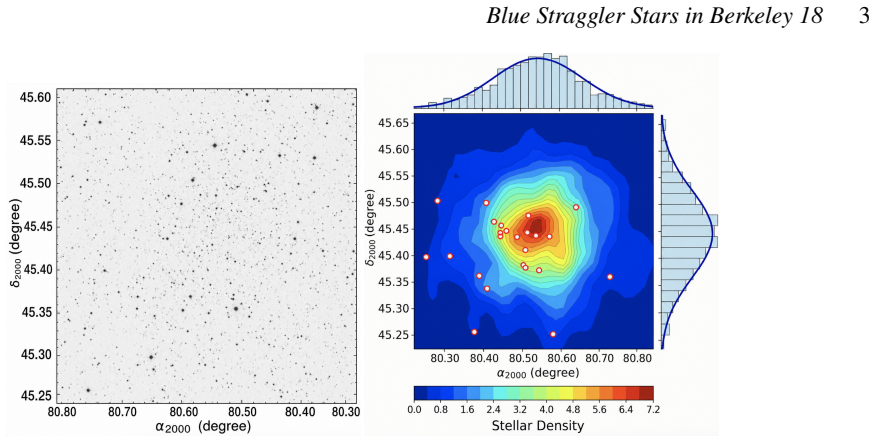
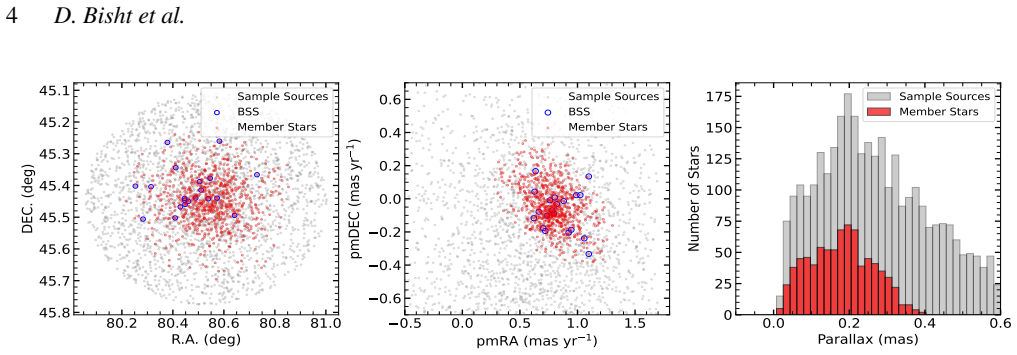
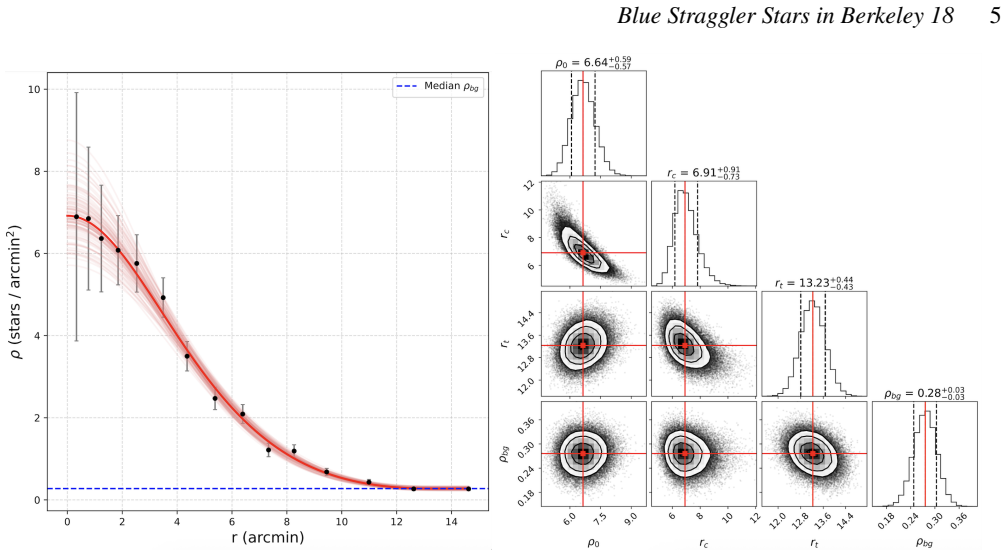
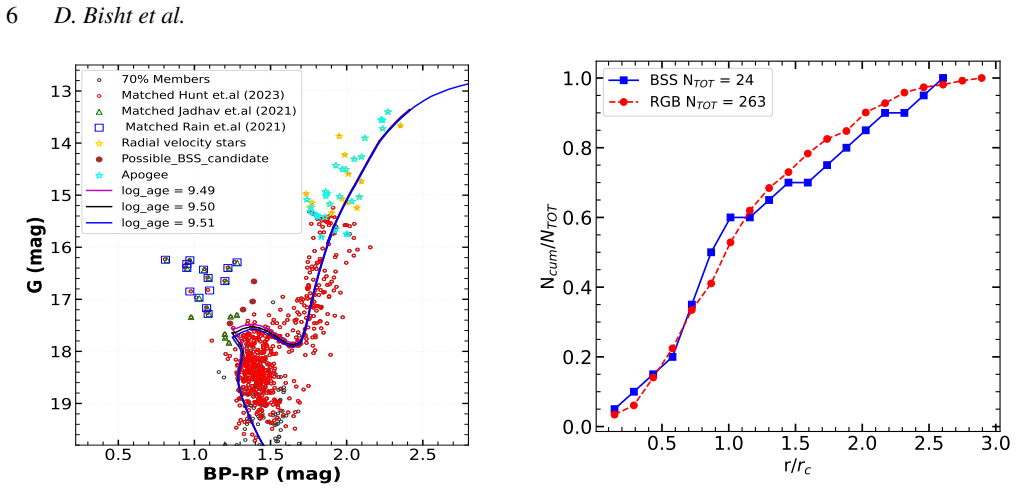
Using a Gaussian Mixture Model on Gaia DR3 astrometry the authors select 798 high-probability members, fit an isochrone to derive an age of 3.2 Gyr and distance 5.01 kpc, and identify 24 BSS candidates. SED fitting gives temperatures 6000-8500 K, radii 1.4-5.7 solar radii and luminosities 3.3-38 solar luminosities. The BSS show only mild central concentration, a low A+ parameter, and an extremely low collision-rate proxy; King-profile fits give core and tidal radii consistent with a dynamically evolved low-density cluster. No photometric variability is detected in TESS data and apparent mid-infrared excesses are attributed to background contamination, leaving binary evolution as the dominant
What carries the argument
The A+ parameter, which quantifies the central concentration of BSS relative to the general population, together with a stellar collision-rate proxy calculated from cluster density and velocity dispersion; these quantities measure the efficiency of the collisional channel versus binary evolution.
If this is right
- Blue stragglers in low-density open clusters should predominantly arise from binary mass transfer or merger rather than stellar collisions.
- The heterogeneous temperatures, radii, and luminosities of the BSS indicate they occupy multiple evolutionary stages at once.
- The cluster's King-profile parameters confirm it is dynamically evolved yet remains too sparse for efficient dynamical encounters.
- Absence of genuine mid-infrared excess rules out circumstellar dust as a common feature of these BSS.
Where Pith is reading between the lines
- The same multiwavelength approach applied to other outer-disk open clusters could map how BSS formation channels change with local density.
- If binary evolution dominates here, radial-velocity monitoring of the candidates should reveal a higher binary fraction than in dense globular clusters.
- The lack of detected TESS variability sets an upper limit on short-period mass-transfer activity that future higher-cadence photometry could test.
Load-bearing premise
The 24 stars identified above the main-sequence turn-off are genuine cluster blue stragglers free of significant field contamination, and the low A+ value plus collision-rate proxy correctly signal an inefficient collisional channel.
What would settle it
A spectroscopic survey that finds most of the 24 candidates are field stars or that measures a substantially higher collision rate or A+ value in Berkeley 18 would falsify the claim that binary evolution dominates.
Figures
read the original abstract
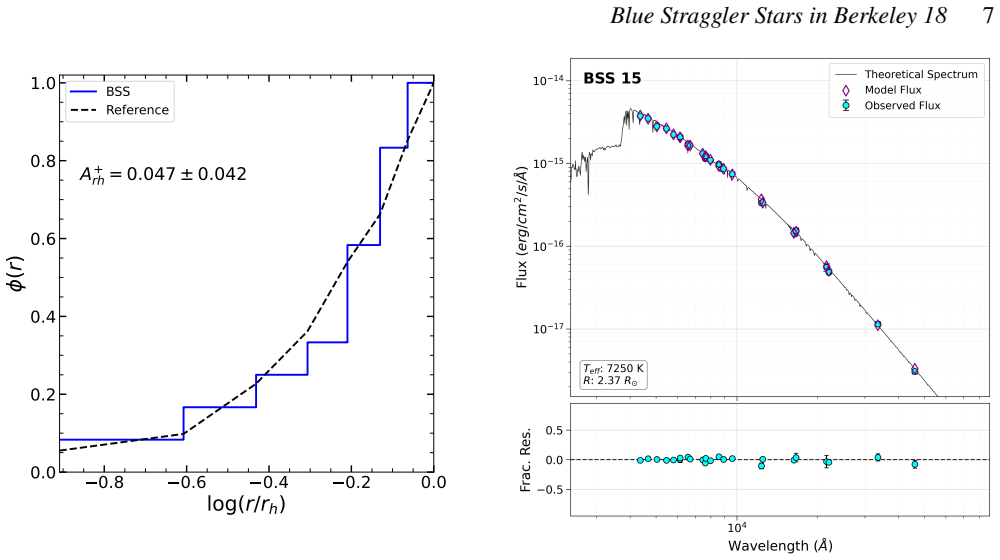
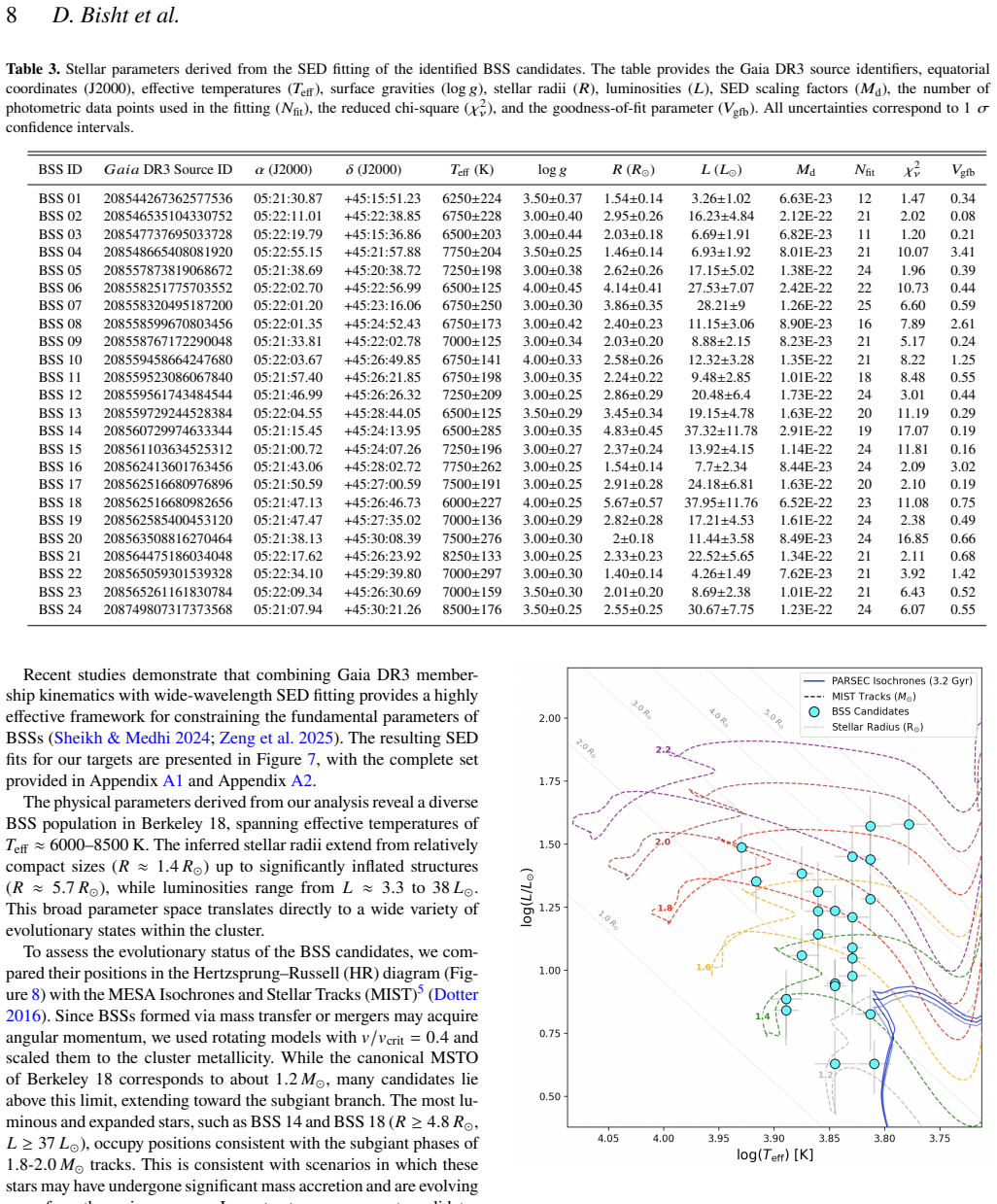
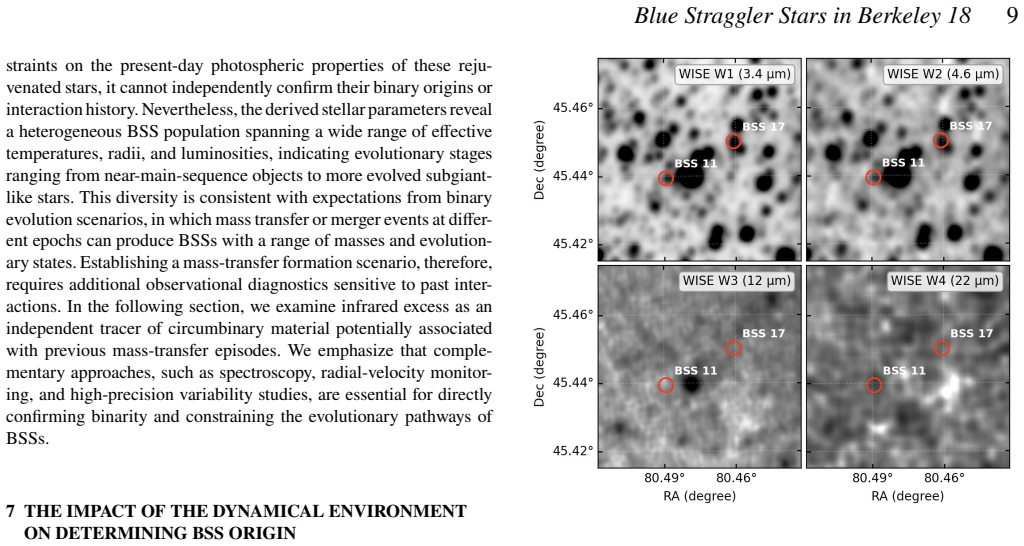
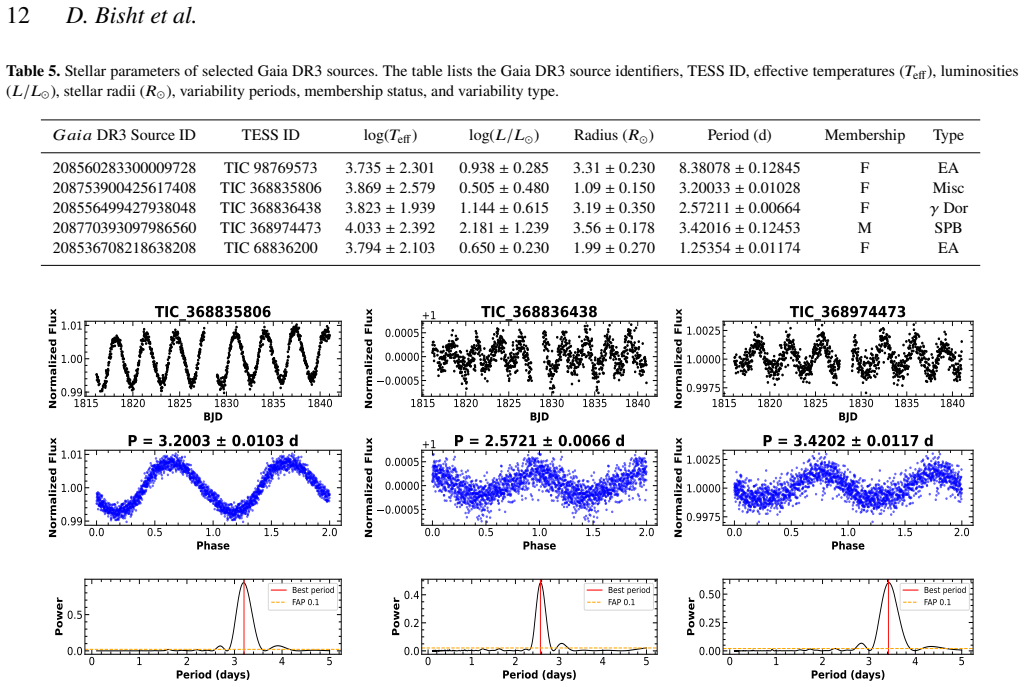
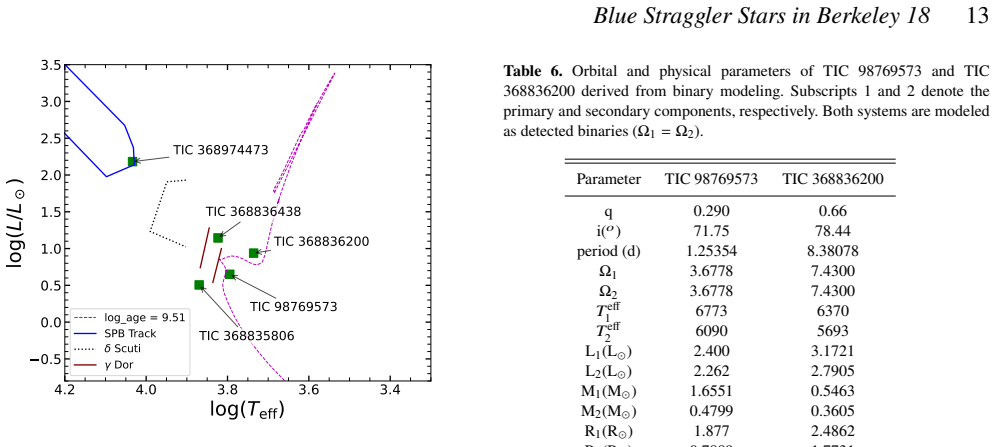
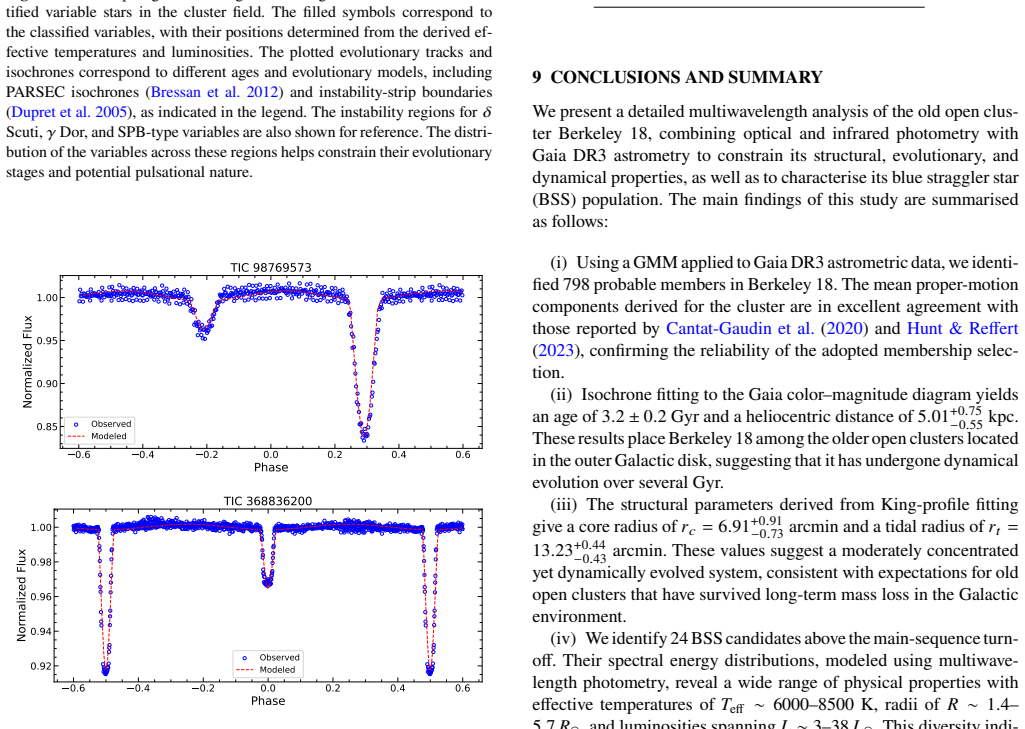
Berkeley~18 is an old open cluster in the outer Galactic disk that hosts a population of blue straggler stars (BSSs). We present a comprehensive multiwavelength analysis of its BSS population using \textit{Gaia} DR3 astrometry, optical--infrared photometry, and time-domain TESS observations. Using a Gaussian Mixture Model (GMM) in astrometric space, we identify 798 high-probability cluster members ($p > 0.7$). Isochrone fitting yields an age of $3.2 \pm 0.2$ Gyr and a heliocentric distance of $5.01^{+0.75}_{-0.55}$ kpc. We identify 24 BSS candidates above the main-sequence turn-off. Spectral energy distribution (SED) modelling reveals effective temperatures of $6000$--$8500$ K, radii of $1.4$--$5.7\,R_\odot$, and luminosities of $3.3$--$38\,L_\odot$, indicating a heterogeneous population spanning multiple evolutionary stages. The BSS population exhibits only a mild central concentration, with a low $A^{+}$ parameter and an extremely low stellar collision-rate proxy, implying weak mass segregation and an inefficient collisional channel. We find no significant photometric variability among the BSS candidates within TESS's sensitivity limits. Although WISE W3/W4 data initially suggested possible mid-infrared excesses, detailed image inspection and SPHEREx spectrophotometry indicate that these are caused by background contamination and blending, with no clear evidence of circumstellar dust. The structural parameters derived from King-profile fitting ($r_c = 6.91^{+0.91}_{-0.73}$ arcmin, $r_t = 13.23^{+0.44}_{-0.43}$ arcmin) indicate a dynamically evolved, low-density system. Together, these results suggest that dynamical interactions are inefficient in Berkeley~18 and that binary evolution is likely the dominant formation channel of BSSs.
Editorial analysis
A structured set of objections, weighed in public.
Referee Report
Summary. The paper presents a multiwavelength study of Berkeley 18 using Gaia DR3, optical-IR photometry, and TESS data. It identifies 798 high-probability members via GMM, derives an age of 3.2 Gyr and distance of ~5 kpc via isochrone fitting, selects 24 BSS candidates above the MSTO, performs SED modeling to obtain Teff, radii, and luminosities, reports a low A+ parameter and extremely low collision-rate proxy from King-profile fits (rc=6.91 arcmin, rt=13.23 arcmin), finds no TESS variability or genuine mid-IR excess, and concludes that dynamical interactions are inefficient so binary evolution dominates BSS formation.
Significance. If the candidate purity and proxy reliability hold, the work adds a well-characterized case of BSSs in a low-density outer-disk cluster, strengthening the case that binary channels dominate where collision rates are low. The multiwavelength dataset (Gaia + SED + TESS) and explicit King-profile parameters are strengths that enable direct comparison to other clusters.
major comments (3)
- [BSS identification and membership] BSS candidate selection: The claim that the 24 candidates (p>0.7 GMM members above MSTO) are genuine cluster BSS with negligible field contamination is load-bearing for the formation-channel conclusion, yet no quantitative test (control-field density, expected field-star contamination in the bright CMD region, or proper-motion distribution comparison) is provided despite the outer-disk location raising the interloper prior.
- [Spatial distribution and collision-rate proxy] Dynamical indicators section: The inference that collisions are inefficient (and thus binary evolution dominates) rests on the reported low A+ and 'extremely low' collision-rate proxy derived from rc, rt, and central density, but with only 24 objects Poisson noise on any concentration statistic is large; the proxy is not shown to be calibrated against N-body runs that include the cluster's binary fraction or full dynamical history, so the conclusion does not follow from the data presented.
- [SED analysis] SED modelling: No error budgets or covariance information are reported on the fitted Teff (6000-8500 K), radii (1.4-5.7 R⊙), or luminosities, which weakens the claim of a 'heterogeneous population spanning multiple evolutionary stages' used to support the overall interpretation.
minor comments (3)
- [Abstract] Abstract and text: the collision-rate proxy is repeatedly called 'extremely low' without a numerical value, formula, or direct comparison to other clusters.
- [Cluster parameters] The asymmetric distance uncertainty (5.01^{+0.75}_{-0.55} kpc) is stated but its propagation into the collision-rate proxy or A+ is not discussed.
- [Time-domain analysis] TESS variability search: the sensitivity limits and any periodogram thresholds used to conclude 'no significant photometric variability' should be stated explicitly.
Simulated Author's Rebuttal
We thank the referee for their thorough and constructive review. We address each major comment point by point below, indicating where revisions will be made.
read point-by-point responses
-
Referee: BSS candidate selection: The claim that the 24 candidates (p>0.7 GMM members above MSTO) are genuine cluster BSS with negligible field contamination is load-bearing for the formation-channel conclusion, yet no quantitative test (control-field density, expected field-star contamination in the bright CMD region, or proper-motion distribution comparison) is provided despite the outer-disk location raising the interloper prior.
Authors: We agree that a quantitative contamination assessment is needed. In the revised manuscript we will add a control-field analysis offset from the cluster to estimate interloper density in the bright CMD region, together with a comparison of proper-motion distributions between BSS candidates and the general member population. revision: yes
-
Referee: Dynamical indicators section: The inference that collisions are inefficient (and thus binary evolution dominates) rests on the reported low A+ and 'extremely low' collision-rate proxy derived from rc, rt, and central density, but with only 24 objects Poisson noise on any concentration statistic is large; the proxy is not shown to be calibrated against N-body runs that include the cluster's binary fraction or full dynamical history, so the conclusion does not follow from the data presented.
Authors: We accept that Poisson uncertainties on statistics derived from 24 objects are substantial and will add an explicit discussion of these errors in the revised text. The collision-rate proxy follows standard analytic prescriptions used in the literature; while we cannot supply new N-body calibrations that incorporate the cluster's binary fraction and full history, we will clarify the proxy's assumptions and present it as supporting rather than conclusive evidence when combined with the structural parameters and lack of variability. revision: partial
-
Referee: SED modelling: No error budgets or covariance information are reported on the fitted Teff (6000-8500 K), radii (1.4-5.7 R⊙), or luminosities, which weakens the claim of a 'heterogeneous population spanning multiple evolutionary stages' used to support the overall interpretation.
Authors: We agree that uncertainties must be reported. The revised manuscript will include formal errors on Teff, radii, and luminosities from the SED fits, together with available covariance information, allowing a clearer evaluation of the population's heterogeneity. revision: yes
- Full calibration of the collision-rate proxy against N-body simulations that include the cluster's binary fraction and complete dynamical history.
Circularity Check
No circularity; fits and interpretations rest on external data and models without self-referential reduction
full rationale
The paper performs standard GMM membership assignment (p>0.7), isochrone fitting for age/distance, SED modeling for BSS parameters, King-profile fitting for rc/rt, and computation of A+ and a collision-rate proxy from those structural parameters. These steps are direct applications of public Gaia/TESS/WISE data and established fitting techniques. The central claim that dynamical interactions are inefficient (hence binary evolution dominates) is an interpretive inference drawn from the low observed values relative to literature expectations for collisional channels; it does not reduce by the paper's own equations to a fitted quantity or self-citation. No load-bearing self-citations, self-definitional loops, or renamed predictions appear in the derivation chain. The analysis is therefore self-contained against external benchmarks.
Axiom & Free-Parameter Ledger
free parameters (3)
- cluster age =
3.2 Gyr
- heliocentric distance =
5.01 kpc
- membership probability threshold =
p > 0.7
axioms (2)
- domain assumption Gaussian Mixture Model in astrometric space separates cluster members from field stars
- domain assumption Standard isochrone grids accurately reproduce the cluster's main-sequence and turn-off
Reference graph
Works this paper leans on
-
[2]
Exploring the near galactic centre: A comprehensive study of bulge OCs HSC 25, HSC 37, HSC 2878 utilising Gaia DR3 data. , keywords =. doi:10.1016/j.newast.2026.102532 , adsurl =
-
[5]
Physics and Astronomy Reports , keywords =
SED Analysis of the Old Open Cluster NGC 188. Physics and Astronomy Reports , keywords =. doi:10.26650/PAR.2024.00002 , archivePrefix =. 2404.13115 , primaryClass =
-
[9]
The Astrophysical Journal , volume=
Investigating the mass segregation process in globular clusters with blue straggler stars: the impact of dark remnants , author=. The Astrophysical Journal , volume=. 2016 , publisher=
2016
-
[11]
Structure of star clusters in the Magellanic Clouds periphery , author=
The VISCACHA survey--II. Structure of star clusters in the Magellanic Clouds periphery , author=. Monthly Notices of the Royal Astronomical Society , volume=. 2020 , publisher=
2020
-
[12]
Monthly Notices of the Royal Astronomical Society , volume=
Evidence for two populations of Galactic globular clusters from the ratio of their half-mass to Jacobi radii , author=. Monthly Notices of the Royal Astronomical Society , volume=. 2010 , publisher=
2010
-
[13]
Monthly Notices of the Royal Astronomical Society , volume=
Investigating kinematics and dynamics of three open clusters towards Galactic anticentre , author=. Monthly Notices of the Royal Astronomical Society , volume=. 2023 , publisher=
2023
-
[14]
Monthly Notices of the Royal Astronomical Society , volume=
Astrometric and photometric study of NGC 6067, NGC 2506, and IC 4651 open clusters based on wide-field ground and Gaia DR2 data , author=. Monthly Notices of the Royal Astronomical Society , volume=. 2019 , publisher=
2019
-
[17]
Monthly Notices of the Royal Astronomical Society , volume=
Mass function and dynamical study of the open clusters Berkeley 24 and Czernik 27 using ground based imaging and Gaia astrometry , author=. Monthly Notices of the Royal Astronomical Society , volume=. 2019 , publisher=
2019
-
[18]
Monthly Notices of the Royal Astronomical Society , volume=
A comprehensive study of open clusters Czernik 14, Haffner 14, Haffner 17 and King 10 using multicolour photometry and Gaia DR2 astrometry , author=. Monthly Notices of the Royal Astronomical Society , volume=. 2020 , publisher=
2020
-
[19]
The Astronomical Journal , volume=
An investigation of poorly studied open cluster NGC 4337 using multicolor photometric and Gaia DR2 astrometric data , author=. The Astronomical Journal , volume=. 2020 , publisher=
2020
-
[20]
The Astronomical Journal , volume=
A comprehensive analysis of NGC 2158 in the Gaia Era: Photometric parameters, apex, and orbit , author=. The Astronomical Journal , volume=. 2021 , publisher=
2021
-
[21]
The Astronomical Journal , volume=
Astrometric and photometric investigation of three old age open clusters in the Gaia era: Berkeley 32, Berkeley 98, and King 23 , author=. The Astronomical Journal , volume=. 2021 , publisher=
2021
-
[22]
Monthly Notices of the Royal Astronomical Society , volume=
Determination of dynamical ages of open clusters through the A+ parameter--I , author=. Monthly Notices of the Royal Astronomical Society , volume=. 2021 , publisher=
2021
-
[23]
The Astrophysical Journal Letters , volume=
Refining the dynamical clock for star clusters , author=. The Astrophysical Journal Letters , volume=. 2016 , publisher=
2016
-
[24]
Astronomical Journal , year = 1962, month = oct, volume =
King, Ivan , title =. Astronomical Journal , year = 1962, month = oct, volume =
1962
-
[25]
A computational guide to physics of eclipsing binaries. I. Demonstrations and perspectives , author=. The Astrophysical Journal , volume=. 2005 , publisher=
2005
-
[26]
The Astrophysical Journal , volume=
Exploring Contact Binaries: Observational Analysis of four W Uma Binaries Using Photometry and Spectroscopy , author=. The Astrophysical Journal , volume=. 2025 , publisher=
2025
-
[27]
International Astronomical Union Colloquium , volume=
Slowly pulsating B stars , author=. International Astronomical Union Colloquium , volume=. 1993 , organization=
1993
-
[28]
The Astrophysical Journal , volume=
A new generation of PARSEC-COLIBRI stellar isochrones including the TP-AGB phase , author=. The Astrophysical Journal , volume=. 2017 , publisher=
2017
-
[29]
Excitation and stabilization mechanisms in Sct and Dor stars , author=
Convection-pulsation coupling-II. Excitation and stabilization mechanisms in Sct and Dor stars , author=. Astronomy & Astrophysics , volume=. 2005 , publisher=
2005
-
[30]
Acta Astronomica, v
Pulsational instability domains in the upper main sequence , author=. Acta Astronomica, v. 49, pp. 119-148,(1999). , volume=
1999
-
[31]
Space Telescopes and Instrumentation 2020: Optical, Infrared, and Millimeter Wave , volume=
SPHEREx: NASA's near-infrared spectrophotometric all-sky survey , author=. Space Telescopes and Instrumentation 2020: Optical, Infrared, and Millimeter Wave , volume=. 2020 , organization=
2020
-
[33]
Homogenised sample , author=
On the metallicity of open clusters-III. Homogenised sample , author=. Astronomy & Astrophysics , volume=. 2016 , publisher=
2016
-
[34]
Estimating distance from parallaxes. IV. Distances to 1.33 billion stars in Gaia data release 2 , author=. The Astronomical Journal , volume=. 2018 , publisher=
2018
-
[35]
Astronomy & Astrophysics , volume=
Goodness-of-fit test for isochrone fitting in the Gaia era-Statistical assessment of the error distribution , author=. Astronomy & Astrophysics , volume=. 2021 , publisher=
2021
-
[36]
Astronomical Journal (ISSN 0004-6256), vol
New limb-darkening coefficients for modeling binary star light curves , author=. Astronomical Journal (ISSN 0004-6256), vol. 106, no. 5, p. 2096-2117 , volume=
2096
-
[38]
The Astrophysical Journal Supplement Series , volume=
Catalog of Galactic Cephei stars , author=. The Astrophysical Journal Supplement Series , volume=
-
[39]
Astronomy & Astrophysics , volume=
Pulsational properties of ten new slowly pulsating B stars , author=. Astronomy & Astrophysics , volume=. 2020 , publisher=
2020
-
[40]
II-Statistical aspects of spectral analysis of unevenly spaced data , author=
Studies in astronomical time series analysis. II-Statistical aspects of spectral analysis of unevenly spaced data , author=. Astrophysical Journal, Part 1, vol. 263, Dec. 15, 1982, p. 835-853. , volume=
1982
-
[41]
Astrophysics and space science , volume=
Least-squares frequency analysis of unequally spaced data , author=. Astrophysics and space science , volume=. 1976 , publisher=
1976
-
[42]
The Astrophysical Journal , volume=
Five Massive Contact Binaries with Twin Components in LMC , author=. The Astrophysical Journal , volume=. 2023 , publisher=
2023
-
[43]
The Astronomy and Astrophysics Review , volume=
Accurate masses and radii of normal stars: modern results and applications , author=. The Astronomy and Astrophysics Review , volume=. 2010 , publisher=
2010
-
[44]
The Astronomical Journal , volume=
The First Comprehensive Photometric Study of the Algol-Type System CL Aurigae , author=. The Astronomical Journal , volume=. 2010 , doi=
2010
-
[46]
Accurate mass and radius determinations of a cool subdwarf in an eclipsing binary
Accurate mass and radius determinations of a cool subdwarf in an eclipsing binary. Nature Astronomy , keywords =. doi:10.1038/s41550-019-0746-7 , archivePrefix =. 1903.02897 , primaryClass =
work page internal anchor Pith review Pith/arXiv arXiv doi:10.1038/s41550-019-0746-7 1903
-
[47]
Comprehensive Analysis of NGC 6134: Structure, Dynamics, and Blue Straggler Star Candidates. , keywords =. doi:10.3847/1538-4365/ae0643 , adsurl =
-
[49]
Ultracool dwarfs in deep extragalactic surveys using the virtual observatory: ALHAMBRA and COSMOS. , keywords =. doi:10.1093/mnras/staa3423 , archivePrefix =. 2010.16392 , primaryClass =
-
[50]
A White Dwarf catalogue from Gaia-DR2 and the Virtual Observatory
A white dwarf catalogue from Gaia-DR2 and the Virtual Observatory. , keywords =. doi:10.1093/mnras/sty2120 , archivePrefix =. 1807.02559 , primaryClass =
work page internal anchor Pith review Pith/arXiv arXiv doi:10.1093/mnras/sty2120
-
[51]
and Anders, F
Cantat-Gaudin, T. and Anders, F. and Castro-Ginard, A. and Jordi, C. and Romero-G. Painting a portrait of the Galactic disc with its stellar clusters , journal =
-
[53]
and Nagai, R
Miyamoto, M. and Nagai, R. , title =. Publications of the Astronomical Society of Japan , keywords =
-
[54]
A charge-coupled device study of high-latitude Galactic structure: testing the model parameters. , keywords =. doi:10.1046/j.1365-8711.2003.06743.x , archivePrefix =. astro-ph/0304530 , primaryClass =
-
[55]
Two additional members of a newly identified group of pulsating pre-He white dwarfs. , keywords =. doi:10.1093/mnras/staf522 , adsurl =
-
[56]
Multi-periodic pulsations of a stripped red giant star in an eclipsing binary
Multi-periodic pulsations of a stripped red-giant star in an eclipsing binary system. , keywords =. doi:10.1038/nature12192 , archivePrefix =. 1307.1654 , primaryClass =
work page internal anchor Pith review Pith/arXiv arXiv doi:10.1038/nature12192
-
[57]
Hot Subluminous Stars. , keywords =. doi:10.1088/1538-3873/128/966/082001 , archivePrefix =. 1604.07749 , primaryClass =
work page internal anchor Pith review Pith/arXiv arXiv doi:10.1088/1538-3873/128/966/082001
-
[58]
New evolutionary sequences for extremely low-mass white dwarfs. Homogeneous mass and age determinations and asteroseismic prospects. , keywords =. doi:10.1051/0004-6361/201321868 , archivePrefix =. 1307.1882 , primaryClass =
work page internal anchor Pith review Pith/arXiv arXiv doi:10.1051/0004-6361/201321868
-
[59]
Models of low-mass helium white dwarfs including gravitational settling, thermal and chemical diffusion, and rotational mixing. , keywords =. doi:10.1051/0004-6361/201628874 , archivePrefix =. 1606.04947 , primaryClass =
work page internal anchor Pith review Pith/arXiv arXiv doi:10.1051/0004-6361/201628874
-
[61]
Local stellar kinematics from RAVE data - III. Radial and vertical metallicity gradients based on red clump stars. , keywords =. doi:10.1111/j.1365-2966.2012.20561.x , archivePrefix =. 1201.3065 , primaryClass =
-
[64]
, year = 1997, month = feb, volume =
New grids of ATLAS9 model atmospheres. , year = 1997, month = feb, volume =
1997
-
[65]
Modelling of Stellar Atmospheres , year = 2003, editor =
New Grids of ATLAS9 Model Atmospheres. Modelling of Stellar Atmospheres , year = 2003, editor =
2003
-
[66]
How stellar feedback simultaneously regulates star formation and drives outflows
Implications for the Formation of Blue Straggler Stars from HST Observations of Old Open Cluster White Dwarf Companions. , keywords =. doi:10.1088/0004-637X/814/2/163 , archivePrefix =. 1510.05650 , primaryClass =
work page internal anchor Pith review Pith/arXiv arXiv doi:10.1088/0004-637x/814/2/163
-
[68]
Characterization of blue straggler stars in young open cluster NGC 7142 using Swift/UVOT. , keywords =. doi:10.1093/mnras/stac2319 , archivePrefix =. 2208.06830 , primaryClass =
-
[69]
Characterization of blue and yellow straggler stars of Berkeley 39 using Swift/UVOT. arXiv e-prints , keywords =. doi:10.48550/arXiv.2409.12062 , archivePrefix =. 2409.12062 , primaryClass =
-
[70]
, keywords =
White dwarf spectra and atmosphere models. , keywords =
-
[71]
The Swift Ultraviolet and Optical Telescope Stars Survey. I. Point-source Catalogs for 103 Galactic Open Clusters. , keywords =. doi:10.3847/1538-3881/ab21e1 , archivePrefix =. 1905.04856 , primaryClass =
-
[72]
The Swift Ultra-Violet/Optical Telescope
The Swift Ultra-Violet/Optical Telescope. , keywords =. doi:10.1007/s11214-005-5095-4 , archivePrefix =. astro-ph/0507413 , primaryClass =
work page internal anchor Pith review Pith/arXiv arXiv doi:10.1007/s11214-005-5095-4
-
[73]
Bayesian Analysis of Open Clusters with Gaia and VOSA. , keywords =. doi:10.3847/1538-3881/aaf877 , archivePrefix =. 1901.00287 , primaryClass =
-
[75]
Summary of the contents and survey properties
Gaia Early Data Release 3. Summary of the contents and survey properties. , keywords =. doi:10.1051/0004-6361/202039657 , archivePrefix =. 2012.01533 , primaryClass =
-
[77]
Tracing the Galactic Origins of Selected Four G-type Stars in the Solar Neighborhood. , keywords =. doi:10.3847/1538-3881/add343 , archivePrefix =. 2504.17844 , primaryClass =
-
[78]
Astrophysical Journal , keywords =
The Structure of Cold Dark Matter Halos. Astrophysical Journal , keywords =
-
[79]
The Astrophysical Journal , keywords =
Bovy, Jo and Tremaine, Scott , title =. The Astrophysical Journal , keywords =
-
[80]
Local stellar kinematics from RAVE data - I
Co. Local stellar kinematics from RAVE data - I. Local standard of rest. Monthly Notices of the Royal Astronomical Society , keywords =
-
[81]
Two distinct halo populations in the solar neighborhood. III. Evidence from stellar ages and orbital parameters. , keywords =. doi:10.1051/0004-6361/201118035 , archivePrefix =. 1111.4026 , primaryClass =
work page internal anchor Pith review Pith/arXiv arXiv doi:10.1051/0004-6361/201118035
-
[82]
The Astrophysical Journal Supplement Series , keywords =
Bovy, Jo , title =. The Astrophysical Journal Supplement Series , keywords =
-
[83]
The Astropy Project: Sustaining and Growing a Community-oriented Open-source Project and the Latest Major Release (v5.0) of the Core Package. , keywords =. doi:10.3847/1538-4357/ac7c74 , archivePrefix =. 2206.14220 , primaryClass =
work page internal anchor Pith review Pith/arXiv arXiv doi:10.3847/1538-4357/ac7c74
-
[84]
The Astropy Project: Building an inclusive, open-science project and status of the v2.0 core package
The Astropy Project: Building an Open-science Project and Status of the v2.0 Core Package. , keywords =. doi:10.3847/1538-3881/aabc4f , archivePrefix =. 1801.02634 , primaryClass =
work page internal anchor Pith review Pith/arXiv arXiv doi:10.3847/1538-3881/aabc4f
-
[85]
Astropy: A Community Python Package for Astronomy
Astropy: A community Python package for astronomy. , keywords =. 2013. doi:10.1051/0004-6361/201322068 , archivePrefix =. 1307.6212 , primaryClass =
work page internal anchor Pith review Pith/arXiv arXiv doi:10.1051/0004-6361/201322068 2013
-
[86]
SExtractor: Software for source extraction. , keywords =. 1996. doi:10.1051/aas:1996164 , adsurl =
-
[87]
Quantifying the Observational Effort Required for the Radial Velocity Characterization of TESS Planets. , keywords =. 2018. doi:10.3847/1538-3881/aacea9 , archivePrefix =. 1807.01263 , primaryClass =
work page internal anchor Pith review Pith/arXiv arXiv doi:10.3847/1538-3881/aacea9 2018
-
[88]
X-Ray Scattering Echoes and Ghost Halos from the Intergalactic Medium: Relation to the Nature of AGN Variability. , keywords =. 2015. doi:10.1088/0004-637X/805/1/23 , archivePrefix =. 1503.01475 , primaryClass =
work page internal anchor Pith review Pith/arXiv arXiv doi:10.1088/0004-637x/805/1/23 2015
-
[89]
, keywords =
The 2013 Release of Cloudy. , keywords =. 2013
2013
-
[90]
1989", month =
T _ E X and LAT _ E X Macro Definition Files for Astronomical Publications. , year = "1989", month = "Mar", pages =
1989
-
[91]
LaTeX: A Document Preparation System. 1994
1994
-
[92]
Quasi-periodic Fast Propagating Magnetoacoustic Waves during the Magnetic Reconnection Between Solar Coronal Loops. , keywords =. 2018. doi:10.3847/2041-8213/aaf167 , archivePrefix =. 1811.08553 , primaryClass =
work page internal anchor Pith review Pith/arXiv arXiv doi:10.3847/2041-8213/aaf167 2018
-
[93]
Nominal values for selected solar and planetary quantities: IAU 2015 Resolution B3
Nominal Values for Selected Solar and Planetary Quantities: IAU 2015 Resolution B3. , keywords =. 2016. doi:10.3847/0004-6256/152/2/41 , archivePrefix =. 1605.09788 , primaryClass =
work page internal anchor Pith review Pith/arXiv arXiv doi:10.3847/0004-6256/152/2/41 2015
-
[94]
Swift X-Ray Observations of Classical Novae. II. The Super Soft Source Sample. , keywords =. 2011. doi:10.1088/0067-0049/197/2/31 , archivePrefix =. 1110.6224 , primaryClass =
work page internal anchor Pith review Pith/arXiv arXiv doi:10.1088/0067-0049/197/2/31 2011
-
[95]
Galaxy emission line classification using 3D line ratio diagrams
Galaxy Emission Line Classification Using Three-dimensional Line Ratio Diagrams. , keywords =. 2014. doi:10.1088/0004-637X/793/2/127 , archivePrefix =. 1406.5186 , primaryClass =
work page internal anchor Pith review Pith/arXiv arXiv doi:10.1088/0004-637x/793/2/127 2014
-
[96]
Clues from ultraviolet photometry
Hunting for UVdim stars in Galactic open clusters. Clues from ultraviolet photometry. , keywords =. doi:10.1093/mnras/staf1173 , archivePrefix =. 2506.21519 , primaryClass =
-
[97]
Empirical Color Correction to MIST and PARSEC Isochrones on Gaia BR ‑ RP and G ‑ RP with Benchmark Open Clusters. , keywords =. doi:10.3847/1538-4357/ad960a , archivePrefix =. 2411.12987 , primaryClass =
-
[98]
Characterization of the Blue Straggler Star Populations, through Statistical, Photometric, and Spectral Energy Distribution Analysis, in the Old Open Cluster: NGC 2243. , keywords =. doi:10.3847/1538-3881/ad84eb , adsurl =
-
[99]
Characterization of Blue and Yellow Straggler Stars of Berkeley 39. , keywords =. doi:10.3847/1538-3881/ad85d2 , archivePrefix =. 2409.12062 , primaryClass =
-
[100]
UOCS XIV: Study of the Open Cluster NGC 2627 Using UVIT/AstroSat. , keywords =. doi:10.3847/1538-3881/ad5a96 , adsurl =
discussion (0)
Sign in with ORCID, Apple, or X to comment. Anyone can read and Pith papers without signing in.