Circuit-Level Noise Estimation via Shuttling in Plaquette Circuits
Pith reviewed 2026-06-28 06:08 UTC · model grok-4.3
The pith
Single-shot plaquette measurements can estimate circuit-level noise rates in quantum error correction without calibration.
A machine-rendered reading of the paper's core claim, the machinery that carries it, and where it could break.
Core claim
We present a method for estimating QEC circuit-level noise levels assuming only single-shot measurements are available and lower-level calibration is not possible, by running surface code plaquette experiments in FRESH and RECYCLE syndrome qubit configurations, compiling them to ion-trap native gates with hardware-aware rewrites, executing on ion-trap and superconducting hardware, and deriving noise estimates directly from the single-shot measurement statistics.
What carries the argument
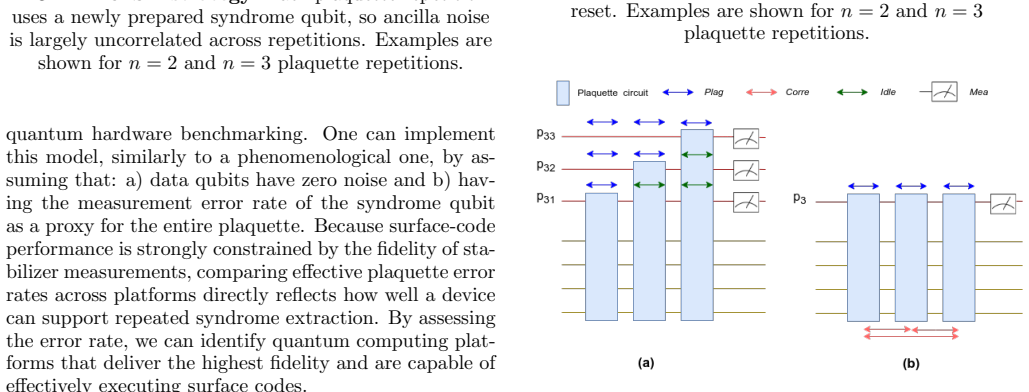
Shuttling-enabled plaquette circuits that perform syndrome extraction in FRESH (fresh qubits per repetition) and RECYCLE (qubit reuse) modes.
If this is right
- Circuit-level noise can be quantified on hardware where repeated measurements or calibration routines are inaccessible.
- Numerical assessment of low-depth QEC viability becomes possible from one round of plaquette data.
- The same estimation procedure applies to both ion-trap and superconducting processors after appropriate compilation.
- Hardware-aware circuit rewrites can shorten plaquette execution time while preserving the noise estimation pathway.
Where Pith is reading between the lines
- The technique could support noise characterization on cloud quantum platforms that restrict user access to calibration routines.
- Similar single-shot plaquette statistics might be collected for other stabilizer codes to broaden the estimation scope.
- Shuttling overhead in the RECYCLE mode could be quantified separately to refine noise models for repeated qubit use.
Load-bearing premise
Single-shot plaquette measurement statistics alone are sufficient to reliably estimate circuit-level noise rates without additional calibration data or repeated measurements.
What would settle it
If noise rates estimated from the single-shot plaquette statistics fail to predict the observed performance of a full low-depth surface code error correction circuit executed on the same hardware.
Figures


read the original abstract
We present a method for estimating QEC circuit-level noise levels assuming that only single-shot measurements are available (e.g. measurements are slow and performed in a zoned/parallel fashion), and that lower level quantum hardware calibration is not possible (e.g. cloud access) or not feasible (e.g. large scale computing). We develop and run surface code plaquette experiments using two syndrome qubit configurations: FRESH, involving fresh qubits for each plaquette repetition, and RECYCLE, reusing qubits. To validate our approach, we compile plaquettes to ion-trap (IonQ Aria1) native gate set and apply hardware-aware rewrite templates to reduce circuit depth and execution time. We also run the experiments on a non-shuttling, superconducting processor (IBM Torino). We estimate circuit-level noise rates from the resulting single-shot plaquette measurement statistics, and conclude numerically about the viability of low-depth QEC experiments.
Editorial analysis
A structured set of objections, weighed in public.
Referee Report
Summary. The manuscript presents a method for estimating circuit-level noise rates in surface-code plaquette circuits from single-shot parity measurement statistics alone, under the constraints of slow/zoned measurements and no access to lower-level calibration. It compares FRESH (fresh qubits per repetition) and RECYCLE (qubit reuse) configurations, compiles the depth-4–6 circuits to IonQ Aria1 native gates with shuttling-aware rewrite templates and to IBM Torino, extracts noise-rate estimates from the observed bit-flip probabilities, and draws numerical conclusions about the feasibility of low-depth QEC experiments.
Significance. If the single-shot inversion is shown to be well-posed, the approach would be useful for noise characterization in cloud or large-scale settings where repeated shots or calibration circuits are unavailable. The hardware-specific compilation and shuttling optimizations constitute a concrete engineering contribution that could be reused beyond the noise-estimation task.
major comments (3)
- [Noise estimation procedure (implicit in abstract and results)] The central claim—that circuit-level noise rates can be extracted directly from the marginal distribution of single-shot plaquette parities—requires that the chosen parametric noise model be identifiable from those statistics. No identifiability analysis, sensitivity study, or cross-validation against multi-shot tomography is reported, leaving open the possibility that multiple distinct error-rate vectors produce indistinguishable parity-flip probabilities (see skeptic note on error locality and independence assumptions).
- [Results and conclusions] The numerical conclusions on low-depth QEC viability rest on the extracted scalar noise rates. Without an explicit statement of the fitting procedure, the number of free parameters, the functional form relating gate/idle/measurement errors to the observed parity bit, or reported uncertainties on the fitted rates, it is impossible to judge whether the estimates are robust or merely consistent with the data under an under-constrained model.
- [Experimental configurations] The FRESH vs. RECYCLE comparison is presented as a validation axis, yet both configurations still yield only a single parity bit per plaquette. It is therefore unclear how the two datasets together resolve the degeneracy between, e.g., CNOT errors on data qubits versus measurement errors on syndrome qubits.
minor comments (2)
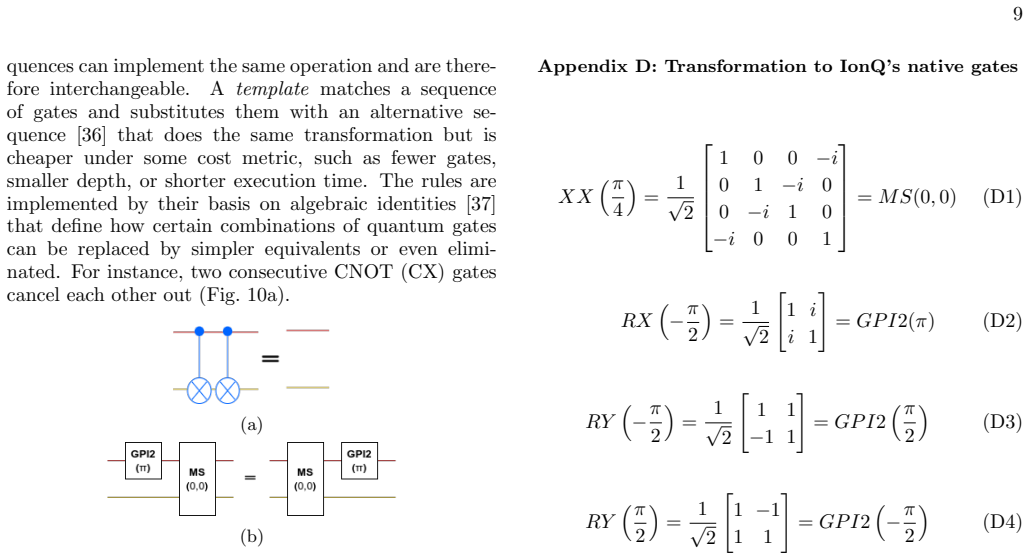
- [Methods] The abstract states that circuits are compiled “to ion-trap native gate set” but does not list the exact native gates or the depth reduction achieved by the rewrite templates; a short table would improve reproducibility.
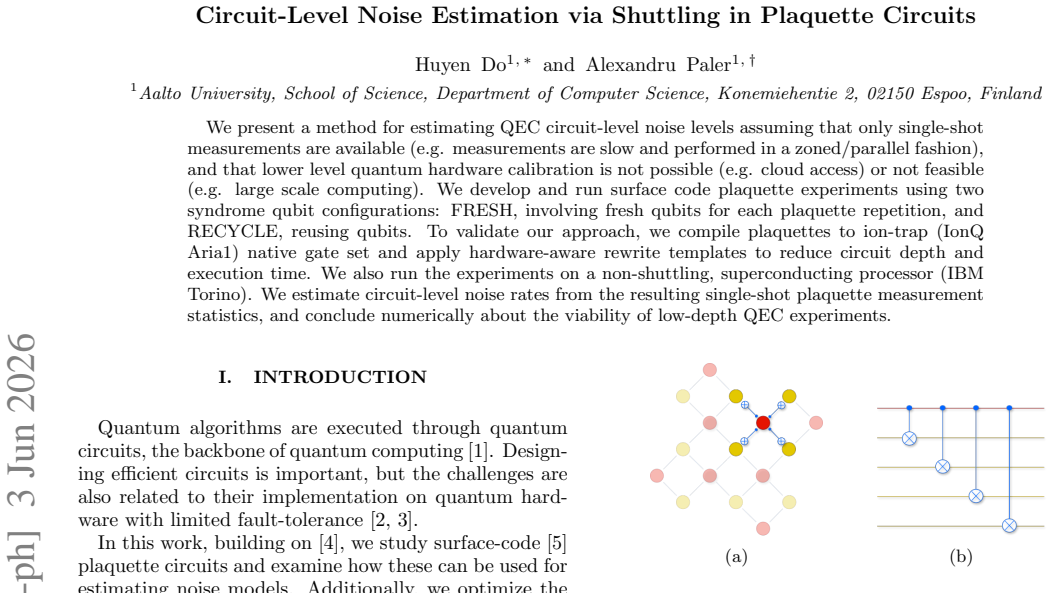
- [Introduction/Methods] Notation for the two configurations (FRESH, RECYCLE) is introduced without an accompanying diagram showing qubit reuse or shuttling paths; a single figure would clarify the distinction for readers unfamiliar with zoned architectures.
Simulated Author's Rebuttal
We thank the referee for the constructive comments. We address each major point below, indicating planned revisions where appropriate to strengthen the manuscript.
read point-by-point responses
-
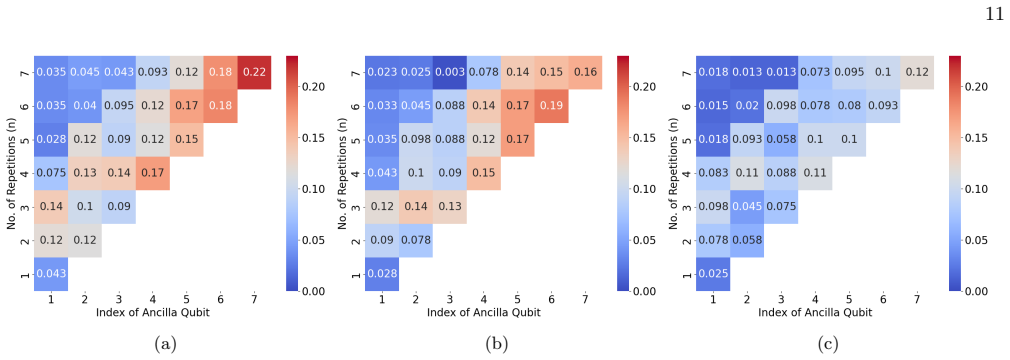
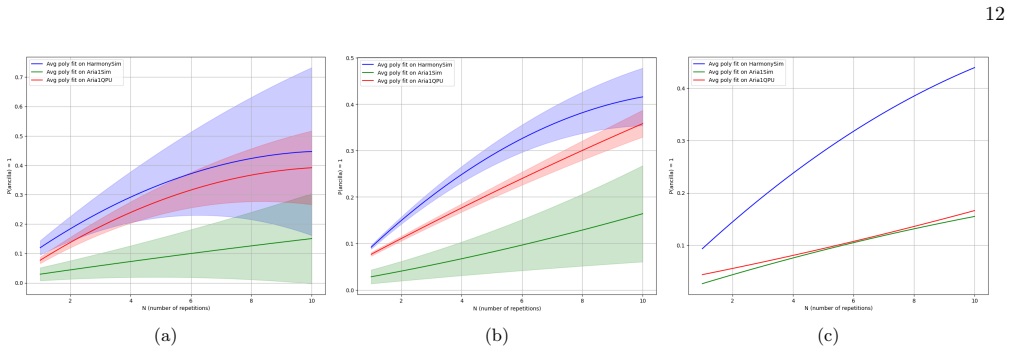
Referee: The central claim—that circuit-level noise rates can be extracted directly from the marginal distribution of single-shot plaquette parities—requires that the chosen parametric noise model be identifiable from those statistics. No identifiability analysis, sensitivity study, or cross-validation against multi-shot tomography is reported, leaving open the possibility that multiple distinct error-rate vectors produce indistinguishable parity-flip probabilities (see skeptic note on error locality and independence assumptions).
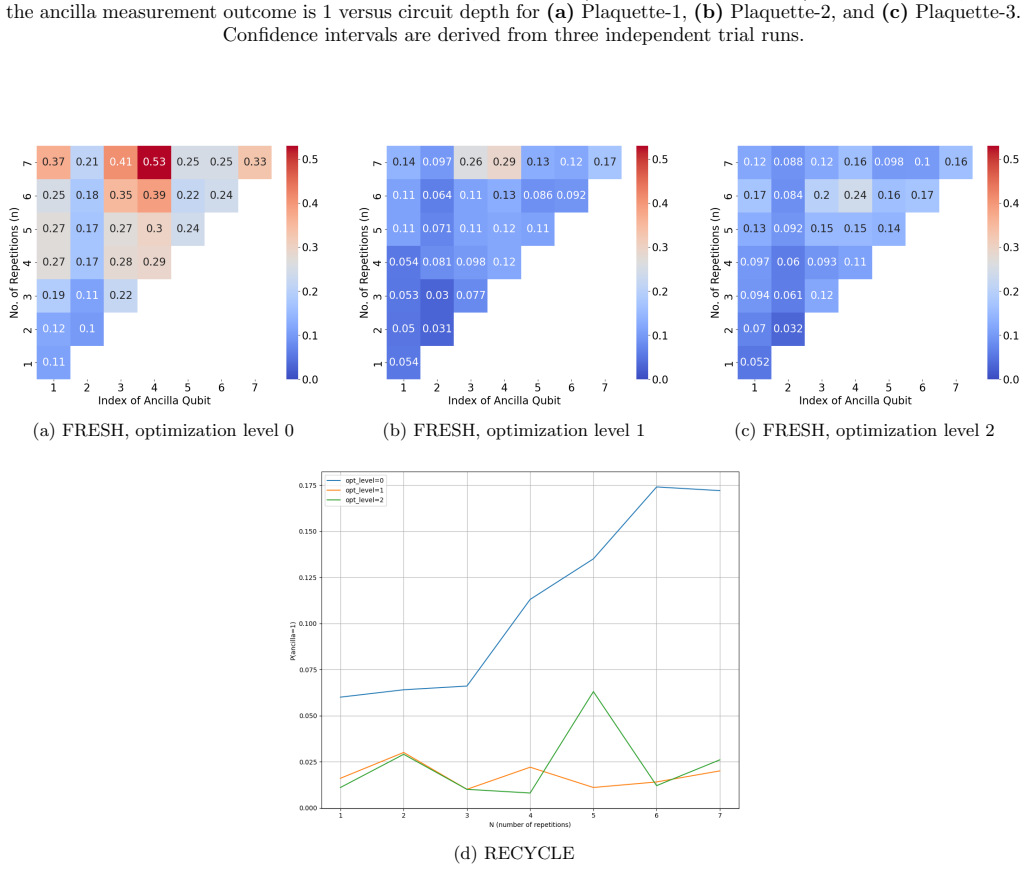
Authors: We acknowledge that the manuscript does not contain an explicit identifiability analysis or sensitivity study. The method assumes a standard independent local depolarizing noise model for gates, idles, and measurements, as is conventional for such circuit-level estimates. The single-shot parity flip probability is modeled as a function of the cumulative error probability through the plaquette circuit. To address the concern we will add a dedicated subsection on model assumptions, discuss potential degeneracies under the locality and independence hypotheses, and include a basic sensitivity analysis showing how variations in individual rates affect the observed parity statistics. revision: yes
-
Referee: The numerical conclusions on low-depth QEC viability rest on the extracted scalar noise rates. Without an explicit statement of the fitting procedure, the number of free parameters, the functional form relating gate/idle/measurement errors to the observed parity bit, or reported uncertainties on the fitted rates, it is impossible to judge whether the estimates are robust or merely consistent with the data under an under-constrained model.
Authors: We agree that the fitting details should be stated explicitly. The model employs three free parameters (two-qubit gate error rate, idle error rate, measurement error rate). The functional form is obtained by error propagation through the compiled depth-4–6 circuit, yielding an effective parity-flip probability p_flip = 1 − (1 − 2p_eff)^k where k depends on the number of error locations. Fitting is performed by least-squares minimization against the experimentally observed flip frequency; uncertainties are obtained via bootstrap resampling over the hardware shots. We will revise the results section to include the explicit equations, parameter count, fitting procedure, and reported uncertainties on the extracted rates. revision: yes
-
Referee: The FRESH vs. RECYCLE comparison is presented as a validation axis, yet both configurations still yield only a single parity bit per plaquette. It is therefore unclear how the two datasets together resolve the degeneracy between, e.g., CNOT errors on data qubits versus measurement errors on syndrome qubits.
Authors: The FRESH configuration uses a fresh syndrome qubit for each repetition, thereby emphasizing measurement and reset errors, while RECYCLE reuses the syndrome qubit and therefore accumulates additional shuttling, idle, and gate errors. Although each run still produces one parity bit, the distinct physical error budgets produce measurably different flip probabilities that serve as a consistency check on the extracted rates. We recognize that the pair of datasets does not fully resolve all location-specific degeneracies. We will revise the experimental-configurations section to clarify the intended role of the comparison and to note its limitations regarding individual error-type separation. revision: partial
Circularity Check
No significant circularity; derivation relies on external hardware data
full rationale
The paper describes compiling plaquette circuits to hardware (IonQ, IBM) and estimating noise rates from single-shot parity statistics in FRESH/RECYCLE configurations. No equations, fitting procedures, or self-citations are visible in the provided text that would reduce a claimed prediction to a fitted input by construction or import uniqueness via prior author work. The central mapping from observed bit-flip probabilities to circuit-level rates is presented as an empirical method validated on physical processors, making the result self-contained against external benchmarks rather than internally forced.
Axiom & Free-Parameter Ledger
Reference graph
Works this paper leans on
-
[1]
M. A. Nielsen and I. L. Chuang,Quantum Computa- tion and Quantum Information: 10th Anniversary Edi- tion(Cambridge University Press, 2010)
2010
-
[2]
J. Eisert and J. Preskill, Mind the gaps: The fraught road to quantum advantage, arXiv preprint arXiv:2510.19928 (2025)
Pith/arXiv arXiv 2025
-
[3]
Preskill, Beyond nisq: The megaquop machine (2025)
J. Preskill, Beyond nisq: The megaquop machine (2025)
2025
-
[4]
Do,Automatic Hardware-aware Optimization of Fault-tolerant Quantum Circuits, Bachelor’s thesis, Aalto University (2024)
H. Do,Automatic Hardware-aware Optimization of Fault-tolerant Quantum Circuits, Bachelor’s thesis, Aalto University (2024)
2024
-
[5]
A. G. Fowler, M. Mariantoni, J. M. Martinis, and A. N. Cleland, Surface codes: Towards practical large- scale quantum computation, Physical Review A86, 10.1103/physreva.86.032324 (2012)
-
[6]
Preskill, Fault-tolerant quantum computation, arXiv preprint quant-ph/9712048 (1997)
J. Preskill, Fault-tolerant quantum computation, arXiv preprint quant-ph/9712048 (1997)
Pith/arXiv arXiv 1997
-
[7]
Chatterjee, K
A. Chatterjee, K. Phalak, and S. Ghosh, Quantum error correction for dummies, in2023 IEEE International Con- ference on Quantum Computing and Engineering (QCE) (IEEE Computer Society, 2023) pp. 70–81
2023
-
[8]
A. Chatterjee, S. Das, and S. Ghosh, Q-pandora unboxed: Characterizing noise resilience of quantum error correc- tion codes (2023), arXiv:2308.02769 [quant-ph]
arXiv 2023
-
[9]
Zhang, Y.-C
J. Zhang, Y.-C. Wu, and G.-P. Guo, Concatenation of the gottesman-kitaev-preskill code with the xzzx surface code, Phys. Rev. A107, 062408 (2023). 8
2023
-
[10]
LeBlond, P
T. LeBlond, P. Groszkowski, J. G. Lietz, C. M. Seck, and R. S. Bennink, Logical error rates for the surface code under a mixed coherent and stochastic circuit-level noise model inspired by trapped ions, Phys. Rev. Res.7, 043184 (2025)
2025
-
[11]
Gidney, Stim: a fast stabilizer circuit simulator, Quan- tum5, 497 (2021)
C. Gidney, Stim: a fast stabilizer circuit simulator, Quan- tum5, 497 (2021)
2021
-
[12]
P.-J. H. Derks, A. Townsend-Teague, A. G. Burchards, and J. Eisert, Designing fault-tolerant circuits using de- tector error models, Quantum9, 1905 (2025)
1905
-
[13]
J. I. Cirac and P. Zoller, Quantum computations with cold trapped ions, Phys. Rev. Lett.74, 4091 (1995)
1995
-
[14]
Quera.com, Trapped ions, Online (Accessed 2024)
2024
-
[15]
Ashkin, J
A. Ashkin, J. M. Dziedzic, J. E. Bjorkholm, and S. Chu, Observation of a single-beam gradient force optical trap for dielectric particles, Optics Letters11, 288 (1986)
1986
-
[16]
Bluvstein, S
D. Bluvstein, S. J. Evered, A. A. Geim, and et al., Logical quantum processor based on reconfigurable atom arrays, Nature626, 58 (2024)
2024
-
[17]
C. J. Trout, M. Li, M. Guti´ errez, Y. Wu, S.-T. Wang, L. Duan, and K. R. Brown, Simulating the performance of a distance-3 surface code in a linear ion trap, New Journal of Physics20, 043038 (2018)
2018
-
[18]
Erhard, H
A. Erhard, H. Poulsen Nautrup, M. Meth, and et al., En- tangling logical qubits with lattice surgery, Nature589, 220 (2021)
2021
-
[19]
Gottesman,Stabilizer codes and quantum error cor- rection(California Institute of Technology, 1997)
D. Gottesman,Stabilizer codes and quantum error cor- rection(California Institute of Technology, 1997)
1997
-
[20]
Leblond, R
T. Leblond, R. S. Bennink, J. G. Lietz, and C. M. Seck, Tiscc: A surface code compiler and resource estimator for trapped-ion processors, inProceedings of the SC ’23 Workshops of The International Conference on High Per- formance Computing, Network, Storage, and Analysis, SC-W 2023 (ACM, 2023)
2023
-
[21]
Schoenberger, S
D. Schoenberger, S. Hillmich, M. Brandl, and R. Wille, Shuttling for scalable trapped-ion quantum computers, IEEE Transactions on Computer-Aided Design of Inte- grated Circuits and Systems44, 2144 (2024)
2024
-
[22]
Kreppel, C
F. Kreppel, C. Melzer, D. O. Mill´ an, J. Wagner, J. Hilder, U. Poschinger, F. Schmidt-Kaler, and A. Brinkmann, Quantum circuit compiler for a shuttling-based trapped- ion quantum computer, Quantum7, 1176 (2023)
2023
-
[23]
Proctor, M
T. Proctor, M. Revelle, E. Nielsen, K. Rudinger, D. Lob- ser, P. Maunz, R. Blume-Kohout, and K. Young, Detect- ing and tracking drift in quantum information processors, Nature Communications11, 5396 (2020)
2020
-
[24]
Huo and Y
M.-X. Huo and Y. Li, Learning time-dependent noise to reduce logical errors: real time error rate estimation in quantum error correction, New Journal of Physics19, 123032 (2017)
2017
-
[25]
A. D. C´ orcoles, Exploiting Dynamic Quantum Cir- cuits in a Quantum Algorithm with Superconducting Qubits, Physical Review Letters127, 10.1103/Phys- RevLett.127.100501 (2021)
-
[26]
J. M. Pino, J. M. Dreiling, C. Figgatt, J. P. Gaebler, S. A. Moses, M. S. Allman, C. H. Baldwin, M. Foss-Feig, D. Hayes, K. Mayer, C. Ryan-Anderson, and B. Neyen- huis, Demonstration of the trapped-ion quantum CCD computer architecture, Nature592, 209 (2021)
2021
-
[27]
C. D. Bruzewicz, J. Chiaverini, R. McConnell, and J. M. Sage, Trapped-ion quantum computing: Progress and challenges, Applied Physics Reviews6, 021314 (2019)
2019
-
[28]
Y. Zheng, Minimizing readout-induced noise for early fault-tolerant quantum computers, Physical Review Re- search6, 10.1103/PhysRevResearch.6.023129 (2024)
-
[29]
Ionq backends,https://cloud.ionq.com/backends, ac- cessed: April 23, 2024
2024
-
[30]
IBM Quantum, Ibm quantum platform: ibm torino (compute resources),https://quantum.cloud.ibm.com/ ?computer=ibm_torino, accessed: 2026-02-25
2026
-
[31]
M. A. Wahl, A. Mari, N. Shammah, W. J. Zeng, and G. S. Ravi, Zero noise extrapolation on logical qubits by scaling the error correction code distance, in2023 IEEE International Conference on Quantum Computing and Engineering (QCE)(IEEE, 2023)
2023
-
[32]
IonQ, Getting started with native gates (2024), accessed: 2024-02-15
2024
-
[33]
Maslov, Basic circuit compilation techniques for an ion-trap quantum machine, New Journal of Physics19, 023035 (2017)
D. Maslov, Basic circuit compilation techniques for an ion-trap quantum machine, New Journal of Physics19, 023035 (2017)
2017
-
[34]
A. F. Kockum and F. Nori, Quantum bits with josephson junctions, inFundamentals and Frontiers of the Joseph- son Effect, edited by F. Tafuri (Springer International Publishing, Cham, 2019) pp. 703–741
2019
-
[35]
A. Wu, G. Li, H. Zhang, G. G. Guerreschi, Y. Ding, and Y. Xie, Mapping surface code to superconducting quantum processors (2021), arXiv:2111.13729 [quant-ph]
arXiv 2021
-
[36]
Miller, D
D. Miller, D. Maslov, and G. Dueck, A transformation based algorithm for reversible logic synthesis, inProceed- ings 2003. Design Automation Conference (IEEE Cat. No.03CH37451)(2003) pp. 318–323
2003
-
[37]
1i i1 # =GP I2(π) (D2) RY − π 2 = 1√ 2
K. Hietala, R. Rand, S.-H. Hung, X. Wu, and M. Hicks, A verified optimizer for quantum circuits, Proceedings of the ACM on Programming Languages5, 1–29 (2021). Appendix A: Superconducting QPUs We use superconducting QPUs as a comparison plat- form to evaluate the generality of our noise-estimation method. Superconducting quantum computers utilize circuits...
2021
-
[38]
1i i1 #! 1√ 2
Cancellation of two consecutive GPI2 gates Using the definition of GPI2, we have GPI2 − π 2 GPI2 π 2 = 1√ 2 " 1i i1 #! 1√ 2 " 1−i −i1 #! = 1 2 " 1 + 1−i+i i−i1 + 1 # = " 1 0 0 1 # =I. (E1)
-
[39]
10 Then AM= 1 2 1 1i−i 1 1−i i i−i1 1 −i i1 1 , M A= 1 2 1 1i−i 1 1−i i i−i1 1 −i i1 1
Commutation ofGPI2(π)⊗IwithMS(0,0) Let A= GPI2(π)⊗I= 1√ 2 1 0i0 0 1 0i i0 1 0 0i0 1 and M= MS(0,0) = 1√ 2 1 0 0−i 0 1−i0 0−i1 0 −i0 0 1 . 10 Then AM= 1 2 1 1i−i 1 1−i i i−i1 1 −i i1 1 , M A= 1 2 1 1i−i 1 1−i i i−i1 1 −i i1 1 . (E2) Therefore, (GPI2(π)⊗I)MS(0,0) = MS(0,0)(GPI2(π)⊗I)
-
[40]
1i i1 #
Four consecutiveGPI2(π)gates cancel up to a global phase. We first compute GPI2(π)2 = 1 2 " 1i i1 #" 1i i1 # = 1 2 " 0 2i 2i0 # = " 0i i0 # . (E3) Therefore, GPI2(π)4 = GPI2(π)2 2 = " 0i i0 #" 0i i0 # = " −1 0 0−1 # =−I. (E4) Appendix F: Details of extractingp x,p xy from histogram Algorithm 1 is designed to estimate the failure rate of plaquette circuits...
-
[41]
We eval- uate three plaquette circuit variants (Plaquette-1 to Plaquette-3) under both ancilla strategies, FRESH and RECYCLE
IonQ Aria1 QPU For IonQ Aria1, we report the probability that the ancilla measurement outcome is 1 as a function of cir- cuit depth (number of plaquette repetitions). We eval- uate three plaquette circuit variants (Plaquette-1 to Plaquette-3) under both ancilla strategies, FRESH and RECYCLE. All circuits were run with 1000 shots. FRESH Experiment.Figure 1...
-
[42]
All circuits were run with 1000 shots
IBM Torino QPU For IBM Torino (Heron1 chip), we execute both FRESH and RECYCLE (Figure 13) and get the prob- ability that the ancilla measurement outcome is 1 as a function of circuit depth under IBM transpiler optimiza- tion levels 0, 1, and 2. All circuits were run with 1000 shots. 12 (a) (b) (c) FIG. 12: RECYCLE experiment on IonQ Aria1: polynomial fit...
discussion (0)
Sign in with ORCID, Apple, or X to comment. Anyone can read and Pith papers without signing in.