BiNSGPS: Geometry Problem Solving via Bidirectional Neuro-Symbolic Interaction
Pith reviewed 2026-06-28 06:16 UTC · model grok-4.3
The pith
Bidirectional feedback lets a multimodal LLM adviser correct formal representations for a symbolic geometry solver.
A machine-rendered reading of the paper's core claim, the machinery that carries it, and where it could break.
Core claim
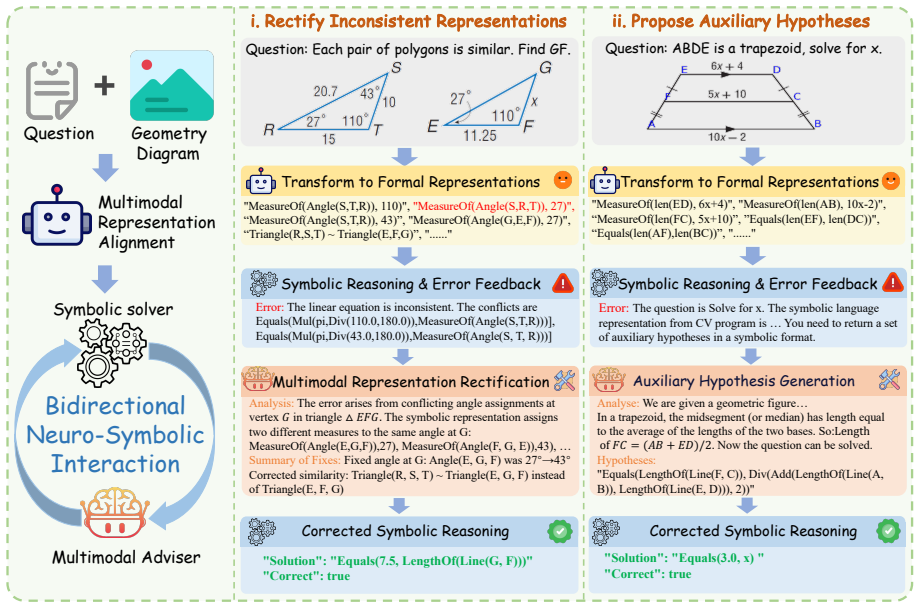
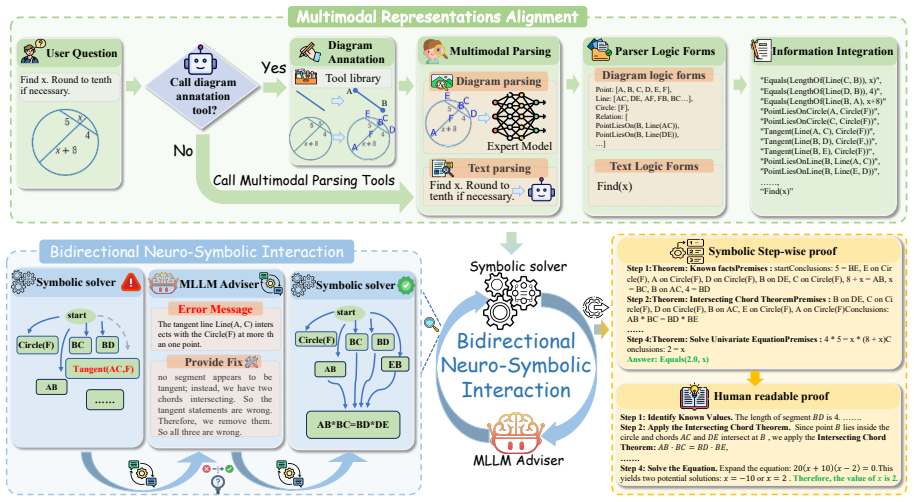
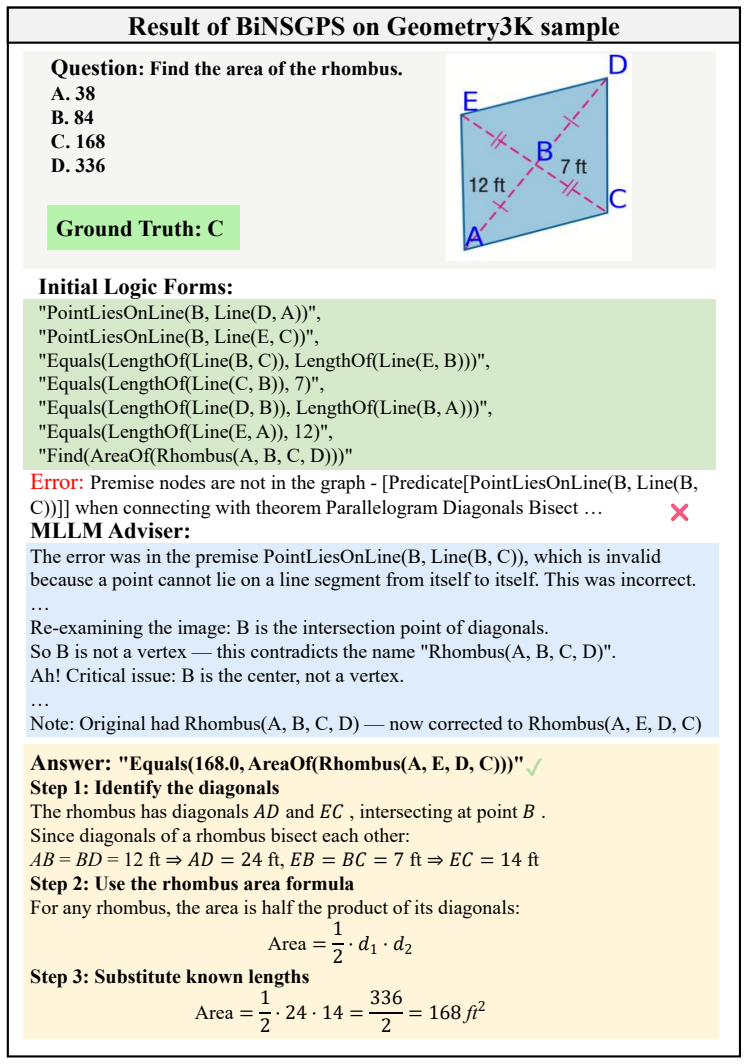
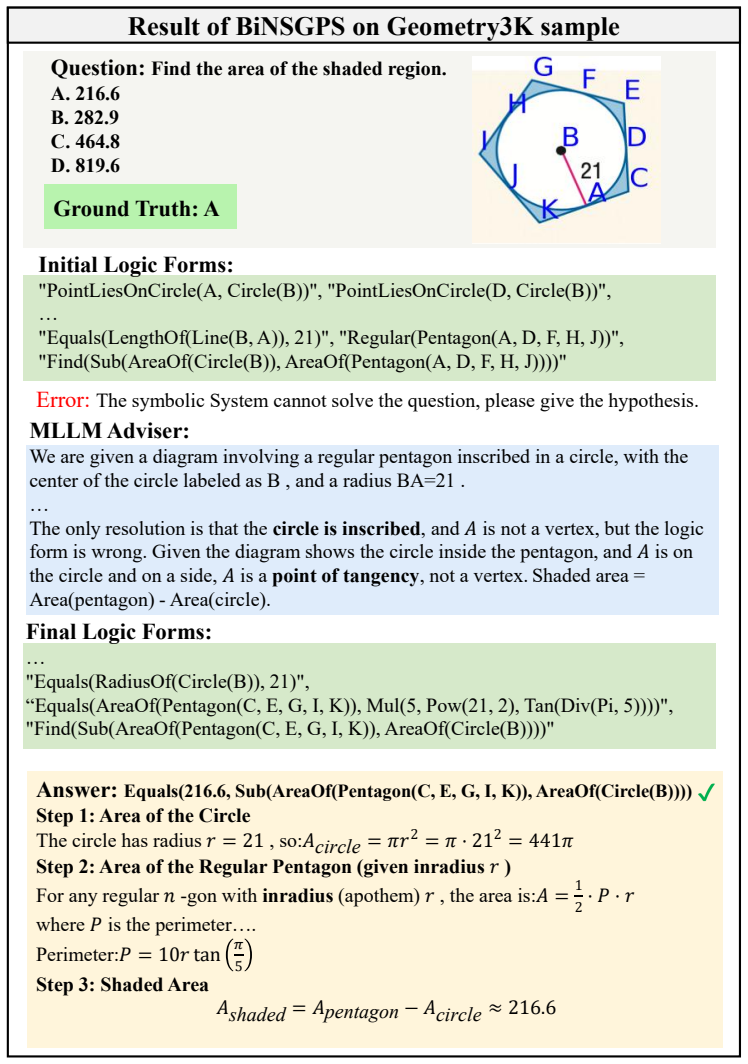
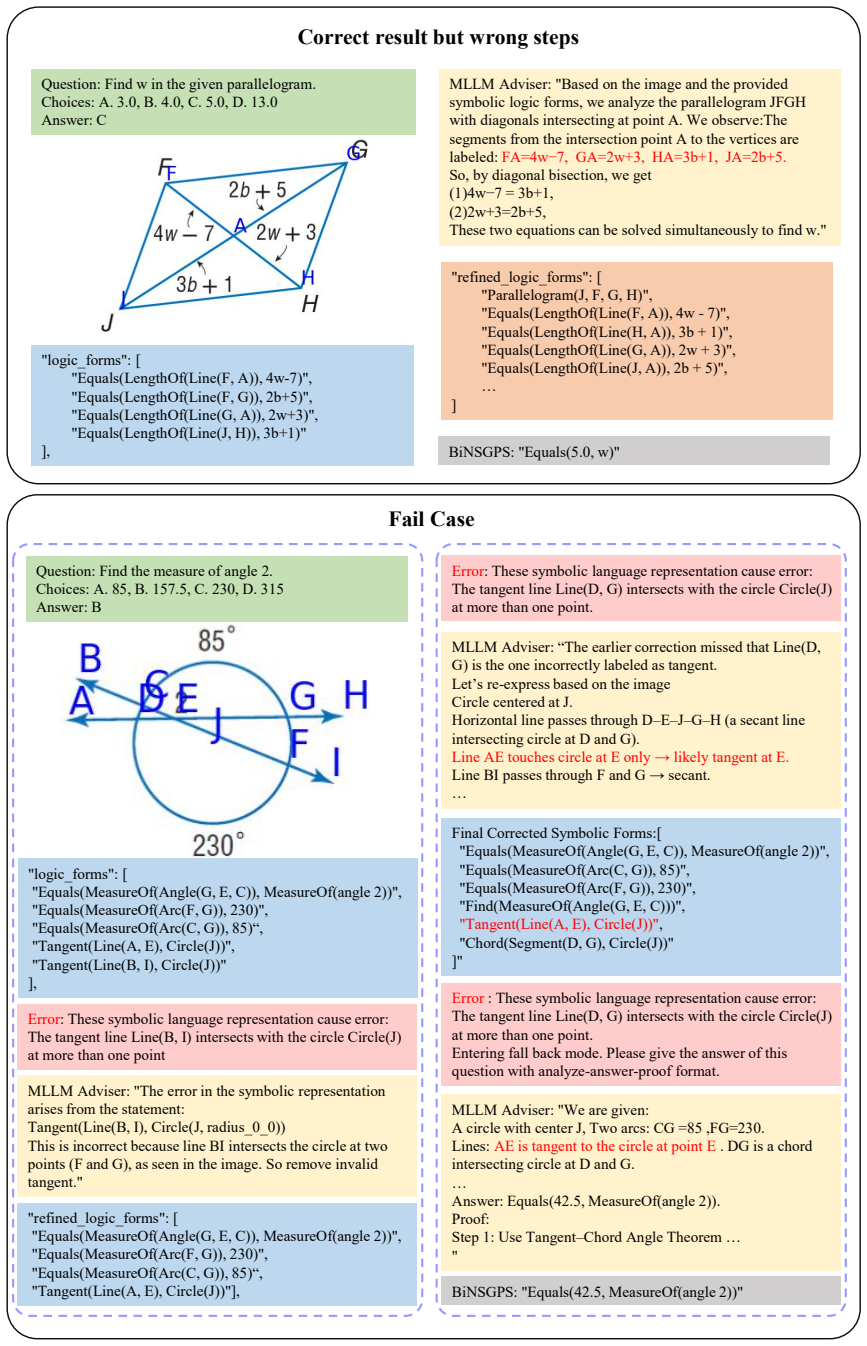
We propose BiNSGPS, a framework that establishes Bidirectional Neuro-Symbolic Interaction (BiNS) between a MLLM Adviser and a Symbolic Solver. MLLM Adviser actively incorporates feedback from the symbolic solver to dynamically rectify inconsistent formal representations or propose auxiliary hypotheses, resolving symbolic conflicts and facilitating complex deductions.
What carries the argument
Bidirectional Neuro-Symbolic Interaction (BiNS): the MLLM Adviser receives and acts on concrete solver feedback to repair or augment the formal representation passed to the solver.
If this is right
- Early-stage neural parsing errors no longer force the entire solution to fail.
- Symbolic conflicts can trigger targeted neural hypothesis generation instead of halting.
- Complex multi-step deductions become reachable through iterative correction rather than single-pass correctness.
- The system gains robustness to variations in diagram or text input that would otherwise produce inconsistent formalizations.
Where Pith is reading between the lines
- The same feedback loop could be applied to other domains that combine neural parsing with symbolic execution, such as algebraic word problems or logical entailment.
- If the adviser's corrections prove reliable, the need for exhaustive upfront diagram parsing decreases.
- Repeated interaction rounds might surface previously hidden auxiliary lemmas that a one-shot pipeline would miss.
Load-bearing premise
The MLLM adviser can reliably interpret solver feedback and produce corrected representations or useful hypotheses without creating new inconsistencies.
What would settle it
A controlled set of geometry problems in which the initial neural formalization contains detectable errors; measure whether the bidirectional loop produces correct final solutions more often than a unidirectional baseline on the same inputs.
Figures
read the original abstract
Geometry problem solving poses distinct challenges in artificial intelligence. Existing approaches typically fall into two paradigms: symbolic methods, which exhibit limited adaptability, and neural methods, which are prone to hallucinations. Recent neuro-symbolic hybrids predominantly rely on a unidirectional pipeline where neural outputs are fed into solvers without feedback, making system brittle to early-stage errors. To break this unidirectional bottleneck, we propose BiNSGPS, a framework that establishes Bidirectional Neuro-Symbolic Interaction (BiNS) between a MLLM Adviser and a Symbolic Solver. MLLM Adviser actively incorporates feedback from the symbolic solver to dynamically rectify inconsistent formal representations or propose auxiliary hypotheses, resolving symbolic conflicts and facilitating complex deductions.
Editorial analysis
A structured set of objections, weighed in public.
Referee Report
Summary. The manuscript proposes BiNSGPS, a framework for geometry problem solving that introduces Bidirectional Neuro-Symbolic Interaction (BiNS) between an MLLM Adviser and a Symbolic Solver. The MLLM Adviser incorporates feedback from the solver to dynamically rectify inconsistent formal representations or propose auxiliary hypotheses, aiming to overcome the brittleness of unidirectional neuro-symbolic pipelines.
Significance. If the bidirectional interaction can be made reliable, the framework could advance neuro-symbolic methods for mathematical reasoning by enabling correction of early errors and supporting complex deductions in geometry, where unidirectional approaches often fail due to unrecoverable mistakes.
major comments (3)
- [Abstract] Abstract: The central claim that the MLLM Adviser can reliably interpret solver feedback to produce corrected formal representations or useful auxiliary hypotheses without introducing new inconsistencies is presented at a high level only, with no architecture, prompt templates, fine-tuning procedure, or error analysis supplied to substantiate the capability.
- [Abstract] Abstract: No experimental results, ablation studies, benchmarks on geometry datasets, or case studies are provided to demonstrate that the bidirectional loop outperforms unidirectional pipelines or resolves symbolic conflicts effectively; the claimed benefit therefore rests on an unshown performance.
- [Abstract] Abstract: The description of how the BiNS interaction resolves conflicts or facilitates deductions lacks any formal specification, pseudocode, or interface definition between the MLLM and symbolic components, making it impossible to assess feasibility or potential for circularity.
Simulated Author's Rebuttal
We thank the referee for the constructive comments highlighting the need for greater detail and substantiation in our presentation of BiNSGPS. We agree that the current manuscript is primarily conceptual and will expand the relevant sections with the requested elements in the revised version.
read point-by-point responses
-
Referee: [Abstract] Abstract: The central claim that the MLLM Adviser can reliably interpret solver feedback to produce corrected formal representations or useful auxiliary hypotheses without introducing new inconsistencies is presented at a high level only, with no architecture, prompt templates, fine-tuning procedure, or error analysis supplied to substantiate the capability.
Authors: We acknowledge that the abstract and initial description remain high-level. The full manuscript elaborates the MLLM Adviser architecture in Section 3, including the bidirectional feedback loop. To directly address the concern, we will incorporate example prompt templates, a description of any fine-tuning, and an error analysis of feedback interpretation in the revised manuscript. revision: yes
-
Referee: [Abstract] Abstract: No experimental results, ablation studies, benchmarks on geometry datasets, or case studies are provided to demonstrate that the bidirectional loop outperforms unidirectional pipelines or resolves symbolic conflicts effectively; the claimed benefit therefore rests on an unshown performance.
Authors: The submitted manuscript presents the BiNSGPS framework and its motivation but does not yet include empirical evaluation. We will add experimental results, ablation studies, benchmarks on standard geometry datasets, and case studies in the revised version to demonstrate the advantages of bidirectional interaction over unidirectional baselines. revision: yes
-
Referee: [Abstract] Abstract: The description of how the BiNS interaction resolves conflicts or facilitates deductions lacks any formal specification, pseudocode, or interface definition between the MLLM and symbolic components, making it impossible to assess feasibility or potential for circularity.
Authors: We agree that a formal specification is necessary for assessing the interaction. The manuscript outlines the high-level BiNS mechanism but lacks pseudocode and explicit interface definitions. In revision we will add pseudocode for the bidirectional loop, a precise interface specification, and a brief discussion of safeguards against circularity. revision: yes
Circularity Check
No derivation chain present; framework proposal only
full rationale
The manuscript describes an architectural framework (BiNS) for bidirectional interaction between an MLLM Adviser and a Symbolic Solver in geometry problem solving. No equations, parameters, predictions, or first-principles derivations appear in the provided text. The central claim is a system design whose correctness rests on empirical performance rather than any closed-form result that could reduce to its own inputs by construction. No self-citation load-bearing steps, ansatz smuggling, or renaming of known results are identifiable. This matches the default expectation for non-circular papers; the work is self-contained as a proposal without mathematical self-reference.
Axiom & Free-Parameter Ledger
Reference graph
Works this paper leans on
-
[1]
Aho and Jeffrey D
Alfred V. Aho and Jeffrey D. Ullman , title =. 1972
1972
-
[2]
Publications Manual , year = "1983", publisher =
1983
-
[3]
Ashok K. Chandra and Dexter C. Kozen and Larry J. Stockmeyer , year = "1981", title =. doi:10.1145/322234.322243
-
[4]
Scalable training of
Andrew, Galen and Gao, Jianfeng , booktitle=. Scalable training of
-
[5]
Dan Gusfield , title =. 1997
1997
-
[6]
Tetreault , title =
Mohammad Sadegh Rasooli and Joel R. Tetreault , title =. Computing Research Repository , volume =. 2015 , url =
2015
-
[7]
A Framework for Learning Predictive Structures from Multiple Tasks and Unlabeled Data , Volume =
Ando, Rie Kubota and Zhang, Tong , Issn =. A Framework for Learning Predictive Structures from Multiple Tasks and Unlabeled Data , Volume =. Journal of Machine Learning Research , Month = dec, Numpages =
-
[8]
Solving Olympiad Geometry without Human Demonstrations , year =
Trinh, Trieu and Wu, Yuhuai and Le, Quoc and He, He and Luong, Thang , journal =. Solving Olympiad Geometry without Human Demonstrations , year =
-
[9]
2025 , eprint=
Gold-medalist Performance in Solving Olympiad Geometry with AlphaGeometry2 , author=. 2025 , eprint=
2025
-
[10]
arXiv preprint arXiv:2505.21177 , year=
Solidgeo: Measuring multimodal spatial math reasoning in solid geometry , author=. arXiv preprint arXiv:2505.21177 , year=
-
[11]
2025 , eprint=
AutoGPS: Automated Geometry Problem Solving via Multimodal Formalization and Deductive Reasoning , author=. 2025 , eprint=
2025
-
[12]
Inter-gps: Interpretable geometry problem solving with formal language and symbolic reasoning , author=. Proceedings of the 59th Annual Meeting of the Association for Computational Linguistics and the 11th International Joint Conference on Natural Language Processing (Volume 1: Long Papers) , pages=
-
[13]
Findings of the Association for Computational Linguistics: ACL-IJCNLP 2021 , pages=
Geoqa: A geometric question answering benchmark towards multimodal numerical reasoning , author=. Findings of the Association for Computational Linguistics: ACL-IJCNLP 2021 , pages=
2021
-
[14]
Proceedings of the Computer Vision and Pattern Recognition Conference , pages=
Mv-math: Evaluating multimodal math reasoning in multi-visual contexts , author=. Proceedings of the Computer Vision and Pattern Recognition Conference , pages=
-
[15]
LANS : A Layout-Aware Neural Solver for Plane Geometry Problem
Li, Zhong-Zhi and Zhang, Ming-Liang and Yin, Fei and Liu, Cheng-Lin. LANS : A Layout-Aware Neural Solver for Plane Geometry Problem. Findings of the Association for Computational Linguistics: ACL 2024. 2024. doi:10.18653/v1/2024.findings-acl.153
-
[16]
Proceedings of the Thirty-First International Joint Conference on Artificial Intelligence,
Plane Geometry Diagram Parsing , author =. Proceedings of the Thirty-First International Joint Conference on Artificial Intelligence,. 2022 , month =. doi:10.24963/ijcai.2022/228 , url =
-
[17]
2025 , eprint=
Enhancing the Geometric Problem-Solving Ability of Multimodal LLMs via Symbolic-Neural Integration , author=. 2025 , eprint=
2025
-
[18]
arXiv preprint arXiv:2504.15780 , year=
TrustGeoGen: Formal-Verified Data Engine for Trustworthy Multi-modal Geometric Problem Solving , author=. arXiv preprint arXiv:2504.15780 , year=
-
[19]
arXiv preprint arXiv:2312.11370 , year=
G-llava: Solving geometric problem with multi-modal large language model , author=. arXiv preprint arXiv:2312.11370 , year=
-
[20]
Findings of the Association for Computational Linguistics: EMNLP 2024 , pages=
Math-llava: Bootstrapping mathematical reasoning for multimodal large language models , author=. Findings of the Association for Computational Linguistics: EMNLP 2024 , pages=
2024
-
[21]
2025 , eprint=
InternVL3: Exploring Advanced Training and Test-Time Recipes for Open-Source Multimodal Models , author=. 2025 , eprint=
2025
-
[22]
arXiv preprint arXiv:2511.21631 , year=
Qwen3-vl technical report , author=. arXiv preprint arXiv:2511.21631 , year=
-
[23]
Measuring Multimodal Mathematical Reasoning with MATH-Vision Dataset , url =
Wang, Ke and Pan, Junting and Shi, Weikang and Lu, Zimu and Ren, Houxing and Zhou, Aojun and Zhan, Mingjie and Li, Hongsheng , booktitle =. Measuring Multimodal Mathematical Reasoning with MATH-Vision Dataset , url =. doi:10.52202/079017-3014 , pages =
-
[24]
Proceedings of the Thirty-Fourth International Joint Conference on Artificial Intelligence , pages=
Neuro-symbolic artificial intelligence: towards improving the reasoning abilities of large language models , author=. Proceedings of the Thirty-Fourth International Joint Conference on Artificial Intelligence , pages=
-
[25]
Proceedings of the 2015 conference on empirical methods in natural language processing , pages=
Solving geometry problems: Combining text and diagram interpretation , author=. Proceedings of the 2015 conference on empirical methods in natural language processing , pages=
2015
-
[26]
E-GPS: Explainable Geometry Problem Solving via Top-Down Solver and Bottom-Up Generator , year=
Wu, Wenjun and Zhang, Lingling and Liu, Jun and Tang, Xi and Wang, Yaxian and Wang, Shaowei and Wang, Qianying , booktitle=. E-GPS: Explainable Geometry Problem Solving via Top-Down Solver and Bottom-Up Generator , year=
-
[27]
ToRA: A Tool-Integrated Reasoning Agent for Mathematical Problem Solving , url =
Gou, Zhibin and Shao, Zhihong and Gong, Yeyun and shen, yelong and Yang, Yujiu and Huang, Minlie and Duan, Nan and Chen, Weizhu , booktitle =. ToRA: A Tool-Integrated Reasoning Agent for Mathematical Problem Solving , url =
-
[28]
Liu, Mingyue and Ueda, Ryo and Wan, Zhen and Inoue, Katsumi and Willcocks, Chris G. , year=. Neuro-Symbolic Contrastive Learning for Cross-domain Inference , volume=. doi:10.4204/eptcs.416.6 , journal=
-
[29]
Neuro-symbolic Training for Reasoning over Spatial Language , url=
Premsri, Tanawan and Kordjamshidi, Parisa , year=. Neuro-symbolic Training for Reasoning over Spatial Language , url=. doi:10.18653/v1/2025.findings-naacl.128 , booktitle=
-
[30]
2024 , eprint=
Chain-of-Symbol Prompting Elicits Planning in Large Langauge Models , author=. 2024 , eprint=
2024
-
[31]
2024 , eprint=
Proposing and solving olympiad geometry with guided tree search , author=. 2024 , eprint=
2024
-
[32]
2024 , eprint=
GeoGPT4V: Towards Geometric Multi-modal Large Language Models with Geometric Image Generation , author=. 2024 , eprint=
2024
-
[33]
Proceedings of the Thirty-Second International Joint Conference on Artificial Intelligence,
A Multi-Modal Neural Geometric Solver with Textual Clauses Parsed from Diagram , author =. Proceedings of the Thirty-Second International Joint Conference on Artificial Intelligence,. 2023 , month =. doi:10.24963/ijcai.2023/376 , url =
-
[34]
Autoformalization with Large Language Models , url =
Wu, Yuhuai and Jiang, Albert Qiaochu and Li, Wenda and Rabe, Markus and Staats, Charles and Jamnik, Mateja and Szegedy, Christian , booktitle =. Autoformalization with Large Language Models , url =
-
[35]
ViperGPT: Visual Inference via Python Execution for Reasoning , booktitle =
Sur. ViperGPT: Visual Inference via Python Execution for Reasoning , booktitle =. 2023 , pages =
2023
-
[36]
Terufumi Morishita, Gaku Morio, Atsuki Yamaguchi, and Yasuhiro Sogawa
Pan, Liangming and Albalak, Alon and Wang, Xinyi and Wang, William. Logic- LM : Empowering Large Language Models with Symbolic Solvers for Faithful Logical Reasoning. Findings of the Association for Computational Linguistics: EMNLP 2023. 2023. doi:10.18653/v1/2023.findings-emnlp.248
-
[37]
Proceedings of the Thirty-Fourth International Joint Conference on Artificial Intelligence,
Neuro-Symbolic Artificial Intelligence: Towards Improving the Reasoning Abilities of Large Language Models , author =. Proceedings of the Thirty-Fourth International Joint Conference on Artificial Intelligence,. 2025 , month =. doi:10.24963/ijcai.2025/1195 , url =
-
[38]
2024 , eprint=
Fuse, Reason and Verify: Geometry Problem Solving with Parsed Clauses from Diagram , author=. 2024 , eprint=
2024
-
[39]
Findings of the Association for Computational Linguistics: ACL 2024 , pages=
Geoeval: benchmark for evaluating llms and multi-modal models on geometry problem-solving , author=. Findings of the Association for Computational Linguistics: ACL 2024 , pages=
2024
-
[40]
2024 , eprint=
FormalGeo: An Extensible Formalized Framework for Olympiad Geometric Problem Solving , author=. 2024 , eprint=
2024
-
[41]
Diagram Formalization Enhanced Multi-Modal Geometry Problem Solver , year=
Zhang, Zeren and Cheng, Jo-Ku and Deng, Jingyang and Tian, Lu and Ma, Jinwen and Qin, Ziran and Zhang, Xiaokai and Zhu, Na and Leng, Tuo , booktitle=. Diagram Formalization Enhanced Multi-Modal Geometry Problem Solver , year=
-
[42]
Proceedings of the Thirty-Fourth International Joint Conference on Artificial Intelligence,
FGeo-HyperGNet: Geometric Problem Solving Integrating FormalGeo Symbolic System and Hypergraph Neural Network , author =. Proceedings of the Thirty-Fourth International Joint Conference on Artificial Intelligence,. 2025 , month =. doi:10.24963/ijcai.2025/527 , url =
-
[43]
GeoX: Geometric Problem Solving Through Unified Formalized Vision-Language Pre-training , author=
-
[44]
MathVista: Evaluating Mathematical Reasoning of Foundation Models in Visual Contexts , url =
Lu, Pan and Bansal, Hritik and Xia, Tony and Liu, Jiacheng and Li, Chunyuan and Hajishirzi, Hannaneh and Cheng, Hao and Chang, Kai-Wei and Galley, Michel and Gao, Jianfeng , booktitle =. MathVista: Evaluating Mathematical Reasoning of Foundation Models in Visual Contexts , url =
-
[45]
2024 , eprint=
Measuring Multimodal Mathematical Reasoning with MATH-Vision Dataset , author=. 2024 , eprint=
2024
-
[46]
2025 , eprint=
GeoLaux: A Benchmark for Evaluating MLLMs' Geometry Performance on Long-Step Problems Requiring Auxiliary Lines , author=. 2025 , eprint=
2025
-
[47]
2025 , eprint=
Thinking with Images for Multimodal Reasoning: Foundations, Methods, and Future Frontiers , author=. 2025 , eprint=
2025
-
[48]
2025 , eprint=
Chain-of-Visual-Thought: Teaching VLMs to See and Think Better with Continuous Visual Tokens , author=. 2025 , eprint=
2025
-
[49]
Visual Sketchpad: Sketching as a Visual Chain of Thought for Multimodal Language Models , url =
Hu, Yushi and Shi, Weijia and Fu, Xingyu and Roth, Dan and Ostendorf, Mari and Zettlemoyer, Luke and Smith, Noah A and Krishna, Ranjay , booktitle =. Visual Sketchpad: Sketching as a Visual Chain of Thought for Multimodal Language Models , url =. doi:10.52202/079017-4423 , editor =
-
[50]
2025 , eprint=
CodePlot-CoT: Mathematical Visual Reasoning by Thinking with Code-Driven Images , author=. 2025 , eprint=
2025
-
[51]
2025 , eprint=
GeoSketch: A Neural-Symbolic Approach to Geometric Multimodal Reasoning with Auxiliary Line Construction and Affine Transformation , author=. 2025 , eprint=
2025
-
[52]
2026 , eprint=
GeoVLMath: Enhancing Geometry Reasoning in Vision-Language Models via Cross-Modal Reward for Auxiliary Line Creation , author=. 2026 , eprint=
2026
-
[53]
2026 , eprint=
Vision-R1: Incentivizing Reasoning Capability in Multimodal Large Language Models , author=. 2026 , eprint=
2026
-
[54]
Peng, Shuai and Fu, Di and Liang, Yijun and Gao, Liangcai and Tang, Zhi. G eo DRL : A Self-Learning Framework for Geometry Problem Solving using Reinforcement Learning in Deductive Reasoning. Findings of the Association for Computational Linguistics: ACL 2023. 2023. doi:10.18653/v1/2023.findings-acl.850
-
[55]
2022 , eprint=
UniGeo: Unifying Geometry Logical Reasoning via Reformulating Mathematical Expression , author=. 2022 , eprint=
2022
-
[56]
Proceedings of the AAAI Conference on Artificial Intelligence , volume=
Gns: Solving plane geometry problems by neural-symbolic reasoning with multi-modal llms , author=. Proceedings of the AAAI Conference on Artificial Intelligence , volume=
-
[57]
Automatic understanding and formalization of natural language geometry problems using syntax-semantics models , volume =
Gan, Wenbin and Yu, Xinguo , year =. Automatic understanding and formalization of natural language geometry problems using syntax-semantics models , volume =. International Journal of Innovative Computing, Information and Control , doi =
-
[58]
2024 , eprint=
Mini-InternVL: A Flexible-Transfer Pocket Multimodal Model with 5\ author=. 2024 , eprint=
2024
-
[59]
2024 , eprint=
AutoGeo: Automating Geometric Image Dataset Creation for Enhanced Geometry Understanding , author=. 2024 , eprint=
2024
-
[60]
Autoformalize Mathematical Statements by Symbolic Equivalence and Semantic Consistency , url =
Li, Zenan and Wu, Yifan and Li, Zhaoyu and Wei, Xinming and Yang, Fan and Zhang, Xian and Ma, Xiaoxing , booktitle =. Autoformalize Mathematical Statements by Symbolic Equivalence and Semantic Consistency , url =. doi:10.52202/079017-1697 , editor =
-
[61]
2024 , eprint=
GPT-4o System Card , author=. 2024 , eprint=
2024
-
[62]
2025 , eprint=
Qwen2.5 Technical Report , author=. 2025 , eprint=
2025
-
[63]
2024 , eprint=
Interactive Evolution: A Neural-Symbolic Self-Training Framework For Large Language Models , author=. 2024 , eprint=
2024
-
[64]
Xu, Fangzhi and Wu, Zhiyong and Sun, Qiushi and Ren, Siyu and Yuan, Fei and Yuan, Shuai and Lin, Qika and Qiao, Yu and Liu, Jun. Symbol- LLM : Towards Foundational Symbol-centric Interface For Large Language Models. Proceedings of the 62nd Annual Meeting of the Association for Computational Linguistics (Volume 1: Long Papers). 2024. doi:10.18653/v1/2024.a...
-
[65]
2024 , eprint=
DeepSeekMath: Pushing the Limits of Mathematical Reasoning in Open Language Models , author=. 2024 , eprint=
2024
-
[66]
2025 , eprint=
DeepSeekMath-V2: Towards Self-Verifiable Mathematical Reasoning , author=. 2025 , eprint=
2025
-
[67]
2024 , eprint=
GPT-4 Technical Report , author=. 2024 , eprint=
2024
-
[68]
2025 , eprint=
Pi-GPS: Enhancing Geometry Problem Solving by Unleashing the Power of Diagrammatic Information , author=. 2025 , eprint=
2025
-
[69]
Proceedings of the AAAI Conference on Artificial Intelligence , volume=
Recoverable compression: A multimodal vision token recovery mechanism guided by text information , author=. Proceedings of the AAAI Conference on Artificial Intelligence , volume=
-
[70]
An Open-Ended Benchmark and Formal Framework for Adjuvant Research with
yi chen and Yu Zhang and Jian Xu and Hua Yue and Xinming Wang and Zequan Lyu and Xu-Yao Zhang and Wei Wei and Cheng-Lin Liu , booktitle=. An Open-Ended Benchmark and Formal Framework for Adjuvant Research with. 2026 , url=
2026
-
[71]
arXiv preprint arXiv:2604.11600 , year=
Geoparsing: Diagram Parsing for Plane and Solid Geometry with a Unified Formal Language , author=. arXiv preprint arXiv:2604.11600 , year=
discussion (0)
Sign in with ORCID, Apple, or X to comment. Anyone can read and Pith papers without signing in.