Why Fe doping kills photoluminescence in CsPbCl₃ but not in CsPbBr₃: Role of midgap Fe 3d states and electron-phonon coupling
Pith reviewed 2026-06-28 05:37 UTC · model grok-4.3
The pith
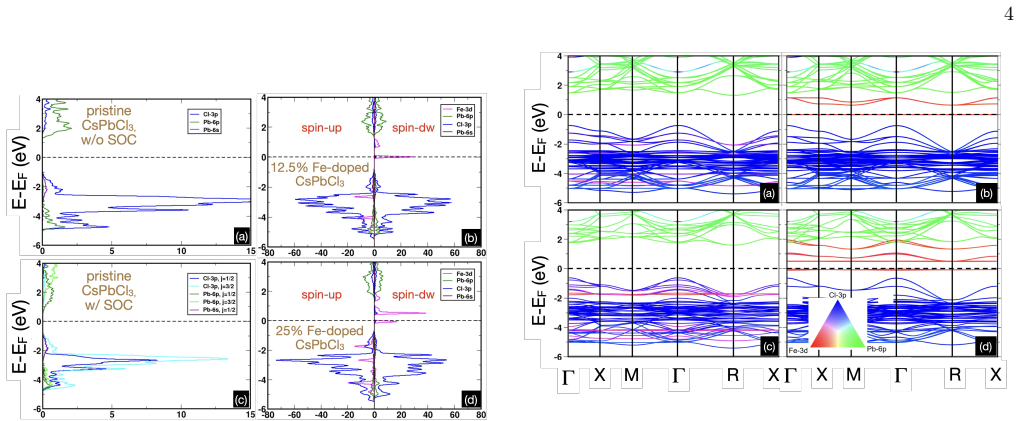
Fe 3d midgap states trap carriers in both CsPbCl3 and CsPbBr3, but stronger electron-phonon coupling quenches photoluminescence only in the chloride.
A machine-rendered reading of the paper's core claim, the machinery that carries it, and where it could break.
Core claim
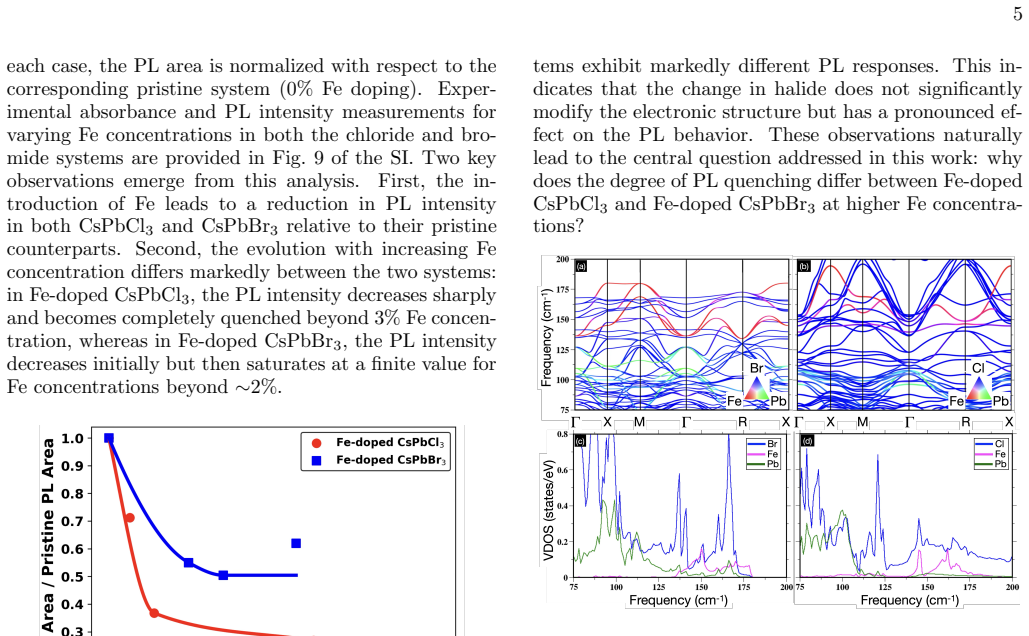
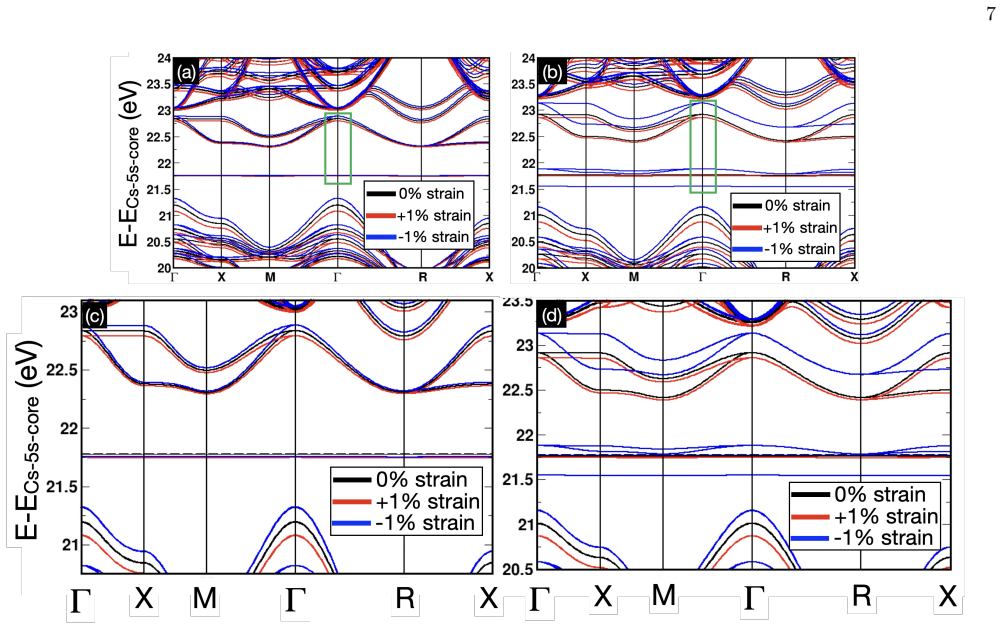
Spin-polarized density functional theory calculations establish that Fe 3d midgap states create efficient electron-trapping centers driving nonradiative recombination in Fe-doped CsPbX3. While electronic structure and phonon calculations yield nearly identical results for X = Cl and Br, electron-phonon coupling strengths computed via the deformation potential approach are significantly larger in the chloride, enabling complete dissipation of electronic excitation energy into lattice vibrations and thus total photoluminescence quenching, in contrast to the finite saturated intensity retained by the bromide.
What carries the argument
Deformation-potential electron-phonon coupling, which measures the interaction between electronic states and lattice vibrations to quantify nonradiative energy dissipation rates.
If this is right
- Electron-phonon coupling, rather than the presence of midgap states alone, determines whether doping leads to complete or partial PL quenching.
- The difference between Cl and Br arises from halide-specific lattice responses to Fe-induced distortions.
- Design of doped halide perovskites for light emission must account for electron-phonon coupling strengths in addition to defect levels.
- Similar halide-dependent behavior may occur with other transition-metal dopants in these perovskites.
Where Pith is reading between the lines
- Measuring the actual relaxation dynamics or coupling constants experimentally in these doped systems would test the deformation potential predictions.
- Engineering the perovskite lattice to reduce coupling, for example by compositional tuning, could potentially recover emission in the chloride.
- Extending this analysis to other halides or mixed compositions might reveal a trend in coupling strength with halide ion size or mass.
Load-bearing premise
The deformation potential approximation suffices to capture the essential differences in electron-phonon coupling between the two doped materials.
What would settle it
An experimental determination showing comparable electron-phonon coupling strengths or nonradiative rates in Fe-doped CsPbCl3 and CsPbBr3 would contradict the explanation for the differing PL behaviors.
Figures
read the original abstract
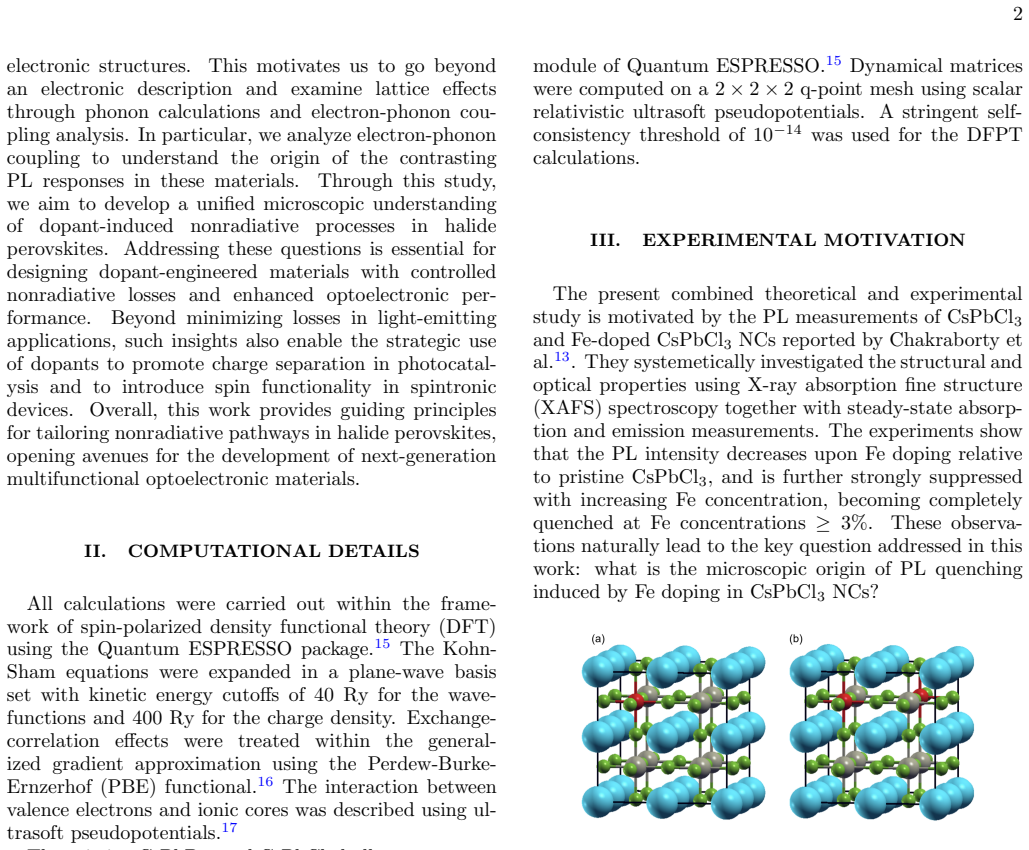
Understanding the impact of transition-metal doping on the optoelectronic properties of halide perovskite nanocrystals is essential for their rational design in photonic applications. We establish the microscopic origin of photoluminescence (PL) quenching in Fe-doped CsPbCl$_3$ using spin-polarized density functional theory calculations. The emergence of Fe 3$d$ midgap states creates efficient electron-trapping centres that drive nonradiative recombination, accounting for the reduced PL intensity. Extending this analysis to Fe-doped CsPbX$_3$ (X = Cl, Br), we show experimentally that although PL intensity is suppressed in both systems relative to their pristine counterparts, their high-doping behaviour diverges: CsPbCl$_3$ becomes completely non-emissive, whereas CsPbBr$_3$ retains a finite, saturated PL intensity. Despite this contrast, electronic structure calculations reveal nearly identical midgap states in both materials, indicating that electronic effects alone cannot explain the distinct PL responses. Phonon calculations likewise fail to capture this difference. In contrast, electron-phonon coupling calculations based on the deformation potential approach reveal significantly stronger coupling in Fe-doped CsPbCl$_3$, enabling efficient dissipation of electronic excitation energy into lattice vibrations and leading to complete PL quenching. These results identify electron-phonon coupling as the key factor governing halide-dependent PL quenching and provide a unified microscopic framework for dopant-induced nonradiative processes in halide perovskites.
Editorial analysis
A structured set of objections, weighed in public.
Referee Report
Summary. The manuscript uses spin-polarized DFT to show that Fe doping introduces similar midgap Fe 3d states in CsPbCl3 and CsPbBr3, creating electron traps that reduce PL intensity in both. While electronic structure and standard phonon calculations do not distinguish the halides, electron-phonon coupling computed via the deformation-potential approach is reported to be significantly stronger in the Cl compound, enabling efficient non-radiative dissipation and complete PL quenching, in contrast to the finite saturated PL retained in Br.
Significance. If the central claim holds, the work supplies a microscopic rationale for the observed halide-dependent PL response to Fe doping and positions electron-phonon coupling (rather than the midgap states themselves) as the decisive factor in dopant-induced non-radiative recombination in halide perovskites.
major comments (2)
- [Electron-phonon coupling analysis (following the phonon calculations section)] The central claim that deformation-potential EPC calculations alone account for the complete versus partial quenching rests on the transferability of this approximation to localized midgap Fe 3d states and to the relevant phonon modes. The manuscript should explicitly justify why a method conventionally applied to delocalized band-edge carriers and acoustic phonons remains reliable here, and should report the numerical EPC values, the precise definition of the deformation potential, and any convergence tests with respect to supercell size or functional choice.
- [Phonon calculations paragraph] The statement that 'phonon calculations likewise fail to capture this difference' is load-bearing for elevating EPC as the distinguishing mechanism. The manuscript must specify the phonon calculation protocol (e.g., finite-displacement vs. DFPT, harmonic vs. anharmonic, supercell size) and the quantitative metric by which the Cl/Br contrast is judged absent, so that readers can assess whether the EPC result is an independent prediction or an alternative that happens to fit the experimental trend.
minor comments (2)
- [Methods / Computational details] The abstract and main text should state the DFT functional, plane-wave cutoff, k-point sampling, and supercell size used for the electronic-structure and EPC calculations; these details are required to evaluate the reliability of the reported midgap-state positions and coupling strengths.
- [Experimental results section] Figure captions or the text should clarify whether the experimental PL data are normalized to the same excitation conditions and doping levels when comparing the saturated intensities of the two halides.
Simulated Author's Rebuttal
We thank the referee for the constructive and detailed comments on our manuscript. We address each major comment below and indicate where revisions will be made to improve clarity and rigor.
read point-by-point responses
-
Referee: The central claim that deformation-potential EPC calculations alone account for the complete versus partial quenching rests on the transferability of this approximation to localized midgap Fe 3d states and to the relevant phonon modes. The manuscript should explicitly justify why a method conventionally applied to delocalized band-edge carriers and acoustic phonons remains reliable here, and should report the numerical EPC values, the precise definition of the deformation potential, and any convergence tests with respect to supercell size or functional choice.
Authors: We agree that the manuscript would be strengthened by an explicit discussion of the method's applicability to localized defect states. In the revised version we will add a dedicated paragraph justifying the use of the deformation-potential approach for Fe 3d midgap states, referencing prior applications to defect levels in perovskites. We will also report the numerical EPC values obtained in our calculations, state the precise definition employed (deformation potential as the strain derivative of the midgap-state energy), and include convergence tests with respect to supercell size and functional choice. These additions will directly address the concern regarding transferability. revision: yes
-
Referee: The statement that 'phonon calculations likewise fail to capture this difference' is load-bearing for elevating EPC as the distinguishing mechanism. The manuscript must specify the phonon calculation protocol (e.g., finite-displacement vs. DFPT, harmonic vs. anharmonic, supercell size) and the quantitative metric by which the Cl/Br contrast is judged absent, so that readers can assess whether the EPC result is an independent prediction or an alternative that happens to fit the experimental trend.
Authors: The referee is correct that the phonon-calculation details are currently underspecified. We will revise the manuscript to state the protocol used (finite-displacement method within the harmonic approximation in a 2×2×2 supercell) and the quantitative metric applied (comparison of phonon frequencies and densities of states between the Cl and Br compounds, which showed no differences large enough to account for the observed PL contrast). This will allow readers to evaluate the independence of the EPC result. revision: yes
Circularity Check
No significant circularity; derivation is self-contained from DFT inputs
full rationale
The paper computes electronic structures via spin-polarized DFT, finds nearly identical midgap Fe 3d states for both halides, notes that standard phonon calculations do not capture the contrast, then applies the deformation-potential approach to obtain a computed EPC difference as an output. No parameter is fitted to the PL quenching data and then re-used as a 'prediction'; no self-citation chain justifies the central claim; the deformation-potential method is invoked as a standard computational technique rather than an ansatz smuggled from prior self-work. The final halide-dependent PL contrast therefore emerges from the calculation rather than being presupposed by construction.
Axiom & Free-Parameter Ledger
Reference graph
Works this paper leans on
-
[1]
Q. Wang, M. Lyu, M. Zhang, J.-H. Yun, H. Chen, and L. Wang, Transition from the tetragonal to cubic phase of organohalide perovskite: the role of chlorine in crystal 9 formation of CH 3NH3PbI3 on TiO 2 substrates, J. Phys. Chem. Lett.6, 4379 (2015)
2015
-
[2]
Kulbak, S
M. Kulbak, S. Gupta, N. Kedem, I. Levine, T. Bendikov, G. Hodes, and D. Cahen, Cesium enhances long-term stability of lead bromide perovskite-based solar cells, J. Phys. Chem. Lett.7, 167 (2016)
2016
-
[3]
Zheng, C
X. Zheng, C. Wu, S. K. Jha, Z. Li, K. Zhu, and S. Priya, Improved phase stability of formamidinium lead triiodide perovskite by strain relaxation, ACS Energy Lett.1, 1014 (2016)
2016
-
[4]
Parobek, B
D. Parobek, B. J. Roman, Y. Dong, H. Jin, E. Lee, M. Sheldon, and D. H. Son, Exciton-to-dopant en- ergy transfer in Mn-doped cesium lead halide perovskite nanocrystals, Nano Lett.16, 7376 (2016)
2016
-
[5]
W. Liu, Q. Lin, H. Li, K. Wu, I. Robel, J. M. Pietryga, and V. I. Klimov, Mn2+-doped lead halide per- ovskite nanocrystals with dual-color emission controlled by halide content, J. Am. Chem. Soc.138, 14954 (2016)
2016
-
[6]
Y. Hu, T. Qiu, F. Bai, X. Miao, and S. Zhang, Enhanc- ing moisture-tolerance and photovoltaic performances of FAPbI3 by bismuth incorporation, J. Mater. Chem.5, 25258 (2017)
2017
-
[7]
D. Bai, J. Zhang, Z. Jin, H. Bian, K. Wang, H. Wang, L. Liang, Q. Wang, and S. F. Liu, Intersti- tial Mn2+-driven high-aspect-ratio grain growth for low- trap-density microcrystalline films for record efficiency CsPbI2Br solar cells, ACS Energy Lett.3, 970 (2018)
2018
-
[8]
J.-S. Yao, J. Ge, B.-N. Han, K.-H. Wang, H.-B. Yao, H.-L. Yu, J.-H. Li, B.-S. Zhu, J.-Z. Song, C. Chen, et al., Ce 3+-doping to modulate photoluminescence ki- netics for efficient CsPbBr 3 nanocrystals based light- emitting diodes, J. Am. Chem. Soc.140, 3626 (2018)
2018
-
[9]
A. Amo, T. Liew, C. Adrados, R. Houdr´ e, E. Giacobino, A. Kavokin, and A. Bramati, Exciton–polariton spin switches, Nat. Photon.4, 361 (2010)
2010
-
[10]
Pradhan, S
N. Pradhan, S. Das Adhikari, A. Nag, and D. D. Sarma, Luminescence, plasmonic, and magnetic properties of doped semiconductor nanocrystals, Angew. Chem. Int. Ed.56, 7038 (2017)
2017
-
[11]
Fainblat, C
R. Fainblat, C. J. Barrows, and D. R. Gamelin, Single magnetic impurities in colloidal quantum dots and magic- size clusters, Chem. Mater.29, 8023 (2017)
2017
-
[12]
Makkar, L
M. Makkar, L. Dheer, A. Singh, L. Moretti, M. Maiuri, S. Ghosh, G. Cerullo, U. V. Waghmare, and R. Viswanatha, Magneto-optical Stark effect in Fe-doped CdS nanocrystals, Nano Lett.21, 3798 (2021)
2021
-
[13]
Chakraborty, P
S. Chakraborty, P. Mandal, and R. Viswanatha, Pho- toluminescence Quenching in CsPbCl 3 upon Fe Doping: Colloidal Synthesis, Structural and Optical Properties, Chemistry–An Asian Journal17, e202200478 (2022)
2022
-
[14]
Shyamal, S
S. Shyamal, S. K. Dutta, and N. Pradhan, Doping iron in CsPbBr3 perovskite nanocrystals for efficient and prod- uct selective CO 2 reduction, J. Phys. Chem. Lett.10, 7965 (2019)
2019
-
[15]
Giannozzi, S
P. Giannozzi, S. Baroni, N. Bonini, M. Calandra, R. Car, C. Cavazzoni, D. Ceresoli, G. L. Chiarotti, M. Cococ- cioni, I. Dabo,et al., QUANTUM ESPRESSO: a modu- lar and open-source software project for quantum simula- tions of materials, J. Phys.: Condens. Matter21, 395502 (2009)
2009
-
[16]
J. P. Perdew, K. Burke, and M. Ernzerhof, Generalized gradient approximation made simple, Phys. Rev. Lett. 77, 3865 (1996)
1996
-
[17]
Vanderbilt, Soft self-consistent pseudopotentials in a generalized eigenvalue formalism, Phys
D. Vanderbilt, Soft self-consistent pseudopotentials in a generalized eigenvalue formalism, Phys. Rev. B41, 7892 (1990)
1990
-
[18]
C. G. Broyden, J. E. Dennis Jr, and J. J. Mor´ e, On the local and superlinear convergence of quasi-newton meth- ods, IMA J. Appl. Math.12, 223 (1973)
1973
-
[19]
Fletcher, A new approach to variable metric algo- rithms, Comput
R. Fletcher, A new approach to variable metric algo- rithms, Comput. J.13, 317 (1970)
1970
-
[20]
Goldfarb, A family of variable-metric methods derived by variational means, Math
D. Goldfarb, A family of variable-metric methods derived by variational means, Math. Comput.24, 23 (1970)
1970
-
[21]
D. F. Shanno, Conditioning of quasi-Newton methods for function minimization, Math. Comput.24, 647 (1970)
1970
-
[22]
H. J. Monkhorst and J. D. Pack, Special points for Brillouin-zone integrations, Phys. Rev. B13, 5188 (1976)
1976
-
[23]
Marzari, D
N. Marzari, D. Vanderbilt, A. De Vita, and M. C. Payne, Thermal Contraction and Disordering of the Al(110) Sur- face, Phys. Rev. Lett.82, 3296 (1999)
1999
-
[24]
Grote, B
C. Grote, B. Ehrlich, and R. F. Berger, Tuning the near- gap electronic structure of tin-halide and lead-halide per- ovskites via changes in atomic layering, Phys. Rev. B90, 205202 (2014)
2014
-
[25]
G. S. Rohrer,Structure and bonding in crystalline mate- rials(Cambridge University Press, 2001)
2001
-
[26]
K. Gesi, K. Ozawa, and S. Hirotsu, Effect of hydrostatic pressure on the structural phase transitions in CsPbCl 3 and CsPbBr3, J. Phys. Soc. Japan.38, 463 (1975)
1975
-
[27]
X. Gong, O. Voznyy, A. Jain, W. Liu, R. Sabatini, Z. Piontkowski, G. Walters, G. Bappi, S. Nokhrin, O. Bushuyev,et al., Electron–phonon interaction in ef- ficient perovskite blue emitters, Nat. Mater.17, 550 (2018)
2018
-
[28]
M. Mehl, J. Osburn, D. Papaconstantopoulos, and B. Klein, Structural properties of ordered high-melting- temperature intermetallic alloys from first-principles total-energy calculations, Phys. Rev. B41, 10311 (1990)
1990
-
[29]
Bardeen and W
J. Bardeen and W. Shockley, Deformation potentials and mobilities in non-polar crystals, Phys. Rev.80, 72 (1950)
1950
discussion (0)
Sign in with ORCID, Apple, or X to comment. Anyone can read and Pith papers without signing in.