Tunable Rashba Splitting in Janus InXPbP (X = S, Se, Te) Monolayers for Enhanced Photocatalytic Water Splitting
Pith reviewed 2026-06-28 05:34 UTC · model grok-4.3
The pith
Janus InXPbP monolayers show tunable Rashba splitting and achieve up to 29.83% solar-to-hydrogen efficiency.
A machine-rendered reading of the paper's core claim, the machinery that carries it, and where it could break.
Core claim
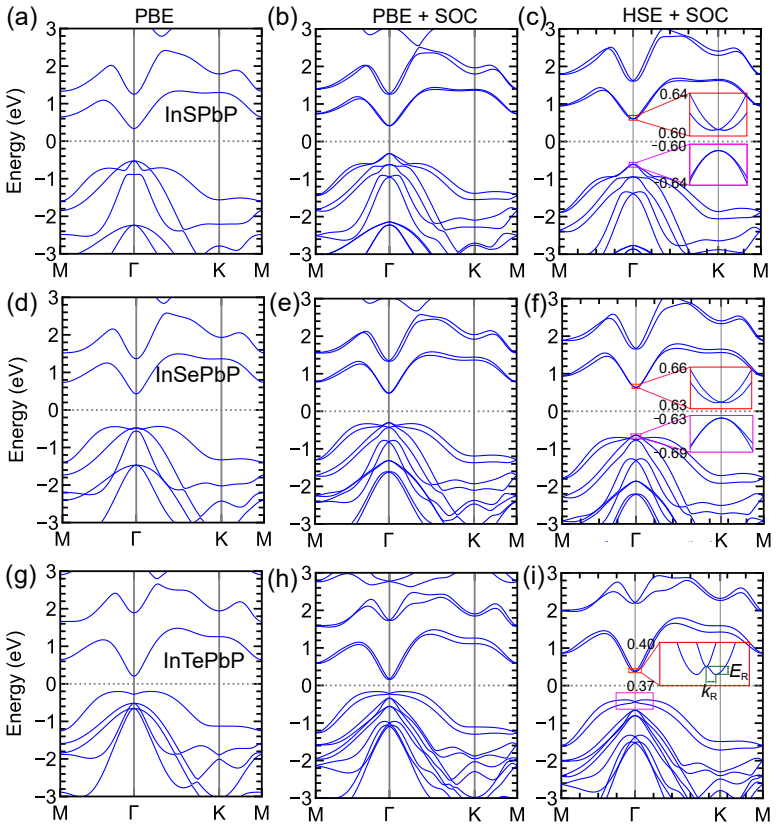
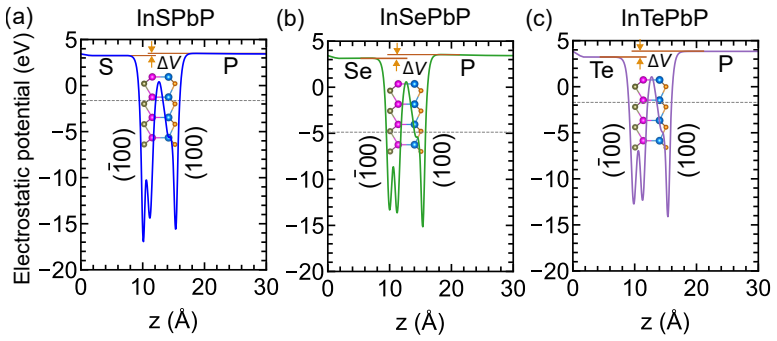
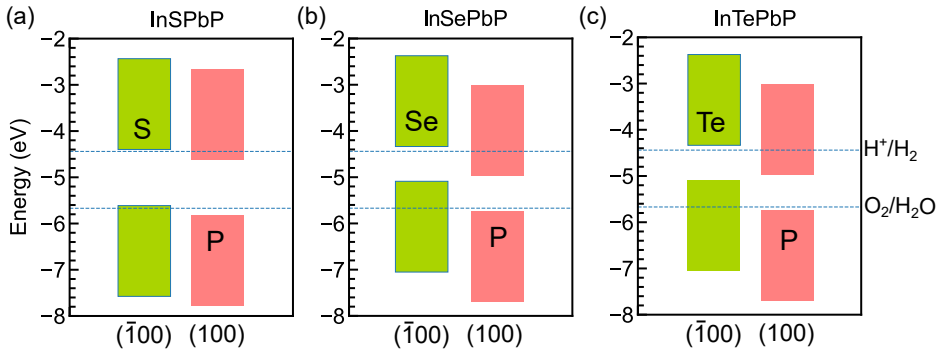
All three InXPbP monolayers are energetically, dynamically, and mechanically stable. By varying the chalcogen atom, the Rashba effect can be tuned, with InTePbP showing giant Rashba spin splitting near both the conduction-band minimum and valence-band maximum with parameters of 0.90 and 0.87 eV Å. The materials have band gaps of 1.21, 1.27, and 0.76 eV that are favorable for photocatalytic applications, possess suitable band-edge alignments for overall water splitting, and yield solar-to-hydrogen efficiencies of 21.67%, 26.03%, and 29.83%.
What carries the argument
The Janus structure inducing Rashba spin splitting, tuned by choice of chalcogen atom X, which controls the magnitude of spin-orbit coupling effects at the band edges for both spintronic and photocatalytic uses.
If this is right
- Varying the chalcogen atom tunes the Rashba parameters from 0.16 eV Å in InSPbP to 0.90 eV Å in InTePbP near the conduction band minimum.
- All three materials have band gaps and alignments suitable for overall photocatalytic water splitting under solar illumination.
- Solar-to-hydrogen conversion efficiencies reach 21.67%, 26.03%, and 29.83% for the S, Se, and Te variants respectively.
- The monolayers are stable and enrich the family of Janus 2D materials for combined spintronic and photocatalytic device applications.
Where Pith is reading between the lines
- If the predicted stabilities hold, these monolayers could be experimentally synthesized using methods like chemical vapor deposition to test the efficiencies.
- The giant Rashba splitting in InTePbP suggests potential for spintronic devices that operate at higher temperatures than materials with smaller splitting.
- Combining the photocatalytic and spintronic properties could lead to devices that use spin-polarized carriers to enhance water-splitting performance.
- Similar tuning strategies by chalcogen substitution might apply to other Janus 2D materials to further optimize their Rashba and photocatalytic metrics.
Load-bearing premise
The first-principles calculations accurately predict the electronic band gaps, band-edge positions and Rashba parameters without significant errors arising from the choice of exchange-correlation functional or other computational settings.
What would settle it
Experimental synthesis of the InXPbP monolayers followed by direct measurement of their solar-to-hydrogen conversion efficiency or confirmation of the predicted band-edge alignments and Rashba parameters.
Figures
read the original abstract
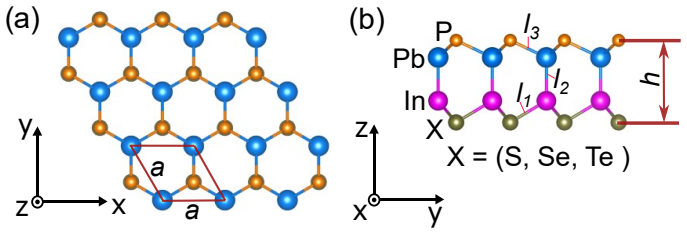
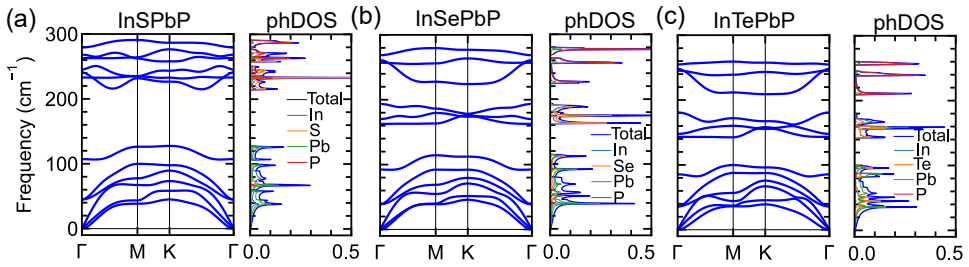
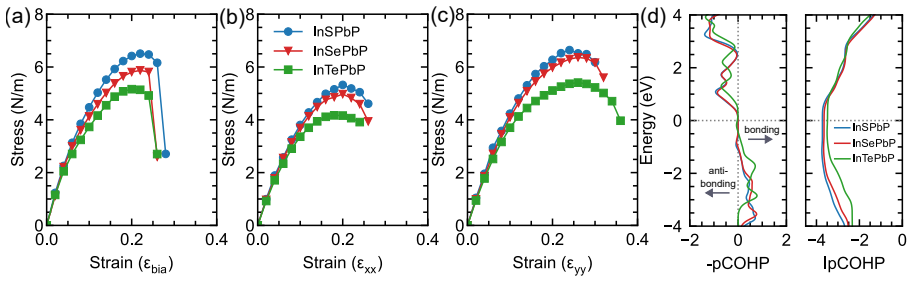
Janus two-dimensional (2D) materials exhibiting Rashba spin splitting have recently attracted considerable attention owing to their potential applications in spintronic devices and photocatalytic water splitting. In this work, we investigate, using first-principles calculations, the structural, mechanical, electronic, optical, and photocatalytic properties of Janus InXPbP (X = S, Se, Te) monolayers that exhibit significant Rashba effects. Our results demonstrate that all three monolayers are energetically, dynamically, and mechanically stable, as evidenced by cohesive energy calculations, phonon dispersion analysis, and elastic constants. By varying the chalcogen atom (X = S, Se, Te), the Rashba effect in InXPbP can be effectively tuned. Rashba parameters of 0.16 and 0.20 eV\r{A} are obtained near the conduction-band minimum (CBM) for InSPbP and InSePbP, respectively, whereas InTePbP exhibits giant Rashba spin splitting near both the CBM and valence-band maximum (VBM), with corresponding Rashba parameters of 0.90 and 0.87 eV\r{A}. Furthermore, the Janus InXPbP monolayers exhibit suitable band gaps of 1.21, 1.27, and 0.76 eV for InSPbP, InSePbP, and InTePbP, respectively, which are favorable for photocatalytic applications. All three monolayers possess suitable band-edge alignments for overall water splitting, yielding solar-to-hydrogen (STH) conversion efficiencies of 21.67%, 26.03%, and 29.83% for InSPbP, InSePbP, and InTePbP, respectively. Our findings not only enrich the family of Janus materials but also suggest that the Janus InXPbP monolayers are promising candidates for spintronic devices and high-performance photocatalytic water-splitting applications.
Editorial analysis
A structured set of objections, weighed in public.
Referee Report
Summary. The manuscript uses first-principles calculations to examine Janus InXPbP (X = S, Se, Te) monolayers, reporting energetic/dynamical/mechanical stability, tunable Rashba spin splitting (parameters 0.16–0.90 eV Å), band gaps of 1.21/1.27/0.76 eV, band-edge alignments suitable for overall water splitting, and solar-to-hydrogen efficiencies of 21.67/26.03/29.83%.
Significance. If the electronic-structure results hold, the work would add three stable 2D Janus candidates with sizable Rashba splitting and competitive STH metrics to the literature on spintronic-photocatalytic materials. The tunability with chalcogen substitution and the reported efficiencies above 20% would be the primary contributions.
major comments (2)
- [Abstract / Electronic and Photocatalytic Properties] Abstract and electronic/photocatalytic results section: the 0.76 eV gap reported for InTePbP lies below the 1.23 eV thermodynamic minimum for overall water splitting, yet the text asserts suitable band-edge alignments and derives an STH efficiency of 29.83%. No justification is given for how the CBM/VBM positions enable the reaction, nor are hybrid-functional or GW corrections supplied to test whether the gap and alignments remain viable.
- [Methods / Results] Computational details (throughout): the manuscript provides no information on the exchange-correlation functional, plane-wave cutoff, k-mesh density, vacuum spacing, or convergence thresholds. Because all quantitative claims (gaps, Rashba parameters, band alignments, and STH values) are direct outputs of these calculations, the absence of this information prevents assessment of the reliability of the central photocatalytic conclusions.
minor comments (2)
- [Abstract] Abstract: the Rashba parameters are written as “0.16 and 0.20 eV\r{A}”; the unit notation contains a LaTeX artifact and should be rendered as eV Å.
- [Abstract] Abstract: the STH efficiencies are quoted to two decimal places without accompanying sensitivity analysis or error estimates arising from the underlying DFT settings.
Simulated Author's Rebuttal
We thank the referee for the constructive comments, which help improve the manuscript. We address each major point below and will revise the manuscript to enhance clarity, completeness, and scientific rigor.
read point-by-point responses
-
Referee: [Abstract / Electronic and Photocatalytic Properties] Abstract and electronic/photocatalytic results section: the 0.76 eV gap reported for InTePbP lies below the 1.23 eV thermodynamic minimum for overall water splitting, yet the text asserts suitable band-edge alignments and derives an STH efficiency of 29.83%. No justification is given for how the CBM/VBM positions enable the reaction, nor are hybrid-functional or GW corrections supplied to test whether the gap and alignments remain viable.
Authors: The referee correctly identifies that the 0.76 eV gap for InTePbP falls below the 1.23 eV thermodynamic threshold for overall water splitting, creating an inconsistency with the claims of suitable alignments and the reported STH efficiency. Our PBE calculations show band edges that appear to straddle the redox potentials, but we acknowledge this may not hold under more accurate methods and lacks explicit justification in the text. In revision, we will add a table or figure with explicit CBM/VBM positions versus vacuum and the standard hydrogen electrode, include HSE06 hybrid-functional calculations for all three systems to reassess gaps and alignments, and either qualify or remove the photocatalytic claims for InTePbP if the corrected results do not support them. The STH values will be updated or restricted accordingly. revision: yes
-
Referee: [Methods / Results] Computational details (throughout): the manuscript provides no information on the exchange-correlation functional, plane-wave cutoff, k-mesh density, vacuum spacing, or convergence thresholds. Because all quantitative claims (gaps, Rashba parameters, band alignments, and STH values) are direct outputs of these calculations, the absence of this information prevents assessment of the reliability of the central photocatalytic conclusions.
Authors: We apologize for the oversight; the computational parameters were omitted from the submitted manuscript. The calculations were performed with the PBE functional, a plane-wave cutoff of 500 eV, a 9 imes9 imes1 k-mesh, 20 Å vacuum spacing, and convergence thresholds of 10^{-5} eV for energy and 0.01 eV/Å for forces. In the revised manuscript we will insert a complete 'Computational Methods' subsection listing all parameters, software version, and convergence tests so that the reliability of the reported gaps, Rashba parameters, alignments, and STH efficiencies can be fully evaluated. revision: yes
Circularity Check
No significant circularity; results are direct DFT outputs
full rationale
The paper reports structural stability, Rashba parameters, band gaps, alignments, and STH efficiencies as outputs of first-principles calculations. No equations, fitted parameters, or self-citations reduce any central claim to its own inputs by construction; the quantities are computed results rather than self-referential definitions or renamed fits.
Axiom & Free-Parameter Ledger
free parameters (1)
- Exchange-correlation functional and convergence parameters
axioms (2)
- domain assumption Absence of imaginary phonon frequencies and positive elastic constants imply dynamical and mechanical stability
- domain assumption DFT-computed band-edge positions relative to vacuum can be compared directly to water redox potentials
Reference graph
Works this paper leans on
-
[1]
2022 , number =
Biswas, Kanishka and Ren, Zhifeng and Grin, Yuri and Lee, Kyu Hyoung and Mori, Takao and Chen, Lidong , journal =. 2022 , number =
2022
-
[2]
2013 , number =
Heremans, Joseph P and Dresselhaus, Mildred S and Bell, Lon E and Morelli, Donald T , journal =. 2013 , number =
2013
-
[3]
2009 , number =
Vining, Cronin B , journal =. 2009 , number =
2009
-
[4]
2010 , volume =
Goldsmid, H Julian and others , publisher =. 2010 , volume =
2010
-
[5]
Energy Environ
Enhancement of thermoelectric figure-of-merit by resonant states of aluminium doping in lead selenide , author=. Energy Environ. Sci. , volume=. 2012 , publisher=
2012
-
[6]
Janus 2D B _
Van Thanh, Vuong and Hung, Nguyen Tuan and others , journal=. Janus 2D B _. 2024 , publisher=
2024
-
[7]
Soviet physics
Resonant scattering of carriers in IV-VI semiconductors , author=. Soviet physics. Semiconductors , volume=
-
[8]
Chemical doping of organic semiconductors for thermoelectric applications , author=. Chem. Soc. Rev. , volume=. 2020 , publisher=
2020
-
[9]
1993 , volume =
Hicks, LD and Dresselhaus, MS , journal =. 1993 , volume =
1993
-
[10]
2007 , number =
Dresselhaus, Mildred S and Chen, Gang and Tang, Ming Y and Yang, RG and Lee, Hohyun and Wang, DZ and Ren, ZF and Fleurial, J-P and Gogna, Pawan , journal =. 2007 , number =
2007
-
[11]
2016 , publisher=
Hung, Nguyen T and Hasdeo, Eddwi H and Nugraha, Ahmad RT and Dresselhaus, Mildred S and Saito, Riichiro , journal=. 2016 , publisher=
2016
-
[12]
2021 , publisher=
Hung, Nguyen T and Saito, Riichiro , journal=. 2021 , publisher=
2021
-
[13]
Convergence of multi-valley bands as the electronic origin of high thermoelectric performance in CoSb _3 skutterudites , author=. Nat. Mater , volume=. 2015 , publisher=
2015
-
[14]
Hung, Nguyen and Nugraha, Ahmad RT and Yang, Teng and Zhang, Zhidong and Saito, Riichiro , journal =
T. Hung, Nguyen and Nugraha, Ahmad RT and Yang, Teng and Zhang, Zhidong and Saito, Riichiro , journal =. 2019 , number =
2019
-
[15]
Nano Energy , volume=
One-dimensional thermoelectrics induced by Rashba spin-orbit coupling in two-dimensional BiSb monolayer , author=. Nano Energy , volume=. 2018 , publisher=
2018
-
[16]
Nano Energy , volume=
Nontrivial thermoelectric behavior in cubic SnSe driven by spin-orbit coupling , author=. Nano Energy , volume=. 2018 , publisher=
2018
-
[17]
Improved thermoelectric performance in PbSe--AgSbSe _
Duan, Sichen and Wang, Hongxiang and Liu, Guo-Qiang and Wu, Qingsong and Man, Na and Zhang, Qiang and Tan, Xiaojian and Yin, Yinong and Xiao, Yukun and Hu, Haoyang and others , journal=. Improved thermoelectric performance in PbSe--AgSbSe _. 2020 , publisher=
2020
-
[18]
Spin orbit coupling induced enhancement of thermoelectric performance of HfX _
Bera, Jayanta and Betal, Atanu and Sahu, Satyajit , journal=. Spin orbit coupling induced enhancement of thermoelectric performance of HfX _. 2021 , publisher=
2021
-
[19]
Thermoelectric transport properties in Janus Rashba semiconductors of monolayer Si _
Xia, Qiong and Xu, Zhiyuan and Zhang, Long and Gao, Guoying , journal=. Thermoelectric transport properties in Janus Rashba semiconductors of monolayer Si _. 2024 , publisher=
2024
-
[20]
Molecular dynamics simulations of lattice thermal conductivity of bismuth telluride using two-body interatomic potentials , author=. Phys. Rev. B Condens. Matter , volume=. 2009 , publisher=
2009
-
[21]
Energy Environ
High thermoelectric figure of merit in heavy hole dominated PbTe , author=. Energy Environ. Sci. , volume=. 2011 , publisher=
2011
-
[22]
What dictates Rashba splitting in 2D van der Waals heterobilayers , author=. J. Am. Chem. Soc. , volume=. 2021 , publisher=
2021
-
[23]
Emergence of electric polarity in BiTeX (X= Br and I) monolayers and the giant Rashba spin splitting , author=. Phys. Chem. Chem. , volume=. 2014 , publisher=
2014
-
[24]
Nanotechnol
Thermal transport characterization of Stanene/Silicene heterobilayer and stanene bilayer nanostructures , author=. Nanotechnol. , volume=. 2018 , publisher=
2018
-
[25]
Excellent thermoelectric performance induced by interface effect in MoS _
Jia, Pin-Zhen and Zeng, Yu-Jia and Wu, Dan and Pan, Hui and Cao, Xuan-Hao and Zhou, Wu-Xing and Xie, Zhong-Xiang and Zhang, Ji-Xu and Chen, Ke-Qiu , journal=. Excellent thermoelectric performance induced by interface effect in MoS _. 2019 , publisher=
2019
-
[26]
Nanoscale , volume=
Superhigh out-of-plane piezoelectricity, low thermal conductivity and photocatalytic abilities in ultrathin 2D van der Waals heterostructures of boron monophosphide and gallium nitride , author=. Nanoscale , volume=. 2019 , publisher=
2019
-
[27]
Surprisingly good thermoelectric performance of a black phosphorus/blue phosphorus van der Waals heterostructure , author=. Phys. Chem. Chem. Phys. , volume=. 2020 , publisher=
2020
-
[28]
Strongly anisotropic in-plane thermal transport in single-layer black phosphorene , author=. Sci. Rep. , volume=. 2015 , publisher=
2015
-
[29]
Nanoscale , volume=
Phonons and thermal conducting properties of borocarbonitride (BCN) nanosheets , author=. Nanoscale , volume=. 2018 , publisher=
2018
-
[30]
ACS Nano , volume=
Thermal conductivity of monolayer molybdenum disulfide obtained from temperature-dependent Raman spectroscopy , author=. ACS Nano , volume=. 2014 , publisher=
2014
-
[31]
Enhanced exciton diffusion from interlayer charge-transfer transitions in PtSe _
Wang, Jiarong and He, Dawei and Bai, Zhiying and Li, Guili and Bai, Jinxuan and Liu, Keqin and Ren, Fangying and Liu, Xiaojing and He, Jiaqi and Zhou, Weiya and others , journal=. Enhanced exciton diffusion from interlayer charge-transfer transitions in PtSe _. 2023 , publisher=
2023
-
[32]
Giannozzi, Paolo and Baroni, Stefano and Bonini, Nicola and Calandra, Matteo and Car, Roberto and Cavazzoni, Carlo and Ceresoli, Davide and Chiarotti, Guido L and Cococcioni, Matteo and Dabo, Ismaila and others , title =. J. Phys. Condens. Matter. , year =
-
[33]
Hung, Nguyen T and Nugraha, Ahmad RT and Saito, Riichiro , year=
-
[34]
Optimized norm-conserving Vanderbilt pseudopotentials , author=. Phys. Rev. B - Condens. Matter Mater. Phys. , volume=. 2013 , publisher=
2013
-
[35]
Perdew, John P and Burke, Kieron and Ernzerhof, Matthias , title =. Phys. Rev. Lett. , year =
-
[36]
2003 , number =
Heyd, Jochen and Scuseria, Gustavo E and Ernzerhof, Matthias , journal =. 2003 , number =
2003
-
[37]
2014 , number =
Mostofi, Arash A and Yates, Jonathan R and Pizzi, Giovanni and Lee, Young-Su and Souza, Ivo and Vanderbilt, David and Marzari, Nicola , journal =. 2014 , number =
2014
-
[38]
2001 , publisher=
Baroni, Stefano and De Gironcoli, Stefano and Dal Corso, Andrea and Giannozzi, Paolo , journal=. 2001 , publisher=
2001
-
[39]
Dispersion-corrected mean-field electronic structure methods , author=. Chem. Rev. , volume=. 2016 , publisher=
2016
-
[40]
1992 , number =
Martyna, Glenn J and Klein, Michael L and Tuckerman, Mark , journal =. 1992 , number =
1992
-
[41]
2014 , publisher=
Pizzi, Giovanni and Volja, Dmitri and Kozinsky, Boris and Fornari, Marco and Marzari, Nicola , journal=. 2014 , publisher=
2014
-
[42]
Li, Wu and Carrete, Jes. Comput. Phys. Commun. , title =. 2014 , number =
2014
-
[43]
A grid-based Bader analysis algorithm without lattice bias , author=. J. Phys.: Condens. Matter , volume=. 2009 , publisher=
2009
-
[44]
Stacking impact on the optical and electronic properties of two-dimensional MoSe _
Almayyali, Ali Obies Muhsen and Kadhim, Bahjat B and Jappor, Hamad Rahman , journal=. Stacking impact on the optical and electronic properties of two-dimensional MoSe _. 2020 , publisher=
2020
-
[45]
A type-II PtS _
Yin, Shaoqian and Luo, Qingqing and Wei, Dong and Guo, Gaofu and Sun, Xiaoxin and Tang, Yanan and Dai, Xianqi , journal=. A type-II PtS _. 2022 , publisher=
2022
-
[46]
and Coudert, F
Mouhat, F. and Coudert, F. , title =. Phys. Rev. B , year =
-
[47]
2017 , number =
Hung, Nguyen T and Nugraha, Ahmad RT and Saito, Riichiro , journal =. 2017 , number =
2017
-
[48]
2023 , publisher=
Thanh, Vuong Van and Truong, Do Van and Tuan Hung, Nguyen , journal=. 2023 , publisher=
2023
-
[49]
First-principles calculations of 2D Janus WSSiN _
Yuan, Gang and Ma, Xinguo and Liao, Jiajun and Xie, Tian and Xie, Qihai and Yuan, Zhongyong , journal=. First-principles calculations of 2D Janus WSSiN _. 2023 , publisher=
2023
-
[50]
Luo, Yi and Sun, Minglei and Yu, Jin and Schwingenschlogl, Udo , journal=. Pd _. 2021 , publisher=
2021
-
[51]
What limits the intrinsic mobility of electrons and holes in two dimensional metal dichalcogenides? , author=. J. Am. Chem. Soc. , volume=. 2018 , publisher=
2018
-
[52]
Hung, Nguyen T and Nugraha, Ahmad RT and Saito, Riichiro , title =. J. Phys. D: Appl. Phys. , year =
-
[53]
Du, Juan and Song, Peng and Fang, Lizhen and Wang, Tianxing and Wei, Zhongming and Li, Jingbo and Xia, Congxin , title =. Appl. Surf. Sci. , year =
-
[54]
Charge-induced electromechanical actuation of Mo-and W-dichalcogenide monolayers , author=. RSC Adv. , volume=. 2018 , publisher=
2018
-
[55]
Li, Tianshu , title =
-
[56]
Nonlinear optical responses of Janus MoSSe/MoS _
Hung, Nguyen Tuan and Zhang, Kunyan and Van Thanh, Vuong and Guo, Yunfan and Puretzky, Alexander A and Geohegan, David B and Kong, Jing and Huang, Shengxi and Saito, Riichiro , journal=. Nonlinear optical responses of Janus MoSSe/MoS _. 2023 , publisher=
2023
-
[57]
Enhanced thermoelectric performance of phosphorene by strain-induced band convergence , author=. Phys. Rev. B. , volume=. 2014 , publisher=
2014
-
[58]
APL Mater
The van der Waals heterostructures of blue phosphorene with GaN/GeC for high-performance thermoelectric applications , author=. APL Mater. , volume=. 2025 , publisher=
2025
-
[59]
Modeling and computation of thermal and optical properties in silicene supported honeycomb bilayer and heterobilayer nanostructures , author=. Mater. Sci. Semicond. , volume=. 2021 , publisher=
2021
-
[60]
Designing Rashba systems for high thermoelectric performance based on the van der Waals heterostructure , author=. Mater. Today Phys. , volume=. 2022 , publisher=
2022
-
[61]
High thermoelectric performance of new two-dimensional IV--VI compounds: A first-principles study , author=. J. Phys. Chem. C , volume=. 2019 , publisher=
2019
-
[62]
Nano Energy , year =
Hung, Nguyen T and Nugraha, Ahmad RT and Saito, Riichiro , title =. Nano Energy , year =
-
[63]
2023 , publisher=
Hung, Nguyen Tuan , journal=. 2023 , publisher=
2023
-
[64]
ACS Appl
Interlayer Coupling Induced Phonon-Glass--Electron-Crystal Behavior in van der Waals Heterostructure PtSe _2 / -GeSe , author=. ACS Appl. Energy Mater. , volume=. 2022 , publisher=
2022
-
[65]
Cell Rep
Room-Temperature Thermoelectric Conversion by Dipole-Enhanced Rashba Spin-Orbit Coupling , author=. Cell Rep. Phys. Sci. , volume=. 2021 , publisher=
2021
-
[66]
Electronic, thermoelectric, transport and optical properties of MoSe _
Li, Yi and Feng, Zhen and Sun, Qian and Ma, Yaqiang and Tang, Yanan and Dai, Xianqi , journal=. Electronic, thermoelectric, transport and optical properties of MoSe _. 2021 , publisher=
2021
-
[67]
Dalton Trans
A cartography of the van der Waals territories , author=. Dalton Trans. , volume=. 2013 , publisher=
2013
-
[68]
Thermoelectric performance of Bi-based novel Janus monolayer structures , author=. Mater. Adv. , volume=. 2025 , publisher=
2025
-
[69]
Multiple-filled skutterudites: high thermoelectric figure of merit through separately optimizing electrical and thermal transports , author=. J. Am. Chem. Soc. , volume=. 2011 , publisher=
2011
-
[70]
2025 , publisher=
Bao, Nguyen Tran Gia and Trang, Ton Nu Quynh and Thoai, Nam and Phan, Thang Bach and Thu, Vu Thi Hanh and Tuan Hung, Nguyen , journal=. 2025 , publisher=
2025
-
[71]
2019 , publisher=
Dai, Zhaohe and Liu, Luqi and Zhang, Zhong , journal=. 2019 , publisher=
2019
-
[72]
Applied Physics Letters , volume=
Negative Poisson's ratio and anisotropic carrier mobility in ternary Janus Si 2 XY (X/Y= S, Se, Te): First-principles prediction , author=. Applied Physics Letters , volume=. 2023 , publisher=
2023
-
[73]
Advanced materials , volume=
Incipient metals: functional materials with a unique bonding mechanism , author=. Advanced materials , volume=. 2018 , publisher=
2018
-
[74]
ACS Applied Energy Materials , volume=
Strain Effect on Rashba Splitting and Phonon Scattering to Improve Thermoelectric Performance of 2D Heterobilayer MoTe2/PtS2 , author=. ACS Applied Energy Materials , volume=. 2025 , publisher=
2025
-
[75]
ACS Applied Energy Materials , volume=
Optical--Acoustic Phonon Hybridization Enhanced Thermoelectric Performance in a 1T′ Phase OsTe2 Monolayer , author=. ACS Applied Energy Materials , volume=. 2022 , publisher=
2022
-
[76]
RSC advances , volume=
A first-principles prediction of novel Janus T′-RuXY (X/Y= S, Se, Te) monolayers: structural properties and electronic structures , author=. RSC advances , volume=. 2022 , publisher=
2022
-
[77]
ACS omega , volume=
Theoretical Investigation of Stacked Two-Dimensional Transition-Metal Dichalcogenide Materials: The Role of Chemical Species and Number of Monolayers , author=. ACS omega , volume=. 2025 , publisher=
2025
-
[78]
The Journal of Physical Chemistry C , volume=
Two-dimensional -PdX2 (X= S, Se, and Te) monolayers with promising potential for thermoelectric applications , author=. The Journal of Physical Chemistry C , volume=. 2022 , publisher=
2022
-
[79]
ACS Applied Energy Materials , volume=
Highly In-Plane Anisotropic 2D-ZrGeTe4: A Promising Thermoelectric Material with a High Power Factor and Figure of Merit , author=. ACS Applied Energy Materials , volume=. 2025 , publisher=
2025
-
[80]
2016 , number =
Lang, Haifeng and Zhang, Shuqing and Liu, Zhirong , journal =. 2016 , number =
2016
discussion (0)
Sign in with ORCID, Apple, or X to comment. Anyone can read and Pith papers without signing in.