Local multiferroic ordering at room temperature in collinear magnetoelectric antiferromagnets induced by flexo-Zeeman coupling
Pith reviewed 2026-06-28 05:28 UTC · model grok-4.3
The pith
Domain walls in Cr2O3 develop local magnetization and polarization at room temperature through flexo-Zeeman coupling.
A machine-rendered reading of the paper's core claim, the machinery that carries it, and where it could break.
Core claim
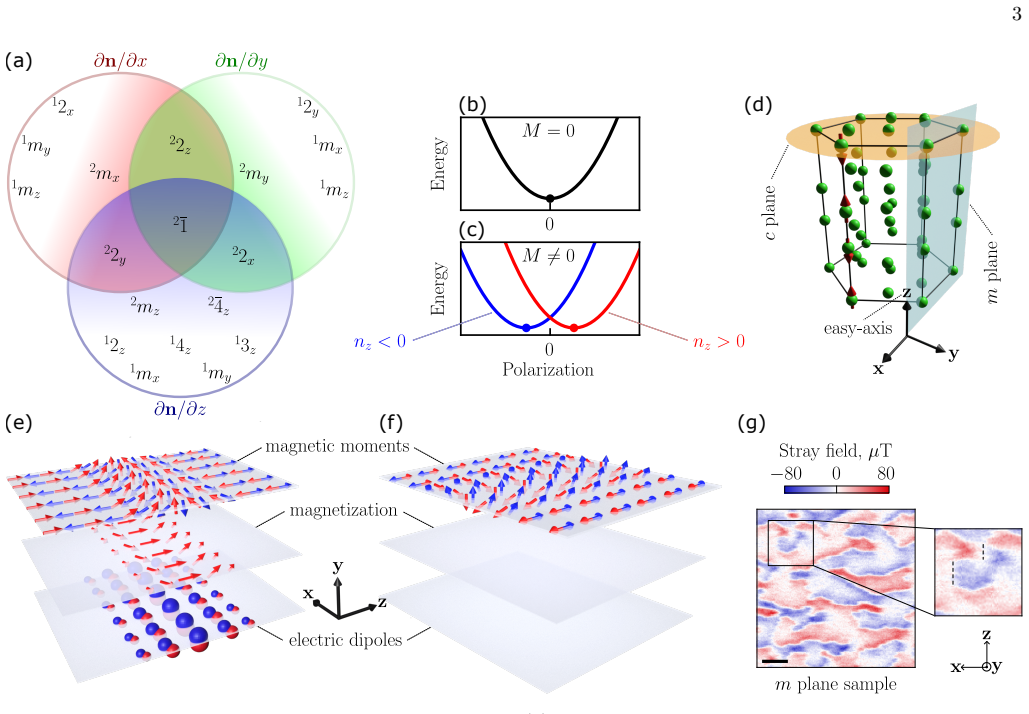
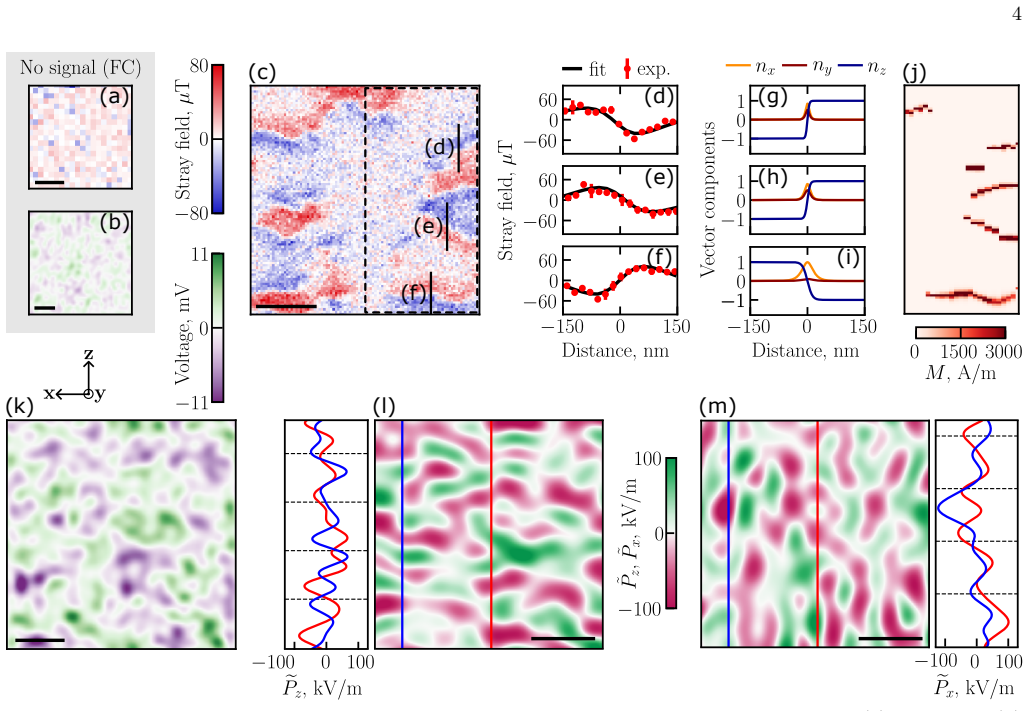
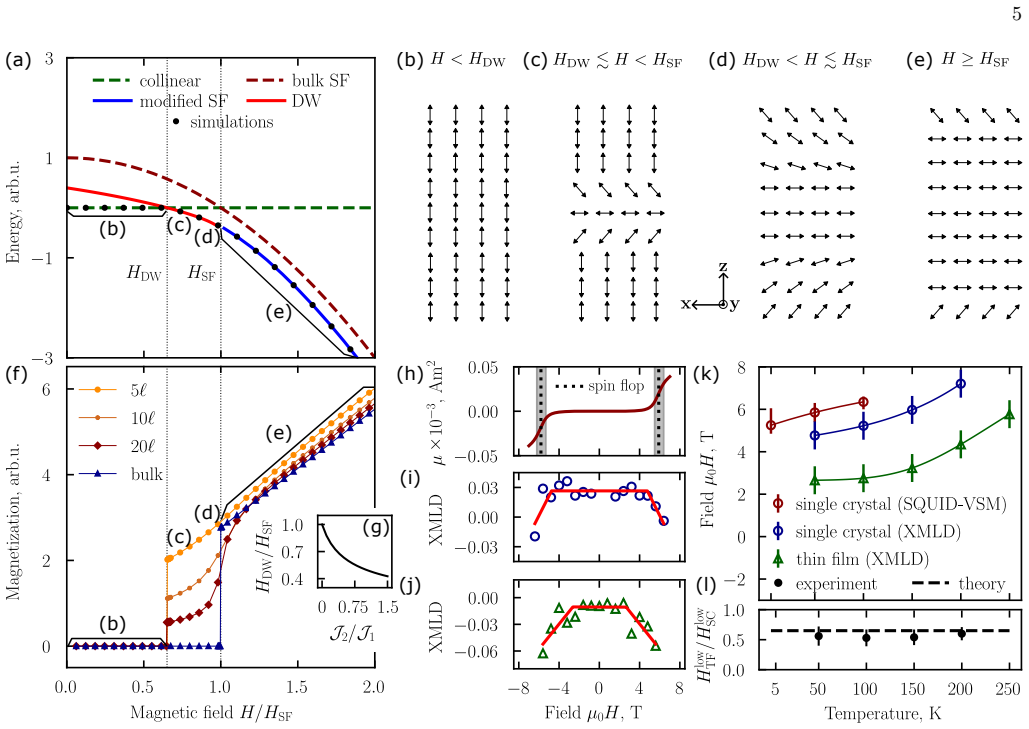
We experimentally demonstrate the existence of specific domain walls that act as room-temperature multiferroic regions in Cr2O3. This behavior stems from an anisotropic crystal-symmetry-dependent mechanism of exchange origin, which is applicable to a broad class of bipartite antiferromagnets. The key signature is the magnetization occurring at antiferromagnetic textures, driven by the flexo-Zeeman interaction.
What carries the argument
Flexo-Zeeman coupling: the anisotropic exchange-origin interaction fixed by crystal symmetry that induces magnetization at antiferromagnetic domain walls in collinear magnetoelectric antiferromagnets.
If this is right
- Room-temperature multiferroic regions appear at domain walls in Cr2O3 without requiring bulk ferroelectric order.
- The same symmetry-dependent exchange mechanism operates in other bipartite antiferromagnets.
- Magnetization is localized at antiferromagnetic textures rather than distributed uniformly.
- The approach supplies a foundation for magnetoelectric spin-orbit memory and logic devices that function at room temperature.
Where Pith is reading between the lines
- Crystal orientation or strain could be used to select or suppress the multiferroic response at the walls.
- The same walls might serve as reconfigurable elements in devices if their position can be moved by external fields.
- Verification in additional antiferromagnets with similar symmetry would test how broadly the flexo-Zeeman route applies.
Load-bearing premise
The measured magnetization at the domain walls originates specifically from the flexo-Zeeman interaction rather than defects, impurities, or measurement artifacts.
What would settle it
Absence of localized magnetization at the domain walls in Cr2O3 samples when the walls are present but the flexo-Zeeman geometry is altered by crystal orientation.
Figures
read the original abstract
Spin-driven multiferroicity attracts significant interest due to its tunability and inherently strong magnetoelectric coupling. While this mechanism induces sizeable electric polarization, it typically occurs at low temperatures and in complex materials. In the simple oxide, the magnetoelectric antiferromagnet Cr$_2$O$_3$, we experimentally demonstrate the existence of specific domain walls that act as room-temperature multiferroic regions. This behavior stems from an anisotropic crystal-symmetry-dependent mechanism of exchange origin, which is applicable to a broad class of bipartite antiferromagnets. The key signature is the magnetization occurring at antiferromagnetic textures, driven by the flexo-Zeeman interaction. These findings establish a foundation for exploring high-temperature spin-driven multiferroicity for magnetoelectric spin-orbit memory and logic applications.
Editorial analysis
A structured set of objections, weighed in public.
Referee Report
Summary. The manuscript claims to experimentally demonstrate the existence of specific antiferromagnetic domain walls in Cr2O3 that function as room-temperature multiferroic regions. This is attributed to an anisotropic, crystal-symmetry-dependent flexo-Zeeman coupling of exchange origin that produces local magnetization at the textures; the mechanism is presented as generalizable to a broad class of bipartite antiferromagnets and relevant for magnetoelectric spin-orbit applications.
Significance. If the experimental attribution of the observed magnetization specifically to the symmetry-allowed flexo-Zeeman term (rather than extrinsic sources) can be secured, the result would identify a route to high-temperature spin-driven multiferroicity in a simple collinear antiferromagnet, potentially enabling new device concepts. The symmetry-based generality claim would also merit testing across related materials.
major comments (2)
- [Abstract] Abstract: the claim of an 'experimental demonstration' of room-temperature multiferroic domain walls is stated without any accompanying methods, data, error bars, controls, or quantitative results, rendering it impossible to evaluate whether the measurements support the central mechanism assignment.
- [Main text (mechanism assignment)] Mechanism assignment (throughout): the weakest link is the attribution of domain-wall magnetization specifically to the flexo-Zeeman interaction fixed by crystal symmetry. Explicit evidence is required that the local signal (i) is intrinsic to the texture, (ii) vanishes or reverses exactly where the symmetry-allowed term predicts, and (iii) is absent in control regions or samples lacking the required domain-wall type; without such controls the mechanism cannot be distinguished from defects, strain, or probe artifacts.
minor comments (1)
- [Abstract] Abstract: the term 'flexo-Zeeman coupling' is introduced without definition or citation, which hinders immediate comprehension for readers outside the immediate subfield.
Simulated Author's Rebuttal
We thank the referee for their careful reading and constructive comments, which have helped us improve the clarity of our claims. We address each major comment below and have revised the manuscript accordingly.
read point-by-point responses
-
Referee: [Abstract] Abstract: the claim of an 'experimental demonstration' of room-temperature multiferroic domain walls is stated without any accompanying methods, data, error bars, controls, or quantitative results, rendering it impossible to evaluate whether the measurements support the central mechanism assignment.
Authors: We agree that the abstract is highly concise and omits explicit mention of methods or quantitative details. We have revised the abstract to include a brief reference to the primary experimental techniques (magneto-optical Kerr microscopy and piezoresponse force microscopy) and the key quantitative observation of local magnetization values at the domain walls. Full methods, data sets with error bars, and controls remain in the main text and supplementary information. revision: yes
-
Referee: [Main text (mechanism assignment)] Mechanism assignment (throughout): the weakest link is the attribution of domain-wall magnetization specifically to the flexo-Zeeman interaction fixed by crystal symmetry. Explicit evidence is required that the local signal (i) is intrinsic to the texture, (ii) vanishes or reverses exactly where the symmetry-allowed term predicts, and (iii) is absent in control regions or samples lacking the required domain-wall type; without such controls the mechanism cannot be distinguished from defects, strain, or probe artifacts.
Authors: We appreciate the referee highlighting the need for explicit mapping to the symmetry predictions. The manuscript already presents data from multiple Cr2O3 samples showing the local magnetization signal only at domain walls whose orientation permits the flexo-Zeeman term (see Figures 2–4 and Section III). The signal reverses sign precisely when the domain-wall type is inverted in a manner consistent with the crystal symmetry, and is absent both in 180° walls (where the term is symmetry-forbidden) and in control regions without the required texture. We have added a new paragraph explicitly addressing points (i)–(iii) and expanded the discussion of controls to further distinguish the signal from possible extrinsic sources. If additional specific control experiments are suggested, we are prepared to perform them. revision: partial
Circularity Check
No circularity in experimental claims or mechanism attribution
full rationale
The paper presents an experimental demonstration of room-temperature multiferroic domain walls in Cr2O3 driven by flexo-Zeeman coupling of exchange origin. No equations, derivations, fitted parameters, or predictions appear in the abstract or described claims. The mechanism is invoked as a known crystal-symmetry-dependent effect applicable to bipartite antiferromagnets, without self-definition, renaming of known results, or load-bearing self-citations that reduce the central observation to its own inputs. The attribution to flexo-Zeeman (vs. artifacts) is an experimental interpretation question, not a circular derivation. The result is self-contained as an observation report.
Axiom & Free-Parameter Ledger
axioms (1)
- domain assumption Crystal symmetry fixes an anisotropic exchange-origin mechanism that produces flexo-Zeeman coupling at domain walls.
invented entities (1)
-
flexo-Zeeman coupling
no independent evidence
Reference graph
Works this paper leans on
-
[1]
Tokura, S
Y. Tokura, S. Seki, and N. Nagaosa, Multiferroics of spin origin, Reports on Progress in Physics77, 076501 (2014)
2014
-
[2]
Fiebig, T
M. Fiebig, T. Lottermoser, D. Meier, and M. Trassin, The evolution of multiferroics, Nature Reviews Materials 1, 16046 (2016)
2016
-
[3]
A. Fert, R. Ramesh, V. Garcia, F. Casanova, and M. Bibes, Electrical control of magnetism by electric field and current-induced torques, Reviews of Modern Physics 96, 015005 (2024)
2024
-
[4]
N. A. Hill, Why are there so few magnetic ferroelectrics?, The Journal of Physical Chemistry B104, 6694 (2000)
2000
-
[5]
J. Wang, J. B. Neaton, H. Zheng, V. Nagarajan, S. B. Ogale, B. Liu, D. Viehland, V. Vaithyanathan, D. G. Schlom, U. V. Waghmare, N. A. Spaldin, K. M. Rabe, M. Wuttig, and R. Ramesh, Epitaxial BiFeO3 multifer- roic thin film heterostructures, Science299, 1719 (2003)
2003
-
[6]
S. H. Chun, Y. S. Chai, B.-G. Jeon, H. J. Kim, Y. S. Oh, I. Kim, H. Kim, B. J. Jeon, S. Y. Haam, J.-Y. Park, S. H. Lee, J.-H. Chung, J.-H. Park, and K. H. Kim, Electric field control of nonvolatile four-state magnetization at room temperature, Physical Review Letters108, 177201 (2012)
2012
-
[7]
Hirose, K
S. Hirose, K. Haruki, A. Ando, and T. Kimura, Mutual control of magnetization and electrical polarization by electric and magnetic fields at room temperature in Y- type BaSrCo2−xZnxFe11AlO22 ceramics, Applied Physics Letters104, 022907 (2014)
2014
-
[8]
G. Fan, S. Wang, X. Zhang, Z. Zhou, J. Zhao, H. Zhou, and G. Rao, Large electric polarization in multiferroic BaFe10.8Sc1.2O19 thin film, Journal of Alloys and Com- pounds1042, 184160 (2025)
2025
-
[9]
Kohara, Y
Y. Kohara, Y. Yamasaki, Y. Onose, and Y. Tokura, Excess-electron induced polarization and magnetoelec- tric effect in yttrium iron garnet, Physical Review B82, 104419 (2010)
2010
-
[10]
G. V. Arzamastseva, A. M. Balbashov, F. V. Lisovskii, E. G. Mansvetova, A. G. Temiryazev, and M. P. Temiryazeva, Properties of epitaxial (210) iron garnet films exhibiting the magnetoelectric effect, Journal of Ex- perimental and Theoretical Physics120, 687 (2015)
2015
-
[11]
Dur´ an, C
A. Dur´ an, C. Ostos, O. Arnache, J. M. Siqueiros, and M. Garc´ ıa-Guaderrama, Multiferroic properties of the Y2BiFe5O12 garnet, Journal of Applied Physics122, 134101 (2017)
2017
-
[12]
Husain, I
S. Husain, I. Harris, G. Gao, X. Li, P. Meisenheimer, C. Shi, P. Kavle, C. H. Choi, T. Y. Kim, D. Kang, P. Behera, D. Perrodin, H. Guo, J. M. Tour, Y. Han, L. W. Martin, Z. Yao, and R. Ramesh, Low-temperature grapho-epitaxial La-substituted BiFeO3 on metallic per- ovskite, Nature Communications15, 479 (2024)
2024
-
[13]
D. C. Vaz, C.-C. Lin, J. J. Plombon, W. Y. Choi, I. Groen, I. C. Arango, A. Chuvilin, L. E. Hueso, D. E. Nikonov, H. Li, P. Debashis, S. B. Clendenning, T. A. Gosavi, Y.-L. Huang, B. Prasad, R. Ramesh, A. Vec- chiola, M. Bibes, K. Bouzehouane, S. Fusil, V. Garcia, I. A. Young, and F. Casanova, Voltage-based magnetiza- tion switching and reading in magneto...
1902
-
[14]
Husain, Z
S. Husain, Z. Yao, and R. Ramesh, Enabling magneto- electric spin-orbit logic and memory, Newton1, 100026 (2025)
2025
-
[15]
Bar’yakhtar, V
V. Bar’yakhtar, V. L’vov, and D. Yablonskii, Magnetic symmetry of the domain walls in magnetically ordered crystals, Zh. Eksp. Teor. Fiz.87, 1863 (1984)
1984
-
[16]
Sparavigna, A
A. Sparavigna, A. Strigazzi, and A. Zvezdin, Electric- field effects on the spin-density wave in magnetic ferro- electrics, Physical Review B50, 2953 (1994)
1994
-
[17]
Mostovoy, Ferroelectricity in spiral magnets, Physical Review Letters96, 067601 (2006)
M. Mostovoy, Ferroelectricity in spiral magnets, Physical Review Letters96, 067601 (2006). 8
2006
-
[18]
Dzyaloshinskii, Magnetoelectricity in ferromagnets, Eur
I. Dzyaloshinskii, Magnetoelectricity in ferromagnets, Eur. Phys. Lett.83, 67001 (2008)
2008
-
[19]
Kimura, T
T. Kimura, T. Goto, H. Shintani, K. Ishizaka, T. Arima, and Y. Tokura, Magnetic control of ferroelectric polar- ization, Nature426, 55 (2003)
2003
-
[20]
T. Goto, T. Kimura, G. Lawes, A. P. Ramirez, and Y. Tokura, Ferroelectricity and giant magnetocapaci- tance in perovskite rare-earth manganites, Physical Re- view Letters92, 257201 (2004)
2004
-
[21]
H. Wang, T. Jiang, W. Pan, X. Wang, H. Wang, J. Tian, L. Li, D. Zhao, Q. Zhang, C. Wang, Y. Yang, H. Xiang, C. Xu, D. Feng, and T. Zhang, Microscopic evidence of spin-driven multiferroicity and topological spin textures in monolayer nii 2, Physical Review Letters136, 026402 (2026)
2026
-
[22]
S. Seki, X. Z. Yu, S. Ishiwata, and Y. Tokura, Observa- tion of skyrmions in a multiferroic material, Science336, 198 (2012)
2012
-
[23]
E. Ruff, S. Widmann, P. Lunkenheimer, V. Tsurkan, S. Bordacs, I. Kezsmarki, and A. Loidl, Multiferroicity and skyrmions carrying electric polarization in GaV 4S8, Science Advances1, e1500916 (2015)
2015
-
[24]
Hanneken, F
C. Hanneken, F. Otte, A. Kubetzka, B. Dup´ e, N. Romming, K. von Bergmann, R. Wiesendanger, and S. Heinze, Electrical detection of magnetic skyrmions by tunnelling non-collinear magnetoresistance, Nature Nan- otech10, 1039 (2015)
2015
-
[25]
Hassanpour, M
E. Hassanpour, M. C. Weber, Y. Zemp, L. Kuerten, A. Bortis, Y. Tokunaga, Y. Taguchi, Y. Tokura, A. Cano, T. Lottermoser, and M. Fiebig, Interconversion of multi- ferroic domains and domain walls, Nature Communica- tions12, 2755 (2021)
2021
-
[26]
Giraldo, Q
M. Giraldo, Q. N. Meier, A. Bortis, D. Nowak, N. A. Spaldin, M. Fiebig, M. C. Weber, and T. Lottermoser, Magnetoelectric coupling of domains, domain walls and vortices in a multiferroic with independent magnetic and electric order, Nature Communications12, 3093 (2021)
2021
-
[27]
Y. Zemp, E. Hassanpour, Y. Tokunaga, Y. Taguchi, Y. Tokura, T. Lottermoser, M. C. Weber, and M. Fiebig, Imaging of a multiferroic domain wall in a non- multiferroic environment, Matter8, 102051 (2025)
2025
-
[28]
Zhang, H
Y. Zhang, H. Lu, X. Yan, X. Cheng, L. Xie, T. Aoki, L. Li, C. Heikes, S. P. Lau, D. G. Schlom, L. Chen, A. Gruverman, and X. Pan, Intrinsic conductance of do- main walls in BiFeO 3, Advanced Materials31, 1902099 (2019)
2019
-
[29]
A. P. Pyatakov, A. K. Zvezdin, A. M. Vlasov, A. S. Sergeev, D. A. Sechin, E. P. Nikolaeva, A. V. Nikolaev, H. Chou, S. J. Sun, and L. E. Calvet, Spin structures and domain walls in multiferroics spin structures and mag- netic domain walls in multiferroics, Ferroelectrics438, 79 (2012)
2012
-
[30]
R. M. Vakhitov, R. V. Solonetsky, V. R. Gurjanova, A. R. Nizjamova, D. A. Sechin, T. T. Gareev, and A. P. Py- atakov, Magnetic-field tuning of domain-wall multifer- roicity, Physical Review B104, 144407 (2021)
2021
-
[31]
J. F. Scott, Room-temperature multiferroic magneto- electrics, NPG Asia Materials5, e72 (2013)
2013
-
[32]
A. V. Shubnikov,Symmetry and Antisymmetry of Finite Figures. Acad. Sci(USSR Press, Moscow, 1951)
1951
-
[33]
A. P. Pyatakov and A. K. Zvezdin, Magnetoelectric and multiferroic media, Physics-Uspekhi55, 557581 (2012)
2012
-
[34]
Mostovoy, A
M. Mostovoy, A. Scaramucci, N. A. Spaldin, and K. T. Delaney, Temperature-dependent magnetoelectric effect from first principles, Physical Review Letters105, 087202 (2010)
2010
-
[35]
O. V. Pylypovskyi, S. F. Weber, P. Makushko, I. Verem- chuk, N. A. Spaldin, and D. Makarov, Surface-symmetry- driven Dzyaloshinskii-Moriya interaction and canted fer- rimagnetism in collinear magnetoelectric antiferromagnet Cr2O3, Physical Review Letters132, 226702 (2024)
2024
-
[36]
Hedrich, K
N. Hedrich, K. Wagner, O. V. Pylypovskyi, B. J. Shields, T. Kosub, D. D. Sheka, D. Makarov, and P. Maletinsky, Nanoscale mechanics of antiferromagnetic domain walls, Nature Physics17, 574 (2021)
2021
-
[37]
Hoser and U
A. Hoser and U. K¨ obler,Renormalization Group Theory (Springer Berlin Heidelberg, 2012)
2012
-
[38]
Samuelsen, M
E. Samuelsen, M. Hutchings, and G. Shirane, Inelastic neutron scattering investigation of spin waves and mag- netic interactions in Cr 2O3, Physica48, 13 (1970)
1970
-
[39]
C. Luo, H. Ryll, C. H. Back, and F. Radu, X-ray mag- netic linear dichroism as a probe for non-collinear mag- netic state in ferrimagnetic single layer exchange bias sys- tems, Scientific Reports9, 18169 (2019)
2019
-
[40]
Makushko, T
P. Makushko, T. Kosub, O. V. Pylypovskyi, N. Hedrich, J. Li, A. Pashkin, S. Avdoshenko, R. H¨ ubner, F. Ganss, D. Wolf, A. Lubk, M. O. Liedke, M. Butterling, A. Wag- ner, K. Wagner, B. J. Shields, P. Lehmann, I. Verem- chuk, J. Fassbender, P. Maletinsky, and D. Makarov, Flexomagnetism and vertically graded N´ eel temperature of antiferromagnetic Cr 2O3 th...
2022
-
[41]
K. D. Belashchenko, O. Tchernyshyov, A. A. Kovalev, and O. A. Tretiakov, Magnetoelectric domain wall dy- namics and its implications for magnetoelectric memory, Applied Physics Letters108, 132403 (2016)
2016
-
[42]
Stengel, Macroscopic polarization from nonlinear gra- dient couplings, Physical Review Letters132, 146801 (2024)
M. Stengel, Macroscopic polarization from nonlinear gra- dient couplings, Physical Review Letters132, 146801 (2024)
2024
-
[43]
Papanicolaou, Antiferromagnetic domain walls, Phys- ical Review B51, 15062 (1995)
N. Papanicolaou, Antiferromagnetic domain walls, Phys- ical Review B51, 15062 (1995)
1995
-
[44]
A. F. Andreev, Macroscopic magnetic fields of anti- ferromagnets, Journal of Experimental and Theoretical Physics Letters63, 758 (1996)
1996
-
[45]
O. V. Pylypovskyi, Y. A. Borysenko, J. Fassbender, D. D. Sheka, and D. Makarov, Curvature-driven ho- mogeneous Dzyaloshinskii–Moriya interaction and emer- gent weak ferromagnetism in anisotropic antiferromag- netic spin chains, Applied Physics Letters118, 182405 (2021)
2021
-
[46]
High Performance Computing at Helmholtz–Zentrum Dresden–Rossendorf,http://www.hzdr.de
discussion (0)
Sign in with ORCID, Apple, or X to comment. Anyone can read and Pith papers without signing in.