Strain-induced suppression of thermochromism in divalent cobalt molybdate thin films
Pith reviewed 2026-06-28 05:25 UTC · model grok-4.3
The pith
Microstrain in CoMoO4 thin films suppresses the thermochromic beta-to-alpha transition observed in bulk powders near 230 K.
A machine-rendered reading of the paper's core claim, the machinery that carries it, and where it could break.
Core claim
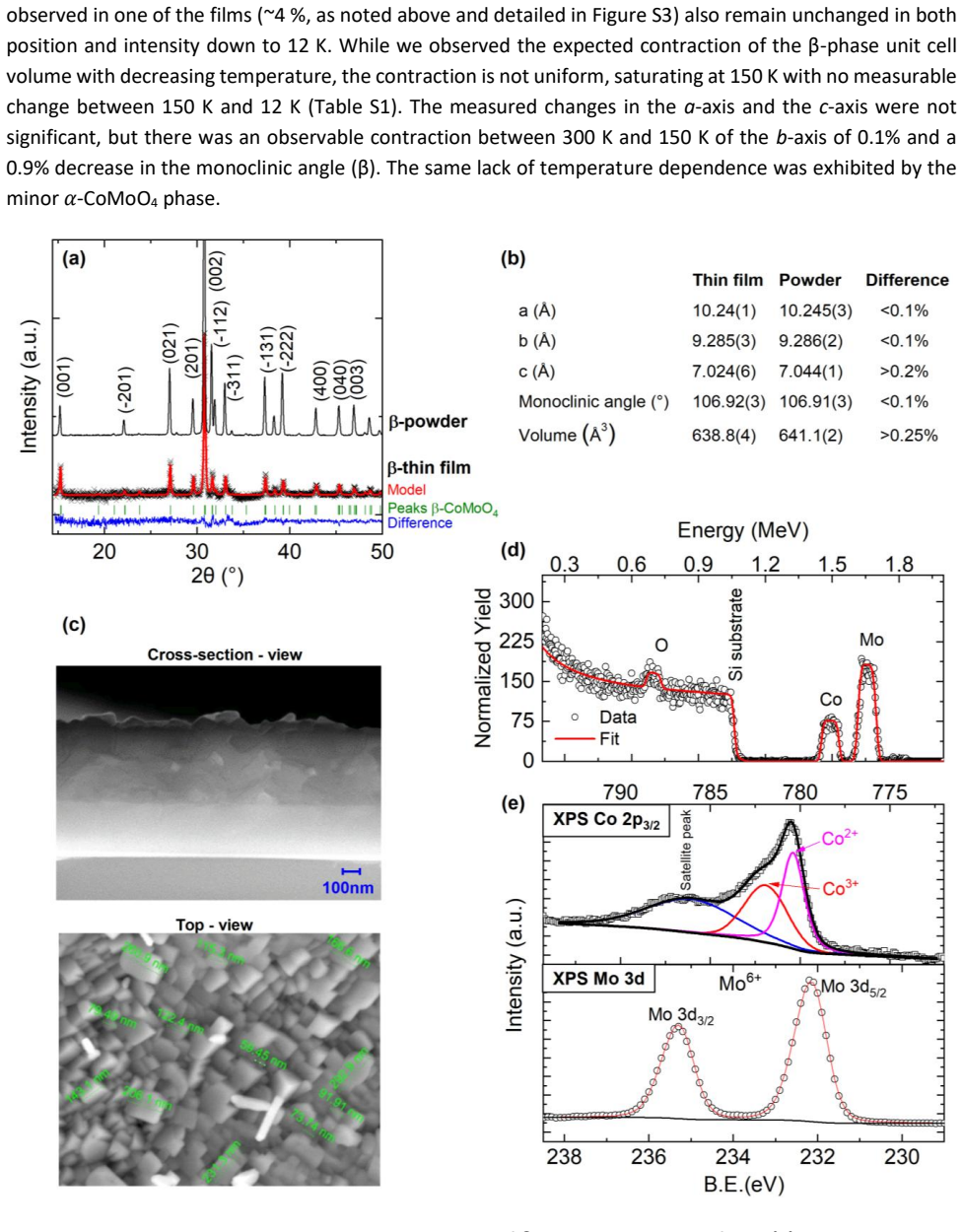
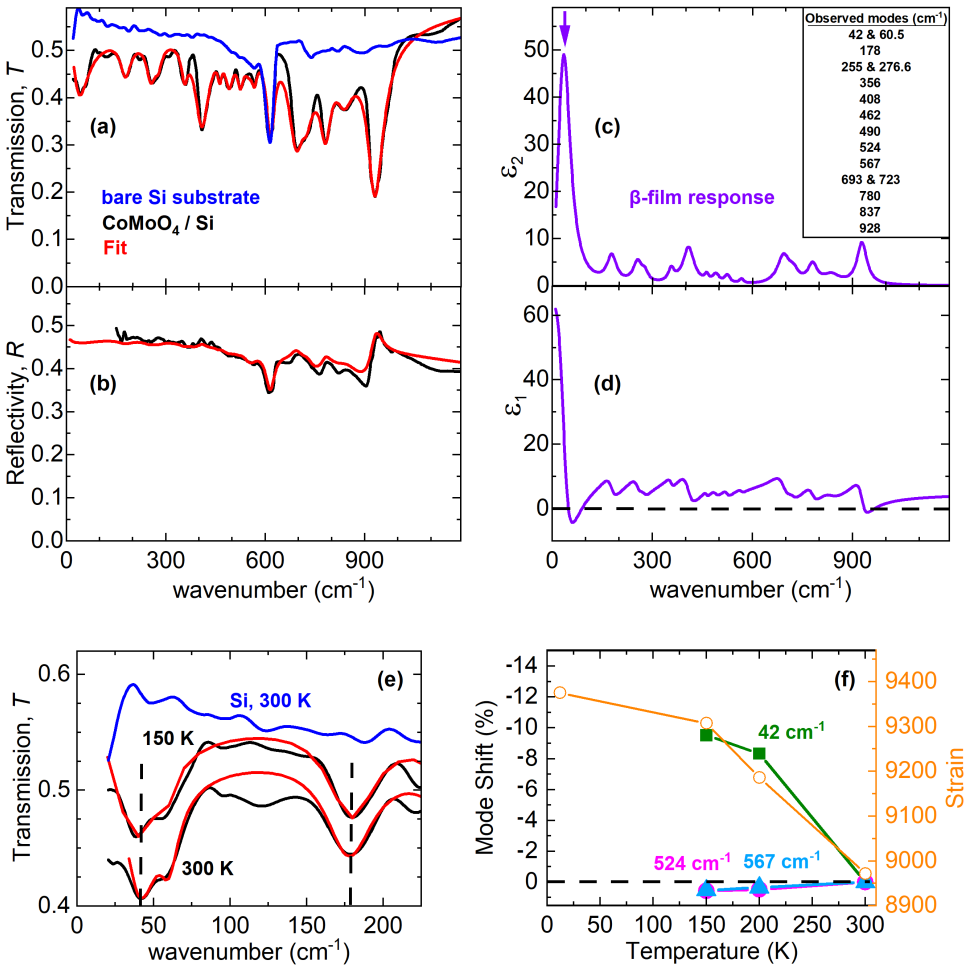
In CoMoO4 thin films the beta phase persists across the full temperature range because microstrain increases the crystal-field splitting at Co2+ sites; this is seen as a blue shift of crystal-field and charge-transfer bands, a softening of the 42 cm-1 cation phonon that saturates below 200 K, and the absence of the first-order structural change that occurs in unstrained bulk powder near 230 K.
What carries the argument
Microstrain-driven crystal-field strengthening that raises the barrier to the beta-to-alpha structural rearrangement.
If this is right
- The beta phase remains the stable structure down to the lowest temperatures in the presence of microstrain.
- Electronic transitions and low-energy phonons shift in ways consistent with an enhanced ligand field but without completing the structural change.
- Strain therefore functions as an external knob that can hold a thermochromic oxide in one phase over a wide temperature window.
- The same microstrain that blocks the transition also produces measurable anomalies in the optical response that saturate between 200 K and 150 K.
Where Pith is reading between the lines
- The same strain mechanism may operate in other molybdate or tungstate thin films where first-order transitions limit device use.
- Independent control of microstrain (for example by buffer layers or post-annealing) could allow deliberate switching between thermochromic and non-thermochromic regimes in the same material system.
- The observed phonon softening without a full transition points to a possible precursor regime that might be tuned for near-transition sensing applications.
Load-bearing premise
The measured microstrain is the dominant thermodynamic variable that controls whether the structural transition occurs, rather than thickness, substrate mismatch, or growth defects.
What would settle it
Prepare a set of CoMoO4 films in which microstrain is systematically reduced while thickness and substrate are held fixed, then check whether the beta-to-alpha transition reappears near 230 K.
Figures
read the original abstract
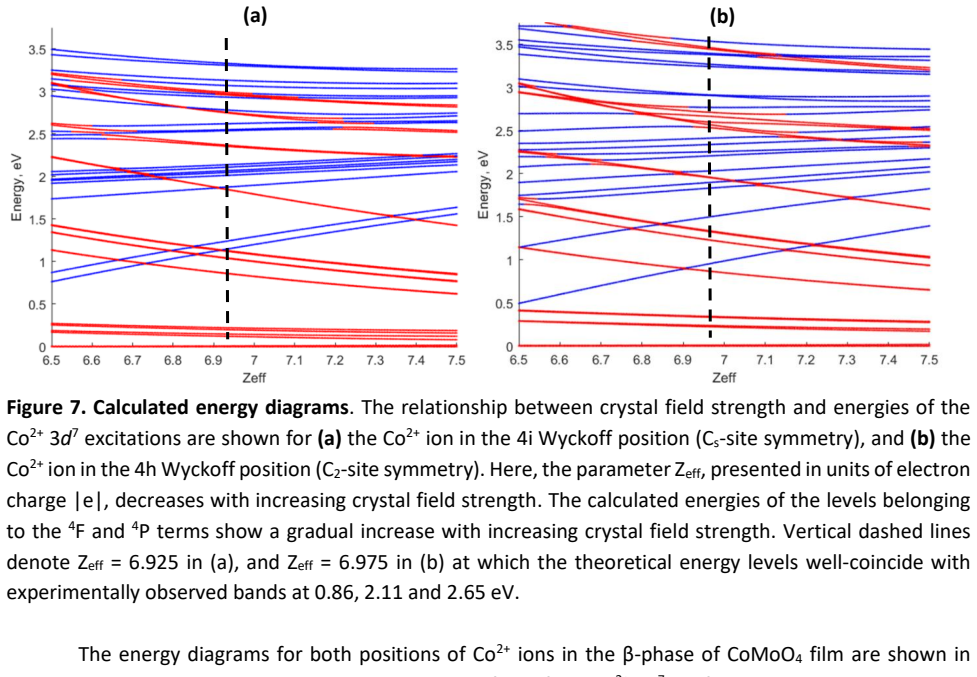
Thermochromic oxides provide a platform for coupling lattice, electronic, and magnetic degrees of freedom, with divalent cobalt molybdate $CoMoO_4$ as a prototypical example. Despite extensive studies on powders, its thin-film behaviour - critical for device applications - remains largely unexplored. Here, we present a combined experimental and theoretical investigation of $CoMoO_4$ thin films, including the first THz-VIS-UV spectra of $\beta - CoMoO_4$ in thin-film form. In contrast to bulk powders, which undergo a first order $\beta \rightarrow \alpha$ structural transition near 230K, the thin films retain the high-temperature $\beta-$phase across the entire temperature range. We show that microstrain fundamentally reshapes the phase landscape, suppressing thermochromism and stabilizing the $\beta-$phase. The optical spectra reveal pronounced phonon and electronic anomalies, including a softening of a low-energy, cation-dominated phonon (42cm$^{-1}$) upon cooling, in contrast to conventional mode-hardening. This behaviour indicates incipient atomic displacements analogous to those driving the bulk $\beta \rightarrow \alpha$ transition, despite the absence of a structural phase change, and saturates between 200 and 150K. Temperature-dependent X-ray diffraction confirms persistent \beta-phase symmetry with increasing microstrain, consistent with strain-induced frustration of the first-order transition. At higher energies (0.12-3.7eV), the optical response exhibits a blue-shift of Co$^{2+}$crystal-field transitions and charge-transfer excitations, indicating a strain-enhanced ligand field. Supported by structural refinements and theoretical calculations, we identify crystal field strengthening as the key mechanism stabilizing the $\beta$-phase. These results establish strain as a thermodynamic lever to control phase stability and functional properties in thermochromic oxides.
Editorial analysis
A structured set of objections, weighed in public.
Referee Report
Summary. The paper claims that CoMoO4 thin films, unlike bulk powders that undergo a first-order β→α transition near 230 K, retain the high-temperature β-phase at all temperatures due to microstrain that suppresses thermochromism; this is attributed to crystal-field strengthening, as shown by persistent β symmetry in temperature-dependent XRD, anomalous softening of a 42 cm⁻¹ phonon, blue-shifts in Co²⁺ crystal-field and charge-transfer transitions (0.12–3.7 eV), structural refinements, and theoretical calculations identifying the enhanced ligand field as the stabilizing mechanism.
Significance. If the central attribution holds, the result establishes microstrain as a thermodynamic control knob for phase stability in thermochromic oxides, enabling thin-film device applications where bulk thermochromism is undesirable. The first reported THz-VIS-UV spectra of β-CoMoO4 thin films and the observation of incipient atomic displacements (phonon softening saturating 200–150 K) without a structural transition are concrete advances; the combined XRD–optical–calculation approach is a strength.
major comments (2)
- [Experimental methods and temperature-dependent XRD results] The central claim that microstrain is the dominant variable stabilizing the β-phase (abstract and discussion) rests on films grown under fixed conditions on one substrate type; no experiments independently vary microstrain while holding thickness, substrate mismatch, or defect density constant (or vice versa). Structural refinements and calculations can demonstrate consistency but cannot establish causality over correlated growth parameters, weakening the mechanistic attribution.
- [Optical spectra analysis and theoretical calculations] The identification of crystal-field strengthening as the key mechanism (abstract) is supported by observed blue-shifts but lacks a quantitative link: no explicit calculation or table shows how the measured microstrain values map onto changes in crystal-field splitting parameters (e.g., via ligand-field theory or DFT strain scans) that would raise the energy barrier to the α-phase.
minor comments (2)
- [THz spectra discussion] Notation for the low-energy phonon mode (42 cm⁻¹) should specify its symmetry label or eigenvector character for reproducibility.
- [XRD section] Error bars or uncertainty estimates on microstrain values extracted from XRD refinements are not mentioned; these should be added to Table or Figure presenting the refinements.
Simulated Author's Rebuttal
We thank the referee for the careful and constructive review. The comments identify important limitations in establishing causality and in the quantitative connection between microstrain and crystal-field changes. We address each point below and will revise the manuscript accordingly.
read point-by-point responses
-
Referee: [Experimental methods and temperature-dependent XRD results] The central claim that microstrain is the dominant variable stabilizing the β-phase (abstract and discussion) rests on films grown under fixed conditions on one substrate type; no experiments independently vary microstrain while holding thickness, substrate mismatch, or defect density constant (or vice versa). Structural refinements and calculations can demonstrate consistency but cannot establish causality over correlated growth parameters, weakening the mechanistic attribution.
Authors: We agree that the present data set, obtained under fixed growth conditions, shows correlation rather than fully isolated causality. The microstrain is an intrinsic consequence of the thin-film geometry on the chosen substrate, and the temperature-dependent XRD demonstrates its increase coinciding with β-phase retention. Nevertheless, the referee correctly notes that other growth-related factors cannot be ruled out. In revision we will add an explicit limitations paragraph in the discussion that states the current experimental design does not independently vary microstrain and outlines the need for future studies that systematically change deposition parameters while monitoring strain, defects, and phase stability. revision: yes
-
Referee: [Optical spectra analysis and theoretical calculations] The identification of crystal-field strengthening as the key mechanism (abstract) is supported by observed blue-shifts but lacks a quantitative link: no explicit calculation or table shows how the measured microstrain values map onto changes in crystal-field splitting parameters (e.g., via ligand-field theory or DFT strain scans) that would raise the energy barrier to the α-phase.
Authors: The referee is correct that the manuscript does not contain an explicit quantitative mapping from the measured microstrain values to shifts in crystal-field parameters or to the computed energy barrier. While the existing DFT results identify an enhanced ligand field, they stop short of the requested strain-scan analysis. We will therefore perform and include additional DFT calculations that apply uniaxial and biaxial strains corresponding to the experimentally refined microstrain values, extract the resulting changes in Co²⁺ d-orbital splitting, and tabulate the effect on the α–β energy difference. These results will be added to the main text or a new supplementary section. revision: yes
Circularity Check
No significant circularity in derivation chain
full rationale
The paper's central claim—that microstrain stabilizes the β-phase via crystal-field strengthening—is supported by direct experimental observations (temperature-dependent XRD showing persistent β symmetry with increasing microstrain, THz-VIS-UV spectra showing phonon softening and blue-shifts of Co²⁺ transitions) plus independent theoretical calculations. No equations or steps reduce a prediction to a fitted parameter defined by the same data, no self-citation is invoked as load-bearing uniqueness, and the derivation remains self-contained against external benchmarks without renaming or smuggling ansatzes.
Axiom & Free-Parameter Ledger
axioms (1)
- domain assumption Crystal-field theory correctly maps blue-shifts in Co2+ d-d transitions to increased ligand-field strength.
Reference graph
Works this paper leans on
-
[1]
The relationship between crystal structures and thermochromism in CoMoO4,
R. K. S. Costa, S. C. Teles and K. P. F. Siqueira, “The relationship between crystal structures and thermochromism in CoMoO4,” Chemical Papers, vol. 75, p. 237–248, (2021)
2021
-
[2]
Theoretical and Experimental Study of Structural Phases in CoMoO 4,
D. Zagorac, J. C. Schön, M. Rosić, J. Zagorac, D. Jordanov, J. Luković and B. Matović, “Theoretical and Experimental Study of Structural Phases in CoMoO 4,” Crystal Research and Technology, vol. 52, p. 1700069, (2017)
2017
-
[3]
Investigation of the First-Order Phase Transition in the Co 1−xMgxMoO4 Solid Solution and Discussion of the Associated Thermochromic Behavior,
L. C. Robertson, M. Gaudon, S. Jobic, P. Deniard and A. Demourgues, “Investigation of the First-Order Phase Transition in the Co 1−xMgxMoO4 Solid Solution and Discussion of the Associated Thermochromic Behavior,” Inorganic Chemistry, vol. 50, pp. 2878-2884, (2011)
2011
-
[4]
Optical study of the piezochromic transition in CuMoO4 by pressure spectroscopy
F. Rodrıguez, D. Hernandez, J. Garcia -Jaca, H. Ehrenberg and H. Weitzel. “Optical study of the piezochromic transition in CuMoO4 by pressure spectroscopy”, Physical Review B 61 16497 (2000)
2000
-
[5]
Co 1−xMgxMoO4 Compounds for Pressure Indicators,
L. Righetti, L. Robertson, A. Largeteau, G. Vignoles, A. Demourgues and M. Gaudon, “Co 1−xMgxMoO4 Compounds for Pressure Indicators,” ACS Appl. Mater. Interfaces, vol. 3, p. 1319–1324, April (2011) 14
2011
-
[6]
CoMoO 4/CuMo0.9W0.1O4 Mixture as an Efficient Piezochromic Sensor to Detect Temperature/Pressure Shock Parameters,
V. Blanco-Gutierrez, L. Cornu, A. Demourgues and M. Gaudon, “CoMoO 4/CuMo0.9W0.1O4 Mixture as an Efficient Piezochromic Sensor to Detect Temperature/Pressure Shock Parameters,” ACS Applied Materials & Interfaces, vol. 7, pp. 7112-7117, (2015) 7 W. Tan and J. Luan, “Investigation into the synthesis conditions of CuMoO4 by an in situ method and its photocat...
2015
-
[7]
Electronic Properties and Phase Transformations in CoMoO 4 and NiMoO 4: XANES and Time -Resolved Synchrotron XRD Studies,
J. A. Rodriguez, S. Chaturvedi, J. C. Hanson, A. Albornoz, and J. L. Brito, “Electronic Properties and Phase Transformations in CoMoO 4 and NiMoO 4: XANES and Time -Resolved Synchrotron XRD Studies,” J. Phys. Chem. B, vol. 102, no. 8, pp. 1347–1355 (1998)
1998
-
[8]
Photoluminescent Properties of CoMoO 4 Nanorods Quickly Synthesized and Annealed in a Domestic Microwave Oven,
A. P. de Moura et al., “Photoluminescent Properties of CoMoO 4 Nanorods Quickly Synthesized and Annealed in a Domestic Microwave Oven,” Advances in Chemical Engineering and Science, vol. 2, no. 4, Art. no. 4 (2012)
2012
-
[9]
T. Ito, H. Takagi and T. Asano, “Drastic and Sharp Change in Color, Shape, and Magnetism in Transition of CuMoO4“ Single Crystals. Chem. Mater. 21, 3376–3379 (2009)
2009
-
[10]
Low temperature X -ray absorption spectroscopy study of CuMoO 4 and CuMo0.90W0.10O4 using reverse Monte-Carlo method
Robertson et al., “Low temperature X -ray absorption spectroscopy study of CuMoO 4 and CuMo0.90W0.10O4 using reverse Monte-Carlo method” J. Mater. Chem. C 3, 2918-2924 (2015)
2015
-
[11]
Fabrication of single crystal molybdate: A new protocol of coupling metal ion interaction and oriented -attachment with assistance of supercritical CO2
X. Wang, Y. Wu, X. Chen, D.Liu, L. Zhang, X. Zhai, M. Li, “Fabrication of single crystal molybdate: A new protocol of coupling metal ion interaction and oriented -attachment with assistance of supercritical CO2” Materials Science and Engineering B, 319 (2025) 118379
2025
-
[12]
Smith, G. W. Crystal Structure of Orthorhombic Cobalt Molybdate Nature, Lond. 188, 306 (1960)
1960
-
[13]
high -pressure
C. Livage et al., J. Mater. Chem. Solution process for the synthesis of the “high -pressure” phase CoMoO4 and X-ray single crystal resolution 12, 1423–1425 (2002)
2002
-
[14]
X-ray photoelectron spectroscopic studies of thin film oxides of cobalt and molybdenum,
N. S. McIntyre, D. D. Johnston, L. L. Coatsworth, R. D. Davidson and J. R. Brown, “X-ray photoelectron spectroscopic studies of thin film oxides of cobalt and molybdenum,” Surf. Interface Anal., vol. 15, p. 265–272, (1990)
1990
-
[15]
Diskus, M
M. Diskus, M. Balasundaram, O. Nilsen, and H. Fjellvåg, Influence of precursors chemistry on ALD growth of cobalt–molybdenum oxide films, Dalton Trans. 41, 2439–2444 (2012)
2012
-
[16]
Structural, optical, electrical and photovoltaic electrochemical studies of cobalt molybdate thin films
P.K. Pandey, N.S. Bhave, R.B. Kharat, “Structural, optical, electrical and photovoltaic electrochemical studies of cobalt molybdate thin films”, Indian Journal of Pure & Applied Physics (IJPAP), Vol.44(01), 52-58 (2006)
2006
-
[17]
Spin flop transitions and complex magnetic behaviour in CoMoO 4 powders and β -CoMoO4 thin films,
J. Williamson, G. V. M. Williams and S. V. Chong, “Spin flop transitions and complex magnetic behaviour in CoMoO 4 powders and β -CoMoO4 thin films,” Journal of Magnetism and Magnetic Materials, vol. 603, p. 172214 (2024)
2024
-
[18]
Algorithms for the rapid simulation of Rutherford backscattering spectra,
L. R. Doolittle, “Algorithms for the rapid simulation of Rutherford backscattering spectra,” Nuclear Instruments and Methods in Physics Research Section B: Beam Interactions with Materials and Atoms, vol. 9, pp. 344-351 (1985)
1985
-
[19]
Spin-lattice and spin-electronic interactions in the van der Waals semiconductor Co2P2S6
K. Van Koughnet, B. Mallett, S. Chong, B. S. Conner, M. A. McGuire, M. A. Susner and R. G. Buckley, “Spin-lattice and spin-electronic interactions in the van der Waals semiconductor Co2P2S6” Phys. Rev. B, vol. 109, no. 16, p. 165142, April (2024)
2024
-
[20]
Using optical spectroscopy to probe the impact of atomic disorder on the Heusler alloy Co2MnG ,
B. Mallett, Y. Zhang, C. Pot, K. Van Koughnet, B. Stanley, R. G. Buckley, A. Koo, Y. Yin, N. V. Medhekar and S. Granville, “Using optical spectroscopy to probe the impact of atomic disorder on the Heusler alloy Co2MnG ,” Phys. Rev. Mater., vol. 7, no. 9, p. 094203, September (2023)
2023
-
[21]
Optical Properties of Aluminum,
H. Ehrenreich, H. R. Philipp and B. Segall, “Optical Properties of Aluminum,” Phys. Rev., vol. 132, no. 5, p. 1918–1928, December (1963)
1918
-
[22]
Kramers –Kronig constrained variational analysis of optical spectra,
A. B. Kuzmenko, “Kramers –Kronig constrained variational analysis of optical spectra,” Review of Scientific Instruments, vol. 76, p. 083108, July (2005)
2005
-
[23]
021-0868, using the X’Pert HighScore
International Committee of Diffraction Data, ICDD card no. 021-0868, using the X’Pert HighScore
-
[24]
Sub-micrometric β-CoMoO4 rods: optical and piezochromic properties,
V. Blanco-Gutierrez, A. Demourgues and M. Gaudon, “Sub-micrometric β-CoMoO4 rods: optical and piezochromic properties,” Dalton Trans., vol. 42, no. 37, pp. 13622-13627, (2013)
2013
-
[25]
B. H. Toby and R. B. Von Dreele, “GSAS -II: the genesis of a modern open -source all purpose crystallography software package,” J Appl Cryst, vol. 46, no. 2, pp. 544 –549, doi: 10.1107/S0021889813003531 (2013)
-
[26]
Microstrain and grain-size analysis from diffraction peak width and graphical derivation of highpressure thermomechanics
Y. Zhao and J. Zhang, “Microstrain and grain-size analysis from diffraction peak width and graphical derivation of highpressure thermomechanics” J. Appl. Cryst. 41, 1095–1108 (2008) 28 Y. Zhang, C. Liu, X. Gao, Z. Luo, J. Hu, G. Zou, H. Hou, Z. Xu, X. Ji “Revealing the activation effects of high valence cobalt in CoMoO4 towards highly reversible conversio...
2008
-
[27]
Direct observation of multiplet splitting in 2P photoelectron peaks of cobalt complexes
D. Briggs and V.A. Gibson “Direct observation of multiplet splitting in 2P photoelectron peaks of cobalt complexes” Chem. Phys. Lett. 25, 493-496 (1974)
1974
-
[28]
Surface spectroscopic characterization of cobalt -molybdenum- alumina catalysts,
R. L. Chin and D. M. Hercules, “Surface spectroscopic characterization of cobalt -molybdenum- alumina catalysts,” J. Phys. Chem., vol. 86, p. 3079–3089 (1982)
1982
-
[29]
Magnetic phase diagrams of alpha -MnMoO4,
H. Ehrenberg, B. Schwarz, and H. Weitzel, “Magnetic phase diagrams of alpha -MnMoO4,” J. Magn. Magn. Mater., vol. 305, no. 1, pp. 57–62 (2006)
2006
-
[30]
Magnetic phase diagrams ofα -NiMoO4,
H. Ehrenberg, M. Wiesmann, H. Paulus, and H. Weitzel, “Magnetic phase diagrams ofα -NiMoO4,” J. Magn. Magn. Mater., vol. 186, no. 1, pp. 74–80,(1998)
1998
-
[31]
Magnetic Ordering and Tunable Structural Phase Transition in the Chromic Compound CuMoO4,
T. Asano et al., “Magnetic Ordering and Tunable Structural Phase Transition in the Chromic Compound CuMoO4,” J. Phys. Soc. Jpn., vol. 80, no. 9, p. 093708 (2011)
2011
-
[32]
Infrared and Raman spectroscopic studies of the polymorphic forms of nickel, cobalt and ferric molybdates,
S. S. Saleem, “Infrared and Raman spectroscopic studies of the polymorphic forms of nickel, cobalt and ferric molybdates,” Infrared Physics, vol. 27, pp. 309-315, (1987)
1987
-
[33]
Influence of europium doping on the structural phase-transition temperature of β− and α−CoMoO4 polymorphs,
R. K. S. Costa, S. C. Teles, P. C. de Sousa Filho, A. Dias and K. P. F. Siqueira, “Influence of europium doping on the structural phase-transition temperature of β− and α−CoMoO4 polymorphs,” Materials Research Bulletin, vol. 118, p. 110517, (2019)
2019
-
[34]
Introduction to Magnetic Materials
B. D. Cullity and C. D. Graham, “Introduction to Magnetic Materials” John Wiley & Sons, (2011)
2011
-
[35]
Spin-flip-driven anomalous Hall effect and anisotropic magnetoresistance in a layered Ising antiferromagnet
D. G. Oh et al., “Spin-flip-driven anomalous Hall effect and anisotropic magnetoresistance in a layered Ising antiferromagnet”, Scientific Reports 13:3391. (2023)
2023
-
[36]
FeMoO 4 Revisited: Crosslike 90° Noncollinear Antiferromagnetic Structure Caused by Dzyaloshinskii–Moriya Interaction,
V. Ksenofontov, Yu. G. Pashkevich, M. Panthöfer, V. Gnezdilov, R. Babkin, R. Klauer, P. Lemmens, and A. Möller, “FeMoO 4 Revisited: Crosslike 90° Noncollinear Antiferromagnetic Structure Caused by Dzyaloshinskii–Moriya Interaction,” J. Phys. Chem. C, 125, 10, 5947–5956 (2021)
2021
-
[37]
Infra -red spectra of anhydrous molybdates and tungstates
G. M. Clark and W. P. Doyle, “Infra -red spectra of anhydrous molybdates and tungstates”, Spectrochimica Acta, 22 1441-144 (1966)
1966
-
[38]
Forbidden transitions in the infra -red spectra of tetrahedral anions -VIII spectra and structures of molybdates, tungstates and periodates of the formula MXO4
R. G. Brown, J. Dinning, A. Hallett and S. D. Ross, “Forbidden transitions in the infra -red spectra of tetrahedral anions -VIII spectra and structures of molybdates, tungstates and periodates of the formula MXO4”, Spectrochimica Acta, 26A, 968-970 (1970)
1970
-
[39]
Precipitation synthesis and characterization of cobalt molybdates nanostructures
G. Kianpour, M. Salavati-Niasari and H. Emadi, “Precipitation synthesis and characterization of cobalt molybdates nanostructures”, Superlattices and Microstructures 58, 120-129 (2013)
2013
-
[40]
Quantum paraelectric and induced ferroelectric states in SrTiO 3
Hemberger, J. et al. “Quantum paraelectric and induced ferroelectric states in SrTiO 3” J. Phys. Condens. Matter 8, 4673–4690 (1996)
1996
-
[41]
H. Vogt “Refined treatment of the model of linearly coupled anharmonic oscillators and its application to the temperature dependence of the zone-center soft-mode frequencies of KTaO3 and SrTiO3” Phys. Rev. B 51, 8046–8059 (1995)
1995
-
[42]
Non-collinear and asymmetric polar moments at back-gated SrTiO3 interfaces
F. Lyzwa et al. “Non-collinear and asymmetric polar moments at back-gated SrTiO3 interfaces” Comm. Phys. 5:133 (2022)
2022
-
[43]
A combined theoretical and experimental study of electronic structure and optical properties of -ZnMoO4 microcrystals
L.S. Cavalcante, E. Moraes, M.A.P. Almeida, C.J. Dalmaschio, N.C. Batista, J.A. Varela, E. Longo, M. Siu Li, J. Andrés and A. Beltrán, “A combined theoretical and experimental study of electronic structure and optical properties of -ZnMoO4 microcrystals”, Polyhedron 54, 13–25 (2013)
2013
-
[44]
Unraveling the MnMoO 4 polymorphism: a comprehensive DFT investigation of a, b, and x phases
L.H. da Silveira Lacerda and M.A. San -Miguel, “Unraveling the MnMoO 4 polymorphism: a comprehensive DFT investigation of a, b, and x phases”, J Mater Sci 57, 10179–10196 (2022)
2022
-
[45]
ESR and optical absorption spectra of Co 2+ ions in LiF-B203 and K2SO4-ZnSO4 glasses
B. Sreedhar, Ch. Sumalatha and H. Yamada, K. Kojima, “ESR and optical absorption spectra of Co 2+ ions in LiF-B203 and K2SO4-ZnSO4 glasses”, Journal of Non-Crystalline Solids 203, 172-175 (1996)
1996
-
[46]
V Lamonova, E
K. V Lamonova, E. S Zhitlukhina, R. Y. Babkin, S.M. Orel, S. G. Ovchinnikov, Y. G. Pashkevich, Intermediate-spin state of a 3d ion in the octahedral environment and generalization of the Tanabe- Sugano diagrams, The Journal of Physical Chemistry A, 115, 13596(2011)
2011
-
[47]
Modified crystal field theory and its applications,
K.V. Lamonova, S.M. Orel, Yu. G. Pashkevich, “Modified crystal field theory and its applications,” PH “Akademperiodyka”(2019)
2019
-
[48]
Determi nation of the effective nuclear charge for free ions of transition metals from experimental spectra,
R. Yu. Babkin, K. V. Lamonova, S. M. Orel, and Yu. G. Pashkevich, “Determi nation of the effective nuclear charge for free ions of transition metals from experimental spectra,” Optics and Spectroscopy 107, 9 (2009)
2009
discussion (0)
Sign in with ORCID, Apple, or X to comment. Anyone can read and Pith papers without signing in.