Ionization energies for Rydberg ⁴ He (1snp\,^(1,3)P) states using the correlated B-spline basis function method
Pith reviewed 2026-06-28 03:03 UTC · model grok-4.3
The pith
The correlated B-spline method yields kHz-accurate ionization energies for helium Rydberg nP states that agree with Hylleraas calculations and determine metastable 2S energies.
A machine-rendered reading of the paper's core claim, the machinery that carries it, and where it could break.
Core claim
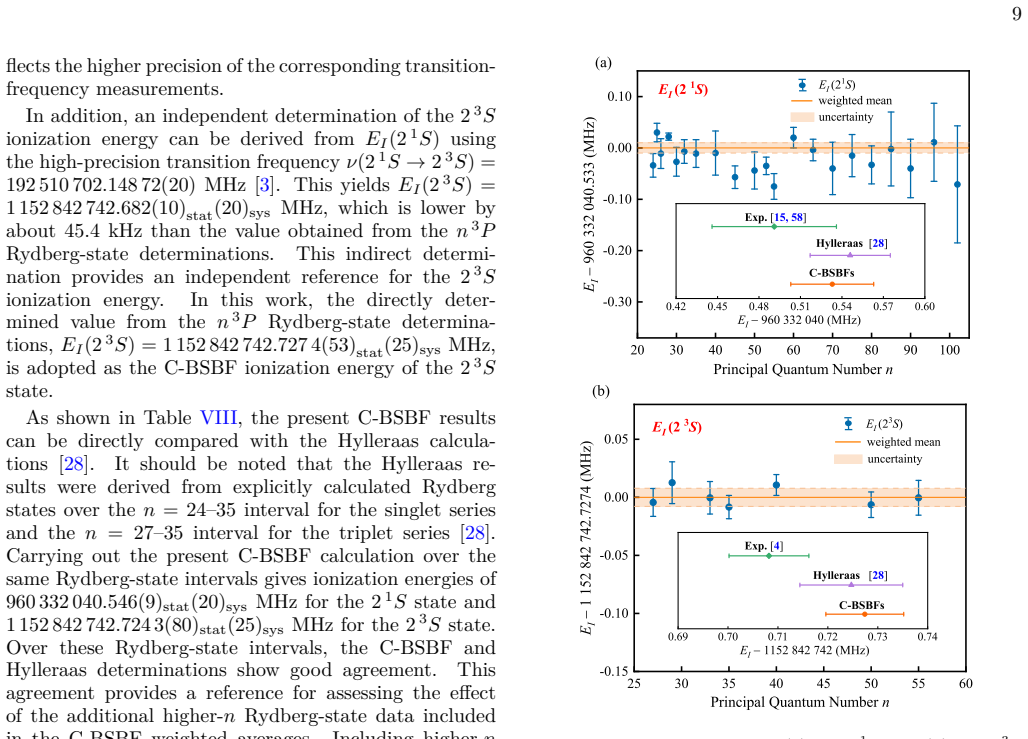
The ionization energies for Rydberg ^4He (1snp ^{1,3}P) states (n=24--35) have been computed using the correlated B-spline basis function method, including nonrelativistic, relativistic, and QED effects up to partial order m alpha^6 with 1/n^3 estimates for the rest. These energies achieve kHz-level accuracy and show excellent agreement with Hylleraas calculations. Quantum-defect parameters derived from them allow extrapolation to n=102. Combining the Rydberg ionization energies with experimental 2S to nP transition frequencies gives the ionization energy of the 2^1S state as 960332040.533(10)stat(20)sys MHz and of the 2^3S state as 1152842742.7274(53)stat(25)sys MHz, with the 2^1S result co
What carries the argument
The correlated B-spline basis function (C-BSBF) method, which uses a unified basis set to evaluate nonrelativistic energies together with relativistic and QED corrections for Rydberg helium states.
If this is right
- Quantum-defect parameters are determined from the calculated ionization energies.
- Ionization energies are extrapolated up to n=102 using the quantum-defect expansion.
- Ionization energies for the metastable 2^{1}S and 2^{3}S states are obtained by combining theoretical Rydberg energies with experimental transition frequencies.
- The C-BSBF results provide cross-validation with Hylleraas calculations.
- The 2^{1}S ionization energy is consistent with experimental Rydberg-series extrapolation, while the 2^{3}S shows a small difference of 0.019(10) MHz.
Where Pith is reading between the lines
- These high-precision values could serve as benchmarks for future QED calculations in few-electron systems.
- The method's success suggests it can be extended to other angular momentum states or higher n with similar accuracy.
- The discrepancy in the 2^3S energy points to a possible need for refined experimental measurements or inclusion of additional theoretical terms.
- Extrapolated energies to very high n may find use in precision spectroscopy or astrophysical modeling of helium.
Load-bearing premise
Higher-order QED contributions not explicitly calculated can be reliably estimated by simple 1/n^3 scaling.
What would settle it
An independent calculation or measurement showing disagreement larger than kHz level between the C-BSBF ionization energies and Hylleraas results for any of the n=24-35 states, or a direct measurement of the 2^3S ionization energy outside the reported uncertainty range.
Figures
read the original abstract
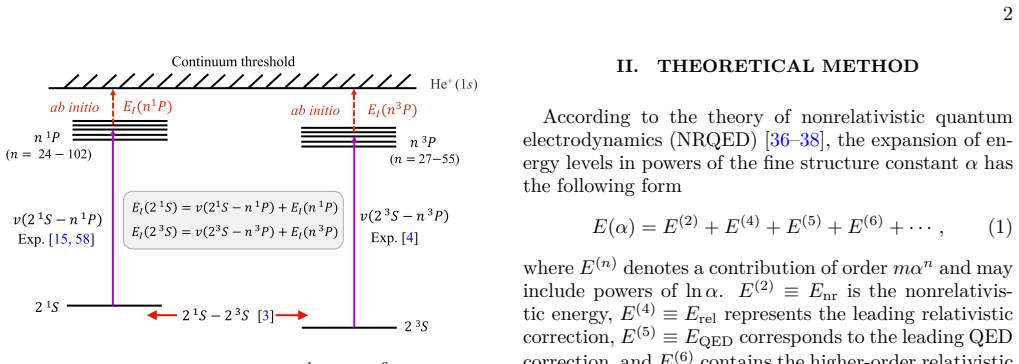
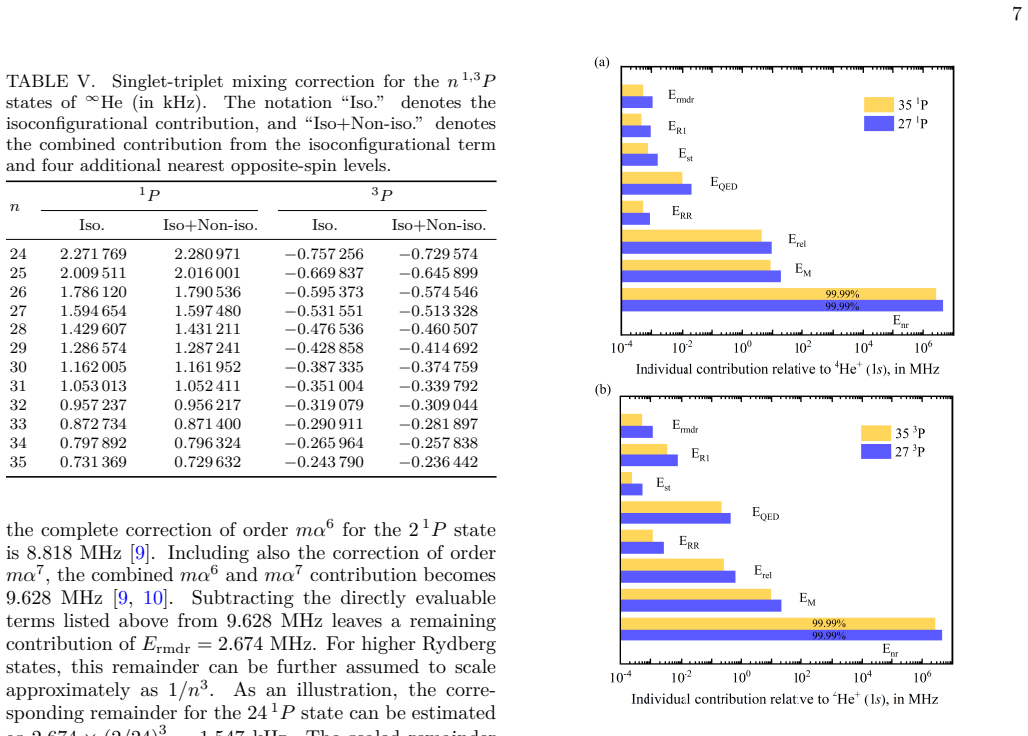
We extend the correlated B-spline basis function (C-BSBF) method to high-precision calculations of the ionization energies of helium Rydberg $n^{1,3}P$ states ($n=24$--$35$). Using a unified basis set, we evaluate nonrelativistic energies, relativistic corrections of order $m\alpha^4$ (including finite-mass recoil), QED contributions of order $m\alpha^5$, and partial $m\alpha^6$ terms (singlet-triplet mixing, one- and two-loop radiative corrections). The remaining higher-order contributions are estimated via $1/n^3$ scaling. The resulting ionization energies achieve kHz-level accuracy and are in excellent agreement with independent Hylleraas calculations, thereby providing cross-validation between two distinct theoretical approaches. From these data, the quantum-defect parameters are determined and used to extrapolate the ionization energies up to $n=102$. Combining our Rydberg ionization energies with high-precision experimental $2S \rightarrow nP$ transition frequencies yields the ionization energies for the metastable $2^{1}S$ and $2^{3}S$ states as \num{960332040.533(10)}$_\mathrm{stat}(20)_ \mathrm{sys}$ MHz and \num{1152842742.7274(53)}$_\mathrm{stat}(25)_ \mathrm{sys}$ MHz, respectively. The C-BSBF result for the $2 \, ^1 S$ state is consistent with the experimental ionization energy obtained from Rydberg-series extrapolation, while for the $2 \, ^3 S$ state the difference is 0.019(10) MHz.
Editorial analysis
A structured set of objections, weighed in public.
Referee Report
Summary. The manuscript extends the correlated B-spline basis function (C-BSBF) method to high-precision calculations of ionization energies for helium Rydberg 1snp ^{1,3}P states (n=24–35). Using a unified basis, it computes nonrelativistic energies, mα^4 relativistic corrections (including recoil), mα^5 QED terms, and partial mα^6 contributions (singlet-triplet mixing, one- and two-loop radiative), estimates remaining higher-order terms via 1/n^3 scaling, reports kHz-level accuracy with excellent agreement to independent Hylleraas results, determines quantum-defect parameters for extrapolation to n=102, and combines the Rydberg energies with experimental 2S→nP frequencies to derive ionization energies for the 2^1S and 2^3S metastable states as 960332040.533(10)stat(20)sys MHz and 1152842742.7274(53)stat(25)sys MHz, respectively, noting a 0.019 MHz difference for the triplet case.
Significance. If the kHz accuracy and error budgets hold, the work supplies valuable cross-validation between the C-BSBF and Hylleraas approaches for helium Rydberg states and delivers high-precision ionization energies for the metastable 2S states that can support precision spectroscopy and tests of QED in few-electron systems.
major comments (2)
- [Abstract] Abstract (paragraph on QED contributions): the kHz-level accuracy claim for the ionization energies and the derived 2^1S/2^3S values rests on estimating all remaining higher-order contributions via 1/n^3 scaling. For n=24–35 this scaling is applied to partial mα^6 and higher terms whose n-dependence is not guaranteed to be purely 1/n^3 (two-loop radiative or recoil corrections can contain 1/n^4 or logarithmic pieces); any mismatch propagates directly into the reported 10–25 kHz uncertainties and the 0.019 MHz triplet discrepancy.
- [Abstract] Abstract (final paragraph): the quantum-defect parameters are fitted to the computed energies and then used for extrapolation to n=102, but the manuscript does not demonstrate that the 1/n^3 scaling coefficient for omitted terms is independently constrained or that its uncertainty is folded into the final error budget.
minor comments (1)
- [Abstract] The abstract states that a 'unified basis set' is employed but provides no quantitative convergence data or basis-size dependence; these details are needed to substantiate the claimed precision.
Simulated Author's Rebuttal
We thank the referee for the careful review and constructive comments. We address each major comment below with our responses and indicate where revisions will be made.
read point-by-point responses
-
Referee: [Abstract] Abstract (paragraph on QED contributions): the kHz-level accuracy claim for the ionization energies and the derived 2^1S/2^3S values rests on estimating all remaining higher-order contributions via 1/n^3 scaling. For n=24–35 this scaling is applied to partial mα^6 and higher terms whose n-dependence is not guaranteed to be purely 1/n^3 (two-loop radiative or recoil corrections can contain 1/n^4 or logarithmic pieces); any mismatch propagates directly into the reported 10–25 kHz uncertainties and the 0.019 MHz triplet discrepancy.
Authors: The 1/n^3 scaling provides an estimate of the magnitude of the remaining uncomputed higher-order terms, consistent with the leading asymptotic behavior for Rydberg states. The partial mα^6 contributions we evaluate explicitly capture the dominant pieces, and the systematic uncertainties (10–25 kHz) are assigned conservatively to cover possible deviations from pure 1/n^3 scaling, including subleading 1/n^4 or logarithmic terms. The reported 0.019 MHz difference for the triplet state remains within the combined uncertainties. We will revise the manuscript to expand the discussion of the scaling assumption, reference the expected n-dependence of two-loop and recoil corrections, and clarify how these considerations enter the error budget. revision: partial
-
Referee: [Abstract] Abstract (final paragraph): the quantum-defect parameters are fitted to the computed energies and then used for extrapolation to n=102, but the manuscript does not demonstrate that the 1/n^3 scaling coefficient for omitted terms is independently constrained or that its uncertainty is folded into the final error budget.
Authors: The quantum-defect parameters are obtained from a fit to the full set of computed ionization energies (n=24–35), which already include the 1/n^3 estimates for omitted terms. The associated uncertainty is propagated through the extrapolation and incorporated into the reported systematic errors. We agree that an explicit demonstration would strengthen the presentation. In the revised manuscript we will add a dedicated paragraph detailing the fitting procedure and the propagation of the scaling uncertainty into the final error budget for the n=102 extrapolations. revision: yes
Circularity Check
No significant circularity; derivation is self-contained
full rationale
The paper directly computes nonrelativistic energies plus mα^4, mα^5 and partial mα^6 corrections in a unified C-BSBF basis for n=24–35, applies an explicit 1/n^3 estimate only to omitted higher-order pieces, fits quantum-defect parameters to those computed values solely for extrapolation to n=102, and subtracts the resulting Rydberg ionization energies from measured 2S–nP frequencies to obtain the 2¹S and 2³S values. None of these steps matches any enumerated circularity pattern: the 1/n^3 scaling is stated as an estimation rather than a derived equality, the quantum-defect fit is standard post-processing and does not rename or predict the input energies, and no load-bearing self-citation or uniqueness theorem is invoked. The central accuracy claim therefore rests on the basis-set evaluation and external experimental data, not on any reduction to its own fitted inputs.
Axiom & Free-Parameter Ledger
free parameters (1)
- 1/n^3 scaling coefficient for higher-order terms
axioms (2)
- domain assumption QED perturbation theory applies order-by-order up to mα^6 with finite-mass recoil included
- domain assumption A single unified B-spline basis suffices for nonrelativistic, relativistic, and QED contributions at kHz level
Reference graph
Works this paper leans on
-
[1]
Iso. ” denotes the isoconfigurational contribution, and “Iso+Non-iso
of ∞He are presented in Table I. The calculated results have converged to at least 14 significant digits. For comparison, high-accuracy values obtained using the Hylleraas basis [ 28] are also listed, and the present re- sults agree within the uncertainties. For lower principal quantum numbers ( n = 24 –27), the agreement is found to reach up to 18 signif...
-
[2]
van Rooij, J
R. van Rooij, J. S. Borbely, J. Simonet, M. D. Hooger- land, K. S. E. Eikema, R. A. Rozendaal, and W. Vassen, Frequency metrology in quantum degenerate helium: Di- rect measurement of the 2 3S1 → 2 1S0 transition, Science 333, 196 (2011)
2011
-
[3]
Zheng, Y
X. Zheng, Y. R. Sun, J.-J. Chen, W. Jiang, K. Pachucki, and S.-M. Hu, Measurement of the frequency of the 2 3S− 2 3P transition of 4He, Phys. Rev. Lett. 119, 263002 (2017)
2017
-
[4]
R. J. Rengelink, Y. Van Der Werf, R. P. M. J. W. Noter- mans, R. Jannin, K. S. E. Eikema, M. D. Hoogerland, and W. Vassen, Precision spectroscopy of helium in a magic wavelength optical dipole trap , Nat. Phys. 14, 1132 (2018)
2018
-
[5]
Clausen, K
G. Clausen, K. Gamlin, J. A. Agner, H. Schmutz, and F. Merkt, Metrology in a two-electron atom: The ioniza- tion energy of metastable triplet helium 2 3S1, Phys. Rev. A 111, 012817 (2025)
2025
-
[6]
Clausen and F
G. Clausen and F. Merkt, Ionization Energy of Metastable 3He (2 3S1) and the Alpha- and Helion- Particle Charge-Radius Difference from Precision Spec- troscopy of the np Rydberg Series , Phys. Rev. Lett. 134, 223001 (2025)
2025
-
[7]
Van Der Werf, K
Y. Van Der Werf, K. Steinebach, R. Jannin, H. L. Bethlem, and K. S. E. Eikema, Alpha and helion par- ticle charge radius difference determined from quantum- degenerate helium, Science 388, 850 (2025)
2025
-
[8]
Wen, J.-D
J.-L. Wen, J.-D. Tang, Y.-N. Lv, Y. R. Sun, C.-L. Zou, J.- F. Dong, and S.-M. Hu, Postselection shifts the transition frequency of helium in an atomic beam , Sci. Adv. 11, eadu9796 (2025)
2025
-
[9]
K. Steinebach, J. C. J. Koelemeij, H. L. Bethlem, and K. S. E. Eikema, Spectroscopy of 4He at 0.25 ppt Uncer- tainty and Improved Alpha-Helion Charge-Radius Differ- ence Determination , arXiv:2601.19444 (2026)
arXiv 2026
-
[10]
Pachucki, V
K. Pachucki, V. Patkóš, and V. A. Yerokhin, Testing fundamental interactions on the helium atom , Phys. Rev. A 95, 062510 (2017)
2017
-
[11]
Patkóš, V
V. Patkóš, V. A. Yerokhin, and K. Pachucki, Complete α7m Lamb shift of helium triplet states , Phys. Rev. A 103, 042809 (2021)
2021
-
[12]
Qi, P.-P
X.-Q. Qi, P.-P. Zhang, Z.-C. Yan, L.-Y. Tang, A.-X. Chen, T.-Y. Shi, and Z.-X. Zhong, Toward resolving the discrepancy in helium-3 and helium-4 nuclear charge radii, Phys. Rev. Res. 7, L022020 (2025)
2025
-
[13]
Pachucki, V
K. Pachucki, V. Patkóš, and V. A. Yerokhin, Second- order hyperfine correction to H, D, and 3He energy levels, Phys. Rev. A 110, 062806 (2024)
2024
-
[14]
Pachucki, V
K. Pachucki, V. Patkóš, and V. A. Yerokhin, QED nu- clear recoil effect in helium isotope shift , Phys. Rev. A 113, 012824 (2026)
2026
-
[15]
Zheng, Y
X. Zheng, Y. R. Sun, J.-J. Chen, W. Jiang, K. Pachucki, and S.-M. Hu, Laser spectroscopy of the fine-structure splitting in the 23PJ levels of 4He, Phys. Rev. Lett. 118, 063001 (2017)
2017
-
[16]
Clausen, P
G. Clausen, P. Jansen, S. Scheidegger, J. A. Agner, H. Schmutz, and F. Merkt, Ionization Energy of the Metastable 2 1S1 State of 4He from Rydberg-Series Ex- trapolation, Phys. Rev. Lett. 127, 093001 (2021)
2021
-
[17]
Clausen, S
G. Clausen, S. Scheidegger, J. A. Agner, H. Schmutz, and F. Merkt, Imaging-Assisted Single-Photon Doppler- Free Laser Spectroscopy and the Ionization Energy of Metastable Triplet Helium , Phys. Rev. Lett. 131, 103001 (2023)
2023
-
[18]
V. A. Yerokhin, V. Patkóš, M. Puchalski, and K. Pachucki, QED calculation of ionization energies of 1snd states in helium , Phys. Rev. A 102, 012807 (2020)
2020
-
[19]
Pachucki and V
K. Pachucki and V. A. Yerokhin, Helium fine structure theory for determination of α, J. Phys.: Conf. Ser. 264, 012007 (2011)
2011
-
[20]
Dorrer, F
C. Dorrer, F. Nez, B. de Beauvoir, L. Julien, and F. Biraben, Accurate measurement of the 2 3S1 − 3 3D1 two-photon transition frequency in helium: New determi- nation of the 2 3S1 lamb shift , Phys. Rev. Lett. 78, 3658 (1997)
1997
-
[21]
Luo, J.-L
P.-L. Luo, J.-L. Peng, J. Hu, Y. Feng, L.-B. Wang, and J.-T. Shy, Precision frequency measurements of 3,4He 2 3P → 3 3D transitions at 588 nm , Phys. Rev. A 94, 062507 (2016)
2016
-
[22]
G. W. F. Drake and Z.-C. Yan, Energies and relativistic corrections for the Rydberg states of helium: Variational results and asymptotic analysis , Phys. Rev. A 46, 2378 (1992)
1992
-
[23]
G. W. F. Drake, High precision theory of atomic helium , Phys. Scr. T83, 83 (1999)
1999
-
[24]
V. A. Yerokhin and K. Pachucki, Theoretical energies of low-lying states of light helium-like ions , Phys. Rev. A 81, 022507 (2010)
2010
-
[25]
D. T. Aznabaev, A. K. Bekbaev, and V. I. Korobov, Non- relativistic energy levels of helium atoms , Phys. Rev. A 98, 012510 (2018)
2018
-
[26]
Wu, S.-J
F.-F. Wu, S.-J. Yang, Y.-H. Zhang, J.-Y. Zhang, H.- X. Qiao, T.-Y. Shi, and L.-Y. Tang, Relativistic full- configuration-interaction calculations of magic wave- lengths for the 2 3S1 → 2 1S0 transition of helium iso- topes, Phys. Rev. A 98, 040501 (2018)
2018
-
[27]
G. W. F. Drake, ed., Springer Handbook of Atomic, Molecular, and Optical Physics , Springer Handbooks (Springer International Publishing, Cham, 2023)
2023
-
[28]
A. T. Bondy, G. W. F. Drake, C. McLeod, E. M. R. Petrimoulx, X.-Q. Qi, and Z.-X. Zhong, Theory for the Rydberg states of helium: Comparison with experiment for the 1s24p 1P1 state ( n = 24), Phys. Rev. A 111, L010803 (2025)
2025
-
[29]
G. W. F. Drake, A. T. Bondy, O. P. Hallett, and B. C. Najem, Theory for the Rydberg states of helium: Results for 2 ≤ n ≤ 35 and comparison with experiments for the singlet and triplet P states, Phys. Rev. A 113, 012810 (2026)
2026
-
[30]
Yang, X.-S
S.-J. Yang, X.-S. Mei, T.-Y. Shi, and H.-X. Qiao, Ap- plication of the Hylleraas- B-spline basis set: Static dipole polarizabilities of helium , Phys. Rev. A 95, 062505 (2017)
2017
-
[31]
Yang, Y.-B
S.-J. Yang, Y.-B. Tang, Y.-H. Zhao, T.-Y. Shi, and H.- X. Qiao, Application of the Hylleraas- B-spline basis set: Nonrelativistic bethe logarithm of helium , Phys. Rev. A 100, 042509 (2019)
2019
-
[32]
Fang, Y.-H
H. Fang, Y.-H. Zhang, P.-P. Zhang, and T.-Y. Shi, Ap- plication of the correlated B-spline basis functions to the leading relativistic and QED corrections of helium , Phys. Rev. A 108, 062818 (2023)
2023
-
[33]
Fang, Y.-H
H. Fang, Y.-H. Zhang, L.-Y. Tang, and T.-Y. Shi, Sub– 14 parts-per-million theoretical calculations of dipole polar- izabilities for helium n1,3S (n = 1 to 7) states using cor- related b-spline basis functions, Phys. Rev. A 110, 062823 (2024)
2024
-
[34]
J. Chi, H. Fang, Y.-H. Zhang, X.-Q. Qi, L.-Y. Tang, and T.-Y. Shi, Accurate nonrelativistic energy calculations for helium 1snp 1,3P (n = 2 to 27) states via correlated B- spline basis functions , Atoms 13, 72 (2025)
2025
-
[35]
H. Fang, J. Chi, X.-Q. Qi, Y.-H. Zhang, L.-Y. Tang, and T.-Y. Shi, Precise ab initio calculations of 4He (1snp 3PJ ) fine structure of high Rydberg states , Phys. Rev. A 113, 012812 (2026)
2026
-
[36]
P. J. Mohr, D. B. Newell, B. N. Taylor, and E. Tiesinga, CODATA recommended values of the fundamental physi- cal constants: 2022 , Rev. Mod. Phys. 97, 025002 (2025)
2022
-
[37]
Caswell and G
W. Caswell and G. Lepage, Effective lagrangians for bound state problems in QED, QCD, and other field the- ories, Phys. Lett. B 167, 437 (1986)
1986
-
[38]
Pachucki, Higher-order effective hamiltonian for light atomic systems , Phys
K. Pachucki, Higher-order effective hamiltonian for light atomic systems , Phys. Rev. A 71, 012503 (2005)
2005
-
[39]
Pachucki, Helium energy levels including mα6 correc- tions, Phys
K. Pachucki, Helium energy levels including mα6 correc- tions, Phys. Rev. A 74, 062510 (2006)
2006
-
[40]
Bachau, E
H. Bachau, E. Cormier, P. Decleva, J. E. Hansen, and F. Martín, Applications of B-splines in atomic and molec- ular physics , Rep. Prog. Phys. 64, 1815 (2001)
2001
-
[41]
D. M. Brink and G. R. Satchler, Angular Momentum (Oxford University Press, Oxford, New York, 1994)
1994
-
[42]
G. W. F. Drake, Angular integrals and radial recurrence relations for two-electron matrix elements in Hylleraas coordinates, Phys. Rev. A 18, 820 (1978)
1978
-
[43]
Pachucki and V
K. Pachucki and V. A. Yerokhin, Theory of the he- lium isotope shift , J. Phys. Chem. Ref. Data 44, 031206 (2015)
2015
-
[44]
Araki, Quantum-electrodynamical corrections to energy-levels of helium , Prog
H. Araki, Quantum-electrodynamical corrections to energy-levels of helium , Prog. Theor. Phys. 17, 619 (1957)
1957
-
[45]
Sucher, Energy levels of the two-electron atom to order α3 Ry; ionization energy of helium , Phys
J. Sucher, Energy levels of the two-electron atom to order α3 Ry; ionization energy of helium , Phys. Rev. 109, 1010 (1958)
1958
-
[46]
Schwartz, Lamb shift in the helium atom , Phys
C. Schwartz, Lamb shift in the helium atom , Phys. Rev. 123, 1700 (1961)
1961
-
[47]
Drake and S
G. Drake and S. P. Goldman, Bethe logarithms for Ps −, H−, and heliumlike atoms , Can. J. Phys. 77, 835 (2000)
2000
-
[48]
V. I. Korobov, Regular and singular integrals for relativis- tic and QED matrix elements of the coulomb three-body problem, for an exponential basis set , J. Phys. B: At. Mol. Opt. Phys. 35, 1959 (2002)
1959
-
[49]
R. J. Drachman, A new global operator for two-particle delta functions , J. Phys. B: At. Mol. Opt. Phys. 14, 2733 (1981)
1981
-
[50]
Pachucki and J
K. Pachucki and J. Komasa, Relativistic and QED correc- tions for the beryllium atom , Phys. Rev. Lett. 92, 213001 (2004)
2004
-
[51]
G. W. F. Drake, Unified relativistic theory for 1s2p 3P1 - 1s2 1 S0 and 1s2p 1P1 - 1s 2 1 S0 frequencies and transition rates in heliumlike ions , Phys. Rev. A 19, 1387 (1979)
1979
-
[52]
G. W. Drake, Theoretical energies for the n = 1 and 2 states of the helium isoelectronic sequence up to Z = 100 , Can. J. Phys. 66, 586 (1988)
1988
-
[53]
Yelkhovsky, QED corrections to singlet levels of the helium atom: A complete set of effective operators to mα6, Phys
A. Yelkhovsky, QED corrections to singlet levels of the helium atom: A complete set of effective operators to mα6, Phys. Rev. A 64, 062104 (2001)
2001
-
[54]
Pachucki, α4R corrections to singlet states of helium , Phys
K. Pachucki, α4R corrections to singlet states of helium , Phys. Rev. A 74, 022512 (2006)
2006
-
[55]
G. W. F. Drake, QED effects in helium and compar- isons with high precision experiment , Phys. Scr. 2001, 22 (2001)
2001
-
[56]
V. I. Korobov, Bethe logarithm for the helium atom , Phys. Rev. A 100, 012517 (2019)
2019
-
[57]
G. W. F. Drake, I. B. Khriplovich, A. I. Milstein, and A. S. Yelkhovsky, Energy corrections of order mc2α6lnα in helium , Phys. Rev. A 48, R15 (1993)
1993
-
[58]
M. Salman and J.-P. Karr, Photodetachment energy of negative hydrogen ions , arXiv:2601.04341 (2026)
arXiv 2026
-
[59]
G. B. Clausen, Precision spectroscopy in 3He and 4He: Rydberg states and ionization energies , Ph.D. thesis, ETH Zurich (2025)
2025
-
[60]
Wu and L.-B
M.-H. Wu and L.-B. Wang, Two-photon spectroscopy of helium 2 3S1-8 3D1,2,3 transitions at 544 nm with a 1.2 w compact laser system , Appl. Phys. B 130, 12 (2024)
2024
-
[61]
Wu and L.-B
M.-H. Wu and L.-B. Wang, Frequency measurement of the 2 3S1–8 3D1 two-photon transition in atomic 4He, Phys. Rev. A 111, 052809 (2025)
2025
-
[62]
G. W. F. Drake, Quantum defect theory and analysis of high-precision helium term energies , Adv. At. Mol. Opt. Phys. 32, 93 (1994)
1994
-
[63]
G. W. F. Drake and A. T. Bondy, Theory for the Rydberg states of helium: quantum defect extensions and compar- ison with experiment up to n = 102 for the singlet and triplet P-states , arXiv:2606.00814 (2026)
Pith/arXiv arXiv 2026
discussion (0)
Sign in with ORCID, Apple, or X to comment. Anyone can read and Pith papers without signing in.