Theory for the Rydberg states of helium: quantum defect extensions and comparison with experiment up to n = 102 for the singlet and triplet P-states
Pith reviewed 2026-06-28 17:36 UTC · model grok-4.3
The pith
Variational calculations extend quantum defect theory to confirm a 9σ discrepancy in the helium 1s2s triplet S ionization energy.
A machine-rendered reading of the paper's core claim, the machinery that carries it, and where it could break.
Core claim
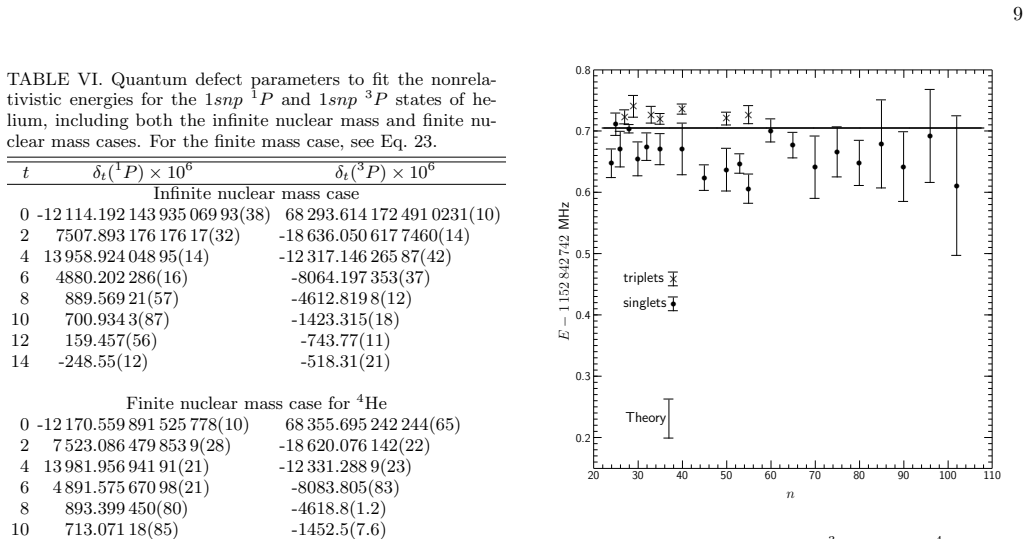
High precision variational calculations for helium in Hylleraas coordinates are used to obtain a combination of quantum defect expansions for the nonrelativistic energy and 1/n expansions for the relativistic and QED corrections. The extrapolations based on direct calculations for the singlet and triplet P-states up to n=35 provide ionization energies up to n=102 with accuracies better than ±1 kHz. The calculated ionization energies are combined with 28 measured transition frequencies to obtain the ionization energy of the 1s2s ^3S1 state as 1152842742.705(16) MHz, differing from theory by 0.474±0.052 MHz and confirming the 9σ disagreement.
What carries the argument
Quantum defect expansions for nonrelativistic energy combined with 1/n expansions for relativistic and QED corrections, fitted to variational calculations up to n=35 and extrapolated to higher n.
If this is right
- The nonrelativistic part justifies the effective reduced-mass Rydberg R_M^{(+)} model.
- Second-order mass polarization terms vary as 1/n^2 in lowest order.
- The Ritz expansion for the nonrelativistic energy holds to 20-figure accuracy.
- Experimental and theoretical values for the 1s2s ^3S1 ionization energy disagree at the 9 sigma level.
- The method allows precise predictions for high-n Rydberg states without direct computation.
Where Pith is reading between the lines
- If the discrepancy persists, it may indicate incomplete QED corrections in the theoretical ionization energy.
- Similar quantum defect extensions could resolve discrepancies in other atomic systems.
- Direct high-n calculations could test the extrapolation accuracy beyond n=35.
- The confirmation suggests the need for re-examination of experimental systematics in transition frequency measurements.
Load-bearing premise
The fitted quantum defect and 1/n expansions remain accurate to better than 1 kHz when extrapolated from n=35 to n=102 without unaccounted higher-order terms.
What would settle it
A new measurement of the 1s2s ^3S1 ionization energy with uncertainty below 0.05 MHz that matches the theoretical value instead of the extrapolated experimental one.
Figures
read the original abstract
High precision variational calculations for helium in Hylleraas coordinates are used to obtain a combination of quantum defect expansions for the nonrelativistic energy and $1/n$ expansions for the relativistic and quantum electrodynamic (QED) corrections. The extrapolations based on direct calculations for the singlet and triplet $P$-states up to principal quantum number $n = 35$ provide ionization energies of the $1snp\;^1P_1$ and $^3P_c$ (centroid) states up to $n=102$ with accuracies better than $\pm$1 kHz. The calculated ionization energies are combined with 28 measured transition frequencies to obtain values for the ionization energy of the $1s2s\;^3S_1$ state. The final result of 1152 842 742.705(16) MHz differs from theory by $0.474\pm 0.052$ MHz, and provides a strong confirmation of the 9$\sigma$ disagreement between theory and experiment obtained previously by quantum defect extrapolation of experimental data to the series limit. An analysis of the quantum defect method is presented, and second-order mass polarization (recoil) terms are identified that vary as $1/n^2$ in lowest order. The nonrelativistic part provides a theoretical justification for the effective reduced-mass Rydberg $R_M^{(+)}$ based on the phenomenological model of a Rydberg electron scattering from a He$^+$ core. The Ritz expansion for the nonrelativistic energy is verified to an unprecedented 20-figure accuracy.
Editorial analysis
A structured set of objections, weighed in public.
Referee Report
Summary. The manuscript uses high-precision variational Hylleraas calculations for helium singlet and triplet P-states up to n=35 to construct quantum defect expansions for the nonrelativistic energies and separate 1/n expansions for the relativistic and QED corrections. These expansions are extrapolated to n=102, yielding ionization energies claimed accurate to better than ±1 kHz. The theoretical values are combined with 28 measured transition frequencies to extract the ionization energy of the 1s2s ^3S1 state as 1152842742.705(16) MHz, which differs from theory by 0.474(52) MHz and confirms a prior 9σ discrepancy. The work also presents an analysis of the quantum defect method, identifies 1/n² recoil terms, justifies the effective reduced-mass Rydberg constant R_M^(+), and verifies the nonrelativistic Ritz expansion to 20-figure accuracy.
Significance. If the claimed extrapolation accuracy holds, the result supplies an independent route to the low-lying ionization energy that strengthens evidence for a theory-experiment discrepancy in helium. The 20-figure verification of the Ritz expansion and the explicit identification of second-order mass-polarization terms constitute clear technical advances that would be of lasting value to the field.
major comments (1)
- [Abstract and the section describing the 1/n expansions] Abstract and the section describing the 1/n expansions: the central claim that ionization energies at n=102 are known to ≲1 kHz (required to reach 16 kHz uncertainty on the 1s2s ^3S1 ionization energy) rests on relativistic/QED 1/n expansions fitted only to direct calculations up to n=35. No explicit convergence test, bound on omitted higher-order coefficients, or check for possible breakdown of the effective reduced-mass model beyond the identified 1/n² recoil terms is supplied; the quoted ±1 kHz figure therefore remains an internal fit uncertainty rather than a validated extrapolation error.
minor comments (1)
- [Abstract] The abstract states that the final result 'provides a strong confirmation' of the 9σ disagreement; a brief quantitative statement of how the new error budget compares with the previous quantum-defect extrapolation would improve clarity.
Simulated Author's Rebuttal
We thank the referee for the careful reading of the manuscript and for highlighting both its strengths and the need for stronger validation of the extrapolation uncertainties. We address the single major comment below.
read point-by-point responses
-
Referee: Abstract and the section describing the 1/n expansions: the central claim that ionization energies at n=102 are known to ≲1 kHz (required to reach 16 kHz uncertainty on the 1s2s ^3S1 ionization energy) rests on relativistic/QED 1/n expansions fitted only to direct calculations up to n=35. No explicit convergence test, bound on omitted higher-order coefficients, or check for possible breakdown of the effective reduced-mass model beyond the identified 1/n² recoil terms is supplied; the quoted ±1 kHz figure therefore remains an internal fit uncertainty rather than a validated extrapolation error.
Authors: We agree that the manuscript as submitted does not supply explicit convergence tests, bounds on omitted coefficients, or a dedicated check on the reduced-mass model at high n. In the revised version we will add (i) a table and accompanying text showing the variation of the n=102 extrapolated values when the number of fitted 1/n^k terms is changed from 3 to 5 and when the fitting range is restricted to n=20–35 versus n=15–35; (ii) an estimate of the truncation error obtained by taking the last included coefficient divided by the appropriate power of 35 and scaling to n=102; and (iii) a short paragraph quantifying the size of the identified 1/n² recoil corrections at n=102 relative to the 1 kHz target and arguing that higher-order recoil contributions remain negligible on the basis of the same asymptotic analysis already used for the leading terms. These additions will replace the internal-fit uncertainty with a documented extrapolation error. revision: yes
Circularity Check
No significant circularity; derivations independent of inputs
full rationale
The paper derives high-n ionization energies from variational Hylleraas calculations up to n=35 fitted to quantum defect and 1/n expansions, then combines the extrapolations with 28 external measured transition frequencies to extract the 1s2s ^3S1 ionization energy. This is compared to prior theory (not the paper's own fitted values). The abstract states the nonrelativistic Ritz expansion reaches 20-figure accuracy via direct verification, and the effective reduced-mass model receives theoretical justification from identified recoil terms. No equation or step reduces a claimed prediction to a fitted input by construction, and no load-bearing premise rests solely on overlapping-author self-citation. The work is self-contained against external experimental benchmarks.
Axiom & Free-Parameter Ledger
axioms (1)
- domain assumption Quantum defect expansions and 1/n expansions derived from n≤35 calculations remain accurate to kHz level at n=102
Forward citations
Cited by 1 Pith paper
-
Ionization energies for Rydberg $^4 \mathrm{He}$ ($1snp\,^{1,3}P$) states using the correlated B-spline basis function method
C-BSBF calculations yield kHz-accurate ionization energies for helium Rydberg states n=24-35 and derived 2^1S/2^3S values of 960332040.533(10)stat(20)sys MHz and 1152842742.7274(53)stat(25)sys MHz, with cross-validati...
Reference graph
Works this paper leans on
-
[1]
(approximately 70 decimal digits) is used. A com- plete calculation for the largest 8588-term basis set in dq precision takes approximately 20 hours on a workstation with a single cpu, including the calculation of derivatives ∂E/∂α p etc. III. RELA TIVISTIC AND QED CORRECTIONS the next step is to calculate the relativistic and QED corrections as expectati...
-
[2]
Ritz defect
or Korobov [29]. For ∆E(3) L,2, theQterm is defined by the improper in- tegral Q= 1 4π lim ϵ→0 ⟨r−3 12 (ϵ) + 4π(γ+ lnϵ)δ(r 12)⟩(17) whereϵis the radius of an infinitesimal sphere that is excluded from the range of integration, andγis Euler’s constant. Contributions of orderα 4 Ry have been calculated in their entirety for the 2 1P1 state by Pachucki et al...
2065
-
[3]
This extends the results obtained previously up to n= 35 [11], and raises the final result slightly from 1 152 842 742.7247(78)stat(25)sys to 1152 842 742.727(11) n E−1 152 842 742MHz 20 30 40 50 60 70 80 90 100 110 0.2 0.3 0.4 0.5 0.6 0.7 0.8 t t t t t t t t t t t t t t t t t t t t t p p p p p p p p p p p p p p p p p p p p p p p p p p p p p p p p p p p p...
-
[4]
The discrepancy is particularly puzzling since it is almost the same for the case of 3He [48], and it is not apparent in the 2 3S1 −2 1S0 isotope shift [15, 49]
of 0.474±0.052 MHz, wth experiment lying lower than theory. The discrepancy is particularly puzzling since it is almost the same for the case of 3He [48], and it is not apparent in the 2 3S1 −2 1S0 isotope shift [15, 49]. It therefore does not depend on the particular isotope or neutron number. In the absence of errors on the theoret- ical side, or unexpe...
-
[5]
Clausen, P
G. Clausen, P. Jansen, S. Scheidegger, J. A. Agner, H. Schmutz, and F. Merkt, Ionization energy of the metastable 2 1S0 state of 4He from Rydberg-series ex- trapolation, Phys. Rev. Lett.127, 093001 (2021)
2021
-
[6]
Clausen, K
G. Clausen, K. Gamlin, J. A. Agner, H. Schmutz, and F. Merkt, Metrology in a two-electron atom: The ionization energy of metastable triplet helium (2 3S1), Phys. Rev. A111, 012817 (2025)
2025
-
[7]
Pachucki, V
K. Pachucki, V. Patk´ os, and V. A. Yerokhin, Testing fundamental interactions on the helium atom, Phys. Rev. A95, 062510 (2017)
2017
-
[8]
Patk´ oˇ s, V.A
V. Patk´ oˇ s, V.A. Yerokhin and K. Pachucki, Complete mα7 Lamb shift of helium triplet states, Phys. Rev. A 103, 042809 (2021)
2021
-
[9]
Yan and G
Z.-C. Yan and G. W. F. Drake, High Precision Calcula- tion of Fine Structure Splittings in Helium and He-Like Ions, Phys. Rev. Lett.74, 4791 (1995)
1995
-
[10]
Pachucki, V
K. Pachucki, V. A. Yerokhin, and P. Cancio Pastor, Quantum electrodynamic calculation of the hyperfine structure of 3He, Phys. Rev. A85, 042517 (2012)
2012
-
[11]
Pachucki and V
K. Pachucki and V. A. Yerokhin, Fine Structure of He- liumlike Ions and Determination of the Fine Structure Constant, Phys. Rev. Lett.104, 070403 (2010)
2010
-
[12]
Zheng, Y
X. Zheng, Y. R. Sun, J.-J. Chen, W. Jiang, K. Pachucki, and S.-M. Hu, Laser Spectroscopy of the Fine-Structure Splitting in the 2 3PJ Levels of 4He, Phys. Rev. Lett. 118, 063001 (2017)
2017
-
[13]
K. Kato, T. D. G. Skinner, and E. A. Hessels, Ultrahigh- Precision Measurement of then= 2 TripletP J Fine Structure of Atomic Helium Using Frequency-Offset Sep- arated Oscillatory Fields, Phys. Rev. Lett.121, 143002 (2018)
2018
-
[14]
A. T. Bondy, G. W. F. Drake, C. Mcleod, E. M. R. Pet- rimoulx, X.-Q. Qi, Z.-X. Zhong, Theory for the Rydberg states of helium: Comparison with experiment for the 1s24p 1P1 state (n= 24), Phys. Rev. A111, L010803 (2025)
2025
-
[15]
G. W. F. Drake, A. T. Bondy, O. P. Hallett, and B. C. Najem, Theory for the Rydberg states of helium: Results for 2≤n≤35 and comparison with experiments for the singlet and triplet P states, Phys. Rev. A113, 012810 (2026)
2026
-
[16]
J. Chi, H. Fang, Y.-H. Zhang, X.-Q. Qi, L.-Y. Tang and T.-Y. Shi, Accurate Nonrelativistic Energy Calculations for Helium 1snp 1,3P(n= 2to27) States via Correlated B-Spline Basis Functions, Atoms13, 72 (2025)
2025
-
[17]
H. Fang, J. Chi,X.-Q. Qi, Y. H. Zhang, L.-Y. Tang, and T.-Y. Shi, Precise ab initio calculations of4He (1snp 3PJ) fine structure of high Rydberg states Phys. Rev. A113, 012812 (2026)
2026
-
[18]
R. J. Rengelink, Y. van der Werf, R. P. M. J. W. Noter- mans, R. Jannin, K. S. E. Eikema, M. D. Hoogerland, 12 TABLE IX. 1/n t expansion coefficientsc(X) t for the spin-independent matrix elements needed to calculate the relativistic and QED contributions to the energy for the 1snp 1Pand 1snp3Pstates of helium, and corresponding mass polarization coeffici...
1921
-
[19]
K. Steinebach, J. C. J. Koelemeij, H. L. Bethlem, and K. S. E. Eikema, Spectroscopy of 4He at 0.25 ppt Uncer- tainty and Improved Alpha-Helion Charge-Radius Differ- ence Determination, arXiv: 2601.19444 (2026)
arXiv 2026
-
[20]
Quantum defect theory and analysis of high precision helium term energies,
G. W. F. Drake, “Quantum defect theory and analysis of high precision helium term energies,” inAdvances in Atomic, Molecular and Optical Physics(Academic Press,
-
[21]
G. W. F. Drake and Z.-C. Yan, Energies and relativistic corrections for the Rydberg states of helium: Variational results and asymptotic analysis, Phys. Rev. A,46, 2378 (1992)
1992
-
[22]
G. W. F. Drake, New variational techniques for the 1snd states of helium, Phys. Rev. Lett.59, 1549 (1987)
1987
-
[23]
G. W. F. Drake and A. J. Makowski, High Precision eigenvalues for the 1s2p 1Pand 3Pstates of helium, J. Opt. Soc. Am. B,5, 2207 (1988)
1988
-
[24]
P. J. Mohr, D. B. Newell, B. N. Taylor, and E. Tiesinga, Codata recommended values of the fundamental physical constants: 2022, Rev. Mod. Phys.97, 025002 (2025)
2022
-
[25]
DQFUN: A double-quad precision pack- age with special functions, Available from https://www.davidhbailey.com/dhbsoftware/README- dqfun.txt [accessed: 2010-09-30]
2010
-
[26]
H. A. Bethe and E. E. Salpeter,Quantum Mechanics of One- and Two-Electron Atoms, (Springer, New York, 1957), p. 181
1957
-
[27]
A. P. Stone, Proc. Phys. Soc.77, 786 (1961);81, 868 (1963)
1961
-
[28]
P. K. Kabir and E. E. Salpeter, Radiative Corrections to the Ground-State Energy of the Helium Atom, Phys. Rev.108, 1256 (1957)
1957
-
[29]
Araki, Quantum-Electrodynamical Corrections to Energy-Levels of Helium, Prog
H. Araki, Quantum-Electrodynamical Corrections to Energy-Levels of Helium, Prog. Theo. Phys.17, 619 (1957)
1957
-
[30]
Sucher, Energy Levels of the Two-Electron Atom to Orderα 3 Ry; Ionization Energy of Helium Phys
J. Sucher, Energy Levels of the Two-Electron Atom to Orderα 3 Ry; Ionization Energy of Helium Phys. Rev. 109, 1010 (1958)
1958
-
[31]
Yan and G
Z.-C. Yan and G. W. F. Drake, Bethe Logarithm and QED Shift for Lithium, Phys. Rev. Lett.91, 113004 (2003)
2003
-
[32]
Pachucki and J
K. Pachucki and J. Komasa, Relativistic and QED Cor- rections for the Beryllium Atom, Phys. Rev. Lett.92, 213001 (2004)
2004
-
[33]
V. I. Korobov, Bethe logarithm for the helium atom, Phys. Rev. A100, 012517 (2019)
2019
-
[34]
Lesiuk and J
M. Lesiuk and J. Lang, Atomic Bethe logarithm in the 13 TABLE X. 1/n t expansion coefficientsc(X) t for the spin- dependent matrix elements needed to calculate the relativis- tic contributions to the energy for the 1snp 3Pstates of he- lium, and correspondingµ/Mmass polarization coefficients c(X) (1) t . Units areα 2 atomic units. t c(H so)c(H soo)c(H ss)...
2023
-
[35]
G. W. F. Drake, QED Effects in Helium and Compar- isons with High Precision Experiment, Phys. Scr.T95, 22 (2001)
2001
-
[36]
Pachucki, V
K. Pachucki, V. Lensky, F. Hagelstein, S. S. L. Muli, S. Bacca, and R. Pohl, Comprehensive theory of the Lamb shift in light muonic atoms Rev. Mod. Phys.96, 015001 (2024)
2024
-
[37]
Further tables of matrix elements for alln Pstates of helium with 2≤n≤35 are available at DOI: 10.5061/dryad.cjsxksnkv
-
[38]
Edl´ en, Atomic spectra, inEncyclopedia of Physics,27, 80 (Springer-Verlag, Berlin, 1964)
B. Edl´ en, Atomic spectra, inEncyclopedia of Physics,27, 80 (Springer-Verlag, Berlin, 1964)
1964
-
[39]
M. J. Seaton, Quantum Defect Theory, Rep. Prog. Phys. 46, 167 (1983)
1983
-
[40]
Jungen, Elements of Quantum Defect Theory, in Handbook of High-resolution Spectroscopy, Edited by M
C. Jungen, Elements of Quantum Defect Theory, in Handbook of High-resolution Spectroscopy, Edited by M. Quack and F. Merkt, (John Wiley & Sons, Ltd., Chich- ester, UK., 2011)
2011
-
[41]
D. R. Hartree, The Wave Mechanics of an Atom with a non-Coulomb Central Field. Part III. Term Values and Intensities in Series in Optical Spectra, Cambridge Phi- los. Soc.,24, 426 (1028)
-
[42]
R. M. Langer, A Generalization of the Rydberg Formula, Phys. Rev.35, 649 (1930)
1930
-
[43]
G. W. F. Drake, Quantum Defect Theory and Analysis of High-Precision Helium Term Energies, Adv. At. Mol. Opt. Phys.32, 93 (1994)
1994
-
[44]
M. J. Seaton, Quantum defect theory II: Illustrative one- channel and two-channel problems, Proc. Phys. Soc.88, 815 (1966)
1966
-
[45]
G. W. F. Drake and R. A. Swainson, Quantum defects and the 1/ndependence of Rydberg energies: Second- order polarization effects, Phys. Rev. A44, 5448 (1991)
1991
-
[46]
W. R. Johnson and K. T. Cheng, Quantum defects for highly stripped ions, J. Phys. B: At. Mol. Phys.12, 863 (1979)
1979
-
[47]
D. M. Jacobs, Relativistic Ritz approach to hydrogenlike atoms: Theoretical considerations, Phys. Rev. A106, 062810 (2022)
2022
-
[48]
R. J. Drachman, Rydberg states of helium: Nuclear- recoil corrections, Phys. Rev. A33, 2780 (1986)
1986
-
[49]
DISS. ETH NO. 31047 G. Clausen, Precision spec- troscopy in 3He and 4He: Rydberg states and ioniza- tion energies, Ph.D. Dissertation (ETH Zurich No. 31047, 2025)
2025
-
[50]
Clausen and F
G. Clausen and F. Merkt, private communication
-
[51]
Wu and L.-B
M.-H. Wu and L.-B. Wang, Frequency measurement of the 2 3S18 3D1 two-photon transition in atomic 4He, Phys. Rev. A111, 052809 (2025)
2025
-
[52]
Clausen and F
G. Clausen and F. Merkt, Ionization Energy of Metastable 3He (2 3S1) and the Alpha- and Helion- Particle Charge-Radius Difference from Precision Spec- troscopy of thenpRydberg Series, Phys. Rev. Lett.134, 223001 (2025)
2025
-
[53]
van der Werf, K
Y. van der Werf, K. Steinebach, R. Jannin, H. L. Beth- lem, and K. S. E. Eikema, Alpha and helion parti- cle charge radius difference determined from quantum- degenerate helium, Science,388, 850, 854 (2025)
2025
-
[54]
L. Cong, F. Ficek, R. Abdullin, M. G. Kozlov, and D. Budker, Testing Exotic Electron Electron Interactions with the Helium Ionization-Energy Anomaly, Phys. Rev. A, submitted (1926)
1926
-
[55]
V. A. Yerokhin, V. Patk´ oˇ s, and K. Pachucki, QEDmα7 effects for triplet states of heliumlike ions, Phys. Rev. A 107, 012810 (2023)
2023
-
[56]
J. Chi, H. Fang, Y.-H. Zhang L.-Y. Tang, and T.-Y. Shi, Ionization energies for Rydberg 4He (1snp 1,3P) states using the correlated B-spline basis function method, Phys. Rev. A. submitted. 14 TABLE XI. Ionization energy of the 1s2s 1S0 state of 4He withI tot(2 1S0) =ν exp(2 1S0 −n 1P1) +I theo(n 1P1). The last column gives ˜Itot(2 3S1) obtained by adding ...
1919
discussion (0)
Sign in with ORCID, Apple, or X to comment. Anyone can read and Pith papers without signing in.