Photoelectron spectroscopy with a resonant dichromatic field: Role of geometric phase
Pith reviewed 2026-06-28 02:58 UTC · model grok-4.3
The pith
Beating dichromatic fields control geometric phases that shape photoelectron spectra via interference in two-level atoms.
A machine-rendered reading of the paper's core claim, the machinery that carries it, and where it could break.
Core claim
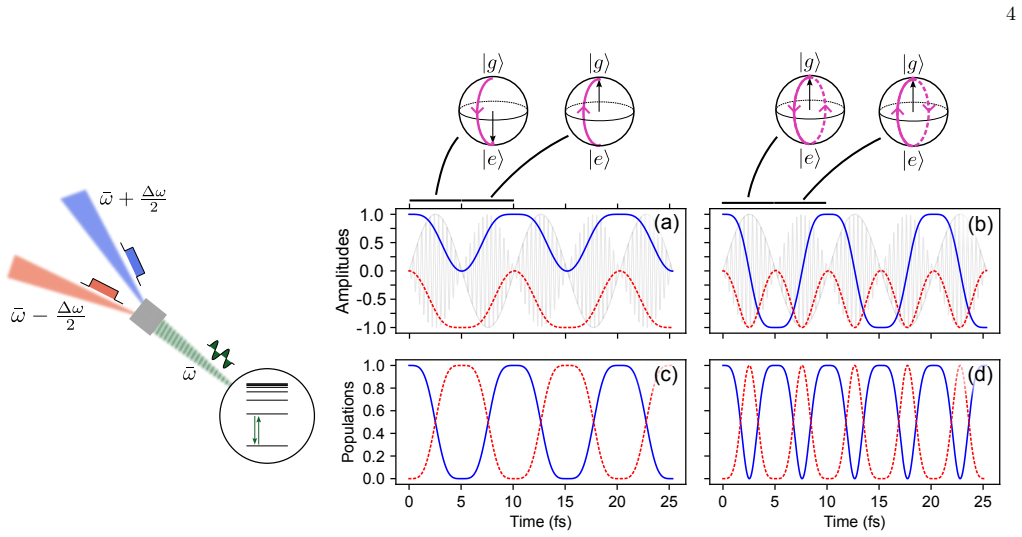
In resonantly driven two-level atoms exposed to near-degenerate dichromatic laser pulses, the formation of Autler-Townes doublets is interpreted as destructive interference associated with geometric phases acquired during completed pseudo-spin rotations. The slowly varying beating envelope generates beat-induced reversal dynamics that lead to qualitatively different spectral structures, including re-emergent central peaks and higher-order sidebands. These effects arise from the nonuniform temporal evolution induced by the beating envelope, which modifies the balance between positive and negative excitation amplitudes.
What carries the argument
Beat-induced reversal dynamics of the pseudo-spin on the Bloch sphere that control accumulation of geometric phase and modify excitation amplitude balance.
If this is right
- Autler-Townes doublets arise specifically from destructive interference tied to geometric phases in completed pseudo-spin rotations.
- The beating envelope produces re-emergent central peaks and higher-order sidebands outside the canonical regime.
- Nonuniform temporal evolution from the beating modifies the balance between positive and negative excitation amplitudes.
- Beating-field control provides a route to engineering geometric-phase interference in light-matter interactions.
Where Pith is reading between the lines
- Varying the frequency separation of the dichromatic components would tune the beat period and thereby select specific numbers of reversals and resulting interference patterns.
- The same reversal mechanism could be tested for controlling ionization yields in molecular or x-ray-driven systems where similar two-level approximations hold.
- Pulse-shape deviations from flat-top might be used as a diagnostic to isolate the contribution of the geometric-phase interference.
Load-bearing premise
The exactly solvable model for flat-top pulse envelopes captures the essential-state dynamics and photoionization without major contributions from non-flat envelopes or multi-level effects.
What would settle it
Photoelectron spectra that fail to exhibit re-emergent central peaks or higher-order sidebands at predicted beating frequencies and pulse durations would contradict the beat-induced reversal mechanism.
Figures
read the original abstract
We investigate geometric-phase control in resonantly driven two-level atoms exposed to near-degenerate dichromatic laser pulses. In contrast to conventional two-color schemes based on widely separated frequencies, the closely spaced frequency components generate a slowly varying beating envelope that repeatedly reverses the pseudo-spin rotation on the Bloch sphere. This enables coherent control of the geometric phase accumulated during Rabi dynamics and strongly modifies the resulting photoelectron spectra. Using an exactly solvable model for flat-top pulse envelopes, we derive the essential-state dynamics analytically and analyze photoionization induced both by an auxiliary field and by the dichromatic driving field itself. We show that the formation of Autler--Townes doublets can be interpreted in terms of destructive interference associated with geometric phases acquired during completed pseudo-spin rotations. Beyond the canonical Autler--Townes regime, beat-induced reversal dynamics lead to qualitatively different spectral structures, including re-emergent central peaks and higher-order sidebands. These effects originate from the nonuniform temporal evolution induced by the beating envelope, which modifies the balance between positive and negative excitation amplitudes. Our results establish beating-field control as a route toward engineering geometric-phase interference in ultrafast light--matter interactions and suggest broader applications in coherent control of atoms, molecules, and x-ray-driven systems.
Editorial analysis
A structured set of objections, weighed in public.
Referee Report
Summary. The manuscript develops an exactly solvable analytical model for the dynamics and photoelectron spectra of a resonantly driven two-level atom exposed to a near-degenerate dichromatic field with flat-top envelopes. It interprets the formation of Autler-Townes doublets as arising from destructive interference due to geometric phases accumulated during completed pseudo-spin rotations on the Bloch sphere, and shows that beat-induced reversal dynamics produce qualitatively new features including re-emergent central peaks and higher-order sidebands.
Significance. If the results hold within the stated model, the work supplies an analytical, parameter-free derivation linking geometric-phase interference to observable spectral structures, which is a clear strength. This offers a new route to coherent control via beating envelopes and could inform ultrafast light-matter interactions, provided the flat-top assumptions are appropriately scoped or extended.
major comments (1)
- [Abstract and essential-state dynamics section] Abstract and the section on essential-state dynamics: the central claims (Autler-Townes interpretation via geometric phase and the emergence of re-emergent central peaks/higher-order sidebands) are derived exactly only for flat-top envelopes that produce completed pseudo-spin trajectories. The manuscript provides no numerical validation or analytic extension to smooth (non-flat) envelopes, where the instantaneous Rabi frequency varies continuously during turn-on/turn-off; this directly affects whether the predicted balance between positive and negative excitation amplitudes, and thus the new spectral structures, survives. This is load-bearing for the suggested broader applications in ultrafast spectroscopy.
minor comments (2)
- Clarify the precise definition of the dichromatic field amplitudes and detuning parameters in the Hamiltonian to ensure the exactly solvable condition is transparent.
- Add a brief statement on the range of validity of the essential-state approximation with respect to multi-level effects or decoherence, even if only to bound the model.
Simulated Author's Rebuttal
We thank the referee for the careful reading of the manuscript and the constructive comment. We respond point by point below.
read point-by-point responses
-
Referee: [Abstract and essential-state dynamics section] Abstract and the section on essential-state dynamics: the central claims (Autler-Townes interpretation via geometric phase and the emergence of re-emergent central peaks/higher-order sidebands) are derived exactly only for flat-top envelopes that produce completed pseudo-spin trajectories. The manuscript provides no numerical validation or analytic extension to smooth (non-flat) envelopes, where the instantaneous Rabi frequency varies continuously during turn-on/turn-off; this directly affects whether the predicted balance between positive and negative excitation amplitudes, and thus the new spectral structures, survives. This is load-bearing for the suggested broader applications in ultrafast spectroscopy.
Authors: We agree that the exact analytic results, including the geometric-phase interpretation of Autler-Townes doublets and the emergence of re-emergent central peaks and higher-order sidebands, hold specifically for flat-top envelopes that enable completed pseudo-spin trajectories. The manuscript states this scope explicitly and does not claim an analytic extension or provide numerical validation for smooth envelopes, where the time-varying Rabi frequency during turn-on/turn-off would generally preclude exact completion of the rotations. The balance between positive and negative amplitudes is a direct consequence of the flat-top assumption. We will revise the abstract and essential-state dynamics section to more explicitly delineate the model's assumptions and to indicate that extensions to smooth pulses, while relevant for broader applications, lie outside the current exactly solvable treatment. The flat-top model nonetheless isolates the essential mechanism of beat-induced reversals and geometric-phase interference. revision: partial
- Whether the predicted spectral structures survive for smooth (non-flat) envelopes cannot be answered analytically within the present framework and would require separate numerical investigation.
Circularity Check
No significant circularity; analytic derivation from exactly solvable flat-top model is self-contained
full rationale
The paper derives Autler-Townes doublet formation and beat-induced sideband structures directly from an exactly solvable model for flat-top envelopes (abstract and essential-state dynamics section). These outcomes are presented as consequences of the model's equations rather than inputs or fitted parameters. No self-citation chains, ansatz smuggling, or renaming of known results are load-bearing in the provided text. The geometric-phase interpretation follows from the pseudo-spin trajectories in the model, not by definition. External validity for non-flat envelopes is a separate modeling assumption, not a circularity issue.
Axiom & Free-Parameter Ledger
axioms (2)
- domain assumption The driven system is accurately described by a two-level atom under resonant dichromatic driving
- domain assumption Flat-top pulse envelopes permit an exactly solvable model of the essential-state dynamics
Reference graph
Works this paper leans on
-
[1]
Rabi dynamics
The dressed states|±⟩satisfy the eigenvalue equation, H|±⟩=± Ω 2 |±⟩,(4) whereH aa =H bb = 0 andH ab =H ba = Ω/2. The Rabi frequency is chosen as real, Ω =E 0zab, wherez andE 0 are dipole element and electric field amplitudes, respectively. It is easy to show that the phases of a Rabi cycling atom are of geometric nature. We simply insert Eq. (3) into Eq....
-
[2]
(19) in Eq
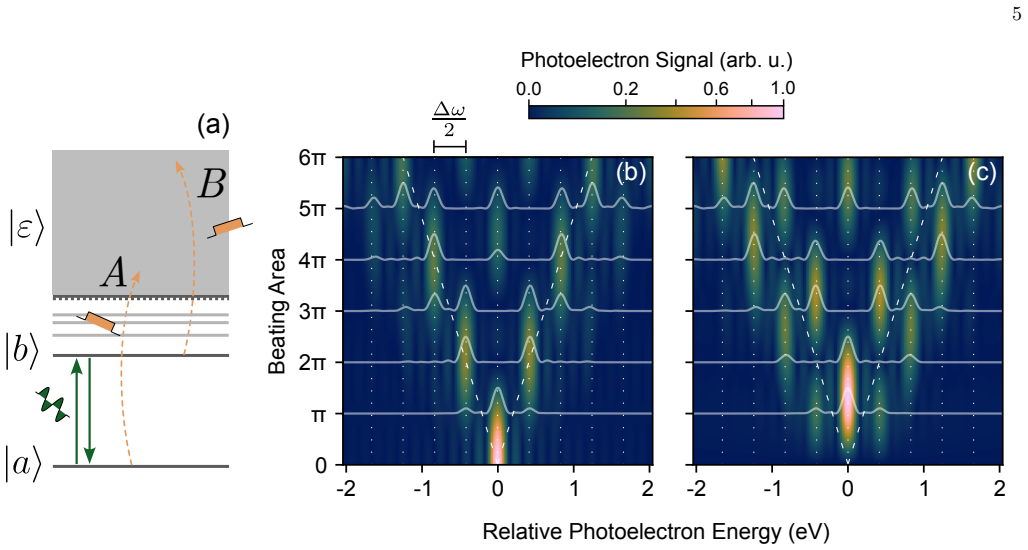
Ground-state ionization To attain the photoelectron spectra ionized from the ground state we insert Eq. (19) in Eq. (16) γ(a)(ε) =γ (a) 0 + 2 ∞X n=1 γ(a) n ,(23) where γ(a) n =a n Z T 0 dt′ cos n∆ω 2 t′ eiεt′ .(24) Similarly, the photoelectron spectrum corresponding to the excited state,|γ (b)(ε, t)|2, is obtained by subsituting aforbin Eqs. (23) and (24)...
-
[3]
Excited-state ionization The photoelectron spectrum ionized from the excited state,|γ (b)(ε, t)|2, is presented in Fig. 2(c). In this case, the spectral behaviour follows a similar trend, but is shifted to larger beating area. The first splitting occurs around 3π-beating area. This can be understood directly from the dynamics of the excited-state amplitud...
-
[4]
An explicit expression for the photoionization spectra is obtained by injecting Eq
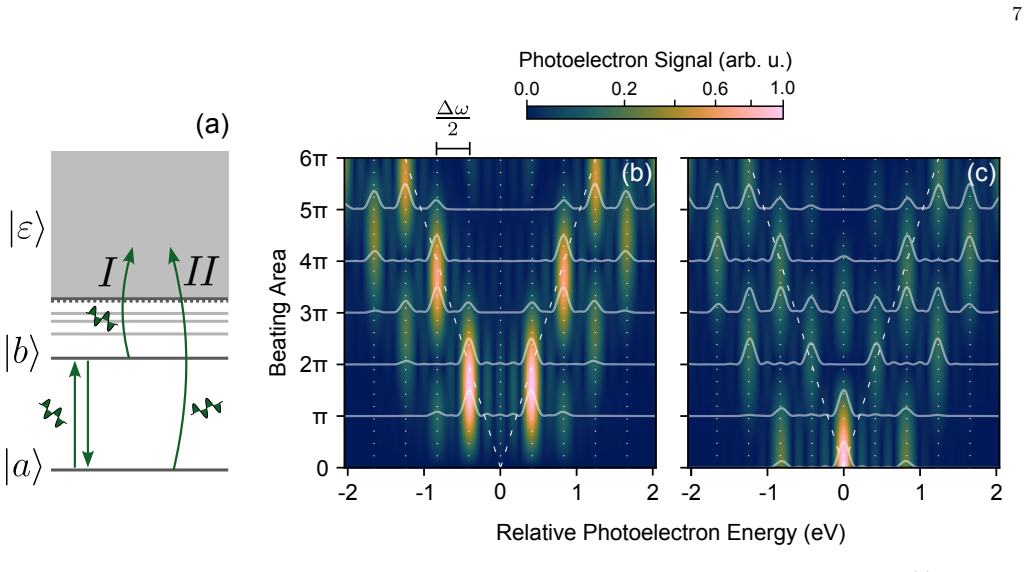
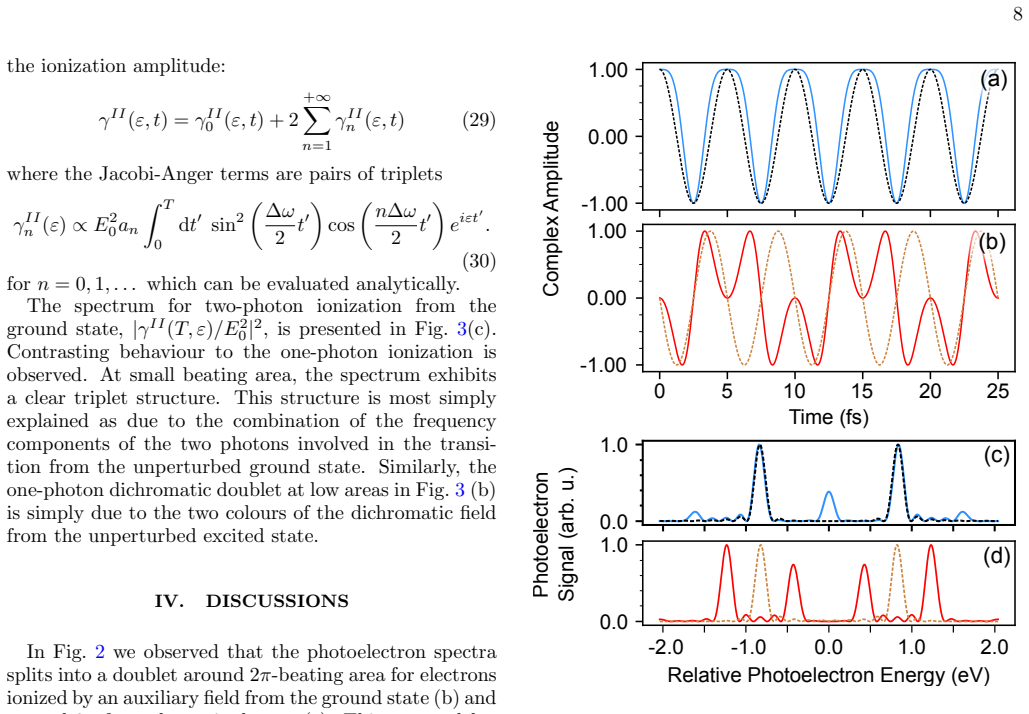
First-order dichromatic ionization The one-photon ionization from the excited state is given by γI(ε)∝E 0 Z T 0 dt′ sin ∆ω 2 t′ b(t′)eiεt′ ,(25) which is the Fourier transform of the ground state am- plitude split up by the dichromatic parameter,±∆ω/2. An explicit expression for the photoionization spectra is obtained by injecting Eq. (21) into Eq. (25) y...
-
[5]
Second-order dichromatic ionization For the second-order dichromatic correction, two- photon ionization from the ground state is considered. Second-order ionization from the excited state is also pos- sible, but this leads to higher energy photoelectrons via above-threshold ionization, which is beyond the scope of the present analytical work. After adiaba...
arXiv 2024
-
[6]
R. P. Feynman, F. L. Vernon, and R. W. Hellwarth, Geo- metrical Representation of the Schr¨ odinger Equation for Solving Maser Problems, Journal of Applied Physics28, 49 (1957)
1957
-
[7]
Rauch, A
H. Rauch, A. Zeilinger, G. Badurek, A. Wilfing, W. Baus- piess, and U. Bonse, Verification of coherent spinor rota- tion of fermions, Physics Letters A54, 425 (1975)
1975
-
[8]
Nogues, A
G. Nogues, A. Rauschenbeutel, S. Osnaghi, M. Brune, J. M. Raimond, and S. Haroche, Seeing a single photon without destroying it, Nature400, 239 (1999)
1999
-
[9]
Berry, The Geometric Phase, Sci Am259, 46 (1988)
M. Berry, The Geometric Phase, Sci Am259, 46 (1988)
1988
-
[10]
A. J. Uzan-Narovlanskyet al., Observation of interband Berry phase in laser-driven crystals, Nature626, 66 (2024)
2024
-
[11]
X. Mi, M. Zhang, L. Zhang, C. Wu, T. Zhou, H. Xu, C. Xie, Z. Li, and Y. Liu, Geometric Phase Effect in Attosecond Stimulated X-ray Raman Spectroscopy, The Journal of Physical Chemistry A127, 3608 (2023)
2023
-
[12]
Wollenhaupt, A
M. Wollenhaupt, A. Pr¨ akelt, C. Sarpe-Tudoran, D. Liese, and T. Baumert, Quantum control by selective popula- tion of dressed states using intense chirped femtosecond laser pulses, Appl. Phys. B82, 183 (2006)
2006
-
[13]
Wollenhaupt, A
M. Wollenhaupt, A. Assion, O. Bazhan, C. Horn, D. Liese, C. Sarpe-Tudoran, M. Winter, and T. Baumert, Control of interferences in an Autler-Townes doublet: Symmetry of control parameters, Phys. Rev. A68, 015401 (2003)
2003
-
[14]
Bayer, K
T. Bayer, K. Eickhoff, D. K¨ ohnke, and M. Wollenhaupt, Bichromatic phase control of interfering Autler-Townes spectra, Phys. Rev. A109, 033111 (2024)
2024
-
[15]
Knight, Saturation and rabi oscillations in resonant multiphoton ionization, Optics Communications22, 173 (1977)
P. Knight, Saturation and rabi oscillations in resonant multiphoton ionization, Optics Communications22, 173 (1977)
1977
-
[16]
Knight, The origin of quantum beats in photoioniza- tion, Optics Communications32, 261 (1980)
P. Knight, The origin of quantum beats in photoioniza- tion, Optics Communications32, 261 (1980)
1980
-
[17]
Nandiet al., Observation of Rabi dynamics with a short-wavelength free-electron laser, Nature608, 488 (2022)
S. Nandiet al., Observation of Rabi dynamics with a short-wavelength free-electron laser, Nature608, 488 (2022)
2022
-
[18]
Zhang, Y
X. Zhang, Y. Zhou, Y. Liao, Y. Chen, J. Liang, Q. Ke, M. Li, A. Csehi, and P. Lu, Effect of nonresonant states in near-resonant two-photon ionization of hydrogen, Physi- cal Review A106, 063114 (2022)
2022
-
[19]
Csehi, Exact analytic characterization of the Autler- Townes doublet via the extended semiclassical Rabi model, Physical Review A113, 033121 (2026)
A. Csehi, Exact analytic characterization of the Autler- Townes doublet via the extended semiclassical Rabi model, Physical Review A113, 033121 (2026)
2026
-
[20]
B. L. Beers and L. Armstrong, Exact solution of a realis- tic model for two-photon ionization, Physical Review A 12, 2447 (1975)
1975
-
[21]
Olofsson and J
E. Olofsson and J. M. Dahlstr¨ om, Photoelectron signa- ture of dressed-atom stabilization in an intense XUV field, Physical Review Research5, 043017 (2023)
2023
-
[22]
Richteret al., Strong-field quantum control in the extreme ultraviolet domain using pulse shaping, Nature 636, 337 (2024)
F. Richteret al., Strong-field quantum control in the extreme ultraviolet domain using pulse shaping, Nature 636, 337 (2024)
2024
-
[23]
T. M. Linkeret al., Attosecond inner-shell lasing at ˚ angstr¨ om wavelengths, Nature642, 934 (2025)
2025
-
[24]
Grobe and J
R. Grobe and J. H. Eberly, Observation of coherence transfer by electron-electron correlation, Physical Review A48, 623 (1993)
1993
-
[25]
K. L. Ishikawa, K. C. Prince, and K. Ueda, Control of Ion-Photoelectron Entanglement and Coherence Via Rabi Oscillations, The Journal of Physical Chemistry A 127, 10638 (2023)
2023
-
[26]
Nandiet al., Generation of entanglement using a short-wavelength seeded free-electron laser, Sci
S. Nandiet al., Generation of entanglement using a short-wavelength seeded free-electron laser, Sci. Adv.10, eado0668 (2024)
2024
-
[27]
Jiang, M.-C
W.-C. Jiang, M.-C. Zhong, Y.-K. Fang, S. Donsa, I. Bˇ rezinov´ a, L.-Y. Peng, and J. Burgd¨ orfer, Time De- lays as Attosecond Probe of Interelectronic Coherence and Entanglement, Physical Review Letters133, 163201 (2024)
2024
-
[28]
Stenquist and J
A. Stenquist and J. M. Dahlstr¨ om, Harnessing time sym- metry to fundamentally alter entanglement in photoion- ization, Phys. Rev. Research7, 013270 (2025)
2025
-
[29]
Stenquist, J
A. Stenquist, J. N. Bruhnke, F. Zapata, and J. M. Dahlstr¨ om, Entanglement transfer in a composite elec- tron–ion–photon system, Rep. Prog. Phys.88, 080502 (2025)
2025
-
[30]
S. B. Zhang and N. Rohringer, Photoemission spec- troscopy with high-intensity short-wavelength lasers, Phys. Rev. A89, 013407 (2014)
2014
-
[31]
Yu and L
C. Yu and L. B. Madsen, Core-resonant ionization of he- lium by intense XUV pulses: Analytical and numerical studies on channel-resolved spectral features, Phys. Rev. A98, 033404 (2018)
2018
-
[32]
Cruz-Rodriguez, D
L. Cruz-Rodriguez, D. Dey, A. Freibert, and P. Stam- mer, Quantum phenomena in attosecond science, Nat Rev Phys6, 691 (2024). 10
2024
-
[33]
Heet al., Coherently driving a single quantum two- level system with dichromatic laser pulses, Nat
Y.-M. Heet al., Coherently driving a single quantum two- level system with dichromatic laser pulses, Nat. Phys.15, 941 (2019)
2019
-
[34]
Jiang, H
W.-C. Jiang, H. Liang, S. Wang, L.-Y. Peng, and J. Burgd¨ orfer, Enhancing Autler-Townes splittings by ultrafast XUV pulses, Physical Review Research3, L032052 (2021)
2021
-
[35]
Zhang, Y
X. Zhang, Y. Liao, Y. Chen, M. Yu, S. Li, M. He, K. Liu, P. Lu, and Y. Zhou, Monitoring the ultrafast buildup of Rabi oscillations in the time domain, Physical Review A 109, 063102 (2024)
2024
-
[36]
Y. Liao, E. Olofsson, J. M. Dahlstr¨ om, L.-W. Pi, Y. Zhou, and P. Lu, Circularly polarized RABBITT ap- plied to a Rabi-cycling atom, Physical Review A109, 043104 (2024)
2024
-
[37]
Anandan, The geometric phase, Nature360, 307 (1992)
J. Anandan, The geometric phase, Nature360, 307 (1992)
1992
-
[38]
Aharonov and J
Y. Aharonov and J. Anandan, Phase change during a cyclic quantum evolution, Phys. Rev. Lett.58, 1593 (1987)
1987
-
[39]
Kaufman, T
B. Kaufman, T. Rozgonyi, P. Marquetand, and T. Weinacht, Adiabatic elimination in strong-field light- matter coupling, Phys. Rev. A102, 063117 (2020)
2020
discussion (0)
Sign in with ORCID, Apple, or X to comment. Anyone can read and Pith papers without signing in.