Reconciling Causality and Non-Equilibrium Thermodynamics with Hamiltonian Causal Models
Pith reviewed 2026-06-28 07:00 UTC · model grok-4.3
The pith
Hamiltonian Causal Models define causal effects as discrepancies in interventional path laws and tie them to entropy production.
A machine-rendered reading of the paper's core claim, the machinery that carries it, and where it could break.
Core claim
Hamiltonian Causal Models treat interventions as controls on Hamiltonian mechanisms while keeping equations of motion fixed. Causal effects are defined as discrepancies between interventional path laws. Entropy production then quantifies irreversibility and acts as a central causal observable that is estimable from data and reveals effects invisible to standard average treatment effect versions. Cause and effect are not primitives between random variables but emerge from the thermodynamic arrow.
What carries the argument
Hamiltonian Causal Models (HCMs), which separate immutable equations of motion from intervenable mechanisms and quantify causal effects via discrepancies in interventional path laws.
If this is right
- Entropy production becomes an estimable witness of causal effects along trajectories.
- Standard average treatment effects miss path-dependent causal influences visible only through entropy production.
- Causal modeling gains a natural interface with non-equilibrium thermodynamics for systems with feedback and nonstationary dynamics.
- Interventions act as controls within Hamiltonian mechanisms rather than arbitrary modifications.
Where Pith is reading between the lines
- The approach may support causal queries in molecular dynamics or control systems where thermodynamic consistency must hold.
- It could extend to analyzing feedback loops in engineered devices by treating dynamics as the mediator.
- Data from physical sensors could be used to estimate entropy production directly as a causal marker without requiring full trajectory models.
Load-bearing premise
Separating immutable equations of motion from intervenable Hamiltonian mechanisms produces a consistent interface with non-equilibrium thermodynamics without inconsistencies in causal effects or path laws.
What would settle it
A controlled physical experiment or simulation in which an intervention alters the path law but produces no corresponding change in measured entropy production, or where entropy production fails to detect a known interventional effect.
Figures
read the original abstract
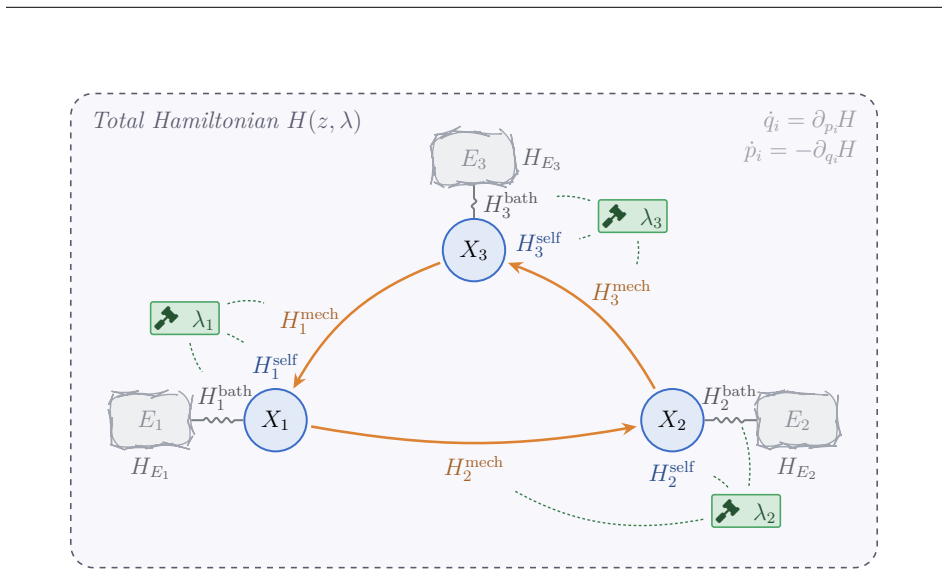
Causal modeling of physical temporal phenomena must handle interventions that act along trajectories, nonstationary induced laws, path-dependent effects, and feedback mediated by dynamics, all challenging in standard causal models. We introduce Hamiltonian Causal Models (HCMs), a trajectory-level framework in which observed variables interact with local environments and interventions act as controls of Hamiltonian mechanisms. HCMs separate immutable equations of motion from intervenable mechanisms and define causal effects as discrepancies between interventional path laws. A key motivation for HCMs is their natural interface with non-equilibrium thermodynamics. Entropy production quantifies the irreversibility of a process and is a central causal observable: it is estimable from data and witnesses causal effects along the system's evolution that are invisible to endpoint and cumulative versions of the standard average treatment effect. As in physics, cause and effect are not primitives of the relation between two random variables but arise from the non-invertibility of the thermodynamic arrow. With this, our paper reconciles the language of statistical causal models and non-stationary thermodynamics, offering new tools to describe causality in a wide range of physical systems.
Editorial analysis
A structured set of objections, weighed in public.
Referee Report
Summary. The manuscript introduces Hamiltonian Causal Models (HCMs) as a trajectory-level framework for causal modeling of physical temporal phenomena. Observed variables interact with local environments; interventions act as controls on Hamiltonian mechanisms. HCMs separate immutable equations of motion from intervenable mechanisms and define causal effects via discrepancies between interventional path laws. The central claim is that this construction yields a natural interface with non-equilibrium thermodynamics, making entropy production an estimable causal observable that witnesses path-dependent effects invisible to endpoint or cumulative versions of the average treatment effect (ATE). The work aims to reconcile statistical causal models with non-stationary thermodynamics.
Significance. If the HCM construction is rigorously shown to be consistent and the thermodynamic interface holds without definitional inconsistencies, the result would be significant. It supplies a new causal observable (entropy production) for dynamical physical systems and offers a principled way to handle path-dependent, nonstationary effects that standard ATE measures miss. This could supply useful tools for physics-informed modeling in machine learning.
major comments (1)
- [Abstract] Abstract: the claim that entropy production 'witnesses causal effects along the system's evolution that are invisible to endpoint and cumulative versions of the standard average treatment effect' is load-bearing for the reconciliation but rests on an unshown construction. No derivation, explicit interventional path law, or calculation is supplied showing how separation of immutable EOM from intervenable Hamiltonian mechanisms produces this property or avoids inconsistencies in causal-effect definitions.
Simulated Author's Rebuttal
We thank the referee for their thoughtful review and for identifying a point where the abstract claim requires stronger explicit support from the technical development. We address the concern directly below and will revise the manuscript accordingly.
read point-by-point responses
-
Referee: [Abstract] Abstract: the claim that entropy production 'witnesses causal effects along the system's evolution that are invisible to endpoint and cumulative versions of the standard average treatment effect' is load-bearing for the reconciliation but rests on an unshown construction. No derivation, explicit interventional path law, or calculation is supplied showing how separation of immutable EOM from intervenable Hamiltonian mechanisms produces this property or avoids inconsistencies in causal-effect definitions.
Authors: We agree that the abstract claim is central and that the manuscript would benefit from an explicit, self-contained derivation linking the separation of immutable equations of motion from intervenable mechanisms to the claimed property of entropy production. The current text defines HCMs, the separation (Definition 3.1), interventional path laws (Definition 3.3), and the thermodynamic interface (Section 4), but does not supply a compact, step-by-step calculation demonstrating the additional path-dependent information captured by entropy production relative to endpoint or cumulative ATE. In the revision we will add a short dedicated paragraph (or subsection) immediately after the definition of interventional path laws that (i) writes the explicit form of the path-law discrepancy under the HCM intervention, (ii) isolates the entropy-production term, and (iii) shows by direct comparison that this term is nonzero for certain path-dependent effects that vanish in both endpoint and cumulative ATE. We will also insert a one-sentence pointer to this new derivation in the abstract. These changes will be made. revision: yes
Circularity Check
No significant circularity
full rationale
The paper introduces Hamiltonian Causal Models by separating immutable equations of motion from intervenable Hamiltonian mechanisms and defines causal effects directly as discrepancies between interventional path laws. Entropy production is positioned as a derived observable from non-equilibrium thermodynamics that witnesses path-dependent effects, without any quoted step reducing the central claim to a self-definition, a fitted parameter renamed as prediction, or a load-bearing self-citation chain. The construction is presented as a modeling choice that interfaces the two domains rather than deriving one from the other by construction. No equations or definitions in the supplied material exhibit the enumerated circular patterns.
Axiom & Free-Parameter Ledger
axioms (2)
- domain assumption Hamiltonian mechanics provides a valid description of the underlying dynamics that can be separated into immutable equations of motion and intervenable mechanisms.
- domain assumption Entropy production is estimable from data and quantifies irreversibility in a manner that aligns with causal path discrepancies.
invented entities (1)
-
Hamiltonian Causal Models (HCMs)
no independent evidence
Reference graph
Works this paper leans on
-
[1]
and Hern
Robins, James M. and Hern. Marginal Structural Models and Causal Inference in Epidemiology , journal =. 2000 , volume =
2000
-
[2]
Marginal Structural Models to Estimate the Causal Effect of Zidovudine on the Survival of HIV-Positive Men , journal =
Hern. Marginal Structural Models to Estimate the Causal Effect of Zidovudine on the Survival of HIV-Positive Men , journal =. 2000 , volume =
2000
-
[3]
Philosophy of Physics , volume=
How Oriented Causation Is Rooted into Thermodynamics , author=. Philosophy of Physics , volume=
-
[4]
2000 , publisher=
Causation, prediction, and search , author=. 2000 , publisher=
2000
-
[5]
, author=
Causality: Models, Reasoning, and Inference. , author=. 2009 , publisher=
2009
-
[6]
2015 , publisher=
Causal inference in statistics, social, and biomedical sciences , author=. 2015 , publisher=
2015
-
[7]
International Conference on Learning Representations , year=
Exploratory Causal Inference in SAEnce , author=. International Conference on Learning Representations , year=
-
[8]
Probabilistic and Causal Inference: The Works of Judea Pearl , pages=
Causal models for dynamical systems , author=. Probabilistic and Causal Inference: The Works of Judea Pearl , pages=
-
[9]
Proceedings of the AAAI Conference on Artificial Intelligence , volume=
Spacetime: Causal discovery from non-stationary time series , author=. Proceedings of the AAAI Conference on Artificial Intelligence , volume=
-
[10]
Econometrica: journal of the Econometric Society , pages=
Investigating causal relations by econometric models and cross-spectral methods , author=. Econometrica: journal of the Econometric Society , pages=. 1969 , publisher=
1969
-
[11]
Journal of machine learning research , volume=
Joint causal inference from multiple contexts , author=. Journal of machine learning research , volume=
-
[12]
2013 , publisher=
Non-equilibrium thermodynamics , author=. 2013 , publisher=
2013
-
[13]
Journal of Machine Learning Research , volume=
Causal Discovery with Continuous Additive Noise Models , author=. Journal of Machine Learning Research , volume=
-
[14]
International Conference on Artificial Intelligence and Statistics , pages=
Causal modeling with stationary diffusions , author=. International Conference on Artificial Intelligence and Statistics , pages=. 2024 , organization=
2024
-
[15]
Proceedings of the National Academy of Sciences , volume=
Modeling confounding by half-sibling regression , author=. Proceedings of the National Academy of Sciences , volume=. 2016 , publisher=
2016
-
[16]
Nature Medicine , volume=
Causal machine learning for predicting treatment outcomes , author=. Nature Medicine , volume=. 2024 , publisher=
2024
-
[17]
The Thirty-ninth Annual Conference on Neural Information Processing Systems , year=
Prediction-Powered Causal Inferences , author=. The Thirty-ninth Annual Conference on Neural Information Processing Systems , year=
-
[18]
2017 , publisher=
Elements of causal inference: foundations and learning algorithms , author=. 2017 , publisher=
2017
-
[19]
Proceedings of the IEEE , volume=
Toward causal representation learning , author=. Proceedings of the IEEE , volume=. 2021 , publisher=
2021
-
[20]
2023 , publisher=
Causal inference: what if , author=. 2023 , publisher=
2023
-
[21]
and Cole, Stephen R
Naimi, Ashley I. and Cole, Stephen R. and Kennedy, Edward H. , title =. International Journal of Epidemiology , year =
-
[22]
, title =
Murphy, Susan A. , title =. Journal of the Royal Statistical Society: Series B , year =
-
[23]
Using Big Data to Emulate a Target Trial When a Randomized Trial Is Not Available , journal =
Hern. Using Big Data to Emulate a Target Trial When a Randomized Trial Is Not Available , journal =. 2016 , volume =
2016
-
[24]
Target Trial Emulation: A Framework for Causal Inference From Observational Data , journal =
Hern. Target Trial Emulation: A Framework for Causal Inference From Observational Data , journal =. 2022 , volume =
2022
-
[25]
, title =
Robins, James M. , title =. Communications in Statistics --- Theory and Methods , year =
-
[26]
, title =
Qian, Tianchen and Yoo, Hyesun and Klasnja, Predrag and Almirall, Daniel and Murphy, Susan A. , title =. Biometrika , year =
-
[27]
Journal of the American Statistical Association , year =
Bojinov, Iavor and Shephard, Neil , title =. Journal of the American Statistical Association , year =
-
[28]
Manuscript, arXiv:1903.01637 , year=
Rambachan, Ashesh and Shephard, Neil , title =. arXiv preprint arXiv:1903.01637 , year =
-
[29]
and Joffe, Marshall M
Neugebauer, Romain and van der Laan, Mark J. and Joffe, Marshall M. and Tager, Ira B. , title =. Electronic Journal of Statistics , year =
-
[30]
and Deeks, Steven G
Petersen, Maya L. and Deeks, Steven G. and Martin, Jeffrey N. and van der Laan, Mark J. , title =. American Journal of Epidemiology , year =
-
[31]
Gill, Richard D. and Robins, James M. , title =. arXiv preprint math/0409436 , year =
-
[32]
A Martingale Approach to Continuous-Time Marginal Structural Models , journal =
R. A Martingale Approach to Continuous-Time Marginal Structural Models , journal =. 2011 , volume =
2011
-
[33]
Journal of the Royal Statistical Society: Series B , year =
Didelez, Vanessa , title =. Journal of the Royal Statistical Society: Series B , year =
-
[34]
Aalen, Odd O. and R. Causality, Mediation and Time: A Dynamic Viewpoint , journal =. 2012 , volume =
2012
-
[35]
and Bongers, Stephan and Mooij, Joris M
Rubenstein, Paul K. and Bongers, Stephan and Mooij, Joris M. and Sch. From Deterministic ODEs to Dynamic Structural Causal Models , booktitle =. 2018 , pages =
2018
- [36]
-
[37]
Electronic Journal of Probability , year =
Sokol, Alexander and Hansen, Niels Richard , title =. Electronic Journal of Probability , year =
-
[38]
Proceedings of the Third Conference on Causal Learning and Reasoning , series =
Ying, Andrew , title =. Proceedings of the Third Conference on Causal Learning and Reasoning , series =
- [39]
-
[40]
Physical Review Letters , year =
Schreiber, Thomas , title =. Physical Review Letters , year =
-
[41]
Advances in neural information processing systems , volume=
BACKSHIFT: Learning causal cyclic graphs from unknown shift interventions , author=. Advances in neural information processing systems , volume=
-
[42]
Conference on Causal Learning and Reasoning , pages=
Causal discovery with score matching on additive models with arbitrary noise , author=. Conference on Causal Learning and Reasoning , pages=. 2023 , organization=
2023
-
[43]
International Conference on Machine Learning , pages=
Score matching enables causal discovery of nonlinear additive noise models , author=. International Conference on Machine Learning , pages=. 2022 , organization=
2022
-
[44]
Proceedings of the Twenty-Ninth Conference on Uncertainty in Artificial Intelligence , pages=
Cyclic causal discovery from continuous equilibrium data , author=. Proceedings of the Twenty-Ninth Conference on Uncertainty in Artificial Intelligence , pages=
-
[45]
The Annals of Statistics , volume=
Foundations of structural causal models with cycles and latent variables , author=. The Annals of Statistics , volume=. 2021 , publisher=
2021
-
[46]
The Journal of Machine Learning Research , volume=
Learning linear cyclic causal models with latent variables , author=. The Journal of Machine Learning Research , volume=. 2012 , publisher=
2012
-
[47]
Artificial intelligence and statistics , pages=
Exact Bayesian structure learning from uncertain interventions , author=. Artificial intelligence and statistics , pages=. 2007 , organization=
2007
-
[48]
Proceedings of the Seventeenth conference on Uncertainty in artificial intelligence , pages=
Causal discovery from changes , author=. Proceedings of the Seventeenth conference on Uncertainty in artificial intelligence , pages=
-
[49]
, title =
Massey, James L. , title =. Proceedings of the 1990 International Symposium on Information Theory and its Applications , year =
1990
-
[50]
Kramer, Gerhard , title =
-
[51]
and Seth, Anil K
Barnett, Lionel and Barrett, Adam B. and Seth, Anil K. , title =. Physical Review Letters , year =
-
[52]
Amblard, Pierre-Olivier and Michel, Olivier J. J. , title =. Entropy , year =
-
[53]
Journal of Financial Econometrics , year =
White, Halbert and Lu, Xun , title =. Journal of Financial Econometrics , year =
-
[54]
Proceedings of the 23rd Conference on Uncertainty in Artificial Intelligence (UAI) , year =
Eichler, Michael and Didelez, Vanessa , title =. Proceedings of the 23rd Conference on Uncertainty in Artificial Intelligence (UAI) , year =
-
[55]
Causal Inference on Time Series using Restricted Structural Equation Models , booktitle =
Peters, Jonas and Janzing, Dominik and Sch. Causal Inference on Time Series using Restricted Structural Equation Models , booktitle =. 2013 , pages =
2013
-
[56]
Quantifying Causal Influences , journal =
Janzing, Dominik and Balduzzi, David and Grosse-Wentrup, Moritz and Sch. Quantifying Causal Influences , journal =. 2013 , volume =
2013
-
[57]
, title =
Barnett, Lionel and Seth, Anil K. , title =. Physical Review E , year =
-
[58]
, title =
Sun, Jie and Bollt, Erik M. , title =. Physica D: Nonlinear Phenomena , year =
-
[59]
, title =
Sun, Jie and Taylor, Dane and Bollt, Erik M. , title =. SIAM Journal on Applied Dynamical Systems , year =
-
[60]
, title =
Sun, Jie and Cafaro, Carlo and Bollt, Erik M. , title =. Entropy , year =
-
[61]
, title =
Surasinghe, Sudam and Bollt, Erik M. , title =. Entropy , year =
-
[62]
Runge, Jakob and Bathiany, Sebastian and Bollt, Erik and Camps-Valls, Gustau and Coumou, Dim and Deyle, Ethan and Glymour, Clark and Kretschmer, Marlene and Mahecha, Miguel D. and Mu. Inferring Causation from Time Series in Earth System Sciences , journal =. 2019 , volume =
2019
-
[63]
Nature Reviews Earth & Environment , year =
Runge, Jakob and Gerhardus, Andreas and Varando, Gherardo and Eyring, Veronika and Camps-Valls, Gustau , title =. Nature Reviews Earth & Environment , year =
-
[64]
and Price, Don C
Prokopenko, Mikhail and Lizier, Joseph T. and Price, Don C. , title =. Entropy , year =
-
[65]
Progress of Theoretical Physics Supplement , number =
Sekimoto, Ken , title =. Progress of Theoretical Physics Supplement , number =. 1998 , doi =
1998
-
[66]
2010 , doi =
Sekimoto, Ken , title =. 2010 , doi =
2010
-
[67]
Physical Review Letters , volume =
Jarzynski, Christopher , title =. Physical Review Letters , volume =. 1997 , doi =
1997
-
[68]
Physical Review E , volume =
Jarzynski, Christopher , title =. Physical Review E , volume =. 1997 , doi =
1997
-
[69]
, title =
Crooks, Gavin E. , title =. Journal of Statistical Physics , volume =. 1998 , doi =
1998
-
[70]
, title =
Crooks, Gavin E. , title =. Physical Review E , volume =. 1999 , doi =
1999
-
[71]
Progress of Theoretical Physics Supplement , number =
Oono, Yoshitsugu and Paniconi, Marco , title =. Progress of Theoretical Physics Supplement , number =. 1998 , doi =
1998
-
[72]
Steady-State Thermodynamics of Langevin Systems , journal =
Hatano, Takahiro and Sasa, Shin. Steady-State Thermodynamics of Langevin Systems , journal =. 2001 , doi =
2001
-
[73]
Physical Review Letters , volume =
Seifert, Udo , title =. Physical Review Letters , volume =. 2005 , doi =
2005
-
[74]
Reports on Progress in Physics , volume =
Seifert, Udo , title =. Reports on Progress in Physics , volume =. 2012 , doi =
2012
-
[75]
and Cohen, E
Evans, Denis J. and Cohen, E. G. D. and Morriss, Gary P. , title =. Physical Review Letters , volume =. 1993 , doi =
1993
-
[76]
and Searles, Debra J
Evans, Denis J. and Searles, Debra J. , title =. Physical Review E , volume =. 1994 , doi =
1994
-
[77]
and Searles, Debra J
Evans, Denis J. and Searles, Debra J. , title =. Advances in Physics , volume =. 2002 , doi =
2002
-
[78]
Gallavotti, Giovanni and Cohen, E. G. D. , title =. Physical Review Letters , volume =. 1995 , doi =
1995
-
[79]
Journal of Physics A: Mathematical and General , volume =
Kurchan, Jorge , title =. Journal of Physics A: Mathematical and General , volume =. 1998 , doi =
1998
-
[80]
and Spohn, Herbert , title =
Lebowitz, Joel L. and Spohn, Herbert , title =. Journal of Statistical Physics , volume =. 1999 , doi =
1999
discussion (0)
Sign in with ORCID, Apple, or X to comment. Anyone can read and Pith papers without signing in.