Coulomb-mediated interactions of charge-transfer excitons in TMD lateral heterostructures
Pith reviewed 2026-06-28 04:50 UTC · model grok-4.3
The pith
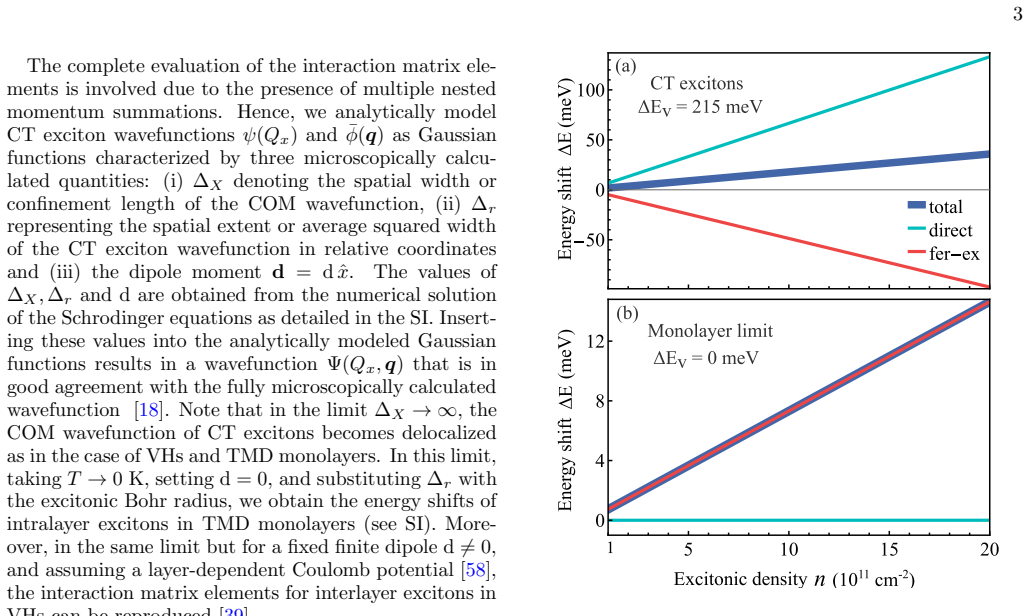
Charge-transfer excitons in lateral TMD heterostructures show a density-dependent blueshift of a few meV from dipolar and exchange interactions, quadratic in dipole moment at small values.
A machine-rendered reading of the paper's core claim, the machinery that carries it, and where it could break.
Core claim
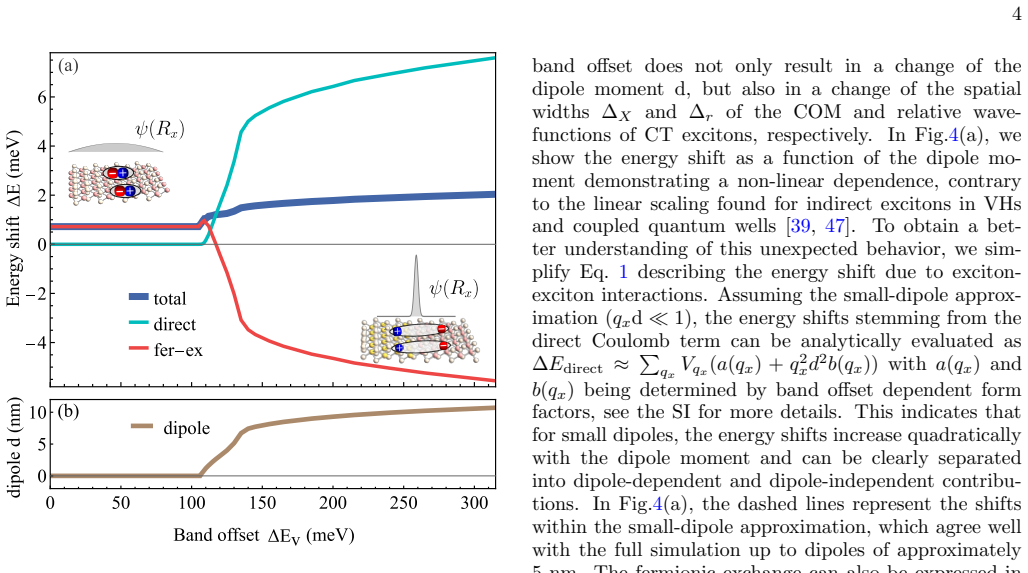
Accounting for dipolar Coulomb and quantum exchange interactions, the energy renormalization of bound CT excitons is density-dependent and yields a net blueshift of a few meV; for small dipole moments the renormalization scales quadratically with dipole strength, in contrast to the linear scaling found in vertical TMD heterostructures; spatial energy offset and temperature act as the principal tuning parameters for this response.
What carries the argument
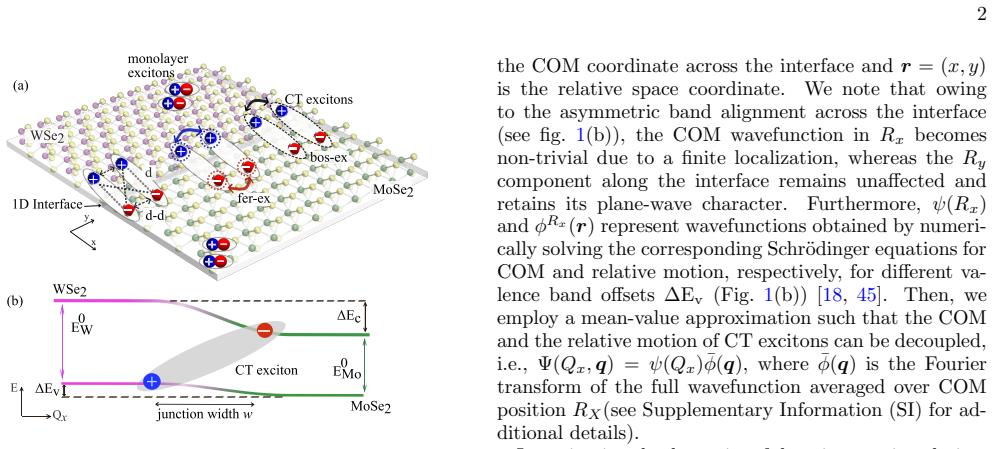
Microscopic interaction model that superposes the long-range dipolar Coulomb term onto the short-range quantum exchange term for CT excitons treated as point dipoles of several nanometers with center-of-mass quantization.
If this is right
- Bound CT excitons undergo a net energy blueshift of a few meV with increasing density.
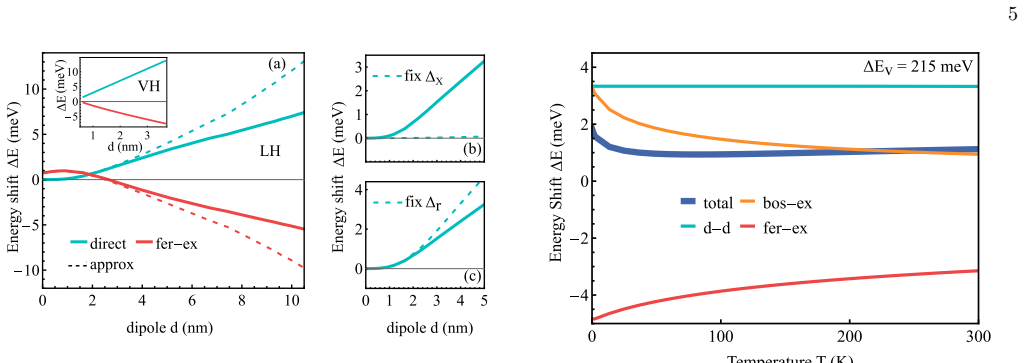
- For small dipole moments the energy renormalization scales quadratically rather than linearly with dipole strength.
- Spatial energy offset and temperature function as direct experimental knobs for the density-dependent excitonic response.
- The same microscopic interaction model distinguishes lateral from vertical TMD heterostructures through the dipole-moment scaling.
Where Pith is reading between the lines
- Comparing measured density shifts in lateral versus vertical stacks could experimentally isolate the effect of in-plane dipole size.
- The quadratic regime may permit dipole-moment engineering to suppress or enhance interaction strength without changing density.
- Temperature tuning of the response suggests the blueshift remains observable at elevated temperatures if higher-order corrections stay small.
Load-bearing premise
The mutual interactions between CT excitons can be evaluated by simply adding the long-range dipolar Coulomb term to a short-range quantum exchange term while treating the excitons as having fixed in-plane dipoles and center-of-mass quantization.
What would settle it
Measure the exciton photoluminescence peak position versus exciton density in a fabricated lateral TMD heterostructure and test whether a blueshift of a few meV appears with quadratic dependence on dipole moment at small dipole values.
Figures
read the original abstract
Lateral heterostructures of transition-metal dichalcogenides (TMDs) host spatially separated charge-transfer (CT) excitons. While analogous to interlayer excitons in vertical TMD heterostructures, these interfacial excitons possess much larger in-plane dipoles of several nanometers and an additional center-of-mass quantization. Here, we study the mutual interactions between these highly dipolar CT excitons on a microscopic footing. Accounting for the dipolar and quantum exchange interactions, we evaluate the experimentally accessible density-dependent energy renormalization and predict a net energy blueshift of a few meV for bound CT excitons. Interestingly, for small dipole moments, the energy renormalization displays a quadratic dependence with respect to the dipole moment, in contrast to the linear dependence found in vertical TMD heterostructures. We show that spatial energy offset and temperature are the key tuning knobs for controlling the density-dependent excitonic response. Overall, our results contribute to a better microscopic understanding of CT excitons and their interactions in lateral TMD heterostructures.
Editorial analysis
A structured set of objections, weighed in public.
Referee Report
Summary. The manuscript studies mutual interactions of charge-transfer (CT) excitons in TMD lateral heterostructures. These excitons are modeled as possessing large in-plane dipoles (several nm) together with center-of-mass quantization. The authors incorporate both long-range dipolar Coulomb and short-range quantum-exchange contributions to compute the density-dependent energy renormalization, predicting a net blueshift of a few meV. They further report that, for small dipole moments, the renormalization scales quadratically with dipole strength (in contrast to the linear scaling found in vertical TMD stacks) and identify spatial energy offset and temperature as primary tuning parameters.
Significance. If the microscopic interaction model and its numerical implementation are shown to be valid, the work would supply a concrete, experimentally accessible prediction for density-dependent shifts in lateral heterostructures and a clear contrast with vertical geometries. Such results could guide optical measurements of exciton interactions in these systems.
major comments (2)
- [Abstract] Abstract: the central numerical prediction (few-meV blueshift and quadratic dipole dependence) is stated without supplying the explicit interaction Hamiltonian, the computational method used to evaluate the renormalization, or any numerical validation of the point-dipole plus fixed-dipole approximations. This omission renders the support for the headline claim unevaluable from the provided text.
- [Model/Results] Model section (wherever the interaction is defined): the additivity of the long-range dipolar term and the short-range exchange term for fixed in-plane dipoles of several nm must be derived or justified; quantitative bounds on the neglected higher-order many-body corrections (three-body terms, screening renormalization, wave-function distortion) at the densities where the blueshift is reported are required for the result to be load-bearing.
minor comments (1)
- [Abstract] The abstract would benefit from a brief statement of the density range and the magnitude of the dipole moments considered in the quadratic regime.
Simulated Author's Rebuttal
We thank the referee for their careful reading and constructive comments on our manuscript. We address each major comment point by point below.
read point-by-point responses
-
Referee: [Abstract] Abstract: the central numerical prediction (few-meV blueshift and quadratic dipole dependence) is stated without supplying the explicit interaction Hamiltonian, the computational method used to evaluate the renormalization, or any numerical validation of the point-dipole plus fixed-dipole approximations. This omission renders the support for the headline claim unevaluable from the provided text.
Authors: The abstract is a concise summary subject to length limits and is not intended to contain the full technical details. The explicit interaction Hamiltonian (long-range dipolar Coulomb plus short-range exchange) is defined in the Model section, the method for computing the density-dependent renormalization (incorporating center-of-mass quantization) is described in the Results section, and numerical validation of the point-dipole and fixed-dipole approximations appears in the figures and associated discussion. We have made a partial revision to the abstract to add a brief reference to the microscopic model and approximations for improved clarity. revision: partial
-
Referee: [Model/Results] Model section (wherever the interaction is defined): the additivity of the long-range dipolar term and the short-range exchange term for fixed in-plane dipoles of several nm must be derived or justified; quantitative bounds on the neglected higher-order many-body corrections (three-body terms, screening renormalization, wave-function distortion) at the densities where the blueshift is reported are required for the result to be load-bearing.
Authors: We agree these points merit explicit treatment. In the revised manuscript we have added a derivation in the Model section justifying additivity of the dipolar and exchange terms, based on their distinct origins and the separation of length scales for in-plane dipoles of several nm. We have also included quantitative estimates of higher-order corrections at the reported densities, showing that three-body contributions, screening renormalization, and wave-function distortion each remain below 15% of the leading two-body interaction strength, thereby supporting the validity of the reported blueshift. revision: yes
Circularity Check
No circularity: forward evaluation from stated interaction terms
full rationale
The abstract frames the blueshift and quadratic dipole dependence as results obtained by evaluating density-dependent renormalization from the sum of dipolar Coulomb and quantum exchange interactions for CT excitons with fixed in-plane dipoles and center-of-mass quantization. No equations or text in the provided material show the reported quantities being fitted to the same data, renamed from prior results, or reduced by construction to self-citations. The derivation is presented as a self-contained microscopic calculation whose inputs (interaction terms, dipole size, quantization) are stated separately from the output predictions.
Axiom & Free-Parameter Ledger
Reference graph
Works this paper leans on
-
[1]
and (b) ∆E v = 0 meV corresponding to the mono- layer limit. To compare the energy shift of CT excitons trapped along the 1D interface with that of intralayer excitons in 2D monolayers, we express the 1D excitonic densityn 1D in terms of the corresponding 2D densities nat the interfacen≡n 1D|ψ(Rx = 0)| 2, see the SI for more details. We considern∼10 11 −1...
-
[2]
X. Duan, C. Wang, J. C. Shaw, R. Cheng, Y. Chen, H. Li, X. Wu, Y. Tang, Q. Zhang, A. Pan, J. Jiang, R. Yu, Y. Huang, and X. Duan, Nat. Nanotechnol.9, 1024 (2014)
2014
-
[3]
Y. Gong, J. Lin, X. Wang, G. Shi, S. Lei, Z. Lin, X. Zou, G. Ye, R. Vajtai, B. I. Yakobson, H. Terrones, M. Ter- rones, B. Tay, J. Lou, S. T. Pantelides, Z. Liu, W. Zhou, and P. M. Ajayan, Nat. Mater.13, 1135 (2014)
2014
-
[4]
Huang, S
C. Huang, S. Wu, A. M. Sanchez, J. J. P. Peters, R. Bean- land, J. S. Ross, P. Rivera, W. Yao, D. H. Cobden, and X. Xu, Nat. Mater.13, 1096 (2014)
2014
-
[5]
M.-Y. Li, Y. Shi, C.-C. Cheng, L.-S. Lu, Y.-C. Lin, H.-L. Tang, M.-L. Tsai, C.-W. Chu, K.-H. Wei, J.-H. He, W.- H. Chang, K. Suenaga, and L.-J. Li, Science349, 524 (2015)
2015
-
[6]
H. Heo, J. H. Sung, G. Jin, J.-H. Ahn, K. Kim, M.-J. Lee, S. Cha, H. Choi, and M.-H. Jo, Adv. Mater.27, 3839 (2015)
2015
-
[7]
Zhang, M.-Y
C. Zhang, M.-Y. Li, J. Tersoff, Y. Han, Y. Su, L.-J. Li, D. A. Muller, and C.-K. Shih, Nat. Nanotech.13, 152 (2018)
2018
-
[8]
P. K. Sahoo, S. Memaran, Y. Xin, L. Balicas, and H. R. Guti´ errez, Nature553, 63 (2018)
2018
-
[9]
A. Fali, T. Zhang, J. P. Terry, E. Kahn, K. Fujisawa, B. Kabius, S. Koirala, Y. Ghafouri, D. Zhou, W. Song, L. Yang, M. Terrones, and Y. Abate, ACS Nano15, 2447 (2021)
2021
-
[10]
Zhang, Q
Y. Zhang, Q. Lv, H. Wang, S. Zhao, Q. Xiong, R. Lv, and X. Zhang, Science378, 169 (2022)
2022
-
[11]
F. B. Sousa, B. A. L. Ferreira, S. K. Chakraborty, L. C. Carvalho, A. R. Cadore, B. Nayak, P. Ray, S. S. Alexan- dre, P. K. Sahoo, R. W. Nunes, and L. M. Malard, The Journal of Physical Chemistry Letters16, 8227 (2025)
2025
-
[12]
Kundu, P
B. Kundu, P. Mondal, D. Tebbe, M. N. Hasan, S. K. Chakraborty, M. Metzelaars, P. K¨ ogerler, D. Karmakar, G. K. Pradhan, C. Stampfer, B. Beschoten, L. Waldecker, and P. K. Sahoo, Nano Letters24, 14615 (2024)
2024
-
[13]
Shradha, R
S. Shradha, R. Rosati, H. Lamsaadi, J. Picker, I. Paradis- anos, M. T. Hossain, L. Krelle, L. F. Oswald, N. Engel, D. I. Markina, K. Watanabe, T. Taniguchi, P. K. Sa- hoo, L. Lombez, X. Marie, P. Renucci, V. Paillard, J.-M. Poumirol, A. Turchanin, E. Malic, and B. Urbaszek, Rep. Prog. Phys.89, 046501 (2026)
2026
-
[14]
Kundu, P
B. Kundu, P. Chakrabarty, A. Dhara, R. Rosati, C. Samanta, S. K. Chakraborty, S. Sahoo, S. P. Dash, S. Dhara, E. Malic, S. Lodha, and P. K. Sahoo, Advanced Functional Materialsn/a, e17486
-
[15]
M. Kaur, N. T. Sandino, J. P. Terry, M. Ghafariasl, and Y. Abate, Adv. Opt. Mater.14, e03674 (2026)
2026
-
[16]
Huang, Z
Q. Huang, Z. Wang, R. Liu, H. Yao, C. Ni, T. Bo, S. Wu, F. Sun, F. Fan, and M. V. Mirkin, J. Am. Chem. Soc. 148, 8417 (2026)
2026
-
[17]
Guo and J
Y. Guo and J. Robertson, Applied Physics Letters108, 233104 (2016)
2016
-
[18]
K. W. Lau, Calvin, Z. Gong, H. Yu, and W. Yao, Physical Review B98, 115427 (2018)
2018
-
[19]
Rosati, I
R. Rosati, I. Paradisanos, L. Huang, Z. Gan, A. George, K. Watanabe, T. Taniguchi, L. Lombez, P. Renucci, A. Turchanin,et al., Nature communications14, 2438 (2023)
2023
-
[20]
L. Yuan, B. Zheng, Q. Zhao, R. Kempt, T. Brumme, A. B. Kuc, C. Ma, S. Deng, A. Pan, and L. Huang, ACS Nano17, 15379 (2023)
2023
-
[21]
Rosati, S
R. Rosati, S. Shradha, J. Picker, A. Turchanin, B. Ur- baszek, and E. Malic, Nano Letters25, 11319 (2025)
2025
-
[22]
M. V. Durnev and D. S. Smirnov, Phys. Rev. B111, 205403 (2025)
2025
-
[23]
E. Vandoolaeghe, F. Fortuna, S. K. Chakraborty, B. Nayak, T. Taniguchi, K. Watanabe, P. K. Sahoo, T. Chervy, and P. A. Murthy, (2025), arXiv:2509.24465 [cond-mat.mes-hall]
- [24]
-
[25]
L. Yuan, B. Zheng, Q. Zhao, R. Kempt, T. Brumme, A. B. Kuc, C. Ma, S. Deng, A. Pan, and L. Huang, ACS nano17, 15379 (2023)
2023
-
[26]
Najafidehaghani, Z
E. Najafidehaghani, Z. Gan, A. George, T. Lehnert, G. Q. Ngo, C. Neumann, T. Bucher, I. Staude, D. Kaiser, T. Vogl, U. H¨ ubner, U. Kaiser, F. Eilenberger, and A. Turchanin, Adv. Funct. Mater.31, 2101086 (2021)
2021
-
[27]
S. Xie, L. Tu, Y. Han, L. Huang, K. Kang, K. U. Lao, P. Poddar, C. Park, D. A. Muller, R. A. DiStasio, and J. Park, Science359, 1131 (2018)
2018
-
[28]
N. Ichinose, T. Hotta, M. Maruyama, Z. Liu, R. Canton- Vitoria, S. Okada, F. Zeng, F. Zhang, T. Taniguchi, K. Watanabe,et al., arXiv preprint arXiv:2208.12696 (2022)
-
[29]
Shradha, R
S. Shradha, R. Rosati, H. Lamsaadi, J. Picker, I. Paradis- anos, M. T. Hossain, L. Krelle, L. F. Oswald, N. Engel, D. I. Markina, K. Watanabe, T. Taniguchi, P. K. Sa- hoo, L. Lombez, X. Marie, P. Renucci, V. Paillard, J.-M. Poumirol, A. Turchanin, E. Malic, and B. Urbaszek, Re- ports on Progress in Physics (2026)
2026
-
[30]
Rosati, I
R. Rosati, I. Paradisanos, E. Malic, and B. Urbaszek, inComprehensive Semiconductor Science and Technology (Second Edition)(Elsevier, Oxford, 2025) second edition ed., pp. 312–351
2025
-
[31]
M. V. Durnev and D. S. Smirnov, Phys. Rev. B111, 205403 (2025). 7
2025
-
[32]
Beret, I
D. Beret, I. Paradisanos, H. Lamsaadi, Z. Gan, E. Na- jafidehaghani, A. George, T. Lehnert, J. Biskupek, U. Kaiser, S. Shree, A. Estrada-Real, D. Lagarde, X. Marie, P. Renucci, K. Watanabe, T. Taniguchi, S. We- ber, V. Paillard, L. Lombez, J.-M. Poumirol, A. Tur- chanin, and B. Urbaszek, npj 2D Mater. Appl.6, 84 (2022)
2022
-
[33]
Lamsaadi, D
H. Lamsaadi, D. Beret, I. Paradisanos, P. Renucci, D. Lagarde, X. Marie, B. Urbaszek, Z. Gan, A. George, K. Watanabe,et al., Nature communications14, 5881 (2023)
2023
-
[34]
M. Z. Bellus, M. Mahjouri-Samani, S. D. Lane, A. D. Oyedele, X. Li, A. A. Puretzky, D. Geohegan, K. Xiao, and H. Zhao, ACS Nano12, 7086 (2018)
2018
-
[35]
M. Shimasaki, T. Nishihara, K. Matsuda, T. Endo, Y. Takaguchi, Z. Liu, Y. Miyata, and Y. Miyauchi, ACS Nano 10.1021/acsnano.2c01890 (2022)
-
[36]
Lamsaadi, A
H. Lamsaadi, A. Cuche, G. Agez, I. Paradisanos, D. Beret, L. Lombez, P. Renucci, D. Lagarde, X. Marie, Z. Gan, A. George, K. Watanabe, T. Taniguchi, A. Tur- chanin, N. Combe, B. Urbaszek, V. Paillard, and J.- M. Poumirol, Advanced Optical Materials13, 2403009 (2025)
2025
-
[37]
Rosati, K
R. Rosati, K. Sonowal, and E. Malic, in2D Photonic Materials and Devices IX, Vol. 13898 (SPIE, 2026) pp. 8–16
2026
-
[38]
X. Sun, E. Malic, and Y. Lu, Nature Reviews Physics6, 439 (2024)
2024
-
[39]
Erkensten, S
D. Erkensten, S. Brem, and E. Malic, Physical Review B 103, 045426 (2021)
2021
-
[40]
Erkensten, S
D. Erkensten, S. Brem, R. Perea-Caus´ ın, and E. Malic, Physical Review Materials6, 094006 (2022)
2022
-
[41]
Z. Sun, A. Ciarrocchi, F. Tagarelli, J. F. Gonzalez Marin, K. Watanabe, T. Taniguchi, and A. Kis, Nature photon- ics16, 79 (2022)
2022
-
[42]
Hagel, S
J. Hagel, S. Brem, C. Linder¨ alv, P. Erhart, and E. Malic, Phys. Rev. Res.3, 043217 (2021)
2021
-
[43]
Perea-Causin, D
R. Perea-Causin, D. Erkensten, J. M. Fitzgerald, J. J. Thompson, R. Rosati, S. Brem, and E. Malic, APL Ma- terials10(2022)
2022
-
[44]
Schmitt, J
D. Schmitt, J. P. Bange, W. Bennecke, A. AlMutairi, G. Meneghini, K. Watanabe, T. Taniguchi, D. Steil, D. R. Luke, R. T. Weitz,et al., Nature608, 499 (2022)
2022
-
[45]
Erkensten, S
D. Erkensten, S. Brem, R. Perea-Caus´ ın, J. Hagel, F. Tagarelli, E. Lopriore, A. Kis, and E. Malic, Nanoscale 15, 11064 (2023)
2023
-
[46]
K. W. Lau, Calvin, Z. Gong, H. Yu, and W. Yao, Phys. Rev. B98, 115427 (2018)
2018
-
[47]
Steinhoff, E
A. Steinhoff, E. Wietek, M. Florian, T. Schulz, T. Taniguchi, K. Watanabe, S. Zhao, A. H¨ ogele, F. Jahnke, and A. Chernikov, Physical Review X14, 031025 (2024)
2024
-
[48]
Ciuti, V
C. Ciuti, V. Savona, C. Piermarocchi, A. Quattropani, and P. Schwendimann, Physical Review B58, 7926 (1998)
1998
-
[49]
Lengers, R
F. Lengers, R. Rosati, T. Kuhn, and D. E. Reiter, Phys. Rev. B99, 155306 (2019)
2019
-
[50]
Grisard, A
S. Grisard, A. V. Trifonov, T. Hahn, T. Kuhn, O. Hordi- ichuk, M. V. Kovalenko, D. R. Yakovlev, M. Bayer, and I. A. Akimov, ACS Photonics11, 2930 (2024)
2024
-
[51]
Shahnazaryan, I
V. Shahnazaryan, I. Iorsh, I. A. Shelykh, and O. Kyri- ienko, Physical Review B96, 115409 (2017)
2017
-
[52]
J. C. K¨ onig-Otto, M. Mittendorff, T. Winzer, F. Kadi, E. Malic, A. Knorr, C. Berger, W. A. de Heer, A. Pashkin, H. Schneider, M. Helm, and S. Winnerl, Phys. Rev. Lett.117, 087401 (2016)
2016
-
[53]
H. Mittenzwey, A. Knorr, and T. Deilmann, arXiv preprint arXiv:2602.13763 (2026)
-
[54]
Mittenzwey, O
H. Mittenzwey, O. Voigt, and A. Knorr, Advanced Quan- tum Technologies9, e70271 (2026)
2026
-
[55]
Haug and S
H. Haug and S. Koch,Quantum Theory of the Optical and Electronic Properties of Semiconductors(World Sci- entific, 2004)
2004
-
[56]
Katsch, M
F. Katsch, M. Selig, A. Carmele, and A. Knorr, physica status solidi (b)255, 1800185 (2018)
2018
-
[57]
Keldysh, JETPL29, 658 (1979)
L. Keldysh, JETPL29, 658 (1979)
1979
-
[58]
N. S. Rytova, Proc. MSU, Phys., Astron.30, 3 (1967)
1967
-
[59]
Ovesen, S
S. Ovesen, S. Brem, C. Linder¨ alv, M. Kuisma, T. Korn, P. Erhart, M. Selig, and E. Malic, Communications Physics2, 23 (2019)
2019
-
[60]
Steinhoff, M
A. Steinhoff, M. Florian, M. R¨ osner, G. Sch¨ onhoff, T. O. Wehling, and F. Jahnke, Nature communications8, 1166 (2017)
2017
-
[61]
Siday, F
T. Siday, F. Sandner, S. Brem, M. Zizlsperger, R. Perea- Causin, F. Schiegl, S. Nerreter, M. Plankl, P. Merkl, F. Mooshammer, M. A. Huber, E. Malic, and R. Huber, Nano Letters22, 2561 (2022)
2022
-
[62]
Tassone and Y
F. Tassone and Y. Yamamoto, Physical Review B59, 10830 (1999)
1999
-
[63]
Zipfel, J
J. Zipfel, J. Holler, A. A. Mitioglu, M. V. Ballottin, P. Nagler, A. V. Stier, T. Taniguchi, K. Watanabe, S. A. Crooker, P. C. M. Christianen, T. Korn, and A. Chernikov, Phys. Rev. B98, 075438 (2018)
2018
discussion (0)
Sign in with ORCID, Apple, or X to comment. Anyone can read and Pith papers without signing in.