REVIEW 3 major objections 1 minor 78 references
ODYSSEY: Reestablishing Confidentiality in Confidential Blockchain via Delegated Execution
T0 review · 3 major / 1 minor · reviewed 2026-06-28 · grok-4.3
Pith's one-line read ODYSSEY delegates transaction execution to designated trustees so that other nodes synchronize only results and thereby shrink the TEE attack surface.
desk verdict ODYSSEY's delegation model cuts TEE exposure by limiting execution to trustees, but the security rests on unexamined assumptions about trustee behavior and result synchronization with no formal analysis provided. read the letter →
The pith
A machine-rendered reading of the paper's core claim, the machinery that carries it, and where it could break.
The reading
What carries the argument
The delegation model, in which each client chooses its own trustees to execute inside the TEE and every other node receives only the resulting state updates.
What would settle it
A demonstration that an adversary can still recover a transaction’s private inputs by observing only the synchronized results and the public ledger state after a single execution round.
Extended reading notes
Core claim
The delegation model lets clients assign transaction execution to designated trustees while all other participants synchronize only the execution results; this arrangement measurably reduces the attack surface for execution-inference and execution-replay attacks without sacrificing confidentiality or system performance.
Load-bearing premise
Designated trustees will execute transactions without introducing new confidentiality leaks or collusion risks, and synchronizing only results will not open alternative inference channels.
Editorial extensions
If this is right
- Only the chosen trustees ever run the confidential transaction logic inside the enclave.
- Side-channel and state-continuity attacks are confined to the smaller trustee set.
- Throughput and latency remain comparable to existing TEE-based systems when location-aware concurrency and failure handling are used.
- The same result-synchronization pattern can be applied to any consortium blockchain that already relies on TEEs.
Reading between the lines
- Trust assumptions shift from the entire validator set to a per-client trustee subset, which may change how consortium governance is structured.
- If trustees are drawn from the same organizations that already operate nodes, the model may require additional audit or rotation mechanisms not described in the paper.
- The approach could be tested on other TEE platforms or in permissionless settings to measure whether the reduced executor set still suffices for liveness.
Editorial analysis
A structured set of objections, weighed in public.
Referee Report
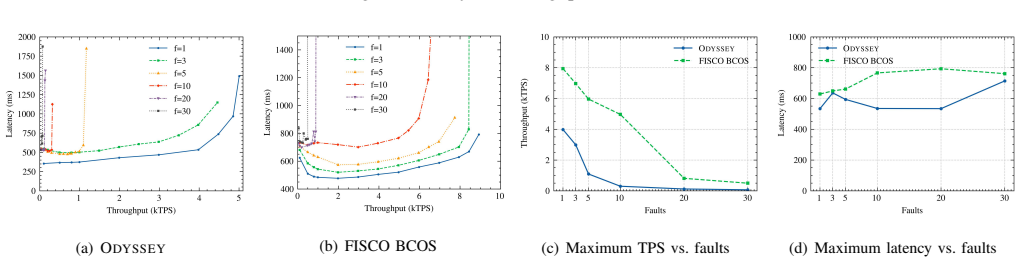
Summary. The paper taxonomizes execution-inference and execution-replay attacks exploiting TEE side-channel and state-continuity issues in confidential consortium blockchains. It proposes ODYSSEY, whose core is a delegation model in which clients delegate transaction execution to designated trustees (who run inside TEEs) while all other participants synchronize only the resulting state; two supporting techniques (location-aware concurrent execution and a delegation failure handler) are introduced to improve efficiency and security. A prototype implemented on FISCO BCOS is reported to achieve roughly 4k TPS with 0.4-0.5 s latency in a 3-node WAN setting.
Significance. If the security properties can be rigorously established, the delegation approach would constitute a practical architectural change that shrinks the TEE-exposed surface while preserving throughput, which could influence the design of enterprise confidential blockchains. The reported prototype numbers indicate that the performance overhead is modest, but the absence of formal verification, reduction proofs, or comparative security evaluations currently limits the result's immediate impact on the literature.
major comments (3)
- [Abstract / Security Claims] Abstract and security claims section: the central assertion that the delegation model 'significantly reduces the attack surface' while preserving confidentiality rests on the unanalyzed assumption that designated trustees introduce neither new leaks nor collusion vectors and that synchronizing only results creates no alternative inference channels; no formal model, game-based definition, or reduction is supplied (formal_verification listed as none).
- [Evaluation] Evaluation section: throughput and latency figures are stated for the 3-node WAN prototype, yet the manuscript supplies neither baseline comparisons against prior TEE-based confidential systems, details of the attack-mitigation test methodology, nor quantitative evidence that the two novel techniques close the taxonomized attack vectors.
- [Attack Taxonomy and Mitigation] Attack taxonomy and mitigation: while execution-inference and execution-replay attacks are defined, the text asserts without supporting analysis or experiments that location-aware concurrent execution and the delegation failure handler suffice to mitigate them; this gap is load-bearing for the paper's primary contribution.
minor comments (1)
- [Abstract] The abstract is dense; expanding the one-sentence description of the two novel techniques would improve readability without altering technical content.
Simulated Author's Rebuttal
We thank the referee for the constructive feedback and the recommendation for major revision. We address each major comment below with clarifications on our design choices and indicate where revisions will strengthen the manuscript.
read point-by-point responses
-
Referee: [Abstract / Security Claims] Abstract and security claims section: the central assertion that the delegation model 'significantly reduces the attack surface' while preserving confidentiality rests on the unanalyzed assumption that designated trustees introduce neither new leaks nor collusion vectors and that synchronizing only results creates no alternative inference channels; no formal model, game-based definition, or reduction is supplied (formal_verification listed as none).
Authors: The delegation model limits TEE execution exposure to client-designated trustees rather than all nodes, with only final state results synchronized to other participants. Trustees are selected and trusted by clients, reducing the surface for side-channel and continuity attacks. We agree a more rigorous treatment is needed and will expand the security claims section with an informal argument addressing collusion risks and potential inference from result synchronization. However, the manuscript does not include a formal model or reduction proof, as the primary contribution is the practical delegation architecture. revision: partial
-
Referee: [Evaluation] Evaluation section: throughput and latency figures are stated for the 3-node WAN prototype, yet the manuscript supplies neither baseline comparisons against prior TEE-based confidential systems, details of the attack-mitigation test methodology, nor quantitative evidence that the two novel techniques close the taxonomized attack vectors.
Authors: We will add baseline comparisons against prior TEE-based confidential blockchain systems in the revised evaluation. The current prototype evaluation reports performance in a 3-node WAN setting. Attack mitigation is supported by the architectural design rather than direct quantitative attack experiments. We will include additional details on the test methodology and explain how the techniques address the taxonomized vectors. New quantitative attack-simulation results cannot be added without further experimental work. revision: partial
-
Referee: [Attack Taxonomy and Mitigation] Attack taxonomy and mitigation: while execution-inference and execution-replay attacks are defined, the text asserts without supporting analysis or experiments that location-aware concurrent execution and the delegation failure handler suffice to mitigate them; this gap is load-bearing for the paper's primary contribution.
Authors: We will revise the mitigation section to provide explicit step-by-step reasoning showing how location-aware concurrent execution distributes execution to limit side-channel visibility and how the delegation failure handler maintains state continuity to prevent replays. These explanations will be tied directly to the defined attack vectors with concrete scenarios. The supporting analysis will be expanded, though it remains design-based rather than experimental. revision: yes
- A formal game-based security model, definition, or reduction proof for the delegation approach and its mitigations.
Circularity Check
No circularity; architecture proposal with independent prototype evaluation
full rationale
The paper introduces a delegation model and two techniques (location-aware concurrent execution, delegation failure handler) to address taxonomized attacks on confidential blockchains, then reports a prototype on FISCO BCOS with measured throughput and latency. No equations, fitted parameters, predictions, or self-citation chains appear in the provided abstract or description; the central claims rest on the proposed design and empirical results rather than reducing to inputs by construction. This is a standard systems paper with no load-bearing self-referential steps.
Assumptions & free parameters
assumptions (1)
- domain assumption TEEs suffer from long-lasting side-channel and state-continuity issues that enable execution-inference and execution-replay attacks.
Cite this review
Pith. "Pith review of ODYSSEY: Reestablishing Confidentiality in Confidential Blockchain via Delegated Execution." pith.science (2026). https://pith.science/paper/FOTGU7QX
@misc{pith2026260604892,
  author       = {Pith},
  title        = {Pith review of: ODYSSEY: Reestablishing Confidentiality in Confidential Blockchain via Delegated Execution},
  year         = {2026},
  howpublished = {\url{https://pith.science/paper/FOTGU7QX}},
  note         = {Machine review of arXiv:2606.04892}
}
read the original abstract
Confidential blockchains leveraging Trusted Execution Environments (TEEs) have garnered extensive attention for transaction confidentiality. In this paper, we first taxonomize two classes of attacks against confidential blockchains, i.e., execution-inference and execution-replay attacks, which exploit TEEs' long-lasting side-channel and state-continuity issues to compromise the confidentiality of existing consortium blockchains. Then, we present ODYSSEY, a confidential blockchain that efficiently mitigates these attacks. The core innovations of ODYSSEY are the following: (1) Its delegation model: clients delegate transaction execution to their designated trustees, while other participants synchronize only the execution results, which significantly reduces the attack surface while preserving confidentiality and system performance. (2) Two novel techniques to improve ODYSSEY's efficiency and security: location-aware concurrent execution and delegation failure handler. Finally, we develop a prototype of ODYSSEY on FISCO BCOS, an enterprise-grade consortium blockchain platform. We have conducted various experiments, and our evaluation results show that in a WAN environment with 3 nodes, ODYSSEY can achieve about 4k throughput while keeping latency as low as 0.4-0.5s.
Figures


Figures from the paper (3 more)


Reference graph
Works this paper leans on
-
[1]
Bitcoin: A peer-to-peer electronic cash system,
S. Nakamoto, “Bitcoin: A peer-to-peer electronic cash system,”Decen- tralized business review, 2008
2008
-
[2]
Proof-of-stake (POS),
“Proof-of-stake (POS),” https://ethereum.org/en/developers/docs/ consensus-mechanisms/pos/
-
[3]
Hyperledger Fabric: A distributed operating system for permissioned blockchains,
E. Androulaki, A. Barger, V . Bortnikov, C. Cachin, K. Christidis, A. De Caro, D. Enyeart, C. Ferris, G. Laventman, Y . Manevichet al., “Hyperledger Fabric: A distributed operating system for permissioned blockchains,” inProceedings of the thirteenth EuroSys conference, 2018, pp. 1–15
2018
-
[4]
“Quorum,” https://consensys.io/
-
[5]
FISCO-BCOS: An enterprise-grade permissioned blockchain system with high-performance,
H. Li, Y . Chen, X. Shi, X. Bai, N. Mo, W. Li, R. Guo, Z. Wang, and Y . Sun, “FISCO-BCOS: An enterprise-grade permissioned blockchain system with high-performance,” inProceedings of the International Conference for High Performance Computing, Networking, Storage and Analysis, 2023, pp. 1–17
2023
-
[6]
Corda: an introduc- tion,
R. G. Brown, J. Carlyle, I. Grigg, and M. Hearn, “Corda: an introduc- tion,”R3 CEV , August, vol. 1, no. 15, p. 14, 2016
2016
-
[7]
A low-cost cross-border payment system based on auditable cryptocurrency with consortium blockchain: Joint digital currency,
M. M. Islam, M. K. Islam, M. Shahjalal, M. Z. Chowdhury, and Y . M. Jang, “A low-cost cross-border payment system based on auditable cryptocurrency with consortium blockchain: Joint digital currency,” IEEE Transactions on Services Computing, 2022
2022
-
[8]
Private-blockchain-based industrial iot for material and product tracking in smart manufacturing,
M. I. S. Assaqty, Y . Gao, X. Hu, Z. Ning, V . C. Leung, Q. Wen, and Y . Chen, “Private-blockchain-based industrial iot for material and product tracking in smart manufacturing,”IEEE Network, vol. 34, no. 5, pp. 91–97, 2020
2020
Show all 78 references
-
[9]
High-efficiency blockchain-based supply chain traceability,
H. Wu, S. Jiang, and J. Cao, “High-efficiency blockchain-based supply chain traceability,”IEEE Transactions on Intelligent Transportation Systems, vol. 24, no. 4, pp. 3748–3758, 2023
2023
-
[10]
Ccf: A framework for building confidential verifiable replicated services,
M. Russinovich, E. Ashton, C. Avanessians, M. Castro, A. Chamayou, S. Clebsch, M. Costa, F. C ´edric, M. Kerner, S. Krishnaet al., “Ccf: A framework for building confidential verifiable replicated services,” Technical report, Microsoft Research and Microsoft Azure, 2019
2019
-
[11]
Confidentiality support over financial grade consortium blockchain,
Y . Yan, C. Wei, X. Guo, X. Lu, X. Zheng, Q. Liu, C. Zhou, X. Song, B. Zhao, H. Zhanget al., “Confidentiality support over financial grade consortium blockchain,” inProceedings of the 2020 ACM SIGMOD international conference on management of data, 2020, pp. 2227–2240
2020
-
[12]
Confidential consortium framework: Secure multiparty applications with confidentiality, integrity, and high availability,
H. Howard, F. Alder, E. Ashton, A. Chamayou, S. Clebsch, M. Costa, A. Delignat-Lavaud, C. Fournet, A. Jeffery, M. Kerner, F. Kounelis, M. A. Kuppe, J. Maffre, M. Russinovich, and C. M. Wintersteiger, “Confidential consortium framework: Secure multiparty applications with confi...
2023
-
[13]
Software grand exposure: SGX cache attacks are practical,
F. Brasser, U. M ¨uller, A. Dmitrienko, K. Kostiainen, S. Capkun, and A.- R. Sadeghi, “Software grand exposure: SGX cache attacks are practical,” in11th USENIX Workshop on Offensive Technologies (WOOT 17), 2017
2017
-
[14]
Cache attacks on intel SGX,
J. G ¨otzfried, M. Eckert, S. Schinzel, and T. M ¨uller, “Cache attacks on intel SGX,” inProceedings of the 10th European Workshop on Systems Security, 2017, pp. 1–6
2017
-
[15]
Malware guard extension: Using SGX to conceal cache attacks,
M. Schwarz, S. Weiser, D. Gruss, C. Maurice, and S. Mangard, “Malware guard extension: Using SGX to conceal cache attacks,” in Detection of Intrusions and Malware, and Vulnerability Assessment: 14th International Conference, DIMVA 2017, Bonn, Germany, July 6-7, 2017, Proceedin...
2017
-
[16]
Cachezoom: How SGX amplifies the power of cache attacks,
A. Moghimi, G. Irazoqui, and T. Eisenbarth, “Cachezoom: How SGX amplifies the power of cache attacks,” inCryptographic Hardware and Embedded Systems–CHES 2017: 19th International Conference, Taipei, Taiwan, September 25-28, 2017, Proceedings. Springer, 2017, pp. 69– 90
2017
-
[17]
Telling your secrets without page faults: Stealthy page table-based attacks on enclaved execution,
J. Van Bulck, N. Weichbrodt, R. Kapitza, F. Piessens, and R. Strackx, “Telling your secrets without page faults: Stealthy page table-based attacks on enclaved execution,” in26th USENIX Security Symposium (USENIX Security 17), 2017, pp. 1041–1056
2017
-
[18]
Controlled-channel attacks: Deter- ministic side channels for untrusted operating systems,
Y . Xu, W. Cui, and M. Peinado, “Controlled-channel attacks: Deter- ministic side channels for untrusted operating systems,” in2015 IEEE Symposium on Security and Privacy. IEEE, 2015, pp. 640–656
2015
-
[19]
Leaky cauldron on the dark land: Un- derstanding memory side-channel hazards in SGX,
W. Wang, G. Chen, X. Pan, Y . Zhang, X. Wang, V . Bindschaedler, H. Tang, and C. A. Gunter, “Leaky cauldron on the dark land: Un- derstanding memory side-channel hazards in SGX,” inProceedings of the 2017 ACM SIGSAC Conference on Computer and Communications Security, 2017, pp....
2017
-
[20]
Multi-certificate attacks against proof-of-elapsed-time and their countermeasures
H. Wang, G. Chen, Y . Zhang, and Z. Lin, “Multi-certificate attacks against proof-of-elapsed-time and their countermeasures.” inNDSS, 2022
2022
-
[21]
Rote: Rollback protection for trusted execution,
S. Matetic, M. Ahmed, K. Kostiainen, A. Dhar, D. Sommer, A. Ger- vais, A. Juels, and S. Capkun, “Rote: Rollback protection for trusted execution,” 2017
2017
-
[22]
Narrator: Secure and practical state continuity for trusted execution in the cloud,
J. Niu, W. Peng, X. Zhang, and Y . Zhang, “Narrator: Secure and practical state continuity for trusted execution in the cloud,” inProceedings of the 2022 ACM SIGSAC Conference on Computer and Communications Security, 2022, pp. 2385–2399. 14
2022
-
[23]
Sok: Privacy-preserving smart contract,
H. Qi, M. Xu, D. Yu, and X. Cheng, “Sok: Privacy-preserving smart contract,”High-Confidence Computing, vol. 4, no. 1, p. 100183, 2024
2024
-
[24]
Sok: Understand- ing design choices and pitfalls of trusted execution environments,
M. Li, Y . Yang, G. Chen, M. Yan, and Y . Zhang, “Sok: Understand- ing design choices and pitfalls of trusted execution environments,” inProceedings of the 19th ACM Asia Conference on Computer and Communications Security, 2024, pp. 1600–1616
2024
-
[25]
Blockchain and trusted computing: Problems, pitfalls, and a solution for hyperledger fabric,
R. K. Marcus Brandenburger, Christian Cachin and A. Sorniotti, “Blockchain and trusted computing: Problems, pitfalls, and a solution for hyperledger fabric,” 2018. [Online]. Available: http: //arxiv.org/abs/1805.08541
2018 arXiv
-
[26]
The oasis blockchain platform,
O. Labs, “The oasis blockchain platform,” 2020
2020
-
[27]
Asymmetric distributed trust,
C. Cachin, “Asymmetric distributed trust,” inProceedings of the 22nd International Conference on Distributed Computing and Networking, ser. ICDCN, 2021, p. 3
2021
-
[28]
Asymmetric asynchronous Byzantine consensus,
C. Cachin and L. Zanolini, “Asymmetric asynchronous Byzantine consensus,” inInternational Workshop on Data Privacy Management. Springer, 2021, pp. 192–207
2021
-
[29]
“Ripple,” https://ripple.com/
-
[30]
Stellar,
“Stellar,” https://stellar.org
-
[31]
Hyperledger besu for private networks,
“Hyperledger besu for private networks,” https://besu.hyperledger.org/ private-networks
-
[32]
FISCO BCOS,
“FISCO BCOS,” https://github.com/FISCO-BCOS/FISCO-BCOS
-
[33]
Viewstamped replication revisited,
B. Liskov and J. Cowling, “Viewstamped replication revisited,” 2012
2012
-
[34]
Intel Trust Domain eXtensions,
“Intel Trust Domain eXtensions,” https://www.intel.com/content/www/ us/en/developer/articles/technical/intel-trust-domain-extensions.html
-
[35]
Ekiden: A platform for confidentiality- preserving, trustworthy, and performant smart contracts,
R. Cheng, F. Zhang, J. Kos, W. He, N. Hynes, N. Johnson, A. Juels, A. Miller, and D. Song, “Ekiden: A platform for confidentiality- preserving, trustworthy, and performant smart contracts,” in2019 IEEE European Symposium on Security and Privacy (EuroS&P). IEEE, 2019, pp. 185–200
2019
-
[36]
AMD Secure Encrypted Virtualization,
“AMD Secure Encrypted Virtualization,” https://www.amd.com/en/ processors/amd-secure-encrypted-virtualization
-
[37]
Practical Byzantine fault tolerance,
M. Castro and B. Liskov, “Practical Byzantine fault tolerance,” inOSDI, 2002
2002
-
[38]
Hot- stuff: Bft consensus with linearity and responsiveness,
M. Yin, D. Malkhi, M. K. Reiter, G. G. Gueta, and I. Abraham, “Hot- stuff: Bft consensus with linearity and responsiveness,” inProceedings of the 2019 ACM Symposium on Principles of Distributed Computing, 2019, pp. 347–356
2019
-
[39]
Solidity,
“Solidity,” https://soliditylang.org
-
[40]
Ethereum virtual machine (EVM),
“Ethereum virtual machine (EVM),” https://ethereum.org/en/developers/ docs/evm/
-
[41]
Intel Software Guard eXtensions,
“Intel Software Guard eXtensions,” https://www.intel.com/content/www/ us/en/architecture-and-technology/software-guard-extensions.html
-
[42]
Security vulnerabilities of SGX and countermeasures: A survey,
S. Fei, Z. Yan, W. Ding, and H. Xie, “Security vulnerabilities of SGX and countermeasures: A survey,”ACM Comput. Surv., vol. 54, no. 6, jul 2021. [Online]. Available: https://doi.org/10.1145/3456631
2021 doi
-
[43]
A systematic look at ciphertext side channels on AMD SEV- SNP,
M. Li, L. Wilke, J. Wichelmann, T. Eisenbarth, R. Teodorescu, and Y . Zhang, “A systematic look at ciphertext side channels on AMD SEV- SNP,” in2022 IEEE Symposium on Security and Privacy (SP). IEEE, 2022, pp. 337–351
2022
-
[44]
Secauctee: Securing auction smart con- tracts using trusted execution environments,
H. Desai and M. Kantarcioglu, “Secauctee: Securing auction smart con- tracts using trusted execution environments,” in2021 IEEE International Conference on Blockchain (Blockchain). IEEE, 2021, pp. 448–455
2021
-
[45]
SgxPectre: Stealing intel secrets from SGX enclaves via speculative execution,
G. Chen, S. Chen, Y . Xiao, Y . Zhang, Z. Lin, and T. H. Lai, “SgxPectre: Stealing intel secrets from SGX enclaves via speculative execution,” in 2019 IEEE European Symposium on Security and Privacy (EuroS&P). IEEE, 2019, pp. 142–157
2019
-
[46]
Foreshadow: Extracting the keys to the intel SGX kingdom with transient out-of-order execution,
J. Van Bulck, M. Minkin, O. Weisse, D. Genkin, B. Kasikci, F. Piessens, M. Silberstein, T. F. Wenisch, Y . Yarom, and R. Strackx, “Foreshadow: Extracting the keys to the intel SGX kingdom with transient out-of-order execution,” in27th USENIX Security Symposium (USENIX Security...
2018
-
[47]
Achilles: Efficient TEE-Assisted BFT Consensus via Rollback Resilient Recovery,
J. Niu, X. Wen, G. Wu, S. Liu, J. Yu, and Y . Zhang, “Achilles: Efficient TEE-Assisted BFT Consensus via Rollback Resilient Recovery,” in EuroSys, 2025
2025
-
[48]
Consensus in the presence of partial synchrony
C. Dwork, N. Lynch, and L. Stockmeyer, “Consensus in the presence of partial synchrony.” ACM, 1988, pp. 288–323
1988
-
[49]
Fast-HotStuff: A fast and robust bft protocol for blockchains,
M. M. Jalalzai, J. Niu, C. Feng, and F. Gai, “Fast-HotStuff: A fast and robust bft protocol for blockchains,”IEEE Transactions on Dependable and Secure Computing, vol. 21, no. 4, pp. 2478–2493, 2024
2024
-
[50]
Fides: Scalable censorship-resistant DAG consensus via trusted components
S. Xie, D. Kang, H. Lyu, J. Niu, and M. Sadoghi, “Fides: Scalable censorship-resistant DAG consensus via trusted components.”
-
[51]
Preventing page faults from telling your secrets,
S. Shinde, Z. L. Chua, V . Narayanan, and P. Saxena, “Preventing page faults from telling your secrets,” inProceedings of the 11th ACM on Asia Conference on Computer and Communications Security, 2016, pp. 317–328
2016
-
[52]
The severest of them all: Inference attacks against secure virtual en- claves,
J. Werner, J. Mason, M. Antonakakis, M. Polychronakis, and F. Monrose, “The severest of them all: Inference attacks against secure virtual en- claves,” inProceedings of the 2019 ACM Asia Conference on Computer and Communications Security, 2019, pp. 73–85
2019
-
[53]
Nemesis: Studying mi- croarchitectural timing leaks in rudimentary CPU interrupt logic,
J. Van Bulck, F. Piessens, and R. Strackx, “Nemesis: Studying mi- croarchitectural timing leaks in rudimentary CPU interrupt logic,” in Proceedings of the 2018 ACM SIGSAC Conference on Computer and Communications Security, 2018, pp. 178–195
2018
-
[54]
Cipherleaks: Breaking constant-time cryptography on AMD SEV via the ciphertext side channel
M. Li, Y . Zhang, H. Wang, K. Li, and Y . Cheng, “Cipherleaks: Breaking constant-time cryptography on AMD SEV via the ciphertext side channel.” inUSENIX Security Symposium, 2021, pp. 717–732
2021
-
[55]
Adam-cs: Advanced asynchronous monotonic counter service,
A. Martin, C. Lian, F. Gregor, R. Krahn, V . Schiavoni, P. Felber, and C. Fetzer, “Adam-cs: Advanced asynchronous monotonic counter service,” in2021 51st Annual IEEE/IFIP International Conference on Dependable Systems and Networks (DSN). IEEE, 2021, pp. 426–437
2021
-
[56]
Cobra: Dynamic proactive secret sharing for confidential BFT services,
R. Vassantlal, E. Alchieri, B. Ferreira, and A. Bessani, “Cobra: Dynamic proactive secret sharing for confidential BFT services,” in2022 IEEE Symposium on Security and Privacy (SP), 2022, pp. 1335–1353
2022
-
[57]
Fast and secure global payments with stellar,
M. Lokhava, G. Losa, D. Mazi `eres, G. Hoare, N. Barry, E. Gafni, J. Jove, R. Malinowsky, and J. McCaleb, “Fast and secure global payments with stellar,” inProceedings of the 27th ACM Symposium on Operating Systems Principles, 2019, pp. 80–96
2019
-
[58]
Is stellar as secure as you think?
M. Kim, Y . Kwon, and Y . Kim, “Is stellar as secure as you think?” in 2019 IEEE European Symposium on Security and Privacy Workshops (EuroS&PW). IEEE, 2019, pp. 377–385
2019
-
[59]
Eosio blockchain,
“Eosio blockchain,” https://eos.io
-
[60]
Near blockchain,
“Near blockchain,” https://near.org
-
[61]
Ethereum flavored webassembly,
“Ethereum flavored webassembly,” https://github.com/ewasm
-
[62]
Engraft: Enclave-guarded raft on Byzantine faulty nodes,
W. Wang, S. Deng, J. Niu, M. K. Reiter, and Y . Zhang, “Engraft: Enclave-guarded raft on Byzantine faulty nodes,” inProceedings of the 2022 ACM SIGSAC Conference on Computer and Communications Security, 2022, pp. 2841–2855
2022
-
[63]
Secret key recovery in a global-scale end-to-end encryption system,
G. Connell, V . Fang, R. Schmidt, E. Dauterman, and R. A. Popa, “Secret key recovery in a global-scale end-to-end encryption system,” in18th USENIX Symposium on Operating Systems Design and Implementation (OSDI 24), Santa Clara, CA, 2024, pp. 703–719
2024
-
[64]
Dgcc: A new dependency graph based concur- rency control protocol for multicore database systems,
C. Yao, D. Agrawal, P. Chang, G. Chen, B. C. Ooi, W.-F. Wong, and M. Zhang, “Dgcc: A new dependency graph based concur- rency control protocol for multicore database systems,”arXiv preprint arXiv:1503.03642, 2015
2015 arXiv
-
[65]
Raccoon: Closing digital side-channels through obfuscated execution,
A. Rane, C. Lin, and M. Tiwari, “Raccoon: Closing digital side-channels through obfuscated execution,” in24th USENIX Security Symposium (USENIX Security 15), 2015, pp. 431–446
2015
-
[66]
Strong and efficient cache side-channel protection using hardware transactional memory,
D. Gruss, J. Lettner, F. Schuster, O. Ohrimenko, I. Haller, and M. Costa, “Strong and efficient cache side-channel protection using hardware transactional memory,” in26th USENIX Security Symposium (USENIX Security 17), 2017, pp. 217–233
2017
-
[67]
The forking way: When tees meet consensus
A. Wilde, T. N. Gruel, C. Soriente, and G. Karame, “The forking way: When tees meet consensus.” inNDSS, 2025
2025
-
[68]
Tz4fabric: Executing smart contracts with arm trust- zone:(practical experience report),
C. M ¨uller, M. Brandenburger, C. Cachin, P. Felber, C. G ¨ottel, and V . Schiavoni, “Tz4fabric: Executing smart contracts with arm trust- zone:(practical experience report),” in2020 International symposium on reliable distributed systems (SRDS). IEEE, 2020, pp. 31–40
2020
-
[69]
Revisiting rollbacks on smart contracts in TEE-protected private blockchains,
C. C. Lew, C. F. Torres, S. Shinde, and M. Brandenburger, “Revisiting rollbacks on smart contracts in TEE-protected private blockchains,” in 2024 IEEE European Symposium on Security and Privacy Workshops (EuroS&PW). IEEE, 2024, pp. 217–224
2024
-
[70]
SGXonerated: Finding (and partially fixing) privacy flaws in TEE-based smart contract platforms without breaking the TEE,
N. Jean-Louis, Y . Li, Y . Ji, H. Malvai, T. Yurek, S. Bellemare, and A. Miller, “SGXonerated: Finding (and partially fixing) privacy flaws in TEE-based smart contract platforms without breaking the TEE,” Cryptology ePrint Archive, Paper 2023/378, 2023. [Online]. Available: ht...
2023
-
[71]
Obscuro: A Bitcoin mixer using trusted execution environments,
M. Tran, L. Luu, M. S. Kang, I. Bentov, and P. Saxena, “Obscuro: A Bitcoin mixer using trusted execution environments,” inProceedings of the 34th Annual Computer Security Applications Conference, 2018, pp. 692–701
2018
-
[72]
Teechain: a secure payment network with asynchronous blockchain access,
J. Lind, O. Naor, I. Eyal, F. Kelbert, E. G. Sirer, and P. Pietzuch, “Teechain: a secure payment network with asynchronous blockchain access,” inProceedings of the 27th ACM Symposium on Operating Systems Principles, 2019, pp. 63–79
2019
-
[73]
Fastkitten: Practical smart contracts on Bitcoin,
P. Das, L. Eckey, T. Frassetto, D. Gens, K. Host ´akov´a, P. Jauernig, S. Faust, and A.-R. Sadeghi, “Fastkitten: Practical smart contracts on Bitcoin,” in28th USENIX security symposium (USENIX security 19), 2019, pp. 801–818
2019
-
[74]
Pose: Practical off-chain smart contract execution,
T. Frassetto, P. Jauernig, D. Koisser, D. Kretzler, B. Schlosser, S. Faust, and A.-R. Sadeghi, “Pose: Practical off-chain smart contract execution,” arXiv preprint arXiv:2210.07110, 2022. 15
2022
-
[75]
TeeRollup: Efficient rollup design using heterogeneous TEE,
X. Wen, Q. Feng, H. Lyu, J. Niu, Y . Zhang, and C. Feng, “TeeRollup: Efficient rollup design using heterogeneous TEE,” inIEEE Transactions on Computers, 2025
2025
-
[76]
Formally verifying a rollback-prevention protocol for TEEs,
W. Wang, J. Niu, M. K. Reiter, and Y . Zhang, “Formally verifying a rollback-prevention protocol for TEEs,” inProc. of FORTE, 2024
2024
-
[77]
Ensuring state continuity for confidential computing: A blockchain-based approach,
W. Peng, X. Li, J. Niu, X. Zhang, and Y . Zhang, “Ensuring state continuity for confidential computing: A blockchain-based approach,” inIEEE TDSC, 2024
2024
-
[78]
Nimble: Rollback protection for confidential cloud services,
S. Angel, A. Basu, W. Cui, T. Jaeger, S. Lau, S. Setty, and S. Singana- malla, “Nimble: Rollback protection for confidential cloud services,” in 17th USENIX Symposium on Operating Systems Design and Implemen- tation (OSDI 23), 2023, pp. 193–208
2023
Reviewed June 28, 2026 · model on record in the stance chip above.
Discussion (0). Continue with ORCID to comment.