DIST-FL: Enhancing Security for TEE-based Aggregation in Federated Learning
Pith reviewed 2026-06-28 05:44 UTC · model grok-4.3
The pith
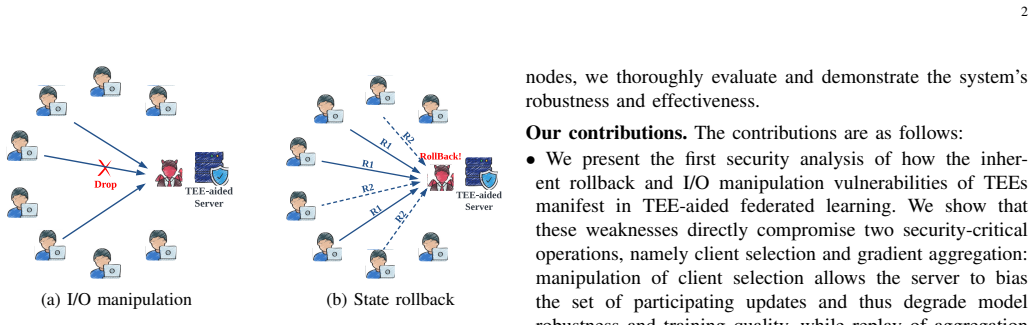
DIST-FL forms an append-only ledger from multiple TEEs to stop rollback and I/O attacks during federated learning aggregation.
A machine-rendered reading of the paper's core claim, the machinery that carries it, and where it could break.
Core claim
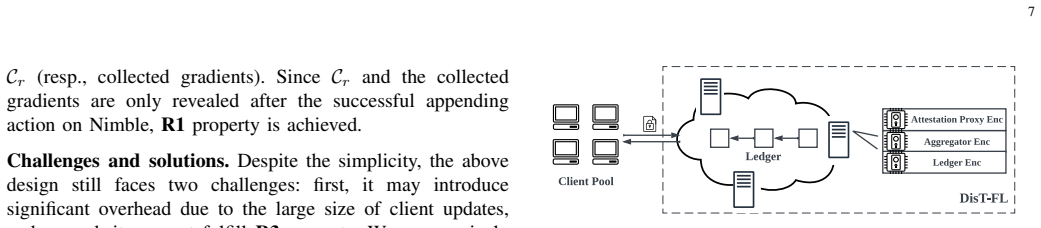
DIST-FL is a distributed system of servers guarded by multiple TEEs forming an append-only ledger for privacy-preserved, robust FL aggregation. It ensures operation linearizability to thwart state rollback attacks and incorporates inputs from reliable servers to mitigate I/O manipulation threats. Implementation and WAN evaluation show that the system counters the attacks while matching single-TEE performance and achieving a 6x throughput increase over prior TEE-based counterparts.
What carries the argument
The append-only ledger maintained across multiple TEE-guarded servers, which records every client selection and aggregation step to enforce linearizability.
If this is right
- Server-side manipulation of client selection becomes impossible once every selection step is recorded in the linearizable ledger.
- Replay of prior aggregation results is blocked because each operation must appear exactly once in the ledger order.
- The system can be deployed across wide-area networks without adding measurable latency beyond a single-TEE baseline.
- Throughput scales to six times that of earlier single-server TEE designs while retaining the same privacy guarantees.
Where Pith is reading between the lines
- The same ledger pattern could be applied to other TEE-protected services that currently rely on a single trusted server.
- If reliable servers prove difficult to identify in practice, the design would need an additional mechanism such as threshold signatures among the TEEs themselves.
- The reported throughput gain suggests that distributing the TEE workload may also reduce the impact of any single TEE's performance limits in large-scale deployments.
Load-bearing premise
The approach requires at least one set of reliable servers whose inputs cannot be forged or altered by the adversary.
What would settle it
An experiment in which an adversary successfully replays an old aggregation result or alters client selection inside DIST-FL despite the ledger would disprove the linearizability and reliable-input claims.
Figures


read the original abstract
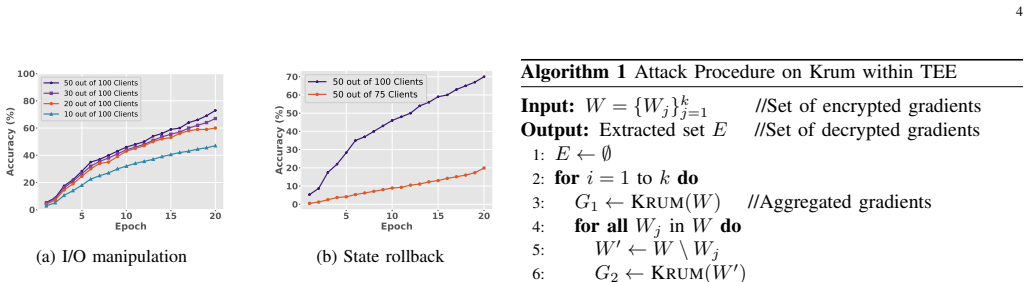
Trusted Execution Environments (TEEs)-aided federated learning protocols emerge as promising solutions to counter server-side adversaries and ensure the trustworthiness of the server. In this paper, we dissect existing protocols and demonstrate that server-side adversaries can still manipulate client selection and replay aggregation to compromise system robustness and privacy, by exploiting TEE limitations, i.e., state rollback and I/O manipulation. To this end, we present DIST-FL, a distributed system of servers guarded by multiple TEEs forming an append-only ledger for privacy-preserved, robust FL aggregation. Specifically, DIST-FL ensures operation linearizability to thwart state rollback attacks and incorporates inputs from reliable servers to mitigate I/O manipulation threats. We implement DIST-FL and conduct evaluations in WAN settings. Experimental results demonstrate that DIST-FL can effectively counter the proposed attacks and match the single-TEE's performance while offering a 6x throughput boost over its counterparts, leveraging TEE's computational advantages.
Editorial analysis
A structured set of objections, weighed in public.
Referee Report
Summary. The paper claims that existing TEE-based federated learning protocols remain vulnerable to server-side adversaries exploiting state rollback and I/O manipulation; it proposes DIST-FL, a distributed multi-TEE system forming an append-only ledger that ensures operation linearizability to counter rollback and incorporates inputs from reliable servers to mitigate I/O manipulation. The work includes an implementation evaluated in WAN settings, asserting that DIST-FL counters the identified attacks while matching single-TEE performance and delivering a 6x throughput improvement over counterparts.
Significance. If the security and performance claims hold, DIST-FL would provide a concrete architectural approach to hardening TEE-aided FL against server-side threats by distributing trust across multiple TEE instances, which is relevant for practical deployment of privacy-preserving FL in adversarial environments. The reported throughput gains, if reproducible, would strengthen the case for multi-TEE designs over single-TEE baselines.
major comments (2)
- [Abstract] Abstract: the mitigation of I/O manipulation threats by 'incorporating inputs from reliable servers' rests on an unstated mechanism for selecting, authenticating, or validating those servers. The threat model already permits server-side adversaries to perform I/O manipulation on any TEE-guarded server, so the reliable-server step must itself be shown to be outside that attack surface (e.g., via majority voting over attested inputs or an independent root of trust); without such a mechanism the mitigation is circular and load-bearing for the central security claim.
- [Abstract] Abstract: the paper states that DIST-FL 'can effectively counter the proposed attacks' yet supplies neither a formalized threat model, proof sketches for linearizability, nor experimental details (attack success rates, ablation studies, or threat-model coverage). These omissions make the central claim that the design thwarts the identified attacks unverifiable from the provided description.
Simulated Author's Rebuttal
We thank the referee for the careful review and constructive feedback on our work. We respond to each major comment below and will revise the manuscript to address the points raised where clarification is needed.
read point-by-point responses
-
Referee: [Abstract] Abstract: the mitigation of I/O manipulation threats by 'incorporating inputs from reliable servers' rests on an unstated mechanism for selecting, authenticating, or validating those servers. The threat model already permits server-side adversaries to perform I/O manipulation on any TEE-guarded server, so the reliable-server step must itself be shown to be outside that attack surface (e.g., via majority voting over attested inputs or an independent root of trust); without such a mechanism the mitigation is circular and load-bearing for the central security claim.
Authors: We agree the abstract is concise and does not spell out the selection mechanism. The full manuscript (Sections 4.1 and 5) describes that reliable servers are identified via quorum agreement over attested inputs in the append-only ledger: each server’s contribution is TEE-attested and accepted only when a majority of independent TEE instances report a consistent state. This quorum requirement places validation outside any single-server attack surface. We will revise the abstract to include a one-sentence description of this quorum-based validation. revision: yes
-
Referee: [Abstract] Abstract: the paper states that DIST-FL 'can effectively counter the proposed attacks' yet supplies neither a formalized threat model, proof sketches for linearizability, nor experimental details (attack success rates, ablation studies, or threat-model coverage). These omissions make the central claim that the design thwarts the identified attacks unverifiable from the provided description.
Authors: The manuscript contains a threat model in Section 3, an informal linearizability argument in Section 4.3 derived from the ledger’s append-only and ordering properties, and Section 6 evaluation that reports attack resistance experiments (0 % success under modeled rollback and I/O attacks). We acknowledge the abstract omits these references and will expand it to point to the relevant sections and include a brief mention of the attack-resistance results. Additional ablation details can be added to the evaluation if space allows. revision: partial
Circularity Check
No circularity; architectural design with no reductive equations or self-definitional steps
full rationale
The paper is a system-design proposal for DIST-FL that describes an append-only ledger of TEE-guarded servers, linearizability for rollback resistance, and incorporation of inputs from reliable servers. No equations, fitted parameters, or derivation chain exist that could reduce a claimed result to its own inputs by construction. The trust assumption on reliable servers is an explicit design choice, not a self-referential definition or a prediction obtained by fitting. Self-citations, if present, are not load-bearing for any mathematical uniqueness claim. The work is therefore self-contained against external benchmarks with score 0.
Axiom & Free-Parameter Ledger
axioms (1)
- domain assumption Trusted Execution Environments provide isolated execution and attestation that cannot be subverted by the host OS or hypervisor.
Reference graph
Works this paper leans on
-
[1]
Advances and open problems in federated learning,
P. Kairouz, H. B. McMahan, B. Avent, A. Bellet, M. Bennis, A. N. Bhagoji, K. Bonawitz, Z. Charles, G. Cormode, R. Cummingset al., “Advances and open problems in federated learning,”Foundations and Trends® in Machine Learning, 2021
2021
-
[2]
Federated learning: Strategies for improving communication efficiency,
J. Kone ˇcn`y, H. B. McMahan, F. X. Yu, P. Richt ´arik, A. T. Suresh, and D. Bacon, “Federated learning: Strategies for improving communication efficiency,”arXiv preprint arXiv:1610.05492, 2016
Pith/arXiv arXiv 2016
-
[3]
Communication-efficient learning of deep networks from decentralized data,
B. McMahan, E. Moore, D. Ramage, S. Hampson, and B. A. y Arcas, “Communication-efficient learning of deep networks from decentralized data,” inArtificial intelligence and statistics. PMLR, 2017
2017
-
[4]
General data protection regulation,
G. GDPR, “General data protection regulation,”Regulation (EU), vol. 679, 2016
2016
-
[5]
American data privacy and protection act,
A. ADPPA, “American data privacy and protection act,”House Energy and Commerce, 2021
2021
-
[6]
Collaborative machine learning without centralized train- ing data,
F. Learning, “Collaborative machine learning without centralized train- ing data,”Publication date: Thursday, April, 2017
2017
-
[7]
Federated evaluation and tuning for on-device personalization: System design & applications,
M. Paulik, M. Seigel, H. Mason, D. Telaar, J. Kluivers, R. C. van Dalen, C. W. Lau, L. Carlson, F. Granqvist, C. Vandevelde, S. Agarwal, J. Freudiger, A. Byde, A. Bhowmick, G. Kapoor, S. Beaumont, ´A. Cahill, D. Hughes, O. Javidbakht, F. Dong, R. Rishi, and S. Hung, “Federated evaluation and tuning for on-device personalization: System design & applicatio...
2021
-
[8]
Utilization of fate in risk management of credit in small and micro enterprises,
“Utilization of fate in risk management of credit in small and micro enterprises,” https://www.fedai.org/cases/utilization-of-fate-in-riskman agement-of-credit-in-small-and-micro-enterprises/, 2019
2019
-
[9]
Secure single-server aggregation with (poly) logarithmic overhead,
J. H. Bell, K. A. Bonawitz, A. Gasc ´on, T. Lepoint, and M. Raykova, “Secure single-server aggregation with (poly) logarithmic overhead,” in Proceedings of the 2020 ACM SIGSAC Conference on Computer and Communications Security, 2020, pp. 1253–1269
2020
-
[10]
Ppfl: privacy-preserving federated learning with trusted execution environments,
F. Mo, H. Haddadi, K. Katevas, E. Marin, D. Perino, and N. Kourtel- lis, “Ppfl: privacy-preserving federated learning with trusted execution environments,” 2021
2021
-
[11]
Microsoft azure confidential computing with intel sgx,
“Microsoft azure confidential computing with intel sgx,” https://softwa re.intel.com/content/www/us/en/develop/blogs/microsoft-azure-confiden tial-computing-with-intel-sgx.html, 2020
2020
-
[12]
Distributed learning in trusted execution environment: A case study of federated learning in sgx,
T. Xu, K. Zhu, A. Andrzejak, and L. Zhang, “Distributed learning in trusted execution environment: A case study of federated learning in sgx,” in2021 7th IEEE International Conference on Network Intelli- gence and Digital Content (IC-NIDC), 2021
2021
-
[13]
Efficient and private federated learning using tee,
F. Mo and H. Haddadi, “Efficient and private federated learning using tee,” inEuroSys, 2019
2019
-
[14]
Shufflefl: Gradient- preserving federated learning using trusted execution environment,
Y . Zhang, Z. Wang, J. Cao, R. Hou, and D. Meng, “Shufflefl: Gradient- preserving federated learning using trusted execution environment,” in Proceedings of the 18th ACM international conference on computing frontiers, 2021
2021
-
[15]
When federated learning meets blockchain: A new distributed learning paradigm,
C. Ma, J. Li, L. Shi, M. Ding, T. Wang, Z. Han, and H. V . Poor, “When federated learning meets blockchain: A new distributed learning paradigm,”IEEE Computational Intelligence Magazine, 2022
2022
-
[16]
Y . J. Cho, J. Wang, and G. Joshi, “Client selection in federated learning: Convergence analysis and power-of-choice selection strategies,”arXiv preprint arXiv:2010.01243, 2020
arXiv 2010
-
[17]
Lotto: Secure participant selection against adversarial servers in federated learning,
Z. Jiang, P. Ye, S. He, W. Wang, R. Chen, and B. Li, “Lotto: Secure participant selection against adversarial servers in federated learning,”
-
[18]
Available: https://arxiv.org/abs/2401.02880
[Online]. Available: https://arxiv.org/abs/2401.02880
-
[19]
Towards understanding biased client selection in federated learning,
Y . Jee Cho, J. Wang, and G. Joshi, “Towards understanding biased client selection in federated learning,” inProceedings of The 25th International Conference on Artificial Intelligence and Statistics, ser. Proceedings of Machine Learning Research, G. Camps-Valls, F. J. R. Ruiz, and I. Valera, Eds., vol. 151. PMLR, 28–30 Mar 2022, pp. 10 351–10 375. [Onlin...
2022
-
[20]
ROTE: Rollback protection for trusted execution,
S. Matetic, M. Ahmed, K. Kostiainen, A. Dhar, D. Sommer, A. Gervais, A. Juels, and S. Capkun, “ROTE: Rollback protection for trusted execution,” in26th USENIX Security Symposium (USENIX Security), 2017
2017
-
[21]
Narrator: Secure and practical state continuity for trusted execution in the cloud,
J. Niu, W. Peng, X. Zhang, and Y . Zhang, “Narrator: Secure and practical state continuity for trusted execution in the cloud,” 2022. 15
2022
-
[22]
Nimble: Rollback protection for confidential cloud services,
S. Angel, A. Basu, W. Cui, T. Jaeger, S. Lau, S. Setty, and S. Singanamalla, “Nimble: Rollback protection for confidential cloud services,” in17th USENIX Symposium on Operating Systems Design and Implementation (OSDI 23). Boston, MA: USENIX Association, Jul. 2023, pp. 193–208. [Online]. Available: https: //www.usenix.org/conference/osdi23/presentation/angel
2023
-
[23]
Client selection in federated learning: Principles, challenges, and opportunities,
L. Fu, H. Zhang, G. Gao, M. Zhang, and X. Liu, “Client selection in federated learning: Principles, challenges, and opportunities,”IEEE Internet of Things Journal, 2023
2023
-
[24]
Client selection for federated learning with heterogeneous resources in mobile edge,
T. Nishio and R. Yonetani, “Client selection for federated learning with heterogeneous resources in mobile edge,” inICC 2019-2019 IEEE international conference on communications (ICC). IEEE, 2019, pp. 1–7
2019
-
[25]
Towards understanding biased client selection in federated learning,
Y . J. Cho, J. Wang, and G. Joshi, “Towards understanding biased client selection in federated learning,” 2022
2022
-
[26]
Google workshop on federated learning and analytics,
“Google workshop on federated learning and analytics,” 2020. [Online]. Available: https://docs.google.com/document/d/1dWzVeFLrPinonQMa uxIo0oI-Vbvqup5cZzgdPXvu97Y/edit#heading=h.7dsxad3c3nf7
2020
-
[27]
Meta-fl: A novel meta-learning framework for optimizing heterogeneous model aggregation in federated learning,
Z. Alsulaimawi, “Meta-fl: A novel meta-learning framework for optimizing heterogeneous model aggregation in federated learning,”
-
[28]
Available: https://arxiv.org/abs/2406.16035
[Online]. Available: https://arxiv.org/abs/2406.16035
-
[29]
Local model poisoning attacks to byzantine-robust federated learning
M. Fang, X. Cao, J. Jia, and N. Z. Gong, “Local model poisoning attacks to byzantine-robust federated learning.” USENIX Association, 2020
2020
-
[30]
Back to the drawing board: A critical evaluation of poisoning attacks on production federated learning,
V . Shejwalkar, A. Houmansadr, P. Kairouz, and D. Ramage, “Back to the drawing board: A critical evaluation of poisoning attacks on production federated learning,” 2022
2022
-
[31]
Data poisoning attacks against federated learning systems,
V . Tolpegin, S. Truex, M. E. Gursoy, and L. Liu, “Data poisoning attacks against federated learning systems,” 2020
2020
-
[32]
How to backdoor federated learning,
E. Bagdasaryan, A. Veit, Y . Hua, D. Estrin, and V . Shmatikov, “How to backdoor federated learning,” 2020
2020
-
[33]
Comprehensive privacy analysis of deep learning: Passive and active white-box inference attacks against centralized and federated learning,
M. Nasr, R. Shokri, and A. Houmansadr, “Comprehensive privacy analysis of deep learning: Passive and active white-box inference attacks against centralized and federated learning,” 2019
2019
-
[34]
Source inference attacks in federated learning,
H. Hu, Z. Salcic, L. Sun, G. Dobbie, and X. Zhang, “Source inference attacks in federated learning,” 2021
2021
-
[35]
Ex- ploiting unintended property leakage in blockchain-assisted federated learning for intelligent edge computing,
M. Shen, H. Wang, B. Zhang, L. Zhu, K. Xu, Q. Li, and X. Du, “Ex- ploiting unintended property leakage in blockchain-assisted federated learning for intelligent edge computing,”IEEE Internet Things J., 2021
2021
-
[36]
Exploiting unintended feature leakage in collaborative learning,
L. Melis, C. Song, E. D. Cristofaro, and V . Shmatikov, “Exploiting unintended feature leakage in collaborative learning,” 2019
2019
-
[37]
Inverting gradients - how easy is it to break privacy in federated learning?
J. Geiping, H. Bauermeister, H. Dr ¨oge, and M. Moeller, “Inverting gradients - how easy is it to break privacy in federated learning?” 2020
2020
-
[38]
Ma- chine learning with adversaries: Byzantine tolerant gradient descent,
P. Blanchard, E. M. El Mhamdi, R. Guerraoui, and J. Stainer, “Ma- chine learning with adversaries: Byzantine tolerant gradient descent,” Advances in neural information processing systems, 2017
2017
-
[39]
J. Le, D. Zhang, X. Lei, L. Jiao, K. Zeng, and X. Liao, “Privacy-preserving federated learning with malicious clients and honest-but-curious servers,”IEEE Trans. Inf. Forensics Secur., vol. 18, pp. 4329–4344, 2023. [Online]. Available: https://doi.org/10.1109/TIFS .2023.3295949
-
[40]
Practical secure aggregation for privacy-preserving machine learning,
K. Bonawitz, V . Ivanov, B. Kreuter, A. Marcedone, H. B. McMahan, S. Patel, D. Ramage, A. Segal, and K. Seth, “Practical secure aggregation for privacy-preserving machine learning,” 2017
2017
-
[41]
Vfl: A verifiable federated learning with privacy-preserving for big data in industrial iot,
A. Fu, X. Zhang, N. Xiong, Y . Gao, H. Wang, and J. Zhang, “Vfl: A verifiable federated learning with privacy-preserving for big data in industrial iot,”IEEE Transactions on Industrial Informatics, 2020
2020
-
[42]
Fast- secagg: Scalable secure aggregation for privacy-preserving federated learning,
S. Kadhe, N. Rajaraman, O. O. Koyluoglu, and K. Ramchandran, “Fast- secagg: Scalable secure aggregation for privacy-preserving federated learning,”arXiv preprint arXiv:2009.11248, 2020
arXiv 2009
-
[43]
Turbo-aggregate: Breaking the quadratic aggregation barrier in secure federated learning,
J. So, B. G ¨uler, and A. S. Avestimehr, “Turbo-aggregate: Breaking the quadratic aggregation barrier in secure federated learning,”IEEE Journal on Selected Areas in Information Theory, 2021
2021
-
[44]
Practical secure aggregation for privacy-preserving machine learning
K. A. Bonawitz, V . Ivanov, B. Kreuter, A. Marcedone, H. B. McMahan, S. Patel, D. Ramage, A. Segal, and K. Seth, “Practical secure aggregation for privacy-preserving machine learning.” ACM, 2017
2017
-
[45]
Prio: Private, robust, and scalable computation of aggregate statistics,
H. Corrigan-Gibbs and D. Boneh, “Prio: Private, robust, and scalable computation of aggregate statistics,” in14th USENIX Symposium on Networked Systems Design and Implementation, NSDI 2017, Boston, MA, USA, March 27-29, 2017, A. Akella and J. Howell, Eds. USENIX Association, 2017, pp. 259–282. [Online]. Available: https://www.usen ix.org/conference/nsdi17...
2017
-
[46]
Giving state to the stateless: Augmenting trustworthy computation with ledgers,
G. Kaptchuk, I. Miers, and M. Green, “Giving state to the stateless: Augmenting trustworthy computation with ledgers,” 2019
2019
-
[47]
Idea: State-continuous transfer of state in protected-module architectures,
R. Strackx and N. Lambrigts, “Idea: State-continuous transfer of state in protected-module architectures,” 2015
2015
-
[48]
ADAM-CS: Advanced asynchronous monotonic counter service,
A. Martin, C. Lian, F. Gregor, R. Krahn, V . Schiavoni, P. Felber, and C. Fetzer, “ADAM-CS: Advanced asynchronous monotonic counter service,” 2021
2021
-
[49]
Learning multiple layers of features from tiny images,
A. Krizhevsky, “Learning multiple layers of features from tiny images,” University of Toronto, 05 2012
2012
-
[50]
Time-sensitive learning for heterogeneous federated edge intelligence,
Y . Xiao, X. Zhang, Y . Li, G. Shi, M. Krunz, D. N. Nguyen, and D. T. Hoang, “Time-sensitive learning for heterogeneous federated edge intelligence,”IEEE Transactions on Mobile Computing, vol. 23, no. 2, p. 1382–1400, Feb. 2024. [Online]. Available: http://dx.doi.org/10.1109/TMC.2023.3237374
-
[51]
Olive: Oblivious federated learning on trusted execution environment against the risk of sparsification,
F. Kato, Y . Cao, and M. Yoshikawa, “Olive: Oblivious federated learning on trusted execution environment against the risk of sparsification,” Proc. VLDB Endow., vol. 16, no. 10, pp. 2404–2417, 2023. [Online]. Available: https://www.vldb.org/pvldb/vol16/p2404-kato.pdf
2023
-
[52]
Papaya: Practical, private, and scalable federated learning,
D. Huba, J. Nguyen, K. Malik, R. Zhu, M. Rabbat, A. Yousefpour, C.-J. Wu, H. Zhan, P. Ustinov, H. Srinivaset al., “Papaya: Practical, private, and scalable federated learning,”Proceedings of Machine Learning and Systems, vol. 4, pp. 814–832, 2022
2022
-
[53]
Deta: Minimizing data leaks in federated learning via decentralized and trustworthy aggregation,
P.-C. Cheng, K. Eykholt, Z. Gu, H. Jamjoom, K. Jayaram, E. Valdez, and A. Verma, “Deta: Minimizing data leaks in federated learning via decentralized and trustworthy aggregation,” inProceedings of the Nineteenth European Conference on Computer Systems, 2024, pp. 219– 235
2024
-
[54]
Confidential federated computations,
H. Eichner, D. Ramage, K. Bonawitz, D. Huba, T. Santoro, B. McLarnon, T. Van Overveldt, N. Fallen, P. Kairouz, A. Cheu et al., “Confidential federated computations,”arXiv preprint arXiv:2404.10764, 2024
arXiv 2024
-
[55]
The sybil attack,
J. R. Douceur, “The sybil attack,” 2002
2002
-
[56]
Brief announcement: Byzantine-tolerant machine learning,
P. Blanchard, E. M. E. Mhamdi, R. Guerraoui, and J. Stainer, “Brief announcement: Byzantine-tolerant machine learning,” 2017
2017
-
[57]
Practical byzantine fault tolerance,
M. Castro, B. Liskovet al., “Practical byzantine fault tolerance,” 1999
1999
-
[58]
HotStuff: BFT consensus with linearity and responsiveness,
M. Yin, D. Malkhi, M. K. Reiter, G. G. Gueta, and I. Abraham, “HotStuff: BFT consensus with linearity and responsiveness,”PODC ’19, pp. 347–356, 2019
2019
-
[59]
Fast-HotStuff: A fast and robust bft protocol for blockchains,
M. M. Jalalzai, J. Niu, C. Feng, and F. Gai, “Fast-HotStuff: A fast and robust bft protocol for blockchains,”IEEE Transactions on Dependable and Secure Computing, vol. 21, no. 4, pp. 2478–2493, 2024
2024
-
[60]
Ladon: High-Performance Multi-BFT Consensus via Dynamic Global Ordering,
H. Lyu, S. Xie, J. Niu, C. Feng, Y . Zhang, and I. Beschastnikh, “Ladon: High-Performance Multi-BFT Consensus via Dynamic Global Ordering,” inEuroSys, 2025
2025
-
[61]
Byzantine- robust and privacy-preserving framework for fedml,
H. Hashemi, Y . Wang, C. Guo, and M. Annavaram, “Byzantine- robust and privacy-preserving framework for fedml,”arXiv preprint arXiv:2105.02295, 2021
arXiv 2021
-
[62]
Damysus: Streamlined BFT consensus leveraging trusted components,
J. Decouchant, D. Kozhaya, V . Rahli, and J. Yu, “Damysus: Streamlined BFT consensus leveraging trusted components,” 2022
2022
-
[63]
Salticidae: minimal C++ asynchronous network library,
“Salticidae: minimal C++ asynchronous network library,” https://github .com/Determinant/salticidae, retrieved May, 2023
2023
-
[64]
Secretflow: A unified framework for privacy-preserving data analysis and machine learning,
“Secretflow: A unified framework for privacy-preserving data analysis and machine learning,” https://github.com/secretflow/secretflow, 2019
2019
-
[65]
{FLAME}: Taming backdoors in federated learning,
T. D. Nguyen, P. Rieger, H. Chen, H. Yalame, H. M ¨ollering, H. Fer- eidooni, S. Marchal, M. Miettinen, A. Mirhoseini, S. Zeitouniet al., “{FLAME}: Taming backdoors in federated learning,” in31st USENIX security symposium (USENIX Security 22), 2022, pp. 1415–1432
2022
-
[66]
Fldetector: Defending federated learning against model poisoning attacks via detecting ma- licious clients,
Z. Zhang, X. Cao, J. Jia, and N. Z. Gong, “Fldetector: Defending federated learning against model poisoning attacks via detecting ma- licious clients,” inProceedings of the 28th ACM SIGKDD conference on knowledge discovery and data mining, 2022, pp. 2545–2555
2022
-
[67]
Fedrecover: Recovering from poisoning attacks in federated learning using historical information,
X. Cao, J. Jia, Z. Zhang, and N. Z. Gong, “Fedrecover: Recovering from poisoning attacks in federated learning using historical information,” in 2023 IEEE Symposium on Security and Privacy (SP). IEEE, 2023, pp. 1366–1383
2023
-
[68]
Fedredefense: Defending against model poisoning attacks for federated learning using model update reconstruction error
Y . Xie, M. Fang, and N. Z. Gong, “Fedredefense: Defending against model poisoning attacks for federated learning using model update reconstruction error.” International Conference on Machine Learning, 2024
2024
-
[69]
Boba: Byzantine-robust federated learning with label skewness,
W. Bao, J. Wu, and J. He, “Boba: Byzantine-robust federated learning with label skewness,” inInternational Conference on Artificial Intelli- gence and Statistics. PMLR, 2024, pp. 892–900
2024
-
[70]
An experimental study of byzantine- robust aggregation schemes in federated learning,
S. Li, E. C.-H. Ngai, and T. V oigt, “An experimental study of byzantine- robust aggregation schemes in federated learning,”IEEE Transactions on Big Data, vol. 10, no. 6, pp. 975–988, 2023
2023
-
[71]
Differentially private federated learning: A client level perspective,
R. C. Geyer, T. Klein, and M. Nabi, “Differentially private federated learning: A client level perspective,”arXiv preprint arXiv:1712.07557, 2017
Pith/arXiv arXiv 2017
-
[72]
Federated learning with differential privacy: Algorithms 16 and performance analysis,
K. Wei, J. Li, M. Ding, C. Ma, H. H. Yang, F. Farokhi, S. Jin, T. Q. Quek, and H. V . Poor, “Federated learning with differential privacy: Algorithms 16 and performance analysis,”IEEE Transactions on Information Forensics and Security, 2020
2020
-
[73]
M. Naseri, J. Hayes, and E. De Cristofaro, “Toward robustness and privacy in federated learning: Experimenting with local and central differential privacy,”arXiv preprint arXiv:2009.03561, 2020
arXiv 2009
-
[74]
Bvdfed: Byzantine-resilient and verifiable aggregation for differentially private federated learning,
X. Gao, S. Fu, L. Liu, and Y . Luo, “Bvdfed: Byzantine-resilient and verifiable aggregation for differentially private federated learning,” Frontiers of Computer Science, vol. 18, no. 5, p. 185810, 2024
2024
-
[75]
Secfl: Confidential federated learning using tees,
D. L. Quoc and C. Fetzer, “Secfl: Confidential federated learning using tees,”arXiv preprint arXiv:2110.00981, 2021
arXiv 2021
-
[76]
Federated learning: Opportunities and challenges,
P. M. Mammen, “Federated learning: Opportunities and challenges,” arXiv preprint arXiv:2101.05428, 2021
arXiv 2021
-
[77]
Sok: Machine learning with confidential computing,
F. Mo, Z. Tarkhani, and H. Haddadi, “Sok: Machine learning with confidential computing,”arXiv preprint arXiv:2208.10134, 2022
arXiv 2022
-
[78]
Enabling execution assurance of federated learning at untrusted participants,
X. Zhang, F. Li, Z. Zhang, Q. Li, C. Wang, and J. Wu, “Enabling execution assurance of federated learning at untrusted participants,” in IEEE INFOCOM 2020-IEEE Conference on Computer Communications, 2020
2020
-
[79]
Privacy-preserving and robust federated deep metric learning,
Y . Tian, X. Ke, Z. Tao, S. Ding, F. Xu, Q. Li, H. Han, S. Zhong, and X. Fu, “Privacy-preserving and robust federated deep metric learning,” in30th IEEE/ACM International Symposium on Quality of Service, IWQoS 2022, Oslo, Norway, June 10-12, 2022. IEEE, 2022, pp. 1–11. [Online]. Available: https://doi.org/10.1109/IWQoS54832.2022.9812909
-
[80]
Kwon, Jagmohan Chauhan, Abhishek Kumar, Pan Hui HKUST, and Cecilia Mascolo
E. N. Kuznetsov, Y . Chen, and M. Zhao, “Securefl: Privacy preserving federated learning with SGX and trustzone,” in6th IEEE/ACM Symposium on Edge Computing, SEC 2021, San Jose, CA, USA, December 14-17, 2021. IEEE, 2021, pp. 55–67. [Online]. Available: https://doi.org/10.1145/3453142.3491287
discussion (0)
Sign in with ORCID, Apple, or X to comment. Anyone can read and Pith papers without signing in.