Phase-correlation-free quantum key distribution source operating at gigahertz rates
Pith reviewed 2026-06-28 05:54 UTC · model grok-4.3
The pith
A superluminescent diode source supplies phase-randomized pulses at 1.25 GHz for secure high-speed QKD.
A machine-rendered reading of the paper's core claim, the machinery that carries it, and where it could break.
Core claim
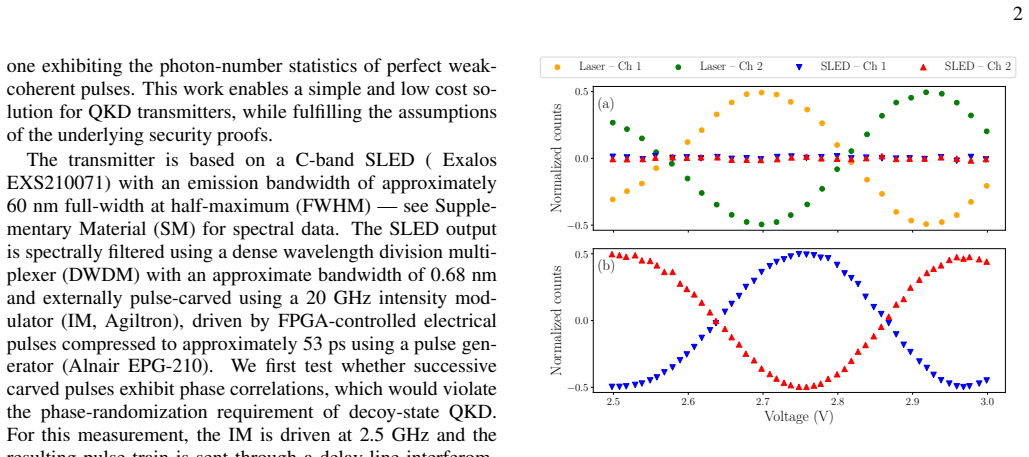
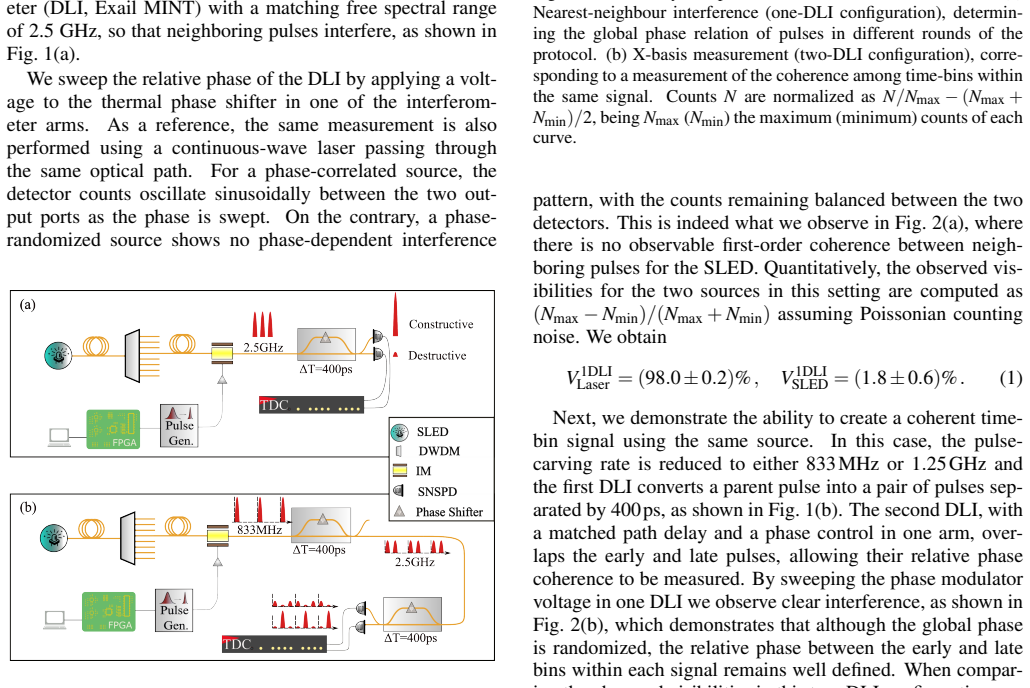
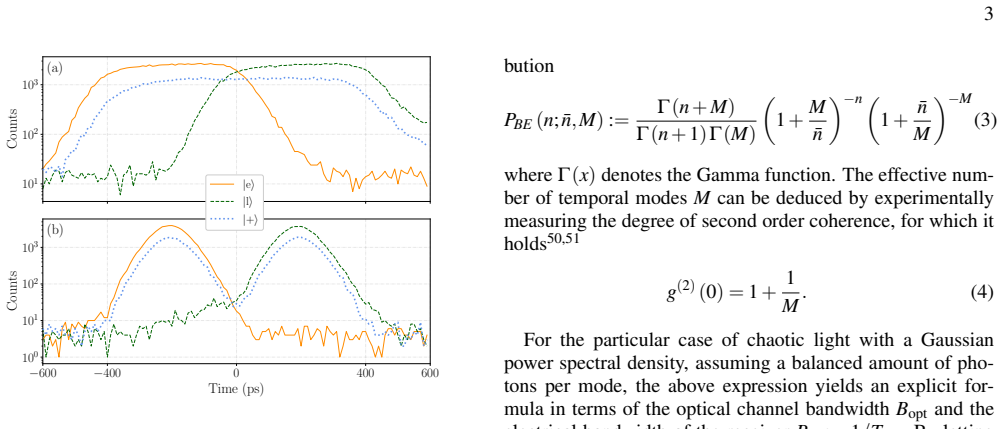
A 1.25 GHz SLED source in the C-band produces approximately 100 ps pulses separated by 400 ps that exhibit greater than 99 percent visibility between adjacent time bins in interferometric measurements, confirming strong first-order coherence within each quantum signal, while the spontaneous-emission-driven operation ensures intrinsic global phase randomization between adjacent signals and thereby supplies a phase-correlation-free source for high-speed time-bin-encoded QKD.
What carries the argument
The spontaneous-emission-driven superluminescent light-emitting diode, which maintains intra-pulse coherence yet randomizes the global phase from one pulse to the next without external modulation.
If this is right
- The source is directly compatible with high-speed time-bin encoding schemes.
- It removes the need for active phase randomization or gain-switching that introduce correlations at gigahertz rates.
- Pulse duration and separation support efficient operation in the C-band for fiber-based QKD.
- The design provides a scalable route to compact prepare-and-measure QKD transmitters.
Where Pith is reading between the lines
- The same spontaneous-emission mechanism could be tested at still higher repetition rates to determine the practical upper limit before residual correlations appear.
- Integration with existing commercial SLED modules might reduce the overall cost and footprint of field-deployed QKD systems.
- The approach could be examined in other protocols that rely on phase randomization, such as certain measurement-device-independent schemes.
Load-bearing premise
Spontaneous emission inside the SLED produces fully uncorrelated phases between successive pulses with no residual correlations that would allow an eavesdropper to extract information.
What would settle it
A direct measurement of non-zero phase correlation between adjacent or successive pulses that exceeds the threshold compatible with positive secret-key rates in a decoy-state protocol run at the stated repetition rate.
Figures
read the original abstract
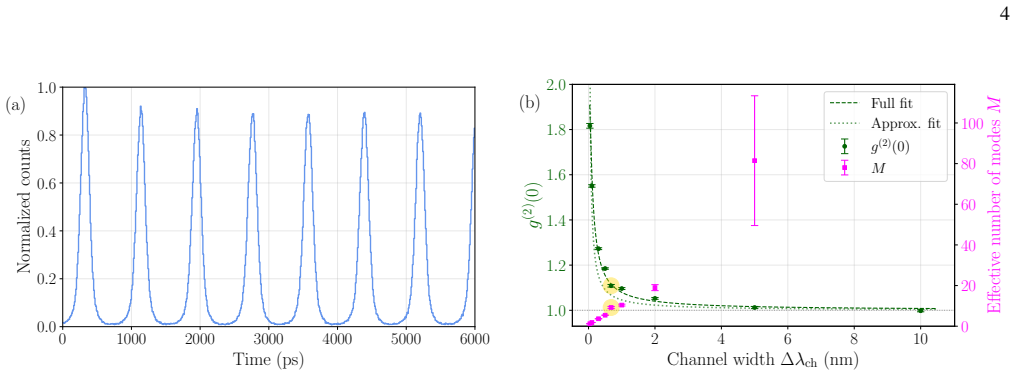
Phase randomization is essential for the security of practical decoy-state quantum key distribution (QKD) systems. Commonly, implementations rely on laser sources which are either actively phase-randomized, or gain-switched. However, at high repetition rates these show correlations, which can ultimately compromise security and performance. We present a 1.25 GHz phase-randomized QKD source based on a super-luminescent light emitting diode (SLED) operating in the C-band as a compact and cost-effective alternative. The source generates $\sim100$ ps optical pulses with $400$ ps pulse-to-pulse separation, compatible with high-speed time-bin encoding. Interferometric measurements demonstrate $>99\%$ visibility between adjacent time bins, confirming strong first-order coherence within the same quantum signals, while the spontaneous-emission-driven nature of the SLED ensures intrinsic global phase randomization between adjacent signals. This work establishes a scalable SLED-based platform for high-speed prepare-and-measure QKD systems.
Editorial analysis
A structured set of objections, weighed in public.
Referee Report
Summary. The manuscript presents a 1.25 GHz SLED-based optical source for prepare-and-measure QKD that generates ~100 ps pulses with 400 ps separation. It reports >99% interferometric visibility between adjacent time bins within individual pulses and asserts that the spontaneous-emission-driven operation of the SLED provides intrinsic global phase randomization between successive pulses, eliminating the need for active randomization or gain-switching while remaining compatible with time-bin encoding.
Significance. If the inter-pulse phase-randomization claim holds with quantitative bounds, the source would constitute a compact, cost-effective alternative to gain-switched lasers for gigahertz-rate decoy-state QKD, directly addressing correlation issues that can compromise security proofs at high repetition rates.
major comments (2)
- [Abstract] Abstract: the central security claim—that spontaneous emission ensures intrinsic global phase randomization between adjacent signals with no residual correlations—is asserted from device physics but is not supported by any interferometric visibility, phase-difference statistics, or correlation measurement performed on pulses belonging to consecutive drive periods (400 ps separation). Only intra-pulse first-order coherence is quantified.
- [Abstract] Abstract: the reported visibility >99% is given without raw data, error bars, statistical analysis, or details of the interferometric setup and fitting procedure, making it impossible to assess whether the measurement meets the quantitative requirements of decoy-state security proofs.
Simulated Author's Rebuttal
We thank the referee for their careful reading of the manuscript and for highlighting these important points regarding the presentation of our security claims and experimental details. We address each comment below.
read point-by-point responses
-
Referee: [Abstract] Abstract: the central security claim—that spontaneous emission ensures intrinsic global phase randomization between adjacent signals with no residual correlations—is asserted from device physics but is not supported by any interferometric visibility, phase-difference statistics, or correlation measurement performed on pulses belonging to consecutive drive periods (400 ps separation). Only intra-pulse first-order coherence is quantified.
Authors: We agree that the manuscript does not include a direct interferometric measurement of phase differences between pulses separated by 400 ps. The claim of intrinsic global phase randomization rests on the device physics of the SLED operating in the amplified spontaneous emission regime, where each pulse is seeded by independent spontaneous emission events with no retained phase memory from prior drive periods. This mechanism is distinct from gain-switched lasers, where carrier density fluctuations can induce correlations. We have revised the manuscript to expand the discussion of the expected phase diffusion timescale (derived from the SLED coherence length) and to cite relevant literature on ASE phase statistics, thereby providing a more quantitative physics-based argument. We have not added new experimental data on inter-pulse correlations, as our setup was configured for intra-pulse time-bin visibility relevant to the QKD protocol. revision: partial
-
Referee: [Abstract] Abstract: the reported visibility >99% is given without raw data, error bars, statistical analysis, or details of the interferometric setup and fitting procedure, making it impossible to assess whether the measurement meets the quantitative requirements of decoy-state security proofs.
Authors: The interferometric setup, raw fringe data, error analysis, and fitting procedure used to determine the >99% visibility are described in the main text (Section on experimental characterization) and supplementary information. To improve clarity and allow direct assessment against decoy-state requirements, we have revised the manuscript to include explicit error bars on the visibility value, a statistical summary of multiple measurements, and additional details on the unbalanced Mach-Zehnder interferometer configuration and data processing. revision: yes
Circularity Check
No circularity; experimental demonstration with external benchmarks
full rationale
The manuscript is a purely experimental report on a SLED-based source. It describes pulse generation at 1.25 GHz, reports an interferometric visibility measurement (>99% between adjacent time bins within a pulse), and attributes inter-pulse phase randomization to the spontaneous-emission physics of the SLED. No equations, fitted parameters, predictions, or derivation chains appear. The visibility datum is an independent experimental observable, not a quantity defined in terms of itself or obtained by fitting a related observable. The phase-randomization premise is presented as a consequence of device physics rather than a self-referential result. No self-citations, ansatzes, or uniqueness theorems are invoked in a load-bearing way. This is the normal case of a self-contained experimental paper.
Axiom & Free-Parameter Ledger
axioms (1)
- domain assumption Spontaneous emission in a SLED produces uncorrelated global phases between successive pulses
Reference graph
Works this paper leans on
-
[1]
Unconditional security in quantum cryptography
Mayers, Dominic. Unconditional security in quantum cryptography. J. ACM
-
[2]
Quantum key distribution with correlated sources
Pereira, Margarida and Kato, Go and Mizutani, Akihiro and Curty, Marcos and Tamaki, Kiyoshi. Quantum key distribution with correlated sources. Sci. Adv
-
[3]
Security of decoy-state quantum key distribution with correlated bit-and-basis encoders
Curr \'a s-Lorenzo, Guillermo and Pereira, Margarida and Marcomini, Alessandro and Tamaki, Kiyoshi and Curty, Marcos. Security of decoy-state quantum key distribution with correlated bit-and-basis encoders. arXiv [quant-ph]
-
[4]
A critical analysis of deployed use cases for quantum key distribution and comparison with post-quantum cryptography
Aquina, Nick and Cimoli, Bruno and Das, Soumya and H \"o velmanns, Kathrin and Weber, Fiona Johanna and Okonkwo, Chigo and Rommel, Simon and S kori \'c , Boris and Tafur Monroy, Idelfonso and Verschoor, Sebastian. A critical analysis of deployed use cases for quantum key distribution and comparison with post-quantum cryptography. EPJ Quantum Technol
-
[5]
Entanglement-based secure quantum cryptography over 1,120 kilometres
Yin, Juan and Li, Yu-Huai and Liao, Sheng-Kai and Yang, Meng and Cao, Yuan and Zhang, Liang and Ren, Ji-Gang and Cai, Wen-Qi and Liu, Wei-Yue and Li, Shuang-Lin and Shu, Rong and Huang, Yong-Mei and Deng, Lei and Li, Li and Zhang, Qiang and Liu, Nai-Le and Chen, Yu-Ao and Lu, Chao-Yang and Wang, Xiang-Bin and Xu, Feihu and Wang, Jian-Yu and Peng, Cheng-Zh...
-
[6]
High-rate quantum key distribution exceeding 110 Mb s--1
Li, Wei and Zhang, Likang and Tan, Hao and Lu, Yichen and Liao, Sheng-Kai and Huang, Jia and Li, Hao and Wang, Zhen and Mao, Hao-Kun and Yan, Bingze and Li, Qiong and Liu, Yang and Zhang, Qiang and Peng, Cheng-Zhi and You, Lixing and Xu, Feihu and Pan, Jian-Wei. High-rate quantum key distribution exceeding 110 Mb s--1. Nat. Photonics
-
[7]
u nenfelder, Fadri and Boaron, Alberto and Resta, Giovanni V and Perrenoud, Matthieu and Rusca, Davide and Barreiro, Claudio and Houlmann, Rapha \
Gr \"u nenfelder, Fadri and Boaron, Alberto and Resta, Giovanni V and Perrenoud, Matthieu and Rusca, Davide and Barreiro, Claudio and Houlmann, Rapha \"e l and Sax, Rebecka and Stasi, Lorenzo and El-Khoury, Sylvain and H \"a nggi, Esther and Bosshard, Nico and Bussi \`e res, F \'e lix and Zbinden, Hugo. Fast single-photon detectors and real-time key disti...
-
[8]
Secure quantum key distribution with realistic devices
Xu, Feihu and Ma, Xiongfeng and Zhang, Qiang and Lo, Hoi-Kwong and Pan, Jian-Wei. Secure quantum key distribution with realistic devices. Rev. Mod. Phys
-
[9]
Quantum key distribution: a survey on current vulnerability trends and potential implementation risks
Brazaola-Vicario, Aitor and Ruiz, Alejandra and Lage, Oscar and Jacob, Eduardo and Astorga, Jasone. Quantum key distribution: a survey on current vulnerability trends and potential implementation risks. Opt. Contin
-
[10]
Quantum cryptography: Public key distribution and coin tossing
Bennett, Charles H and Brassard, Gilles. Quantum cryptography: Public key distribution and coin tossing. Proceedings of the IEEE International Conference on Computers, Systems and Signal Processing
-
[11]
Interference of short optical pulses from independent gain-switched laser diodes for quantum secure communications
Yuan, Z L and Lucamarini, M and Dynes, J F and Fr \"o hlich, B and Ward, M B and Shields, A J. Interference of short optical pulses from independent gain-switched laser diodes for quantum secure communications. Phys. Rev. Appl
-
[12]
A 100-pixel photon-number-resolving detector unveiling photon statistics
Cheng, Risheng and Zhou, Yiyu and Wang, Sihao and Shen, Mohan and Taher, Towsif and Tang, Hong X. A 100-pixel photon-number-resolving detector unveiling photon statistics. Nat. Photonics
-
[13]
Statistical Optics
Goodman, Joseph W. Statistical Optics
-
[14]
Quantum key distribution over multicore fiber
Dynes, J F and Kindness, S J and Tam, S W-B and Plews, A and Sharpe, A W and Lucamarini, M and Fr \"o hlich, B and Yuan, Z L and Penty, R V and Shields, A J. Quantum key distribution over multicore fiber. Opt. Express
-
[15]
Quantum key distribution with high loss: toward global secure communication
Hwang, Won-Young. Quantum key distribution with high loss: toward global secure communication. Phys. Rev. Lett
-
[16]
QKD security proofs for decoy-state BB84: protocol variations, proof techniques, gaps and limitations
Tupkary, Devashish and Tan, Ernest Y-Z and Nahar, Shlok and Kamin, Lars and L \"u tkenhaus, Norbert. QKD security proofs for decoy-state BB84: protocol variations, proof techniques, gaps and limitations. arXiv [quant-ph]
-
[17]
Enhanced detection rate and high photon-number efficiencies with a scalable parallel SNSPD
Stasi, Lorenzo and Taher, Towsif and Resta, Giovanni V and Zbinden, Hugo and Thew, Rob and Bussi \`e res, F \'e lix. Enhanced detection rate and high photon-number efficiencies with a scalable parallel SNSPD. ACS Photonics
-
[18]
Numerical security analysis for practical quantum key distribution
Navarrete, \'A lvaro and Curr \'a s-Lorenzo, Guillermo and Pereira, Margarida and Curty, Marcos. Numerical security analysis for practical quantum key distribution. arXiv:2605.12984 [quant-ph]
work page internal anchor Pith review Pith/arXiv arXiv
-
[19]
Quantum networks using rare-earth ions
Tittel, Wolfgang and Afzelius, Mikael and Kinos, A and Rippe, L and Walther, A. Quantum networks using rare-earth ions. Quantum Sci Technol
-
[20]
Multi-channel high speed quantum random number generating with DWDM and superluminescent LED
Chen, Ziyang and Wang, Gan and Li, Zhengyu and Peng, Xiang and Guo, Hong. Multi-channel high speed quantum random number generating with DWDM and superluminescent LED. 2017 IEEE 85th Vehicular Technology Conference (VTC Spring)
2017
-
[21]
Mode-pairing quantum key distribution
Zeng, Pei and Zhou, Hongyi and Wu, Weijie and Ma, Xiongfeng. Mode-pairing quantum key distribution. Nat. Commun
-
[22]
Randomness quantification for quantum random number generation based on detection of amplified spontaneous emission noise
Yang, Jie and Fan, Fan and Liu, Jinlu and Su, Qi and Li, Yang and Huang, Wei and Xu, Bingjie. Randomness quantification for quantum random number generation based on detection of amplified spontaneous emission noise. Quantum Sci. Technol
-
[23]
Photon statistics of amplified spontaneous emission in a dense wavelength-division multiplexing regime
Pietralunga, Silvia M and Martelli, Paolo and Martinelli, Mario. Photon statistics of amplified spontaneous emission in a dense wavelength-division multiplexing regime. Opt. Lett
-
[24]
Photon statistics of amplified spontaneous emission noise in a 10-Gbit/s optically preamplified direct-detection receiver
Wong, W S and Haus, H A and Jiang, L A and Hansen, P B and Margalit, M. Photon statistics of amplified spontaneous emission noise in a 10-Gbit/s optically preamplified direct-detection receiver. Opt. Lett
-
[25]
Experimental study on the security of superluminescent LED-based quantum random generator
Li, Yuanhao and Fei, Yangyang and Wang, Weilong and Meng, Xiangdong and Wang, Hong and Duan, Qianheng and Ma, Zhi. Experimental study on the security of superluminescent LED-based quantum random generator. Opt. Eng
-
[26]
Phase-randomized laser pulse generation at 10 GHz for quantum photonic applications
Lo, Yuen San and Brzosko, Adam H and Smith, Peter R and Woodward, Robert I and Marangon, Davide G and Dynes, James F and Ju \'a rez, Sergio and Para \"i so, Taofiq K and Stevenson, R Mark and Shields, Andrew J. Phase-randomized laser pulse generation at 10 GHz for quantum photonic applications. arXiv:2601.04031 [quant-ph]
-
[27]
Secure quantum key distribution
Lo, Hoi-Kwong and Curty, Marcos and Tamaki, Kiyoshi. Secure quantum key distribution. Nat. Photonics
-
[28]
Advances in quantum cryptography
Pirandola, S and Andersen, U L and Banchi, L and Berta, M and Bunandar, D and Colbeck, R and Englund, D and Gehring, T and Lupo, C and Ottaviani, C and Pereira, J L and Razavi, M and Shamsul Shaari, J and Tomamichel, M and Usenko, V C and Vallone, G and Villoresi, P and Wallden, P. Advances in quantum cryptography. Adv. Opt. Photonics
-
[29]
Quantum cryptography based on Bell's theorem
Ekert, A K. Quantum cryptography based on Bell's theorem. Phys. Rev. Lett
-
[30]
Overcoming the rate-distance limit of quantum key distribution without quantum repeaters
Lucamarini, M and Yuan, Z L and Dynes, J F and Shields, A J. Overcoming the rate-distance limit of quantum key distribution without quantum repeaters. Nature
-
[31]
Quantum cryptography: Public key distribution and coin tossing
Bennett, Charles H and Brassard, Gilles. Quantum cryptography: Public key distribution and coin tossing. Theor. Comput. Sci
-
[32]
Security bounds for decoy-state quantum key distribution with arbitrary photon-number statistics
Foletto, Giulio and Picciariello, Francesco and Agnesi, Costantino and Villoresi, Paolo and Vallone, Giuseppe. Security bounds for decoy-state quantum key distribution with arbitrary photon-number statistics. Phys. Rev. A
-
[33]
Simple proof of security of the BB84 quantum key distribution protocol
Shor, P W and Preskill, J. Simple proof of security of the BB84 quantum key distribution protocol. Phys. Rev. Lett
-
[34]
The quantum theory of light
Loudon, Rodney. The quantum theory of light
-
[35]
Optical coherence and quantum optics
Mandel, Leonard and Wolf, Emil and Shapiro, Jeffrey H. Optical coherence and quantum optics. Am. J. Phys
-
[36]
Testing the photon-number statistics of a quantum key distribution light source
Dynes, J F and Lucamarini, M and Patel, K A and Sharpe, A W and Ward, M B and Yuan, Z L and Shields, A J. Testing the photon-number statistics of a quantum key distribution light source. Opt. Express
-
[37]
Decoy state quantum key distribution
Lo, Hoi-Kwong and Ma, Xiongfeng and Chen, Kai. Decoy state quantum key distribution. Phys. Rev. Lett
-
[38]
Getting something out of nothing
Lo, H-K. Getting something out of nothing. Quantum Inf. Comput
-
[39]
Practical decoy state for quantum key distribution
Ma, Xiongfeng and Qi, Bing and Zhao, Yi and Lo, Hoi-Kwong. Practical decoy state for quantum key distribution. Phys. Rev. A
-
[40]
Loss-tolerant quantum cryptography with imperfect sources
Tamaki, Kiyoshi and Curty, Marcos and Kato, Go and Lo, Hoi-Kwong and Azuma, Koji. Loss-tolerant quantum cryptography with imperfect sources. Phys. Rev. A
-
[41]
A Study on Implementation Attacks against QKD Systems
BSI. A Study on Implementation Attacks against QKD Systems
-
[42]
Reference-beam attacks against twin-field quantum key distribution using optical injection locking
Ju \'a rez, Sergio and Marcomini, Alessandro and Petrov, Mikhail and Woodward, Robert I and Dowling, Toby J and Stevenson, R Mark and Curty, Marcos and Rusca, Davide. Reference-beam attacks against twin-field quantum key distribution using optical injection locking. Phys. Rev. A
-
[43]
Practical security of twin-field quantum key distribution with optical phase-locked loop under wavelength-switching attack
Peng, Qingquan and Chen, Jiu-Peng and Xing, Tianyi and Wang, Dongyang and Wang, Yizhi and Liu, Yang and Huang, Anqi. Practical security of twin-field quantum key distribution with optical phase-locked loop under wavelength-switching attack. NPJ Quantum Inf
-
[44]
Quantum repeaters: The role of imperfect local operations in quantum communication
Briegel, H-J and D \"u r, W and Cirac, J I and Zoller, P. Quantum repeaters: The role of imperfect local operations in quantum communication. Phys. Rev. Lett
-
[45]
Quantum repeaters: From quantum networks to the quantum internet
Azuma, Koji and Economou, Sophia E and Elkouss, David and Hilaire, Paul and Jiang, Liang and Lo, Hoi-Kwong and Tzitrin, Ilan. Quantum repeaters: From quantum networks to the quantum internet. Rev. Mod. Phys
-
[46]
Preparing a commercial quantum key distribution system for certification against implementation loopholes
Makarov, Vadim and Abrikosov, Alexey and Chaiwongkhot, Poompong and Fedorov, Aleksey K and Huang, Anqi and Kiktenko, Evgeny and Petrov, Mikhail and Ponosova, Anastasiya and Ruzhitskaya, Daria and Tayduganov, Andrey and Trefilov, Daniil and Zaitsev, Konstantin. Preparing a commercial quantum key distribution system for certification against implementation ...
-
[47]
Quantum key distribution with imperfectly isolated devices
Sixto, Xoel and Navarrete, \'A lvaro and Pereira, Margarida and Curr \'a s-Lorenzo, Guillermo and Tamaki, Kiyoshi and Curty, Marcos. Quantum key distribution with imperfectly isolated devices. Quantum Sci. Technol
-
[48]
Implementation security in quantum key distribution
Zapatero, V \'i ctor and Navarrete, \'A lvaro and Curty, Marcos. Implementation security in quantum key distribution. Adv. Quantum Technol
-
[49]
Modeling and characterization of arbitrary order pulse correlations for quantum key distribution
Agulleiro, Ainhoa and Gr \"u nenfelder, Fadri and Pereira, Margarida and Curr \'a s-Lorenzo, Guillermo and Zbinden, Hugo and Curty, Marcos and Rusca, Davide. Modeling and characterization of arbitrary order pulse correlations for quantum key distribution. arXiv [quant-ph] 2506.18684
-
[50]
Rigorous phase-error-estimation security framework for QKD with correlated sources
Curr \'a s-Lorenzo, Guillermo and Pereira, Margarida and Tamaki, Kiyoshi and Curty, Marcos. Rigorous phase-error-estimation security framework for QKD with correlated sources. arXiv [quant-ph] 2601.08417
-
[51]
Quantum key distribution with unbounded pulse correlations
Pereira, Margarida and Curr \'a s-Lorenzo, Guillermo and Mizutani, Akihiro and Rusca, Davide and Curty, Marcos and Tamaki, Kiyoshi. Quantum key distribution with unbounded pulse correlations. Quantum Sci. Technol
-
[52]
Characterising higher-order phase correlations in gain-switched laser sources with application to quantum key distribution
Marcomini, Alessandro and Curr \'a s-Lorenzo, Guillermo and Rusca, Davide and Valle, Angel and Tamaki, Kiyoshi and Curty, Marcos. Characterising higher-order phase correlations in gain-switched laser sources with application to quantum key distribution. EPJ Quantum Technol
-
[53]
Intensity correlations in decoy-state BB84 quantum key distribution systems
Trefilov, Daniil and Sixto, Xoel and Zapatero, V \'i ctor and Huang, Anqi and Curty, Marcos and Makarov, Vadim. Intensity correlations in decoy-state BB84 quantum key distribution systems. Opt. Quantum
-
[54]
Security of quantum key distribution with imperfect phase randomisation
Curr \'a s-Lorenzo, Guillermo and Nahar, Shlok and L \"u tkenhaus, Norbert and Tamaki, Kiyoshi and Curty, Marcos. Security of quantum key distribution with imperfect phase randomisation. Quantum Sci. Technol
-
[55]
Simple 2.5 GHz time-bin quantum key distribution
Boaron, Alberto and Korzh, Boris and Houlmann, Raphael and Boso, Gianluca and Rusca, Davide and Gray, Stuart and Li, Ming-Jun and Nolan, Daniel and Martin, Anthony and Zbinden, Hugo. Simple 2.5 GHz time-bin quantum key distribution. Appl. Phys. Lett
-
[56]
Security of quantum key distribution with intensity correlations
Zapatero, V \'i ctor and Navarrete, \'A lvaro and Tamaki, Kiyoshi and Curty, Marcos. Security of quantum key distribution with intensity correlations. Quantum
-
[57]
An integrated space-to-ground quantum communication network over 4,600 kilometres
Chen, Yu-Ao and Zhang, Qiang and Chen, Teng-Yun and Cai, Wen-Qi and Liao, Sheng-Kai and Zhang, Jun and Chen, Kai and Yin, Juan and Ren, Ji-Gang and Chen, Zhu and Han, Sheng-Long and Yu, Qing and Liang, Ken and Zhou, Fei and Yuan, Xiao and Zhao, Mei-Sheng and Wang, Tian-Yin and Jiang, Xiao and Zhang, Liang and Liu, Wei-Yue and Li, Yang and Shen, Qi and Cao...
-
[58]
Satellite-to-ground quantum key distribution
Liao, Sheng-Kai and Cai, Wen-Qi and Liu, Wei-Yue and Zhang, Liang and Li, Yang and Ren, Ji-Gang and Yin, Juan and Shen, Qi and Cao, Yuan and Li, Zheng-Ping and Li, Feng-Zhi and Chen, Xia-Wei and Sun, Li-Hua and Jia, Jian-Jun and Wu, Jin-Cai and Jiang, Xiao-Jun and Wang, Jian-Feng and Huang, Yong-Mei and Wang, Qiang and Zhou, Yi-Lin and Deng, Lei and Xi, T...
-
[59]
Long-distance coherent quantum communications in deployed telecom networks
Pittaluga, Mirko and Lo, Yuen San and Brzosko, Adam and Woodward, Robert I and Scalcon, Davide and Winnel, Matthew S and Roger, Thomas and Dynes, James F and Owen, Kim A and Ju \'a rez, Sergio and Rydlichowski, Piotr and Vicinanza, Domenico and Roberts, Guy and Shields, Andrew J. Long-distance coherent quantum communications in deployed telecom networks. Nature
-
[60]
Large-scale quantum communication networks with integrated photonics
Zheng, Yun and Wang, Hanyu and Jia, Xinyu and Huang, Jiahui and Yuan, Huihong and Zhai, Chonghao and Dai, Junhao and Shi, Jingbo and Zhang, Lei and Zhang, Xuguang and Zhuang, Minxue and Liu, Jinchang and Mao, Jun and Dai, Tianxiang and Fu, Zhaorong and Jiao, Yuqing and Shi, Yaocheng and Dai, Daoxin and Wang, Xingjun and Li, Yan and Gong, Qihuang and Yuan,...
-
[61]
Integration of quantum key distribution and high-throughput classical communications in field-deployed multi-core fibers
Wu, Qi and Ribezzo, Domenico and Di Sciullo, Giammarco and Cocchi, Sebastiano and Ann Shaji, Divya and Alves Zischler, Lucas and Luis, Ruben and Serena, Paolo and Lasagni, Chiara and Bononi, Alberto and Hayashi, Tetsuya and Gagliano, Alessandro and Martelli, Paolo and Gatto, Alberto and Parolari, Paola and Boffi, Pierpaolo and Bacco, Davide and Zavatta, A...
-
[62]
Concise security bounds for practical decoy-state quantum key distribution
Lim, Charles Ci Wen and Curty, Marcos and Walenta, Nino and Xu, Feihu and Zbinden, Hugo. Concise security bounds for practical decoy-state quantum key distribution. Phys. Rev. A
-
[63]
Finite-key analysis for the 1-decoy state QKD protocol
Rusca, Davide and Boaron, Alberto and Gr \"u nenfelder, Fadri and Martin, Anthony and Zbinden, Hugo. Finite-key analysis for the 1-decoy state QKD protocol. Appl. Phys. Lett
-
[64]
Performance and security of 5 GHz repetition rate polarization-based quantum key distribution
Gr \"u nenfelder, Fadri and Boaron, Alberto and Rusca, Davide and Martin, Anthony and Zbinden, Hugo. Performance and security of 5 GHz repetition rate polarization-based quantum key distribution. Appl. Phys. Lett
-
[65]
Evaluation of the phase randomness of a light source in quantum-key-distribution systems with an attenuated laser
Kobayashi, Toshiya and Tomita, Akihisa and Okamoto, Atsushi. Evaluation of the phase randomness of a light source in quantum-key-distribution systems with an attenuated laser. Phys. Rev. A
-
[66]
Beating the photon-number-splitting attack in practical quantum cryptography
Wang, Xiang-Bin. Beating the photon-number-splitting attack in practical quantum cryptography. Phys. Rev. Lett
-
[67]
The security of practical quantum key distribution
Scarani, Valerio and Bechmann-Pasquinucci, Helle and Cerf, Nicolas J and Du s ek, Miloslav and L \"u tkenhaus, Norbert and Peev, Momtchil. The security of practical quantum key distribution. Rev. Mod. Phys
-
[68]
Quantum cryptography
Gisin, Nicolas and Ribordy, Gr \'e goire and Tittel, Wolfgang and Zbinden, Hugo. Quantum cryptography. Rev. Mod. Phys
-
[69]
Pulsed energy-time entangled twin-photon source for quantum communication
Brendel, J and Gisin, N and Tittel, W and Zbinden, H. Pulsed energy-time entangled twin-photon source for quantum communication. Phys. Rev. Lett
-
[70]
Quantum cryptography using entangled photons in energy-time bell states
Tittel, W and Brendel, J and Zbinden, H and Gisin, N. Quantum cryptography using entangled photons in energy-time bell states. Phys. Rev. Lett
-
[71]
Effects of magnetized plasma on the propagation properties of obliquely incident THz waves
Tian, Yunxian and Yan, Weizhong and Gu, Xiaoliang and Jin, Xiaolin and Li, Jianqing and Li, Bin. Effects of magnetized plasma on the propagation properties of obliquely incident THz waves. AIP Adv
-
[72]
Optical coherence and quantum optics
Mandel, Leonard and Wolf, Emil. Optical coherence and quantum optics
-
[73]
Generator of arbitrary classical photon statistics
Straka, Ivo and Mika, Jarom \'i r and Je z ek, Miroslav. Generator of arbitrary classical photon statistics. Opt. Express
-
[74]
Simultaneous quantum cryptographic key distributionand conventional data transmission over installed fibre using wavelength-divisionmultiplexing
Townsend, P D. Simultaneous quantum cryptographic key distributionand conventional data transmission over installed fibre using wavelength-divisionmultiplexing. Electron. Lett
-
[75]
Detecting single infrared photons with 93\
Marsili, F and Verma, V B and Stern, J A and Harrington, S and Lita, A E and Gerrits, T and Vayshenker, I and Baek, B and Shaw, M D and Mirin, R P and Nam, S W. Detecting single infrared photons with 93\. Nat. Photonics
-
[76]
Efficient time-bin encoding for practical high-dimensional quantum key distribution
Vagniluca, Ilaria and Da Lio, Beatrice and Rusca, Davide and Cozzolino, Daniele and Ding, Yunhong and Zbinden, Hugo and Zavatta, Alessandro and Oxenl we, Leif K and Bacco, Davide. Efficient time-bin encoding for practical high-dimensional quantum key distribution. Phys. Rev. Appl
-
[77]
Limitations on practical quantum cryptography
Brassard, G and Lutkenhaus, N and Mor, T and Sanders, B C. Limitations on practical quantum cryptography. Phys. Rev. Lett
-
[78]
A fully passive transmitter for decoy-state quantum key distribution
Zapatero, V \'i ctor and Wang, Wenyuan and Curty, Marcos. A fully passive transmitter for decoy-state quantum key distribution. Quantum Sci. Technol
-
[79]
Fully passive quantum key distribution
Wang, Wenyuan and Wang, Rong and Hu, Chengqiu and Zapatero, Victor and Qian, Li and Qi, Bing and Curty, Marcos and Lo, Hoi-Kwong. Fully passive quantum key distribution. Phys. Rev. Lett
discussion (0)
Sign in with ORCID, Apple, or X to comment. Anyone can read and Pith papers without signing in.