SLUSCHI-UP: A Web Infrastructure for SLUSCHI Melting-Temperature Calculations Using Universal Machine-Learning Interatomic Potentials
Pith reviewed 2026-06-28 05:14 UTC · model grok-4.3
The pith
SLUSCHI-UP deploys the SLUSCHI coexistence workflow on universal ML interatomic potentials through a web interface for melting-temperature screening.
A machine-rendered reading of the paper's core claim, the machinery that carries it, and where it could break.
Core claim
SLUSCHI-UP provides a practical, provenance-aware deployment layer between fast scalar melting-temperature predictors and much more expensive first-principles coexistence calculations by coupling small-cell solid-liquid coexistence simulations and statistical analysis of short molecular-dynamics trajectories to universal machine-learning interatomic potentials, while retaining the usual limitations of uMLIP transferability, finite-size sampling, and high-temperature trajectory stability.
What carries the argument
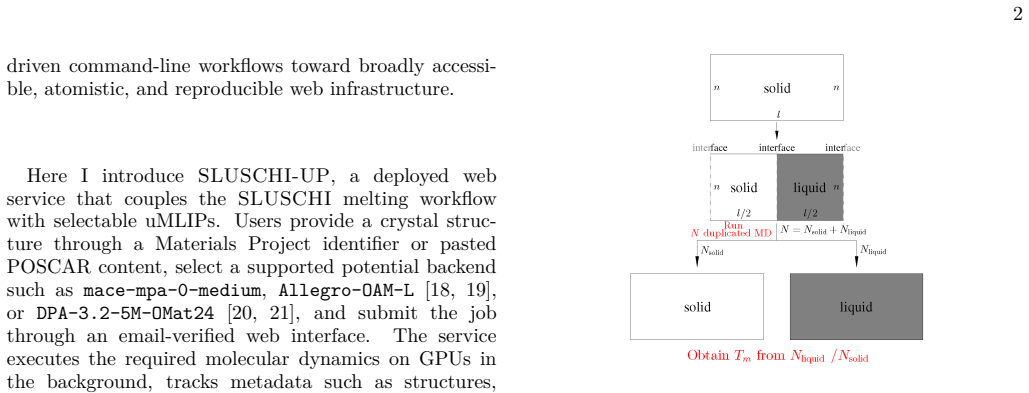
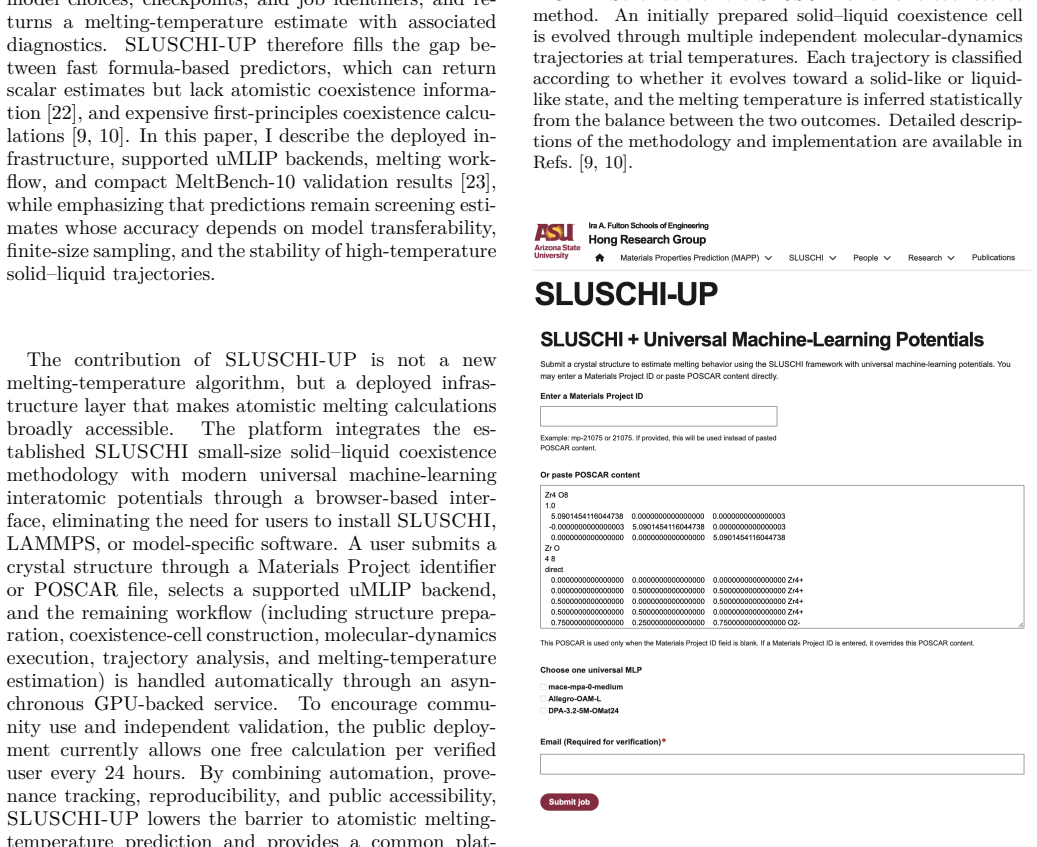
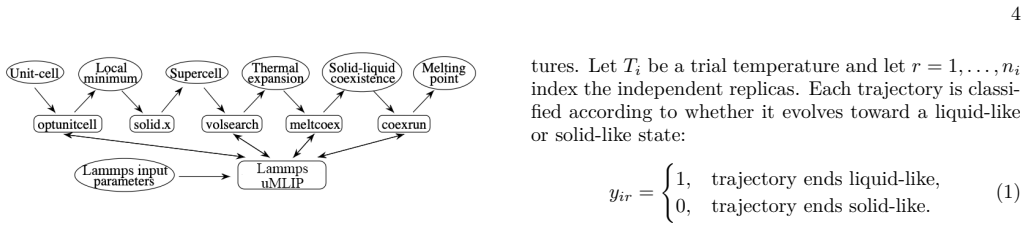
The SLUSCHI method of small-cell solid-liquid coexistence simulations with statistical analysis of many short molecular-dynamics trajectories, exposed through a web service that queues jobs on selectable uMLIP backends such as mace-mpa-0-medium, Allegro-OAM-L, and DPA-3.2-5M-OMat24.
If this is right
- The production interface supports three specific uMLIP backends and allows queued calculations from Materials Project identifiers or POSCAR input.
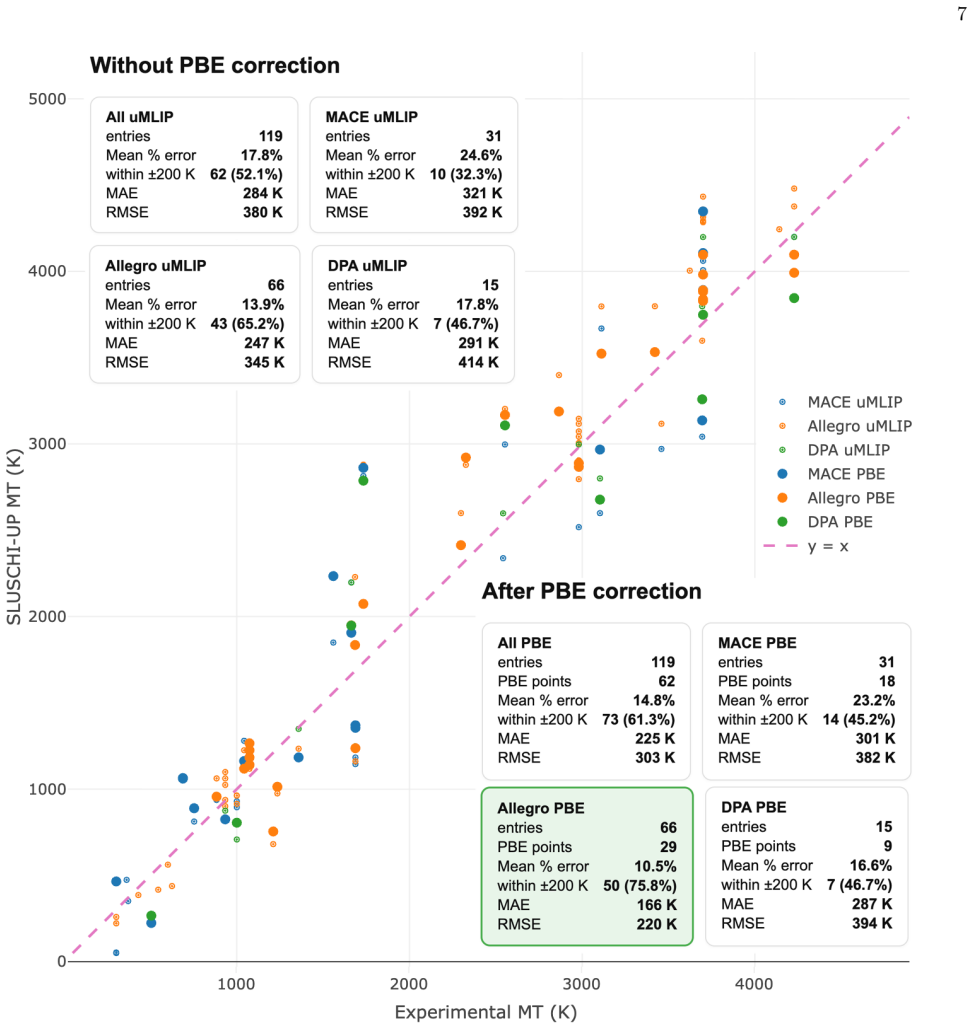
- PBE-corrected Allegro-OAM-L predictions reach a mean absolute error of approximately 166 K across the materials tested so far.
- The service keeps results at screening-level validation rather than definitive uMLIP rankings.
- The infrastructure preserves the standard constraints of uMLIP transferability, finite-size effects, and trajectory stability.
Where Pith is reading between the lines
- The same web deployment pattern could be reused for other finite-temperature properties that rely on short molecular-dynamics trajectories.
- Larger MeltBench collections or experimental melting-point benchmarks would provide a clearer test of when the screening errors become practically actionable.
- Adding more uMLIP options in beta could reveal whether accuracy gains come mainly from model choice or from the underlying SLUSCHI sampling.
- Integration with existing materials databases would let the service scale to automated high-throughput screening campaigns.
Load-bearing premise
The chosen universal ML interatomic potentials remain sufficiently transferable and stable for the materials in the MeltBench sets so that the reported mean absolute errors reflect useful screening performance.
What would settle it
A case in the MeltBench set where one supported uMLIP produces unstable high-temperature trajectories or melting-temperature estimates that diverge sharply from direct first-principles coexistence results for the same material.
Figures
read the original abstract
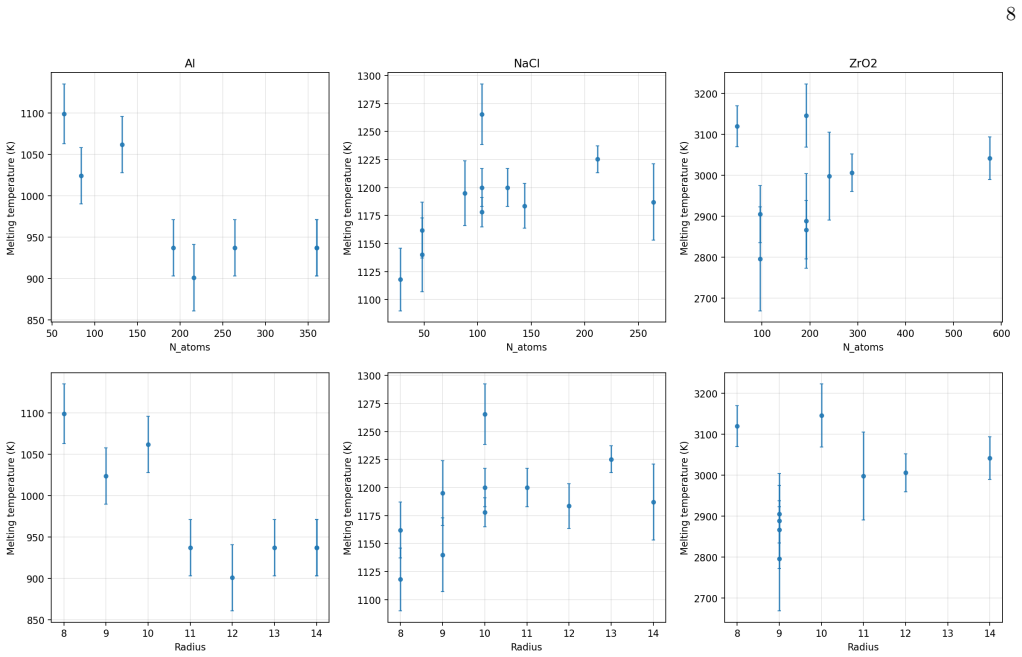
Melting temperature is a critical property for high-temperature materials design, but first-principles melting calculations based on finite-temperature molecular dynamics can require substantial computational resources. The SLUSCHI method reduces this cost by using small-cell solid--liquid coexistence simulations and statistical analysis of many short molecular-dynamics trajectories. Here I present SLUSCHI-UP, a deployed web service for atomistic melting-temperature estimation that couples the SLUSCHI workflow to selectable pretrained universal machine-learning interatomic potentials (uMLIPs) and asynchronous GPU execution. Users submit a crystal structure through a Materials Project identifier or POSCAR input, select a uMLIP backend, and launch a queued melting calculation without local installation of simulation software. The current production interface supports mace-mpa-0-medium, Allegro-OAM-L, and DPA-3.2-5M-OMat24, while beta deployments expose additional models. On the compact MeltBench-10 validation set, the three production backends produce raw coexistence mean absolute errors in the range of approximately 178--327 K. Across the broader set of materials tested so far in MeltBench, the current deployed-job snapshot contains 119 raw uMLIP entries, and PBE-corrected Allegro-OAM-L predictions reach a mean absolute error of approximately 166 K. These values should be interpreted as screening-level infrastructure validation rather than a definitive ranking of uMLIPs. The results demonstrate that SLUSCHI-UP provides a practical, provenance-aware deployment layer between fast scalar melting-temperature predictors and much more expensive first-principles coexistence calculations, while retaining the usual limitations of uMLIP transferability, finite-size sampling, and high-temperature trajectory stability.
Editorial analysis
A structured set of objections, weighed in public.
Referee Report
Summary. The manuscript presents SLUSCHI-UP, a deployed web service that couples the SLUSCHI small-cell solid-liquid coexistence workflow to selectable pretrained universal machine-learning interatomic potentials (uMLIPs) for melting-temperature estimation. Users submit structures via Materials Project ID or POSCAR, choose backends such as mace-mpa-0-medium, Allegro-OAM-L, or DPA-3.2-5M-OMat24, and receive queued GPU results without local installation. The paper reports raw coexistence MAEs of 178-327 K on MeltBench-10 and ~166 K (PBE-corrected Allegro-OAM-L) on broader MeltBench materials, explicitly framing these as screening-level infrastructure validation while noting the usual limits of uMLIP transferability, finite-size effects, and trajectory stability.
Significance. If the service performs as described, it supplies a practical, provenance-aware bridge between fast scalar predictors and expensive first-principles coexistence runs. The explicit labeling of results as screening-level and the listing of retained limitations constitute a strength; the work does not claim new physics or superior accuracy but demonstrates accessible deployment of existing components.
minor comments (2)
- [Abstract] Abstract: the phrasing 'approximately 178--327 K' and 'approximately 166 K' would benefit from either exact tabulated values or a statement that these are rounded from the full MeltBench results presented later in the manuscript.
- The manuscript would be strengthened by a short workflow diagram or screenshot of the submission interface to illustrate the provenance tracking and asynchronous execution steps.
Simulated Author's Rebuttal
We thank the referee for their positive summary, significance assessment, and recommendation to accept the manuscript. No major comments were provided in the report.
Circularity Check
No significant circularity: infrastructure service with empirical validation only
full rationale
The paper describes deployment of an existing SLUSCHI workflow on top of pretrained uMLIPs as a web service. No derivation chain, parameter fitting, or prediction step is present. Reported MAEs on MeltBench sets are framed explicitly as screening-level empirical validation numbers, not as outputs of any model or equation that reduces to the inputs. No self-citation load-bearing for a uniqueness theorem, ansatz smuggling, or renaming of known results occurs. The central claim (practical provenance-aware deployment layer) is independent of any internal reduction and remains self-contained against external benchmarks.
Axiom & Free-Parameter Ledger
axioms (2)
- domain assumption The SLUSCHI method yields reliable melting-temperature estimates from small-cell solid-liquid coexistence simulations
- domain assumption Universal ML interatomic potentials are transferable enough to the tested materials to support the reported screening-level errors
Reference graph
Works this paper leans on
-
[1]
Widom, The Journal of Chemical Physics39, 2808 (1963)
B. Widom, The Journal of Chemical Physics39, 2808 (1963)
1963
-
[2]
Hong and A
Q.-J. Hong and A. van de Walle, The Journal of Chemical Physics137, 094114 (2012)
2012
-
[3]
S.-T. Lin, M. Blanco, and W. A. Goddard, The Journal of Chemical Physics119, 11792 (2003)
2003
-
[4]
Hong and Z.-K
Q.-J. Hong and Z.-K. Liu, Physical Review Research7, L012030 (2025)
2025
-
[5]
Frenkel and B
D. Frenkel and B. Smit,Understanding Molecular Sim- ulation: From Algorithms to Applications, 2nd ed. (Aca- demic Press, San Diego, 2001)
2001
-
[6]
J. R. Morris, C. Z. Wang, K. M. Ho, and C. T. Chan, Physical Review B49, 3109 (1994)
1994
-
[7]
D. Alf` e, M. J. Gillan, and G. D. Price, Complementary approaches to the ab initio calculation of melting prop- erties (2001), arXiv:cond-mat/0111510 [cond-mat]
Pith/arXiv arXiv 2001
-
[8]
C. Cazorla, M. J. Gillan, S. Taioli, and D. Alf` e, Ab initio melting curve of molybdenum by the phase coexistence method (2007), arXiv:0706.1012 [cond-mat.mtrl-sci]
Pith/arXiv arXiv 2007
-
[9]
Hong and A
Q.-J. Hong and A. van de Walle, The Journal of Chemical Physics139, 094114 (2013)
2013
-
[10]
Hong and A
Q.-J. Hong and A. van de Walle, Calphad: Computer Coupling of Phase Diagrams and Thermochemistry52, 88 (2016)
2016
-
[11]
Kresse and J
G. Kresse and J. Furthm¨ uller, Physical Review B54, 11169 (1996)
1996
-
[12]
Chen and S
C. Chen and S. P. Ong, Nature Computational Science 2, 718 (2022)
2022
-
[13]
B. Deng, P. Zhong, K. Jun, J. Riebesell, K. Han, C. J. Bartel, and G. Ceder, Nature Machine Intelligence5, 1031 (2023)
2023
-
[14]
H. Yanget al., MatterSim: A deep learning atom- istic model across elements, temperatures and pressures (2024), arXiv:2405.04967 [cond-mat.mtrl-sci]
Pith/arXiv arXiv 2024
-
[15]
I. Batatiaet al., A foundation model for atomistic mate- rials chemistry (2024), arXiv:2401.00096 [physics.chem- ph]
Pith/arXiv arXiv 2024
-
[16]
CampBell, L
A. CampBell, L. Wang, and Q. J. Hong, Journal of the American Ceramic Society109, e70398 (2026)
2026
-
[17]
A. P. Thompson, H. M. Aktulga, R. Berger, D. S. Bolin- tineanu, W. M. Brown, P. S. Crozier, P. J. in ’t Veld, A. Kohlmeyer, S. G. Moore, T. D. Nguyen, R. Shan, 11 M. J. Stevens, J. Tranchida, C. Trott, and S. J. Plimpton, Computer Physics Communications271, 108171 (2022)
2022
-
[18]
Musaelian, S
A. Musaelian, S. Batzner, A. Johansson, L. Sun, C. J. Owen, M. Kornbluth, and B. Kozinsky, Nature Commu- nications14, 579 (2023)
2023
-
[19]
MIR Group, Allegro-OAM-L: Allegro foundational po- tential for materials,https://www.nequip.net/models/ mir-group/Allegro-OAM-L\%3A0.1(2025), accessed 2026-05-14
2025
- [20]
-
[21]
DeepModeling Community, DPA-3.2-5M model card, https://huggingface.co/deepmodelingcommunity/ DPA-3.2-5M(2026), accessed 2026-05-14
2026
-
[22]
Q.-J. Hong, S. V. Ushakov, A. van de Walle, and A. Navrotsky, Proceedings of the National Academy of Sciences119, e2209630119 (2022)
2022
-
[23]
org/meltbench(2026), accessed 2026-06-01
Hong Research Group, MeltBench: Validation bench- mark for SLUSCHI-UP,https://jobs.sluschi-mapp. org/meltbench(2026), accessed 2026-06-01
2026
-
[24]
com/ACEsuit/mace-foundations(2026), accessed 2026- 05-14
ACEsuit, MACE foundation models,https://github. com/ACEsuit/mace-foundations(2026), accessed 2026- 05-14
2026
-
[25]
Batzner, A
S. Batzner, A. Musaelian, L. Sun, M. Geiger, J. P. Mailoa, M. Kornbluth, N. Molinari, T. E. Smidt, and B. Kozinsky, Nature Communications13, 2453 (2022)
2022
-
[26]
A. Jain, S. P. Ong, G. Hautier, W. Chen, W. D. Richards, S. Dacek, S. Cholia, D. Gunter, D. Skinner, G. Ceder, and K. A. Persson, APL Materials1, 011002 (2013)
2013
-
[27]
P. Huck, A. Jain, D. Gunter, D. Winston, and K. A. Persson, A community contribution framework for sharing materials data with materials project (2015), arXiv:1510.05024 [cond-mat.mtrl-sci]
Pith/arXiv arXiv 2015
-
[28]
E. B. Tadmor, R. S. Elliott, J. P. Sethna, R. E. Miller, and C. A. Becker, JOM63, 17 (2011)
2011
-
[29]
R. S. Elliott and E. B. Tadmor, Computer Physics Com- munications182, 2791 (2011)
2011
-
[30]
A. V. Yakutovich, K. Eimre, O. Sch¨ utt, L. Talirz, C. S. Adorf, C. W. Andersen, E. Ditler, D. Du, D. Passerone, B. Smit, N. Marzari, G. Pizzi, and C. A. Pignedoli, AiiDAlab: An ecosystem for developing, executing, and sharing scientific workflows (2020), arXiv:2010.02731 [cs.CE]
arXiv 2020
-
[31]
Hong, SLUSCHI source code and documentation, https://github.com/qjhong/SLUSCHI(2026), accessed 2026-05-14
Q.-J. Hong, SLUSCHI source code and documentation, https://github.com/qjhong/SLUSCHI(2026), accessed 2026-05-14
2026
-
[32]
engineering.asu.edu/hong/sluschi-up/(2026), ac- cessed 2026-05-14
Hong Research Group, SLUSCHI-UP: SLUSCHI + uni- versal machine-learning potentials,https://faculty. engineering.asu.edu/hong/sluschi-up/(2026), ac- cessed 2026-05-14
2026
-
[33]
A. Mazitov, F. Bigi, M. Kellner, P. Pegolo, D. Tisi, G. Fraux, S. Pozdnyakov, P. Loche, and M. Ceri- otti, PET-MAD, a universal interatomic potential for advanced materials modeling (2025), arXiv:2503.14118 [cond-mat.mtrl-sci]
arXiv 2025
-
[34]
C. Malosso, F. Bigi, P. Pegolo, J. W. Abbott, P. Loche, M. Rossi, M. Ceriotti, and A. Mazitov, High-quality, high-information dataset for universal atomistic machine learning (2026), arXiv:2603.02089 [cond-mat.mtrl-sci]
arXiv 2026
-
[35]
L. Barroso-Luque, M. Shuaibi, X. Fu, B. M. Wood, M. Dzamba, M. Gao, A. Rizvi, C. L. Zitnick, and Z. W. Ulissi, Open Materials 2024 (OMat24) inorganic materi- als dataset and models (2024), arXiv:2410.12771 [cond- mat.mtrl-sci]
Pith/arXiv arXiv 2024
-
[36]
J. Kim, J. You, Y. Park, Y. Lim, Y. Kang, J. Kim, H. Jeon, D. Hong, S. Y. Lee, S. Choi, Y. Kim, J. W. Lee, and S. Han, Optimizing cross-domain transfer for universal machine learning interatomic potentials (2025), arXiv:2510.11241 [cond-mat.mtrl-sci]
arXiv 2025
-
[37]
B. Deng, Y. Choi, P. Zhong, J. Riebesell, S. Anand, Z. Li, K. Jun, K. A. Persson, and G. Ceder, Overcoming systematic softening in universal machine learning interatomic potentials by fine-tuning (2024), arXiv:2405.07105 [cond-mat.mtrl-sci]
arXiv 2024
-
[38]
B. Focassio, L. P. M. Freitas, and G. R. Schleder, Per- formance assessment of universal machine learning inter- atomic potentials: Challenges and directions for mate- rials’ surfaces (2024), arXiv:2403.04217 [cond-mat.mtrl- sci]
arXiv 2024
discussion (0)
Sign in with ORCID, Apple, or X to comment. Anyone can read and Pith papers without signing in.