Berry-Curvature Activation by Orbital Flux in a Kagome Altermagnet
Pith reviewed 2026-06-28 05:11 UTC · model grok-4.3
The pith
Orbital chiral flux breaks a hidden symmetry to generate Berry curvature in kagome altermagnets
A machine-rendered reading of the paper's core claim, the machinery that carries it, and where it could break.
Core claim
Finite Berry curvature emerges only after introducing an orbital chiral flux term that breaks the hidden symmetry T C2z and generates effective momentum-space gauge fields, producing local Berry curvature hot spots even in the complete absence of spin-orbit coupling and scalar spin chirality.
What carries the argument
orbital chiral flux term, which breaks the hidden antiunitary symmetry T C2z and generates effective momentum-space gauge fields analogous to a Haldane-type orbital flux
If this is right
- Noncollinear exchange alone produces altermagnetic spin splitting and spin-polarized Fermi surfaces without relativistic effects.
- The system transitions from a symmetry-protected altermagnetic metal to a topological phase with strong Hall response once the flux is introduced.
- A hierarchy of competing energy scales (exchange, spin-orbit, chiral flux) controls the strength of the anomalous Hall conductivity.
- Frustrated kagome altermagnets form a platform for engineering Berry curvature and spin-selective electronic structure in compensated magnetic systems.
Where Pith is reading between the lines
- The orbital mechanism suggests that similar hidden symmetries in other altermagnetic lattices could be broken by flux-like terms to activate topology.
- Varying the flux strength independently could map how the Hall response scales with the three energy scales in real materials.
- This route decouples topological responses from net magnetization, opening possibilities for spin-selective transport in zero-field compensated magnets.
Load-bearing premise
The orbital chiral flux term is a physically realizable perturbation that can be added independently to the tight-binding Hamiltonian without being generated by or coupled to the existing exchange or spin-orbit terms.
What would settle it
Observation that anomalous Hall conductivity stays zero in the strictly coplanar state without orbital flux but becomes finite when the flux term is included, even at zero spin-orbit coupling.
Figures
read the original abstract
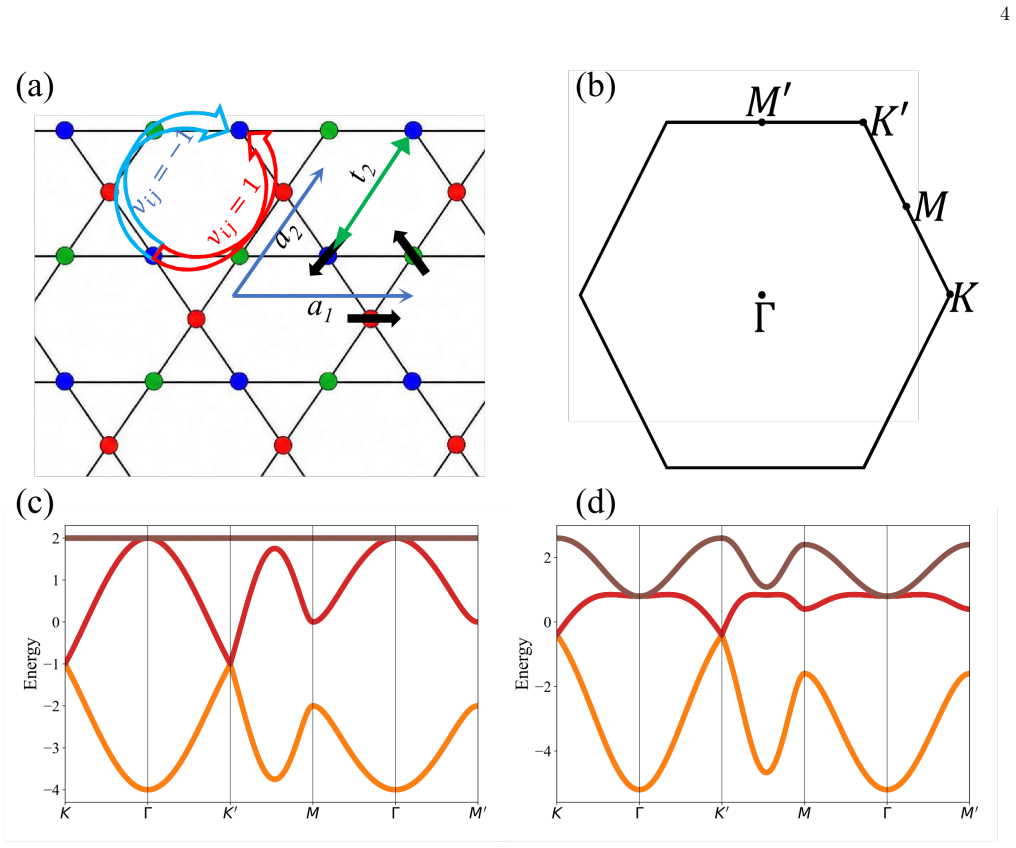
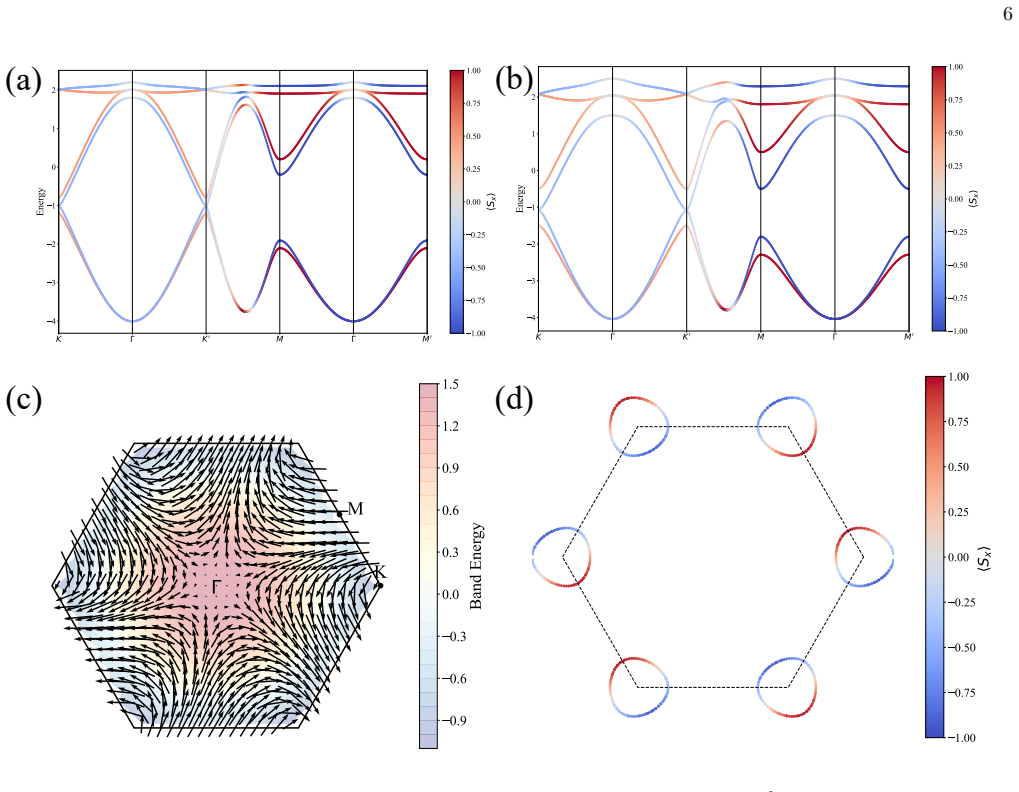
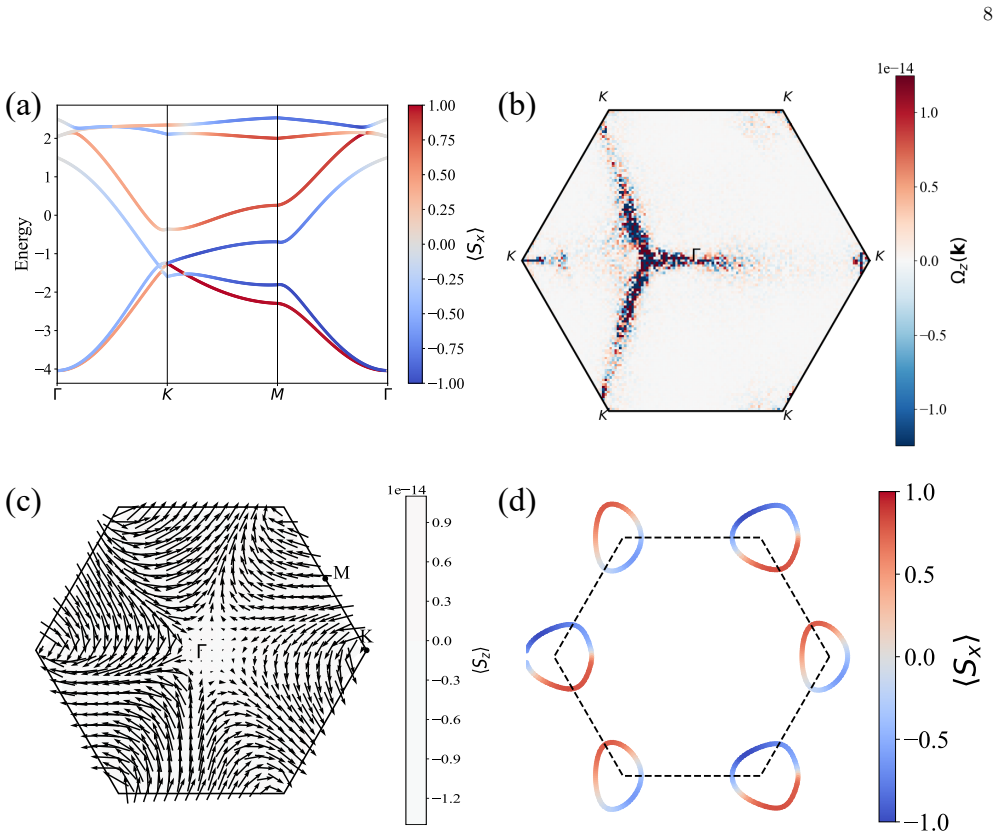
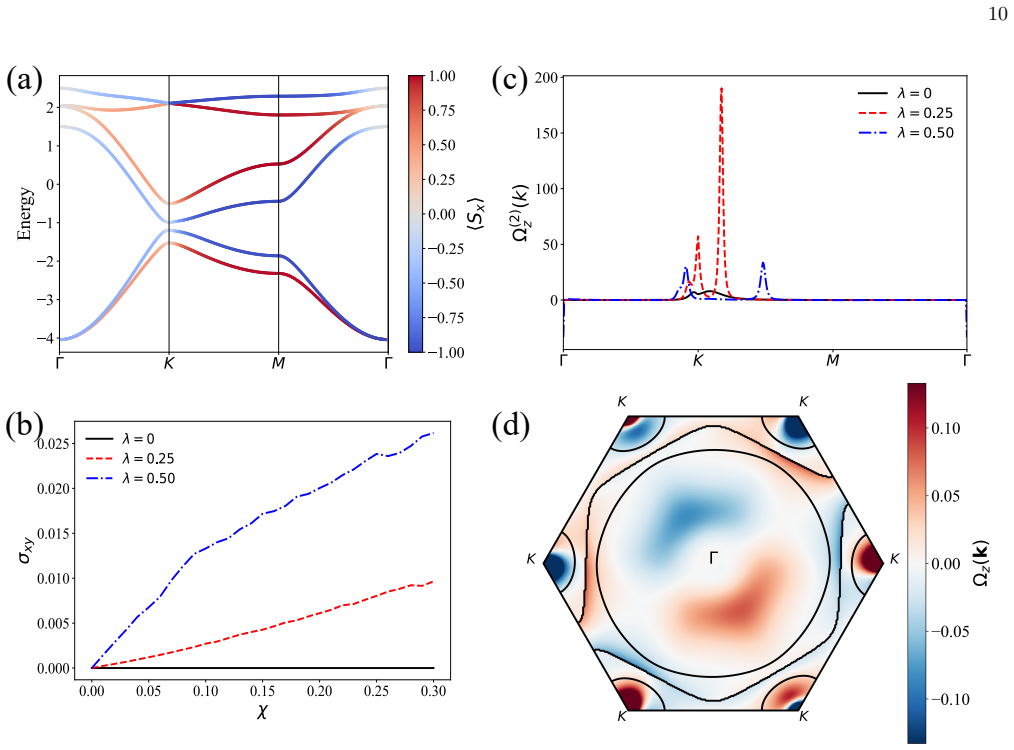
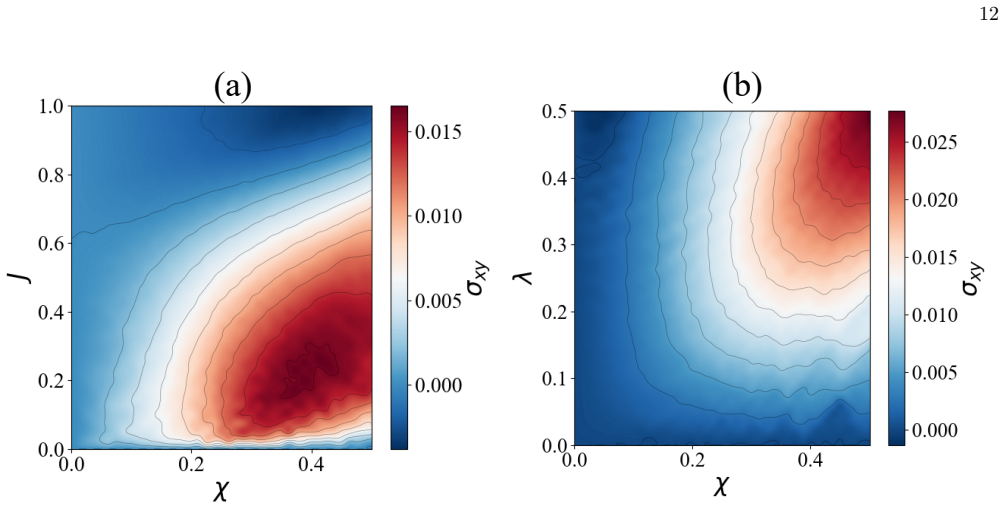
We investigate topological electronic responses in a kagome altermagnetic metal hosting a compensated coplanar $120^\circ$ magnetic texture. Using a minimal tight-binding model incorporating nearest-neighbor hopping, noncollinear exchange coupling, intrinsic spin--orbit coupling, and an emergent orbital chiral flux, we demonstrate that frustrated kagome altermagnets provide a natural platform for realizing momentum-dependent spin splitting and Berry-curvature engineering without net magnetization. The noncollinear exchange field alone generates pronounced altermagnetic spin splitting and spin-polarized Fermi surfaces despite the absence of relativistic effects. However, for a strictly coplanar magnetic state, the system preserves a hidden antiunitary symmetry $\mathcal{T}C_{2z}$, which enforces identically vanishing Berry curvature even in the presence of sizeable spin--orbit coupling. We show that finite Berry curvature emerges only after introducing an orbital chiral flux term that breaks the hidden symmetry and generates effective momentum-space gauge fields analogous to a Haldane-type orbital flux. Remarkably, this mechanism produces local Berry curvature hot spots even in the complete absence of spin--orbit coupling and scalar spin chirality, establishing a purely orbital route toward topological altermagnetism. By systematically analyzing the anomalous Hall conductivity as a function of exchange coupling, spin--orbit interaction, and chiral flux, we identify a hierarchy of competing energy scales governing the transition from a symmetry-protected altermagnetic metal to a topological altermagnetic phase with strong Hall response. Our results demonstrate that frustrated kagome altermagnets constitute a versatile platform for engineering topological transport, Berry curvature, and spin-selective electronic structure in compensated magnetic systems.
Editorial analysis
A structured set of objections, weighed in public.
Referee Report
Summary. The paper investigates topological responses in a kagome altermagnet with compensated coplanar 120° order using a minimal tight-binding model that includes nearest-neighbor hopping, noncollinear exchange J, intrinsic SOC λ, and an emergent orbital chiral flux. It claims that the hidden antiunitary symmetry TC2z forces vanishing Berry curvature for coplanar states even with SOC, but the orbital flux breaks this symmetry, generates momentum-space gauge fields, and produces finite local Berry curvature and anomalous Hall conductivity even in the complete absence of SOC and scalar spin chirality. The work maps the AHC dependence on J, λ, and flux strength to identify competing energy scales.
Significance. If the orbital chiral flux can be shown to arise independently, the result would identify a purely orbital route to Berry-curvature engineering in altermagnets, extending the platform beyond relativistic or scalar-chirality mechanisms and offering a hierarchy of scales for tuning the transition to a topological phase.
major comments (3)
- [Model Hamiltonian] Model section (Hamiltonian definition): the orbital chiral flux is added as an independent phenomenological parameter whose strength is scanned to activate the Hall response. No microscopic derivation (e.g., from a Hubbard model or superexchange in the 120° texture) is supplied demonstrating that this term appears at leading order without being generated by or coupled to the existing noncollinear exchange or SOC, which is load-bearing for the claim of an independent symmetry-breaking mechanism.
- [Symmetry Analysis] Symmetry analysis paragraph: the statement that TC2z enforces identically vanishing Berry curvature is asserted for the coplanar state, yet the explicit matrix representation or proof that the flux term fully breaks this symmetry (rather than leaving a residual antiunitary operator) is not provided, leaving the activation mechanism incompletely verified.
- [AHC Results] Results on anomalous Hall conductivity: the reported hierarchy of energy scales and the transition to strong Hall response rely on treating the flux strength as a free parameter whose value is chosen to produce the desired effect; without a fixed microscopic value, the quantitative claims about when the topological phase appears remain conditional on parameter choice.
minor comments (2)
- [Abstract] The abstract is information-dense; separating the symmetry argument from the numerical hierarchy would improve readability.
- [Model] Notation for the flux term (e.g., its phase or amplitude symbol) should be defined at first use in the model section for clarity.
Simulated Author's Rebuttal
We thank the referee for the careful reading and constructive criticism of our manuscript. We respond point-by-point to the major comments below.
read point-by-point responses
-
Referee: [Model Hamiltonian] Model section (Hamiltonian definition): the orbital chiral flux is added as an independent phenomenological parameter whose strength is scanned to activate the Hall response. No microscopic derivation (e.g., from a Hubbard model or superexchange in the 120° texture) is supplied demonstrating that this term appears at leading order without being generated by or coupled to the existing noncollinear exchange or SOC, which is load-bearing for the claim of an independent symmetry-breaking mechanism.
Authors: We agree that the orbital chiral flux is introduced as a phenomenological term in the minimal tight-binding model. A full microscopic derivation from a Hubbard model or superexchange would strengthen the independence claim but is technically involved and lies outside the scope of this work, which focuses on the electronic-structure consequences of the symmetry breaking. In the revised manuscript we will add an explicit statement that the term is phenomenological, together with a short discussion of possible physical origins (e.g., orbital currents on the frustrated kagome lattice) that are not generated by the existing J or λ terms. revision: partial
-
Referee: [Symmetry Analysis] Symmetry analysis paragraph: the statement that TC2z enforces identically vanishing Berry curvature is asserted for the coplanar state, yet the explicit matrix representation or proof that the flux term fully breaks this symmetry (rather than leaving a residual antiunitary operator) is not provided, leaving the activation mechanism incompletely verified.
Authors: We thank the referee for this observation. In the revised manuscript we will supply the explicit matrix representation of the TC2z operator in the spin-orbital basis of the tight-binding model and demonstrate that the flux term anticommutes with it, leaving no residual antiunitary symmetry that would force vanishing Berry curvature. revision: yes
-
Referee: [AHC Results] Results on anomalous Hall conductivity: the reported hierarchy of energy scales and the transition to strong Hall response rely on treating the flux strength as a free parameter whose value is chosen to produce the desired effect; without a fixed microscopic value, the quantitative claims about when the topological phase appears remain conditional on parameter choice.
Authors: We agree that the results are conditional on the value of the flux parameter. The manuscript already presents the AHC as a function of J, λ and flux to identify the competing energy scales. We will revise the text to state more explicitly that the transition is conditional on the flux exceeding a threshold set by those scales, and to frame the quantitative statements accordingly. revision: yes
- A microscopic derivation of the orbital chiral flux from a Hubbard model or superexchange in the 120° texture.
Circularity Check
No significant circularity in derivation chain
full rationale
The paper constructs a minimal tight-binding Hamiltonian that explicitly includes an orbital chiral flux term alongside hopping, exchange, and SOC. It then performs a symmetry analysis showing that the coplanar 120° state preserves TC2z (forcing zero Berry curvature) and that the added flux breaks this symmetry, yielding finite Berry curvature via standard computation. This is a direct model-to-observable mapping rather than any reduction of the output to the input by definition or by self-citation. No equations or sections in the supplied text equate a 'prediction' to a fitted parameter, smuggle an ansatz via prior self-work, or rename a known result. The flux is presented as an independent model ingredient whose consequences are calculated; whether it is microscopically justified is a modeling assumption, not a circularity in the reported derivation steps. The central claim therefore remains self-contained against external benchmarks.
Axiom & Free-Parameter Ledger
free parameters (3)
- orbital chiral flux strength
- exchange coupling J
- spin-orbit coupling lambda
axioms (2)
- domain assumption The kagome lattice with 120-degree coplanar order preserves the antiunitary symmetry T C2z that forces Berry curvature to vanish.
- domain assumption Nearest-neighbor hopping plus local exchange and SOC terms are sufficient to capture the low-energy physics.
invented entities (1)
-
orbital chiral flux term
no independent evidence
Reference graph
Works this paper leans on
-
[1]
Physical Review X , volume=
Emerging research landscape of altermagnetism , author=. Physical Review X , volume=. 2022 , publisher=
2022
-
[2]
Nature Reviews Materials , volume=
Altermagnets as a new class of functional materials , author=. Nature Reviews Materials , volume=. 2025 , publisher=
2025
-
[3]
Physical Review X , volume=
Beyond conventional ferromagnetism and antiferromagnetism: A phase with nonrelativistic spin and crystal rotation symmetry , author=. Physical Review X , volume=. 2022 , publisher=
2022
-
[4]
Nature , volume=
Altermagnetic lifting of Kramers spin degeneracy , author=. Nature , volume=. 2024 , publisher=
2024
-
[5]
Advanced Functional Materials , volume=
Altermagnetism: Exploring new frontiers in magnetism and spintronics , author=. Advanced Functional Materials , volume=. 2024 , publisher=
2024
-
[6]
Nature Communications , volume=
Direct observation of altermagnetic band splitting in CrSb thin films , author=. Nature Communications , volume=. 2024 , publisher=
2024
-
[7]
Physical Review Letters , volume=
Large band splitting in g-wave altermagnet CrSb , author=. Physical Review Letters , volume=. 2024 , publisher=
2024
-
[8]
Nature Communications , volume=
Three-dimensional mapping of the altermagnetic spin splitting in CrSb , author=. Nature Communications , volume=. 2025 , publisher=
2025
-
[9]
Nature Reviews Materials , volume=
Non-collinear antiferromagnetic spintronics , author=. Nature Reviews Materials , volume=. 2025 , publisher=
2025
-
[10]
Nature Materials , volume=
Spontaneous Hall effect induced by collinear antiferromagnetic order at room temperature , author=. Nature Materials , volume=. 2025 , publisher=
2025
-
[11]
Nature Nanotechnology , volume=
Spin-torque-driven gigahertz magnetization dynamics in the non-collinear antiferromagnet Mn3Sn , author=. Nature Nanotechnology , volume=. 2025 , publisher=
2025
-
[12]
Nature Materials , volume=
Chiral-spin rotation of non-collinear antiferromagnet by spin--orbit torque , author=. Nature Materials , volume=. 2021 , publisher=
2021
-
[13]
Nature Communications , volume=
Phase transitions associated with magnetic-field induced topological orbital momenta in a non-collinear antiferromagnet , author=. Nature Communications , volume=. 2024 , publisher=
2024
-
[14]
Nature Materials , volume=
Handedness anomaly in a non-collinear antiferromagnet under spin--orbit torque , author=. Nature Materials , volume=. 2023 , publisher=
2023
-
[15]
Nature , volume=
Magnetic and magnetic inverse spin Hall effects in a non-collinear antiferromagnet , author=. Nature , volume=. 2019 , publisher=
2019
-
[16]
Nature communications , volume=
Controlling spin current polarization through non-collinear antiferromagnetism , author=. Nature communications , volume=. 2020 , publisher=
2020
-
[17]
Nature communications , volume=
Imaging and writing magnetic domains in the non-collinear antiferromagnet Mn3Sn , author=. Nature communications , volume=. 2019 , publisher=
2019
-
[18]
Nature Electronics , volume=
Electrical switching of the topological anomalous Hall effect in a non-collinear antiferromagnet above room temperature , author=. Nature Electronics , volume=. 2018 , publisher=
2018
-
[19]
Nature , volume=
Massive Dirac fermions in a ferromagnetic kagome metal , author=. Nature , volume=. 2018 , publisher=
2018
-
[20]
Nature materials , volume=
Dirac fermions and flat bands in the ideal kagome metal FeSn , author=. Nature materials , volume=. 2020 , publisher=
2020
-
[21]
Physical Review Letters , volume=
Cs V 3 Sb 5: AZ 2 topological kagome metal with a superconducting ground state , author=. Physical Review Letters , volume=. 2020 , publisher=
2020
-
[22]
Nature Physics , volume=
Spin Berry curvature-enhanced orbital Zeeman effect in a kagome metal , author=. Nature Physics , volume=. 2024 , publisher=
2024
-
[23]
Nature communications , volume=
Field-linear anomalous Hall effect and Berry curvature induced by spin chirality in the kagome antiferromagnet Mn3Sn , author=. Nature communications , volume=. 2023 , publisher=
2023
-
[24]
Nature Physics , volume=
Flat band separation and robust spin Berry curvature in bilayer kagome metals , author=. Nature Physics , volume=. 2023 , publisher=
2023
-
[25]
Nature Materials , volume=
Interwoven magnetic kagome metal overcomes geometric frustration , author=. Nature Materials , volume=. 2026 , publisher=
2026
-
[26]
Nature Reviews Physics , volume=
Topological kagome metals , author=. Nature Reviews Physics , volume=
-
[27]
Nature Physics , volume=
Topological aspects of kagome metals , author=. Nature Physics , volume=
-
[28]
Nature , volume=
Topological kagome magnets and superconductors , author=. Nature , volume=. 2022 , publisher=
2022
-
[29]
Reviews of Modern Physics , volume=
Kagome metals , author=. Reviews of Modern Physics , volume=. 2026 , publisher=
2026
-
[30]
Nano Letters , volume=
Two-dimensional artificial Ge superlattice confining in electronic kagome lattice potential valleys , author=. Nano Letters , volume=. 2023 , publisher=
2023
-
[31]
Nature , volume=
Large anomalous Hall effect in a non-collinear antiferromagnet at room temperature , author=. Nature , volume=. 2015 , publisher=
2015
-
[32]
Physical Review B , volume=
Giant anomalous Hall effect in the chiral antiferromagnet Mn _3 Ge , author=. Physical Review B , volume=
-
[33]
Physical Review Letters , volume=
Anomalous Hall effect arising from noncollinear antiferromagnetism , author=. Physical Review Letters , volume=
-
[34]
Physical Review B , volume=
Cluster multipole theory for anomalous Hall effect in antiferromagnets , author=. Physical Review B , volume=
-
[35]
Nature Materials , volume=
Topological and magnetic materials: a review , author=. Nature Materials , volume=
-
[36]
Nature Communications , volume=
Flatbands and emergent ferromagnetic ordering in Fe _3 Sn _2 , author=. Nature Communications , volume=
-
[37]
Physical Review X , volume=
Superconductivity in the kagome metal KV _3 Sb _5 , author=. Physical Review X , volume=
-
[38]
Nature , volume=
Quantum geometry and flat-band superconductivity in a kagome metal , author=. Nature , volume=
-
[39]
Nature Communications , volume=
Giant anomalous Hall effect in FeSn , author=. Nature Communications , volume=
-
[40]
Nature Reviews Physics , volume=
Nonreciprocal responses from noncollinear magnetism , author=. Nature Reviews Physics , volume=
-
[41]
Reviews of Modern Physics , volume=
Anomalous Hall effect , author=. Reviews of Modern Physics , volume=
-
[42]
Physical Review B , volume=
Nature of chiral spin liquids on the kagome lattice , author=. Physical Review B , volume=. 2015 , publisher=
2015
-
[43]
Science , volume=
Quantum spin liquids , author=. Science , volume=. 2020 , publisher=
2020
-
[44]
Physical Review Letters , volume=
Anomalous magnetothermopower in a metallic frustrated antiferromagnet , author=. Physical Review Letters , volume=. 2016 , publisher=
2016
-
[45]
Physical Review B , volume=
Magnetic ground state, field-induced transitions, electronic structure, and optical band gap of the frustrated antiferromagnet GeCo 2 O 4 , author=. Physical Review B , volume=. 2019 , publisher=
2019
-
[46]
Physical Review B—Condensed Matter and Materials Physics , volume=
Antiferromagnetic topological insulators , author=. Physical Review B—Condensed Matter and Materials Physics , volume=. 2010 , publisher=
2010
-
[47]
Nature physics , volume=
Topological antiferromagnetic spintronics , author=. Nature physics , volume=. 2018 , publisher=
2018
-
[48]
Applied Physics Letters , volume =
Mostovoy, Maxim , title =. Applied Physics Letters , volume =. 2025 , month =. doi:10.1063/5.0283630 , url =
-
[49]
Journal of Physics D: Applied Physics , abstract =
Bonbien, V and Zhuo, Fengjun and Salimath, A and Ly, O and Abbout, A and Manchon, A , title =. Journal of Physics D: Applied Physics , abstract =. 2021 , month =. doi:10.1088/1361-6463/ac28fa , url =
-
[50]
Reliable magnetometry for antiferromagnets and thin films: Correcting substrate artifacts in
Gas, Katarzyna and Sawicki, Maciej , journal =. Reliable magnetometry for antiferromagnets and thin films: Correcting substrate artifacts in. 2026 , month =. doi:10.1103/wvr7-9s6r , url =
-
[51]
Gas, K. and Yoon, J.-Y. and Sato, Y. and Kubota, H. and Dłużewski, P. and Kret, S. and Domagala, J. Z. and Edathumkandy, Y. K. and Takeuchi, Y. and Kanai, S. and Ohno, H. and Sawicki, M. and Fukami, S. , title =. APL Materials , volume =. 2025 , month =. doi:10.1063/5.0254918 , url =
-
[52]
León, Andrea and Autieri, Carmine and Brumme, Thomas and González, Jhon W. , year =. Hybrid d/p-wave altermagnetism in Ca3Ru2O7 and strain-controlled spin splitting , volume =. npj Quantum Materials , publisher =. doi:10.1038/s41535-025-00814-y , number =
-
[53]
Autieri, Carmine and Cuono, Giuseppe and Chakraborty, Debmalya and Gentile, Paola and Black-Schaffer, Annica M. , journal =. Conditions for orbital-selective altermagnetism in. 2025 , month =. doi:10.1103/ssxp-gz9l , url =
-
[54]
Multipole analysis of spin currents in altermagnetic MnTe , author =. Phys. Rev. B , volume =. 2026 , month =. doi:10.1103/ssr6-5w3v , url =
-
[55]
Dominant orbital magnetization in the prototypical altermagnet MnTe , author =. Phys. Rev. B , volume =. 2026 , month =. doi:10.1103/g32j-hnvz , url =
-
[56]
Tenzin, Karma and Kilic, Berkay and Sattigeri, Raghottam M. and He, Zhiren and Ye, Chao Chen and Costa, Marcio and Nardelli, Marco Buongiorno and Autieri, Carmine and Sławińska, Jagoda , year =. Persistent spin textures, altermagnetism and charge-to-spin conversion in metallic chiral crystals TM3X6 , volume =. npj Spintronics , publisher =. doi:10.1038/s4...
-
[57]
The Journal of Physical Chemistry Letters , volume =
Autieri, Carmine and Fakhredine, Amar , title =. The Journal of Physical Chemistry Letters , volume =. 2026 , doi =
2026
-
[58]
Staggered Dzyaloshinskii-Moriya interaction inducing weak ferromagnetism in centrosymmetric altermagnets and weak ferrimagnetism in noncentrosymmetric altermagnets , author =. Phys. Rev. B , volume =. 2025 , month =. doi:10.1103/PhysRevB.111.054442 , url =
-
[59]
2026 , eprint=
Staggered Dzyaloshinskii-Moriya and canting angle in centrosymmetric altermagnetic and ferromagnetic phases: influence on the anomalous Hall effect and Weyl points , author=. 2026 , eprint=
2026
-
[60]
Cheong, Sang-Wook and Huang, Fei-Ting , title=. npj Quantum Materials , year=. doi:10.1038/s41535-024-00626-6 , url=
-
[61]
Quasisymmetry-Constrained Spin Ferromagnetism in Altermagnets , author =. Phys. Rev. Lett. , volume =. 2025 , month =. doi:10.1103/839n-rckn , url =
-
[62]
Yuansheng Bu and Ziyin Song and Zhong Fang and Quansheng Wu and Hongming Weng , year=. Disentangling Anomalous. 2603.21246 , archivePrefix=
-
[63]
2026 , note =
Benny, Mathews and Autieri, Carmine and others , title =. 2026 , note =
2026
-
[64]
2026 , eprint=
Competing magnetic states in a non-coplanar Kagome magnet , author=. 2026 , eprint=
2026
-
[65]
Nearly perfect spin polarization of noncollinear antiferromagnets
Gurung, Gautam and Elekhtiar, Mohamed and Luo, Qing-Qing and Shao, Ding-Fu and Tsymbal, Evgeny Y. Nearly perfect spin polarization of noncollinear antiferromagnets. Nat. Commun
-
[66]
Physical review letters , volume=
Spin Phonon Induced Collinear Order and Magnetization Plateaus in Triangular<? format?> and Kagome Antiferromagnets: Applications to CuFeO 2 , author=. Physical review letters , volume=. 2008 , publisher=
2008
-
[67]
npj Quantum Materials , volume=
Altermagnetism classification , author=. npj Quantum Materials , volume=. 2025 , publisher=
2025
-
[68]
Nature Communications , volume=
Emergence of flat bands and ferromagnetic fluctuations via orbital-selective electron correlations in Mn-based kagome metal , author=. Nature Communications , volume=. 2024 , publisher=
2024
-
[69]
ACS Omega , year=
A-Site and Epitaxial Strain Effect on the Properties of A Mn3Sb5 (A= K, Cs, and Rb) Kagome Lattices , author=. ACS Omega , year=
-
[70]
Physical review letters , volume=
Quantum spin Hall effect in graphene , author=. Physical review letters , volume=. 2005 , publisher=
2005
-
[71]
Science advances , volume=
Large anomalous Hall effect driven by a nonvanishing Berry curvature in the noncolinear antiferromagnet Mn3Ge , author=. Science advances , volume=. 2016 , publisher=
2016
discussion (0)
Sign in with ORCID, Apple, or X to comment. Anyone can read and Pith papers without signing in.