REVIEW 2 major objections 10 references
New Benchmarking Shows Limited Generalization Power of TCR Antigenic Epitope Prediction Models
T0 review · 2 major / 0 minor · reviewed 2026-06-28 · grok-4.3
Pith's one-line read Existing TCR epitope prediction models show limited generalization to unseen antigens.
desk verdict The paper's contribution is two new classes of TCR benchmark datasets meant to be strictly unseen, but the abstract gives zero details on construction or results so the generalization claim can't be evaluated yet. read the letter →
The pith
A machine-rendered reading of the paper's core claim, the machinery that carries it, and where it could break.
The reading
What carries the argument
Two complementary classes of rigorously defined unseen benchmark datasets for assessing TCR antigenic epitope prediction models.
What would settle it
A model achieving high accuracy and specificity on both classes of these new unseen benchmark datasets would indicate that the claim of limited generalization does not hold.
Extended reading notes
Core claim
Models for predicting TCR-antigen specificity lack sufficient generalization power, as demonstrated by their performance on two new classes of rigorously defined unseen benchmark datasets that enable unbiased evaluation.
Load-bearing premise
The two new dataset classes are truly unseen by the models being tested and any performance drop reflects genuine lack of generalization rather than how the datasets were built.
Editorial extensions
If this is right
- Current models will exhibit reduced sensitivity and specificity on the new unseen datasets compared to standard tests.
- The new datasets will serve as a standard for evaluating and improving future prediction algorithms.
- Accurate generalization testing will support scalable immune engineering applications.
- Absence of such benchmarks has previously led to overoptimistic assessments of model performance.
Reading between the lines
- Similar issues of overfitting to seen data may affect other biological sequence prediction tasks.
- Developing models that can handle truly novel epitopes may require incorporating structural or evolutionary information beyond sequence patterns.
- These benchmarks could be extended to other immune receptor types like BCRs.
- Performance on these sets might correlate with real-world utility in vaccine design or cancer immunotherapy.
Editorial analysis
A structured set of objections, weighed in public.
Referee Report
Summary. The paper claims that existing TCR-epitope prediction models exhibit limited generalization, as evidenced by performance drops when evaluated on two new complementary classes of rigorously defined unseen benchmark datasets introduced by the authors; these datasets are positioned as a framework for unbiased model assessment and future algorithm development.
Significance. If the datasets are verifiably free of overlap with training corpora and the reported performance drops hold, the work would provide a valuable new evaluation standard in TCR specificity prediction, addressing a recognized gap in the field and potentially guiding more robust model development.
major comments (2)
- [Dataset description / Methods] The manuscript provides no details on dataset construction protocols, including any overlap or homology checks against standard corpora (VDJdb, IEDB, McPAS-TCR) or model-specific training splits, nor on similarity thresholds used to ensure the sets are unseen; this is load-bearing for the central claim of true generalization failure rather than leakage or artifact.
- [Results / Abstract] No quantitative results, specific models evaluated, performance metrics (e.g., AUC, sensitivity/specificity), or validation procedures are supplied, preventing assessment of whether the claimed drops support the generalization conclusion.
Simulated Author's Rebuttal
We thank the referee for their constructive comments, which highlight important areas for improvement in our manuscript. We address each major comment below and will incorporate the necessary revisions.
read point-by-point responses
-
Referee: [Dataset description / Methods] The manuscript provides no details on dataset construction protocols, including any overlap or homology checks against standard corpora (VDJdb, IEDB, McPAS-TCR) or model-specific training splits, nor on similarity thresholds used to ensure the sets are unseen; this is load-bearing for the central claim of true generalization failure rather than leakage or artifact.
Authors: We agree with the referee that detailed information on dataset construction is crucial for validating the claims of limited generalization. The current manuscript's description is indeed high-level. In the revised manuscript, we will add a comprehensive Methods section detailing the protocols for creating the two classes of unseen benchmark datasets. This will include: (1) exact procedures for selecting TCR-epitope pairs, (2) overlap and homology checks against VDJdb, IEDB, and McPAS-TCR using specific tools and thresholds (e.g., sequence similarity <30% identity or e-value thresholds), (3) verification against model-specific training splits, and (4) justification of the similarity thresholds to ensure the sets are truly unseen. These additions will allow readers to confirm the absence of leakage or artifacts. revision: yes
-
Referee: [Results / Abstract] No quantitative results, specific models evaluated, performance metrics (e.g., AUC, sensitivity/specificity), or validation procedures are supplied, preventing assessment of whether the claimed drops support the generalization conclusion.
Authors: We acknowledge that the abstract does not contain quantitative results, and the manuscript would be strengthened by including them explicitly. While the full text discusses the performance drops, we will revise the abstract to summarize key quantitative findings, such as the specific models evaluated (e.g., several deep learning-based TCR-epitope predictors), the performance metrics used (AUC-ROC, sensitivity, specificity), and the observed drops on the new benchmarks compared to standard evaluations. Additionally, we will detail the validation procedures in the Results section to better support the generalization conclusion. revision: yes
Circularity Check
No circularity: benchmark dataset construction is an empirical claim, not a self-referential derivation
full rationale
The paper introduces two classes of benchmark datasets claimed to be rigorously unseen for evaluating TCR-epitope models. No equations, parameters, or derivations exist that could reduce to inputs by construction. The central assertion (unseen status enabling unbiased evaluation of generalization) is an empirical statement about data partitioning and overlap checks, not a tautological redefinition or fitted-input prediction. No self-citation load-bearing, uniqueness theorems, or ansatz smuggling appear in the provided text. This is a standard non-circular benchmarking contribution.
Assumptions & free parameters
Cite this review
Pith. "Pith review of New Benchmarking Shows Limited Generalization Power of TCR Antigenic Epitope Prediction Models." pith.science (2026). https://pith.science/paper/6HM2DSQH
@misc{pith2026260604994,
  author       = {Pith},
  title        = {Pith review of: New Benchmarking Shows Limited Generalization Power of TCR Antigenic Epitope Prediction Models},
  year         = {2026},
  howpublished = {\url{https://pith.science/paper/6HM2DSQH}},
  note         = {Machine review of arXiv:2606.04994}
}
read the original abstract
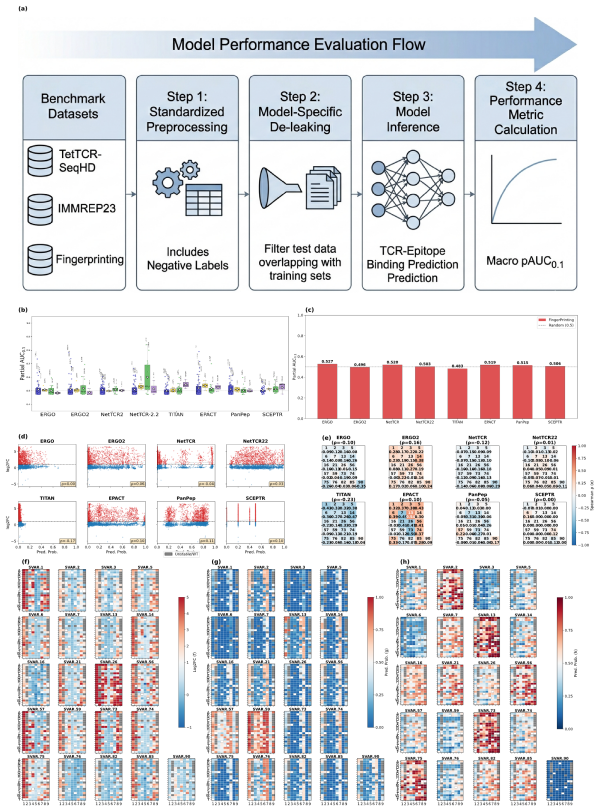
Accurate computational prediction of T cell receptor (TCR) antigen specificity would transform the study of T cell biology and enable scalable immune engineering, yet existing models lack sufficient sensitivity and specificity for broad applications. A major limitation is the absence of rigorously defined, unseen benchmark datasets that allow unbiased evaluation of model performance and generalizability. Here, we describe two complementary classes of datasets that meet this criterion and argue that they provide both a robust framework for model assessment and a foundation for next-generation TCR-antigen prediction algorithm development.
Figures
Reference graph
Works this paper leans on
-
[1]
& Davis, M.M
Hedrick, S.M., Cohen, D.I., Nielsen, E.A. & Davis, M.M. Isolation of cDNA clones encoding T cell-specific membrane-associated proteins.Nature308, 149-153 (1984)
1984
-
[2]
Yanagi, Y. et al. A human T cell-specific cDNA clone encodes a protein having extensive homology to immunoglobulin chains.Nature308, 145-149 (1984)
1984
-
[3]
The major histocompatibility complex determines susceptibility to cytotoxic T cells directed against minor histocompatibility antigens.J Exp Med142, 1349-1364 (1975)
Bevan, M.J. The major histocompatibility complex determines susceptibility to cytotoxic T cells directed against minor histocompatibility antigens.J Exp Med142, 1349-1364 (1975)
1975
-
[4]
& Samelson, L.E
Gordon, R.D., Simpson, E. & Samelson, L.E. In vitro cell-mediated immune responses to the male specific(H-Y) antigen in mice.J Exp Med142, 1108-1120 (1975). 5
1975
-
[5]
& Marrack, P.C
Kappler, J.W. & Marrack, P.C. Helper T cells recognise antigen and macrophage surface com- ponents simultaneously.Nature262, 797-799 (1976)
1976
-
[6]
Bjorkman, P.J. et al. The foreign antigen binding site and T cell recognition regions of class I histocompatibility antigens.Nature329, 512-518 (1987)
1987
-
[7]
Garcia, K.C. et al. An alphabeta T cell receptor structure at 2.5 A and its orientation in the TCR-MHC complex.Science274, 209-219 (1996)
1996
-
[8]
Ma, K.-Y. et al. High-throughput and high-dimensional single-cell analysis of antigen-specific CD8+ T cells.Nature Immunology22, 1590-1598 (2021)
2021
Show all 10 references
-
[9]
Malone, M.J. et al. Resistance Potential of the HLA-A2-restricted Immunodominant SARS- CoV-2 Specific CD8+ T Cell Receptor Repertoire to Antigenic Drift.Nature Communications, Accepted
-
[10]
Assessment of computational methods in predicting TCR-epitope binding recognition
Nielsen, M. et al. Lessons learned from the IMMREP23 TCR-epitope prediction challenge. ImmunoInformatics16, 100045 (2024). Lu, Y., Y. Wang, M. Xu, B. Xie, Y. Yang, H. Xu and S. Suo (2026). "Assessment of computational methods in predicting TCR-epitope binding recognition."Nat ...
2024
Reviewed June 28, 2026 · model on record in the stance chip above.
Discussion (0). Continue with ORCID to comment.