High-fidelity neutral atom gates leveraging low-rank Hessian optimization
Pith reviewed 2026-06-28 05:33 UTC · model grok-4.3
The pith
A low-rank Hessian calibration method tunes high-dimensional optimal-control waveforms for neutral-atom gates to 0.999 fidelity.
A machine-rendered reading of the paper's core claim, the machinery that carries it, and where it could break.
Core claim
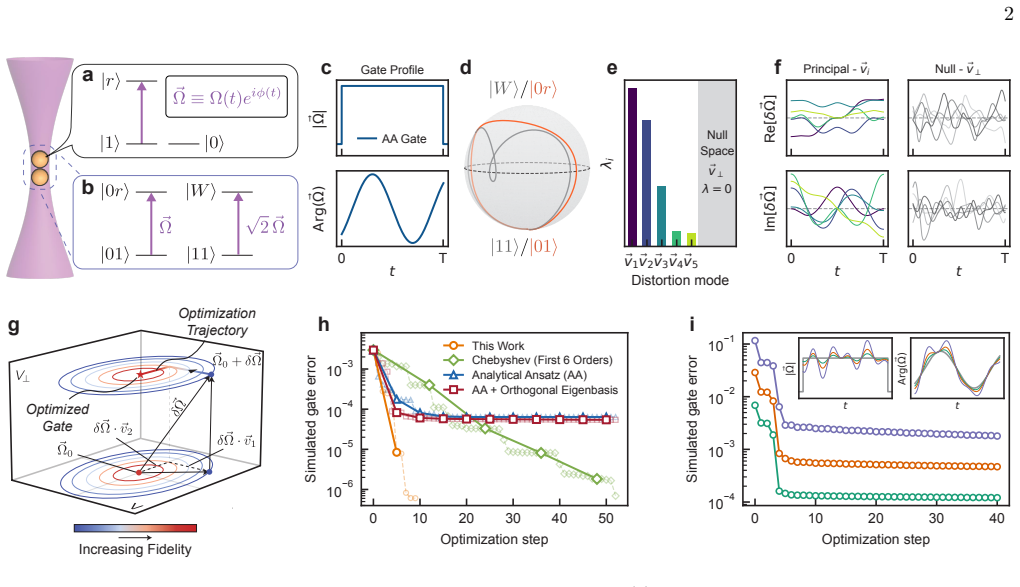
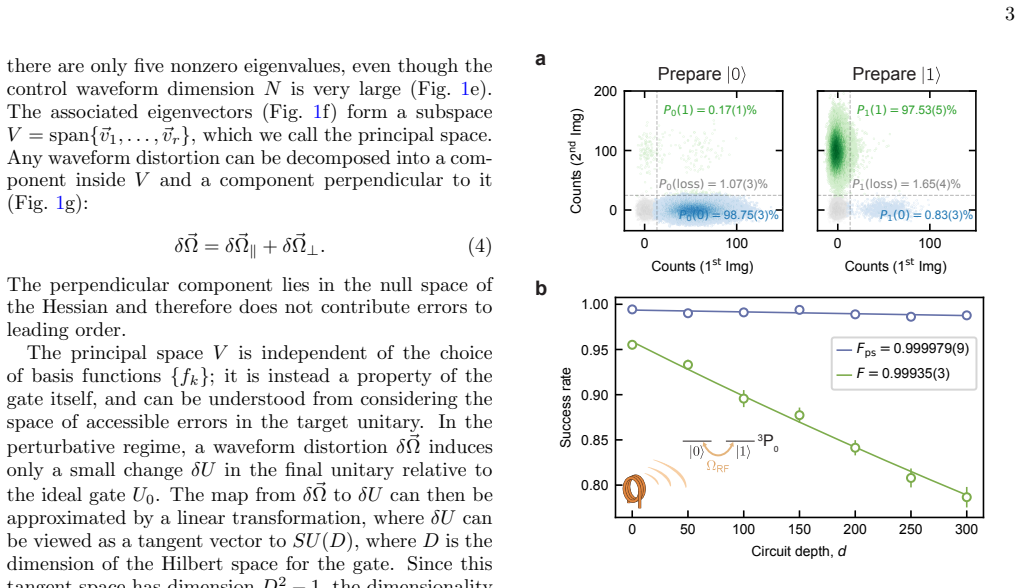
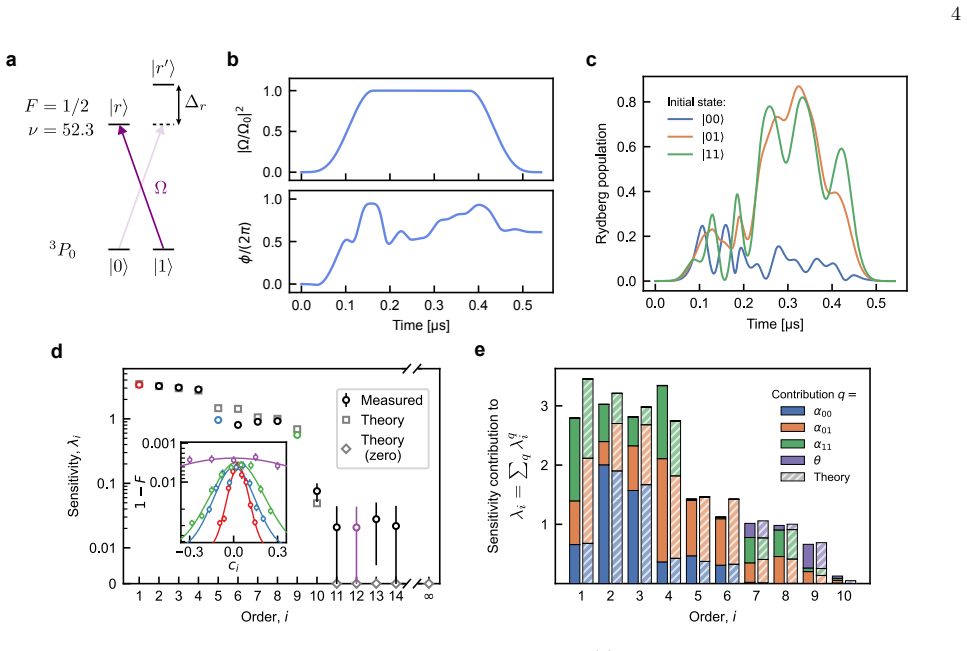
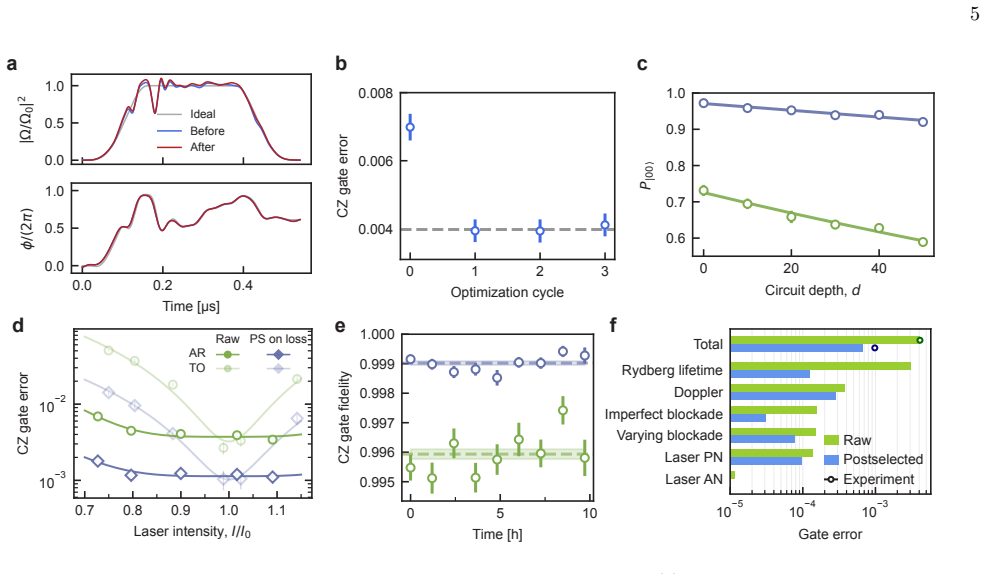
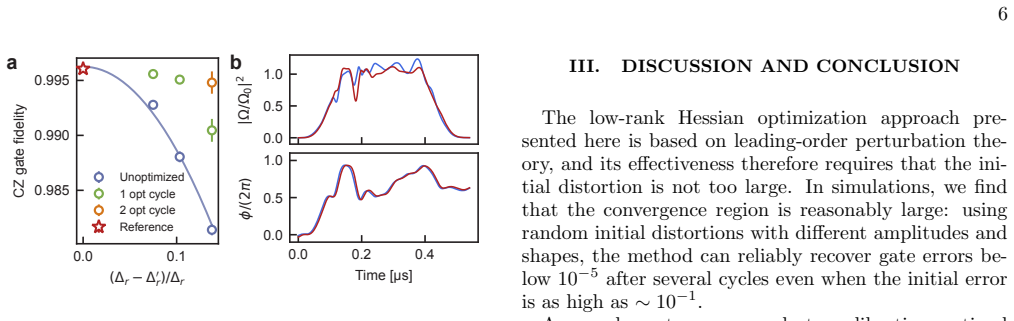
The low-rank Hessian optimization method identifies the principal subspace of waveform directions that affect fidelity to leading order, with the subspace dimension set by the number of accessible leakage and coherent error channels, and performs closed-loop experimental feedback only inside that subspace. Applied to an amplitude-robust controlled-Z gate on metastable-state 171Yb nuclear-spin qubits, the optimized gate reaches a raw fidelity of 0.9959(2), which increases to 0.99902(7) after postselection on no detected loss; performance is essentially unchanged under laser-power variations of up to 20 percent. The same fidelity Hessian directions can also be used to correct certain Hamiltoni
What carries the argument
The fidelity Hessian matrix restricted to its low-rank principal subspace, whose rank equals the number of accessible leakage and coherent error channels.
If this is right
- Calibration converges rapidly because only a small number of waveform directions need experimental tuning.
- The resulting gate fidelity remains stable against laser-power fluctuations of up to 20 percent.
- The identified Hessian directions simultaneously correct certain systematic Hamiltonian parameter errors.
- The same low-rank approach applies to high-dimensional optimal-control gates on many other qubit platforms.
Where Pith is reading between the lines
- If the low-rank structure persists for gates on larger numbers of qubits, the experimental overhead of calibration would grow only with the number of error channels rather than with waveform dimensionality.
- The method could be combined with existing pulse-shaping techniques to further reduce the number of required experimental shots.
- Testing whether the same Hessian directions remain effective when additional decoherence channels are present would clarify the limits of the low-rank assumption.
Load-bearing premise
The quantum-control fidelity landscape possesses a low-rank Hessian whose rank is set exactly by the accessible leakage and coherent error channels.
What would settle it
An experiment that measures the fidelity Hessian eigenvalues and finds that their number above a chosen threshold substantially exceeds the count of leakage plus coherent error channels, or that optimization confined to the predicted principal subspace yields no fidelity improvement over a full-space search.
Figures
read the original abstract
Quantum optimal control can produce fast and robust multi-qubit gates, but experimentally calibrating the resulting high-dimensional waveforms remains challenging because direct searches over large parameter spaces converge slowly. Building on the low-rank structure of quantum-control landscapes, we develop and benchmark a Hessian-based calibration method for optimal-control gates. The method identifies the few waveform directions that affect fidelity to leading order, with the number of directions set by the accessible leakage and coherent error channels, and optimizes only within this principal space using closed-loop experimental feedback. We apply this approach to an amplitude-robust controlled-Z gate on metastable-state 171Yb nuclear-spin qubits. Experimentally, we verify the predicted Hessian-sensitive directions and demonstrate rapid convergence of the optimization protocol. The optimized gate reaches a raw fidelity of 0.9959(2), increasing to 0.99902(7) after postselection on no detected loss, and the performance is essentially unchanged under laser-power variations of up to 20%. We further show that the same fidelity Hessian directions can correct certain Hamiltonian parameter errors. These results establish low-rank Hessian optimization as an efficient and physically motivated calibration strategy for high-dimensional optimal-control gates, which is broadly applicable to many qubit types.
Editorial analysis
A structured set of objections, weighed in public.
Referee Report
Summary. The manuscript develops a Hessian-based calibration method for optimal-control gates that exploits the low-rank structure of quantum-control landscapes. The number of optimized directions is set by the accessible leakage and coherent error channels; optimization is performed only inside this principal subspace via closed-loop experimental feedback. Applied to an amplitude-robust controlled-Z gate on metastable 171Yb nuclear-spin qubits, the protocol yields a raw fidelity of 0.9959(2) that rises to 0.99902(7) after postselection on no detected loss, remains essentially unchanged under 20% laser-power variations, and can also correct certain Hamiltonian parameter errors.
Significance. If the low-rank assumption holds, the approach supplies a physically motivated and experimentally efficient route to high-fidelity multi-qubit gates without exhaustive search of high-dimensional waveform spaces. The closed-loop verification of the predicted directions and the reported robustness constitute concrete strengths that could extend to other qubit platforms.
major comments (1)
- [Abstract and §4] Abstract and §4 (results on subspace verification): the claim that the low-rank Hessian is fully determined by leakage and coherent error channels is load-bearing for the headline fidelities and robustness figures. The manuscript states that the predicted directions were verified experimentally, yet does not report an explicit test showing that enlarging the subspace dimension produces no further fidelity improvement. Without this check, unmodeled channels (spatial inhomogeneity, motional coupling, or higher-order distortions) could still contribute significant eigenvalues outside the retained subspace.
minor comments (1)
- [Methods] Methods section: the full derivation of the Hessian directions and the precise data-exclusion criteria used in the fidelity estimates are not visible in the provided text; adding these would strengthen reproducibility.
Simulated Author's Rebuttal
We thank the referee for their careful reading and constructive feedback. We address the single major comment below.
read point-by-point responses
-
Referee: [Abstract and §4] Abstract and §4 (results on subspace verification): the claim that the low-rank Hessian is fully determined by leakage and coherent error channels is load-bearing for the headline fidelities and robustness figures. The manuscript states that the predicted directions were verified experimentally, yet does not report an explicit test showing that enlarging the subspace dimension produces no further fidelity improvement. Without this check, unmodeled channels (spatial inhomogeneity, motional coupling, or higher-order distortions) could still contribute significant eigenvalues outside the retained subspace.
Authors: The low-rank property follows from the analytic structure of the quantum-control fidelity landscape: the Hessian rank equals the number of independent leakage and coherent-error channels that couple to the control waveforms. In §4 we experimentally extract the Hessian eigenvectors and verify that fidelity variations are localized to these directions, with the closed-loop optimizer converging rapidly to the reported fidelities. We agree that an explicit check—optimizing in an enlarged subspace and confirming no further gain—would strengthen the claim that unmodeled channels lie outside the retained subspace. Because the original data set did not include such a comparison, we will add a short discussion in the revised manuscript explaining the theoretical rank prediction together with the existing experimental verification; if new measurements become available we will include them as well. revision: partial
Circularity Check
No significant circularity; closed-loop experimental optimization stands independently
full rationale
The paper develops a calibration protocol that identifies a low-rank principal subspace from the Hessian of the quantum-control landscape and then performs closed-loop experimental feedback to optimize gate waveforms inside that subspace. Fidelity numbers (0.9959 raw, 0.99902 post-selected) and robustness claims are obtained directly from laboratory measurements rather than from any fitted model or self-referential derivation. The low-rank assumption is presented as a known structural property of control landscapes and is experimentally verified within the work; no step reduces a claimed prediction to a parameter fit or to a self-citation chain that itself lacks independent support. The derivation chain is therefore self-contained against external experimental benchmarks.
Axiom & Free-Parameter Ledger
axioms (1)
- domain assumption Quantum-control landscapes exhibit low-rank Hessian structure whose effective dimension is fixed by accessible leakage and coherent error channels.
Reference graph
Works this paper leans on
-
[1]
J. P. Palao and R. Kosloff, Quantum Computing by an Optimal Control Algorithm for Unitary Transforma- tions, Physical Review Letters89, 188301 (2002). 15
2002
-
[2]
Khaneja, T
N. Khaneja, T. Reiss, C. Kehlet, T. Schulte-Herbr¨ uggen, and S. J. Glaser, Optimal control of coupled spin dy- namics: design of NMR pulse sequences by gradient as- cent algorithms, Journal of Magnetic Resonance172, 296 (2005)
2005
-
[3]
Caneva, T
T. Caneva, T. Calarco, and S. Montangero, Chopped random-basis quantum optimization, Physical Review A 84, 022326 (2011)
2011
-
[4]
Machnes, E
S. Machnes, E. Ass´ emat, D. Tannor, and F. K. Wilhelm, Tunable, Flexible, and Efficient Optimization of Con- trol Pulses for Practical Qubits, Physical Review Letters 120, 150401 (2018)
2018
-
[5]
F. K. Wilhelm, S. Kirchhoff, S. Machnes, N. Wittler, and D. Sugny, An introduction into optimal control for quantum technologies (2020), arXiv:2003.10132
arXiv 2020
-
[6]
Sp¨ orl, T
A. Sp¨ orl, T. Schulte-Herbr¨ uggen, S. J. Glaser, V. Bergholm, M. J. Storcz, J. Ferber, and F. K. Wilhelm, Optimal control of coupled josephson qubits, Physical Review A75, 012302 (2007)
2007
-
[7]
T. Choi, S. Debnath, T. A. Manning, C. Figgatt, Z.- X. Gong, L.-M. Duan, and C. Monroe, Optimal quan- tum control of multimode couplings between trapped ion qubits for scalable entanglement, Physical Review Let- ters112, 190502 (2014)
2014
-
[8]
P. H. Leung, K. A. Landsman, C. Figgatt, N. M. Linke, C. Monroe, and K. R. Brown, Robust 2-qubit gates in a linear ion crystal using a frequency-modulated driving force, Physical Review Letters120, 020501 (2018)
2018
-
[9]
M. Kang, Q. Liang, B. Zhang, S. Huang, Y. Wang, C. Fang, J. Kim, and K. R. Brown, Batch optimiza- tion of frequency-modulated pulses for robust two-qubit gates in ion chains, Phys. Rev. Appl.16, 024039 (2021)
2021
-
[10]
Levine, A
H. Levine, A. Keesling, G. Semeghini, A. Omran, T. T. Wang, S. Ebadi, H. Bernien, M. Greiner, V. Vuleti´ c, H. Pichler, and M. D. Lukin, Parallel Implementation of High-Fidelity Multiqubit Gates with Neutral Atoms, Physical Review Letters123, 170503 (2019)
2019
-
[11]
Jandura and G
S. Jandura and G. Pupillo, Time-Optimal Two- and Three-Qubit Gates for Rydberg Atoms, Quantum6, 712 (2022)
2022
-
[12]
Fromonteil, D
C. Fromonteil, D. Bluvstein, and H. Pichler, Proto- cols for Rydberg Entangling Gates Featuring Robustness against Quasistatic Errors, PRX Quantum4, 020335 (2023)
2023
-
[13]
Jandura, J
S. Jandura, J. D. Thompson, and G. Pupillo, Optimiz- ing Rydberg Gates for Logical-Qubit Performance, PRX Quantum4, 020336 (2023)
2023
-
[14]
Glaser, F
N. Glaser, F. Roy, I. Tsitsilin, L. Koch, N. Bruck- moser, J. Schirk, J. Romeiro, G. Huber, F. Wallner, M. Singh, G. Krylov, A. Marx, L. S¨ odergren, C. Schnei- der, M. Werninghaus, and S. Filipp, Closed-loop opti- mization for high-fidelity controlled-zgates in supercon- ducting qubits, Phys. Rev. Appl.24, 024048 (2025)
2025
-
[15]
L. S. Theis, F. Motzoi, F. K. Wilhelm, and M. Saffman, High-fidelity Rydberg-blockade entangling gate using shaped, analytic pulses, Physical Review A94, 032306 (2016)
2016
-
[16]
S. J. Evered, D. Bluvstein, M. Kalinowski, S. Ebadi, T. Manovitz, H. Zhou, S. H. Li, A. A. Geim, T. T. Wang, N. Maskara, H. Levine, G. Semeghini, M. Greiner, V. Vuleti´ c, and M. D. Lukin, High-fidelity parallel entan- gling gates on a neutral-atom quantum computer, Na- ture622, 268 (2023)
2023
-
[17]
J. A. Muniz, M. Stone, D. T. Stack, M. Jaffe, J. M. Kindem, L. Wadleigh, E. Zalys-Geller, X. Zhang, C.-A. Chen, M. A. Norcia, J. Epstein, E. Halperin, F. Hum- mel, T. Wilkason, M. Li, K. Barnes, P. Battaglino, T. C. Bohdanowicz, G. Booth, A. Brown, M. O. Brown, W. B. Cairncross, K. Cassella, R. Coxe, D. Crow, M. Feldkamp, C. Griger, A. Heinz, A. M. W. Jon...
2025
-
[18]
Kelly, R
J. Kelly, R. Barends, B. Campbell, Y. Chen, Z. Chen, B. Chiaro, A. Dunsworth, A. G. Fowler, I.-C. Hoi, E. Jef- frey, A. Megrant, J. Mutus, C. Neill, P. J. J. O’Malley, C. Quintana, P. Roushan, D. Sank, A. Vainsencher, J. Wenner, T. C. White, A. N. Cleland, and J. M. Martinis, Optimal Quantum Control Using Randomized Benchmarking, Physical Review Letters11...
2014
-
[19]
S. Ma, G. Liu, P. Peng, B. Zhang, S. Jandura, J. Claes, A. P. Burgers, G. Pupillo, S. Puri, and J. D. Thompson, High-fidelity gates and mid-circuit erasure conversion in an atomic qubit, Nature622, 279 (2023)
2023
-
[20]
Werninghaus, D
M. Werninghaus, D. J. Egger, F. Roy, S. Machnes, F. K. Wilhelm, and S. Filipp, Leakage reduction in fast super- conducting qubit gates via optimal control, npj Quan- tum Information7, 14 (2021)
2021
-
[21]
V. V. Sivak, A. Eickbusch, H. Liu, B. Royer, I. Tsiout- sios, and M. H. Devoret, Model-Free Quantum Control with Reinforcement Learning, Physical Review X12, 011059 (2022)
2022
-
[22]
Porotti, V
R. Porotti, V. Peano, and F. Marquardt, Gradient- Ascent Pulse Engineering with Feedback, PRX Quantum 4, 030305 (2023)
2023
-
[23]
J. L. White, B. J. Pearson, and P. H. Bucksbaum, Ex- tracting quantum dynamics from genetic learning al- gorithms through principal control analysis, Journal of Physics B: Atomic, Molecular and Optical Physics37, L399 (2004)
2004
-
[24]
Rabitz, T.-S
H. Rabitz, T.-S. Ho, M. Hsieh, R. Kosut, and M. Demi- ralp, Topology of optimally controlled quantum mechan- ical transition probability landscapes, Physical Review A 74, 012721 (2006)
2006
-
[25]
Z. Shen, M. Hsieh, and H. Rabitz, Quantum optimal control: Hessian analysis of the control landscape, The Journal of Chemical Physics124, 204106 (2006)
2006
-
[26]
T.-S. Ho, J. Dominy, and H. Rabitz, Landscape of uni- tary transformations in controlled quantum dynamics, Physical Review A79, 013422 (2009)
2009
- [27]
-
[28]
Jaksch, J
D. Jaksch, J. I. Cirac, P. Zoller, S. L. Rolston, R. Cˆ ot´ e, and M. D. Lukin, Fast Quantum Gates for Neutral Atoms, Physical Review Letters85, 2208 (2000)
2000
-
[29]
Isenhower, E
L. Isenhower, E. Urban, X. Zhang, A. Gill, T. Henage, T. A. Johnson, T. Walker, and M. Saffman, Demon- stration of a neutral atom controlled-not quantum gate, Physical Review Letters104, 010503 (2010)
2010
-
[30]
T. Wilk, A. Ga¨ etan, C. Evellin, J. Wolters, Y. Mirosh- nychenko, P. Grangier, and A. Browaeys, Entanglement of two individual neutral atoms using rydberg blockade, 16 Physical Review Letters104, 010502 (2010)
2010
-
[31]
Saffman, I
M. Saffman, I. Beterov, A. Dalal, E. P´ aez, and B. Sanders, Symmetric rydberg controlled-z gates with adiabatic pulses, Physical Review A101, 062309 (2020)
2020
-
[32]
Pagano, S
A. Pagano, S. Weber, D. Jaschke, T. Pfau, F. Meinert, S. Montangero, and H. P. B¨ uchler, Error budgeting for a controlled-phase gate with strontium-88 Rydberg atoms, Physical Review Research4, 033019 (2022)
2022
-
[33]
Peper, Y
M. Peper, Y. Li, D. Y. Knapp, M. Bileska, S. Ma, G. Liu, P. Peng, B. Zhang, S. P. Horvath, A. P. Burg- ers, and J. D. Thompson, Spectroscopy and Modeling of 171Yb Rydberg States for High-Fidelity Two-Qubit Gates, Physical Review X15, 011009 (2025)
2025
-
[34]
J. W. Lis, A. Senoo, W. F. McGrew, F. R¨ onchen, A. Jenkins, and A. M. Kaufman, Midcircuit Operations Using the omg Architecture in Neutral Atom Arrays, Physical Review X13, 041035 (2023)
2023
-
[35]
Y. Wu, S. Kolkowitz, S. Puri, and J. D. Thompson, Era- sure conversion for fault-tolerant quantum computing in alkaline earth Rydberg atom arrays, Nature Communi- cations13, 4657 (2022)
2022
-
[36]
Sahay, J
K. Sahay, J. Jin, J. Claes, J. D. Thompson, and S. Puri, High-threshold codes for neutral-atom qubits with bi- ased erasure errors, Physical Review X13, 041013 (2023)
2023
-
[37]
B. Zhang, G. Liu, G. Bornet, S. P. Horvath, P. Peng, S. Ma, S. Huang, S. Puri, and J. D. Thompson, Lever- aging erasure errors in logical qubits with metastable 171Yb atoms (2025), arXiv:2506.13724
Pith/arXiv arXiv 2025
-
[38]
Perrin, S
H. Perrin, S. Jandura, and G. Pupillo, Quantum Error Correction resilient against Atom Loss, Quantum9, 1884 (2025)
2025
-
[39]
Baranes, M
G. Baranes, M. Cain, J. P. B. Ataides, D. Bluvstein, J. Sinclair, V. Vuleti´ c, H. Zhou, and M. D. Lukin, Lever- aging Qubit Loss Detection in Fault-Tolerant Quantum Algorithms, Physical Review X16, 011002 (2026)
2026
-
[40]
Yu, Z.-H
C.-C. Yu, Z.-H. Chen, Y.-H. Deng, C.-Y. Lu, M.- C. Chen, and J.-W. Pan, Taming rydberg decay with measurement-based quantum computation, Physical Re- view Letters136, 160601 (2026)
2026
-
[41]
Bluvstein, A
D. Bluvstein, A. A. Geim, S. H. Li, S. J. Evered, J. P. Bonilla Ataides, G. Baranes, A. Gu, T. Manovitz, M. Xu, M. Kalinowski, S. Majidy, C. Kokail, N. Maskara, E. C. Trapp, L. M. Stewart, S. Hollerith, H. Zhou, M. J. Gullans, S. F. Yelin, M. Greiner, V. Vuleti´ c, M. Cain, and M. D. Lukin, A fault-tolerant neutral-atom archi- tecture for universal quantu...
2026
-
[42]
Y. Li, Y. Bao, M. Peper, C. Li, and J. D. Thompson, Fast, continuous and coherent atom replacement in a neutral atom qubit array (2025), arXiv:2506.15633
arXiv 2025
-
[43]
Norcia, W
M. Norcia, W. Cairncross, K. Barnes, P. Battaglino, A. Brown, M. Brown, K. Cassella, C.-A. Chen, R. Coxe, D. Crow,et al., Midcircuit qubit measurement and rear- rangement in a 171Yb atomic array, Physical Review X 13, 041034 (2023)
2023
-
[44]
M. N. Chow, V. Buchemmavari, S. Omanakuttan, B. J. Little, S. Pandey, I. H. Deutsch, and Y.-Y. Jau, Circuit- based leakage-to-erasure conversion in a neutral-atom quantum processor, PRX Quantum5, 040343 (2024)
2024
-
[45]
M. A. Rol, L. Ciorciaro, F. K. Malinowski, B. M. Tarasinski, R. E. Sagastizabal, C. C. Bultink, Y. Salathe, N. Haandbaek, J. Sedivy, and L. DiCarlo, Time-domain characterization and correction of on-chip distortion of control pulses in a quantum processor, Applied Physics Letters116, 054001 (2020)
2020
-
[46]
C. Hellings, N. Lacroix, A. Remm, R. Boell, J. Her- rmann, S. Laz˘ ar, S. Krinner, F. Swiadek, C. K. Ander- sen, C. Eichler, and A. Wallraff, Calibrating Magnetic Flux Control in Superconducting Circuits by Compen- sating Distortions on Time Scales from Nanoseconds up to Tens of Microseconds, Physical Review Research7, 10.1103/1qhb-r4fb (2025), arXiv:2503.04610
-
[47]
S. J. Evered, M. Xu, S. H. Li, A. A. Geim, J. Ataides, M. Kalinowski, D. Bluvstein, N. Maskara, C. Kokail, M. Greiner,et al., High-fidelity entangling gates and nonlocal circuits with neutral atoms, arXiv:2604.25987 (2026)
Pith/arXiv arXiv 2026
-
[48]
Saskin, J
S. Saskin, J. T. Wilson, B. Grinkemeyer, and J. D. Thompson, Narrow-line cooling and imaging of ytter- bium atoms in an optical tweezer array, Physical Review Letters122, 143002 (2019)
2019
-
[49]
Wilson, S
J. Wilson, S. Saskin, Y. Meng, S. Ma, R. Dilip, A. Burg- ers, and J. Thompson, Trapping Alkaline Earth Rydberg Atoms Optical Tweezer Arrays, Physical Review Letters 128, 033201 (2022)
2022
discussion (0)
Sign in with ORCID, Apple, or X to comment. Anyone can read and Pith papers without signing in.