Fermionic non-Gaussianity via Bell sampling: monotones and efficient quantum algorithms
Pith reviewed 2026-06-28 05:31 UTC · model grok-4.3
The pith
The bridge degree of even pure fermionic states is non-increasing under post-selected Gaussian protocols, yielding stronger no-go theorems for conversion and proving irreversibility of the resource theory.
A machine-rendered reading of the paper's core claim, the machinery that carries it, and where it could break.
Core claim
The bridge degree, defined as the largest eigenvalue sector of Lambda populated by two copies of an even pure fermionic state, is non-increasing under post-selected Gaussian protocols. This property yields no-go theorems for Gaussian conversion of fermionic states that are stronger than those obtainable from previously known monotones. It also shows that the resource theory of fermionic non-Gaussianity is irreversible under exact conversion. The eigenvalue structure further supports an approximate variant with a measurable lower bound on non-Gaussian preparation cost, plus two Bell-sampling primitives with polynomial sample complexity: a two-copy Gaussianity test with perfect completeness an
What carries the argument
The bridge degree, defined as the largest eigenvalue sector of the operator Lambda = sum gamma_j tensor gamma_j populated by two copies of the state.
If this is right
- The bridge degree supplies stronger no-go theorems for converting one fermionic state to another using only Gaussian operations than prior monotones allow.
- Exact conversion between certain fermionic states is impossible under Gaussian protocols even when earlier monotones permit it.
- The bridge degree lower-bounds the number of non-Gaussian gates needed to prepare a given even pure state.
- It also lower-bounds the non-Gaussian gate cost of generating ensembles that form quantum state designs.
- An approximate version of the bridge degree, together with a Bell-sampling lower bound, certifies the non-Gaussian cost of approximately preparing any state.
Where Pith is reading between the lines
- The same Bell-sampling approach could be adapted to certify non-Gaussianity in experimental fermionic platforms without full tomography.
- Irreversibility under exact conversion suggests that approximate or probabilistic Gaussian protocols may still achieve useful conversions at finite non-Gaussian cost.
- The eigenvalue structure of Lambda might generalize to other fermionic resource theories beyond non-Gaussianity.
- The two-copy Gaussianity test could serve as a building block for verifying larger classes of fermionic circuits in near-term hardware.
Load-bearing premise
The bridge degree is a monotone for even pure states under the post-selected Gaussian protocols formalized in the paper.
What would settle it
An explicit pair of even pure states together with a post-selected Gaussian protocol that converts one to the other while increasing the bridge degree would falsify the central monotonicity claim.
Figures
read the original abstract
Fermionic non-Gaussianity is an essential resource for unlocking the full computational power of fermionic quantum platforms. In this work we develop monotones and efficient quantum algorithms for fermionic non-Gaussianity, all built on the eigenvalue structure of the operator $\Lambda = \sum_{j=1}^{2n}\gamma_j\otimes\gamma_j$ defined on two copies of an $n$-mode fermionic state, accessible via Bell sampling. In particular, we introduce the \emph{bridge degree} of even pure states, a novel non-Gaussianity monotone defined as the largest eigenvalue sector of $\Lambda$ populated by two copies of the state. Our key technical result is that the bridge degree is non-increasing under post-selected Gaussian protocols, which yields no-go theorems for Gaussian conversion stronger than those obtainable from previously known monotones and shows that the resource theory of fermionic non-Gaussianity is irreversible in the exact-conversion setting. Beyond this, the bridge degree exhibits several further features: it (i) is easy to compute, (ii) is efficiently witnessed through Bell sampling, (iii) lower-bounds the non-Gaussian gate complexity of state preparation, (iv) controls the non-Gaussian gate complexity of producing quantum state designs, and (v) naturally extends to mixed states via the Choi--Jamio{\l}kowski isomorphism. We further develop an approximate variant together with an efficiently measurable lower bound, yielding an experimentally certifiable lower bound on the non-Gaussian cost of approximately preparing any state, based directly on Bell-sampling data. Finally, the same eigenvalue structure underlies two Bell-sampling-based algorithmic primitives, both with polynomial sample complexity: a two-copy Gaussianity test with perfect completeness, optimal among two-copy tests sharing this property, and a test for the state $2$-design property of matchgate-invariant ensembles.
Editorial analysis
A structured set of objections, weighed in public.
Referee Report
Summary. The paper introduces the bridge degree, a novel monotone for fermionic non-Gaussianity defined as the largest populated eigenvalue sector of the operator Λ = ∑_{j=1}^{2n} γ_j ⊗ γ_j on two copies of an even pure n-mode fermionic state. The central technical result is that this quantity is non-increasing under post-selected Gaussian protocols, which implies stronger no-go theorems for Gaussian conversion than prior monotones and establishes irreversibility of the resource theory in the exact-conversion setting. The work also develops two Bell-sampling algorithms with polynomial sample complexity (a two-copy Gaussianity test with perfect completeness and a test for matchgate-invariant 2-designs), an approximate variant with a measurable lower bound, and an extension to mixed states via the Choi–Jamiołkowski isomorphism; all are grounded in the same eigenvalue structure of Λ.
Significance. If the monotonicity proof and algorithmic claims hold, the bridge degree supplies a computationally tractable, Bell-sampling-accessible monotone that strengthens existing no-go results and directly lower-bounds non-Gaussian gate complexity for state preparation and designs. The efficient, experimentally certifiable lower bound on approximate non-Gaussian cost and the optimal two-copy Gaussianity test are practically relevant for fermionic quantum platforms. The irreversibility result is a notable structural contribution to the resource theory.
major comments (2)
- [section introducing the protocols and the proof of monotonicity] The monotonicity proof for the bridge degree under post-selected Gaussian protocols (the section introducing the protocols and the proof of monotonicity) is load-bearing for all no-go and irreversibility claims; the manuscript should explicitly state the precise class of protocols considered and verify that the largest-eigenvalue-sector definition remains well-defined and non-increasing when the post-selection probability is zero.
- [extension to mixed states via the Choi–Jamiołkowski isomorphism] The extension of the bridge degree to mixed states via the Choi–Jamiołkowski isomorphism (mentioned after the pure-state results) must be shown to preserve the monotonicity property under the same class of protocols; without an explicit statement or counter-example check, the claim that the monotone “naturally extends” remains unverified for the mixed-state case that is used in the approximate variant.
minor comments (3)
- [algorithmic primitives] The abstract states that the two-copy Gaussianity test is “optimal among two-copy tests sharing this property”; the optimality argument should be stated explicitly (e.g., by exhibiting a matching lower bound on sample complexity) rather than left implicit.
- [definition of bridge degree] Notation for the operator Λ and the eigenvalue sectors should be introduced with a short self-contained paragraph before the definition of the bridge degree to aid readers unfamiliar with the fermionic Majorana representation.
- [Bell-sampling-based algorithmic primitives] The polynomial sample complexity of the Bell-sampling algorithms is asserted but the precise dependence on n and the error parameters is not summarized in a theorem statement; adding such a compact statement would improve readability.
Simulated Author's Rebuttal
We thank the referee for their careful reading, positive assessment, and constructive suggestions. We address each major comment below and will incorporate the requested clarifications into the revised manuscript.
read point-by-point responses
-
Referee: The monotonicity proof for the bridge degree under post-selected Gaussian protocols (the section introducing the protocols and the proof of monotonicity) is load-bearing for all no-go and irreversibility claims; the manuscript should explicitly state the precise class of protocols considered and verify that the largest-eigenvalue-sector definition remains well-defined and non-increasing when the post-selection probability is zero.
Authors: We agree that an explicit statement of the protocol class strengthens the presentation. In the revised manuscript we will add a dedicated paragraph in the relevant section that (i) precisely defines post-selected Gaussian protocols as Gaussian unitaries followed by a projective measurement with strictly positive post-selection probability, and (ii) notes that the bridge-degree definition is only invoked for protocols with positive success probability; when the probability is zero the protocol is simply not applicable, so the non-increase condition holds vacuously. This clarification does not alter the existing proof but makes its scope unambiguous. revision: yes
-
Referee: The extension of the bridge degree to mixed states via the Choi–Jamiołkowski isomorphism (mentioned after the pure-state results) must be shown to preserve the monotonicity property under the same class of protocols; without an explicit statement or counter-example check, the claim that the monotone “naturally extends” remains unverified for the mixed-state case that is used in the approximate variant.
Authors: We acknowledge that the monotonicity claim for the mixed-state extension requires explicit verification. In the revision we will insert a short subsection after the pure-state results that (i) recalls the Choi–Jamiołkowski representation of the mixed-state bridge degree, (ii) shows that the eigenvalue sectors of the associated two-copy operator transform identically under the same post-selected Gaussian protocols, and (iii) confirms that the largest populated sector therefore remains non-increasing. The argument follows directly from the isomorphism and the already-established pure-state monotonicity; we will also note that this covers the approximate variant used later in the paper. revision: yes
Circularity Check
No significant circularity; derivation self-contained
full rationale
The paper defines the bridge degree directly from the eigenvalue sectors of the operator Λ on two copies of an even pure state and proves its monotonicity under post-selected Gaussian protocols as an independent technical result. No steps reduce by construction to fitted parameters, self-referential definitions, or load-bearing self-citations; the no-go theorems and irreversibility claims follow from this new monotone without circular reduction to inputs. The algorithmic primitives and extensions are presented as downstream applications.
Axiom & Free-Parameter Ledger
axioms (2)
- domain assumption Standard properties of fermionic Gaussian operations and post-selection in quantum resource theories
- standard math Choi-Jamiołkowski isomorphism for extending to mixed states
invented entities (1)
-
bridge degree
no independent evidence
Forward citations
Cited by 1 Pith paper
-
Unitary Designs from Doped Matchgate Circuits
Doped matchgate circuits achieve approximate parity-preserving 2-designs in polylogarithmic depth using a sparse number of non-Gaussian gates, with the design formation mapped exactly to a birth-death Markov chain.
Reference graph
Works this paper leans on
-
[1]
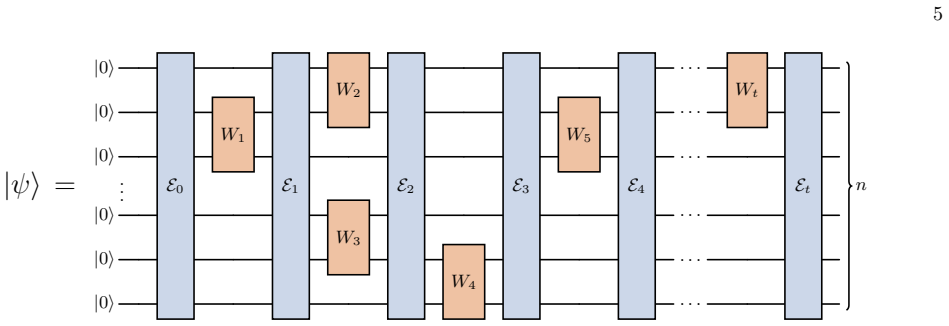
We begin with the exact-design case, wheret-doped Gaussian protocols must containt= Ω(n) non-Gaussian gates
Non-Gaussian gate lower bounds We now state the central result of this section: a lower bound on the number of non-Gaussian gates anyt-doped Gaussian protocol must contain to form state designs. We begin with the exact-design case, wheret-doped Gaussian protocols must containt= Ω(n) non-Gaussian gates. Corollary 6(Non-Gaussian gate lower bound for exact 2...
-
[2]
≤” direction is immediate: restricting the outer minimization to pureτrecovers the definition of Λ d,ϵ, since Λ cr d (ϕ) = Λd(ϕ) for pureϕ. For the “≥
This is Eq. (118). 27 (b)Decaying-ϵregime.We use the Berry–Esseen-type bound: by Lemma 19, s(H) a ≥2(1−Φ(a))− 2C√n ,∀a >0,(124) withCthe absolute constant of Lemma 19. Combining with Eq. (123), ra ≥2(1−Φ(a))−ϵ− 2C√n ≥2(1−Φ(a))−2ϵ,(125) where the last inequality uses the assumptionϵ≥C ∗/√nwithC ∗ := 2C. Settinga ∗ := Φ −1(1−2ϵ) gives ra∗ ≥2ϵ. It remains to...
-
[3]
Preskill, Quantum computing and the entanglement frontier, arXiv:1203.5813 (2012)
J. Preskill, Quantum computing and the entanglement frontier, arXiv:1203.5813 (2012)
Pith/arXiv arXiv 2012
-
[4]
A. W. Harrow and A. Montanaro, Quantum computational supremacy, Nature549, 203–209 (2017)
2017
-
[5]
Gour,Quantum Resource Theories(Cambridge University Press, 2025)
G. Gour,Quantum Resource Theories(Cambridge University Press, 2025)
2025
-
[6]
Chitambar and G
E. Chitambar and G. Gour, Quantum resource theories, Rev. Mod. Phys.91, 025001 (2019)
2019
-
[7]
Knill, Fermionic linear optics and matchgates (2001), arXiv:quant-ph/0108033 [quant-ph]
E. Knill, Fermionic linear optics and matchgates (2001), arXiv:quant-ph/0108033 [quant-ph]
Pith/arXiv arXiv 2001
-
[8]
L. G. Valiant, Quantum computers that can be simulated classically in polynomial time, inProceedings of the Thirty-Third Annual ACM Symposium on Theory of Computing, STOC ’01 (Association for Computing Machinery, New York, NY, USA, 2001) p. 114–123
2001
-
[9]
B. M. Terhal and D. P. DiVincenzo, Classical simulation of noninteracting-fermion quantum circuits, Phys. Rev. A65, 032325 (2002)
2002
-
[10]
Jozsa and A
R. Jozsa and A. Miyake, Matchgates and classical simulation of quantum circuits, Proceedings of the Royal Society A: Mathematical, Physical and Engineering Sciences464, 3089–3106 (2008)
2008
-
[11]
Bravyi, Lagrangian representation for fermionic linear optics, Quantum Information and Computation5, 216–238 (2005)
S. Bravyi, Lagrangian representation for fermionic linear optics, Quantum Information and Computation5, 216–238 (2005)
2005
-
[12]
D. J. Brod, Efficient classical simulation of matchgate circuits with generalized inputs and measurements, Phys. Rev. A 93, 062332 (2016)
2016
-
[13]
Surace and L
J. Surace and L. Tagliacozzo, Fermionic Gaussian states: an introduction to numerical approaches, SciPost Physics Lecture Notes (2022)
2022
-
[14]
Altland and B
A. Altland and B. D. Simons,Condensed Matter Field Theory(Cambridge University Press, 2010)
2010
-
[15]
D. R. Hartree, The wave mechanics of an atom with a non-coulomb central field. part i. theory and methods, Mathematical Proceedings of the Cambridge Philosophical Society24, 89–110 (1928)
1928
-
[16]
Kitaev, Anyons in an exactly solved model and beyond, Annals of Physics321, 2–111 (2006)
A. Kitaev, Anyons in an exactly solved model and beyond, Annals of Physics321, 2–111 (2006)
2006
-
[17]
Hebenstreit, R
M. Hebenstreit, R. Jozsa, B. Kraus, S. Strelchuk, and M. Yoganathan, All pure fermionic non-gaussian states are magic states for matchgate computations, Physical review letters123, 080503 (2019)
2019
-
[18]
Koepsell, D
J. Koepsell, D. Bourgund, P. Sompet, S. Hirthe, A. Bohrdt, Y. Wang, F. Grusdt, E. Demler, G. Salomon, C. Gross, and I. Bloch, Microscopic evolution of doped mott insulators from polaronic metal to fermi liquid, Science374, 82–86 (2021)
2021
-
[19]
P. T. Brown, D. Mitra, E. Guardado-Sanchez, R. Nourafkan, A. Reymbaut, C.-D. H´ ebert, S. Bergeron, A.-M. S. Tremblay, J. Kokalj, D. A. Huse, P. Schauß, and W. S. Bakr, Bad metallic transport in a cold atom fermi-hubbard system, Science 363, 379–382 (2019)
2019
-
[20]
Hartke, B
T. Hartke, B. Oreg, C. Turnbaugh, N. Jia, and M. Zwierlein, Direct observation of nonlocal fermion pairing in an attractive fermi-hubbard gas, Science381, 82–86 (2023)
2023
-
[21]
M. Xu, L. H. Kendrick, A. Kale, Y. Gang, C. Feng, S. Zhang, A. W. Young, M. Lebrat, and M. Greiner, A neutral-atom hubbard quantum simulator in the cryogenic regime, Nature642, 909–915 (2025)
2025
-
[22]
Vijayan, P
J. Vijayan, P. Sompet, G. Salomon, J. Koepsell, S. Hirthe, A. Bohrdt, F. Grusdt, I. Bloch, and C. Gross, Time-resolved observation of spin-charge deconfinement in fermionic hubbard chains, Science367, 186–189 (2020)
2020
-
[23]
J¨ ordens, N
R. J¨ ordens, N. Strohmaier, K. G¨ unter, H. Moritz, and T. Esslinger, A mott insulator of fermionic atoms in an optical lattice, Nature455, 204–207 (2008). 47
2008
-
[24]
D. Gonz´ alez-Cuadra, D. Bluvstein, M. Kalinowski, R. Kaubruegger, N. Maskara, P. Naldesi, T. V. Zache, A. M. Kaufman, M. D. Lukin, H. Pichler, B. Vermersch, J. Ye, and P. Zoller, Fermionic quantum processing with programmable neutral atom arrays, Proceedings of the National Academy of Sciences120, 10.1073/pnas.2304294120 (2023)
-
[25]
R. W. Chien, M. Chiew, B. Harrison, J. Necaise, W. Wang, M. Mudassar, C. McLauchlan, T. M. Henderson, G. E. Scuseria, S. Strelchuk, and J. D. Whitfield, Simulating fermions with a digital quantum computer, Nature Reviews Physics8, 131–145 (2026)
2026
-
[26]
Bojovi´ c, T
P. Bojovi´ c, T. Hilker, S. Wang, J. Obermeyer, M. Barendregt, D. Tell, T. Chalopin, P. M. Preiss, I. Bloch, and T. Franz, High-fidelity collisional quantum gates with fermionic atoms, Nature652, 602–608 (2026)
2026
-
[27]
Dias and R
B. Dias and R. Koenig, Classical simulation of non-gaussian fermionic circuits, Quantum8, 1350 (2024)
2024
-
[28]
J. Cudby and S. Strelchuk, Gaussian decomposition of magic states for matchgate computations, arxiv:2307.12654 (2023)
arXiv 2023
-
[29]
Reardon-Smith, M
O. Reardon-Smith, M. Oszmaniec, and K. Korzekwa, Improved simulation of quantum circuits dominated by free fermionic operations, Quantum8, 1549 (2024)
2024
-
[30]
P. S. Tarabunga, B. Jobst, R. Morral-Yepes, M. Langer, B. Kraus, F. Pollmann, and S.-H. Lin, Computable measures of fermionic non-gaussianity from the covariance matrix (2026), to appear
2026
-
[31]
A. D. Gottlieb and N. J. Mauser, Properties of nonfreeness: an entropy measure of electron correlation (2006), arxiv:0608171
2006
-
[32]
A. D. Gottlieb and N. J. Mauser, Correlation in fermion or boson systems as the minimum of entropy relative to all free states, arxiv:1403.7640 (2014)
Pith/arXiv arXiv 2014
-
[33]
Lyu and K
X. Lyu and K. Bu, Fermionic gaussian testing and non-gaussian measures via convolution (2024)
2024
-
[34]
C. J. Turner, K. Meichanetzidis, Z. Papi´ c, and J. K. Pachos, Optimal free descriptions of many-body theories, Nature communications8, 14926 (2017)
2017
-
[35]
J. K. Pachos and Z. Papic, Quantifying the effect of interactions in quantum many-body systems, SciPost Phys. Lect. Notes , 4 (2018)
2018
-
[36]
J. K. Pachos and C. Vlachou, Quantifying fermionic interactions from the violation of Wick’s theorem, Quantum6, 840 (2022)
2022
-
[37]
Meichanetzidis, C
K. Meichanetzidis, C. J. Turner, A. Farjami, Z. Papi´ c, and J. K. Pachos, Free-fermion descriptions of parafermion chains and string-net models, Physical Review B97, 125104 (2018)
2018
-
[38]
L. Coffman, G. Smith, and X. Gao, Measuring non-Gaussian magic in fermions: Convolution, entropy, and the violation of Wick’s theorem and the matchgate identity, arXiv:2501.06179 (2025)
arXiv 2025
-
[39]
Sierant, P
P. Sierant, P. Stornati, and X. Turkeshi, Fermionic magic resources of quantum many-body systems, PRX Quantum7, 010302 (2026)
2026
-
[40]
Vidal, Entanglement monotones, Journal of Modern Optics47, 355–376 (2000)
G. Vidal, Entanglement monotones, Journal of Modern Optics47, 355–376 (2000)
2000
-
[41]
Baumgratz, M
T. Baumgratz, M. Cramer, and M. B. Plenio, Quantifying coherence, Phys. Rev. Lett.113, 140401 (2014)
2014
-
[42]
Bittel and L
L. Bittel and L. Leone, Operational interpretation of the stabilizer entropy, Quantum10, 2069 (2026)
2069
-
[43]
F. A. Mele, S. F. E. Oliviero, V. Upreti, and U. Chabaud, The symplectic rank of non-gaussian quantum states (2025), arXiv:2504.19319 [quant-ph]
arXiv 2025
-
[44]
The name bridge operator was coined later in Ref. [91]
-
[45]
Hangleiter and M
D. Hangleiter and M. J. Gullans, Bell sampling from quantum circuits, Physical Review Letters133, 020601 (2024)
2024
-
[46]
Huang, M
H.-Y. Huang, M. Broughton, J. Cotler, S. Chen, J. Li, M. Mohseni, H. Neven, R. Babbush, R. Kueng, J. Preskill, and J. R. McClean, Quantum advantage in learning from experiments, Science376, 1182–1186 (2022)
2022
-
[47]
Huang, R
H.-Y. Huang, R. Kueng, and J. Preskill, Information-theoretic bounds on quantum advantage in machine learning, Physical Review Letters126, 190505 (2021)
2021
-
[48]
Haug and M
T. Haug and M. Kim, Scalable measures of magic resource for quantum computers, PRX Quantum4, 010301 (2023)
2023
-
[49]
Montanaro, Learning stabilizer states by bell sampling, arxiv:1707.04012 (2017)
A. Montanaro, Learning stabilizer states by bell sampling, arxiv:1707.04012 (2017)
Pith/arXiv arXiv 2017
-
[50]
Gross, S
D. Gross, S. Nezami, and M. Walter, Schur–weyl duality for the clifford group with applications: Property testing, a robust hudson theorem, and de finetti representations, Communications in Mathematical Physics385, 1325–1393 (2021)
2021
-
[51]
Grewal, V
S. Grewal, V. Iyer, W. Kretschmer, and D. Liang, Efficient learning of quantum states prepared with few non-clifford gates, Quantum9, 1907 (2025)
1907
-
[52]
R. King, D. Gosset, R. Kothari, and R. Babbush, Triply efficient shadow tomography, PRX Quantum6, 010336 (2025)
2025
-
[53]
M. A. Nielsen and I. L. Chuang,Quantum Computation and Quantum Information: 10th Anniversary Edition(Cambridge University Press, 2010)
2010
-
[54]
S. Chen, J. Cotler, H.-Y. Huang, and J. Li, Exponential Separations Between Learning With and Without Quantum Memory , in2021 IEEE 62nd Annual Symposium on Foundations of Computer Science (FOCS)(IEEE Computer Society, Los Alamitos, CA, USA, 2022) pp. 574–585
2022
-
[55]
Bluvstein, S
D. Bluvstein, S. J. Evered, A. A. Geim, S. H. Li, H. Zhou, T. Manovitz, S. Ebadi, M. Cain, M. Kalinowski, D. Hangleiter, et al., Logical quantum processor based on reconfigurable atom arrays, Nature626, 58 (2024)
2024
-
[56]
Islam, R
R. Islam, R. Ma, P. M. Preiss, M. Eric Tai, A. Lukin, M. Rispoli, and M. Greiner, Measuring entanglement entropy in a quantum many-body system, Nature528, 77–83 (2015)
2015
-
[57]
A. M. Kaufman, M. E. Tai, A. Lukin, M. Rispoli, R. Schittko, P. M. Preiss, and M. Greiner, Quantum thermalization through entanglement in an isolated many-body system, Science353, 794–800 (2016)
2016
-
[58]
N. M. Linke, S. Johri, C. Figgatt, K. A. Landsman, A. Y. Matsuura, and C. Monroe, Measuring the r´ enyi entropy of a two-site fermi-hubbard model on a trapped ion quantum computer, Physical Review A98, 052334 (2018)
2018
-
[59]
Haug and P
T. Haug and P. S. Tarabunga, Efficient witnessing and testing of magic in mixed quantum states, npj Quantum Information 12, 40 (2026). 48
2026
-
[60]
P. S. Tarabunga and Y.-M. Ding, Bell sampling in quantum monte carlo simulations, Physical Review Letters135, 200403 (2025)
2025
-
[61]
P. S. Tarabunga and T. Haug, Efficient mutual magic and magic capacity with matrix product states, SciPost Physics 19, 085 (2025)
2025
-
[62]
Lami and M
G. Lami and M. Collura, Nonstabilizerness via perfect pauli sampling of matrix product states, Phys. Rev. Lett.131, 180401 (2023)
2023
-
[63]
Haug and L
T. Haug and L. Piroli, Stabilizer entropies and nonstabilizerness monotones, Quantum7, 1092 (2023)
2023
-
[64]
P. S. Tarabunga, E. Tirrito, T. Chanda, and M. Dalmonte, Many-body magic via pauli-markov chains—from criticality to gauge theories, PRX Quantum4, 040317 (2023)
2023
-
[65]
Collura, J
M. Collura, J. D. Nardis, V. Alba, and G. Lami, The non-stabilizerness of fermionic gaussian states, Quantum10, 2036 (2026)
2036
-
[66]
Knill, D
E. Knill, D. Leibfried, R. Reichle, J. Britton, R. B. Blakestad, J. D. Jost, C. Langer, R. Ozeri, S. Seidelin, and D. J. Wineland, Randomized benchmarking of quantum gates, Phys. Rev. A77, 012307 (2008)
2008
-
[67]
Huang, R
H.-Y. Huang, R. Kueng, and J. Preskill, Predicting many properties of a quantum system from very few measurements, Nature Physics16, 1050–1057 (2020)
2020
-
[68]
Ji, Y.-K
Z. Ji, Y.-K. Liu, and F. Song, Pseudorandom quantum states, inAdvances in Cryptology – CRYPTO 2018(Springer International Publishing, 2018) p. 126–152
2018
-
[69]
Aaronson and P
S. Aaronson and P. Christiano, Quantum money from hidden subspaces, inProceedings of the Forty-Fourth Annual ACM Symposium on Theory of Computing, STOC ’12 (Association for Computing Machinery, New York, NY, USA, 2012) p. 41–60
2012
-
[70]
W. Kretschmer, Quantum Pseudorandomness and Classical Complexity, in16th Conference on the Theory of Quantum Computation, Communication and Cryptography (TQC 2021), Leibniz International Proceedings in Informatics (LIPIcs), Vol. 197, edited by M.-H. Hsieh (Schloss Dagstuhl – Leibniz-Zentrum f¨ ur Informatik, Dagstuhl, Germany, 2021) pp. 2:1–2:20
2021
-
[71]
Boixo, S
S. Boixo, S. V. Isakov, V. N. Smelyanskiy, R. Babbush, N. Ding, Z. Jiang, M. J. Bremner, J. M. Martinis, and H. Neven, Characterizing quantum supremacy in near-term devices, Nature Physics14, 595–600 (2018)
2018
-
[72]
Bouland, B
A. Bouland, B. Fefferman, C. Nirkhe, and U. Vazirani, On the complexity and verification of quantum random circuit sampling, Nature Physics15, 159–163 (2018)
2018
-
[73]
Nakata, Y
Y. Nakata, Y. Takeuchi, M. Kliesch, and A. Darmawan, Computational complexity of unitary and state design properties, PRX Quantum6, 030345 (2025)
2025
-
[74]
B. M. Terhal and P. Horodecki, Schmidt number for density matrices, Phys. Rev. A61, 040301(R) (2000)
2000
-
[75]
Bravyi, Classical capacity of fermionic product channels (2005), arXiv:quant-ph/0507282 [quant-ph]
S. Bravyi, Classical capacity of fermionic product channels (2005), arXiv:quant-ph/0507282 [quant-ph]
Pith/arXiv arXiv 2005
-
[76]
C. H. Bennett, H. J. Bernstein, S. Popescu, and B. Schumacher, Concentrating partial entanglement by local operations, Phys. Rev. A53, 2046 (1996)
2046
-
[77]
Vidal and J
G. Vidal and J. I. Cirac, Irreversibility in asymptotic manipulations of entanglement, Phys. Rev. Lett.86, 5803 (2001)
2001
-
[78]
A. Ambainis and J. Emerson, Quantum t-designs: t-wise independence in the quantum world (2007), arXiv:quant- ph/0701126 [quant-ph]
arXiv 2007
-
[79]
Leone, S
L. Leone, S. F. Oliviero, A. Hamma, J. Eisert, and L. Bittel, Non-clifford cost of random unitaries, PRX Quantum7, 020321 (2026)
2026
-
[80]
Haferkamp, F
J. Haferkamp, F. Montealegre-Mora, M. Heinrich, J. Eisert, D. Gross, and I. Roth, Efficient unitary designs with a system-size independent number of non-clifford gates, Communications in Mathematical Physics397, 995–1041 (2022)
2022
discussion (0)
Sign in with ORCID, Apple, or X to comment. Anyone can read and Pith papers without signing in.