Density-functional theory calculation of hydrogen solubility in cubic silicon carbide at finite temperatures
Pith reviewed 2026-06-28 05:02 UTC · model grok-4.3
The pith
Hydrogen solubility in cubic silicon carbide increases substantially in carbon-rich amorphous structures and at silicon vacancies relative to interstitial sites in the perfect crystal.
A machine-rendered reading of the paper's core claim, the machinery that carries it, and where it could break.
Core claim
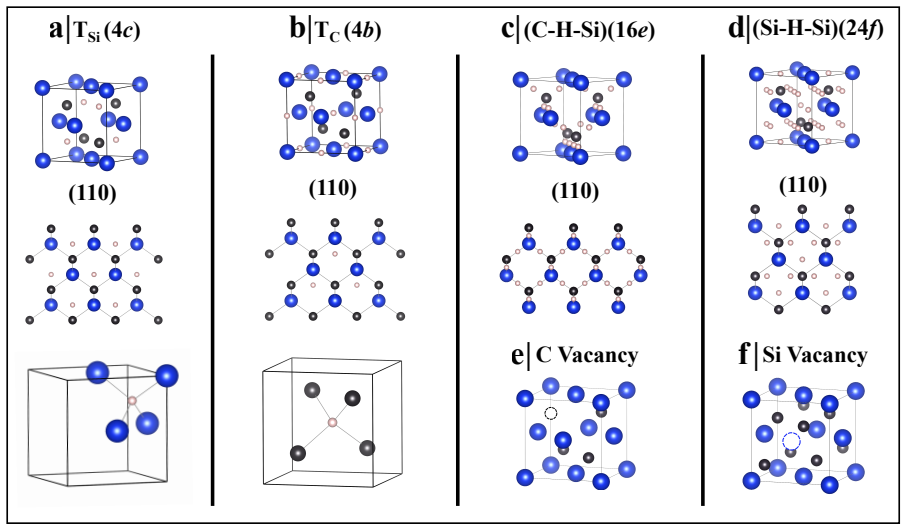
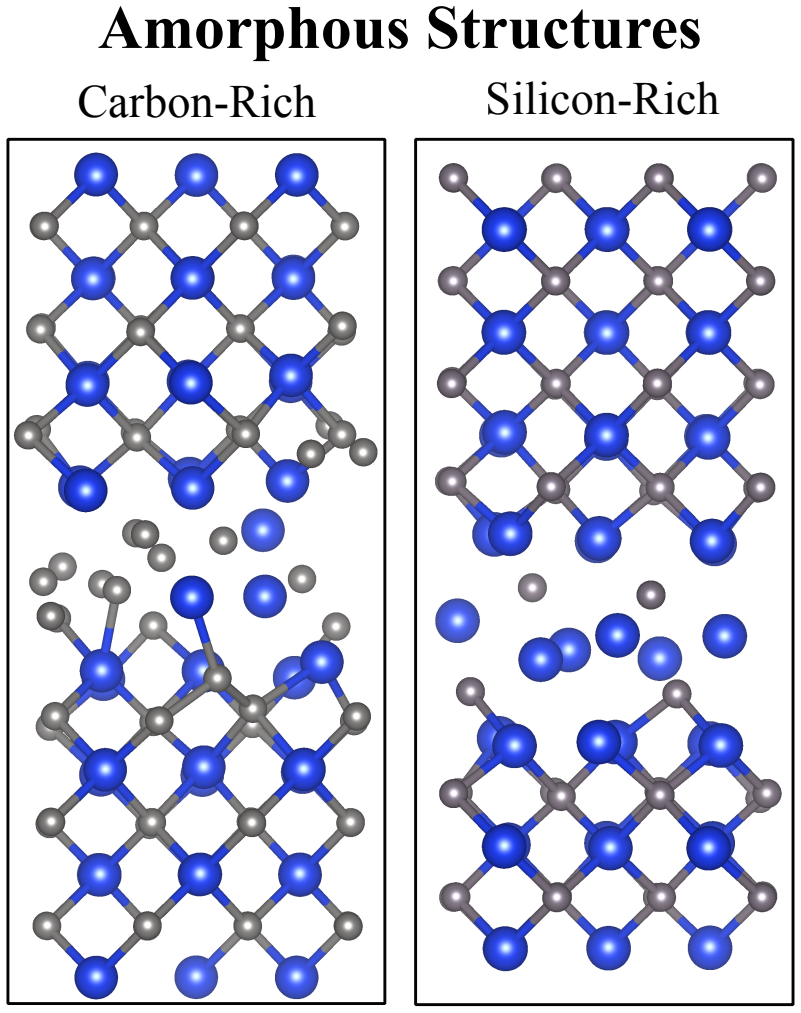
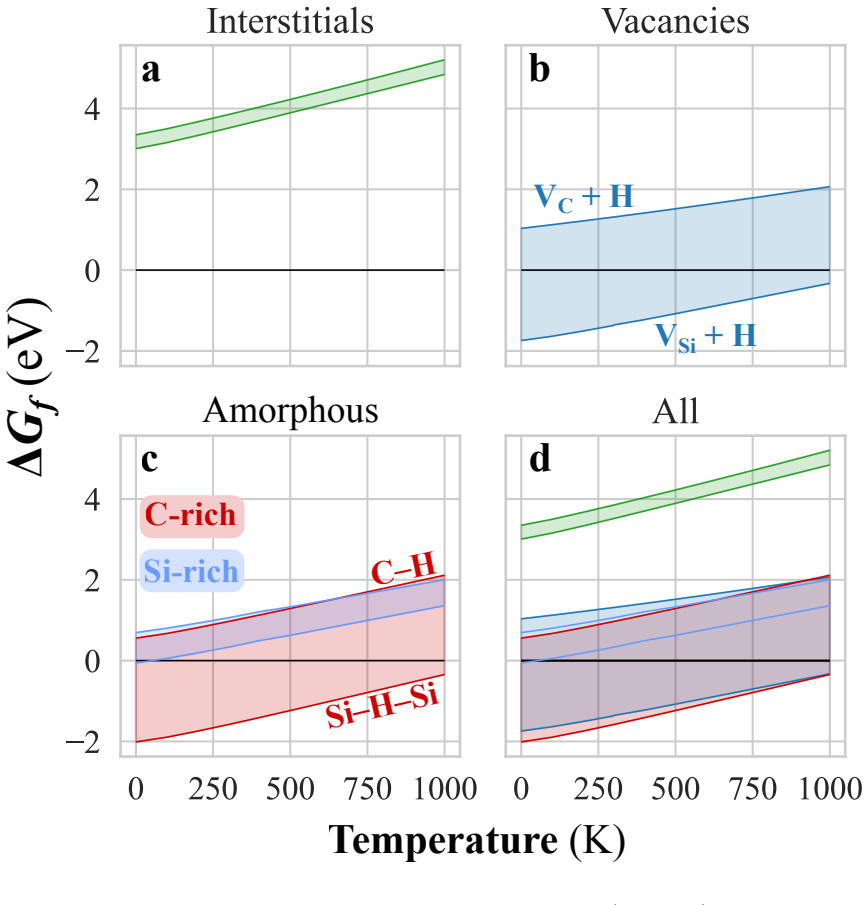
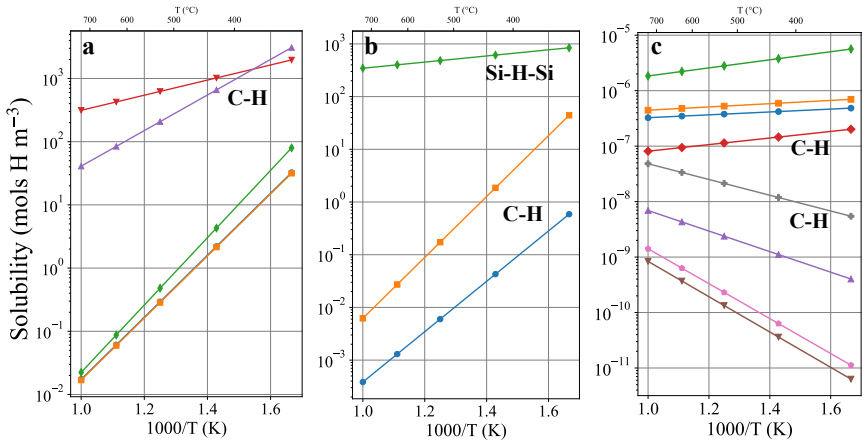
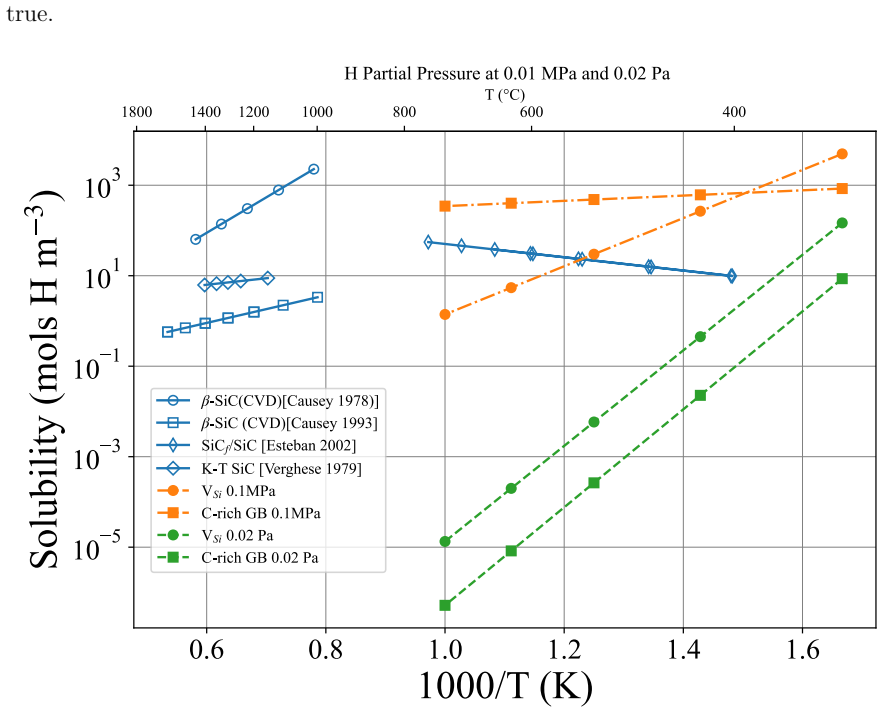
An ab initio framework using density-functional theory has been developed to predict hydrogen solubility in both pristine and defective β-SiC. First principles calculations are employed to quantify the effects of interstitials, vacancies, and nonstoichiometric (amorphous) structures on hydrogen behavior in β-SiC. Our results show that hydrogen solubility is significantly enhanced in carbon-rich nonstoichiometric amorphous structures and silicon vacancies compared to hydrogen occupying interstitial sites in pure β-SiC.
What carries the argument
Ab initio density-functional theory calculations of hydrogen formation energies and vibrational free-energy contributions in crystalline, defective, and amorphous β-SiC supercells.
If this is right
- Hydrogen uptake is higher in silicon-vacancy sites than interstitial sites.
- Carbon-rich amorphous SiC exhibits enhanced solubility compared to stoichiometric crystal.
- Permeation barrier performance models must incorporate defect effects for accuracy.
- Real materials with defects will retain more hydrogen than ideal-crystal predictions suggest.
Where Pith is reading between the lines
- Experimental validation could compare solubility in amorphous SiC films versus single crystals.
- Material processing to control defect density might tune hydrogen retention in TPBs.
- Similar DFT approaches could be applied to other candidate barrier materials like oxides.
Load-bearing premise
The chosen DFT exchange-correlation functional and supercell models accurately capture the relative formation energies and vibrational contributions that determine solubility at finite temperatures in both crystalline and amorphous configurations.
What would settle it
Measurement of hydrogen solubility in carbon-rich amorphous β-SiC at elevated temperatures showing values comparable to or lower than in pure crystalline β-SiC would contradict the predicted enhancement.
Figures
read the original abstract
An ab initio framework using density-functional theory has been developed to predict hydrogen solubility in both pristine and defective \b{eta}-SiC. This study is motivated by the critical need for accurate hydrogen permeation models in fusion reactor designs, where predicting hydrogen permeation through tritium permeation barrier (TPB) materials is essential. Although silicon carbide is one of the leading candidates for TPBs, experimental permeation values vary widely due to differences between ideal single crystals and real, defect-containing materials. First principles calculations are employed to quantify the effects of interstitials, vacancies, and nonstoichiometric (amorphous) structures on hydrogen behavior in \b{eta}-SiC. Our results show that hydrogen solubility is significantly enhanced in carbon-rich nonstoichiometric amorphous structures and silicon vacancies compared to hydrogen occupying interstitial sites in pure \b{eta}-SiC.
Editorial analysis
A structured set of objections, weighed in public.
Referee Report
Summary. The paper develops an ab initio DFT framework to compute hydrogen solubility in pristine β-SiC, Si-vacancy defects, and carbon-rich nonstoichiometric amorphous configurations at finite temperatures. Motivated by tritium permeation barrier applications in fusion reactors, it reports that solubility is significantly enhanced in the defective and amorphous environments relative to interstitial sites in perfect crystalline β-SiC, attributing the difference to lower formation energies and vibrational contributions.
Significance. If the relative formation energies and entropic terms are accurate, the work supplies a concrete, first-principles explanation for the wide scatter in experimental permeation data and supplies quantitative inputs for engineering models of real TPB materials. The direct (non-fitted) calculation of solubility from defect thermodynamics across multiple structural environments is a clear strength.
minor comments (4)
- §3 (Computational Methods): the supercell sizes and k-point meshes used for the amorphous models should be stated explicitly, together with the convergence criterion for the formation energies that enter the solubility expression.
- §4 (Results): the temperature range and the explicit form of the vibrational free-energy contribution (e.g., harmonic vs. quasi-harmonic) are not summarized in a single equation or table; adding this would make the finite-T solubility formula immediately reproducible.
- Figure 5 and Table 2: axis labels and captions should clarify whether the plotted solubilities are absolute or relative to the perfect-crystal interstitial value, and whether error bars reflect only statistical sampling or also functional uncertainty.
- References: several key experimental permeation studies on SiC are cited only in the introduction; a short comparison table linking the calculated enhancement factors to the range of measured values would strengthen the discussion.
Simulated Author's Rebuttal
We thank the referee for the positive assessment of our work, the recognition of its significance for tritium permeation barrier applications, and the recommendation for minor revision. No specific major comments were provided in the report.
Circularity Check
No significant circularity in derivation chain
full rationale
The paper applies standard DFT defect thermodynamics (formation energies plus vibrational free energies) to compute hydrogen solubilities directly in multiple SiC environments. No equations reduce the reported solubilities to fitted inputs, self-citations, or ansatzes; the central comparisons between interstitial, vacancy, and amorphous sites are independent first-principles outputs under the stated functional and supercell assumptions. The derivation is therefore self-contained against external benchmarks.
Axiom & Free-Parameter Ledger
Reference graph
Works this paper leans on
-
[1]
I. A. Hassan, H. S. Ramadan, M. A. Saleh, and D. Hissel. Hydrogen storage technologies for stationary and mobile applications: Review, analysis and perspectives. Renewable Sustainable Energy Rev., 149:111311, 2021
2021
-
[2]
B. V. Ivanov and S. S. Ananev. Demand of fusion energy for tritium and the possibility of its production in nuclear reactors.At. Energy, 135(3):183–188, 2024
2024
-
[3]
W. G. Luscher, D. J. Senor, K. K. Clayton, and G. R. Longhurst. In situ measurement of tritium permeation through stainless steel.J. Nucl. Mater., 437(1):373–379, 2013
2013
-
[4]
Houben, M
A. Houben, M. Rasinski, and C. Linsmeier. Hydrogen permeation in fusion materials and the development of tritium permeation barriers.Plasma Fusion Res., 15:2405016, 2020
2020
-
[5]
Linsmeier, M
C. Linsmeier, M. Rieth, J. Aktaa, T. Chikada, A. Hoffmann, J. Hoffmann, A. Houben, H. Kurishita, X. Jin, M. Li, A. Litnovsky, S. Matsuo, A. von Müller, V. Nikolic, T. Palacios, R. Pippan, D. Qu, J. Reiser, J. Riesch, T. Shikama, R. Stieglitz, T. Weber, S. Wurster, J. H. You, and Z. Zhou. Development of advanced high heat flux and plasma-facing materials.N...
2017
-
[6]
Chikada, A
T. Chikada, A. Suzuki, and T. Terai. Deuterium permeation and thermal behaviors of amorphous silicon carbide coatings on steels.Fusion Eng. Des., 86(9):2192–2195, 2011
2011
-
[7]
Y. Oya, Y. Onishi, T. Takeda, H. Kimura, K. Okuno, and S. Tanaka. Interaction between hydrogen isotopes and damaged structures produced by He+ implantation in SiC.Fusion Eng. Des., 81(8):987–992, 2006
2006
-
[8]
Sizyuk, J
T. Sizyuk, J. N. Brooks, T. Abrams, and A. Hassanein. Comprehensive new insights on the potential use of SiC as plasma-facing materials in future fusion reactors.Nucl. Fusion, 64(8):086036, 2024
2024
-
[9]
R. A. Causey, J. D. Fowler, C. Ravanbakht, T. S. Elleman, and K. Verghese. Hydrogen diffusion and solubility in silicon carbide.J. Am. Ceram. Soc., 61(5–6):221–225, 1978. 17
1978
-
[10]
R. A. Causey and W. R. Wampler. The use of silicon carbide as a tritium permeation barrier.J. Nucl. Mater., 220–222:823–826, 1995
1995
-
[11]
Verghese, L
K. Verghese, L. R. Zumwalt, C. P. Feng, and T. S. Elleman. Hydrogen permeation through non-metallic solids.J. Nucl. Mater., 85–86:1161–1164, 1979
1979
-
[12]
Sinharoy and W
S. Sinharoy and W. J. Lange. Summary abstract: Permeation of hydrogen through CVD silicon carbide.J. Vac. Sci. Technol. A, 2(2):636–637, 1984
1984
-
[13]
R. A. Causey, W. R. Wampler, J. R. Retelle, and J. L. Kaae. Tritium migration in vapor-depositedβ-silicon carbide.J. Nucl. Mater., 203(3):196–205, 1993
1993
-
[14]
R. A. Causey, R. A. Karnesky, and C. San Marchi. Tritium barriers and tritium diffusion in fusion reactors. In R. J. M. Konings, editor,Comprehensive Nuclear Materials, pages 511–549. Elsevier, Oxford, 2012
2012
-
[15]
S. W. Tam, J. P. Kopasz, and C. E. Johnson. Tritium transport and retention in SiC.J. Nucl. Mater., 219:87–92, 1995
1995
-
[16]
Minami, S
T. Minami, S. Niigawa, Y. Ueno, T. Hinoki, Y. Yamamoto, and S. Konishi. SiC permeation study. InProc. 2007 IEEE 22nd Symp. on Fusion Engineering, pages 1–4, 2007
2007
-
[17]
Yamamoto, Y
Y. Yamamoto, Y. Murakami, H. Yamaguchi, T. Yamamoto, D. Yonetsu, K. Noborio, and S. Konishi. Re-evaluation of SiC permeation coefficients at high temperatures. Fusion Eng. Des., 109–111:1286–1290, 2016
2016
-
[18]
G. M. Wright, M. G. Durrett, K. W. Hoover, L. A. Kesler, and D. G. Whyte. Silicon carbide as a tritium permeation barrier in tungsten plasma-facing components.J. Nucl. Mater., 458:272–274, 2015
2015
-
[19]
Katoh, N
Y. Katoh, N. Hashimoto, S. Kondo, L. L. Snead, and A. Kohyama. Microstructural development in cubic silicon carbide during irradiation at elevated temperatures.J. Nucl. Mater., 351(1):228–240, 2006
2006
-
[20]
R. J. Price. Neutron irradiation-induced voids inβ-silicon carbide.J. Nucl. Mater., 48(1):47–57, 1973
1973
-
[21]
D. J. Senor, G. E. Youngblood, L. R. Greenwood, D. V. Archer, D. L. Alexander, M. C. Chen, and G. A. Newsome. Defect structure and evolution in silicon carbide irradiated to 1 dpa-SiC at 1100°c.J. Nucl. Mater., 317(2):145–159, 2003
2003
-
[22]
D. J. Sprouster, T. Koyanagi, D. L. Drey, Y. Katoh, and L. L. Snead. Atomic and microstructural origins of stored energy release in neutron-irradiated silicon carbide. Phys. Rev. Mater., 5(10):103601, 2021. 18
2021
-
[23]
L. L. Snead, Y. Katoh, and T. Nozawa. Radiation effects in SiC and SiC–SiC. In R. J. M. Konings, editor,Comprehensive Nuclear Materials, pages 215–240. Elsevier, Oxford, 2012
2012
-
[24]
Sun, Y.-W
J. Sun, Y.-W. You, J. Hou, X. Li, B. S. Li, C. S. Liu, and Z. G. Wang. The effect of irradiation-induced point defects on energetics and kinetics of hydrogen in 3c-SiC in a fusion environment.Nucl. Fusion, 57(6):066031, 2017
2017
-
[25]
T. Yano, T. Suzuki, T. Maruyama, and T. Iseki. Microstructure and annealing behavior of heavily neutron-irradiatedβ-SiC.J. Nucl. Mater., 155–157:311–314, 1988
1988
-
[26]
G. A. Esteban, A. Perujo, F. Legarda, L. A. Sedano, and B. Riccardi. Deuterium transport in SiCf/SiC composites.J. Nucl. Mater., 307–311:1430–1435, 2002
2002
-
[27]
Aradi, A
B. Aradi, A. Gali, P. Deák, J. E. Lowther, N. T. Son, E. Janzén, and W. J. Choyke. Ab initiodensity-functional supercell calculations of hydrogen defects in cubic SiC. Phys. Rev. B, 63(24):245202, 2001
2001
-
[28]
Bernardini, A
F. Bernardini, A. Mattoni, and L. Colombo. Energetics of native point defects in cubic silicon carbide.Eur. Phys. J. B, 38(3):437–444, 2004
2004
-
[29]
Iwamoto and B
N. Iwamoto and B. G. Svensson. Point defects in silicon carbide. In L. Romano, V. Privitera, and C. Jagadish, editors,Semiconductors and Semimetals, volume 91, pages 369–407. Elsevier, 2015
2015
-
[30]
Kaukonen, C
M. Kaukonen, C. J. Fall, and J. Lento. Interstitial H and H2 in SiC.Appl. Phys. Lett., 83(5):923–925, 2003
2003
-
[31]
Torpo, M
L. Torpo, M. Marlo, T. E. M. Staab, and R. M. Nieminen. Comprehensiveab initio study of properties of monovacancies and antisites in 4h-SiC.J. Phys.: Condens. Matter, 13(28):6203, 2001
2001
-
[32]
X. Wang, J. Zhao, Z. Xu, F. Djurabekova, M. Rommel, Y. Song, and F. Fang. Density functional theory calculation of the properties of carbon vacancy defects in silicon carbide.Nanotechnol. Precis. Eng., 3(4):211–217, 2020
2020
-
[33]
Zywietz, J
A. Zywietz, J. Furthmüller, and F. Bechstedt. Vacancies in SiC: Influence of Jahn- Teller distortions, spin effects, and crystal structure.Phys. Rev. B, 59(23):15166– 15180, 1999
1999
-
[34]
Nadaoka, K
R. Nadaoka, K. Uriu, Y. Yamamoto, and S. Konishi. SiC hydrogen solubility study. InProc. 2009 23rd IEEE/NPSS Symp. on Fusion Engineering, pages 1–4, 2009. 19
2009
-
[35]
B. Delley. From molecules to solids with the DMol3 approach.J. Chem. Phys., 113(18):7756–7764, 2000
2000
-
[36]
Brauer, W
G. Brauer, W. Anwand, P. Coleman, A. Knights, F. Plazaola, Y. Pacaud, W. Skorupa, J. Störmer, and P. Willutzki. Positron studies of defects in ion-implanted SiC.Phys. Rev. B, 54(5):3084, 1996
1996
-
[37]
K. Lee, M. Yuan, and J. Wilcox. Understanding deviations in hydrogen solubility predictions in transition metals through first-principles calculations.J. Phys. Chem. C, 119(34):19642–19653, 2015
2015
-
[38]
Chase, Malcolm W.NIST-JANAF Thermochemical Tables
Jr. Chase, Malcolm W.NIST-JANAF Thermochemical Tables. American Chemical Society / American Institute of Physics, Washington, DC / New York, 4th edition, 1998
1998
-
[39]
A. M. Chaka and A. R. Felmy.Ab Initiothermodynamic model for magnesium carbonates and hydrates.J. Phys. Chem. A, 118(35):7469–7488, 2014
2014
-
[40]
Reuter and M
K. Reuter and M. Scheffler. Composition, structure, and stability of RuO2(110) as a function of oxygen pressure.Phys. Rev. B, 65(3):035406, 2001
2001
-
[41]
X. Wang, A. Chaka, and M. Scheffler. Effect of the environment onα-Al2O3(0001) surface structures.Phys. Rev. Lett., 84(16):3650–3653, 2000
2000
-
[42]
Zhang, J
W. Zhang, J. R. Smith, and X. G. Wang. Thermodynamics fromab initiocomputa- tions.Phys. Rev. B, 70(2):024103, 2004
2004
-
[43]
S. E. Mason, C. R. Iceman, T. P. Trainor, and A. M. Chaka. Density functional theory study of clean, hydrated, and defective alumina (1¯102) surfaces.Phys. Rev. B, 81(12):125423, 2010
2010
-
[44]
Bockstedte, A
M. Bockstedte, A. Mattausch, and O. Pankratov.Ab initiostudy of the annealing of vacancies and interstitials in cubic SiC: Vacancy-interstitial recombination and aggregation of carbon interstitials.Phys. Rev. B, 69(23):235202, 2004
2004
-
[45]
M. A. Roberson and S. K. Estreicher. Interstitial hydrogen in cubic and hexagonal SiC.Phys. Rev. B, 44(19):10578–10584, 1991
1991
-
[46]
P. Deák, A. Bálint, and G. Adam. Boron and aluminium doping in SiC and its passivation by hydrogen.J. Phys.: Condens. Matter, 13(40):9019, 2001
2001
-
[47]
X. F. Zhang, M. E. Sixta, and L. C. De Jonghe. Grain boundary evolution in hot-pressed ABC-SiC.J. Am. Ceram. Soc., 83(11):2813–2820, 2000. 20
2000
-
[48]
A. Gali, B. Aradi, P. Deák, W. J. Choyke, and N. T. Son. Overcoordinated hydrogens in the carbon vacancy: Donor centers of SiC.Phys. Rev. Lett., 84(21):4926–4929, 2000
2000
-
[49]
R. Johnson. NIST 101: Computational chemistry comparison and benchmark database, 1999. Personal correspondence
1999
-
[50]
Aradi, P
B. Aradi, P. Deák, A. Gali, N. T. Son, and E. Janzén. Diffusion of hydrogen in perfect, p-type doped, and radiation-damaged 4h-SiC.Phys. Rev. B, 69(23):233202, 2004
2004
-
[51]
Blackstone and E
R. Blackstone and E. H. Voice. The expansion of silicon carbide by neutron irradiation at high temperature.J. Nucl. Mater., 39(3):319–322, 1971
1971
-
[52]
Dutta, P
R. Dutta, P. K. Banerjee, and S. S. Mitra. Effect of hydrogenation on the electrical conductivity of amorphous silicon carbide.Solid State Commun., 42(3):219–222, 1982
1982
-
[53]
W. K. Choi, F. L. Loo, F. C. Loh, and K. L. Tan. Effects of hydrogen and rf power on the structural and electrical properties of rf sputtered hydrogenated amorphous silicon carbide films.J. Appl. Phys., 80(3):1611–1616, 1996. 21
1996
discussion (0)
Sign in with ORCID, Apple, or X to comment. Anyone can read and Pith papers without signing in.