Early Multiwavelength Observations of AT 2026fgk: The Luminous Afterglow to Sub-luminous GRB 260310A, Identified Independently of a Gamma-ray Trigger
Pith reviewed 2026-06-28 04:55 UTC · model grok-4.3
The pith
Sub-luminous GRB rate matches the high-luminosity long-GRB rate, constraining low initial Lorentz factors and beaming.
A machine-rendered reading of the paper's core claim, the machinery that carries it, and where it could break.
Core claim
The central claim is that the similarity between the volumetric rate of AT 2026fgk-like sub-luminous events and the on-axis high-luminosity long-GRB rate directly limits how prevalent low-Gamma0 bursts can be and how the initial relativistic outflow is beamed.
What carries the argument
The afterglow modeling that yields Gamma0 approx 40 or off-axis angle less than or equal to 3 degrees, combined with the ZTF-derived volumetric rate comparison to high-luminosity GRBs.
If this is right
- Low initial Lorentz factor bursts must be rare in the overall GRB population.
- The beaming fraction of the initial relativistic material is comparable for sub-luminous and high-luminosity events.
- Sub-luminous GRBs do not form a separate population with distinctly different jet properties.
- Optical flux-limited surveys can independently recover sub-luminous GRB afterglows at rates matching gamma-ray-triggered samples.
Where Pith is reading between the lines
- If the rate match holds, GRB jets may follow a continuous distribution of Lorentz factors rather than a sharp separation between luminous and sub-luminous classes.
- Repeated optical detections of similar events could test whether host galaxy properties or supernova parameters correlate with the inferred low Gamma0 or off-axis geometry.
- The result suggests that the central engine can produce comparable total energy release across a wide range of observed luminosities.
Load-bearing premise
The ZTF flux-limited survey selection function and single-event rate extrapolation accurately represent the full population of sub-luminous GRBs without large unrecognized biases in detection efficiency or host properties.
What would settle it
A larger optical survey sample that yields a volumetric rate for similar events differing by more than the reported uncertainties would falsify the claimed rate consistency.
Figures
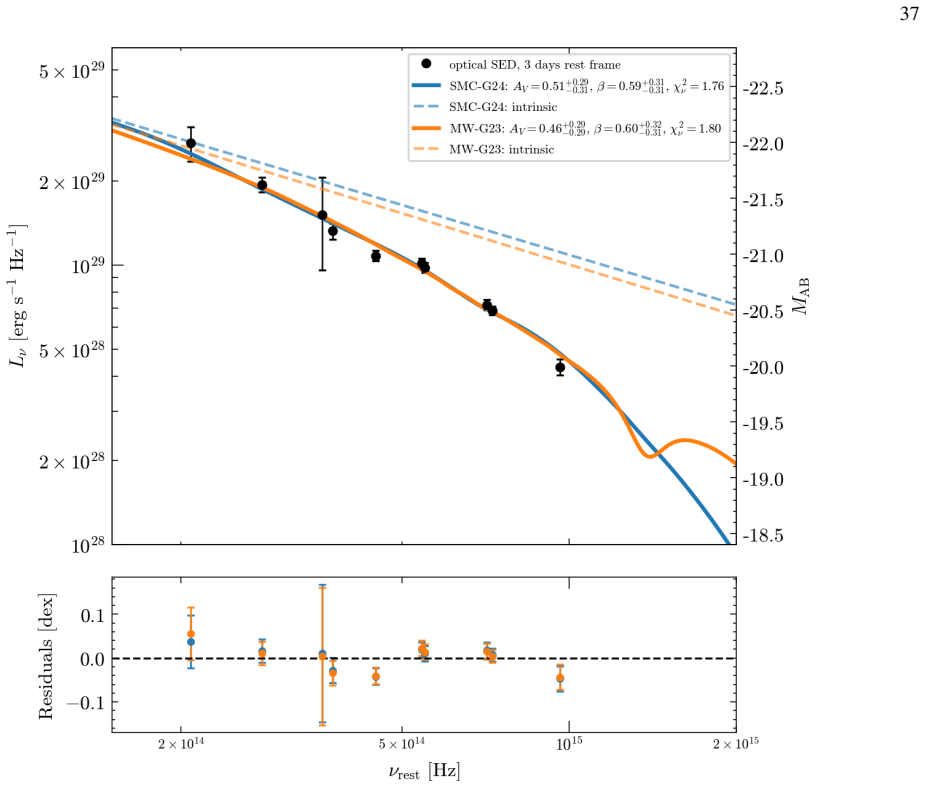
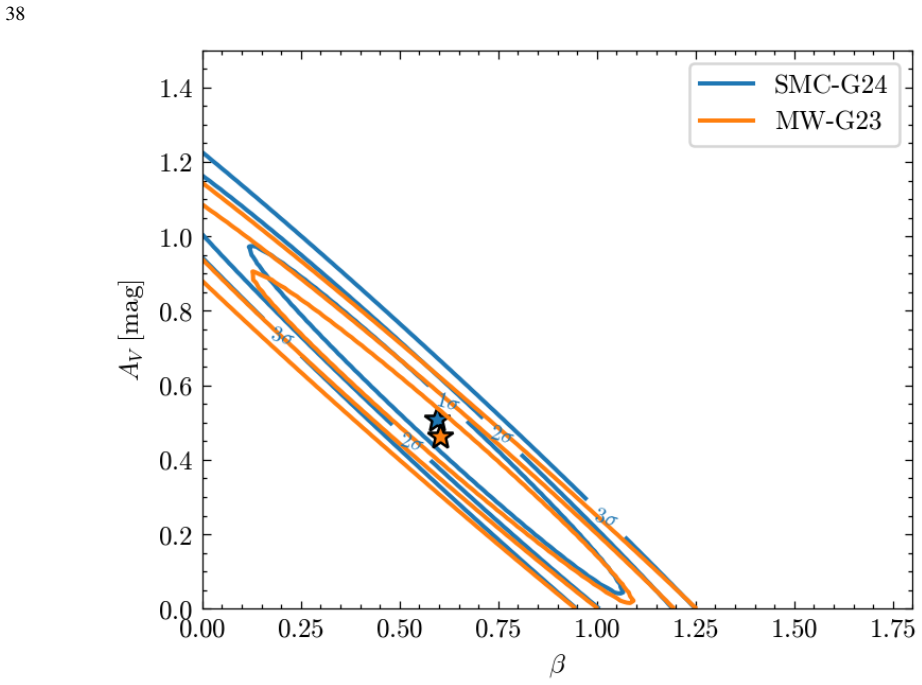
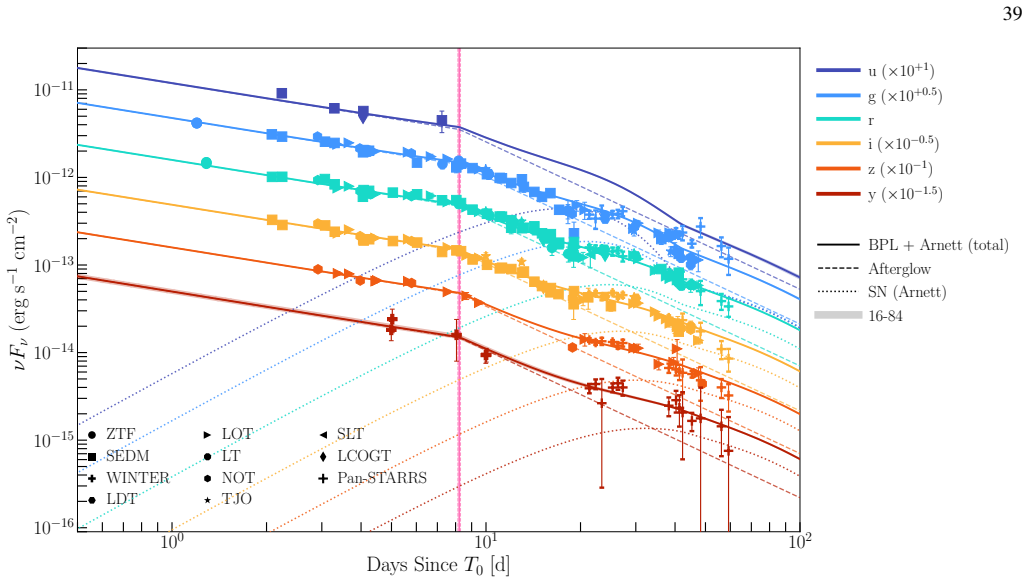
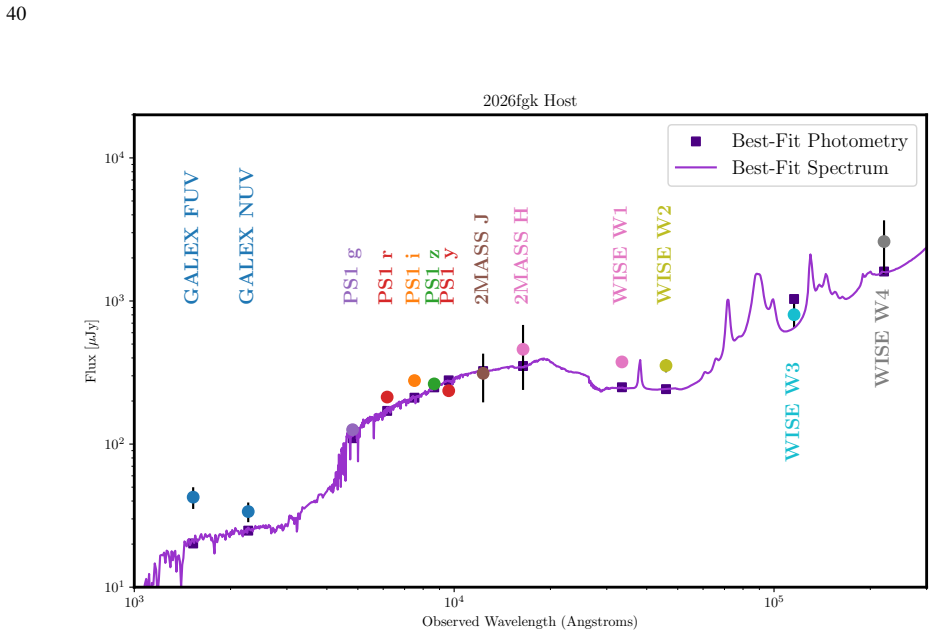
read the original abstract
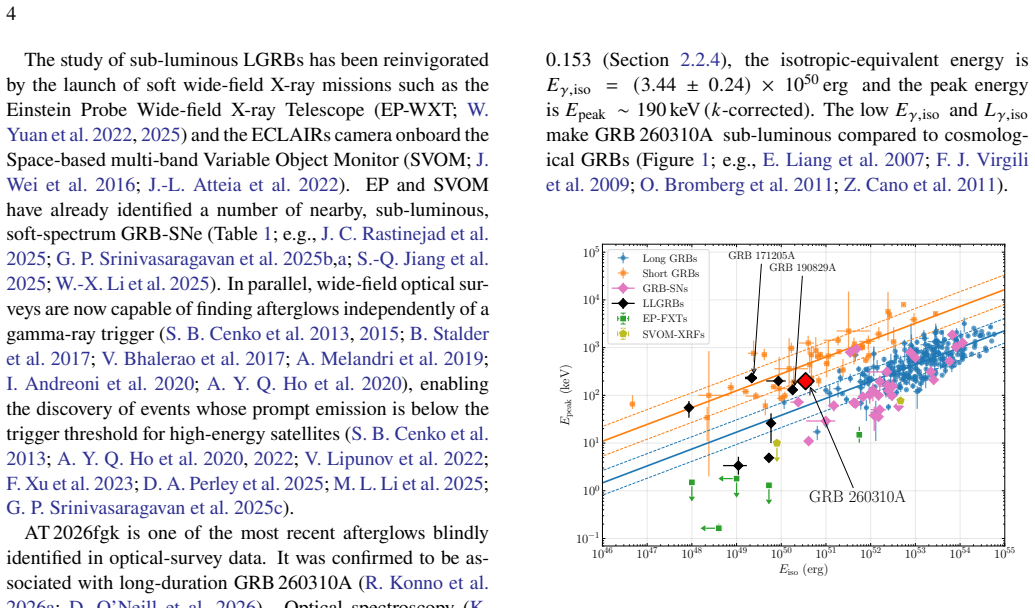
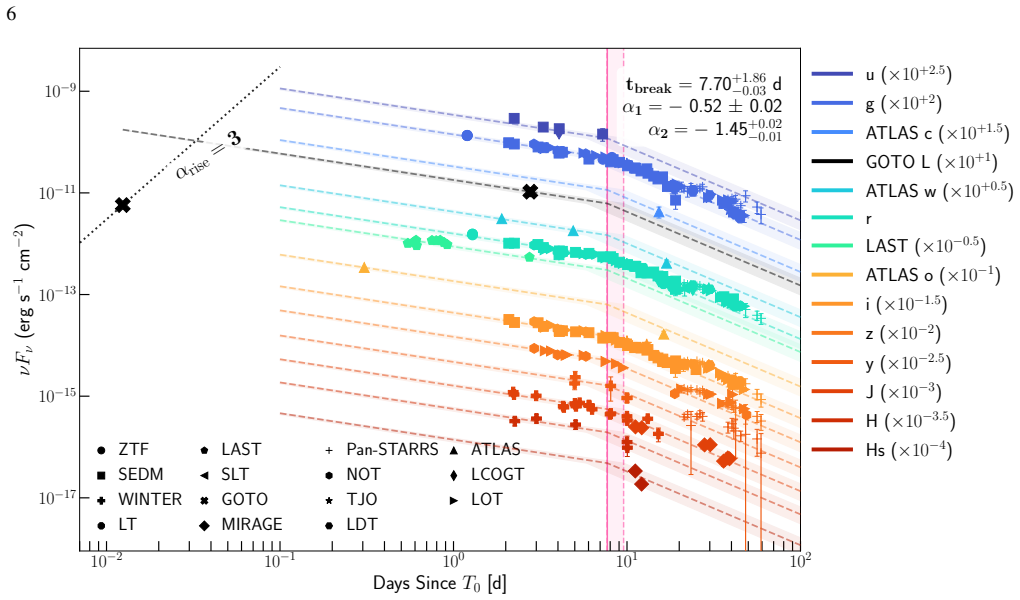
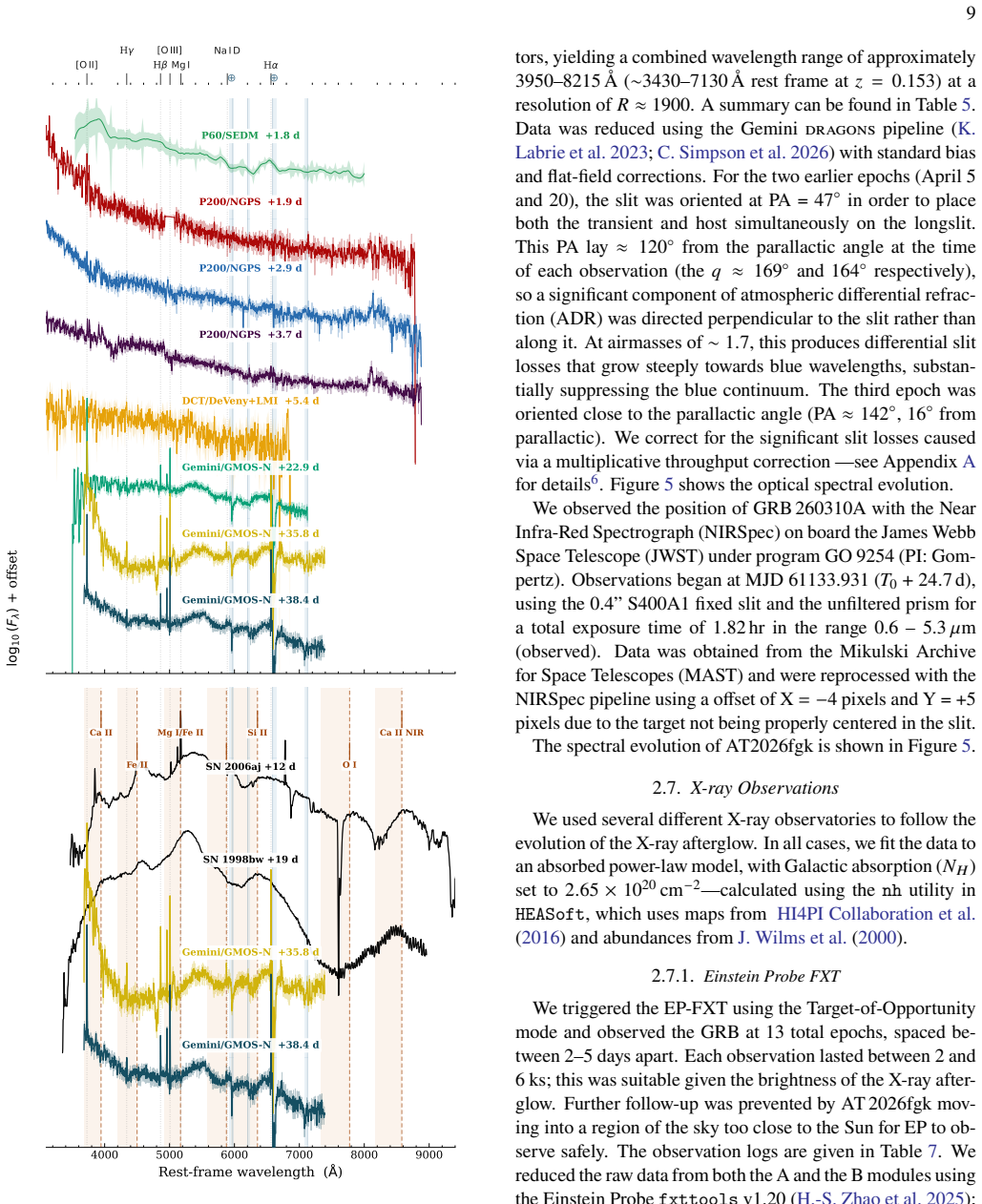
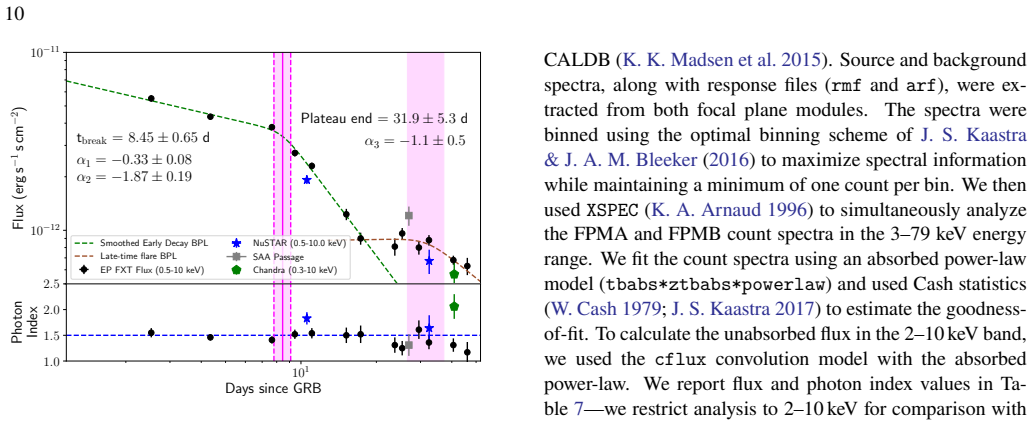
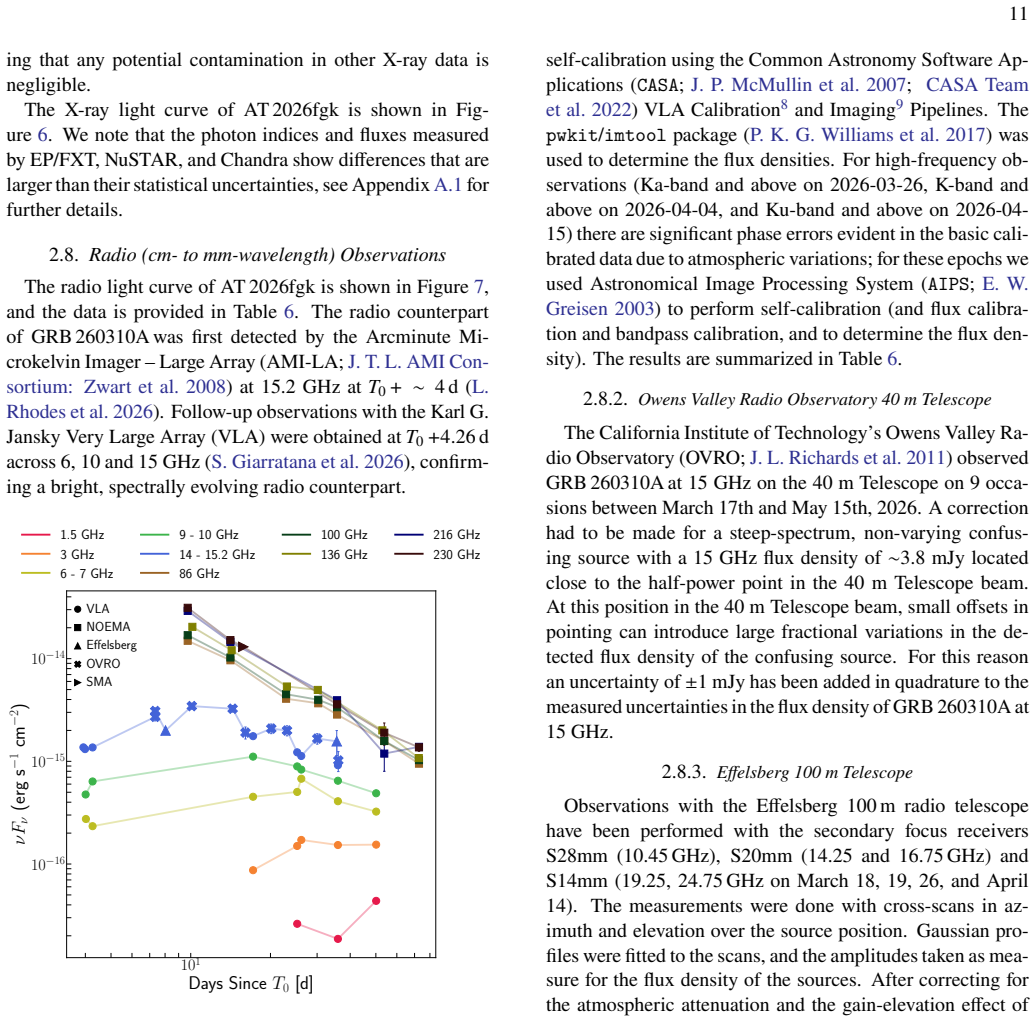
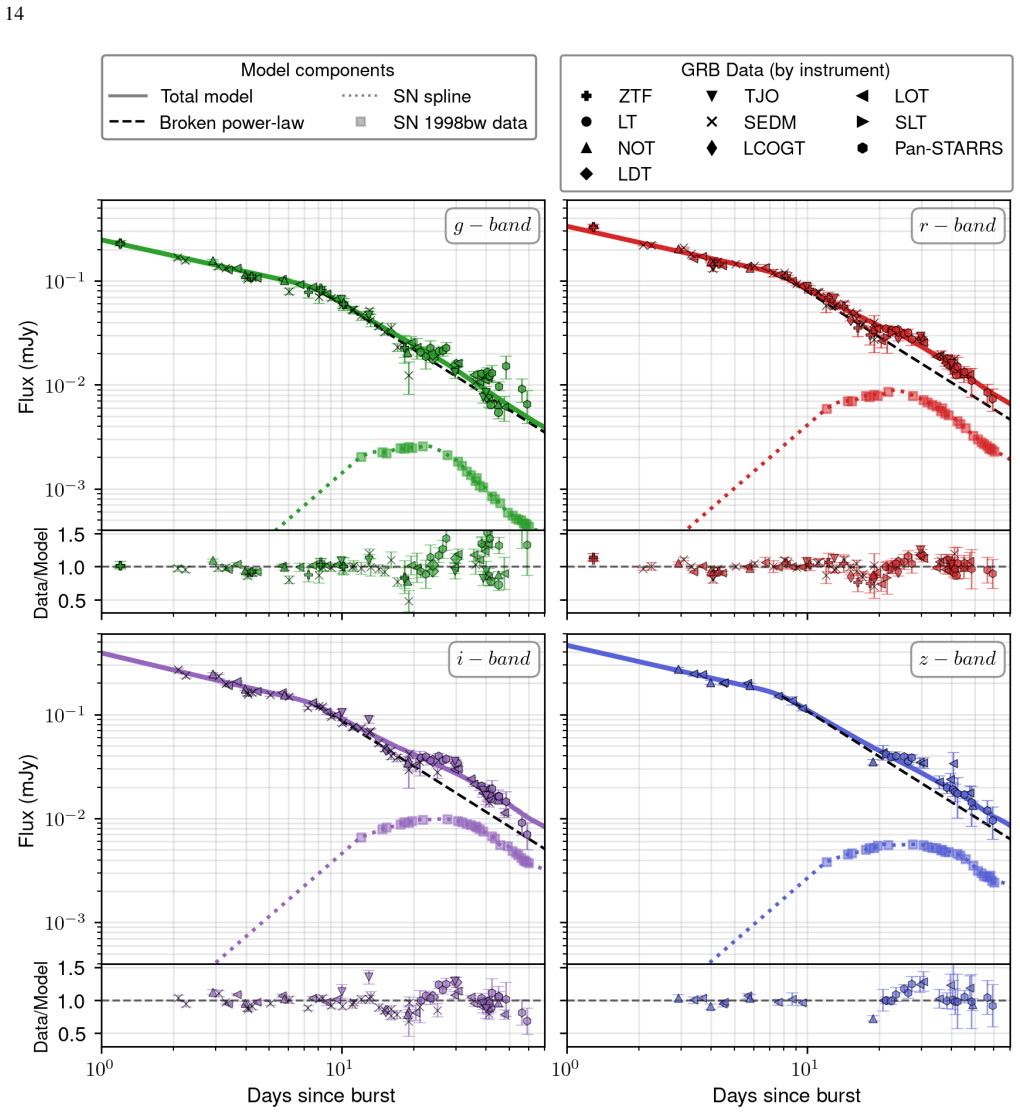
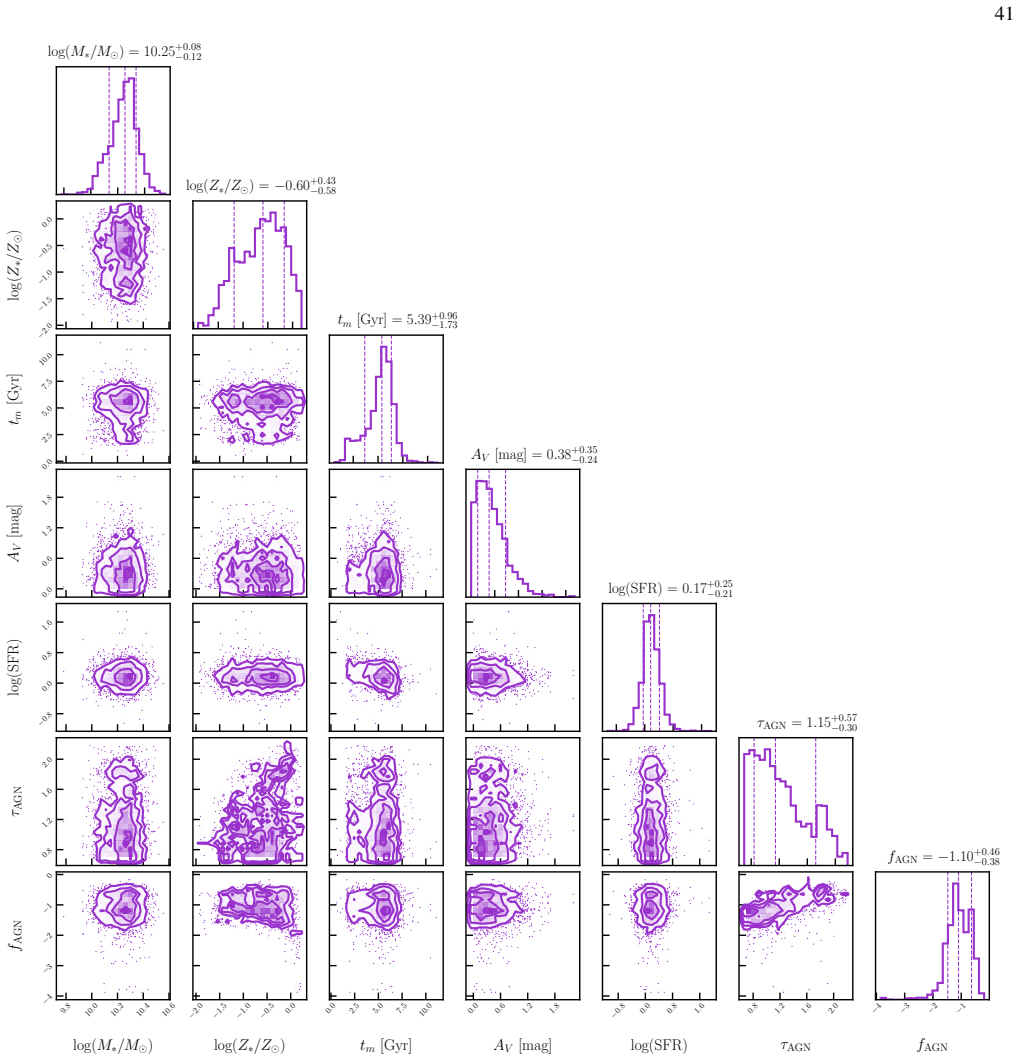
The origins of sub-luminous ($L_\mathrm{\gamma,\mathrm{iso}} < 10^{49.5}$\,erg\,s$^{-1}$) gamma-ray bursts (GRBs) associated with broad-lined Type~Ic supernovae (Ic-BL SNe) are poorly understood, in part due to the low discovery rate and faint afterglows. Here we present the identification of the optical afterglow of Fermi-GBM-detected GRB\,260310A (AT\,2026fgk) as a rapidly rising ($>1\,$mag\,d$^{-1}$), red ($g-r=0.4$\,mag) transient using the Gravitational-wave Optical Transient Observatory, Large Array Survey Telescope, and Zwicky Transient Facility (ZTF) data streams. We present multiwavelength follow-up observations from the first 50\,days, which reveal that GRB 260310A/AT\,2026fgk was sub-luminous ($L_\mathrm{\gamma,iso}=10^{48.8}\,$erg\,s$^{-1}$); it was the most nearby ($z=0.153$) afterglow identified blindly by an optical survey; and that it is one of the brightest afterglows ever observed at X-ray, optical, and radio (cm to mm) wavelengths. We spectroscopically confirm an underlying Ic-BL SN with properties typical of GRB-SNe ($M_\mathrm{ej}\approx3\,M_\odot$, $E_{\rm K}\approx 10^{52}\,$erg). With basic modeling of the afterglow, including the long optical rise ($\approx10^{3}\,$s), we infer either a low initial Lorentz factor ($\Gamma_0\approx40$) or a slightly off-axis viewing angle ($\lesssim3^\circ$). The host galaxy's mass and star formation rate are similar to the hosts of other sub-luminous GRBs. ZTF's flux-limited survey gives a volumetric rate of AT\,2026fgk-like events of $0.30^{+1.37}_{-0.29}\,$Gpc\,$^{-3}$\,yr$^{-1}$, which is consistent with the on-axis, high luminosity ($L_{\rm \gamma,iso}>10^{49.5}$\,erg\,s$^{-1}$) long-GRB rate. The similarity in the rates strongly constrains the prevalence of low-$\Gamma_0$ bursts and the beaming of the initial relativistic material in GRBs.
Editorial analysis
A structured set of objections, weighed in public.
Referee Report
Summary. The manuscript reports the blind optical discovery and multiwavelength follow-up (X-ray to radio) of AT 2026fgk, the afterglow of sub-luminous GRB 260310A at z=0.153. It presents photometry showing a rapid red rise, spectroscopic confirmation of an underlying Ic-BL SN with M_ej≈3 M_⊙ and E_K≈10^52 erg, basic afterglow modeling of the ≈10^3 s optical rise that infers Γ_0≈40 or viewing angle ≲3°, and a ZTF-derived volumetric rate of 0.30^{+1.37}_{-0.29} Gpc^{-3} yr^{-1} that is stated to be consistent with the on-axis high-luminosity long-GRB rate, thereby constraining the prevalence of low-Γ_0 bursts and initial beaming.
Significance. If the rate holds, the result supplies a direct empirical constraint on the fraction of low-Γ_0 or off-axis GRBs by showing that the sub-luminous population rate matches the high-luminosity on-axis rate. The multiwavelength dataset, SN spectroscopy, and independent optical identification of the nearest known afterglow add concrete value to the characterization of this rare class.
major comments (1)
- [rate calculation paragraph] Rate calculation paragraph: the headline claim that the measured rate is consistent with the on-axis high-luminosity long-GRB rate (and therefore constrains low-Γ_0 prevalence plus beaming) rests on the assumption that the ZTF flux-limited selection function and single-event extrapolation accurately represent the full population without large unrecognized biases in detection efficiency or host properties. No injection-recovery tests, color-cut validation, or cross-survey comparison are presented to support the efficiency for red, rapidly-rising events at z≈0.15; if efficiency is lower than modeled, the true rate could be substantially higher and the claimed similarity would not hold.
Simulated Author's Rebuttal
We thank the referee for their thoughtful comments on our manuscript. We address the major comment on the rate calculation below.
read point-by-point responses
-
Referee: [rate calculation paragraph] Rate calculation paragraph: the headline claim that the measured rate is consistent with the on-axis high-luminosity long-GRB rate (and therefore constrains low-Γ_0 prevalence plus beaming) rests on the assumption that the ZTF flux-limited selection function and single-event extrapolation accurately represent the full population without large unrecognized biases in detection efficiency or host properties. No injection-recovery tests, color-cut validation, or cross-survey comparison are presented to support the efficiency for red, rapidly-rising events at z≈0.15; if efficiency is lower than modeled, the true rate could be substantially higher and the claimed similarity would not hold.
Authors: We agree that the absence of explicit injection-recovery tests or color-cut validations for this specific class of transients represents a limitation in the current analysis. The volumetric rate is calculated based on the single detection within the ZTF survey volume, using the survey's standard efficiency for detecting optical transients of similar brightness. While we did not perform dedicated simulations for red, rapidly-rising events at z≈0.15, the event was independently detected by multiple facilities (GOTO, LAST, ZTF), which provides some empirical support for the detectability. Nevertheless, to address the referee's concern, in the revised version we will expand the rate section to include a more detailed discussion of possible selection biases, including the potential impact of color and rise-time on efficiency, and qualify the consistency claim accordingly. We will also note that the large Poisson uncertainties already reflect the limitations of a single-event rate. revision: partial
Circularity Check
No circularity: rate derived directly from survey volume and single detection without self-referential reduction
full rationale
The volumetric rate of 0.30^{+1.37}_{-0.29} Gpc^{-3} yr^{-1} is computed from the ZTF flux-limited survey detection of this one event and the corresponding comoving volume, with no parameters fitted to the same data then re-used as a 'prediction.' The similarity to the on-axis high-luminosity long-GRB rate is a comparison against an external literature value, and the resulting constraint on low-Gamma0 prevalence follows from that external comparison. No self-citation chain, self-definitional step, or ansatz smuggling appears in the provided derivation. The central claim therefore remains independent of its own inputs.
Axiom & Free-Parameter Ledger
free parameters (1)
- initial Lorentz factor Gamma0 =
40
axioms (2)
- domain assumption Standard synchrotron afterglow model in a constant-density medium applies to this event
- domain assumption ZTF detection efficiency and flux limit are correctly modeled for the survey volume calculation
Reference graph
Works this paper leans on
-
[1]
, year = 2011, month = nov, volume =
Cross Spectral Calibration of Suzaku, XMM-Newton, and Chandra with PKS 2155304 as an Activity of IACHEC. , year = 2011, month = nov, volume =. doi:10.1093/pasj/63.sp3.S657 , adsurl =
-
[2]
IACHEC Cross-calibration of Chandra, NuSTAR, Swift, Suzaku, XMM-Newton with 3C 273 and PKS 2155-304. , keywords =. doi:10.3847/1538-3881/153/1/2 , archivePrefix =. 1609.09032 , primaryClass =
work page internal anchor Pith review Pith/arXiv arXiv doi:10.3847/1538-3881/153/1/2
-
[3]
Cross-calibrating X-ray detectors with clusters of galaxies: an IACHEC study
Cross-calibrating X-ray detectors with clusters of galaxies: an IACHEC study. , keywords =. doi:10.1051/0004-6361/201015176 , archivePrefix =. 1008.2102 , primaryClass =
work page internal anchor Pith review Pith/arXiv arXiv doi:10.1051/0004-6361/201015176
-
[4]
GRB Coordinates Network , year = 2026, month = apr, volume =
GRB 260310A / AT2026fgk: NuSTAR detection of the rebrightening. GRB Coordinates Network , year = 2026, month = apr, volume =
2026
-
[5]
Cosmological Fast Optical Transients with the Zwicky Transient Facility: A Search for Dirty Fireballs. , keywords =. doi:10.3847/1538-4357/ac8bd0 , archivePrefix =. 2201.12366 , primaryClass =
-
[6]
The Nature of Optical Afterglows without Gamma-Ray Bursts: Identification of AT2023lcr and Multiwavelength Modeling. , keywords =. doi:10.3847/1538-4357/adc800 , archivePrefix =. 2411.07973 , primaryClass =
-
[7]
Constraining the Kilonova Rate with Zwicky Transient Facility Searches Independent of Gravitational Wave and Short Gamma-Ray Burst Triggers. , keywords =. doi:10.3847/1538-4357/abbf4c , archivePrefix =. 2008.00008 , primaryClass =
-
[8]
Fast-transient Searches in Real Time with ZTFReST: Identification of Three Optically Discovered Gamma-Ray Burst Afterglows and New Constraints on the Kilonova Rate. , keywords =. doi:10.3847/1538-4357/ac0bc7 , archivePrefix =. 2104.06352 , primaryClass =
-
[9]
The luminous, slow-rising orphan afterglow AT2019pim as a candidate moderately relativistic outflow. , keywords =. doi:10.1093/mnras/staf125 , archivePrefix =. 2401.16470 , primaryClass =
-
[10]
Discovery of a Cosmological, Relativistic Outburst via its Rapidly Fading Optical Emission
Discovery of a Cosmological, Relativistic Outburst via its Rapidly Fading Optical Emission. , keywords =. doi:10.1088/0004-637X/769/2/130 , archivePrefix =. 1304.4236 , primaryClass =
work page internal anchor Pith review Pith/arXiv arXiv doi:10.1088/0004-637x/769/2/130
-
[11]
iPTF14yb: The First Discovery of a GRB Afterglow Independent of a High-Energy Trigger
iPTF14yb: The First Discovery of a Gamma-Ray Burst Afterglow Independent of a High-energy Trigger. , keywords =. doi:10.1088/2041-8205/803/2/L24 , archivePrefix =. 1504.00673 , primaryClass =
work page internal anchor Pith review Pith/arXiv arXiv doi:10.1088/2041-8205/803/2/l24 2041
-
[12]
Observations of the GRB afterglow ATLAS17aeu and its possible association with GW170104
Observations of the GRB Afterglow ATLAS17aeu and Its Possible Association with GW 170104. , keywords =. doi:10.3847/1538-4357/aa95c1 , archivePrefix =. 1706.00175 , primaryClass =
work page internal anchor Pith review Pith/arXiv arXiv doi:10.3847/1538-4357/aa95c1
-
[13]
A Tale of Two Transients: GW 170104 and GRB 170105A. , keywords =. doi:10.3847/1538-4357/aa81d2 , archivePrefix =. 1706.00024 , primaryClass =
-
[14]
Unveiling the enigma of ATLAS17aeu. , keywords =. doi:10.1051/0004-6361/201833814 , archivePrefix =. 1807.03681 , primaryClass =
-
[15]
Gamma-ray bursts. Reports on Progress in Physics , keywords =. doi:10.1088/0034-4885/69/8/R01 , archivePrefix =. astro-ph/0605208 , primaryClass =
work page internal anchor Pith review Pith/arXiv arXiv doi:10.1088/0034-4885/69/8/r01
-
[16]
A New Forced Photometry Service for the Zwicky Transient Facility. arXiv e-prints , keywords =. doi:10.48550/arXiv.2305.16279 , archivePrefix =. 2305.16279 , primaryClass =
-
[17]
Transient Name Server AstroNote , keywords =
Release of the ATLAS Forced Photometry server for public use. Transient Name Server AstroNote , keywords =
-
[18]
ZTF20aajnksq (AT 2020blt): A Fast Optical Transient at z ≍ 2.9 with No Detected Gamma-Ray Burst Counterpart. , keywords =. doi:10.3847/1538-4357/abc34d , archivePrefix =. 2006.10761 , primaryClass =
-
[19]
Optical Photometry and Spectroscopy of the SN 1998bw-like Type Ic Supernova 2002ap
Optical Photometry and Spectroscopy of the SN 1998bw-like Type Ic Supernova 2002ap. , keywords =. doi:10.1086/378242 , archivePrefix =. astro-ph/0307136 , primaryClass =
work page internal anchor Pith review Pith/arXiv arXiv doi:10.1086/378242
-
[20]
GRB 060218/SN 2006aj: A Gamma-Ray Burst and Prompt Supernova at z=0.0335
GRB 060218/SN 2006aj: A Gamma-Ray Burst and Prompt Supernova at z = 0.0335. , keywords =. doi:10.1086/505177 , archivePrefix =. astro-ph/0603686 , primaryClass =
work page internal anchor Pith review Pith/arXiv arXiv doi:10.1086/505177
-
[21]
Photometry and Spectroscopy of GRB 030329 and Its Associated Supernova 2003dh: The First Two Months
Photometry and Spectroscopy of GRB 030329 and Its Associated Supernova 2003dh: The First Two Months. , keywords =. doi:10.1086/379228 , archivePrefix =. astro-ph/0307435 , primaryClass =
work page internal anchor Pith review Pith/arXiv arXiv doi:10.1086/379228
-
[22]
X-Ray Emission from Supernovae in Dense Circumstellar Matter Environments: A Search for Collisionless Shocks. , keywords =. doi:10.1088/0004-637X/763/1/42 , archivePrefix =. 1206.0748 , primaryClass =
work page internal anchor Pith review Pith/arXiv arXiv doi:10.1088/0004-637x/763/1/42
-
[23]
Variabilities of Gamma-Ray Burst Afterglows: Long-acting Engine, Anisotropic Jet, or Many Fluctuating Regions?. , keywords =. doi:10.1086/432567 , archivePrefix =. astro-ph/0409376 , primaryClass =
work page internal anchor Pith review Pith/arXiv arXiv doi:10.1086/432567
-
[24]
, year = 2011, month = nov, volume =
Swift 1644+57: the longest gamma-ray burst?. , keywords =. doi:10.1111/j.1745-3933.2011.01151.x , archivePrefix =. 1105.3209 , primaryClass =
-
[25]
The Variable Light Curve of GRB 030329: The Case for Refreshed Shocks
Astrophysics: refreshed shocks from a -ray burst. , keywords =. doi:10.1038/426138a , archivePrefix =. astro-ph/0304563 , primaryClass =
work page internal anchor Pith review Pith/arXiv arXiv doi:10.1038/426138a
-
[26]
Late evolution of the X-ray afterglow of GRB 030329
Late evolution of the X-ray afterglow of GRB 030329. , keywords =. doi:10.1051/0004-6361:20041027 , archivePrefix =. astro-ph/0402644 , primaryClass =
work page internal anchor Pith review Pith/arXiv arXiv doi:10.1051/0004-6361:20041027
-
[27]
XRF 100316D / SN 2010bh and the Nature of Gamma Ray Burst Supernovae
XRF 100316D/SN 2010bh and the Nature of Gamma-Ray Burst Supernovae. , keywords =. doi:10.1088/0004-637X/740/1/41 , archivePrefix =. 1104.5141 , primaryClass =
work page internal anchor Pith review Pith/arXiv arXiv doi:10.1088/0004-637x/740/1/41
-
[28]
A new population of ultra-long duration gamma-ray bursts
A New Population of Ultra-long Duration Gamma-Ray Bursts. , keywords =. doi:10.1088/0004-637X/781/1/13 , archivePrefix =. 1302.2352 , primaryClass =
work page internal anchor Pith review Pith/arXiv arXiv doi:10.1088/0004-637x/781/1/13
-
[29]
10.4 m GTC observations of the nearby VHE-detected GRB 190829A/SN 2019oyw. , keywords =. doi:10.1051/0004-6361/202039349 , archivePrefix =. 2009.04021 , primaryClass =
-
[30]
A Hubble Space Telescope Search for r-Process Nucleosynthesis in Gamma-Ray Burst Supernovae. , keywords =. doi:10.3847/1538-4357/ad409c , archivePrefix =. 2312.04630 , primaryClass =
-
[31]
The Fast Evolution of SN 2010bh associated with XRF 100316D
The fast evolution of SN 2010bh associated with XRF 100316D. , keywords =. doi:10.1051/0004-6361/201117929 , archivePrefix =. 1110.4109 , primaryClass =
work page internal anchor Pith review Pith/arXiv arXiv doi:10.1051/0004-6361/201117929
-
[32]
Early-Time Photometry and Spectroscopy of the Fast Evolving SN 2006AJ Associated with GRB 060218
Early-Time Photometry and Spectroscopy of the Fast Evolving SN 2006aj Associated with GRB 060218. , keywords =. doi:10.1086/505906 , archivePrefix =. astro-ph/0603377 , primaryClass =
work page internal anchor Pith review Pith/arXiv arXiv doi:10.1086/505906
-
[33]
The First Systematic Study of Type Ibc Supernova Multi-band Light Curves
The First Systematic Study of Type Ibc Supernova Multi-band Light Curves. , keywords =. doi:10.1088/0004-637X/741/2/97 , archivePrefix =. 1011.4959 , primaryClass =
work page internal anchor Pith review Pith/arXiv arXiv doi:10.1088/0004-637x/741/2/97
-
[34]
Optimal binning of X-ray spectra and response matrix design
Optimal binning of X-ray spectra and response matrix design. , keywords =. doi:10.1051/0004-6361/201527395 , archivePrefix =. 1601.05309 , primaryClass =
work page internal anchor Pith review Pith/arXiv arXiv doi:10.1051/0004-6361/201527395
-
[35]
The Large Array Survey Telescope-System Overview and Performances. , keywords =. doi:10.1088/1538-3873/acd8f0 , archivePrefix =. 2304.04796 , primaryClass =
-
[36]
The Large Array Survey Telescope-Pipeline. I. Basic Image Reduction and Visit Coaddition. , keywords =. doi:10.1088/1538-3873/ad0977 , archivePrefix =. 2310.13063 , primaryClass =
-
[37]
TRANSLIENT: Detecting Transients Resulting from Point-source Motion or Astrometric Errors. , keywords =. doi:10.3847/1538-3881/ad408d , archivePrefix =. 2403.09771 , primaryClass =
-
[38]
The Large Array Survey Telescope-Pipeline. II. Image Subtraction and Transient Detection. arXiv e-prints , keywords =. doi:10.48550/arXiv.2604.27921 , archivePrefix =. 2604.27921 , primaryClass =
work page internal anchor Pith review Pith/arXiv arXiv doi:10.48550/arxiv.2604.27921
-
[39]
Handbook of X-ray and Gamma-ray Astrophysics , year = 2022, editor =
The Einstein Probe Mission. Handbook of X-ray and Gamma-ray Astrophysics , year = 2022, editor =. doi:10.1007/978-981-16-4544-0_151-1 , adsurl =
-
[40]
Science China Physics, Mechanics, and Astronomy , keywords =
Science objectives of the Einstein Probe mission. Science China Physics, Mechanics, and Astronomy , keywords =. doi:10.1007/s11433-024-2600-3 , archivePrefix =. 2501.07362 , primaryClass =
-
[41]
Palomar Gattini-IR: Survey Overview, Data Processing System, On-sky Performance and First Results. , keywords =. doi:10.1088/1538-3873/ab6069 , archivePrefix =. 1910.13319 , primaryClass =
-
[42]
Calibration of the NuSTAR High Energy Focusing X-ray Telescope
Calibration of the NuSTAR High-energy Focusing X-ray Telescope. , keywords =. doi:10.1088/0067-0049/220/1/8 , archivePrefix =. 1504.01672 , primaryClass =
work page internal anchor Pith review Pith/arXiv arXiv doi:10.1088/0067-0049/220/1/8
-
[43]
Observatory Operations: Strategies, Processes, and Systems , year = 2006, editor =
CIAO: Chandra's data analysis system. Observatory Operations: Strategies, Processes, and Systems , year = 2006, editor =. doi:10.1117/12.671760 , adsurl =
-
[44]
GRB Coordinates Network , year = 2026, month = apr, volume =
GRB 260310A: Late-time Chandra X-ray Detection. GRB Coordinates Network , year = 2026, month = apr, volume =
2026
-
[45]
The long-active afterglow of GRB 210204A: detection of the most delayed flares in a gamma-ray burst. , keywords =. doi:10.1093/mnras/stac1061 , archivePrefix =. 2204.07587 , primaryClass =
-
[46]
The Nuclear Spectroscopic Telescope Array (NuSTAR) Mission
The Nuclear Spectroscopic Telescope Array (NuSTAR) High-energy X-Ray Mission. , keywords =. doi:10.1088/0004-637X/770/2/103 , archivePrefix =. 1301.7307 , primaryClass =
work page internal anchor Pith review Pith/arXiv arXiv doi:10.1088/0004-637x/770/2/103
-
[47]
ATLAS: A High-Cadence All-Sky Survey System
ATLAS: A High-cadence All-sky Survey System. , keywords =. doi:10.1088/1538-3873/aabadf , archivePrefix =. 1802.00879 , primaryClass =
work page internal anchor Pith review Pith/arXiv arXiv doi:10.1088/1538-3873/aabadf
-
[48]
Radiation Detection Technology and Methods , keywords =
Data reduction and processing for the Follow-up X-ray Telescope onboard Einstein Probe. Radiation Detection Technology and Methods , keywords =. doi:10.1007/s41605-025-00526-8 , adsurl =
-
[49]
Astronomical Data Analysis Software and Systems V , year = 1996, editor =
XSPEC: The First Ten Years. Astronomical Data Analysis Software and Systems V , year = 1996, editor =
1996
-
[50]
1979, ApJ, 228, 939, doi: 10.1086/156922
Parameter estimation in astronomy through application of the likelihood ratio. , keywords =. doi:10.1086/156922 , adsurl =
-
[51]
On the use of C-stat in testing models for X-ray spectra
On the use of C-stat in testing models for X-ray spectra. , keywords =. doi:10.1051/0004-6361/201629319 , archivePrefix =. 1707.09202 , primaryClass =
work page internal anchor Pith review Pith/arXiv arXiv doi:10.1051/0004-6361/201629319
-
[52]
Design and Operation of the ATLAS Transient Science Server. , keywords =. doi:10.1088/1538-3873/ab936e , archivePrefix =. 2003.09052 , primaryClass =
-
[53]
Transient Name Server Discovery Report , keywords =
GOTO Transient Discovery Report for 2026-03-10. Transient Name Server Discovery Report , keywords =
2026
-
[54]
The Fermi Gamma-Ray Burst Monitor
The Fermi Gamma-ray Burst Monitor. , keywords =. doi:10.1088/0004-637X/702/1/791 , archivePrefix =. 0908.0450 , primaryClass =
work page internal anchor Pith review Pith/arXiv arXiv doi:10.1088/0004-637x/702/1/791
-
[55]
GRB Coordinates Network , year = 2026, month = mar, volume =
GRB 260310A: Fermi GBM Final Real-time Localization. GRB Coordinates Network , year = 2026, month = mar, volume =
2026
-
[56]
GRB Coordinates Network , year = 2026, month = mar, volume =
GRB 260310A / AT 2026fgk: COLIBR \'I photometric evidence of the emerging supernova. GRB Coordinates Network , year = 2026, month = mar, volume =
2026
-
[57]
GRB Coordinates Network , year = 2026, month = mar, volume =
GRB 260310A: OSIRIS+/GTC spectroscopic detection of the associated BL-Ic, SN 2026fgk. GRB Coordinates Network , year = 2026, month = mar, volume =
2026
-
[58]
GRB Coordinates Network , year = 2026, month = mar, volume =
Fermi GRB 260310A: Global MASTER-Net observations report. GRB Coordinates Network , year = 2026, month = mar, volume =
2026
-
[59]
GRB Coordinates Network , year = 2026, month = mar, volume =
GRB 260310A: AstroSat CZTI detection of a long burst. GRB Coordinates Network , year = 2026, month = mar, volume =
2026
-
[60]
GRB Coordinates Network , year = 2026, month = mar, volume =
GRB 260310A: potential optical counterpart. GRB Coordinates Network , year = 2026, month = mar, volume =
2026
-
[61]
GRB Coordinates Network , year = 2026, month = mar, volume =
GRB 260310A: Fermi GBM Observation. GRB Coordinates Network , year = 2026, month = mar, volume =
2026
-
[62]
GRB Coordinates Network , year = 2026, month = mar, volume =
GRB260310A / AT2026fgk: P200 Spectroscopy. GRB Coordinates Network , year = 2026, month = mar, volume =
2026
-
[63]
GRB Coordinates Network , year = 2026, month = mar, volume =
GRB 260310A / AT2026fgk: MASTER OT rebrightening during 7h observations. GRB Coordinates Network , year = 2026, month = mar, volume =
2026
-
[64]
GRB Coordinates Network , year = 2026, month = mar, volume =
GRB 260310A / AT2026fgk: CAHA 1.23m telescope optical observations. GRB Coordinates Network , year = 2026, month = mar, volume =
2026
-
[65]
GRB Coordinates Network , year = 2026, month = mar, volume =
GRB 260310A / AT 2026fgk: COLIBRÍ optical observations. GRB Coordinates Network , year = 2026, month = mar, volume =
2026
-
[66]
GRB Coordinates Network , year = 2026, month = mar, volume =
GRB 260310A / AT 2026fgk: Location in the Epeak - Eiso diagram. GRB Coordinates Network , year = 2026, month = mar, volume =
2026
-
[67]
GRB Coordinates Network , year = 2026, month = mar, volume =
GRB 260310A / AT2026fgk: OSIRIS+/GTC spectroscopy confirms redshift z = 0.153. GRB Coordinates Network , year = 2026, month = mar, volume =
2026
-
[68]
GRB Coordinates Network , year = 2026, month = mar, volume =
GRB 260310A/AT 2026fgk: Bok spectroscopic observation. GRB Coordinates Network , year = 2026, month = mar, volume =
2026
-
[69]
GRB Coordinates Network , year = 2026, month = mar, volume =
GRB 260310A: NOT optical polarimetry. GRB Coordinates Network , year = 2026, month = mar, volume =
2026
-
[70]
GRB Coordinates Network , year = 2026, month = mar, volume =
GRB 260310A/AT 2026fgk: DDOTI Optical Detection. GRB Coordinates Network , year = 2026, month = mar, volume =
2026
-
[71]
GRB Coordinates Network , year = 2026, month = mar, volume =
GRB 260310A/AT 2026fgk: J-band observations by the SYSU 80 cm infrared telescope. GRB Coordinates Network , year = 2026, month = mar, volume =
2026
-
[72]
GRB Coordinates Network , year = 2026, month = mar, volume =
GRB 260310A: Einstein Probe Follow-up X-ray Telescope (FXT) Detection. GRB Coordinates Network , year = 2026, month = mar, volume =
2026
-
[73]
GRB Coordinates Network , year = 2026, month = mar, volume =
GRB 260310A/AT 2026fgk: WINTER NIR Detections. GRB Coordinates Network , year = 2026, month = mar, volume =
2026
-
[74]
GRB Coordinates Network , year = 2026, month = mar, volume =
GRB 260310A / AT2026fgk: further CAHA 1.23m telescope optical observations suggest shallow decay. GRB Coordinates Network , year = 2026, month = mar, volume =
2026
-
[75]
GRB Coordinates Network , year = 2026, month = mar, volume =
GRB 260310A / AT 2026fgk: COLIBRÍ continuing optical observations. GRB Coordinates Network , year = 2026, month = mar, volume =
2026
-
[76]
GRB Coordinates Network , year = 2026, month = mar, volume =
GRB 260310A / AT2026fgk: Multiband optical follow-up with Kinder observations. GRB Coordinates Network , year = 2026, month = mar, volume =
2026
-
[77]
GRB Coordinates Network , year = 2026, month = mar, volume =
GRB 260310A / AT2026fgk: OASDG optical observations. GRB Coordinates Network , year = 2026, month = mar, volume =
2026
-
[78]
GRB Coordinates Network , year = 2026, month = mar, volume =
GRB 260310A / AT2026fgk: TNG NIR detection. GRB Coordinates Network , year = 2026, month = mar, volume =
2026
-
[79]
GRB Coordinates Network , year = 2026, month = mar, volume =
GRB 260310A/AT2026fgk: radio detection at 15GHz. GRB Coordinates Network , year = 2026, month = mar, volume =
2026
-
[80]
GRB Coordinates Network , year = 2026, month = mar, volume =
GRB 260310A / AT2026fgk: SAO RAS optical observations. GRB Coordinates Network , year = 2026, month = mar, volume =
2026
discussion (0)
Sign in with ORCID, Apple, or X to comment. Anyone can read and Pith papers without signing in.