Hairpin Vortices Extraction in Turbulent Boundary Layer Flows
Pith reviewed 2026-06-28 07:11 UTC · model grok-4.3
The pith
A bottom-up rejoining method extracts complete hairpin vortices from turbulent boundary layers without manual tuning.
A machine-rendered reading of the paper's core claim, the machinery that carries it, and where it could break.
Core claim
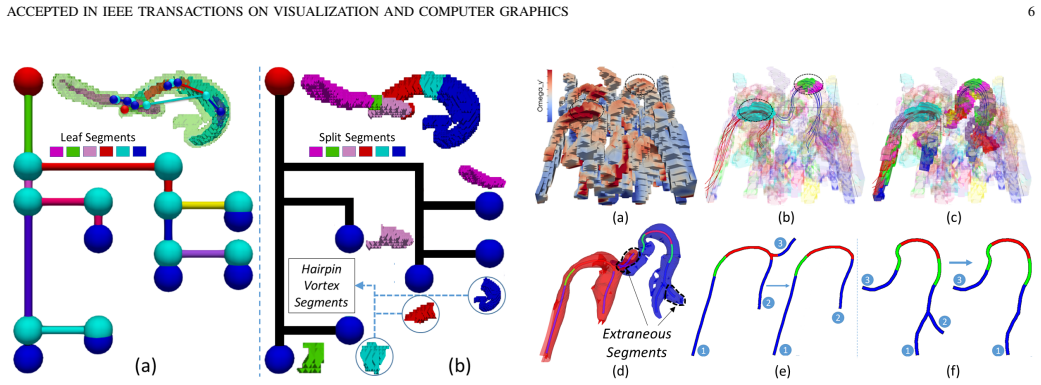
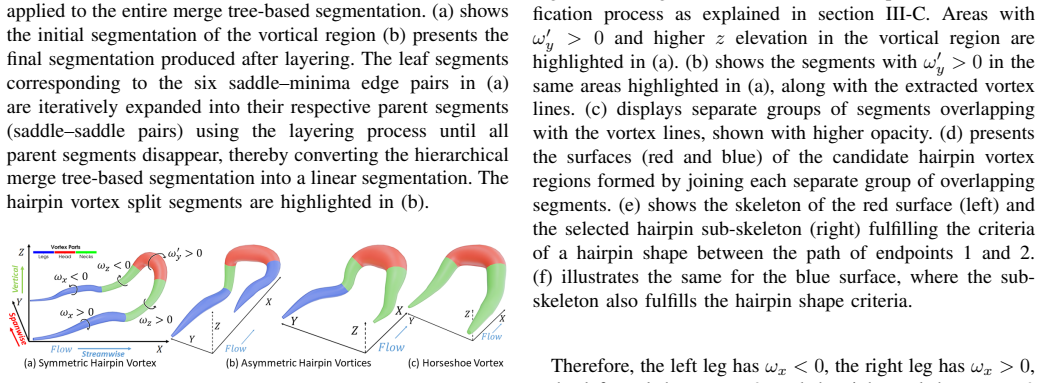
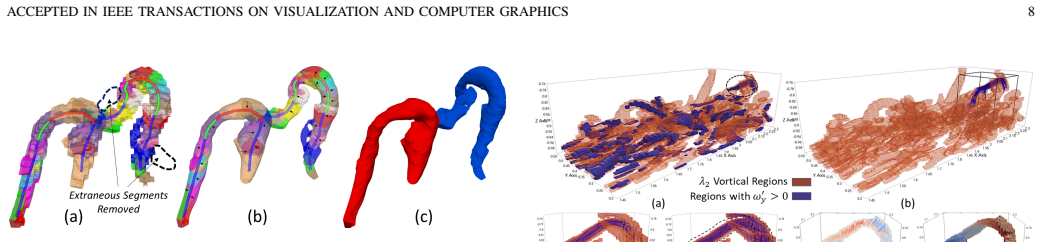
The central claim is that a merge tree segmentation followed by a novel bottom-up rejoining of candidate segments according to geometric and physical characteristics of hairpin vortices, refined by skeleton analysis and scalar criteria, produces regions containing complete hairpin vortex structures and enables accurate extraction without manual parameter tuning.
What carries the argument
The bottom-up rejoining approach that groups segments based on the geometric and physical characteristics of hairpin vortices after initial merge tree segmentation.
If this is right
- Eliminates manual parameter tuning in vortex extraction.
- Reduces under-segmentation and over-segmentation errors.
- Improves accuracy and computational efficiency compared to existing approaches.
- Supports robust extraction across varying boundary layer conditions.
- Enables generation of smooth enclosing surfaces for visualization.
Where Pith is reading between the lines
- The method could support more quantitative studies of how hairpin vortices drive mixing and transport in turbulence.
- Similar rejoining logic might apply to extracting other complex, entangled flow structures.
- The use of ground truth references could help establish benchmarks for comparing vortex extraction algorithms.
Load-bearing premise
The geometric and physical characteristics of hairpin vortices are distinctive enough to permit reliable bottom-up rejoining of segments into complete structures without significant grouping errors.
What would settle it
Applying the rejoining step to a turbulent boundary layer dataset with independently verified hairpin vortices and finding systematic incorrect groupings or missed structures would falsify the claim of reliable extraction.
Figures


read the original abstract
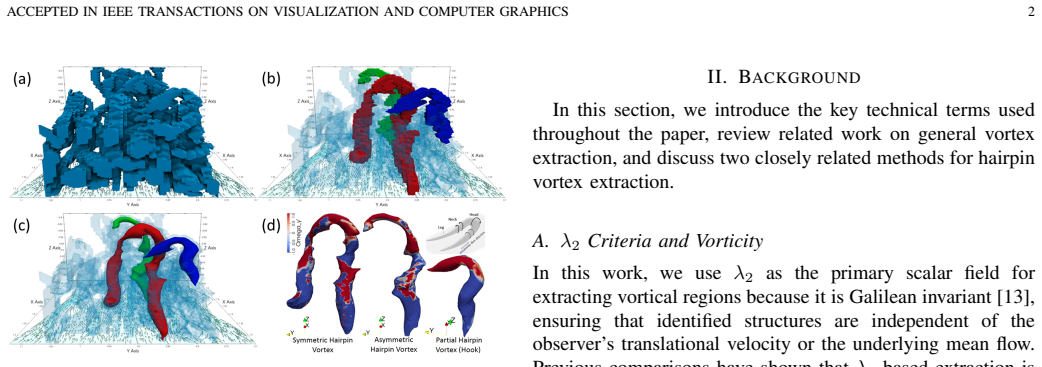
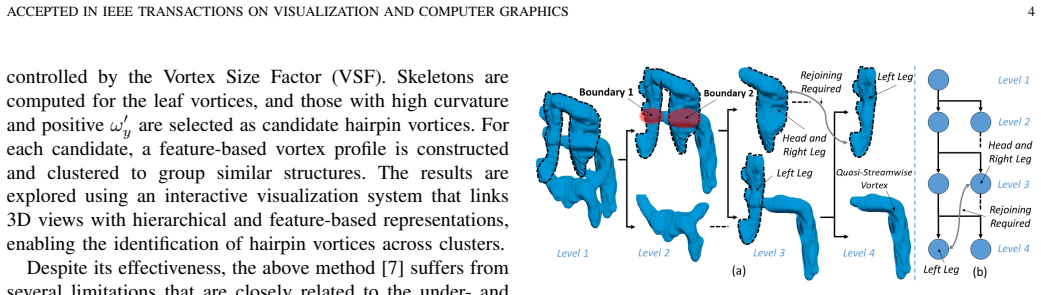
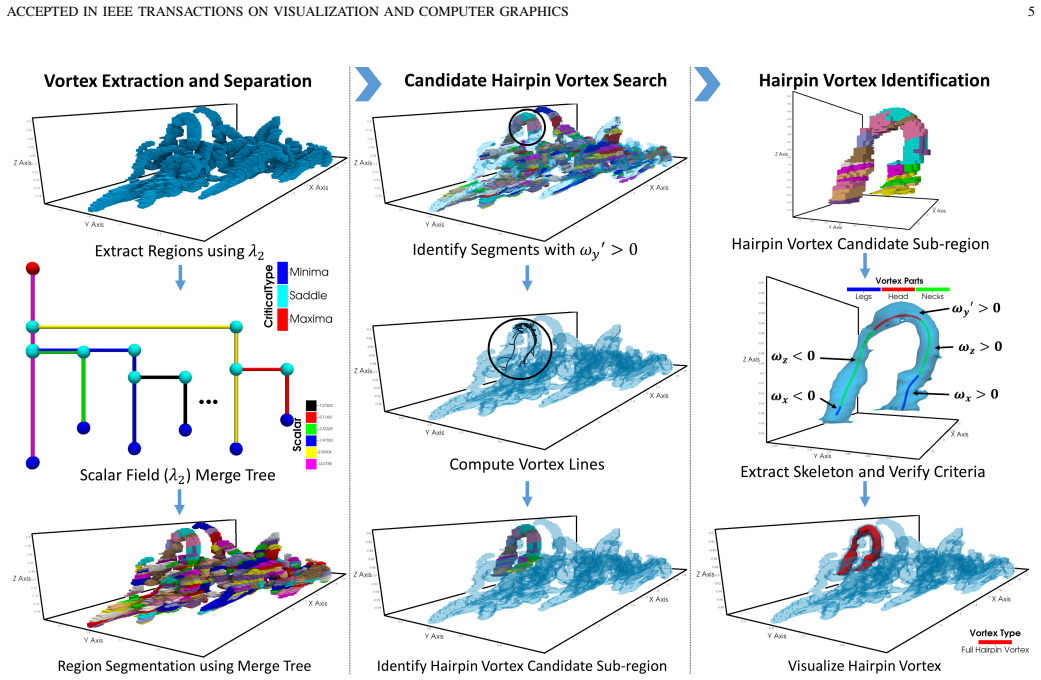
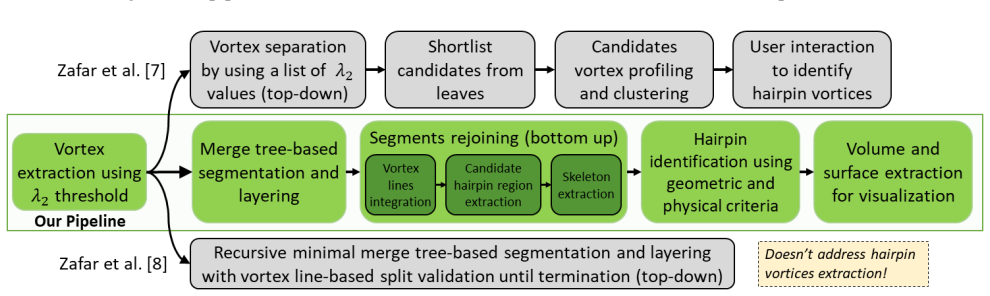
Hairpin vortices are fundamental structures within turbulent boundary layers, playing a crucial role in energy dissipation, mixing, and momentum transport. However, accurately extracting these structures remains challenging due to their irregular shapes, varying scales, and entanglement with surrounding vortical structures. This paper presents a novel framework for the extraction of hairpin vortices from turbulent boundary layers. The method begins by identifying vortical regions and decomposing them into smaller segments using merge tree based segmentation. A novel bottom up rejoining approach is then introduced to group candidate segments according to the geometric and physical characteristics of hairpin vortices, resulting in regions that encompass complete hairpin vortex structures. These regions are subsequently refined and validated through skeleton analysis to detect the characteristic hairpin shape and are further confirmed using additional scalar based criteria. Finally, smooth enclosing surfaces are generated for effective visualization. To enable quantitative evaluation, reference hairpin vortices are extracted from several flow datasets and used as ground truth. Compared with existing approaches, the proposed method eliminates manual parameter tuning, reduces under and over segmentation, and significantly improves both accuracy and computational efficiency. Demonstrations on multiple turbulent flow cases show that the method is robust and effective for hairpin vortex extraction under varying boundary layer conditions.
Editorial analysis
A structured set of objections, weighed in public.
Referee Report
Summary. The paper presents a framework for extracting hairpin vortices in turbulent boundary layer flows. It identifies vortical regions, applies merge-tree segmentation to decompose them into segments, uses a bottom-up rejoining procedure based on geometric and physical characteristics to assemble complete structures, refines via skeleton analysis to detect hairpin shapes and additional scalar criteria, and generates smooth enclosing surfaces. The method is claimed to eliminate manual parameter tuning, reduce under- and over-segmentation, and significantly improve accuracy and computational efficiency relative to prior approaches, with quantitative evaluation performed against reference hairpin vortices extracted as ground truth from multiple flow datasets.
Significance. If the evaluation were strengthened with independent ground truth and explicit metrics, the approach could meaningfully advance automated coherent-structure identification in turbulence research by addressing segmentation challenges without extensive tuning, enabling more reproducible analysis of energy dissipation and momentum transport in boundary layers.
major comments (4)
- [Abstract] Abstract: the central claim that the method 'eliminates manual parameter tuning' is load-bearing for the contribution yet is not supported, as the segmentation and rejoining steps are described as using thresholds whose values and independence from manual adjustment are unspecified.
- [Abstract] Abstract: the assertions of 'significantly improves both accuracy and computational efficiency' and 'reduces under and over segmentation' lack any quantitative support (e.g., precision/recall, timing benchmarks, or error rates against baselines), making the comparative advantage impossible to assess.
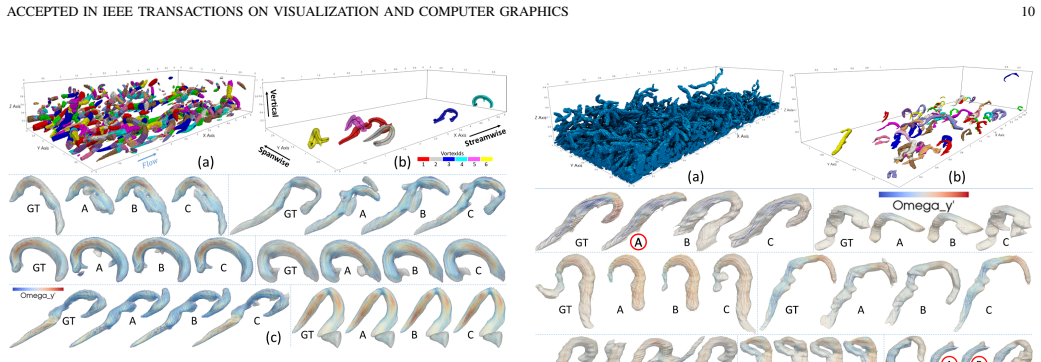
- [Abstract] Abstract: the procedure used to extract the 'reference hairpin vortices' employed as ground truth is not described; without an independent extraction method, the quantitative evaluation risks circularity when the same geometric criteria may be used for both the proposed method and the references.
- [Abstract] Abstract: the bottom-up rejoining step relies on 'geometric and physical characteristics of hairpin vortices' to group segments, but no explicit criteria, uniqueness arguments, or independence from ground-truth extraction are provided, leaving the weakest assumption (distinctiveness sufficient for error-free grouping) untested.
Simulated Author's Rebuttal
We thank the referee for the detailed and constructive comments on the abstract. We address each major comment below and will revise the manuscript to strengthen the presentation of claims, support, and methodological details.
read point-by-point responses
-
Referee: [Abstract] Abstract: the central claim that the method 'eliminates manual parameter tuning' is load-bearing for the contribution yet is not supported, as the segmentation and rejoining steps are described as using thresholds whose values and independence from manual adjustment are unspecified.
Authors: We agree the abstract overstates the claim. The manuscript applies fixed thresholds derived from standard physical properties of hairpin vortices reported in the turbulence literature, without per-dataset adjustment. We will revise the abstract to state that the method reduces reliance on manual tuning through the use of these fixed, physically motivated criteria rather than claiming complete elimination. revision: yes
-
Referee: [Abstract] Abstract: the assertions of 'significantly improves both accuracy and computational efficiency' and 'reduces under and over segmentation' lack any quantitative support (e.g., precision/recall, timing benchmarks, or error rates against baselines), making the comparative advantage impossible to assess.
Authors: Quantitative evaluations, including accuracy metrics and timing comparisons against prior methods, appear in the results section of the manuscript. We will revise the abstract to incorporate key quantitative results (e.g., precision/recall improvements and runtime reductions) to substantiate the claims. revision: yes
-
Referee: [Abstract] Abstract: the procedure used to extract the 'reference hairpin vortices' employed as ground truth is not described; without an independent extraction method, the quantitative evaluation risks circularity when the same geometric criteria may be used for both the proposed method and the references.
Authors: We will add an explicit description of the ground-truth extraction procedure to the manuscript. This procedure combines expert manual identification with established vortex criteria from the literature that are independent of the proposed merge-tree and skeleton-based approach, thereby addressing the circularity concern. revision: yes
-
Referee: [Abstract] Abstract: the bottom-up rejoining step relies on 'geometric and physical characteristics of hairpin vortices' to group segments, but no explicit criteria, uniqueness arguments, or independence from ground-truth extraction are provided, leaving the weakest assumption (distinctiveness sufficient for error-free grouping) untested.
Authors: We will revise the manuscript to state the explicit rejoining criteria (curvature thresholds, orientation alignment, proximity, and vorticity consistency) and note their basis in prior hairpin vortex studies. The evaluation against independent ground truth provides empirical validation of the grouping; we will also add discussion of limitations regarding perfect error-free grouping in entangled flows. revision: yes
Circularity Check
No circularity: algorithmic pipeline with independent geometric criteria
full rationale
The paper describes a procedural extraction method consisting of merge-tree segmentation, bottom-up rejoining using geometric and physical characteristics of hairpin vortices, skeleton analysis for shape detection, and scalar-based confirmation. No equations, fitted parameters, or predictions are present that reduce to inputs by construction. No self-citations or uniqueness theorems are invoked as load-bearing. The ground-truth reference extraction is stated without evidence that it employs the proposed method itself, so no self-definitional loop is exhibited. The derivation chain is a sequence of independent algorithmic steps rather than a mathematical reduction.
Axiom & Free-Parameter Ledger
free parameters (1)
- segmentation and rejoining thresholds
axioms (1)
- domain assumption Vortical regions can be decomposed using merge trees and rejoined based on hairpin vortex characteristics.
Reference graph
Works this paper leans on
-
[1]
V ortex organization in the outer region of the turbulent boundary layer,
R. J. ADRIAN, C. D. MEINHART, and C. D. TOMKINS, “V ortex organization in the outer region of the turbulent boundary layer,”Journal of Fluid Mechanics, vol. 422, p. 1–54, 2000
2000
-
[2]
Hairpin vortex organization in wall turbulence,
R. J. Adrian, “Hairpin vortex organization in wall turbulence,”Physics of Fluids, vol. 19, no. 4, p. 041301, 04 2007. [Online]. Available: https://doi.org/10.1063/1.2717527
-
[3]
Experimental observation of hairpin auto-generation events in a turbulent boundary layer,
N. Hutchins, W. T. Hambleton, I. Marusic, J. P. Monty, and J. C. Klewicki, “Experimental observation of hairpin auto-generation events in a turbulent boundary layer,”Journal of Fluid Mechanics, vol. 747, pp. 1–17, 2014
2014
-
[4]
Mechanisms for generating coherent packets of hairpin vortices in channel flow,
J. Zhou, R. J. Adrian, S. Balachandar, and T. Kendall, “Mechanisms for generating coherent packets of hairpin vortices in channel flow,”Journal of Fluid Mechanics, vol. 387, 1999
1999
-
[5]
On the identification of a vortex,
J. Jeong and F. Hussain, “On the identification of a vortex,”Journal of Fluid Mechanics, vol. 285, p. 69–94, 1995
1995
-
[6]
V orticity and vortex dynamics in complex turbulent flows,
J. Hunt, “V orticity and vortex dynamics in complex turbulent flows,”Transactions of the Canadian Society for Mechanical Engineering, vol. 11, no. 1, pp. 21–35, 1987. [Online]. Available: https://doi.org/10.1139/tcsme-1987-0004
-
[7]
Extract and characterize hairpin vortices in turbulent flows,
A. Zafar, D. Yang, and G. Chen, “Extract and characterize hairpin vortices in turbulent flows,”IEEE Transactions on Visualization and Computer Graphics, vol. 30, no. 1, pp. 716–726, 2024
2024
-
[8]
Topological separa- tion of vortices,
A. Zafar, Z. Poorshayegh, D. Yang, and G. Chen, “Topological separa- tion of vortices,” in2024 IEEE Visualization and Visual Analytics (VIS), 2024, pp. 311–315
2024
-
[9]
Computing contour trees in all dimensions,
H. Carr, J. Snoeyink, and U. Axen, “Computing contour trees in all dimensions,”Computational Geometry, vol. 24, no. 2, pp. 75–94, 2003, special Issue on the Fourth CGC Workshop on Computational Geometry. [Online]. Available: https://www.sciencedirect.com/science/ article/pii/S0925772102000937
2003
-
[10]
M. Li and D. Yang, “Direct numerical simulation and statistical analysis of stress-driven turbulent Couette flow with a free-slip boundary,” Physics of Fluids, vol. 31, no. 8, 08 2019, 085113. [Online]. Available: https://doi.org/10.1063/1.5099650
-
[11]
A web services accessible database of turbulent channel flow and its use for testing a new integral wall model for les,
J. Graham, K. Kanov, X. Yang, M. Lee, N. Malaya, C. Lalescu, R. Burns, G. Eyink, A. Szalay, R. Moseret al., “A web services accessible database of turbulent channel flow and its use for testing a new integral wall model for les,”Journal of Turbulence, vol. 17, no. 2, pp. 181–215, 2016
2016
-
[12]
A public turbulence database cluster and applications to study lagrangian evolution of velocity increments in turbulence,
Y . Li, E. Perlman, M. Wan, Y . Yang, C. Meneveau, R. Burns, S. Chen, A. Szalay, and G. Eyink, “A public turbulence database cluster and applications to study lagrangian evolution of velocity increments in turbulence,”Journal of Turbulence, vol. 9, no. 31, 2008
2008
-
[13]
The state of the art in vortex extraction,
T. G ¨unther and H. Theisel, “The state of the art in vortex extraction,” Computer Graphics Forum, vol. 37, no. 6, pp. 149–173, 2018. [Online]. Available: https://onlinelibrary.wiley.com/doi/abs/10.1111/cgf.13319
-
[14]
Bremer, A
P.-T. Bremer, A. Gruber, J. Bennett, A. Gyulassy, H. Kolla, J. Chen, and R. Grout, “s,”Communications in Applied Mathematics and Computa- tional Science, vol. 11, no. 1, pp. 37–53, 2015
2015
-
[15]
Edelsbrunner and J
H. Edelsbrunner and J. L. Harer,Computational topology: an introduc- tion. American Mathematical Society, 2010
2010
-
[16]
A general classification of three-dimensional flow fields,
M. S. Chong, A. E. Perry, and B. J. Cantwell, “A general classification of three-dimensional flow fields,”Physics of Fluids A: Fluid Dynamics, vol. 2, no. 5, pp. 765–777, 05 1990. [Online]. Available: https://doi.org/10.1063/1.857730
-
[17]
Rortex—A new vortex vector definition and vorticity tensor and vector decompositions,
C. Liu, Y . Gao, S. Tian, and X. Dong, “Rortex—A new vortex vector definition and vorticity tensor and vector decompositions,”Physics of Fluids, vol. 30, no. 3, p. 035103, 03 2018. [Online]. Available: https://doi.org/10.1063/1.5023001
-
[18]
Eddies, streams, and convergence zones in turbulent flows,
J. C. Hunt, A. Wray, and P. Moin, “Eddies, streams, and convergence zones in turbulent flows,”Studying Turbulence Using Numerical Simu- lation Databases, vol. 1, pp. 193–208, 1988
1988
-
[19]
Identification of swirling flow in 3-d vector fields,
D. Sujudi and R. Haimes, “Identification of swirling flow in 3-d vector fields,” in12th Computational Fluid Dynamics Conference. San Diego, CA, U.S.A.: AIAA, 1995, p. 1715
1995
-
[20]
The “parallel vectors
R. Peikert and M. Roth, “The “parallel vectors” operator: a vector field visualization primitive,” inVIS ’99: Proceedings of the conference on Visualization ’99. Los Alamitos, CA, USA: IEEE Computer Society Press, 1999, pp. 263–270
1999
-
[21]
Cores of swirling particle motion in unsteady flows,
T. Weinkauf, J. Sahner, H. Theisel, and H.-C. Hege, “Cores of swirling particle motion in unsteady flows,”IEEE Transactions on Visualization and Computer Graphics, vol. 13, no. 6, pp. 1759–1766, 2007
2007
-
[22]
Topology-preserving lambda2-based vortex core line detection for flow visualization,
T. Schafhitzel, J. E. V ollrath, J. P. Gois, D. Weiskopf, A. Castelo, and T. Ertl, “Topology-preserving lambda2-based vortex core line detection for flow visualization,”Comput. Graph. Forum, vol. 27, no. 3, pp. 1023– 1030, 2008
2008
-
[23]
Exact analytical parallel vectors,
H. Guo and T. Peterka, “Exact analytical parallel vectors,” in2021 IEEE Visualization Conference (VIS). IEEE, 2021, pp. 101–105
2021
-
[24]
V ortex lens: Interactive vortex core line extraction using observed line integral convolution,
P. Rautek, X. Zhang, B. Woschizka, T. Theußl, and M. Hadwiger, “V ortex lens: Interactive vortex core line extraction using observed line integral convolution,”IEEE Transactions on Visualization and Computer Graphics, vol. 30, no. 1, pp. 55–65, 2023
2023
-
[25]
Hairpin vortex identification using template fitting on vortex corelines,
A. Zafar and G. Chen, “Hairpin vortex identification using template fitting on vortex corelines,” [Poster presented at IEEE Visualization 2022]. [Online]. Available: https://ieeevis.b-cdn.net/vis 2022/posters/ v-vis-posters-1059.pdf
2022
-
[26]
Geometric methods for vortex extrac- tion,
I. A. Sadarjoen and F. H. Post, “Geometric methods for vortex extrac- tion,” inData Visualization’99. Springer, 1999, pp. 53–62
1999
-
[27]
Detection, quantification, and tracking of vortices using streamline geometry,
I. Ari Sadarjoen and F. H. Post, “Detection, quantification, and tracking of vortices using streamline geometry,”Computers & Graphics, vol. 24, no. 3, pp. 333–341, 2000. [Online]. Available: https://www.sciencedirect.com/science/article/pii/S0097849300000297
2000
-
[28]
Topological flow structures in a mathematical model for rotation-mediated cell aggregation,
A. Wiebel, R. Chan, C. Wolf, A. Robitzki, A. Stevens, and S. Gerik, “Topological flow structures in a mathematical model for rotation-mediated cell aggregation,” inTopological Methods in Data Analysis and Visualization: Theory, Algorithms, and Applications. Berlin, Heidelberg: Springer, 2011, pp. 193–204. [Online]. Available: https://doi.org/10.1007/978-3...
-
[29]
Streak lines as tangent curves of a derived vector field,
T. Weinkauf and H. Theisel, “Streak lines as tangent curves of a derived vector field,”IEEE Transactions on Visualization and Computer Graphics, vol. 16, no. 6, pp. 1225–1234, 2010
2010
-
[30]
Visual analysis of spatia-temporal relations of pairwise attributes in unsteady ACCEPTED IN IEEE TRANSACTIONS ON VISUALIZATION AND COMPUTER GRAPHICS 13 flow,
M. Berenjkoub, R. O. Monico, R. S. Laramee, and G. Chen, “Visual analysis of spatia-temporal relations of pairwise attributes in unsteady ACCEPTED IN IEEE TRANSACTIONS ON VISUALIZATION AND COMPUTER GRAPHICS 13 flow,”IEEE Transactions on Visualization and Computer Graphics, vol. 25, no. 1, pp. 1246–1256, 2019
2019
-
[31]
Physics-based pathline clustering and exploration,
D. B. Nguyen, L. Zhang, R. S. Laramee, D. Thompson, R. O. Monico, and G. Chen, “Physics-based pathline clustering and exploration,” Computer Graphics Forum, vol. 40, no. 1, pp. 22–37, 2021. [Online]. Available: https://onlinelibrary.wiley.com/doi/abs/10.1111/cgf.14093
-
[32]
Defining coherent vortices objectively from the vorticity,
G. Haller, A. Hadjighasem, M. Farazmand, and F. Huhn, “Defining coherent vortices objectively from the vorticity,”Journal of Fluid Mechanics, vol. 795, pp. 136–173, 2016
2016
-
[33]
V ortex boundary identifica- tion using convolutional neural network,
M. Berenjkoub, G. Chen, and T. G ¨unther, “V ortex boundary identifica- tion using convolutional neural network,” in2020 IEEE Visualization Conference (VIS). Salt Lake City, UT, USA: IEEE Computer Society, 2020, pp. 261–265
2020
-
[34]
A CNN-based vortex identification method,
L. Deng, Y . Wang, Y . Liu, F. Wang, S. Li, and J. Liu, “A CNN-based vortex identification method,”Journal of Visualization, vol. 22, no. 1, p. 65–78, feb 2019. [Online]. Available: https: //doi.org/10.1007/s12650-018-0523-1
-
[35]
A rapid vortex identification method using fully convolutional segmentation network,
Y . Wang, D. Liang, Z. Yang, D. Zhao, and F. Wang, “A rapid vortex identification method using fully convolutional segmentation network,” The Visual Computer, vol. 37, p. 261–273, 02 2021
2021
-
[36]
Eddynet: A deep neural network for pixel-wise classification of oceanic eddies,
R. Lguensat, M. Sun, R. Fablet, P. Tandeo, E. Mason, and G. Chen, “Eddynet: A deep neural network for pixel-wise classification of oceanic eddies,” inIGARSS 2018 - 2018 IEEE International Geoscience and Remote Sensing Symposium, 2018, pp. 1764–1767
2018
-
[37]
Ocean eddy identification and tracking using neural networks,
K. Franz, R. Roscher, A. Milioto, S. Wenzel, and J. Kusche, “Ocean eddy identification and tracking using neural networks,” in2018 IEEE International Geoscience and Remote Sensing Symposium. IEEE, 2018, pp. 6887–6890
2018
-
[38]
A streampath-based rcnn approach to ocean eddy detection,
X. Bai, C. Wang, and C. Li, “A streampath-based rcnn approach to ocean eddy detection,”IEEE Access, vol. 7, pp. 106 336–106 345, 2019
2019
-
[39]
Robust reference frame extraction from unsteady 2d vector fields with convolutional neural networks,
B. Kim and T. G ¨unther, “Robust reference frame extraction from unsteady 2d vector fields with convolutional neural networks,”Computer Graphics Forum, vol. 38, no. 3, pp. 285–295, jun 2019. [Online]. Available: https://doi.org/10.1111%2Fcgf.13689
2019
-
[40]
A visualization framework for multi-scale coherent structures in taylor-couette turbulence,
D. B. Nguyen, R. O. Monico, and G. Chen, “A visualization framework for multi-scale coherent structures in taylor-couette turbulence,”IEEE Transactions on Visualization and Computer Graphics, vol. 27, no. 2, pp. 902–912, 2021
2021
-
[41]
Understanding the structure of the turbulent mixing layer in hydrodynamic instabilities,
D. Laney, A. Mascarenhas, P. Miller, V . Pascucciet al., “Understanding the structure of the turbulent mixing layer in hydrodynamic instabilities,” IEEE Transactions on Visualization and Computer Graphics, vol. 12, no. 5, pp. 1053–1060, 2006
2006
-
[42]
V ortex identification method based on topological analysis and velocity gradient invariance,
X. Qu, R. He, and T. Wang, “V ortex identification method based on topological analysis and velocity gradient invariance,”Journal of Fluids Engineering, vol. 146, no. 7, p. 071111, 2024
2024
-
[43]
Topological analysis of high velocity turbulent flow,
T. Bridel-Bertomeu, B. Fovet, J. Tierny, and F. Vivodtzev, “Topological analysis of high velocity turbulent flow,” in2019 IEEE 9th Symposium on Large Data Analysis and Visualization (LDAV), 2019, pp. 87–88
2019
-
[44]
V ortex axis tracking by iterative propagation (vatip): a method for analysing three-dimensional turbulent structures,
L. Zhu and L. Xi, “V ortex axis tracking by iterative propagation (vatip): a method for analysing three-dimensional turbulent structures,”Journal of Fluid Mechanics, vol. 866, p. 169–215, 2019
2019
-
[45]
Klassische runge-kutta-formeln f ¨unfter und siebenter ord- nung mit schrittweiten-kontrolle,
E. Fehlberg, “Klassische runge-kutta-formeln f ¨unfter und siebenter ord- nung mit schrittweiten-kontrolle,”Computing, vol. 4, pp. 93–106, 1969
1969
-
[46]
The structure of the vorticity field in turbulent channel flow. part 1. analysis of instantaneous fields and statistical correlations,
P. Moin and J. Kim, “The structure of the vorticity field in turbulent channel flow. part 1. analysis of instantaneous fields and statistical correlations,”Journal of Fluid Mechanics, vol. 155, p. 441–464, 1985
1985
-
[47]
Mean curvature skeletons,
A. Tagliasacchi, I. Alhashim, M. Olson, and H. Zhang, “Mean curvature skeletons,”Computer Graphics Forum, vol. 31, no. 5, pp. 1735–1744, 2012
2012
-
[48]
New aspects of turbulent boundary- layer structure,
M. R. Head and P. Bandyopadhyay, “New aspects of turbulent boundary- layer structure,”Journal of Fluid Mechanics, vol. 107, p. 297–338, 1981
1981
-
[49]
Coherent motions in the turbulent boundary layer,
S. Robinsonet al., “Coherent motions in the turbulent boundary layer,” Annual review of fluid mechanics, vol. 23, no. 1, pp. 601–639, 1991
1991
-
[50]
On the dynamics of near-wall turbulence,
C. R. Smith, J. Walker, A. Haidari, and U. Sobrun, “On the dynamics of near-wall turbulence,”Philosophical Transactions of the Royal Society of London. Series A: Physical and Engineering Sciences, vol. 336, no. 1641, pp. 131–175, 1991
1991
-
[51]
A wall-wake model for the turbulence structure of boundary layers. part 1. extension of the attached eddy hypothesis,
A. Perry and I. Maru ˇsi´c, “A wall-wake model for the turbulence structure of boundary layers. part 1. extension of the attached eddy hypothesis,” Journal of Fluid Mechanics, vol. 298, pp. 361–388, 1995. Adeel Zafaris a Ph.D. student in the Department of Computer Science at the University of Houston. He earned an M.S. in Software Engineering from Shangha...
1995
discussion (0)
Sign in with ORCID, Apple, or X to comment. Anyone can read and Pith papers without signing in.