Nambu Nonequilibrium Thermodynamics and the Lyapunov Structure of Open Systems
Pith reviewed 2026-06-28 04:30 UTC · model grok-4.3
The pith
A dissipation potential S_NB increases monotonically in open systems even when subsystem entropy does not.
A machine-rendered reading of the paper's core claim, the machinery that carries it, and where it could break.
Core claim
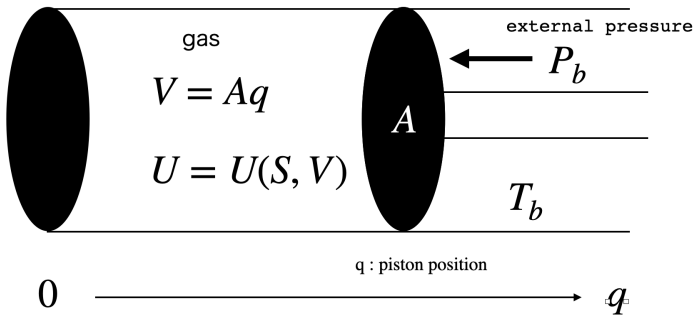
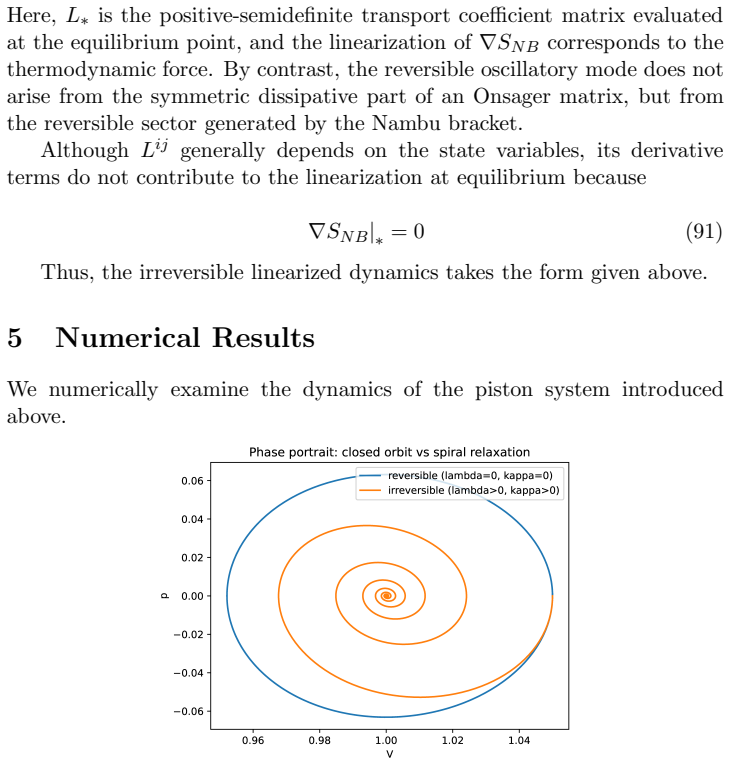
In the open-piston model the reversible sector is formulated as a Nambu rotational flow generated by the extended energy and the subsystem entropy while the irreversible sector is written as a gradient flow generated by the dissipation potential S_NB. After coupling to a heat bath and friction the subsystem entropy S exhibits nonmonotonic oscillations whereas S_NB increases monotonically. This monotonicity follows from two geometric conditions: the reversible Nambu flow preserves S_NB and the irreversible dynamics constitute a positive-semidefinite gradient flow generated by S_NB rather than from any identification of S_NB with thermodynamic entropy.
What carries the argument
The dissipation potential S_NB, which generates the irreversible positive-semidefinite gradient flow and is preserved by the reversible Nambu flow.
If this is right
- Subsystem entropy S can oscillate nonmonotonically while S_NB still increases.
- In the adiabatic reversible limit the piston motion is oscillatory on the intersection of conserved level surfaces.
- Monotonicity of S_NB holds independently of whether S_NB equals thermodynamic entropy.
- The model separates thermodynamic entropy, dissipation potential, reversible temporal order, and irreversible relaxation explicitly.
Where Pith is reading between the lines
- The same geometric separation of Nambu preservation and gradient flow might be constructible in other open systems such as chemical reactors or driven fluids.
- If the two geometric conditions can be identified more broadly they would supply a systematic route to Lyapunov functions for open nonequilibrium models.
- The explicit separation of reversible and irreversible sectors could be used to design numerical integrators that enforce monotonicity of a chosen potential by construction.
Load-bearing premise
The irreversible sector of the open-piston dynamics can be formulated as a positive-semidefinite gradient flow generated by the dissipation potential S_NB.
What would settle it
A numerical integration of the coupled piston equations in which S_NB decreases over any interval under the stated reversible-plus-irreversible structure would falsify the monotonicity claim.
Figures



read the original abstract
In open nonequilibrium systems, the thermodynamic entropy of a subsystem is not generally a Lyapunov function. Even during relaxation toward equilibrium, it may decrease temporarily because of exchanges with external reservoirs. This raises a basic question: what thermodynamic quantity, if any, organizes irreversible relaxation in an open system? We address this question using an explicit open-piston model coupled to both a pressure reservoir and a heat bath. The reversible sector is formulated as a Nambu rotational flow generated by the extended energy and the subsystem entropy, while the irreversible sector is written as a gradient flow generated by a dissipation potential $S_{NB}$. In the adiabatic reversible limit, the Nambu bracket produces the oscillatory piston motion on the intersection of conserved level surfaces. After coupling to a heat bath and adding friction, the subsystem entropy $S$ can exhibit nonmonotonic oscillations, whereas $S_{NB}=S-H_{1}/T_{b}$ increases monotonically under the proposed positive-semidefinite dissipative structure. We show that this monotonicity is not a consequence of identifying $S_{NB}$ with thermodynamic entropy. Rather, it follows from two geometric conditions: the reversible Nambu flow preserves $S_{NB}$, and the irreversible dynamics can be written as a positive-semidefinite gradient flow generated by $S_{NB}$. The open-piston model therefore provides a minimal macroscopic realization in which thermodynamic entropy, dissipation potential, reversible temporal order, and irreversible relaxation can be separated explicitly.
Editorial analysis
A structured set of objections, weighed in public.
Referee Report
Summary. The paper constructs an explicit open-piston model coupled to a pressure reservoir and heat bath. The reversible sector is formulated as Nambu rotational flow generated by extended energy and subsystem entropy S; the irreversible sector is formulated as a gradient flow generated by the dissipation potential S_NB = S - H1/Tb under a proposed positive-semidefinite structure. The central claim is that monotonic increase of S_NB (while S may oscillate) follows from two geometric conditions—the reversible Nambu flow preserves S_NB and the irreversible dynamics are a positive-semidefinite gradient flow of S_NB—rather than from any identification of S_NB with thermodynamic entropy. The model is presented as a minimal macroscopic realization separating these quantities.
Significance. If the geometric construction is non-circular and the positive-semidefinite structure can be independently motivated or verified, the work would supply a concrete example in which a Lyapunov function for open-system relaxation is distinguished from the thermodynamic entropy of the subsystem. This could clarify the organization of irreversible dynamics in systems with external exchanges, using Nambu brackets for the reversible part.
major comments (2)
- [Abstract] Abstract: The statement that monotonicity of S_NB 'follows from two geometric conditions' is undercut by the explicit modeling choice that 'the irreversible sector is written as a gradient flow generated by S_NB under the proposed positive-semidefinite dissipative structure.' Because the irreversible vector field is defined to be the gradient of S_NB with respect to a positive-semidefinite metric, monotonicity is immediate by construction and does not constitute an independent physical prediction or derivation.
- [Abstract] Abstract and introduction: S_NB is introduced by definition as S - H1/Tb and the irreversible dynamics are stipulated to be its gradient flow. No external benchmark, microscopic derivation, or consistency check with known open-system thermodynamics is supplied to show that this choice is required rather than chosen to enforce the desired monotonicity. This renders the separation between thermodynamic entropy and Lyapunov function tautological within the model.
Simulated Author's Rebuttal
We thank the referee for the careful reading and the detailed comments on the abstract and introduction. We address each point below, clarifying the geometric motivation while acknowledging where the presentation can be improved.
read point-by-point responses
-
Referee: [Abstract] Abstract: The statement that monotonicity of S_NB 'follows from two geometric conditions' is undercut by the explicit modeling choice that 'the irreversible sector is written as a gradient flow generated by S_NB under the proposed positive-semidefinite dissipative structure.' Because the irreversible vector field is defined to be the gradient of S_NB with respect to a positive-semidefinite metric, monotonicity is immediate by construction and does not constitute an independent physical prediction or derivation.
Authors: We agree that monotonicity follows directly once the irreversible sector is written as a positive-semidefinite gradient flow of S_NB. The manuscript's central point, however, is that this structure is proposed on physical grounds (dissipation associated with the bath coupling) and that the resulting Lyapunov property does not require identifying S_NB with the subsystem thermodynamic entropy S. The independent geometric condition is the preservation of S_NB under the reversible Nambu flow, which is verified separately. We will revise the abstract to state more explicitly that the gradient-flow ansatz is a modeling choice motivated by dissipation and to highlight the distinction from an entropy identification. revision: partial
-
Referee: [Abstract] Abstract and introduction: S_NB is introduced by definition as S - H1/Tb and the irreversible dynamics are stipulated to be its gradient flow. No external benchmark, microscopic derivation, or consistency check with known open-system thermodynamics is supplied to show that this choice is required rather than chosen to enforce the desired monotonicity. This renders the separation between thermodynamic entropy and Lyapunov function tautological within the model.
Authors: The functional form S_NB = S - H1/Tb is chosen because H1 is the energy exchanged with the thermal bath; subtracting the bath contribution converts the dissipation potential into a quantity whose gradient flow yields the correct irreversible work and heat terms. The model is explicitly macroscopic and phenomenological; no microscopic derivation is attempted. Consistency with standard thermodynamics is recovered in the adiabatic reversible limit, where the Nambu sector reproduces the expected piston oscillations, and the open-system trajectories exhibit the physically expected feature that S can decrease temporarily while S_NB increases. We therefore maintain that the separation is not tautological but is a direct consequence of the explicit open-piston construction. No revision is required on this point. revision: no
Circularity Check
Monotonicity of S_NB follows by construction from modeling the irreversible sector as its gradient flow
specific steps
-
self definitional
[Abstract (paragraph beginning 'We show that this monotonicity...')]
"We show that this monotonicity is not a consequence of identifying $S_{NB}$ with thermodynamic entropy. Rather, it follows from two geometric conditions: the reversible Nambu flow preserves $S_{NB}$, and the irreversible dynamics can be written as a positive-semidefinite gradient flow generated by $S_{NB}$."
The second condition is that the irreversible dynamics 'can be written as' a gradient flow generated by S_NB. A positive-semidefinite gradient flow of any scalar F increases F monotonically by definition of the flow. Since the paper explicitly formulates the model to satisfy this condition, the monotonicity result is equivalent to the input modeling assumption rather than derived from it.
full rationale
The paper constructs an explicit open-piston model in which the irreversible dynamics are written as a positive-semidefinite gradient flow generated by the defined quantity S_NB = S - H1/Tb. The central claim then states that monotonicity follows from this geometric condition (plus Nambu preservation). Because a positive-semidefinite gradient flow of a scalar function increases that function by definition, the reported monotonicity reduces directly to the modeling choice rather than an independent derivation. This matches the self-definitional pattern. The reversible Nambu sector is standard and non-circular. No self-citations or other patterns are load-bearing in the provided text. The result is therefore partially circular (score 6) but the paper frames itself as exhibiting a minimal realization rather than a universal first-principles theorem.
Axiom & Free-Parameter Ledger
axioms (2)
- domain assumption The reversible sector is formulated as a Nambu rotational flow generated by the extended energy and the subsystem entropy.
- ad hoc to paper The irreversible sector is written as a gradient flow generated by S_NB under a positive-semidefinite dissipative structure.
invented entities (1)
-
Dissipation potential S_NB
no independent evidence
Reference graph
Works this paper leans on
-
[1]
Reciprocal Relations in Irreversible Pro cesses
Lars Onsager. Reciprocal Relations in Irreversible Pro cesses. I. Physical Review, 37(4):405–426, February 1931
1931
-
[2]
Glansdorff and I
P. Glansdorff and I. Prigogine. On a general evolution cri terion in macroscopic physics. Physica, 30(2):351–374, February 1964
1964
-
[3]
Some extremum principles in irreversible thermodynam- ics, with application to continuum mechanics
Hans Ziegler. Some extremum principles in irreversible thermodynam- ics, with application to continuum mechanics. In I. N. Snedd on and R. Hill, editors, Progress in Solid Mechanics , volume 4, pages 91–193. North-Holland, Amsterdam, 1963
1963
-
[4]
Dynamics and ther- modynamics of complex fluids
Miroslav Grmela and Hans Christian ¨Ottinger. Dynamics and ther- modynamics of complex fluids. I. Development of a general for malism. Physical Review E , 56(6):6620–6632, December 1997
1997
-
[5]
Geomet ric decom- position of entropy production in out-of-equilibrium syst ems
Andreas Dechant, Shin-ichi Sasa, and Sosuke Ito. Geomet ric decom- position of entropy production in out-of-equilibrium syst ems. Physical Review Research, 4(1):l012034, March 2022
2022
-
[6]
Housekeeping and excess entropy production for genera l nonlinear dynamics
Kohei Yoshimura, Artemy Kolchinsky, Andreas Dechant, a nd Sosuke Ito. Housekeeping and excess entropy production for genera l nonlinear dynamics. Physical Review Research, 5(1):013017, January 2023
2023
-
[7]
So Katagiri, Yoshiki Matsuoka, and Akio Sugamoto. Fluct uating Non- linear Non-equilibrium System in Terms of Nambu Thermodyna mics. arXiv preprint arXiv:2209.08469 , 2022
-
[8]
Nambu Non-equilibrium Thermodynamics: Axiomatic Formulation and Foundation
So Katagiri, Yoshiki Matsuoka, and Akio Sugamoto. Nambu Non- equilibrium Thermodynamics: Axiomatic Formulation and Fo undation. arXiv preprint arXiv:2508.00207 , 2025
work page internal anchor Pith review Pith/arXiv arXiv 2025
-
[9]
Reduc tion of complex dynamics in far-from-equilibrium systems: Namb u non- equilibrium thermodynamics
So Katagiri, Yoshiki Matsuoka, and Akio Sugamoto. Reduc tion of complex dynamics in far-from-equilibrium systems: Namb u non- equilibrium thermodynamics. Journal of Mathematical Physics , 67(4), April 2026
2026
-
[10]
Applications of Nambu Non-equilibrium Thermodynamics to Specific Phenomena
So Katagiri, Yoshiki Matsuoka, and Akio Sugamoto. Appl ications of Nambu Non-equilibrium Thermodynamics to Specific Phenom ena. arXiv preprint arXiv:2509.12641 , 2025. 29
work page internal anchor Pith review Pith/arXiv arXiv 2025
-
[11]
Geometry of T hermody- namic Processes
Arjan Van der Schaft and Bernhard Maschke. Geometry of T hermody- namic Processes. Entropy, 20(12):925, December 2018
2018
-
[12]
Generalized Hamiltonian Dynamics
Yoichiro Nambu. Generalized Hamiltonian Dynamics. Physical Review D, 7(8):2405–2412, April 1973
1973
-
[13]
Onsager’s No n- Equilibrium Thermodynamics as Gradient Flow in Informatio n Geom- etry
Tatsuaki Wada and Antonio Maria Scarfone. Onsager’s No n- Equilibrium Thermodynamics as Gradient Flow in Informatio n Geom- etry. Entropy, 27(7):710, June 2025
2025
-
[14]
Non-equilibrium thermodynamics as gauge fixing
So Katagiri. Non-equilibrium thermodynamics as gauge fixing. Progress of Theoretical and Experimental Physics , 2018(9), September 2018
2018
-
[15]
Grav ity analog model of non-equilibrium thermodynamics
Noriaki Aibara, Naoaki Fujimoto, So Katagiri, Mayumi S aitou, Akio Sugamoto, Takashi Yamamoto, and Tsukasa Yumibayashi. Grav ity analog model of non-equilibrium thermodynamics. Progress of Theo- retical and Experimental Physics , 2019(7), July 2019
2019
-
[16]
Linear nonequilibrium thermodynami cs of re- versible periodic processes and chemical oscillations
Thomas Heimburg. Linear nonequilibrium thermodynami cs of re- versible periodic processes and chemical oscillations. Physical Chem- istry Chemical Physics , 19(26):17331–17341, 2017
2017
-
[17]
Geometric thermodynamics for the Fokker–P lanck equa- tion: stochastic thermodynamic links between information geometry and optimal transport
Sosuke Ito. Geometric thermodynamics for the Fokker–P lanck equa- tion: stochastic thermodynamic links between information geometry and optimal transport. Information Geometry , 7(S1):441–483, March 2023. 30
2023
discussion (0)
Sign in with ORCID, Apple, or X to comment. Anyone can read and Pith papers without signing in.