REGEN: Reference-Guided Synthetic Multivariate Time Series Generation for Forecasting
Pith reviewed 2026-06-28 07:29 UTC · model grok-4.3
The pith
ReGeN decomposes reference time series into periodic backbone, Gaussian process residuals, and structural causal model to produce synthetic data that substitutes for or exceeds real data in forecasting.
A machine-rendered reading of the paper's core claim, the machinery that carries it, and where it could break.
Core claim
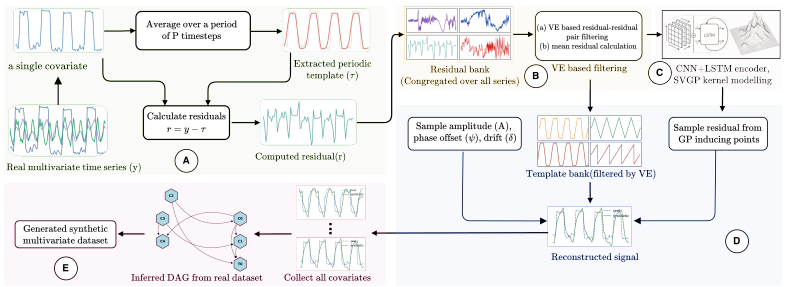
ReGeN treats observed sequences as scaffolds by decomposing each into a phase-aligned periodic backbone that captures dominant domain morphology, per-variable stochastic residuals modeled with a deep-kernel Gaussian process, and lag-aware cross-variable dependencies injected through a structural causal model with fitted coupling coefficients; sampling these components at controllable temperature produces synthetic series that preserve domain-grounded structure while broadening distributional coverage.
What carries the argument
The three-component decomposition of each reference into phase-aligned periodic backbone, deep-kernel Gaussian process residuals, and structural causal model with coupling coefficients.
If this is right
- ReGeN-generated data substitutes for real sibling data with minimal forecasting degradation.
- In strongly periodic domains such as traffic, ReGeN data can outperform the real source itself.
- A foundation model pretrained on ReGeN corpora outperforms models pretrained on prior-based and data-driven synthetic alternatives.
- Controllable sampling of the decomposed components broadens distributional coverage while keeping domain structure intact.
Where Pith is reading between the lines
- The same scaffold decomposition may allow synthetic augmentation in other sequential domains where real data are scarce.
- If structural components can be extracted reliably, the volume of real data needed for pretraining could drop further than current low-data methods assume.
- The relative importance of explicit periodicity and causal coupling versus raw sample count could be tested by ablating individual components in new forecasting benchmarks.
Load-bearing premise
The three-component breakdown of each reference fully captures the relevant domain morphology, local variability, and cross-variable dynamics without material information loss.
What would settle it
Train identical forecasters on ReGeN data versus real sibling sequences in a non-periodic domain and measure whether test error rises by more than a few percent.
Figures
read the original abstract
Training robust multivariate time series forecasting models requires large, diverse corpora, yet many real-world domains provide only a handful of observed sequences. Existing generators fail to resolve this mismatch: prior-based approaches (e.g., CauKer, TimePFN) produce domain-agnostic samples, while data-driven methods (e.g., TimeGAN) treat references as black-box supervision, forfeiting explicit control over periodic structure, local variability, and cross-variable dynamics. We propose ReGeN, a reference-guided generative pipeline that treats observed sequences not as examples to imitate, but as structural scaffolds for controllable synthesis. ReGeN decomposes each reference into three interpretable components: a phase-aligned periodic backbone capturing dominant domain morphology; per-variable stochastic residuals modeled with a deep-kernel Gaussian process; and lag-aware cross-variable dependencies injected through a structural causal model with fitted coupling coefficients. Sampling these components at controllable temperature broadens distributional coverage while preserving domain-grounded structure. We show that ReGeN-generated data consistently substitutes for real sibling data with minimal forecasting degradation, and in strongly periodic domains such as traffic, can outperform the real source itself. We further show that a foundation model pretrained on ReGeN corpora outperforms those pretrained on prior-based and data-driven synthetic alternatives. This suggests that in low-data regimes, how reference data is structurally exploited can matter as much as how much data is available.
Editorial analysis
A structured set of objections, weighed in public.
Referee Report
Summary. The paper proposes ReGeN, a reference-guided generative pipeline for multivariate time series that decomposes each reference sequence into a phase-aligned periodic backbone, per-variable deep-kernel Gaussian process residuals, and a lag-aware structural causal model with fitted coupling coefficients. Sampling at controllable temperature is used to broaden coverage while preserving structure. The central claims are that ReGeN-generated data substitutes for real sibling data with minimal forecasting degradation (and can outperform real data in strongly periodic domains such as traffic) and that foundation models pretrained on ReGeN corpora outperform those pretrained on prior-based or data-driven synthetic alternatives.
Significance. If the empirical claims hold and the decomposition is shown to incur no material information loss, the work could meaningfully address data scarcity in multivariate time series forecasting by supplying controllable, domain-grounded synthetic corpora. The interpretable three-component scaffold approach, as opposed to black-box imitation, would be a useful methodological contribution for low-data regimes.
major comments (2)
- [Methods description of the SCM component and the substitution experiments] The substitution and outperformance claims rest on the assertion that the three-component decomposition (phase-aligned periodic backbone + per-variable deep-kernel GP residuals + lag-aware SCM with fitted coupling coefficients) fully captures morphology, local variability, and cross-variable dynamics without material loss. However, the SCM step relies on fitted coupling coefficients within a chosen lag window and is therefore limited to linear or low-order dependencies; any nonlinear, non-stationary, or higher-order interactions not absorbed into the backbone or GP residuals would be lost, directly threatening the forecasting-substitution results. This concern is load-bearing and requires explicit validation (e.g., ablation on nonlinear synthetic benchmarks or residual analysis of cross-variable structure).
- [Abstract] Abstract: performance claims are stated without any quantitative results, experimental setup, baselines, datasets, or validation metrics. The full manuscript must supply these details (including tables reporting forecasting degradation or outperformance) to allow evaluation of whether the decomposition supports the asserted outcomes.
minor comments (1)
- [Abstract] The abstract would benefit from a brief parenthetical mention of the specific domains or datasets (beyond the traffic example) used to support the periodic-domain outperformance claim.
Simulated Author's Rebuttal
We thank the referee for the constructive feedback. We address each major comment below, indicating planned revisions where appropriate.
read point-by-point responses
-
Referee: [Methods description of the SCM component and the substitution experiments] The substitution and outperformance claims rest on the assertion that the three-component decomposition (phase-aligned periodic backbone + per-variable deep-kernel GP residuals + lag-aware SCM with fitted coupling coefficients) fully captures morphology, local variability, and cross-variable dynamics without material loss. However, the SCM step relies on fitted coupling coefficients within a chosen lag window and is therefore limited to linear or low-order dependencies; any nonlinear, non-stationary, or higher-order interactions not absorbed into the backbone or GP residuals would be lost, directly threatening the forecasting-substitution results. This concern is load-bearing and requires explicit validation (e.g., ablation on nonlinear synthetic benchmarks or residual analysis of cross-variable structure).
Authors: We agree that the SCM models linear lag-aware couplings and that nonlinear or higher-order interactions must be captured elsewhere in the decomposition. The design intends for the phase-aligned backbone and deep-kernel GP residuals to absorb such effects, but we acknowledge the need for explicit validation of no material loss. We will add an ablation on nonlinear synthetic benchmarks together with residual cross-variable analysis in the revised manuscript. revision: yes
-
Referee: [Abstract] Abstract: performance claims are stated without any quantitative results, experimental setup, baselines, datasets, or validation metrics. The full manuscript must supply these details (including tables reporting forecasting degradation or outperformance) to allow evaluation of whether the decomposition supports the asserted outcomes.
Authors: The abstract is written at a high level per standard practice. The full manuscript already contains the experimental setups, baselines (CauKer, TimePFN, TimeGAN), datasets, and tables with quantitative forecasting degradation and outperformance metrics. We will revise the abstract to include selected key quantitative results for improved clarity. revision: partial
Circularity Check
No circularity: generative pipeline is a modeling choice without self-referential derivations
full rationale
The paper describes a reference-guided synthesis method that decomposes time series into a periodic backbone, deep-kernel GP residuals, and an SCM with fitted couplings. No equations, uniqueness theorems, or predictions are presented that reduce by construction to the inputs or to self-citations. The substitution claims rest on empirical evaluation rather than any fitted-input-called-prediction or self-definitional step. The method is self-contained against external benchmarks and does not invoke load-bearing self-citations or ansatzes smuggled via prior work.
Axiom & Free-Parameter Ledger
free parameters (2)
- coupling coefficients
- temperature
axioms (1)
- domain assumption Observed sequences can be decomposed into phase-aligned periodic backbone, per-variable stochastic residuals modeled with deep-kernel Gaussian process, and lag-aware cross-variable dependencies injected through a structural causal model.
Reference graph
Works this paper leans on
-
[1]
International Conference on Learning Representations , year =
A Time Series is Worth 64 Words: Long-term Forecasting with Transformers , author =. International Conference on Learning Representations , year =
-
[2]
2024 , eprint=
Unified Training of Universal Time Series Forecasting Transformers , author=. 2024 , eprint=
2024
-
[3]
2024 , eprint=
Chronos: Learning the Language of Time Series , author=. 2024 , eprint=
2024
-
[4]
2024 , eprint=
Toto: Time Series Optimized Transformer for Observability , author=. 2024 , eprint=
2024
-
[5]
2024 , eprint=
A decoder-only foundation model for time-series forecasting , author=. 2024 , eprint=
2024
-
[6]
International Conference on Artificial Intelligence and Statistics , year=
Adversarial Vulnerabilities in Large Language Models for Time Series Forecasting , author=. International Conference on Artificial Intelligence and Statistics , year=
-
[7]
unknown , year=
Time-Series Foundation AI Model for Value-at-Risk Forecasting , author=. unknown , year=
-
[8]
Circuits, Systems, and Signal Processing , year=
Transformers in Time-Series Analysis: A Tutorial , author=. Circuits, Systems, and Signal Processing , year=
-
[9]
Proceedings of the AAAI conference on artificial intelligence , volume=
Timepfn: Effective multivariate time series forecasting with synthetic data , author=. Proceedings of the AAAI conference on artificial intelligence , volume=
-
[10]
Advances in Neural Information Processing Systems , volume=
Softs: Efficient multivariate time series forecasting with series-core fusion , author=. Advances in Neural Information Processing Systems , volume=
-
[11]
Proceedings of the 31st ACM international conference on information & knowledge management , pages=
Spatial-temporal identity: A simple yet effective baseline for multivariate time series forecasting , author=. Proceedings of the 31st ACM international conference on information & knowledge management , pages=
-
[12]
Proceedings of the AAAI conference on artificial intelligence , volume=
Msgnet: Learning multi-scale inter-series correlations for multivariate time series forecasting , author=. Proceedings of the AAAI conference on artificial intelligence , volume=
-
[13]
2023 , eprint=
Encoding Time-Series Explanations through Self-Supervised Model Behavior Consistency , author=. 2023 , eprint=
2023
-
[14]
2025 , eprint=
Exploring Representations and Interventions in Time Series Foundation Models , author=. 2025 , eprint=
2025
-
[15]
2023 , eprint=
DANLIP: Deep Autoregressive Networks for Locally Interpretable Probabilistic Forecasting , author=. 2023 , eprint=
2023
-
[16]
Robert C. Merton , abstract =. Option pricing when underlying stock returns are discontinuous , journal =. 1976 , issn =. doi:https://doi.org/10.1016/0304-405X(76)90022-2 , url =
-
[17]
2004 , publisher=
Financial Modelling with Jump Processes , author=. 2004 , publisher=
2004
-
[18]
Neural Information Processing Systems , year=
Deep State Space Models for Time Series Forecasting , author=. Neural Information Processing Systems , year=
-
[19]
ArXiv , year=
GluonTS: Probabilistic Time Series Models in Python , author=. ArXiv , year=
-
[20]
IEEE Access , year=
Time Series Prediction Based on LSTM-Attention-LSTM Model , author=. IEEE Access , year=
-
[21]
2019 IEEE International Conference on Big Data (Big Data) , year=
The Performance of LSTM and BiLSTM in Forecasting Time Series , author=. 2019 IEEE International Conference on Big Data (Big Data) , year=
2019
-
[22]
2020 , eprint=
Temporal Fusion Transformers for Interpretable Multi-horizon Time Series Forecasting , author=. 2020 , eprint=
2020
-
[23]
Journal of Official Statistics , volume=
STL: A Seasonal-Trend Decomposition Procedure Based on Loess , author=. Journal of Official Statistics , volume=
-
[24]
Philosophical Transactions of the Royal Society A: Mathematical, Physical and Engineering Sciences , volume=
Gaussian Processes for Time-Series Modelling , author=. Philosophical Transactions of the Royal Society A: Mathematical, Physical and Engineering Sciences , volume=. 2013 , doi=
2013
-
[25]
Proceedings of the 19th International Conference on Artificial Intelligence and Statistics , series=
Deep Kernel Learning , author=. Proceedings of the 19th International Conference on Artificial Intelligence and Statistics , series=. 2016 , url=
2016
-
[26]
Journal of Machine Learning Research , volume=
Learning Scalable Deep Kernels with Recurrent Structure , author=. Journal of Machine Learning Research , volume=. 2017 , url=
2017
-
[27]
2006 , publisher=
Gaussian Processes for Machine Learning , author=. 2006 , publisher=
2006
-
[28]
Neural Computation , volume=
Long Short-Term Memory , author=. Neural Computation , volume=. 1997 , doi=
1997
-
[29]
2017 , publisher=
Elements of Causal Inference: Foundations and Learning Algorithms , author=. 2017 , publisher=
2017
-
[30]
Xie, Shifeng and Feofanov, Vasilii and Alonso, Marius and Odonnat, Ambroise and Zhang, Jianfeng and Palpanas, Themis and Zan, Lei and Pan, Lujia and Zhang, Keli and Redko, Ievgen , year=. 2508.02879 , archivePrefix=
-
[31]
Advances in Neural Information Processing Systems 32 , year=
Time-series Generative Adversarial Networks , author=. Advances in Neural Information Processing Systems 32 , year=
-
[32]
Advances in Neural Information Processing Systems 36 , year=
ForecastPFN: Synthetically-Trained Zero-Shot Forecasting , author=. Advances in Neural Information Processing Systems 36 , year=
-
[33]
Proceedings of the 3rd Workshop on Machine Learning and Systems , year=
TSMix: Time Series Data Augmentation by Mixing Sources , author=. Proceedings of the 3rd Workshop on Machine Learning and Systems , year=
-
[34]
2023 , eprint=
Embarrassingly Simple MixUp for Time-series , author=. 2023 , eprint=
2023
-
[35]
International Conference on Machine Learning , pages=
Structure discovery in nonparametric regression through compositional kernel search , author=. International Conference on Machine Learning , pages=. 2013 , organization=
2013
-
[36]
Advances in neural information processing systems , volume=
Autoformer: Decomposition transformers with auto-correlation for long-term series forecasting , author=. Advances in neural information processing systems , volume=
-
[37]
Proceedings of the AAAI conference on artificial intelligence , volume=
Informer: Beyond efficient transformer for long sequence time-series forecasting , author=. Proceedings of the AAAI conference on artificial intelligence , volume=
-
[38]
NeurIPS Workshop on Time Series in the Age of Large Models , year=
GIFT-Eval: A Benchmark for General Time Series Forecasting Model Evaluation , author=. NeurIPS Workshop on Time Series in the Age of Large Models , year=
-
[39]
This Time is Different: An Observability Perspective on Time Series Foundation Models , author=
-
[40]
International Conference on Machine Learning , pages=
A decoder-only foundation model for time-series forecasting , author=. International Conference on Machine Learning , pages=. 2024 , organization=
2024
-
[41]
Forty-first International Conference on Machine Learning , year=
Unified training of universal time series forecasting transformers , author=. Forty-first International Conference on Machine Learning , year=
-
[42]
Chronos-2: From Univariate to Universal Forecasting
Chronos-2: From univariate to universal forecasting , author=. arXiv preprint arXiv:2510.15821 , year=
work page internal anchor Pith review Pith/arXiv arXiv
-
[43]
C-RNN-GAN: Continuous recurrent neural networks with adversarial training
C-RNN-GAN: Continuous recurrent neural networks with adversarial training , author=. arXiv preprint arXiv:1611.09904 , year=
work page internal anchor Pith review Pith/arXiv arXiv
-
[44]
Real-valued (Medical) Time Series Generation with Recurrent Conditional GANs
Real-valued (medical) time series generation with recurrent conditional gans , author=. arXiv preprint arXiv:1706.02633 , year=
work page internal anchor Pith review Pith/arXiv arXiv
-
[45]
The Annals of Statistics , volume=
Foundations of structural causal models with cycles and latent variables , author=. The Annals of Statistics , volume=. 2021 , publisher=
2021
-
[46]
2026 , eprint=
Zero-shot Forecasting by Simulation Alone , author=. 2026 , eprint=
2026
-
[47]
NeurIPS 2023 Track on Datasets and Benchmarks , year=
BuildingsBench: A Large-Scale Dataset of 900K Buildings and Benchmark for Short-Term Load Forecasting , author=. NeurIPS 2023 Track on Datasets and Benchmarks , year=
2023
-
[48]
NeurIPS 2023 Track on Datasets and Benchmarks , year=
SubseasonalClimateUSA: A Dataset for Subseasonal Forecasting and Benchmarking , author=. NeurIPS 2023 Track on Datasets and Benchmarks , year=
2023
-
[49]
arXiv preprint arXiv:2304.14343 , year=
LibCity: A Unified Library Towards Efficient and Comprehensive Urban Spatial-Temporal Prediction , author=. arXiv preprint arXiv:2304.14343 , year=
-
[50]
arXiv preprint arXiv:2310.05063 , year=
Pushing the Limits of Pre-training for Time Series Forecasting in the CloudOps Domain , author=. arXiv preprint arXiv:2310.05063 , year=
-
[51]
The Twelfth International Conference on Learning Representations , year=
iTransformer: Inverted Transformers Are Effective for Time Series Forecasting , author=. The Twelfth International Conference on Learning Representations , year=
-
[52]
Neurocomputing , volume=
Is Mamba Effective for Time Series Forecasting? , author=. Neurocomputing , volume=. 2025 , doi=
2025
-
[53]
Proceedings of the AAAI Conference on Artificial Intelligence , volume=
Are Transformers Effective for Time Series Forecasting? , author=. Proceedings of the AAAI Conference on Artificial Intelligence , volume=. 2023 , doi=
2023
-
[54]
Science Advances , volume=
Detecting and quantifying causal associations in large nonlinear time series datasets , author=. Science Advances , volume=. 2019 , doi=
2019
-
[55]
Proceedings of the Twenty Third International Conference on Artificial Intelligence and Statistics , pages=
DYNOTEARS: Structure Learning from Time-Series Data , author=. Proceedings of the Twenty Third International Conference on Artificial Intelligence and Statistics , pages=
-
[56]
Journal of Machine Learning Research , volume=
Estimation of a Structural Vector Autoregression Model Using Non-Gaussianity , author=. Journal of Machine Learning Research , volume=
-
[57]
Econometrica , volume=
Investigating Causal Relations by Econometric Models and Cross-spectral Methods , author=. Econometrica , volume=. 1969 , doi=
1969
-
[58]
Machine Learning , volume=
Random Forests , author=. Machine Learning , volume=. 2001 , doi=
2001
-
[59]
Journal of Machine Learning Research , volume=
Visualizing Data using t-SNE , author=. Journal of Machine Learning Research , volume=
-
[60]
IEEE Transactions on Audio and Electroacoustics , volume=
The Use of Fast Fourier Transform for the Estimation of Power Spectra: A Method Based on Time Averaging Over Short, Modified Periodograms , author=. IEEE Transactions on Audio and Electroacoustics , volume=. 1967 , doi=
1967
-
[61]
The American Journal of Psychology , volume=
The Proof and Measurement of Association Between Two Things , author=. The American Journal of Psychology , volume=. 1904 , doi=
1904
discussion (0)
Sign in with ORCID, Apple, or X to comment. Anyone can read and Pith papers without signing in.