Learning Manifold and It\^o Dynamics with Branched Neural Rough Differential Equations
Pith reviewed 2026-06-28 07:06 UTC · model grok-4.3
The pith
Branched neural rough differential equations use rooted trees to handle Itô dynamics and manifold-valued processes.
A machine-rendered reading of the paper's core claim, the machinery that carries it, and where it could break.
Core claim
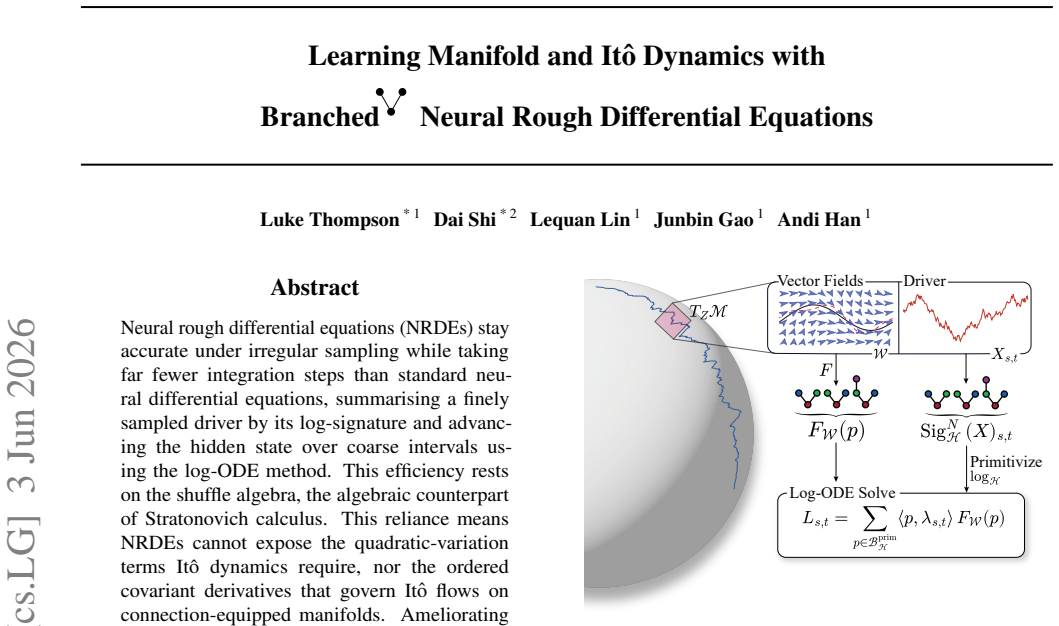
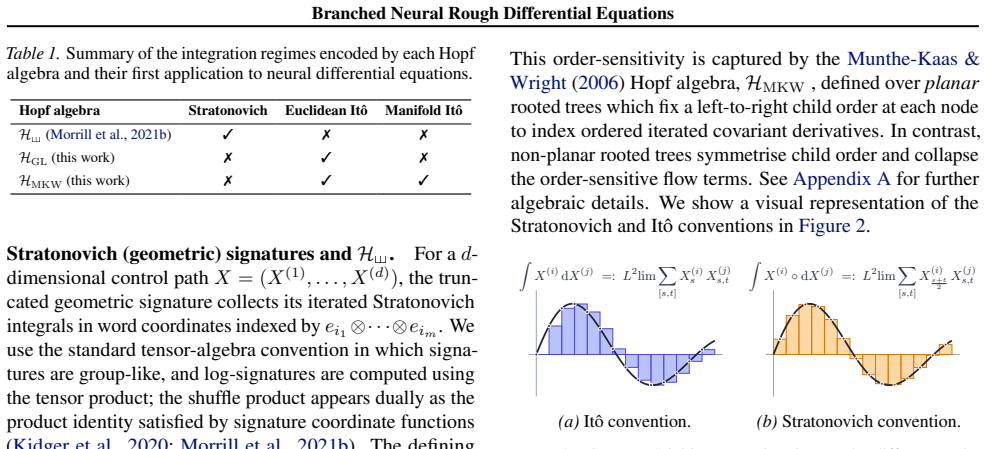
B-NRDEs provide a Hopf-algebraic framework that recasts the NRDE log-ODE step as geometric numerical integration on the state-space manifold, matching the driving algebra to the governing calculus: Grossman-Larson rooted trees for Euclidean Itô dynamics, Munthe-Kaas-Wright planar rooted trees for ordered covariant derivatives on manifolds, and the shuffle algebra in the classical Stratonovich case. This yields intrinsic coarse-step dynamics that exactly preserve manifold constraints. A branched signature-kernel objective enables Itô-consistent law matching by making quadratic-variation terms visible during training.
What carries the argument
Branched signatures using rooted trees (Grossman-Larson for Itô, Munthe-Kaas-Wright for manifolds) to align driving algebra with the target calculus in the log-ODE step
If this is right
- NRDEs can now address Itô dynamics by surfacing quadratic-variation terms that the shuffle algebra hides.
- Coarse integration steps on manifolds become intrinsic and constraint-preserving without post-processing.
- A single framework unifies Stratonovich, Itô, and connection-equipped manifold flows.
- The branched signature-kernel objective supports direct Itô-consistent distribution matching in training.
Where Pith is reading between the lines
- The tree-based construction may extend naturally to other geometric structures such as Lie groups beyond SO(3) or additional covariance manifolds.
- In finance applications the visibility of quadratic variations could improve calibration of rough volatility models under Itô semantics.
- Sim-to-real transfer tasks involving orientation or pose data might see gains from the exact manifold preservation property.
Load-bearing premise
Recasting the NRDE log-ODE step as geometric numerical integration via specific rooted trees on the manifold will exactly preserve constraints and expose quadratic-variation terms during training.
What would settle it
Running the SPD covariance experiments and checking whether B-NRDE trajectories stay on the manifold without extra projection steps while also showing better quadratic-variation matching than standard NRDEs on rough Bergomi paths.
Figures
read the original abstract
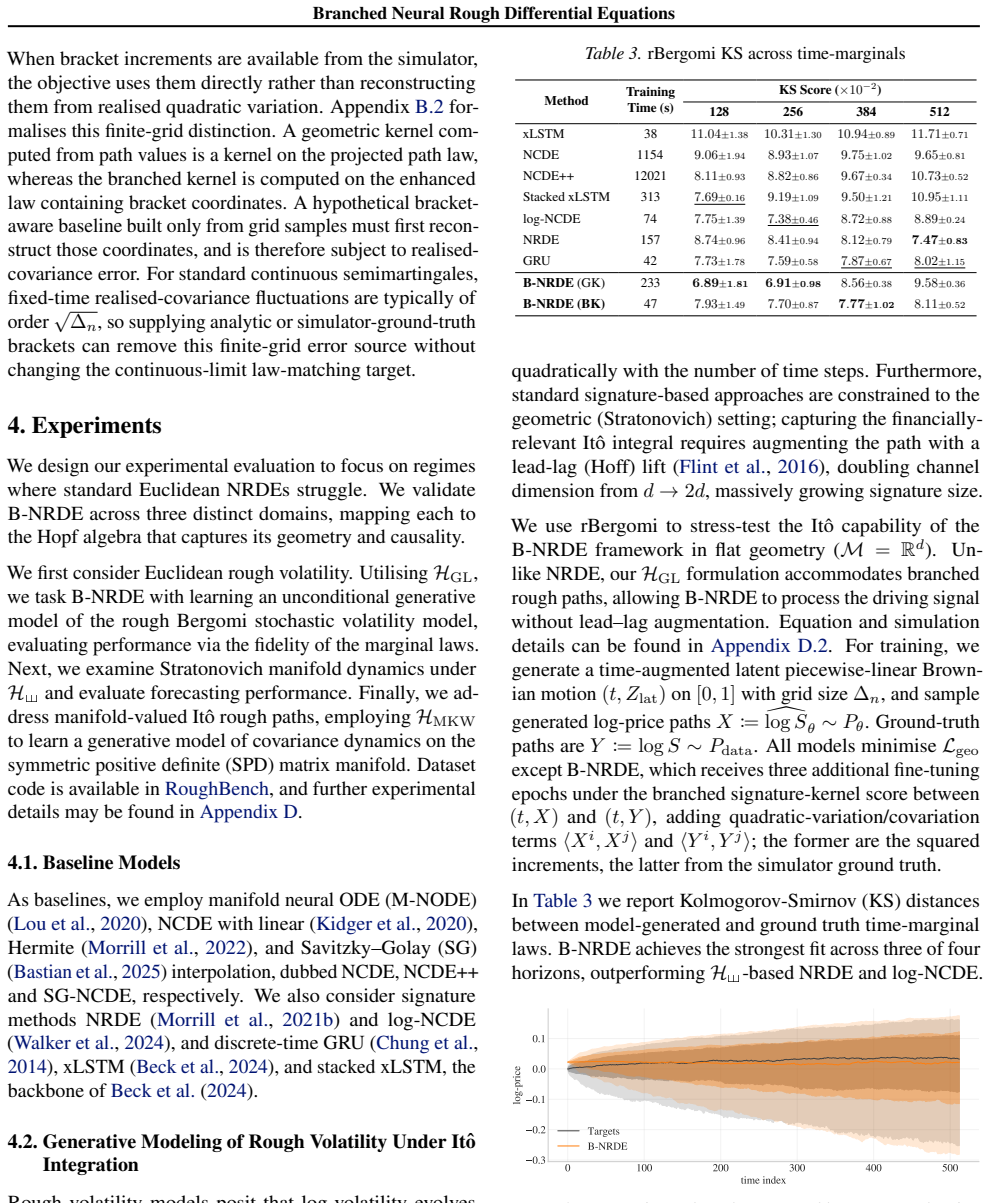
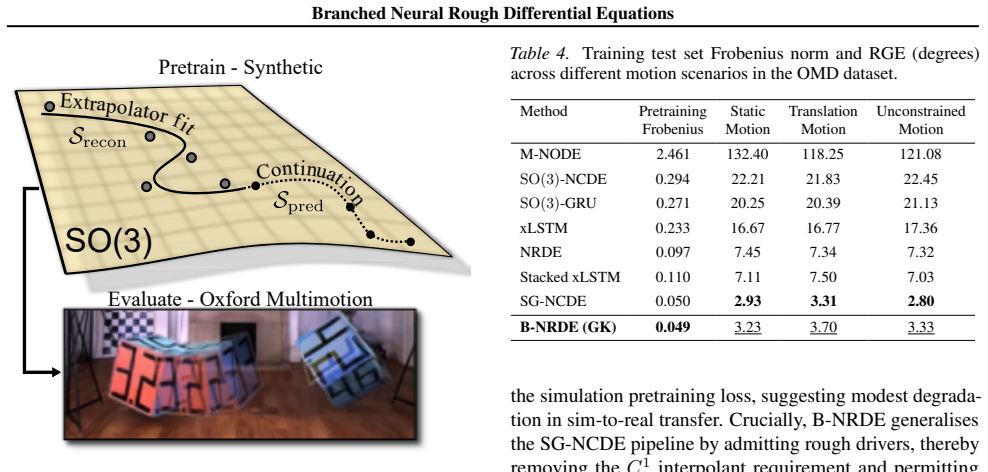
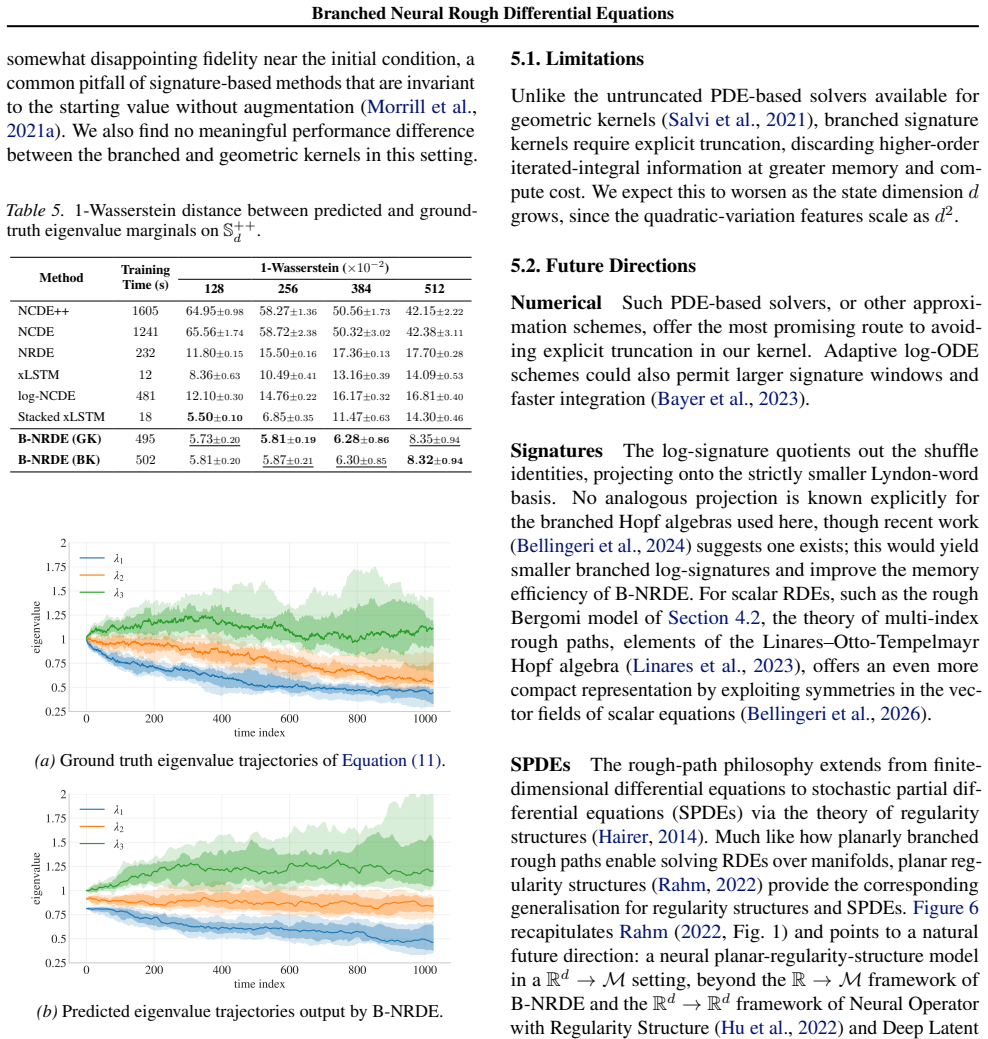
Neural rough differential equations (NRDEs) stay accurate under irregular sampling while taking far fewer integration steps than standard neural differential equations, summarising a finely sampled driver by its log-signature and advancing the hidden state over coarse intervals using the log-ODE method. This efficiency rests on the shuffle algebra, the algebraic counterpart of Stratonovich calculus. This reliance means NRDEs cannot expose the quadratic-variation terms It\^o dynamics require, nor the ordered covariant derivatives that govern It\^o flows on connection-equipped manifolds. Ameliorating this, we introduce Branched Neural Rough Differential Equations (B-NRDEs), a Hopf-algebraic framework that recasts the NRDE log-ODE step as geometric numerical integration on the state-space manifold, matching the driving algebra to the governing calculus: Grossman--Larson rooted trees for Euclidean It\^o dynamics, Munthe-Kaas--Wright planar rooted trees for ordered covariant derivatives on manifolds, and the shuffle algebra in the classical Stratonovich case. This yields intrinsic coarse-step dynamics that exactly preserve manifold constraints. Finally, we introduce a branched signature-kernel objective to enable It\^o-consistent law matching by making quadratic-variation terms visible during training. On rough Bergomi volatility, sim-to-real $\mathrm{SO}(3)$ dynamics forecasting, and SPD covariance dynamics, B-NRDEs offer a unified, effective approach to stochastic and manifold-valued dynamics beyond the Euclidean--Stratonovich setting.
Editorial analysis
A structured set of objections, weighed in public.
Referee Report
Summary. The manuscript introduces Branched Neural Rough Differential Equations (B-NRDEs), extending NRDEs via Hopf-algebraic branched signatures and rooted-tree structures (Grossman-Larson for Euclidean Itô, Munthe-Kaas-Wright for manifolds with connection, shuffle for Stratonovich). It recasts the log-ODE step as geometric integration to exactly preserve manifold constraints and introduces a branched signature-kernel objective that exposes quadratic-variation terms for Itô-consistent law matching. Experiments are reported on rough Bergomi volatility, sim-to-real SO(3) forecasting, and SPD covariance dynamics.
Significance. If the algebraic matching and exact-preservation claims hold, the work supplies a principled unification of neural rough-path methods across Itô, Stratonovich, and manifold settings, with potential impact on stochastic volatility modeling and geometric time-series tasks. The explicit use of tree algebras to surface quadratic variation during training is a concrete technical contribution.
major comments (2)
- [Abstract] Abstract (final paragraph) and the central derivation of the log-ODE step: the claim that Munthe-Kaas-Wright / Grossman-Larson trees yield dynamics that lie exactly on the manifold (no drift off the constraint) and recover the Itô correction without truncation error at finite depth is asserted but not accompanied by an explicit commutativity argument between the neural vector field and the tree-based retraction, nor by an error analysis for the finite-depth branched signature. This is load-bearing for the headline claim of exact constraint preservation.
- [Method / algebraic construction (likely §3)] The equivalence between the classical NRDE shuffle-algebra log-ODE and the new branched-tree integrators is stated as following directly from matching the driving algebra to the governing calculus, yet no intermediate algebraic identity or diagram is supplied showing how the neural vector field is lifted to the Grossman-Larson or Munthe-Kaas-Wright algebra while preserving the manifold embedding.
minor comments (1)
- [Abstract / §4] Notation for the branched signature truncation depth and the precise form of the kernel objective should be introduced with an explicit equation rather than only in prose.
Simulated Author's Rebuttal
We thank the referee for the careful and constructive report. The two major comments both concern the need for more explicit algebraic derivations to support the exact manifold preservation and Itô-correction claims. We agree these clarifications will strengthen the manuscript and will supply them in revision.
read point-by-point responses
-
Referee: [Abstract] Abstract (final paragraph) and the central derivation of the log-ODE step: the claim that Munthe-Kaas-Wright / Grossman-Larson trees yield dynamics that lie exactly on the manifold (no drift off the constraint) and recover the Itô correction without truncation error at finite depth is asserted but not accompanied by an explicit commutativity argument between the neural vector field and the tree-based retraction, nor by an error analysis for the finite-depth branched signature. This is load-bearing for the headline claim of exact constraint preservation.
Authors: We accept that an explicit commutativity argument and finite-depth error analysis are required to make the exact-preservation claim fully rigorous. In the revised manuscript we will insert a new subsection (after the definition of the branched log-ODE step) that (i) proves the neural vector field commutes with the retraction induced by the Munthe-Kaas–Wright / Grossman–Larson rooted-tree series, thereby showing the integrated flow remains on the manifold by algebraic construction, and (ii) supplies a remainder estimate for the truncated branched signature that quantifies how the Itô quadratic-variation correction is recovered exactly in the infinite-depth limit and with an explicit O(2^{-N}) bound at depth N. These additions directly address the load-bearing claim. revision: yes
-
Referee: [Method / algebraic construction (likely §3)] The equivalence between the classical NRDE shuffle-algebra log-ODE and the new branched-tree integrators is stated as following directly from matching the driving algebra to the governing calculus, yet no intermediate algebraic identity or diagram is supplied showing how the neural vector field is lifted to the Grossman-Larson or Munthe-Kaas-Wright algebra while preserving the manifold embedding.
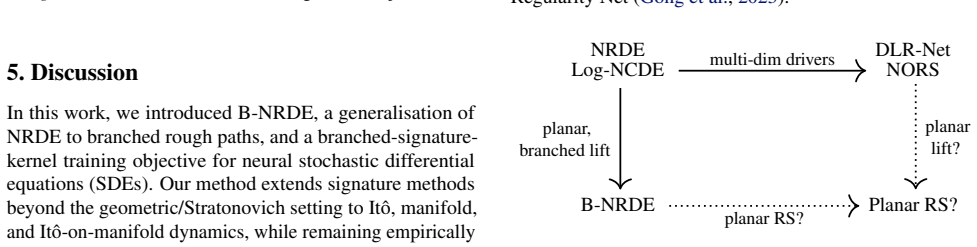
Authors: We agree that an explicit lifting diagram and intermediate identities would make the equivalence transparent. In the revised §3 we will add a commutative diagram (Figure 3) together with the corresponding algebraic identities that show how the neural vector field is lifted first to the Grossman–Larson algebra (Euclidean Itô), then to the Munthe-Kaas–Wright planar trees (manifold case), with the classical shuffle algebra recovered as the quotient by the ideal generated by the Lie bracket. The diagram will also indicate the embedding of the manifold constraint at each step. revision: yes
Circularity Check
No significant circularity; derivation introduces independent algebraic extensions
full rationale
The paper presents B-NRDEs as a new Hopf-algebraic framework that recasts the NRDE log-ODE step via Grossman-Larson and Munthe-Kaas-Wright rooted trees to handle Itô dynamics and manifold constraints. The abstract asserts that matching the driving algebra (branched signatures) to the governing calculus yields intrinsic dynamics that exactly preserve manifold constraints and expose quadratic-variation terms. No equations or claims in the provided text reduce any prediction or result to a fitted input by construction, nor do they rely on self-citations for load-bearing uniqueness theorems or ansatzes. The central construction is positioned as an extension of existing shuffle-algebra NRDEs with new tree algebras, without tautological redefinitions or renaming of known results. This is self-contained against external benchmarks of rough-path theory and geometric integration.
Axiom & Free-Parameter Ledger
axioms (2)
- standard math The shuffle algebra is the algebraic counterpart of Stratonovich calculus
- domain assumption Hopf-algebraic rooted trees can recast log-ODE steps as geometric integration on manifolds
invented entities (2)
-
Branched Neural Rough Differential Equations (B-NRDEs)
no independent evidence
-
Branched signature-kernel objective
no independent evidence
Reference graph
Works this paper leans on
-
[1]
URL http://arxiv.org/abs/2506.067
-
[2]
arXiv:2506.06780 [cs]. Bayer, C., Friz, P. K., and Gatheral, J. Pricing Under Rough V olatility.SSRN Electronic Journal, 2015. ISSN 1556-
arXiv 2015
-
[3]
URL http://dx .doi.org/10.2139/ssrn.2554754
doi: 10.2139/ssrn.2554754. URL http://dx .doi.org/10.2139/ssrn.2554754 . Publisher: Elsevier BV . Bayer, C., Breneis, S., and Lyons, T. An Adaptive Al- gorithm for Rough Differential Equations, July 2023. URL http://arxiv.org/abs/2307.12590 . arXiv:2307.12590 [math]. Beck, M., P¨oppel, K., Spanring, M., Auer, A., Prudnikova, O., Kopp, M., Klambauer, G., B...
-
[4]
URL http:// dx.doi.org/10.1007/s00780-017-0335-5
doi: 10.1007/s00780-017-0335-5. URL http:// dx.doi.org/10.1007/s00780-017-0335-5 . Publisher: Springer Science and Business Media LLC. Beyer, T. and Hedetniemi, S. M. Constant Time Generation of Rooted Trees.SIAM Journal on Computing, 9(4):706– 712, November 1980. ISSN 0097-5397. doi: 10.1137/02 09055. URL https://epubs.siam.org/doi/1 0.1137/0209055 . Pub...
-
[5]
doi: 10.1016/0304-3975(88)901 13-2
ISSN 0304-3975. doi: 10.1016/0304-3975(88)901 13-2. URL https://www.sciencedirect.com/ science/article/pii/0304397588901132. D¨unkel, O., Salzmann, T., and Pfaff, F. Normalizing Flows on the Product Space of SO(3) Manifolds for Probabilistic Human Pose Modeling, April 2024. URL http://ar xiv.org/abs/2404.05675 . arXiv:2404.05675 [cs]. Flint, G., Hambly, B...
-
[6]
ISSN 03044149. doi: 10.1016/j.spa.2016.02.01
-
[7]
Discretely sampled signals and the rough Hoff process
URL http://arxiv.org/abs/1310.4054 . arXiv:1310.4054 [math]. Gatheral, J., Jaisson, T., and Rosenbaum, M. V olatility is rough, October 2014. URL http://arxiv.org/ab s/1410.3394. arXiv:1410.3394 [q-fin]. Gierjatowicz, P., Sabate-Vidales, M., ˇSiˇska, D., Szpruch, L., and ˇZuriˇc, v. Robust pricing and hedging via neural SDEs, July 2020. URL http://arxiv.o...
work page internal anchor Pith review Pith/arXiv arXiv doi:10.1609/aaai.v37i6.25938 2014
-
[8]
A theory of regularity structures
URL http://arxiv.org/abs/1303.5113 . arXiv:1303.5113 [math]. Hairer, M. and Kelly, D. Geometric versus non-geometric rough paths, January 2014. URL http://arxiv.or g/abs/1210.6294. arXiv:1210.6294 [math]. Hu, P., Meng, Q., Chen, B., Gong, S., Wang, Y ., Chen, W., Zhu, R., Ma, Z.-M., and Liu, T.-Y . Neural Operator with Regularity Structure for Modeling Dy...
work page internal anchor Pith review Pith/arXiv arXiv doi:10.1007/s10851-009-0161-2 2014
-
[9]
ISSN 0003486X. doi: 10.2307/1970615. URL 12 Branched Neural Rough Differential Equations https://www.jstor.org/stable/1970615 ?origin=crossref. Morad, S. smorad/cyreal, January 2026. URL https: //github.com/smorad/cyreal . original-date: 2025-12-15T05:39:30Z. Morrill, J., Fermanian, A., Kidger, P., and Lyons, T. A Gen- eralised Signature Method for Multiv...
-
[10]
URL https://www.sciencedirect.com/scienc e/chapter/edited-volume/abs/pii/B9780 128147252000108
doi: 10.1016/B978-0-12-814725-2.00010-8. URL https://www.sciencedirect.com/scienc e/chapter/edited-volume/abs/pii/B9780 128147252000108. Rahm, L. Planar Regularity Structures, December 2022. URL http://arxiv.org/abs/2212.04856 . arXiv:2212.04856 [math]. Reiss, A., Indlekofer, I., Schmidt, P., and Van Laerhoven, K. Deep ppg: Large-scale heart rate estimati...
-
[11]
ISSN 1424-8220. doi: 10.3390/s19143079. URL http://dx.doi.org/10.3390/s19143079. Salvi, C., Cass, T., Foster, J., Lyons, T., and Yang, W. The Signature Kernel is the solution of a Goursat PDE.SIAM Journal on Mathematics of Data Science, 3(3):873–899, January 2021. ISSN 2577-0187. doi: 10.1137/20M13667
-
[12]
URL http://arxiv.org/abs/2006.14794. arXiv:2006.14794 [math]. Sastre, J., Ib´a˜nez, J., and Defez, E. Boosting the computa- tion of the matrix exponential.Applied Mathematics and Computation, 340:206–220, January 2019. ISSN 0096-
arXiv 2006
-
[13]
URL http:// dx.doi.org/10.1016/j.amc.2018.08.017
doi: 10.1016/j.amc.2018.08.017. URL http:// dx.doi.org/10.1016/j.amc.2018.08.017. Schreiner, M., Winther, O., and Olsson, S. Implicit Transfer Operator Learning: Multiple Time-Resolution Surrogates for Molecular Dynamics, October 2023. URL http:// arxiv.org/abs/2305.18046. arXiv:2305.18046 [physics]. Shmelev, D. and Salvi, C. pySigLib – Fast Signature- Ba...
-
[14]
URL https://arxiv.org/abs/2509.2 0599. S¨oderlind, G. Automatic control and adaptive time-stepping. Numerical Algorithms, 31:281–310, 2002. Thornton, J., Hutchinson, M., Mathieu, E., Bortoli, V . D., Teh, Y . W., and Doucet, A. Riemannian Diffusion Schr¨odinger Bridge, July 2022. URL http://arxiv. org/abs/2207.03024. arXiv:2207.03024 [stat]. Tsitouras, C....
arXiv 2002
-
[15]
URL https: //onlinelibrary.wiley.com/doi/abs/10 .1112/S0025579300005659
doi: 10.1112/S0025579300005659. URL https: //onlinelibrary.wiley.com/doi/abs/10 .1112/S0025579300005659. Witt, E. Treue Darstellung Liescher Ringe.Journal f ¨ur die reine und angewandte Mathematik, 177:152–160, 1937. ISSN 0075-4102; 1435-5345/e. URL https://eudm l.org/doc/150011. Yang, H., Doran, C., and Slotine, J.-J. Dynamical Pose Estimation. In2021 IE...
-
[16]
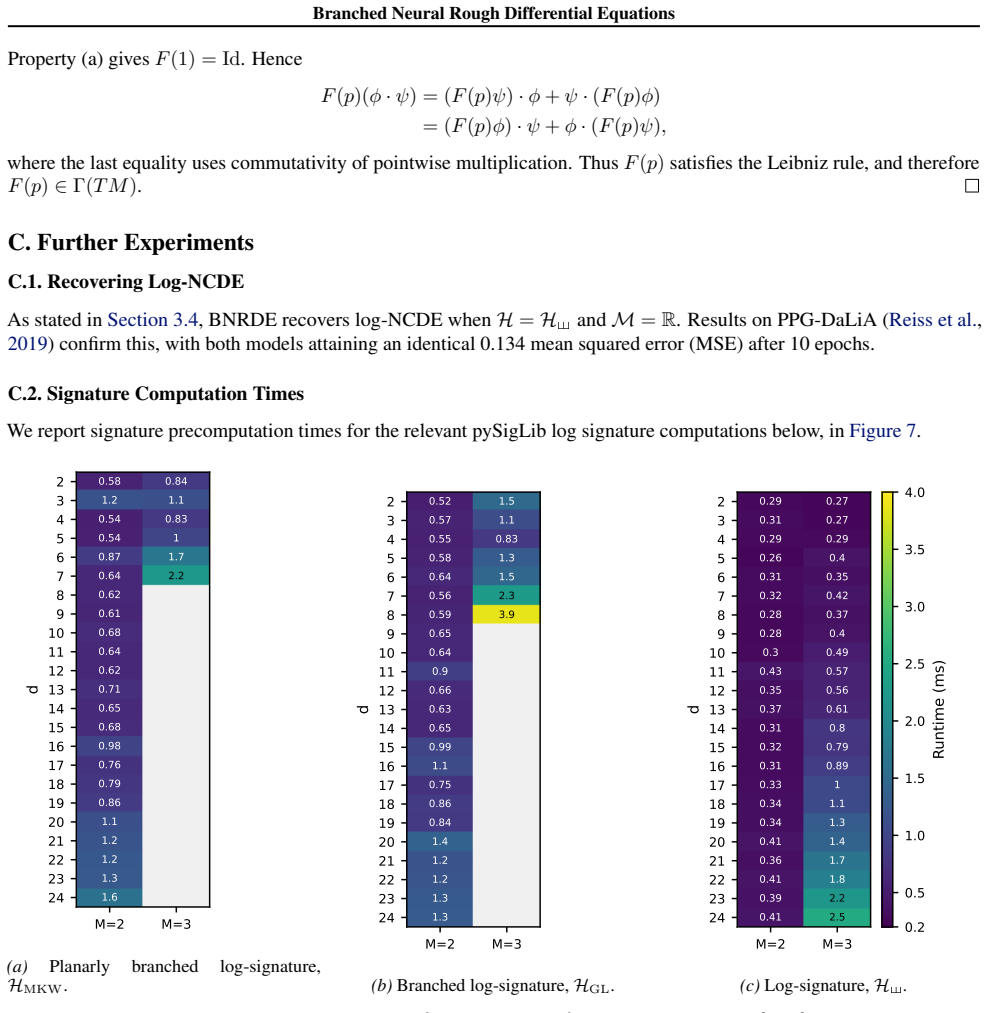
confirm this, with both models attaining an identical 0.134 mean squared error (MSE) after 10 epochs. C.2. Signature Computation Times We report signature precomputation times for the relevant pySigLib log signature computations below, in Figure 7. M=2 M=3 2 3 4 5 6 7 8 9 10 11 12 13 14 15 16 17 18 19 20 21 22 23 24 d 0.58 0.84 1.2 1.1 0.54 0.83 0.54 1 0....
2018
-
[17]
SG-NCDE: Weighted Savitsky-Golay polynomial
-
[18]
Branched neural rough differential equation (B-NRDE): multilayer perceptron (MLP) To save parameters in the readout MLP, all models output vectors inR6, which are transformed back into R3×3 rotation matrices via a Gram-Schmidt procedure (Zhou et al., 2020). D.4. Mean-reverting Dynamics over the SPD Manifold under Affine-invariant Geometry We simulate Equa...
2020
discussion (0)
Sign in with ORCID, Apple, or X to comment. Anyone can read and Pith papers without signing in.