Eppur binaria non \'e esclusa: Gaia astrometry does not disfavor a binary origin for Long Secondary Periods
Pith reviewed 2026-06-28 03:56 UTC · model grok-4.3
The pith
Gaia astrometry does not disfavor binary origins for long secondary period stars once contaminants are removed.
A machine-rendered reading of the paper's core claim, the machinery that carries it, and where it could break.
Core claim
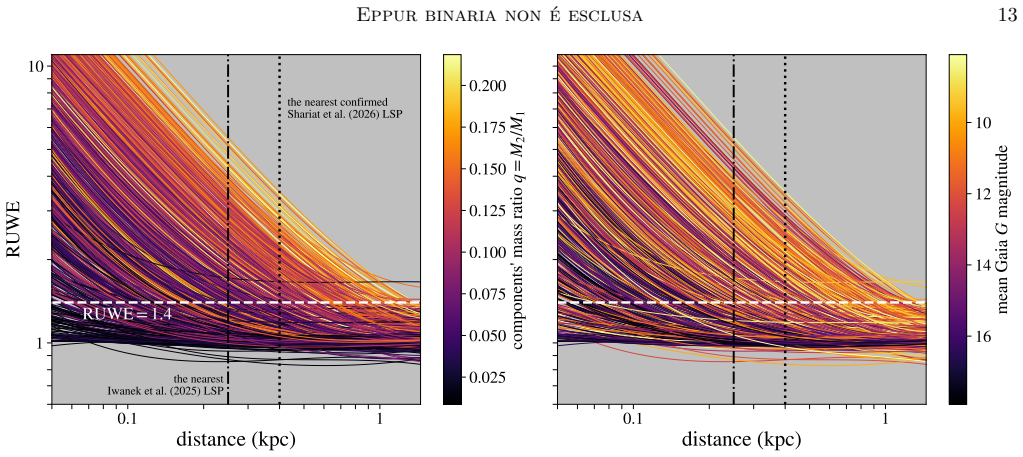
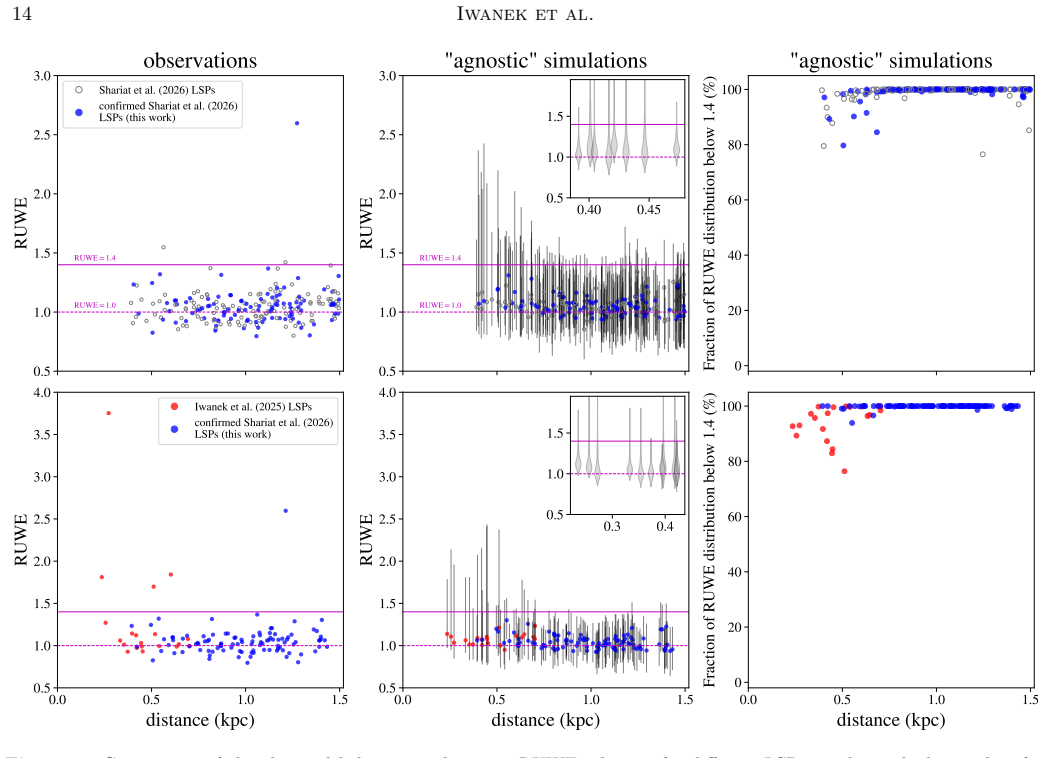
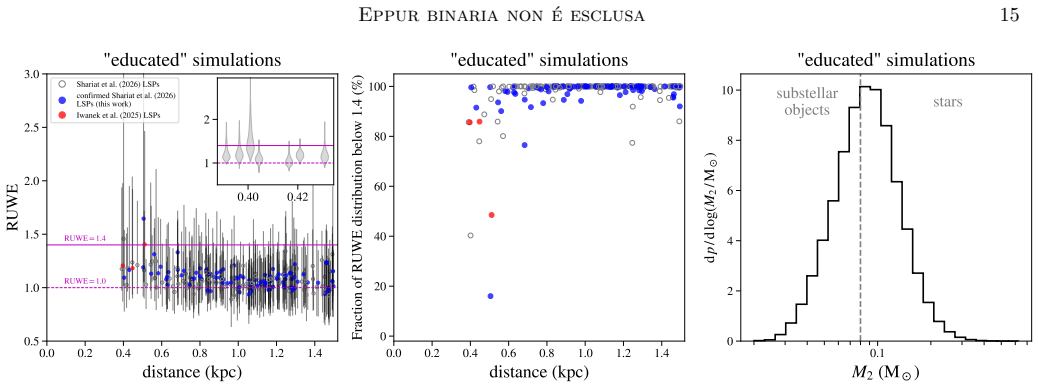
After separating true LSP stars from semi-regular variables via light curve inspection, the binary-nature hypothesis for LSP stars produces no discrepancy between observed and expected distance-RUWE relations, because gaiamock simulations of binary systems predict that even the nearest LSP stars need not exhibit elevated RUWE.
What carries the argument
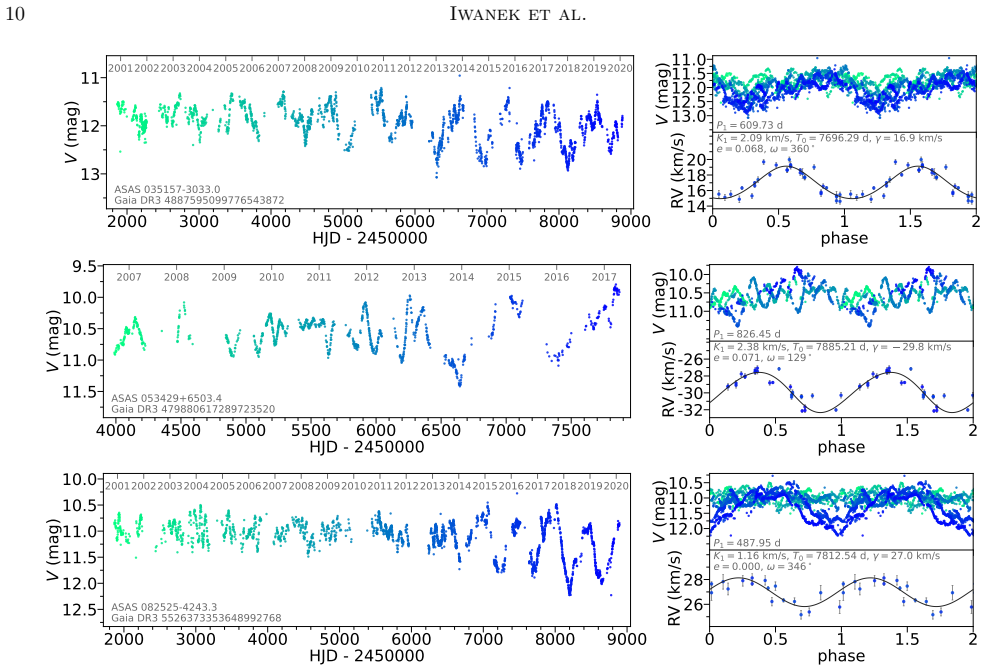
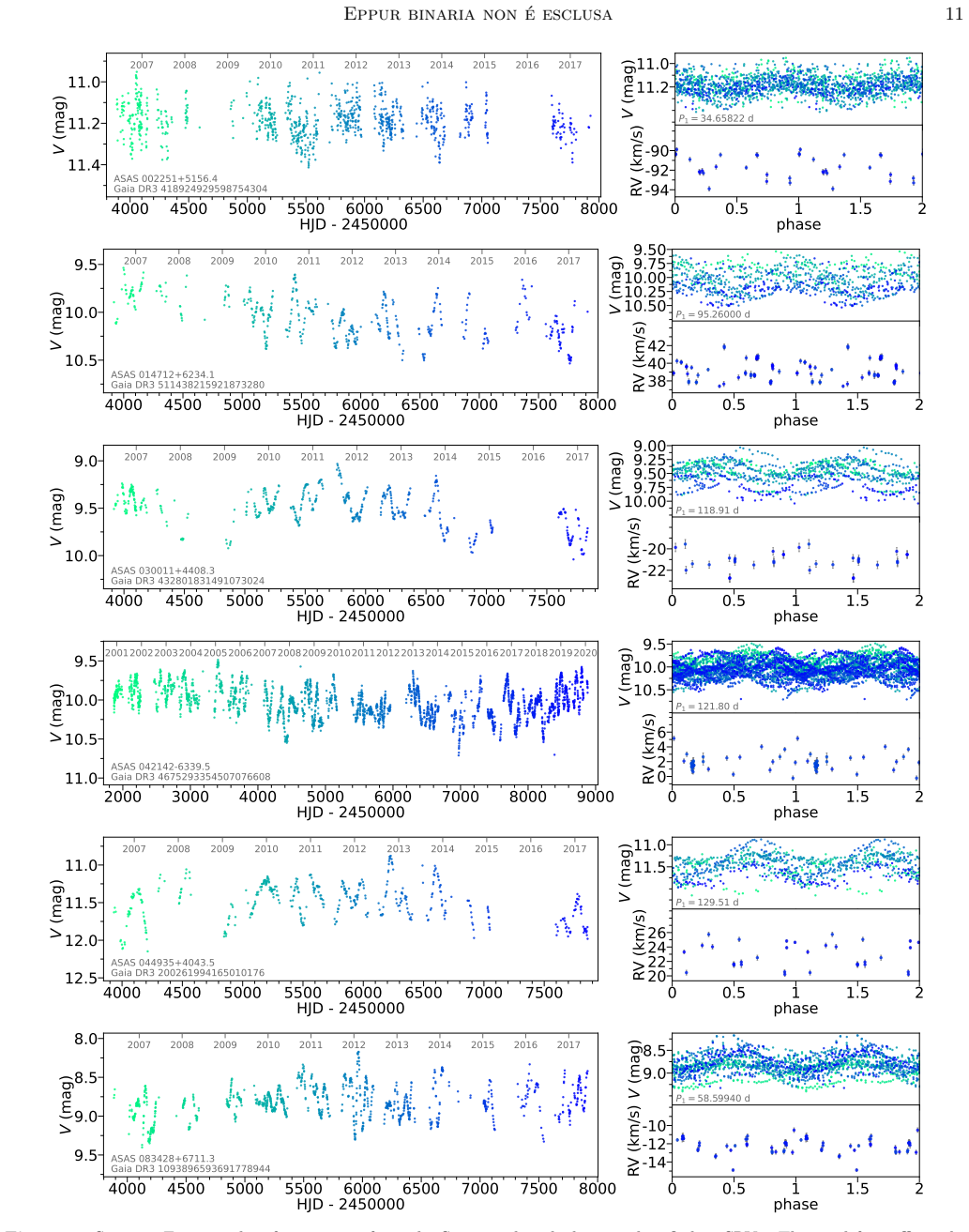
Classification of candidates through visual inspection of long-term ASAS light curves to isolate genuine LSP behavior, followed by comparison of Gaia RUWE observations against RUWE predictions generated by the gaiamock tool for binary configurations.
If this is right
- The sample of 224 LSP candidates analyzed in the prior study is not representative of the classical period-luminosity sequence-D population.
- Nearest LSP stars do not have to show elevated RUWE values as a direct consequence of binarity.
- The binary hypothesis for LSP stars remains consistent with the observed distance-RUWE relation.
- Conclusions drawn from the full unfiltered sample require revision once non-LSP objects are excluded.
Where Pith is reading between the lines
- Studies of LSP origins that rely on photometrically unverified samples may carry similar contamination and should apply light-curve vetting first.
- Higher-precision astrometry from future surveys could directly test whether any residual RUWE signal appears once samples are cleaned.
- The period-luminosity sequence-D population may contain a smaller fraction of binaries than previously inferred from contaminated catalogs.
Load-bearing premise
Visual inspection of ASAS light curves can reliably and objectively separate true LSP stars from semi-regular variables without introducing selection bias that affects the distance-RUWE comparison.
What would settle it
An independent, automated or multi-observer classification of the same ASAS light curves that assigns a substantially higher fraction of the sample to true LSPs while still showing no RUWE excess in the cleaned set.
Figures
read the original abstract
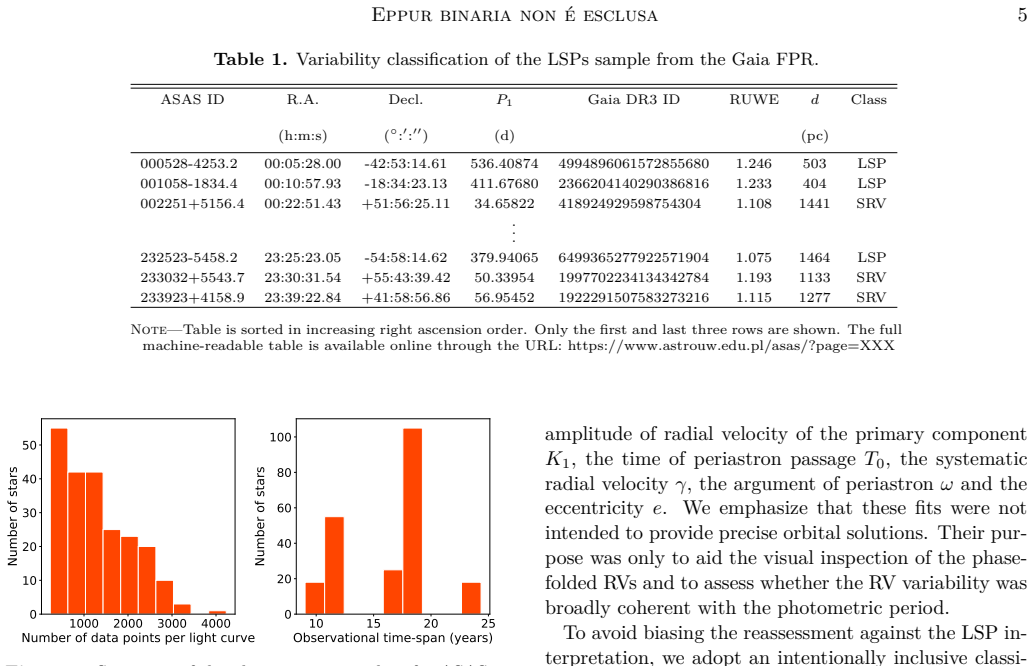
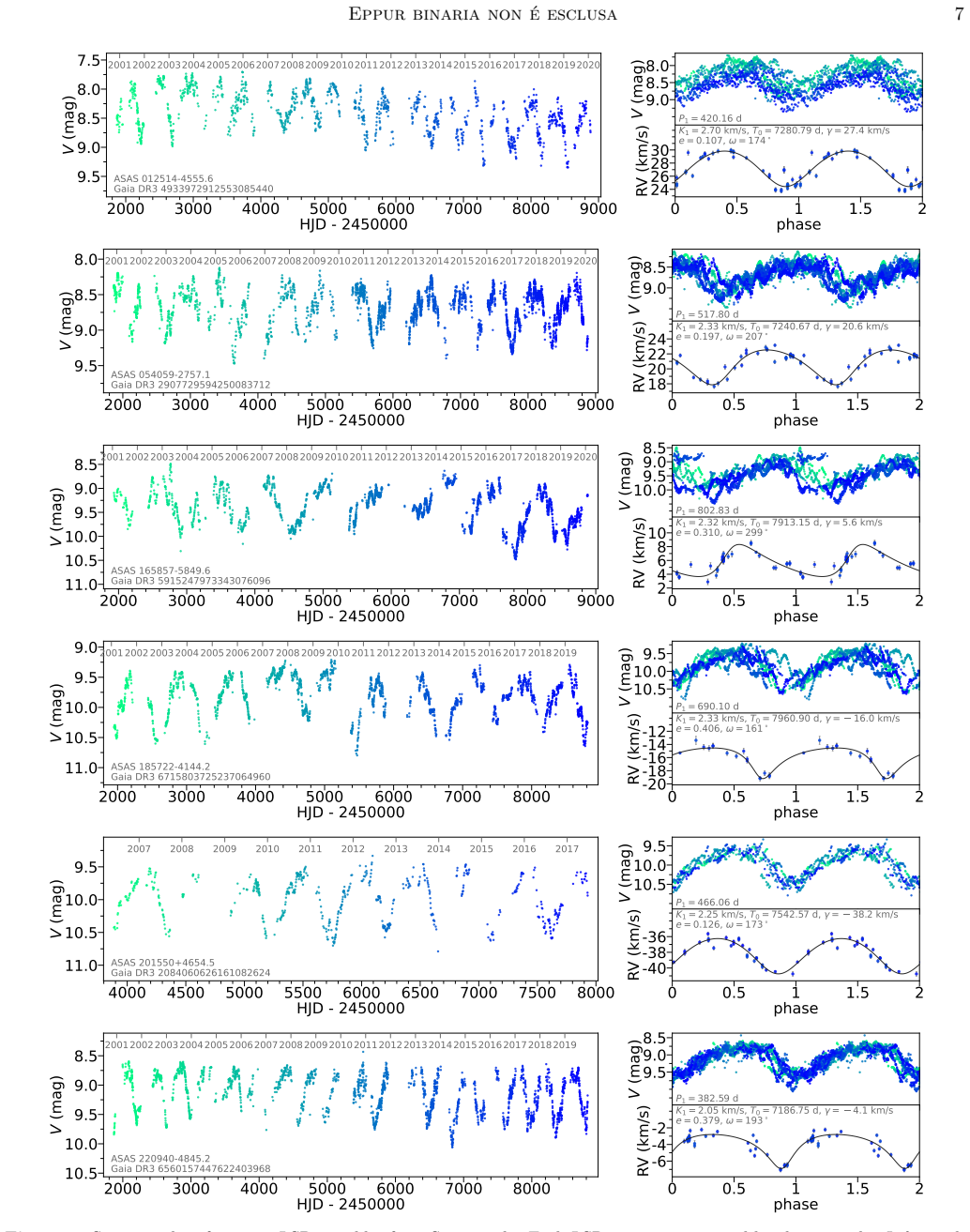
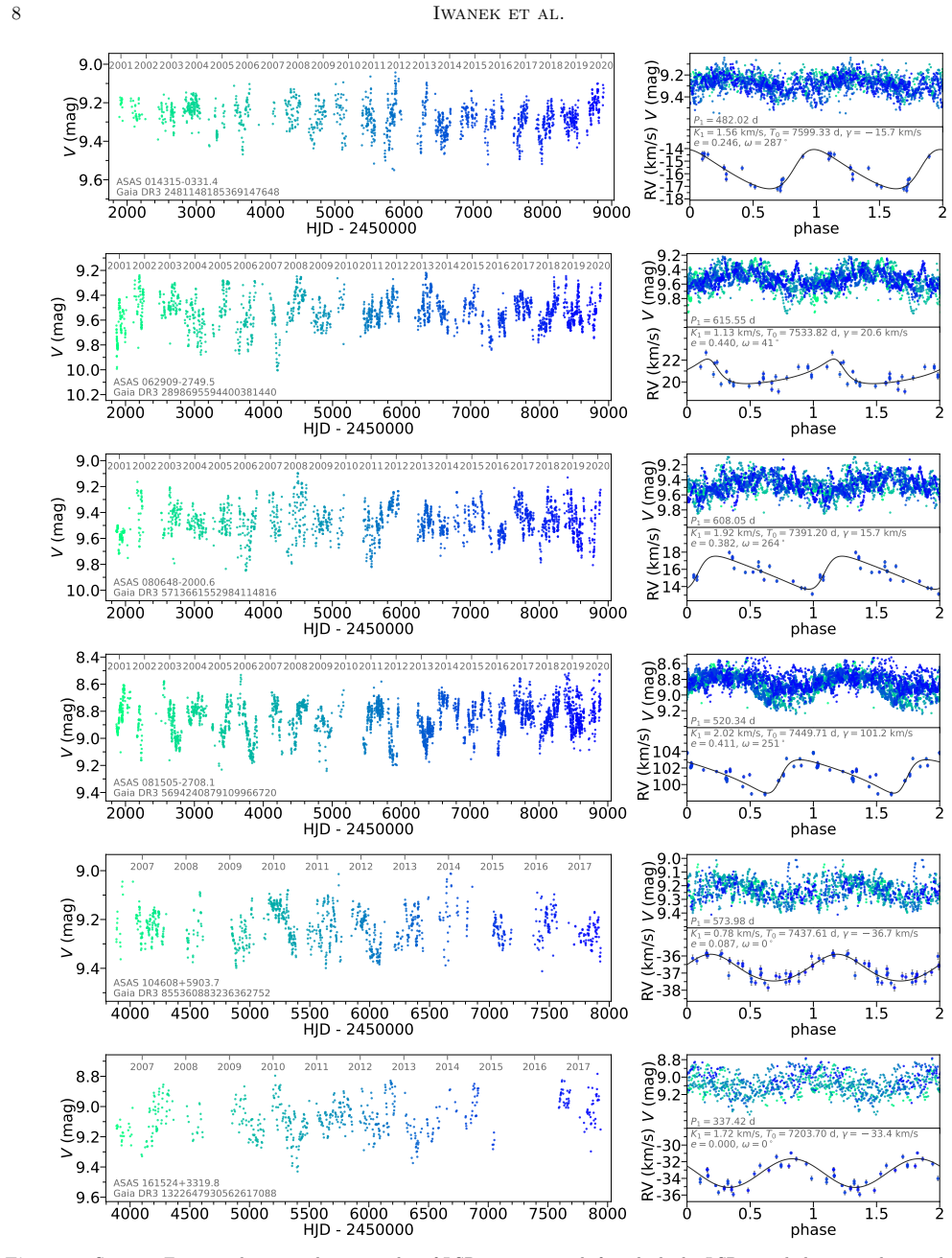
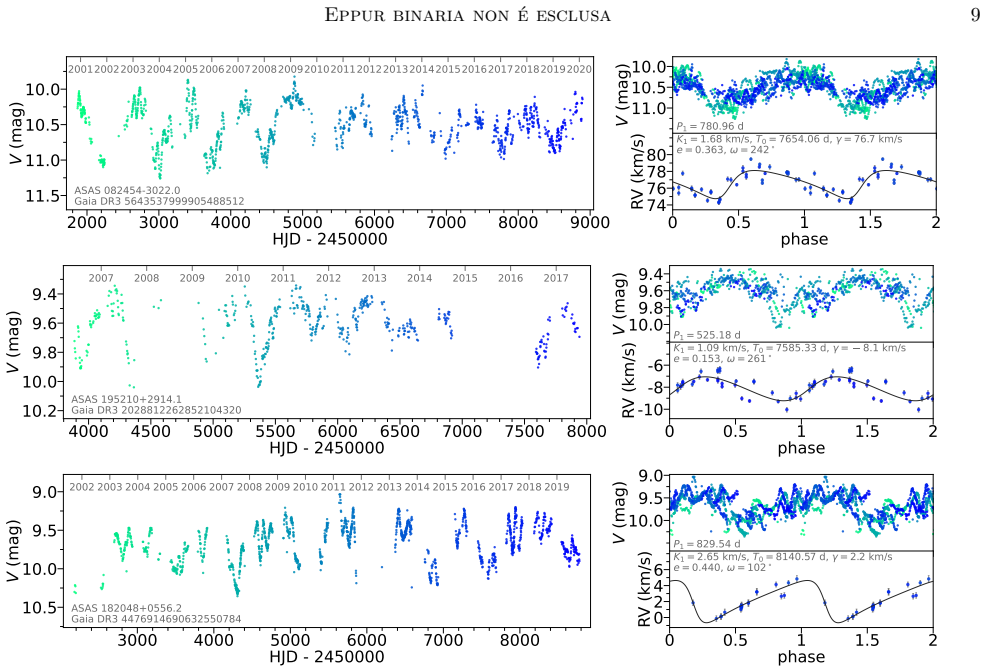
We present an independent reassessment of the nearby long secondary period (LSP) stars analyzed by Shariat et al. (2026). By inspecting long-term All Sky Automated Survey (ASAS) light curves, together with Gaia Focused Product Release (Gaia FPR) radial velocity (RV) curves, for 221 LSP candidates (out of 224) located within 1.5 kpc from the Sun, we find that less than half of the sample (103 objects, $\sim 47$%) exhibit convincing LSP-like behavior. The remaining part of the sample could be more naturally interpreted as that of semi-regular variables (SRVs), characterized by irregular or multi-periodic pulsations. This indicates that the analyzed sample is significantly contaminated by non-LSP objects and therefore is not representative of the classical period-luminosity sequence-D population. Using the gaiamock tool to predict Gaia renormalized unit weight error (RUWE) values for binary systems, we show that even the nearest LSP stars do not have to exhibit elevated RUWE values as a consequence of their binarity. We also argue that the binary-nature hypothesis for LSP stars does not lead to a discrepancy between the observed and expected distance-RUWE relation for these variables.
Editorial analysis
A structured set of objections, weighed in public.
Referee Report
Summary. The paper reexamines 221 nearby LSP candidates (within 1.5 kpc) from Shariat et al. (2026) via visual inspection of ASAS light curves and Gaia FPR RV curves. It concludes that only 103 objects (~47%) exhibit convincing LSP-like behavior while the remainder are better classified as semi-regular variables, indicating significant sample contamination. Using the gaiamock tool, the authors show that binary systems need not produce elevated RUWE and argue that the binary hypothesis for LSPs produces no discrepancy with the observed distance-RUWE relation.
Significance. If the classification holds, the contamination result would be relevant for interpretations of the period-luminosity sequence-D population. The explicit use of gaiamock to generate falsifiable RUWE predictions for binaries is a methodological strength that grounds the consistency argument.
major comments (2)
- [Abstract] Abstract: the claim that 103 objects (~47%) exhibit 'convincing LSP-like behavior' is presented without quantitative criteria (e.g., periodogram power thresholds, amplitude ratios, or period stability metrics) or uncertainty estimates on the fraction; this classification is load-bearing for both the contamination conclusion and the subsequent distance-RUWE analysis restricted to the 103-object subsample.
- [Classification procedure] Classification procedure: the separation of the 221 ASAS light curves into 103 LSPs versus SRVs rests entirely on visual inspection with no reported inter-rater reliability, blinded protocol, or test for correlation between classification judgment and Gaia astrometric quality (RUWE or photocenter motion); any such correlation would render the 'no discrepancy' result for the binary hypothesis circular.
minor comments (1)
- [Abstract] Abstract: the selection of the 221 candidates from the original 224 is stated but not detailed with respect to the three excluded objects or any additional filters applied before visual inspection.
Simulated Author's Rebuttal
We thank the referee for the careful and constructive review. We address the two major comments point by point below. Where the comments correctly identify areas needing greater clarity, we have revised the manuscript accordingly.
read point-by-point responses
-
Referee: [Abstract] Abstract: the claim that 103 objects (~47%) exhibit 'convincing LSP-like behavior' is presented without quantitative criteria (e.g., periodogram power thresholds, amplitude ratios, or period stability metrics) or uncertainty estimates on the fraction; this classification is load-bearing for both the contamination conclusion and the subsequent distance-RUWE analysis restricted to the 103-object subsample.
Authors: We agree that the abstract and main text would benefit from a clearer description of the classification criteria. The assessment was performed by visual inspection of ASAS light curves and Gaia FPR RV curves, identifying the characteristic stable long secondary period with amplitude and phase properties distinct from the irregular or multi-periodic behavior of SRVs. In the revised manuscript we will expand the methods section to list the specific morphological features used (e.g., presence of a coherent LSP with amplitude ratio ~0.1–0.5 relative to the primary mode and phase stability over the observing baseline) and will note that the reported fraction is approximate, with a brief discussion of borderline cases. Because the classification rests on established visual criteria rather than automated metrics, we cannot retroactively impose periodogram thresholds that were not applied; the revision therefore provides additional qualitative detail rather than new quantitative thresholds. revision: partial
-
Referee: [Classification procedure] Classification procedure: the separation of the 221 ASAS light curves into 103 LSPs versus SRVs rests entirely on visual inspection with no reported inter-rater reliability, blinded protocol, or test for correlation between classification judgment and Gaia astrometric quality (RUWE or photocenter motion); any such correlation would render the 'no discrepancy' result for the binary hypothesis circular.
Authors: The classification was carried out solely on the basis of the photometric and RV time series; no Gaia astrometric quantities entered the decision. Consequently, a correlation between classification outcome and RUWE (or photocenter motion) is not possible by construction, removing any risk of circularity in the subsequent distance–RUWE analysis. We acknowledge that the procedure is a single-expert visual assessment without inter-rater reliability or blinded protocols, which is a methodological limitation common to many variable-star studies but still merits explicit mention. In the revised manuscript we will add a dedicated paragraph in the methods section stating (i) the data sources used for classification, (ii) the independence from astrometric parameters, and (iii) the absence of formal inter-rater testing, thereby addressing the referee’s concern directly. revision: yes
Circularity Check
No significant circularity; derivation relies on external data and simulation tool
full rationale
The paper classifies LSP candidates via visual inspection of external ASAS light curves and predicts RUWE values using the external gaiamock tool on Gaia data. No equations or parameters are fitted from the analyzed sample and then renamed as predictions of the same quantities. No self-citations are invoked as load-bearing uniqueness theorems or ansatzes. The distance-RUWE argument applies the external tool to the visually selected subsample without the selection criterion being defined in terms of RUWE or distance. The chain is therefore self-contained against external benchmarks and does not reduce to its inputs by construction.
Axiom & Free-Parameter Ledger
axioms (2)
- domain assumption Visual inspection of long-term light curves can reliably distinguish LSP from SRV behavior.
- domain assumption The gaiamock tool produces accurate RUWE predictions for binary systems with parameters matching LSP stars.
Reference graph
Works this paper leans on
-
[1]
Demleitner, M., & Andrae, R. 2021, AJ, 161, 147, doi: 10.3847/1538-3881/abd806
work page internal anchor Pith review doi:10.3847/1538-3881/abd806 2021
-
[2]
2020, MNRAS, 496, 1922, doi: 10.1093/mnras/staa1522
Belokurov, V., Penoyre, Z., Oh, S., et al. 2020, MNRAS, 496, 1922, doi: 10.1093/mnras/staa1522
-
[3]
Boffin, H. M. J., & Jones, D. 2025, Contributions of the Astronomical Observatory Skalnate Pleso, 55, 21, doi: 10.31577/caosp.2025.55.3.21
-
[4]
Progress in Particle and Nuclear Physics , volume =
Chen, X., Liu, Z., & Han, Z. 2024, Progress in Particle and Nuclear Physics, 134, 104083, doi: 10.1016/j.ppnp.2023.104083
-
[5]
Danilovich, T., Samaratunge, N., Mori, Y. L., et al. 2025, A&A, 704, A341, doi: 10.1051/0004-6361/202554878
-
[6]
2025, A&A, 703, L23, doi: 10.1051/0004-6361/202557634 Duchˆ ene, G., & Kraus, A
Decin, L., Vermeulen, O., Esseldeurs, M., et al. 2025, A&A, 703, L23, doi: 10.1051/0004-6361/202557634 Duchˆ ene, G., & Kraus, A. 2013, ARA&A, 51, 269, doi: 10.1146/annurev-astro-081710-102602
-
[7]
2024, The Open Journal of Astrophysics, 7, 100, doi: 10.33232/001c.125461
El-Badry, K., Lam, C., Holl, B., et al. 2024, The Open Journal of Astrophysics, 7, 100, doi: 10.33232/001c.125461
-
[8]
El-Badry, K., Rix, H.-W., & Heintz, T. M. 2021, MNRAS, 506, 2269, doi: 10.1093/mnras/stab323
-
[9]
2021, A&A, 649, A5, doi: 10.1051/0004-6361/202039834
Fabricius, C., Luri, X., Arenou, F., et al. 2021, A&A, 649, A5, doi: 10.1051/0004-6361/202039834
-
[10]
Fraser, O. J., Hawley, S. L., & Cook, K. H. 2008, AJ, 136, 1242, doi: 10.1088/0004-6256/136/3/1242 Gaia Collaboration, Trabucchi, M., Mowlavi, N., et al. 2023a, A&A, 680, A36, doi: 10.1051/0004-6361/202347287 Gaia Collaboration, Vallenari, A., Brown, A. G. A., et al. 2023b, A&A, 674, A1, doi: 10.1051/0004-6361/202243940
-
[11]
Goldberg, J. A., Joyce, M., & Moln´ ar, L. 2024, ApJ, 977, 35, doi: 10.3847/1538-4357/ad87f4
-
[12]
Grether, D., & Lineweaver, C. H. 2006, ApJ, 640, 1051, doi: 10.1086/500161
-
[13]
Han, Z.-W., Ge, H.-W., Chen, X.-F., & Chen, H.-L. 2020, Research in Astronomy and Astrophysics, 20, 161, doi: 10.1088/1674-4527/20/10/161 H¨ ofner, S., & Olofsson, H. 2018, A&A Rv, 26, 1, doi: 10.1007/s00159-017-0106-5
-
[14]
1963, AJ, 68, 253, doi: 10.1086/108948
Houk, N. 1963, AJ, 68, 253, doi: 10.1086/108948
-
[15]
Iorio, G., Nagarajan, P., Bobrick, A., et al. 2026, arXiv e-prints, arXiv:2603.20429, doi: 10.48550/arXiv.2603.20429
work page internal anchor Pith review Pith/arXiv arXiv doi:10.48550/arxiv.2603.20429 2026
-
[16]
M., Pojma´ nski, G., & Soszy´ nski, I
Iwanek, P., Skowron, D. M., Pojma´ nski, G., & Soszy´ nski, I. 2025, AcA, 75, 297, doi: 10.32023/0001-5237/75.4.2
-
[17]
2023, A&A, 674, A15, doi: 10.1051/0004-6361/202244241
Lebzelter, T., Mowlavi, N., Lecoeur-Taibi, I., et al. 2023, A&A, 674, A15, doi: 10.1051/0004-6361/202244241
-
[18]
2018, A&A, 616, A2, doi: 10.1051/0004-6361/201832727
Lindegren, L., Hern´ andez, J., Bombrun, A., et al. 2018, A&A, 616, A2, doi: 10.1051/0004-6361/201832727
-
[19]
MacLeod, M., Blunt, S., De Rosa, R. J., et al. 2025, ApJ, 978, 50, doi: 10.3847/1538-4357/ad93c8 Eppur binaria non ´e esclusa17
-
[20]
Marcy, G. W., & Butler, R. P. 2000, PASP, 112, 137, doi: 10.1086/316516
-
[21]
2026, MNRAS, 548, stag704, doi: 10.1093/mnras/stag704
McDonald, I. 2026, MNRAS, 548, stag704, doi: 10.1093/mnras/stag704
-
[22]
Nicholls, C. P., Wood, P. R., Cioni, M.-R. L., & Soszy´ nski, I. 2009, MNRAS, 399, 2063, doi: 10.1111/j.1365-2966.2009.15401.x O’Connell, D. J. K. 1933, Harvard College Observatory Bulletin, 893, 19
-
[23]
2019, MNRAS, 487, 5932, doi: 10.1093/mnras/stz1681
Pawlak, M., Pejcha, O., Jakubˇ c ´ ık, P., et al. 2019, MNRAS, 487, 5932, doi: 10.1093/mnras/stz1681
-
[24]
Payne-Gaposchkin, C. 1954, Annals of Harvard College Observatory, 113, 189 Pojma´ nski, G. 1997, AcA, 47, 467, doi: 10.48550/arXiv.astro-ph/9712146 Pojma´ nski, G. 2001, in Astronomical Society of the Pacific Conference Series, Vol. 246, IAU Colloquium 183: Small Telescope Astronomy on Global Scales, ed. B. Paczynski, W.-P. Chen, & C. Lemme, 53 —. 2002, A...
work page internal anchor Pith review Pith/arXiv arXiv doi:10.48550/arxiv.astro-ph/9712146 1954
-
[25]
Saio, H., Wood, P. R., Takayama, M., & Ita, Y. 2015, MNRAS, 452, 3863, doi: 10.1093/mnras/stv1587
-
[26]
Shariat, C., El-Badry, K., MacLeod, M., & Leiner, E. 2026, PASP, 138, 054202, doi: 10.1088/1538-3873/ae6a70 Soszy´ nski, I., & Udalski, A. 2014, ApJ, 788, 13, doi: 10.1088/0004-637X/788/1/13 Soszy´ nski, I., Dziembowski, W. A., Udalski, A., et al. 2007, AcA, 57, 201, doi: 10.48550/arXiv.0710.2780 Soszy´ nski, I., Udalski, A., Szyma´ nski, M. K., et al. 20...
work page internal anchor Pith review Pith/arXiv arXiv doi:10.1088/1538-3873/ae6a70 2026
-
[27]
Stassun, K. G., & Torres, G. 2021, ApJL, 907, L33, doi: 10.3847/2041-8213/abdaad
-
[28]
Stothers, R. B. 2010, ApJ, 725, 1170, doi: 10.1088/0004-637X/725/1/1170
-
[29]
2020, MNRAS, 492, 1348, doi: 10.1093/mnras/stz3577
Takayama, M., & Ita, Y. 2020, MNRAS, 492, 1348, doi: 10.1093/mnras/stz3577
-
[30]
Takayama, M., Wood, P. R., & Ita, Y. 2015, MNRAS, 448, 464, doi: 10.1093/mnras/stv002
-
[31]
Wood, P. R. 2000a, PASA, 17, 18, doi: 10.1071/AS00018
-
[32]
Wood, P. R., & Nicholls, C. P. 2009, ApJ, 707, 573, doi: 10.1088/0004-637X/707/1/573
-
[33]
Wood, P. R., Olivier, E. A., & Kawaler, S. D. 2004, ApJ, 604, 800, doi: 10.1086/382123
-
[34]
R., Alcock, C., Allsman, R
Wood, P. R., Alcock, C., Allsman, R. A., et al. 1999, in IAU Symposium, Vol. 191, Asymptotic Giant Branch Stars, ed. T. Le Bertre, A. Lebre, & C. Waelkens, 151
1999
discussion (0)
Sign in with ORCID, Apple, or X to comment. Anyone can read and Pith papers without signing in.