Hydrogen-induced lattice cohesion weakening favors atomic displacement
Pith reviewed 2026-06-28 04:56 UTC · model grok-4.3
The pith
Lattice-dissolved hydrogen weakens interatomic cohesion and promotes atomic displacement at sub-threshold stresses.
A machine-rendered reading of the paper's core claim, the machinery that carries it, and where it could break.
Core claim
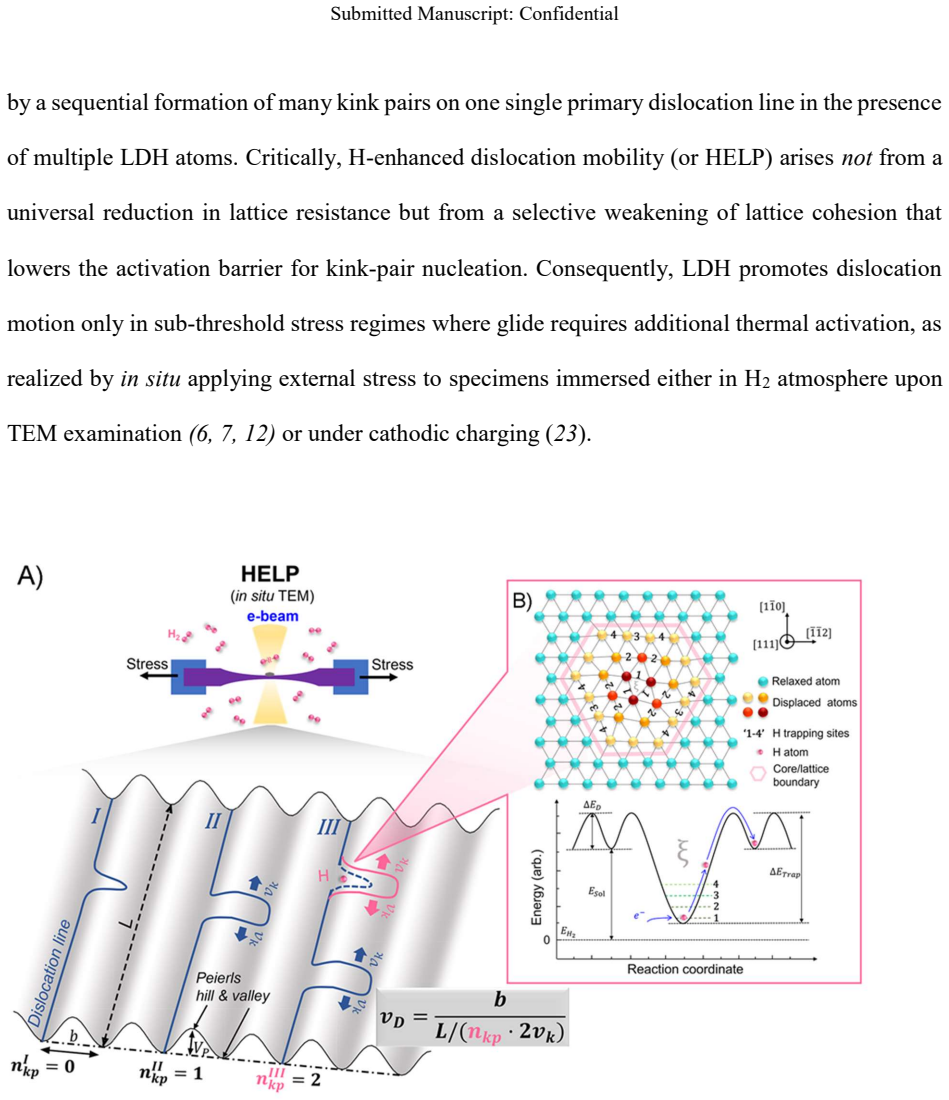
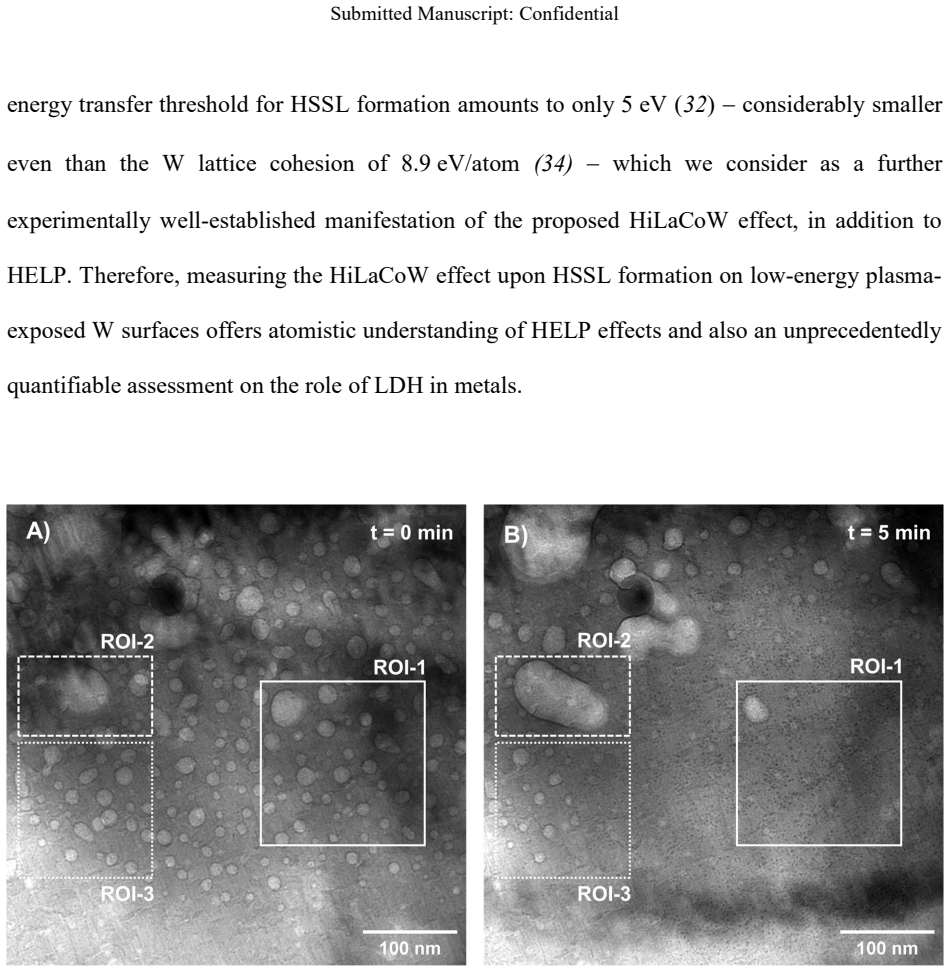
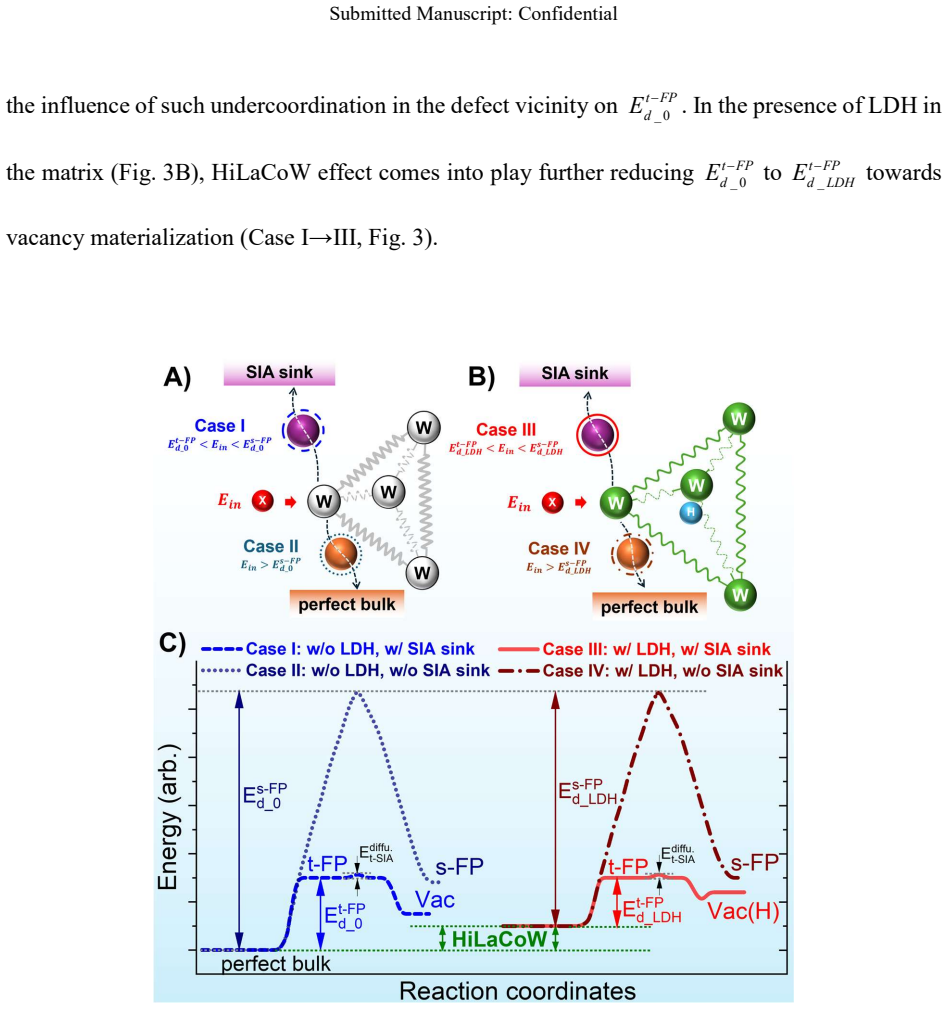
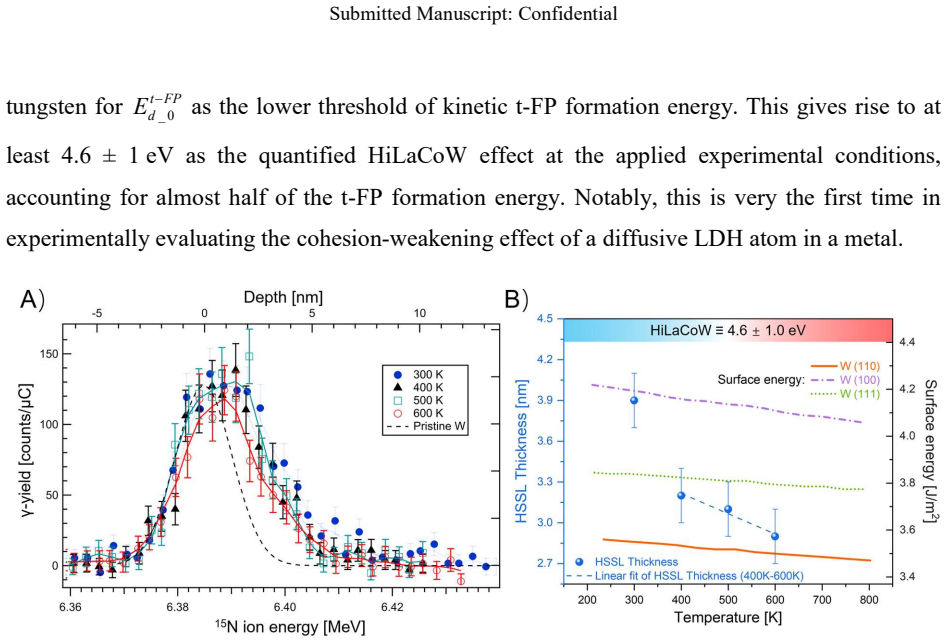
Lattice-dissolved hydrogen (LDH) occurring in metals under direct hydrogen exposure is identified to effectively weaken lattice cohesion, and thereby facilitating atomic displacement and dislocation movement upon plastic deformation in sub-threshold stress regime. This atomic-scale insight provides a physically transparent mechanism for hydrogen-enhanced localized plasticity implicated in hydrogen embrittlement. We quantitatively verify the hydrogen-induced lattice cohesion weakening effect on metal surfaces exposed to low-energy hydrogen plasma, where massive defects are generated despite the absence of sufficient ion momentum for direct displacement damage. By unprecedentedly quantifying t
What carries the argument
lattice-dissolved hydrogen (LDH) as the agent that weakens lattice cohesion to facilitate atomic displacement
If this is right
- Atomic displacement and dislocation motion occur more readily in the presence of LDH even under stresses below the usual threshold.
- Massive surface defects arise from low-energy hydrogen plasma exposure due to reduced cohesion rather than direct ion displacement.
- The cohesion-weakening effect of LDH can be measured separately from contributions of hydrogen trapped at defects.
- Hydrogen-enhanced localized plasticity in embrittlement has a direct atomic-scale origin in reduced interatomic bonding strength.
Where Pith is reading between the lines
- If LDH weakens cohesion, controlling the amount of dissolved hydrogen could be a strategy to reduce embrittlement susceptibility in metals.
- Similar cohesion effects might be tested in other environments where hydrogen or other light atoms dissolve in lattices.
- The approach of using low-energy plasma to isolate the effect could be extended to study other impurity-induced changes in material properties.
Load-bearing premise
Defects generated on metal surfaces by low-energy hydrogen plasma exposure are caused by hydrogen-induced weakening of lattice cohesion rather than any remaining ion momentum or unrelated processes.
What would settle it
If no defects form under low-energy hydrogen plasma when hydrogen is prevented from dissolving into the lattice, or if atomic displacement thresholds remain unchanged with LDH present.
Figures
read the original abstract
Atomic displacement -- the fundamental process underlying diverse deformation and damage phenomena in metals, from irradiation defect production to stress-driven dislocation motion -- is governed by interatomic cohesion strength. Here, lattice-dissolved hydrogen (LDH) occurring in metals under direct hydrogen exposure is identified to effectively weaken lattice cohesion, and thereby facilitating atomic displacement and dislocation movement upon plastic deformation in sub-threshold stress regime. This atomic-scale insight provides a physically transparent mechanism for hydrogen-enhanced localized plasticity implicated in hydrogen embrittlement. We quantitatively verify the hydrogen-induced lattice cohesion weakening effect on metal surfaces exposed to low-energy hydrogen plasma, where massive defects are generated despite the absence of sufficient ion momentum for direct displacement damage. By unprecedentedly quantifying the cohesion-weakening effect of LDH independently from defect-trapped H, we establish a new paradigm to understand hydrogen embrittlement.
Editorial analysis
A structured set of objections, weighed in public.
Referee Report
Summary. The manuscript claims that lattice-dissolved hydrogen (LDH) weakens interatomic cohesion in metals, thereby facilitating atomic displacement and dislocation motion under sub-threshold stresses. This is presented as the mechanism underlying hydrogen-enhanced localized plasticity (HELP) in hydrogen embrittlement. The central evidence is low-energy hydrogen-plasma exposure of metal surfaces producing massive defects despite insufficient ion momentum for direct damage, together with an 'unprecedented' quantification of the LDH cohesion-weakening effect performed independently of defect-trapped hydrogen.
Significance. If the independent quantification of LDH effects and the exclusion of plasma artifacts are robust, the work would supply a physically transparent atomic-scale account of HELP and a new paradigm for hydrogen embrittlement. The attempt to separate LDH from trapped-H contributions is a potential strength, but the soundness of that separation remains unverified from the provided information.
major comments (2)
- Abstract: the claim that the cohesion-weakening effect of LDH has been 'unprecedentedly quantified independently from defect-trapped H' is load-bearing for the central thesis; without an explicit description of the separation procedure (including how LDH concentration is measured or modeled apart from trapped H), the independence cannot be assessed and circularity cannot be ruled out.
- Plasma-exposure experiments (as described in the abstract): the assertion that ion momentum is verifiably insufficient for direct displacement damage is load-bearing; the manuscript must supply the explicit ion-energy threshold calculation, the plasma ion-energy distribution, and control data excluding charging, chemical sputtering, or surface supersaturation before the defects can be attributed to LDH cohesion weakening.
minor comments (1)
- Abstract: the abbreviation LDH is introduced without an immediate parenthetical definition, which reduces immediate readability.
Simulated Author's Rebuttal
We thank the referee for the detailed and constructive report. The comments highlight important points regarding clarity and explicitness in our presentation of the LDH cohesion-weakening quantification and the plasma-exposure controls. We address each major comment below and indicate where revisions will be made.
read point-by-point responses
-
Referee: [—] Abstract: the claim that the cohesion-weakening effect of LDH has been 'unprecedentedly quantified independently from defect-trapped H' is load-bearing for the central thesis; without an explicit description of the separation procedure (including how LDH concentration is measured or modeled apart from trapped H), the independence cannot be assessed and circularity cannot be ruled out.
Authors: The abstract is necessarily concise and therefore omits the procedural details. The full manuscript (Methods section) describes the separation: LDH concentration is obtained from equilibrium solubility models calibrated against independent permeation measurements on defect-free reference samples, while trapped-H contributions are quantified separately via thermal desorption spectroscopy peak deconvolution and subtracted. This uses distinct experimental observables and avoids circularity. We will revise the abstract to include a one-sentence outline of this procedure for immediate accessibility. revision: yes
-
Referee: [—] Plasma-exposure experiments (as described in the abstract): the assertion that ion momentum is verifiably insufficient for direct displacement damage is load-bearing; the manuscript must supply the explicit ion-energy threshold calculation, the plasma ion-energy distribution, and control data excluding charging, chemical sputtering, or surface supersaturation before the defects can be attributed to LDH cohesion weakening.
Authors: The manuscript states that the hydrogen plasma is low-energy and below the displacement threshold, but does not present the supporting calculation or distribution explicitly. We will add these in a revised Methods/Supplementary section: the displacement threshold energy (~25 eV for the metals studied) is compared against the measured plasma ion-energy distribution (peaking below 8 eV with tail <15 eV), together with control data from Ar-plasma exposures at matched conditions showing no comparable defect generation, thereby excluding charging, sputtering, and supersaturation artifacts. This will directly address the load-bearing claim. revision: yes
Circularity Check
No significant circularity; derivation remains independent of inputs
full rationale
The paper's central claim rests on experimental quantification of LDH cohesion weakening isolated from trapped H, presented as unprecedented and independent. No equations, self-citations, or ansatzes are shown reducing the result to a fit or prior self-work by construction. The derivation chain is self-contained against external benchmarks (plasma exposure data, sub-threshold momentum checks) without the forbidden patterns of self-definition or fitted inputs renamed as predictions.
Axiom & Free-Parameter Ledger
axioms (1)
- domain assumption Atomic displacement is governed by interatomic cohesion strength.
invented entities (1)
-
Lattice-dissolved hydrogen (LDH)
no independent evidence
Reference graph
Works this paper leans on
-
[1]
Pundt, R
A. Pundt, R. Kirchheim, HYDROGEN IN METALS: Microstructural Aspects. Ann Rev Mater Res 36, 555-608 (2006)
2006
-
[2]
W. H. Johnson, II. On some remarkable changes produced in iron and steel by the action of hydrogen and acids. Proceedings of the Royal Society of London 23, 168-179 (1875)
-
[3]
M. L. Martin, M. J. Connolly, F. W. DelRio, A. J. Slifka, Hydorgen embrittlement in ferritic steels. Applied Physics Reviews 7, 041301 (2020)
2020
-
[4]
M. B. Djukic, G. M. Bakic, V. Sijacki Zeravcic, A. Sedmak, B. Rajicic, The synergistic action and interplay of hydrogen embrittlement mechanisms in steels and iron: Localized plasticity and decohesion. Eng Fract Mech 216, 106528 (2019)
2019
-
[5]
Barrera et al., Understanding and mitigating hydrogen embrittlement of steels: a review of experimental, modelling and design progress from atomistic to continuum
O. Barrera et al., Understanding and mitigating hydrogen embrittlement of steels: a review of experimental, modelling and design progress from atomistic to continuum. J Mater Sci 53, 6251-6290 (2018)
2018
-
[6]
I. M. Robertson et al., Hydrogen Embrittlement Understood. Metall and Materi Trans B 46, 1085-1103 (2015). Submitted Manuscript: Confidential 16
2015
-
[7]
M. L. Martin, M. Dadfarnia, A. Nagao, S. Wang, P. Sofronis, Enumeration of the hydrogen-enhanced localized plasticity mechanism for H embrittlement in structural materials. Acta Mater 165, 734-750 (2019)
2019
-
[8]
D. Hull, D. J. Bacon, Introduction to dislocations. (Elsevier, 2011), vol. 37
2011
-
[9]
embrittlement
C. D. Beachem, A new model for hydrogen-assisted cracking (Hydorgen “embrittlement”). Metallurgical Transactions 3, 441-455 (1972)
1972
-
[10]
I. M. Robertson, The effect of hydrogen on dislocation dynamics. Eng Fract Mech 68, 671- 692 (2001)
2001
-
[11]
D. Shih, I. Robertson, H. Birnbaum, Hydrogen embrittlement of α titanium: in situ TEM studies. Acta Metallurgica 36, 111-124 (1988)
1988
-
[12]
Huang et al., Quantitative tests revealing hydrogen-enhanced dislocation motion in α- iron
L. Huang et al., Quantitative tests revealing hydrogen-enhanced dislocation motion in α- iron. Nature Materials 22, 710-716 (2023)
2023
-
[13]
D. R. Trinkle, C. Woodward, The Chemistry of Deformation: How Solutes Soften Pure Metals. Science 310, 1665-1667 (2005)
2005
-
[14]
A. H. Cottrell, M. A. Jaswon, Distribution of Solute Atoms Round a Slow Dislocation. Proc. A 199 (1056), 104-114 (1949)
1949
-
[15]
Sofronis, H
P. Sofronis, H. K. Birnbaum, Mechanics of the H-dislocation-impurity interactions—I. Increasing shear modulus. J Mech Phys Solids 43, 49-90 (1995)
1995
-
[16]
M. Wen, S. Fukuyama, K. Yokogawa, Atomistic simulations of effect of hydrogen on kink- pair energetics of screw dislocations in bcc iron. Acta Mater 51, 1767-1773 (2003)
2003
-
[17]
Itakura, H
M. Itakura, H. Kaburaki, M. Yamaguchi, T. Okita, The effect of hydrogen atoms on the screw dislocation mobility in bcc iron: A first-principles study. Acta Mater 61, 6857-6867 (2013)
2013
-
[18]
Li et al., Hydrogen induced dislocation core reconstruction in bcc tungsten
Y.-H. Li et al., Hydrogen induced dislocation core reconstruction in bcc tungsten. Acta Mater 226, 117622 (2022)
2022
-
[19]
Hou et al., Hydrogen modulated dislocation reaction and defect accumulation in bcc metals
J. Hou et al., Hydrogen modulated dislocation reaction and defect accumulation in bcc metals. Acta Mater 301, 121524 (2025)
2025
-
[20]
J. Song, W. A. Curtin, Mechanisms of hydrogen-enhanced localized plasticity: An atomistic study using α-Fe as a model system. Acta Mater 68, 61-69 (2014)
2014
-
[21]
G. Lu, Q. Zhang, N. Kioussis, E. Kaxiras, H-Enhanced Local Plasticity in Aluminum: An Ab Initio Study. Phys Rev Lett 87, 095501 (2001)
2001
-
[22]
Kim, Q.-J
K.-S. Kim, Q.-J. Li, J. Li, C. C. Tasan, Hydrogen can both move or pin dislocations in body-centered cubic metals. Nature Communications 16, 3936 (2025)
2025
-
[23]
Yang et al., Direct Imaging of H-Driven Dislocation and Strain Field Evolution in a Stainless Steel Grain
D. Yang et al., Direct Imaging of H-Driven Dislocation and Strain Field Evolution in a Stainless Steel Grain. Adv Mater 37, e00221 (2025)
2025
-
[24]
P. P. P. O. Borges, E. Clouet, L. Ventelon, Ab initio investigation of the screw dislocation- H interaction in bcc tungsten and iron. Acta Mater 234, (2022)
2022
-
[25]
Leveau, L
T. Leveau, L. Ventelon, M.-C. Marinica, E. Clouet, Segregation of H on screw dislocations in tungsten and its impact on dislocation mobility. Acta Mater 306, 121869 (2026)
2026
-
[26]
N. Abe, H. Suzuki, K. Takai, N. Ishikawa, H. Sueyoshi, paper presented at Materials Science & Technology Conference and Exhibition (MS&T) 2011, Columbus, Ohio, October 16-20 2011
2011
-
[27]
R. D. Ramsier, J. T. Yates, Electron-stimulated desorption: Principles and applications. Surf Sci Rep 12, 246-378 (1991)
1991
-
[28]
Gao et al., Stress-triggered atomic explosion of trapped hydrogen initiates crack nucleation
L. Gao et al., Stress-triggered atomic explosion of trapped hydrogen initiates crack nucleation. http://arxiv.org/abs/2606.03298 (2026)
Pith/arXiv arXiv 2026
-
[29]
Heinola, T
K. Heinola, T. Ahlgren, Diffusion of hydrogen in bcc tungsten studied with first principle calculations. J Appl Phys 107, 113531 (2010). Submitted Manuscript: Confidential 17
2010
-
[30]
Bulatov, W
V. Bulatov, W. Cai, One dislocation at a time. Nat Mater 22, 679-680 (2023)
2023
-
[31]
L. Gao, X. Yi, M. Wilde, T. Schwarz-Selinger, C. Linsmeier, Early-stage structure and evolution mechanism of hydrogen supersaturated surface layers on tungsten under low- energy plasma exposure. Acta Mater 256, 119137 (2023)
2023
-
[32]
L. Gao, M. Wilde, A. Manhard, U. von Toussaint, W. Jacob, Hydrogen atom-ion synergy in surface lattice modification at sub-threshold energy. Acta Mater 201, 55-62 (2020)
2020
-
[33]
Gao et al., Deuterium supersaturation in low-energy plasma-loaded tungsten surfaces
L. Gao et al., Deuterium supersaturation in low-energy plasma-loaded tungsten surfaces. Nucl Fusion 57, 016026 (2017)
2017
-
[34]
Bylander, L
D. Bylander, L. Kleinman, Self-consistent relativistic calculation of the energy bands and cohesive energy of W. Phys Rev B 29, 1534 (1984)
1984
-
[35]
Nordlund et al., Primary radiation damage: A review of current understanding and models
K. Nordlund et al., Primary radiation damage: A review of current understanding and models. J Nucl Mater 512, 450-479 (2018)
2018
-
[36]
Maury, M
F. Maury, M. Biget, P. Vajda, A. Lucasson, P. Lucasson, Frenkel pair creation and stage I recovery in W crystals irradiated near threshold. Radiation Effects 38, 53-65 (1978)
1978
-
[37]
Nakashima, R
K. Nakashima, R. E. Stoller, H. Xu, Recombination radius of a Frenkel pair and capture radius of a self-interstitial atom by vacancy clusters in bcc Fe. Journal of Physics: Condensed Matter 27, 335401 (2015)
2015
-
[38]
R. A. Barker, P. J. Estrup, H on Tungsten(100): Adsorbate-Induced Surface Reconstruction. Phys Rev Lett 41, 1307-1310 (1978)
1978
-
[39]
Starchenko, E
I. Starchenko, E. Sadanov, Features of helium complexes behaviour near the free surface in tungsten. Probl At Sci Technol 120(2), 3-6 (2019)
2019
-
[40]
Heikinheimo et al., Direct observation of mono-vacancy and self-interstitial recovery in tungsten
J. Heikinheimo et al., Direct observation of mono-vacancy and self-interstitial recovery in tungsten. APL Materials 7, 021103 (2019)
2019
-
[41]
D. R. Mason et al., Parameter-free quantitative simulation of high-dose microstructure and hydrogen retention in ion-irradiated tungsten. Phys Rev Mate 5, 095403 (2021)
2021
-
[42]
Wilde, K
M. Wilde, K. Fukutani, Hydrogen detection near surfaces and shallow interfaces with resonant nuclear reaction analysis. Surf Sci Rep 69, 196-295 (2014)
2014
-
[43]
Scheiber, O
D. Scheiber, O. Renk, M. Popov, L. Romaner, Temperature dependence of surface and grain boundary energies from first principles. Phys Rev B 101, (2020)
2020
-
[44]
V. Y. Bodryakov, Correlation of temperature dependences of thermal expansion and heat capacity of refractory metal up to the melting point: Tungsten. High Temp 53, 643-648 (2015)
2015
-
[45]
Fukai, The metal-hydrogen system: basic bulk properties
Y. Fukai, The metal-hydrogen system: basic bulk properties. (Springer Science & Business Media, 2006), vol. 21
2006
-
[46]
S. L. Dudarev, Density Functional Theory Models for Radiation Damage. Ann Rev Mater Res 43, 35-61 (2013)
2013
-
[50]
Qin et al., Surface blistering and deuterium retention in tungsten exposed to low-energy deuterium plasma at different temperatures
S. Qin et al., Surface blistering and deuterium retention in tungsten exposed to low-energy deuterium plasma at different temperatures. Nucl Instr Meth Phys B 450, 210-214 (2019). Submitted Manuscript: Confidential 18 Acknowledgments: Fruitful discussions with Dr. U. von Toussaint, Dr. Y. Ferro and Dr. D. Mason are highly appreciated. AI is employed for l...
2019
-
[51]
Manhard, T
A. Manhard, T. Schwarz-Selinger, W. Jacob, Quantification of the deuterium ion fluxes from a plasma source. Plasma Sources Sci T 20, 015010 (2011)
2011
-
[52]
SDTrimSP Version 5.00
A. Mutzke, R. Schneider, W. Eckstein, R. Dohmen, "SDTrimSP Version 5.00" (Max- Planck-Institut für Plasmaphysik, D-85748, Garching, Germany, 2012)
2012
-
[53]
Eckstein, R
W. Eckstein, R. Dohmen, A. Mutzke, R. Schneider, Max-Planck-Institut für Plasmaphysik, Garching, IPP Report Number: IPP 12/3 (2007)
2007
-
[54]
Qin et al., Surface blistering and deuterium retention in tungsten exposed to low-energy deuterium plasma at different temperatures
S. Qin et al., Surface blistering and deuterium retention in tungsten exposed to low-energy deuterium plasma at different temperatures. Nucl Instr Meth Phys B 450, 210-214 (2019)
2019
discussion (0)
Sign in with ORCID, Apple, or X to comment. Anyone can read and Pith papers without signing in.