Feature Encoding in Quantum Machine Learning: A Survey and Practical Guidelines
Pith reviewed 2026-06-28 05:31 UTC · model grok-4.3
The pith
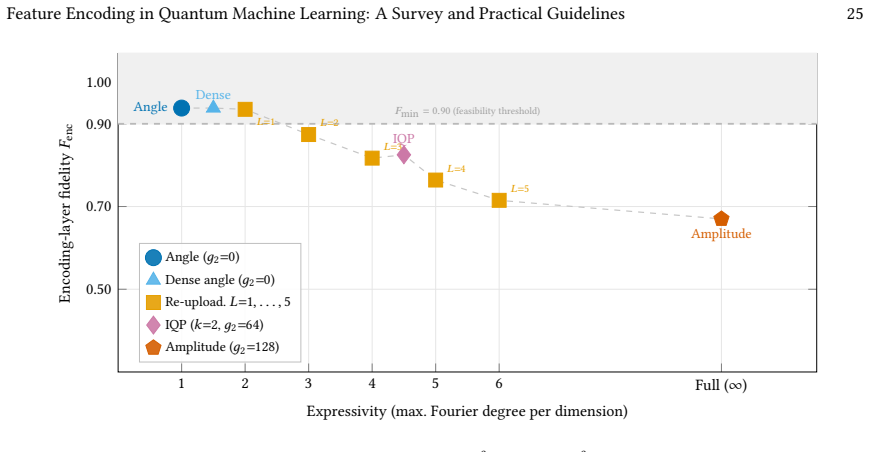
For gate error rates at or above 10^{-3}, shallow angle-based encodings outperform amplitude encoding on NISQ devices in quantum machine learning.
A machine-rendered reading of the paper's core claim, the machinery that carries it, and where it could break.
Core claim
The paper establishes through systematic review and analysis that for error rates p >= 10^{-3}, shallow angle-based encodings consistently outperform amplitude encoding in practice, despite the latter's exponential qubit advantage. It supports this with a taxonomy, closed-form depth-fidelity bounds identifying the critical p* ~ 10^{-3}, and a unified trainability analysis.
What carries the argument
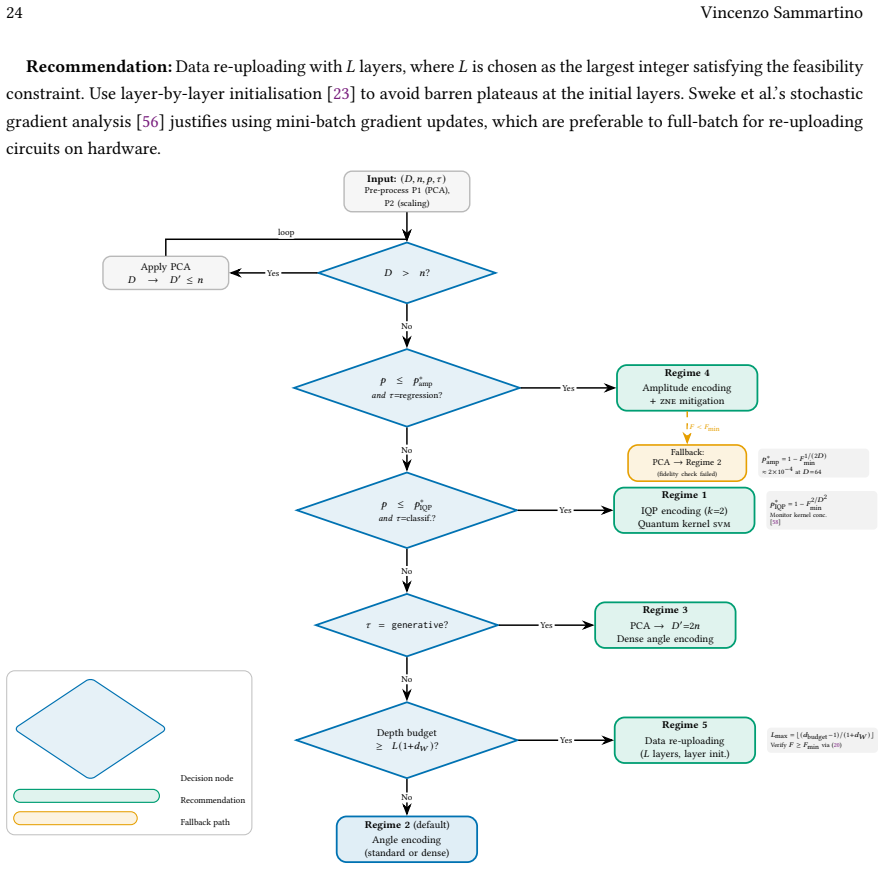
The five-regime decision framework that maps feature dimension D, qubit budget n, error rate p, and task type tau to a hardware-grounded encoding recommendation.
If this is right
- Angle-based encodings are recommended for current NISQ hardware with p >= 10^{-3}.
- Amplitude encoding is viable only when gate error rates drop below approximately 10^{-3}.
- The cost-expressivity-robustness taxonomy enables consistent comparison of encoding families.
- Joint analysis of Fourier expressivity and barren plateaus guides trainability choices.
Where Pith is reading between the lines
- Future hardware improvements below the threshold could shift preference to amplitude encodings.
- The framework might extend to other quantum algorithms using data encoding.
- Real-device experiments could test if additional noise sources alter the predicted p*.
Load-bearing premise
The 66 reviewed works are representative of the literature and the derived depth-fidelity bounds accurately predict real-device performance without unmodeled noise.
What would settle it
A controlled experiment on a NISQ device with p >= 10^{-3} showing higher accuracy or fidelity with amplitude encoding than with shallow angle encodings in a standard QML benchmark would falsify the central finding.
Figures
read the original abstract
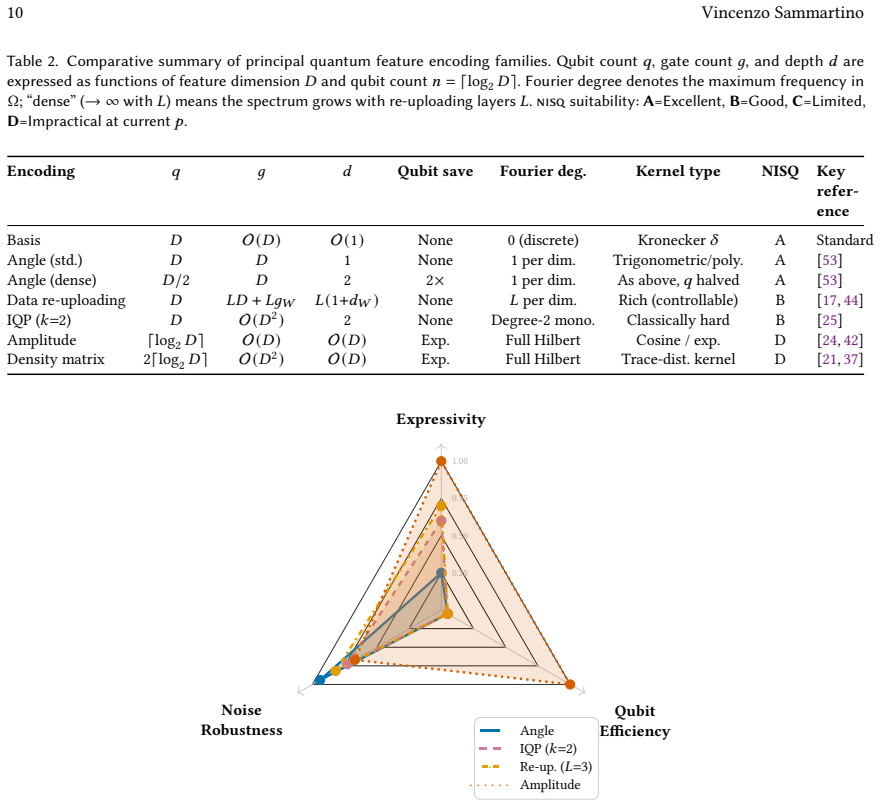
The encoding of classical data into quantum states constitutes the primary performance bottleneck in Quantum Machine Learning (qml) on Noisy Intermediate-Scale Quantum (nisq) devices. No existing framework jointly characterises resource cost, expressivity, and noise robustness, nor provides actionable selection guidelines for practitioners. This survey addresses that gap through a systematic review of 66 primary works (2017-2026) assembled via a PRISMA-adapted protocol across five academic databases. Four principal contributions are made. First, a three-axis cost-expressivity-robustness taxonomy classifies all major encoding families - basis, angle, dense-angle, amplitude, data re-uploading, and IQP - along independently measurable axes. Second, closed-form depth-fidelity bounds under nisq decoherence channels identify the critical gate-error rate p* ~ 10^-3 below which amplitude encoding is viable. Third, a unified treatment of Fourier expressivity, barren-plateau onset, and quantum kernel concentration as functions of the encoding circuit provides the first joint trainability analysis. Fourth, a five-regime decision framework maps (D, n, p, tau) - feature dimension, qubit budget, error rate, and task type - to a hardware-grounded encoding recommendation. The central finding is that for p >= 10^-3, shallow angle-based encodings consistently outperform amplitude encoding in practice, despite the latter's exponential qubit advantage.
Editorial analysis
A structured set of objections, weighed in public.
Referee Report
Summary. The manuscript conducts a systematic review of 66 primary works (2017-2026) on feature encoding in quantum machine learning, assembled via a PRISMA-adapted protocol across five databases. It proposes a three-axis cost-expressivity-robustness taxonomy for encoding families (basis, angle, dense-angle, amplitude, data re-uploading, IQP), derives closed-form depth-fidelity bounds under NISQ decoherence channels that identify a critical gate-error rate p* ~ 10^{-3} below which amplitude encoding becomes viable, provides a unified analysis of Fourier expressivity, barren-plateau onset, and quantum kernel concentration, and introduces a five-regime decision framework mapping (D, n, p, tau) to encoding recommendations. The central claim is that for p >= 10^{-3}, shallow angle-based encodings consistently outperform amplitude encoding in practice despite the latter's exponential qubit advantage.
Significance. If the bounds and synthesis hold, the work supplies actionable, hardware-grounded guidelines for the primary bottleneck in NISQ QML. The joint trainability analysis and systematic review protocol are strengths that aggregate prior results into a coherent framework; the explicit mapping from device parameters to recommendations could directly inform experimental choices.
major comments (2)
- [depth-fidelity bounds section] Section deriving the closed-form depth-fidelity bounds: the p* ~ 10^{-3} threshold is obtained from standard depolarizing/amplitude-damping channels applied to circuit depth, but the derivation omits crosstalk, spectator errors, leakage, and non-Markovian effects that disproportionately affect amplitude encoding's multi-controlled rotations and state-preparation subroutines; without hardware calibration data at relevant error rates, the claim that angle encodings outperform for p >= 10^{-3} rests on an idealized model whose real-device validity is untested.
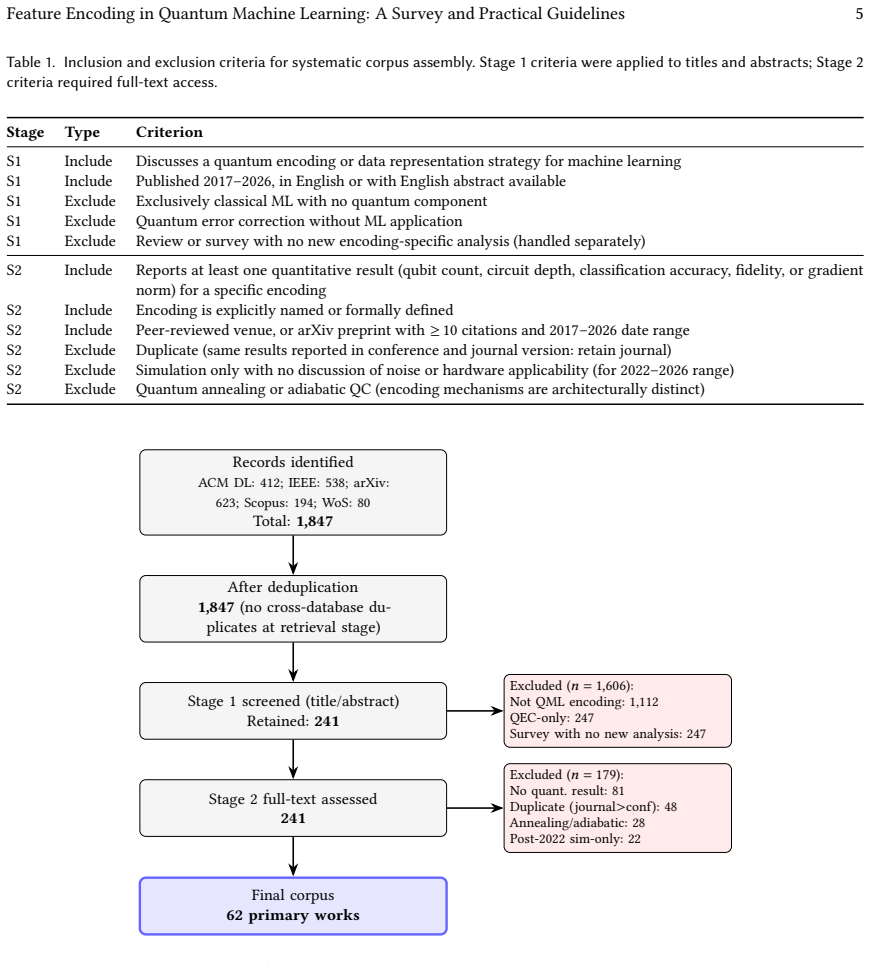
- [survey methodology section] Survey methodology section: the PRISMA-adapted protocol assembles 66 works, yet the precise search strings, database-specific filters, and data-exclusion criteria are not stated in sufficient detail to assess whether the sample is representative or whether post-hoc selection influenced the empirical synthesis supporting the central recommendation.
minor comments (1)
- [decision framework section] Notation for the five-regime framework (D, n, p, tau) is introduced without an explicit table summarizing the regime boundaries and corresponding recommendations.
Simulated Author's Rebuttal
We thank the referee for the constructive feedback and positive evaluation of the manuscript's contributions. We address each major comment below with proposed revisions where the points identify areas for clarification or expansion.
read point-by-point responses
-
Referee: [depth-fidelity bounds section] Section deriving the closed-form depth-fidelity bounds: the p* ~ 10^{-3} threshold is obtained from standard depolarizing/amplitude-damping channels applied to circuit depth, but the derivation omits crosstalk, spectator errors, leakage, and non-Markovian effects that disproportionately affect amplitude encoding's multi-controlled rotations and state-preparation subroutines; without hardware calibration data at relevant error rates, the claim that angle encodings outperform for p >= 10^{-3} rests on an idealized model whose real-device validity is untested.
Authors: We agree that the closed-form bounds are derived under standard Markovian depolarizing and amplitude-damping channels and do not model crosstalk, spectator errors, leakage, or non-Markovian effects, which can impact amplitude encoding more severely. The p* threshold is therefore a theoretical guideline under these idealized NISQ noise models. In revision we will expand the bounds section to state these assumptions explicitly, discuss their potential effect on the threshold, and qualify the central recommendation accordingly. The manuscript aggregates empirical results from the surveyed literature (many involving real or simulated hardware) to support the practical preference for angle encodings at p >= 10^{-3}; we will add a forward-looking note on the value of future calibration-data validation while keeping the scope of the current theoretical analysis clear. revision: partial
-
Referee: [survey methodology section] Survey methodology section: the PRISMA-adapted protocol assembles 66 works, yet the precise search strings, database-specific filters, and data-exclusion criteria are not stated in sufficient detail to assess whether the sample is representative or whether post-hoc selection influenced the empirical synthesis supporting the central recommendation.
Authors: We acknowledge that the current description of the PRISMA-adapted protocol provides an overview but omits the precise search strings, database-specific filters, and exclusion criteria. We will revise the manuscript by expanding the methodology section and/or adding a dedicated appendix that reports the exact queries for each of the five databases, the full inclusion/exclusion criteria, and the quantitative PRISMA flow diagram. This addition will enable readers to evaluate sample representativeness and the robustness of the synthesis. revision: yes
Circularity Check
No circularity: survey synthesis and standard-model bounds are externally grounded
full rationale
The paper is a PRISMA-adapted systematic review aggregating 66 external works across five databases. Its closed-form depth-fidelity bounds are stated to be derived from standard NISQ decoherence channels (not fitted inside the paper), the taxonomy classifies existing families along independent axes, and the five-regime framework maps (D, n, p, tau) to recommendations via synthesized evidence. No quoted step reduces a claimed prediction to a self-defined input, renames a fitted parameter, or loads the central claim on a self-citation chain. The derivation chain remains self-contained against external benchmarks.
Axiom & Free-Parameter Ledger
Reference graph
Works this paper leans on
-
[1]
Amira Abbas, David Sutter, Christa Zoufal, Aurelien Lucchi, Arnulf Figalli, and Stefan Woerner. 2021. The power of quantum neural networks. Nature Computational Science1, 6 (2021), 403–409. doi:10.1038/s43588-021-00084-1
-
[2]
Ruipérez-Valiente, and Félix Gómez Mármol
Mariano Albaladejo-González, José A. Ruipérez-Valiente, and Félix Gómez Mármol. 2024. Artificial intelligence to support the training and assessment of professionals: a systematic literature review.Comput. Surveys57, 3 (2024), 56:1–56:29. doi:10.1145/3699712
-
[3]
Andrew Arrasmith, Marco Cerezo, Piotr Czarnik, Lukasz Cincio, and Patrick J. Coles. 2021. Effect of barren plateaus on gradient-free optimization. Quantum5 (2021), 558. doi:10.22331/q-2021-10-05-558
-
[4]
Bardin, Rami Barends, Rupak Biswas, Sergio Boixo, Fernando G
Frank Arute, Kunal Arya, Ryan Babbush, Dave Bacon, Joseph C. Bardin, Rami Barends, Rupak Biswas, Sergio Boixo, Fernando G. S. L. Brandao, David A. Buell, et al. 2019. Quantum supremacy using a programmable superconducting processor.Nature574, 7779 (2019), 505–510. doi:10.1038/s41586-019- 1666-5
-
[5]
McClean, Michael Newman, Craig Gidney, Sergio Boixo, and Hartmut Neven
Ryan Babbush, Jarrod R. McClean, Michael Newman, Craig Gidney, Sergio Boixo, and Hartmut Neven. 2021. Focus beyond quadratic speedups for error-corrected quantum advantage.PRX Quantum2, 1 (2021), 010103. doi:10.1103/PRXQuantum.2.010103
-
[6]
Jan Balewski, Mercy G. Amankwah, Roel Van Beeumen, E. Wes Bethel, Talita Perciano, and Daan Camps. 2024. Quantum-parallel vectorized data encodings and computations on trapped-ion and transmon QPUs.Scientific Reports14, 1 (2024), 3435. doi:10.1038/s41598-024-53720-x
-
[7]
Marcello Benedetti, Erika Lloyd, Stefan Sack, and Mattia Fiorentini. 2019. Parameterized quantum circuits as machine learning models.Quantum Science and Technology4, 4 (2019), 043001. doi:10.1088/2058-9565/ab4eb5
-
[8]
Jacob Biamonte, Peter Wittek, Nicola Pancotti, Patrick Rebentrost, Nathan Wiebe, and Seth Lloyd. 2017. Quantum machine learning.Nature549, 7671 (2017), 195–202. doi:10.1038/nature23474
-
[9]
Robin Blume-Kohout and Kevin C. Young. 2020. A volumetric framework for quantum computer benchmarks.Quantum4 (2020), 362. doi:10.22331/q- 2020-11-15-362
work page doi:10.22331/q- 2020
-
[10]
High-threshold and low-overhead fault-tolerant quantum mem- ory
Sergey Bravyi, Andrew W. Cross, Jay M. Gambetta, Dmitri Maslov, Patrick Rall, and Theodore J. Yoder. 2024. High-threshold and low-overhead fault-tolerant quantum memory.Nature627, 8005 (2024), 778–782. doi:10.1038/s41586-024-07107-7
-
[11]
Caro, Hsin-Yuan Huang, Marco Cerezo, Kunal Sharma, Andrew Sornborger, Lukasz Cincio, and Patrick J
Matthias C. Caro, Hsin-Yuan Huang, Marco Cerezo, Kunal Sharma, Andrew Sornborger, Lukasz Cincio, and Patrick J. Coles. 2022. Generalization in quantum machine learning from few training data.Nature Communications13, 1 (2022), 4919. doi:10.1038/s41467-022-32550-3
-
[12]
Caro, Hsin-Yuan Huang, Nicholas Ezzell, Joe Gibbs, Andrew T
Matthias C. Caro, Hsin-Yuan Huang, Nicholas Ezzell, Joe Gibbs, Andrew T. Sornborger, Lukasz Cincio, Patrick J. Coles, and Zoë Holmes. 2023. Out-of-distribution generalization for learning quantum dynamics.Nature Communications14, 1 (2023), 3751. doi:10.1038/s41467-023-39381-w
-
[13]
Variational quantum algorithms,
Marco Cerezo, Andrew Arrasmith, Ryan Babbush, Simon C. Benjamin, Suguru Endo, Keisuke Fujii, Jarrod R. McClean, Kosuke Mitarai, Xiao Yuan, Lukasz Cincio, and Patrick J. Coles. 2021. Variational quantum algorithms.Nature Reviews Physics3, 9 (2021), 625–644. doi:10.1038/s42254-021-00348-9
-
[14]
Marco Cerezo, Akira Sone, Tyler Volkoff, Lukasz Cincio, and Patrick J. Coles. 2021. Cost function dependent barren plateaus in shallow parametrized quantum circuits.Nature Communications12, 1 (2021), 1791. doi:10.1038/s41467-021-21728-w
-
[15]
Christopher Chamberland and Andrew W. Cross. 2020. Fault-tolerant weave codes.Quantum4 (2020), 369. doi:10.22331/q-2020-12-07-369
-
[16]
Andrew M. Childs. 2010. On the relationship between continuous- and discrete-time quantum walk.Communications in Mathematical Physics294, 2 (2010), 581–603
2010
-
[17]
Tarun Dutta, Adrián Pérez-Salinas, Jasper Phua Sing Cheng, José I. Latorre, and Manas Mukherjee. 2022. Single-qubit universal classifier implemented on an ion-trap quantum device.Physical Review A106, 1 (2022), 012411. doi:10.1103/PhysRevA.106.012411
-
[18]
Suguru Endo, Simon C. Benjamin, and Ying Li. 2018. Practical quantum error mitigation for near-future applications.Physical Review X8, 3 (2018), 031027. doi:10.1103/PhysRevX.8.031027
-
[19]
Francisco Javier Gil Vidal and Dirk Oliver Theis. 2020. Input redundancy for parameterized quantum circuits.Frontiers in Physics8 (2020), 297. doi:10.3389/fphy.2020.00297
-
[20]
Tudor Giurgica-Tiron, Yousef Hindy, Ryan LaRose, Andrea Mari, and William J. Zeng. 2020. Digital zero noise extrapolation for quantum error mitigation. In2020 IEEE International Conference on Quantum Computing and Engineering (QCE). IEEE, 306–316. doi:10.1109/QCE49297.2020.00045
-
[21]
González, Alejandro Gallego, Santiago Toledo-Cortés, and Vladimir Vargas-Calderón
Fabio A. González, Alejandro Gallego, Santiago Toledo-Cortés, and Vladimir Vargas-Calderón. 2022. Learning with density matrices and random features.Quantum Machine Intelligence4, 2 (2022), 23. doi:10.1007/s42484-022-00079-9
-
[22]
Takahiro Goto, Quoc Hoan Tran, and Kohei Nakajima. 2021. Universal approximation property of quantum machine learning models in quantum- enhanced feature spaces.Physical Review Letters127, 9 (2021), 090506. doi:10.1103/PhysRevLett.127.090506
-
[23]
Edward Grant, Leonard Wossnig, Mateusz Ostaszewski, and Marcello Benedetti. 2019. An initialization strategy for addressing barren plateaus in parametrized quantum circuits.Quantum3 (2019), 214. doi:10.22331/q-2019-12-09-214
-
[24]
Lov K. Grover and Terry Rudolph. 2002. Creating superpositions that correspond to efficiently integrable probability distributions. (2002). arXiv:quant-ph/0208112 arXiv:quant-ph/0208112
Pith/arXiv arXiv 2002
-
[25]
Vojtěch Havlíček, Antonio D. Córcoles, Kristan Temme, Aram W. Harrow, Abhinav Kandala, Jerry M. Chow, and Jay M. Gambetta. 2019. Supervised learning with quantum-enhanced feature spaces.Nature567, 7747 (2019), 209–212. doi:10.1038/s41586-019-0980-2
-
[26]
Maxwell Henderson, Samriddhi Shakya, Shashindra Pradhan, and Tristan Cook. 2020. Quanvolutional neural networks: powering image recognition with quantum circuits.Quantum Machine Intelligence2, 1 (2020), 2. doi:10.1007/s42484-020-00012-y
-
[27]
Hsin-Yuan Huang, Michael Broughton, Jordan Cotler, Sitan Chen, Jerry Li, Masoud Mohseni, Hartmut Neven, Ryan Babbush, Richard Kueng, John Preskill, and Jarrod R. McClean. 2022. Quantum advantage in learning from experiments.Science376, 6598 (2022), 1182–1186. doi:10.1126/science. Feature Encoding in Quantum Machine Learning: A Survey and Practical Guideli...
-
[28]
Hsin-Yuan Huang, Richard Kueng, and John Preskill. 2021. Information-theoretic bounds on quantum advantage in machine learning.Physical Review Letters126, 19 (2021), 190505. doi:10.1103/PhysRevLett.126.190505
-
[29]
Thomas Hubregtsen, David Wierichs, Elies Gil-Fuster, Peter-Jan H. S. Derks, Paul K. Faehrmann, and Johannes Jakob Meyer. 2022. Training quantum embedding kernels on near-term quantum computers.Physical Review A106, 4 (2022), 042431. doi:10.1103/PhysRevA.106.042431
-
[30]
Fiderer, Hendrik Poulsen Nautrup, Jonas M
Sofiene Jerbi, Lukas J. Fiderer, Hendrik Poulsen Nautrup, Jonas M. Kübler, Hans J. Briegel, and Vedran Dunjko. 2023. Quantum machine learning beyond kernel methods.Nature Communications14, 1 (2023), 517. doi:10.1038/s41467-023-36159-y
-
[31]
Hardware-efficient variational quantum eigensolver for small molecules and quantum magnets,
Abhinav Kandala, Antonio Mezzacapo, Kristan Temme, Maika Takita, Markus Brink, Jerry M. Chow, and Jay M. Gambetta. 2017. Hardware-efficient variational quantum eigensolver for small molecules and quantum magnets.Nature549, 7671 (2017), 242–246. doi:10.1038/nature23879
-
[32]
Applied Physics Reviews 6(2), 021318 (2019) https://doi.org/10.1063/1.5089550 41
Philip Krantz, Morten Kjaergaard, Fei Yan, Terry P. Orlando, Simon Gustavsson, and William D. Oliver. 2019. A quantum engineer’s guide to superconducting qubits.Applied Physics Reviews6, 2 (2019), 021318. doi:10.1063/1.5089550
-
[33]
Martin Larocca, Nathan Ju, Diego García-Martín, Patrick J. Coles, and Marco Cerezo. 2022. Group-invariant quantum machine learning.PRX Quantum3, 3 (2022), 030341. doi:10.1103/PRXQuantum.3.030341
-
[34]
Ryan LaRose and Brian Coyle. 2020. Robust data encodings for quantum classifiers.Physical Review A102, 3 (2020), 032420. doi:10.1103/PhysRevA. 102.032420
-
[35]
Phuc Q. Le, Fangyan Dong, and Kaoru Hirota. 2011. A flexible representation of quantum images for polynomial preparation, image compression, and processing operations.Quantum Information Processing10, 1 (2011), 63–84. doi:10.1007/s11128-010-0177-y
-
[36]
Yunchao Liu, Srinivasan Arunachalam, and Kristan Temme. 2021. A rigorous and robust quantum speed-up in supervised machine learning.Nature Physics17, 9 (2021), 1013–1017. doi:10.1038/s41567-021-01287-z
-
[37]
Seth Lloyd, Maria Schuld, Aroosa Ijaz, Josh Izaac, and Nathan Killoran. 2020. Quantum embeddings for machine learning. arXiv:2001.03622 [quant-ph]
arXiv 2020
-
[38]
Seth Lloyd and Christian Weedbrook. 2018. Quantum generative adversarial learning.Physical Review Letters121, 4 (2018), 040502. doi:10.1103/ PhysRevLett.121.040502
2018
-
[39]
Nature Communications , author =
Jarrod R. McClean, Sergio Boixo, Vadim N. Smelyanskiy, Ryan Babbush, and Hartmut Neven. 2018. Barren plateaus in quantum neural network training landscapes.Nature Communications9, 1 (2018), 4812. doi:10.1038/s41467-018-07090-4
-
[40]
Kosuke Mitarai, Makoto Negoro, Masahiro Kitagawa, and Keisuke Fujii. 2018. Quantum circuit learning.Physical Review A98, 3 (2018), 032309. doi:10.1103/PhysRevA.98.032309
-
[41]
Vartiainen, Ville Bergholm, and Martti M
Mikko Möttönen, Juha J. Vartiainen, Ville Bergholm, and Martti M. Salomaa. 2004. Decompositions of n-qubit Toffoli gates with linear circuit complexity.International Journal of Quantum Information2, 4 (2004), 415–438. doi:10.1142/S0219749904000122
-
[42]
Nielsen and Isaac L
Michael A. Nielsen and Isaac L. Chuang. 2010.Quantum Computation and Quantum Information(10th anniversary ed.). Cambridge University Press, Cambridge
2010
-
[43]
Matthew J. Page, Joanne E. McKenzie, Patrick M. Bossuyt, Isabelle Boutron, Tammy C. Hoffmann, Cynthia D. Mulrow, Larissa Shamseer, Jennifer M. Tetzlaff, Elie A. Akl, Sue E. Brennan, et al. 2021. The PRISMA 2020 statement: an updated guideline for reporting systematic reviews.BMJ372 (2021), n71. doi:10.1136/bmj.n71
-
[44]
Adrián Pérez-Salinas, Alba Cervera-Lierta, Elies Gil-Fuster, and José I. Latorre. 2020. Data re-uploading for a universal quantum classifier.Quantum 4 (2020), 226. doi:10.22331/q-2020-02-06-226
-
[45]
John Preskill. 2018. Quantum computing in the NISQ era and beyond.Quantum2 (2018), 79. doi:10.22331/q-2018-08-06-79
work page internal anchor Pith review doi:10.22331/q-2018-08-06-79 2018
-
[46]
Deepak Ranga, Aryan Rana, Sunil Prajapat, Pankaj Kumar, Kranti Kumar, and Athanasios V. Vasilakos. 2024. Quantum machine learning: exploring the role of data encoding techniques, challenges, and future directions.Mathematics12, 21 (2024), 3318. doi:10.3390/math12213318
-
[47]
Francesc Rodríguez-Díaz, David Gutiérrez-Avilés, Alicia Troncoso, and Francisco Martínez-Álvarez. 2025. A survey of quantum machine learning: foundations, algorithms, frameworks, data and applications.Comput. Surveys58, 4 (2025), 91:1–91:35. doi:10.1145/3764582
-
[48]
Bernhard Schölkopf and Alexander J. Smola. 2002.Learning with Kernels: Support Vector Machines, Regularization, Optimization, and Beyond. MIT Press, Cambridge, MA
2002
-
[49]
Maria Schuld. 2021. Supervised quantum machine learning models are kernel methods. arXiv:2101.11020 [quant-ph] arXiv:2101.11020; adapted as Chapter 6 inMachine Learning with Quantum Computers, 2nd ed., Springer, 2021, doi:10.1007/978-3-030-83098-4_6
-
[50]
Maria Schuld and Nathan Killoran. 2019. Quantum Machine Learning in Feature Hilbert Spaces.Physical Review Letters122, 4 (2019), 040504. doi:10.1103/PhysRevLett.122.040504
-
[52]
2021.Machine Learning with Quantum Computers(2nd ed.)
Maria Schuld and Francesco Petruccione. 2021.Machine Learning with Quantum Computers(2nd ed.). Springer International Publishing, Cham. doi:10.1007/978-3-030-83098-4
-
[53]
Maria Schuld, Ryan Sweke, and Johannes Jakob Meyer. 2021. Effect of data encoding on the expressive power of variational quantum-machine- learning models.Physical Review A103, 3 (2021), 032430. doi:10.1103/PhysRevA.103.032430
-
[54]
Vivek V. Shende, Stephen S. Bullock, and Igor L. Markov. 2006. Synthesis of quantum-logic circuits.IEEE Transactions on Computer-Aided Design of Integrated Circuits and Systems25, 6 (2006), 1000–1010. doi:10.1109/TCAD.2005.855930
-
[55]
Advanced Quantum Technologies , author =
Sukin Sim, Peter D. Johnson, and Alán Aspuru-Guzik. 2019. Expressibility and entangling capability of parameterized quantum circuits for hybrid quantum-classical algorithms.Advanced Quantum Technologies2, 12 (2019), 1900070. doi:10.1002/qute.201900070 32 Vincenzo Sammartino
-
[56]
Fährmann, Barthélémy Meynard-Piganeau, and Jens Eisert
Ryan Sweke, Frederik Wilde, Johannes Meyer, Maria Schuld, Paul K. Fährmann, Barthélémy Meynard-Piganeau, and Jens Eisert. 2020. Stochastic gradient descent for hybrid quantum-classical optimization.Quantum4 (2020), 314. doi:10.22331/q-2020-08-31-314
-
[57]
Kristan Temme, Sergey Bravyi, and Jay M. Gambetta. 2017. Error mitigation for short-depth quantum circuits.Physical Review Letters119, 18 (2017), 180509. doi:10.1103/PhysRevLett.119.180509
work page internal anchor Pith review doi:10.1103/physrevlett.119.180509 2017
-
[58]
Supanut Thanasilp, Samson Wang, Marco Cerezo, and Zoë Holmes. 2024. Exponential concentration in quantum kernel methods.Nature Communications15, 1 (2024), 5200. doi:10.1038/s41467-024-49287-w
-
[59]
Md Palash Uddin, Yong Xiang, Mahmudul Hasan, Jun Bai, Yindi Zhao, and Longxiang Gao. 2025. A systematic literature review of robust federated learning: issues, solutions, and future research directions.Comput. Surveys57, 10 (2025), 245:1–245:62. doi:10.1145/3727643
-
[60]
Guillaume Verdon, Trevor McCourt, Enxhell Luzhnica, Vikash Singh, Stefan Leichenauer, and Jack Hidary. 2019. Quantum Graph Neural Networks. arXiv:1909.12264 [quant-ph]
arXiv 2019
-
[61]
Samson Wang, Enrico Fontana, Marco Cerezo, Kunal Sharma, Akira Sone, Lukasz Cincio, and Patrick J. Coles. 2021. Noise-induced barren plateaus in variational quantum algorithms.Nature Communications12, 1 (2021), 6961. doi:10.1038/s41467-021-27045-6
-
[62]
Manuela Weigold, Johanna Barzen, Frank Leymann, and Marie Salm. 2021. Expanding data encoding patterns for quantum algorithms. InProceedings of the 2021 IEEE 18th International Conference on Software Architecture Companion (ICSA-C). IEEE, 95–101. doi:10.1109/ICSA-C52384.2021.00025
-
[63]
David Wierichs, Josh Izaac, Cody Wang, and Cedric Yen-Yu Lin. 2022. General parameter-shift rules for quantum gradients.Quantum6 (2022), 677. doi:10.22331/q-2022-03-30-677
-
[64]
2014.Quantum Machine Learning: What Quantum Computing Means to Data Mining
Peter Wittek. 2014.Quantum Machine Learning: What Quantum Computing Means to Data Mining. Academic Press, Waltham, MA
2014
-
[65]
Yi Zhang, Kai Lu, Yinghui Gao, and Mo Wang. 2013. NEQR: a novel enhanced quantum representation of digital images.Quantum Information Processing12, 8 (2013), 2833–2860. doi:10.1007/s11128-013-0567-z
-
[66]
Christa Zoufal, Aurélien Lucchi, and Stefan Woerner. 2019. Quantum generative adversarial networks for learning and loading random distributions. npj Quantum Information5, 1 (2019), 103. doi:10.1038/s41534-019-0223-2
discussion (0)
Sign in with ORCID, Apple, or X to comment. Anyone can read and Pith papers without signing in.