Multi-Qubit Dyadic Phase Fixing for Fault-Tolerant Quantum Compilation
Pith reviewed 2026-06-28 05:28 UTC · model grok-4.3
The pith
Dyadic Phase Fixing extracts dyadic-angle rotations from arbitrary circuits to cut T-count by up to 70 percent.
A machine-rendered reading of the paper's core claim, the machinery that carries it, and where it could break.
Core claim
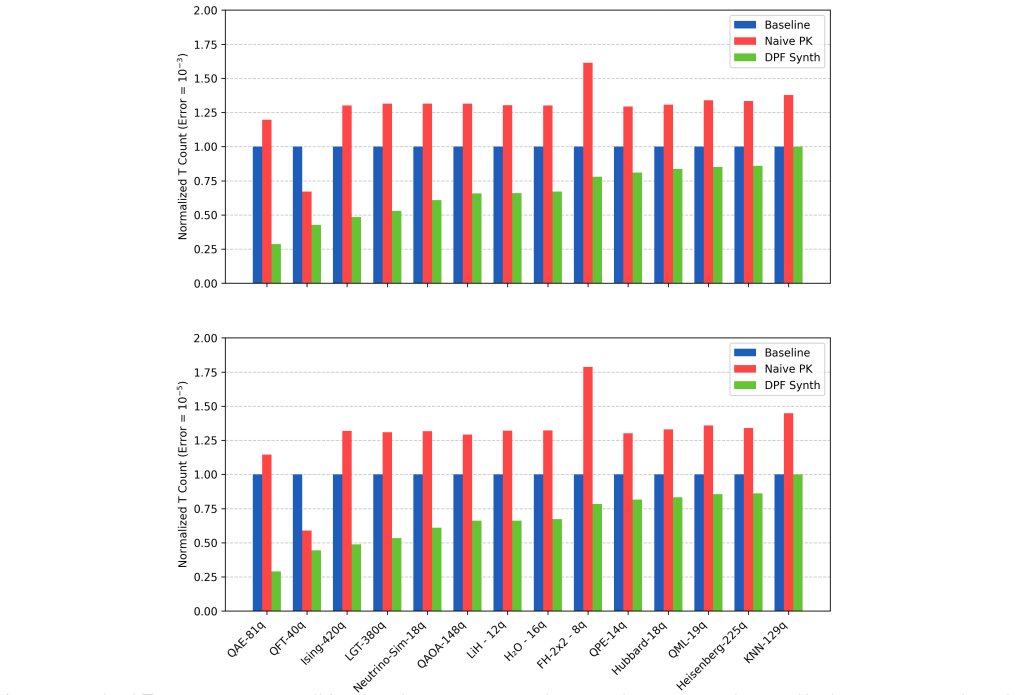
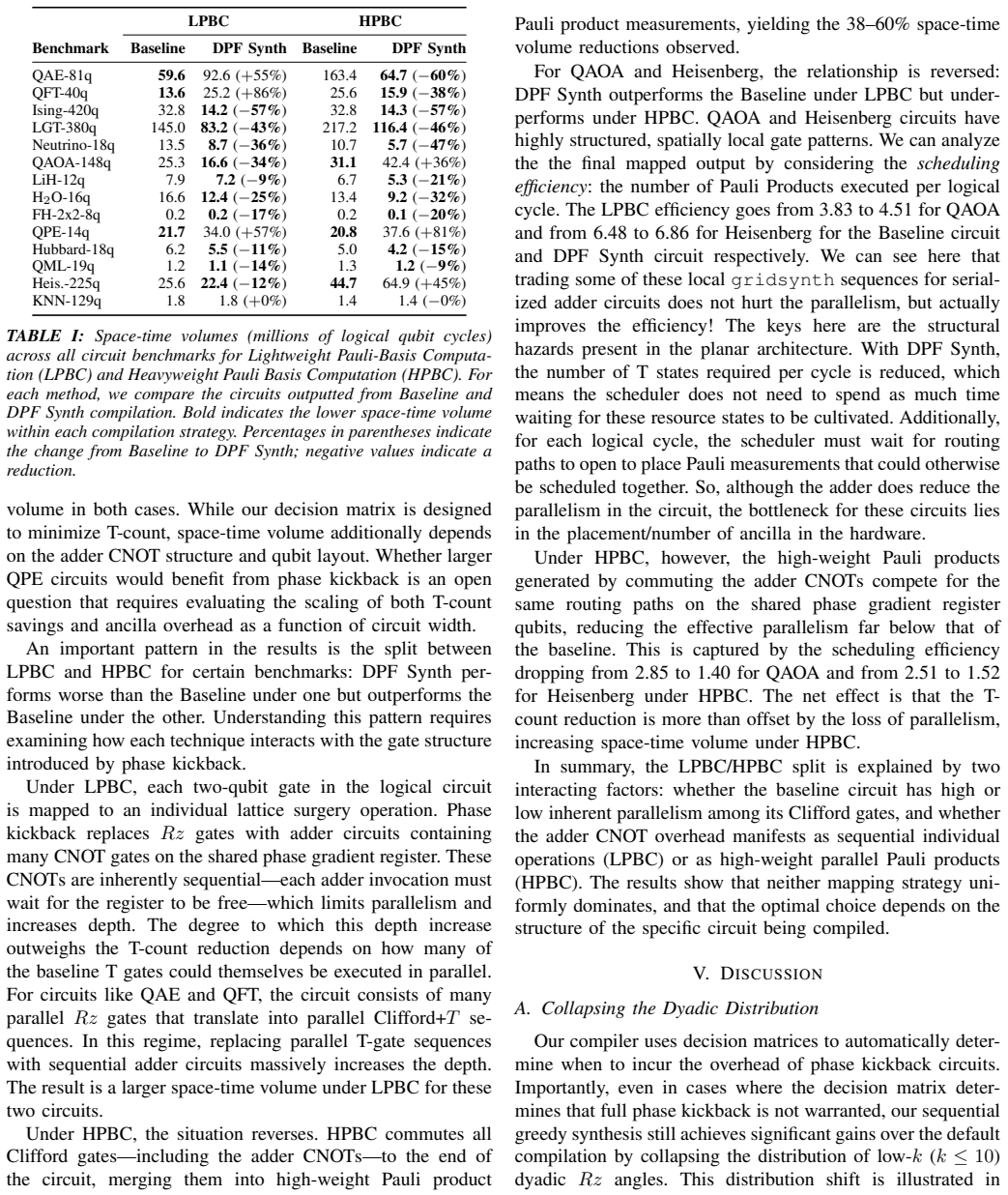
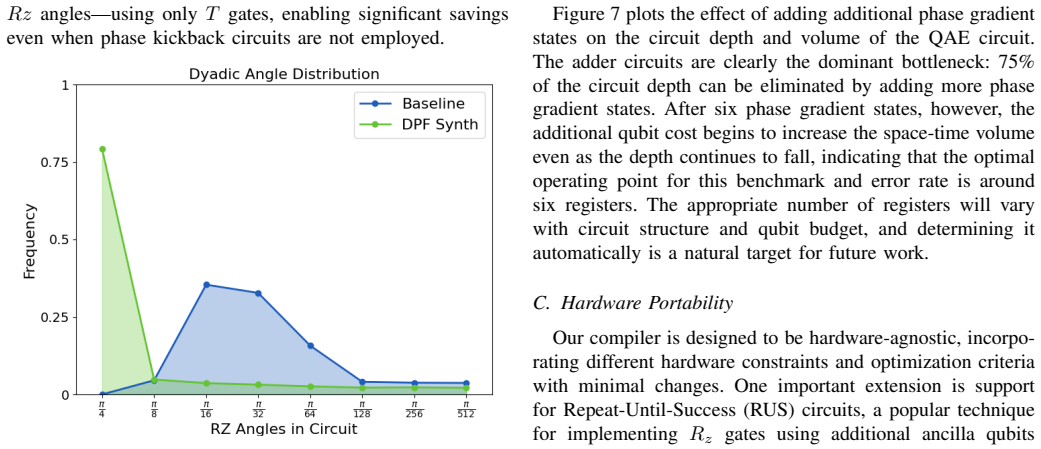
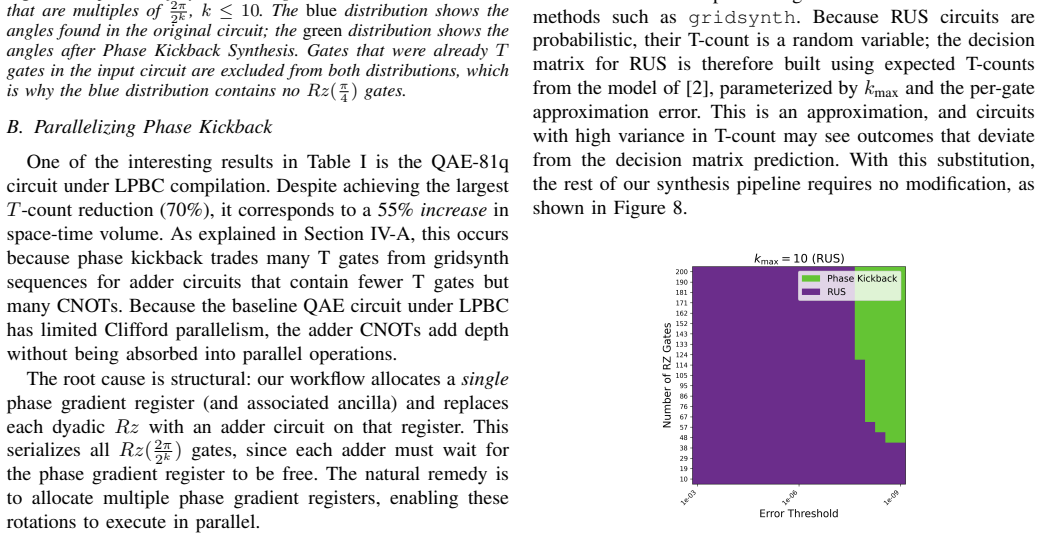
Dyadic Phase Fixing is a multi-qubit synthesis tool that uses numerical unitary synthesis to greedily extract dyadic-angle rotations from general quantum circuits and a decision matrix to size the final phase gradient register, delivering up to 70 percent T-count reduction and up to 60 percent space-time volume reduction on surface-code mappings.
What carries the argument
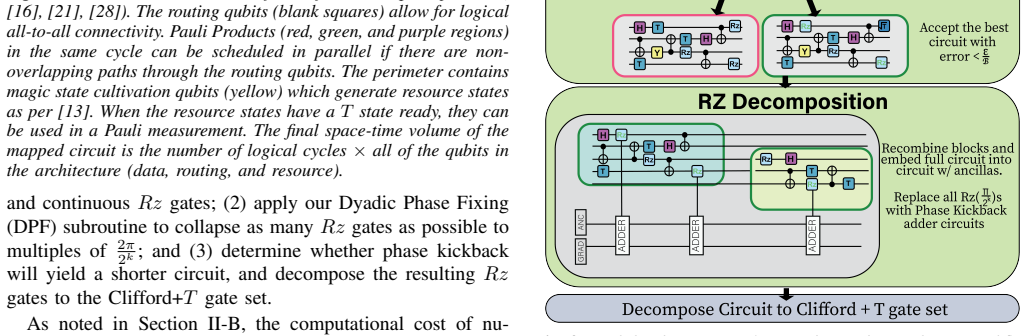
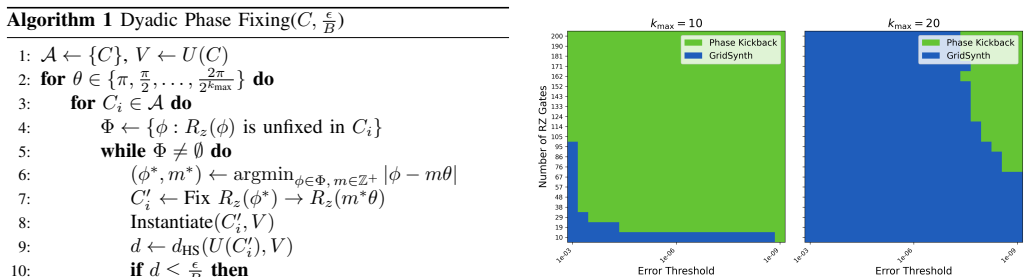
Numerical unitary synthesis that greedily extracts dyadic-angle rotations, combined with a decision matrix for phase gradient register sizing.
Load-bearing premise
Numerical unitary synthesis can reliably extract dyadic-angle rotations from arbitrary circuits without introducing errors or extra overhead that cancels the savings.
What would settle it
A circuit on which the workflow produces a higher T-count than gridsynth or repeat-until-success synthesis.
Figures
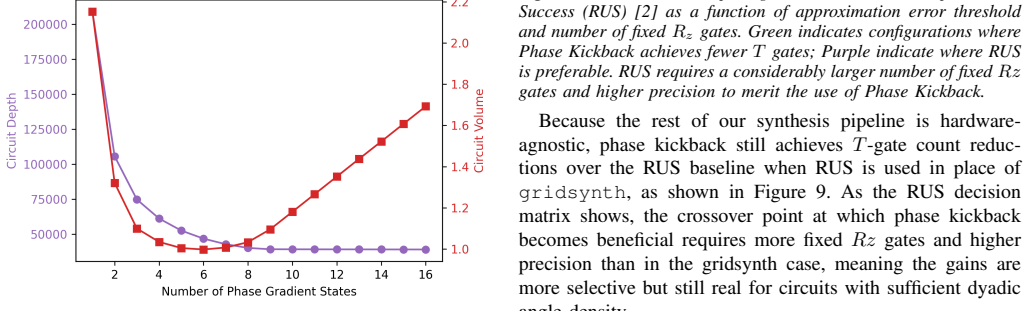
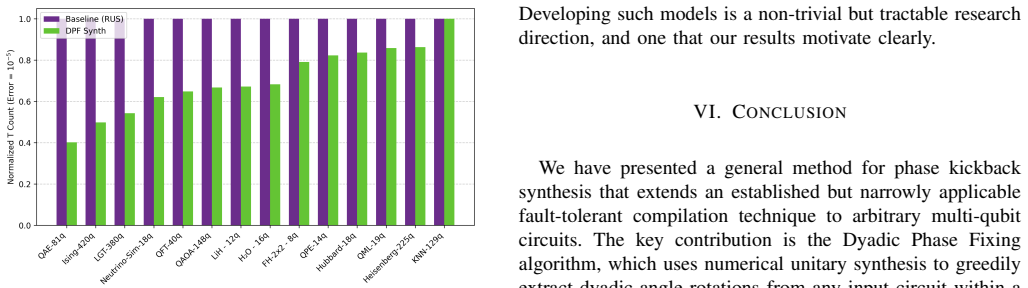
read the original abstract
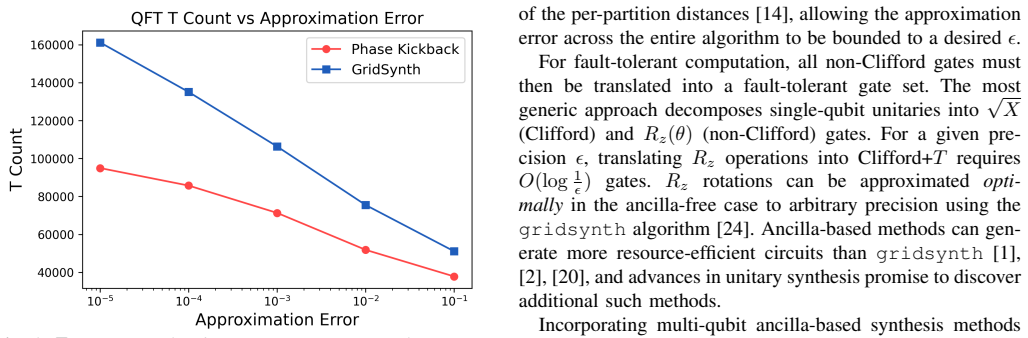
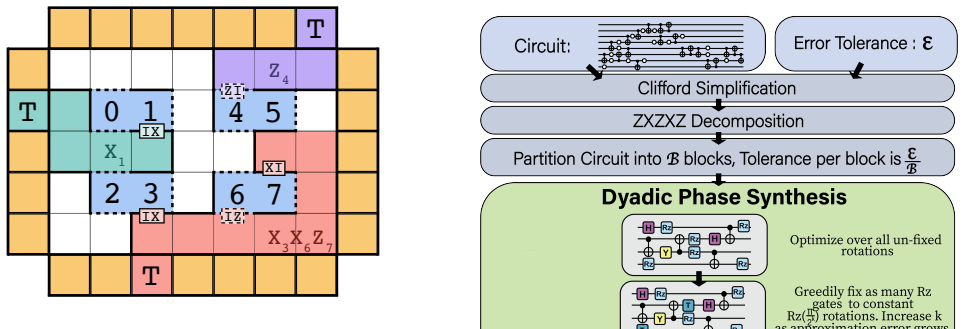
Fault-tolerant quantum computing requires translating application-level quantum circuits into the Clifford+$T$ gate set, where the $T$ gate is the dominant resource cost. Phase kickback is an ancilla-based technique that can dramatically reduce $T$-count for rotations with dyadic angles, but has previously been limited to highly structured circuit families. We present Dyadic Phase Fixing (DPF), a general multi-qubit synthesis tool that extends phase kickback to general quantum circuits. DPF uses numerical unitary synthesis to greedily extract dyadic angle rotations from any input circuit. Combined with a decision matrix to automatically size the final phase gradient register, our end-to-end workflow achieves up to 70% reduction in $T$-count compared to \texttt{gridsynth} and up to 60% compared to Repeat-Until-Success synthesis on a diverse set of benchmarks. We map these compiled circuits to a surface-code architecture to evaluate space-time volume, demonstrating up to a 60\% reduction in this metric as well. However, for some circuits and mapping strategies the two metrics diverge significantly, demonstrating that $T$-count alone is a useful but incomplete proxy for fault-tolerant program costs.
Editorial analysis
A structured set of objections, weighed in public.
Referee Report
Summary. The manuscript introduces Dyadic Phase Fixing (DPF), a general multi-qubit synthesis method that uses numerical unitary synthesis to greedily extract dyadic-angle rotations from arbitrary input circuits, thereby extending phase kickback beyond structured families. Combined with an automatic decision matrix for phase-gradient register sizing, the end-to-end workflow is reported to achieve up to 70% T-count reduction versus gridsynth and 60% versus Repeat-Until-Success synthesis on diverse benchmarks, with up to 60% space-time volume reduction when mapped to surface-code architectures; the authors also note that T-count and space-time metrics can diverge substantially.
Significance. If the numerical extraction step reliably identifies exact dyadic rotations without introducing approximation errors or net overhead, the technique would meaningfully lower the dominant T-gate cost for fault-tolerant compilation of general circuits and provide a concrete demonstration that T-count alone is an incomplete resource proxy. The generalization of phase kickback and the surface-code volume results would be a practical contribution to compilation toolchains.
major comments (2)
- [numerical synthesis subsection] The description of the numerical unitary synthesis procedure (greedy dyadic-angle extraction) supplies no explicit error bounds, floating-point tolerance, convergence criteria, or post-extraction fidelity/unitarity verification. This is load-bearing for the central claim: without these, it is impossible to confirm that the extracted rotations remain exact for arbitrary multi-qubit inputs or that the reported T-count savings are not offset by corrective overhead.
- [benchmark evaluation section] Benchmark results (T-count and space-time volume reductions) are stated without error bars, raw circuit lists, or explicit verification steps against post-hoc selection. This undermines assessment of whether the up-to-70% and up-to-60% figures hold across the full benchmark set or only selected instances.
minor comments (2)
- The abstract and methods mention a 'decision matrix' for register sizing but provide no pseudocode, construction details, or validation against manual sizing.
- Figure captions and tables would benefit from explicit column definitions for 'original T-count', 'DPF T-count', and 'space-time volume' to allow direct comparison with gridsynth and RUS baselines.
Simulated Author's Rebuttal
We thank the referee for their careful reading and constructive feedback on our manuscript. We address each major comment below and will revise the manuscript accordingly to improve clarity and reproducibility.
read point-by-point responses
-
Referee: [numerical synthesis subsection] The description of the numerical unitary synthesis procedure (greedy dyadic-angle extraction) supplies no explicit error bounds, floating-point tolerance, convergence criteria, or post-extraction fidelity/unitarity verification. This is load-bearing for the central claim: without these, it is impossible to confirm that the extracted rotations remain exact for arbitrary multi-qubit inputs or that the reported T-count savings are not offset by corrective overhead.
Authors: We agree that the numerical synthesis subsection requires additional technical detail to substantiate the exactness of extracted dyadic rotations. In the revised manuscript we will add an explicit subsection on numerical parameters, including: floating-point tolerance of 1e-12 for angle matching and unitarity residual; convergence criterion defined as residual norm below tolerance after at most 100 iterations; and post-extraction verification that computes the operator fidelity against the original unitary using exact dyadic arithmetic where possible. Any rotation whose angle deviates beyond tolerance is rejected, ensuring no corrective overhead is introduced and that reported T-count reductions reflect exact dyadic extractions within the stated bound. revision: yes
-
Referee: [benchmark evaluation section] Benchmark results (T-count and space-time volume reductions) are stated without error bars, raw circuit lists, or explicit verification steps against post-hoc selection. This undermines assessment of whether the up-to-70% and up-to-60% figures hold across the full benchmark set or only selected instances.
Authors: The synthesis procedure is fully deterministic, so statistical error bars are not applicable. We will nevertheless strengthen the benchmark section by (i) providing the complete list of benchmark circuits and per-circuit T-count and volume numbers in a supplementary data file, (ii) stating that all circuits in the reported set were processed without post-hoc filtering, and (iii) adding a short verification paragraph confirming that each output circuit was checked for unitary equivalence to the input within the numerical tolerance. Average as well as maximum reductions will also be reported to give a fuller picture of performance across the set. revision: yes
Circularity Check
No significant circularity; workflow is self-contained and benchmark-driven
full rationale
The paper describes an algorithmic workflow (numerical unitary synthesis + greedy dyadic extraction + decision matrix for register sizing) whose claimed T-count and space-time reductions are obtained by direct empirical comparison to external baselines (gridsynth, RUS) on a diverse benchmark set. No equations, fitted parameters, or self-citations are shown that would make any reported reduction equivalent to its own inputs by construction. The central claims rest on the correctness and efficiency of the described synthesis procedure rather than on any definitional loop or imported uniqueness result.
Axiom & Free-Parameter Ledger
Reference graph
Works this paper leans on
-
[1]
Alex Bocharov, Martin Roetteler, and Krysta M. Svore. Efficient synthesis of probabilistic quantum circuits with fallback.Physical Review A, 91(5):052317, May 2015. arXiv:1409.3552 [quant-ph]
work page internal anchor Pith review Pith/arXiv arXiv 2015
-
[2]
Alex Bocharov, Martin Roetteler, and Krysta M. Svore. Efficient synthesis of universal Repeat-Until-Success circuits.Physical Review Letters, 114(8):080502, February 2015. arXiv:1404.5320 [quant-ph]
work page internal anchor Pith review Pith/arXiv arXiv 2015
-
[3]
Campbell and Mark Howard
Earl T. Campbell and Mark Howard. Unified framework for magic state distillation and multiqubit gate synthesis with reduced resource cost. Phys. Rev. A, 95:022316, Feb 2017
2017
-
[4]
Cerezo, Guillaume Verdon, Hsin-Yuan Huang, Lukasz Cincio, and Patrick J
M. Cerezo, Guillaume Verdon, Hsin-Yuan Huang, Lukasz Cincio, and Patrick J. Coles. Challenges and opportunities in quantum machine learning.Nature Computational Science, 2(9):567–576, September
-
[5]
Number: 9 Publisher: Nature Publishing Group
-
[6]
Tian-Fu Chen, Cheng-Han Liu, and Jie-Hong R. Jiang. A holistic approach to rotation synthesis for fault- tolerant quantum computation. In2024 IEEE International Conference on Quantum Computing and Engineering (QCE), volume 01, pages 1026–1036, 2024
2024
-
[7]
Faster quantum chemistry simulation on fault-tolerant quantum com- puters.New Journal of Physics, 14(11):115023, nov 2012
N Cody Jones, James D Whitfield, Peter L McMahon, Man-Hong Yung, Rodney Van Meter, Al ´an Aspuru-Guzik, and Yoshihisa Yamamoto. Faster quantum chemistry simulation on fault-tolerant quantum com- puters.New Journal of Physics, 14(11):115023, nov 2012
2012
-
[8]
PhD thesis, Massachusetts Institute of Technology, 02 2023
Marc Grau Davis.Numerical Synthesis of Arbitrary Multi-Qubit Unitaries with low T-Count. PhD thesis, Massachusetts Institute of Technology, 02 2023
2023
-
[9]
Reducing the quantum- computing overhead with complex gate distillation.Physical Review A, 91(4), April 2015
Guillaume Duclos-Cianci and David Poulin. Reducing the quantum- computing overhead with complex gate distillation.Physical Review A, 91(4), April 2015
2015
-
[10]
Restrictions on transversal encoded quantum gate sets.Phys
Bryan Eastin and Emanuel Knill. Restrictions on transversal encoded quantum gate sets.Phys. Rev. Lett., 102:110502, Mar 2009
2009
-
[11]
A Quantum Approximate Optimization Algorithm
Edward Farhi, Jeffrey Goldstone, and Sam Gutmann. A Quantum Ap- proximate Optimization Algorithm, November 2014. arXiv:1411.4028 [quant-ph]
work page internal anchor Pith review Pith/arXiv arXiv 2014
-
[12]
Fowler, Matteo Mariantoni, John M
Austin G. Fowler, Matteo Mariantoni, John M. Martinis, and Andrew N. Cleland. Surface codes: Towards practical large-scale quantum compu- tation.Physical Review A, 86(3):032324, 2012
2012
-
[13]
Halving the cost of quantum addition.Quantum, 2:74, June 2018
Craig Gidney. Halving the cost of quantum addition.Quantum, 2:74, June 2018
2018
-
[14]
Magic state cultivation: growing t states as cheap as cnot gates, 2024
Craig Gidney, Noah Shutty, and Cody Jones. Magic state cultivation: growing t states as cheap as cnot gates, 2024
2024
-
[15]
Distance measures to compare real and ideal quantum processes
Alexei Gilchrist, Nathan K. Langford, and Michael A. Nielsen. Distance measures to compare real and ideal quantum processes.Physical Review A, 71(6):062310, June 2005. arXiv:quant-ph/0408063
work page internal anchor Pith review Pith/arXiv arXiv 2005
-
[16]
Daniel Gottesman and Isaac L. Chuang. Demonstrating the viability of universal quantum computation using teleportation and single-qubit operations.Nature, 402(6760):390–393, November 1999
1999
-
[17]
Scheduling lattice surgery with magic state cultivation, 2026
Steven Hofmeyr, Mathias Weiden, Justin Kalloor, John Kubiatowicz, and Costin Iancu. Scheduling lattice surgery with magic state cultivation, 2026
2026
-
[18]
Fowler, Simon Devitt, and Rodney Van Meter
Dominic Horsman, Austin G. Fowler, Simon Devitt, and Rodney Van Meter. Surface code quantum computing by lattice surgery.New Journal of Physics, 14(12):123011, 2012
2012
-
[19]
Wood, Jake Lishman, Julien Gacon, Simon Martiel, Paul D
Ali Javadi-Abhari, Matthew Treinish, Kevin Krsulich, Christopher J. Wood, Jake Lishman, Julien Gacon, Simon Martiel, Paul D. Nation, Lev S. Bishop, Andrew W. Cross, Blake R. Johnson, and Jay M. Gambetta. Quantum computing with Qiskit, 2024
2024
-
[20]
Kitaev, Alexander H
Alexei Yu. Kitaev, Alexander H. Shen, and Mikhail N. Vyalyi.Classical and Quantum Computation. American Mathematical Society, 1 edition, 2002
2002
-
[21]
Andrew J. Landahl and Chris Cesare. Complex instruction set computing architecture for performing accurate quantum $Z$ rotations with less magic, October 2013. arXiv:1302.3240 [quant-ph]
work page internal anchor Pith review Pith/arXiv arXiv 2013
-
[22]
A game of surface codes: Large-scale quantum com- puting with lattice surgery.Quantum, 3:128, March 2019
Daniel Litinski. A game of surface codes: Large-scale quantum com- puting with lattice surgery.Quantum, 3:128, March 2019
2019
-
[23]
Synthetiq: Fast and versatile quantum circuit synthesis.Proc
Anouk Paradis, Jasper Dekoninck, Benjamin Bichsel, and Martin Vechev. Synthetiq: Fast and versatile quantum circuit synthesis.Proc. ACM Program. Lang., 8(OOPSLA1), April 2024
2024
-
[24]
Rahman, Randy Lewis, Emanuele Mendicelli, and Sarah Powell
Sarmed A. Rahman, Randy Lewis, Emanuele Mendicelli, and Sarah Powell. Self-mitigating Trotter circuits for SU(2) lattice gauge theory on a quantum computer.Physical Review D, 106(7):074502, October
- [25]
-
[26]
Ross and Peter Selinger
Neil J. Ross and Peter Selinger. Optimal ancilla-free clifford+t approx- imation of z-rotations, 2016
2016
-
[27]
Smith, Shraddha Singh, and Shruti Puri
Kaavya Sahay, Pei-Kai Tsai, Kathleen Chang, Qile Su, Thomas B. Smith, Shraddha Singh, and Shruti Puri. Fold-transversal surface code cultivation, 2025
2025
-
[28]
Sanders, Dominic W
Yuval R. Sanders, Dominic W. Berry, Pedro C.S. Costa, Louis W. Tessler, Nathan Wiebe, Craig Gidney, Hartmut Neven, and Ryan Bab- bush. Compilation of fault-tolerant quantum heuristics for combinatorial optimization.PRX Quantum, 1:020312, Nov 2020
2020
-
[29]
Peter W. Shor. Scheme for reducing decoherence in quantum computer memory.Physical Review A, 52(4):R2493, Oct 1995
1995
-
[30]
Multi-qubit lattice surgery scheduling
Allyson Silva, Xiangyi Zhang, Zak Webb, Mia Kramer, Chan-Woo Yang, Xiao Liu, Jessica Lemieux, Ka-Wai Chen, Artur Scherer, and Pooya Ronagh. Multi-qubit lattice surgery scheduling. In19th Conference on the Theory of Quantum Computation, Communication and Cryptography (TQC 2024), volume 310 ofLeibniz International Proceedings in Infor- matics (LIPIcs), page...
2024
-
[31]
Seyon Sivarajah, Silas Dilkes, Alexander Cowtan, Will Simmons, Alec Edgington, and Ross Duncan. tket : A Retargetable Compiler for NISQ Devices.Quantum Science and Technology, 6(1):014003, January 2021. arXiv:2003.10611 [quant-ph]
-
[32]
Multiple particle interference and quantum error correction.Proceedings of the Royal Society A: Mathematical, Physical and Engineering Sciences, 452, 01 1996
Andrew Steane. Multiple particle interference and quantum error correction.Proceedings of the Royal Society A: Mathematical, Physical and Engineering Sciences, 452, 01 1996
1996
-
[33]
Efficient magic state cultivation on the surface code, 2025
Yotam Vaknin, Shoham Jacoby, Arne Grimsmo, and Alex Retzker. Efficient magic state cultivation on the surface code, 2025
2025
-
[34]
High-precision multi-qubit clifford+t synthesis by uni- tary diagonalization.Electronic Proceedings in Theoretical Computer Science, 426:215–230, August 2025
Mathias Weiden, Justin Kalloor, John Kubiatowicz, Ed Younis, and Costin Iancu. High-precision multi-qubit clifford+t synthesis by uni- tary diagonalization.Electronic Proceedings in Theoretical Computer Science, 426:215–230, August 2025
2025
-
[35]
Ed Younis, Costin C. Iancu, Wim Lavrijsen, Marc Davis, and Ethan Smith. Berkeley quantum synthesis toolkit (bqskit) v1. [Computer Software] https://doi.org/10.11578/dc.20210603.2, apr 2021
discussion (0)
Sign in with ORCID, Apple, or X to comment. Anyone can read and Pith papers without signing in.