Interplay of non-local transport and local scattering during electron thermalization and spatial equilibration in laser-excited metals
Pith reviewed 2026-06-28 04:53 UTC · model grok-4.3
The pith
In laser-excited metals, electron transport makes thermalization appear faster at the surface but delays full system equilibration.
A machine-rendered reading of the paper's core claim, the machinery that carries it, and where it could break.
Core claim
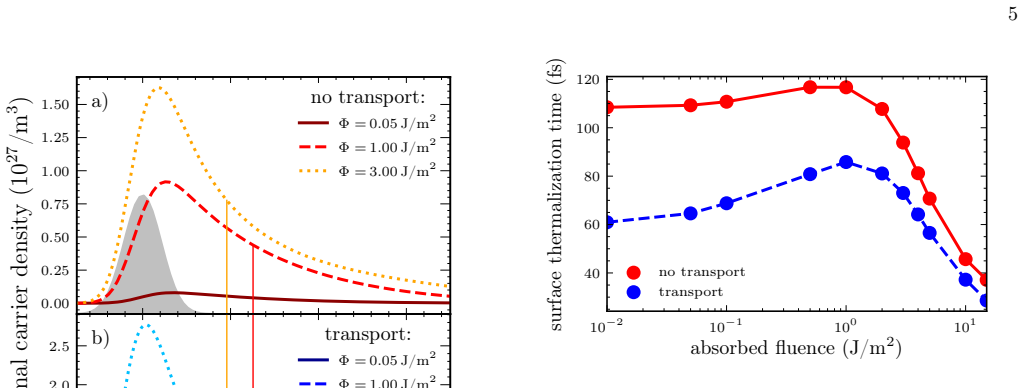
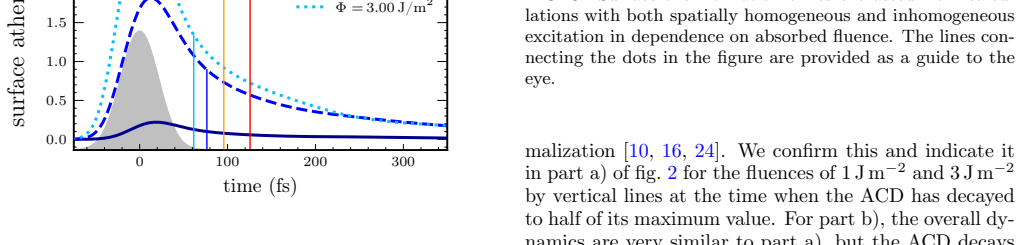
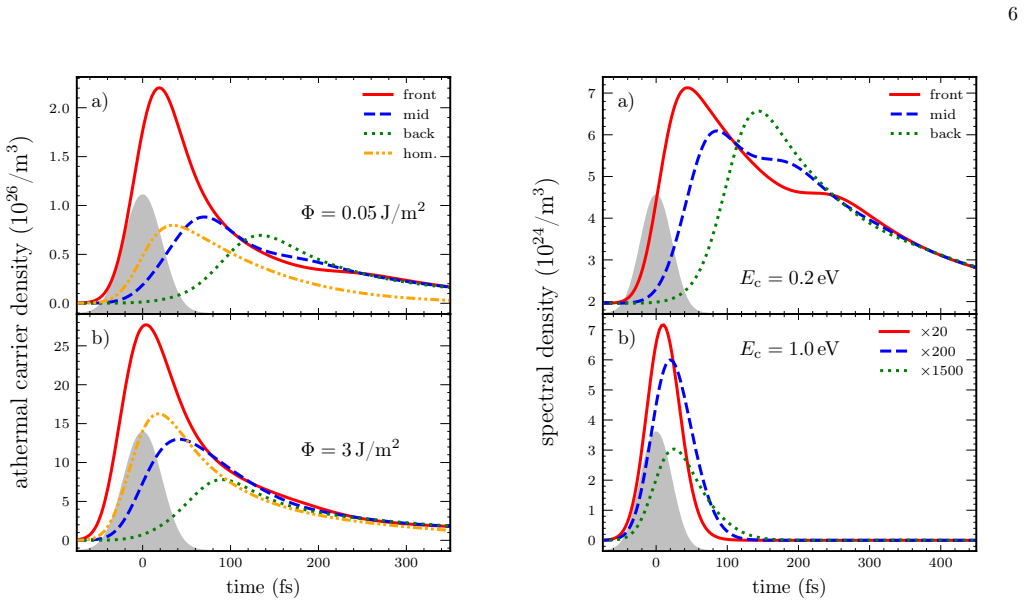
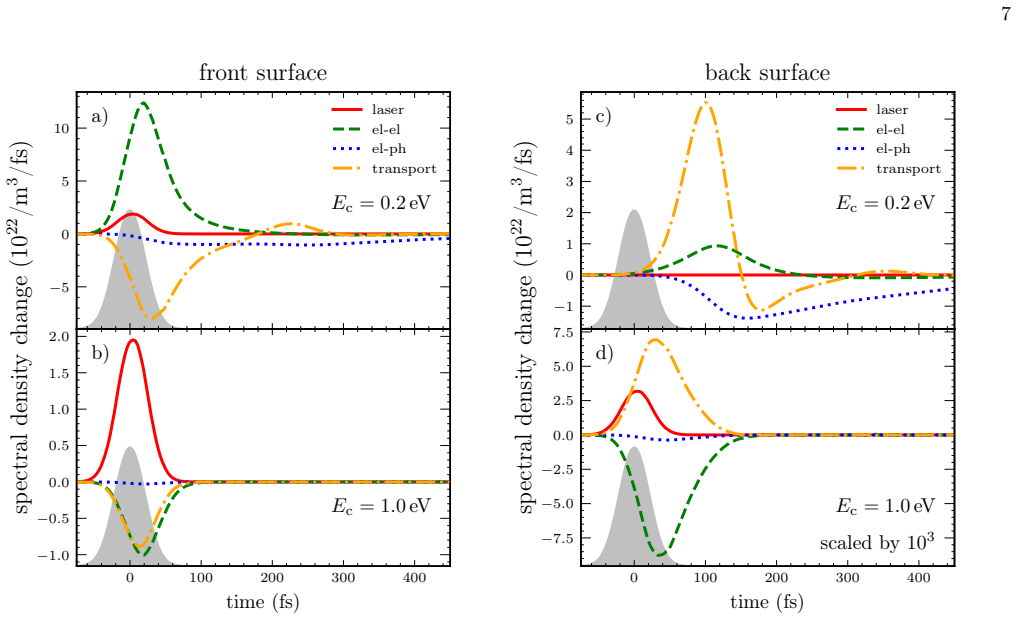
Transport accelerates the apparent thermalization observed at the irradiated surface by removing athermal carriers, while the same spatial redistribution delays complete equilibration of the full electron system. The dominant process varies with position and with the energetic window examined.
What carries the argument
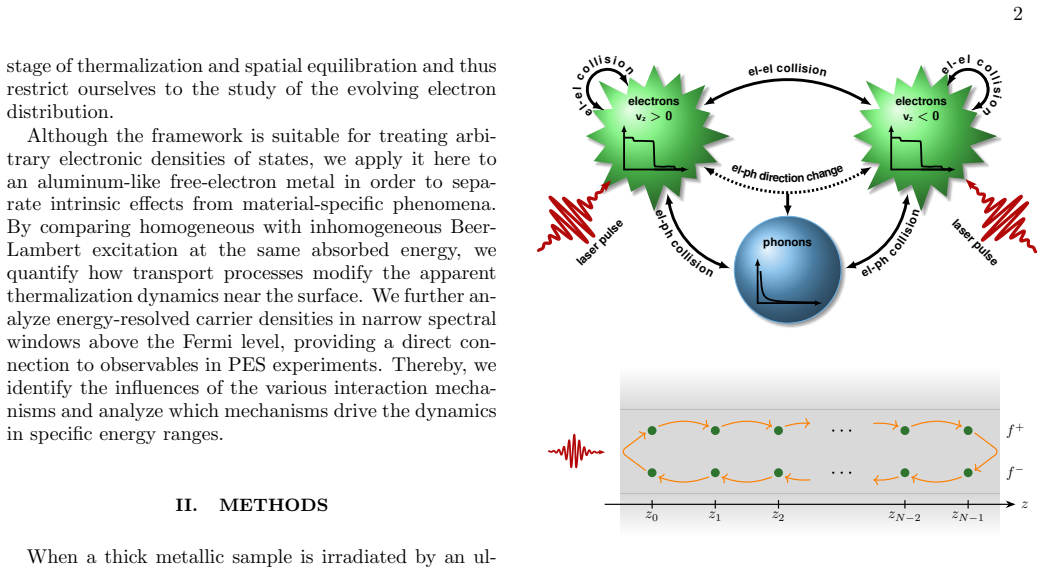
Reformulation of the Boltzmann transport equation in energy space that describes both spatial equilibration and scattering through full collision integrals.
If this is right
- Transport dominates the observed thermalization rate at the irradiated front surface.
- Scattering plays a larger relative role in certain energy windows at the back surface.
- Energy-dependent probes at different positions reveal different balances between the two processes.
- The findings apply directly to optically thick samples where spatial effects cannot be ignored.
Where Pith is reading between the lines
- Ultrafast models used for predicting material response may need separate tracking of surface and bulk relaxation times.
- Similar transport-scattering competition could appear in laser-excited semiconductors or thin films.
- Hot-electron devices may experience longer effective recovery times than local models predict.
- Comparing front-surface and transmission signals offers a direct experimental test of the position dependence.
Load-bearing premise
The reformulation of the Boltzmann transport equation in energy space consistently describes both spatial equilibration and scattering through full collision integrals without additional approximations that would alter the interplay.
What would settle it
Time-resolved measurements of the electron energy distribution at the front surface versus the back surface that compare the apparent thermalization time at the surface against the time required for global equilibration across the sample.
Figures
read the original abstract
Ultrafast laser excitation of metals induces electronic nonequilibrium both in space and locally in the energy distribution. The subsequent dynamics are governed by the interplay between non-local transport and local scattering of hot electrons, yet combined microscopic descriptions of these processes remain sparse. Here, we disentangle the influence of these processes on thermalization using a reformulation of the Boltzmann transport equation in energy space that consistently describes both spatial equilibration and scattering through full collision integrals. Our results reveal that transport accelerates the apparent thermalization observed at the irradiated surface by removing athermal carriers, while the same spatial redistribution delays complete equilibration of the full electron system. We analyze the experimentally accessible energy-dependent dynamics at the front and back surface and find that the dominant process varies, depending on both position and on the energetic window. Overall, our work improves the understanding of the interplay of electronic nonequilibrium processes occurring in optically thick laser-driven systems with relevant implications for future electronic applications.
Editorial analysis
A structured set of objections, weighed in public.
Referee Report
Summary. The paper develops a reformulation of the Boltzmann transport equation (BTE) in energy space for laser-excited metals. It claims this approach consistently incorporates both non-local spatial transport and local scattering via full collision integrals, without additional approximations. The central result is that transport accelerates apparent thermalization at the irradiated surface by removing athermal carriers, while the same redistribution delays complete equilibration of the entire electron system. The work further analyzes position- and energy-dependent dynamics at front and back surfaces.
Significance. If the energy-space reformulation is shown to preserve the full collision integrals and non-local terms exactly, the results would clarify the competing roles of transport and scattering in ultrafast nonequilibrium dynamics, with direct relevance to time-resolved experiments on optically thick samples and to applications in ultrafast electronics and materials processing.
major comments (2)
- [§2] §2 (energy-space reformulation of the BTE): The central claim that the reformulation 'consistently describes both spatial equilibration and scattering through full collision integrals' without altering the transport-scattering interplay requires an explicit derivation showing that the change of variables and any moment integration over momentum space introduce no averaging or neglected higher-order spatial derivatives that would decouple local scattering from non-local redistribution. Without this step-by-step verification, the reported acceleration of surface thermalization versus delay of global equilibration does not follow directly from the numerics.
- [§3–4] §3–4 (numerical results on thermalization times): The quantitative statements that transport 'accelerates the apparent thermalization observed at the irradiated surface' and 'delays complete equilibration of the full electron system' rest on the validity of the reformulation; any implicit approximation in the energy-space collision integrals would undermine the separation of the two effects and the position-dependent dominance analysis.
minor comments (2)
- [Abstract, §1] Abstract and §1: The statement that the method uses 'full collision integrals' should be accompanied by a brief reference to the explicit form retained after the energy-space transformation.
- [Figures] Figure captions (e.g., those showing front/back surface dynamics): Add explicit labels for the energetic windows and time scales used to distinguish transport-dominated versus scattering-dominated regimes.
Simulated Author's Rebuttal
We thank the referee for the careful reading of our manuscript and the constructive comments. We address the major points below and will revise the manuscript accordingly to strengthen the presentation.
read point-by-point responses
-
Referee: [§2] §2 (energy-space reformulation of the BTE): The central claim that the reformulation 'consistently describes both spatial equilibration and scattering through full collision integrals' without altering the transport-scattering interplay requires an explicit derivation showing that the change of variables and any moment integration over momentum space introduce no averaging or neglected higher-order spatial derivatives that would decouple local scattering from non-local redistribution. Without this step-by-step verification, the reported acceleration of surface thermalization versus delay of global equilibration does not follow directly from the numerics.
Authors: We agree that an explicit step-by-step derivation would improve clarity. The reformulation begins from the momentum-space BTE with explicit spatial dependence retained; the change of variables to energy space is performed without integrating over momentum or introducing spatial averaging, and the collision integrals remain local and unchanged in form. No higher-order spatial derivatives are neglected. We will add a dedicated appendix in the revised manuscript providing this full derivation, confirming that the transport-scattering interplay is preserved exactly as claimed. revision: yes
-
Referee: [§3–4] §3–4 (numerical results on thermalization times): The quantitative statements that transport 'accelerates the apparent thermalization observed at the irradiated surface' and 'delays complete equilibration of the full electron system' rest on the validity of the reformulation; any implicit approximation in the energy-space collision integrals would undermine the separation of the two effects and the position-dependent dominance analysis.
Authors: The numerical results follow directly from solving the reformulated equation. Once the explicit derivation is included as noted above, the separation of transport and scattering effects will be rigorously justified. We will add a brief clarifying paragraph in §§3–4 that references the new appendix and explains how the position-dependent dominance arises from the consistent treatment. revision: yes
Circularity Check
No significant circularity; derivation self-contained in standard BTE reformulation
full rationale
The provided abstract and context describe a reformulation of the Boltzmann transport equation in energy space that is presented as consistently incorporating full collision integrals and non-local transport without additional approximations that would force the claimed interplay. No equations, fitted parameters, self-citations, or ansatzes are quoted that reduce any prediction or result to the inputs by construction. The central claims follow from numerical solution of the reformulated equation rather than from definitional equivalence or load-bearing self-reference. This matches the default case of a self-contained modeling paper with no detectable circular steps.
Axiom & Free-Parameter Ledger
axioms (1)
- domain assumption Boltzmann transport equation with full collision integrals applies to the nonequilibrium electron system in laser-excited metals
Reference graph
Works this paper leans on
-
[1]
Hot electron lifetimes in metals probed by time-resolved two-photon photoemission,
M. Bauer, A. Marienfeld, and M. Aeschlimann, “Hot electron lifetimes in metals probed by time-resolved two-photon photoemission,” Progress in Surface Science, vol. 90, no. 3, pp. 319 – 376, 2015. [Online]. Avail- able: http://www.sciencedirect.com/science/article/pii/ S0079681615000192
2015
-
[2]
The 2025 roadmap to ultrafast dynamics: frontiers of theoretical and compu- tational modeling,
F. Caruso, M. A. Sentef, C. Attaccalite, M. Bonitz, C. Draxl, U. De Giovannini, M. Eckstein, R. Ernstorfer, M. Fechner, M. Gr¨ uninget al., “The 2025 roadmap to ultrafast dynamics: frontiers of theoretical and compu- tational modeling,” Journal of Physics: Materials, vol. 9, no. 1, p. 012501, 2026
2025
-
[3]
Spin-lasers: spintronics beyond magnetoresistance,
“Spin-lasers: spintronics beyond magnetoresistance,” Solid State Communications, vol. 316-317, p. 113949,
-
[4]
Available: https://www.sciencedirect
[Online]. Available: https://www.sciencedirect. com/science/article/pii/S0038109820301472
-
[5]
Modelling ultrafast laser ablation,
B. Rethfeld, D. S. Ivanov, M. E. Garcia, and S. I. Anisi- mov, “Modelling ultrafast laser ablation,” Journal of Physics D: Applied Physics, vol. 50, no. 19, p. 193001, 2017
2017
-
[6]
Ultrafast hot electron dynamics in plasmonic nanostruc- tures: experiments, modelling, design,
A. Schirato, M. Maiuri, G. Cerullo, and G. Della Valle, “Ultrafast hot electron dynamics in plasmonic nanostruc- tures: experiments, modelling, design,” Nanophotonics, vol. 12, no. 1, pp. 1–28, 2023
2023
-
[7]
Plasmon-induced hot carrier science and technology,
M. L. Brongersma, N. J. Halas, and P. Nordlander, “Plasmon-induced hot carrier science and technology,” Nature Nanotechnology, vol. 10, no. 1, pp. 25–34, Jan 2015. [Online]. Available: https://doi.org/10.1038/ nnano.2014.311
2015
-
[8]
Femtosecond-tunable measurement of electron thermalization in gold,
C.-K. Sun, F. Vall´ ee, L. H. Acioli, E. P. Ippen, and J. G. Fujimoto, “Femtosecond-tunable measurement of electron thermalization in gold,” Phys. Rev. B, vol. 50, pp. 15 337–15 348, Nov 1994
1994
-
[9]
Time-resolved thermoreflectivity of thin gold films and its dependence on film thickness,
J. Hohlfeld, J. G. M¨ uller, S.-S. Wellershoff, and E. Matthias, “Time-resolved thermoreflectivity of thin gold films and its dependence on film thickness,” Appl. Phys. B, vol. 64, pp. 387–390, 1997
1997
-
[10]
Ballistic electron transport in Au films,
X. Liu, R. Stock, and W. Rudolph, “Ballistic electron transport in Au films,” Phys. Rev. B, vol. 72, p. 195431, Nov 2005. [Online]. Available: https://link.aps.org/doi/10.1103/PhysRevB.72.195431
-
[11]
Electron thermalization in gold,
W. S. Fann, R. Storz, H. W. K. Tom, and J. Bokor, “Electron thermalization in gold,” Phys. Rev. B, vol. 46, pp. 13 592–13 595, Nov 1992
1992
-
[12]
M. Obergfell and J. Demsar, “Tracking the Time Evolution of the Electron Distribution Func- tion in Copper by Femtosecond Broadband Op- tical Spectroscopy,” Phys. Rev. Lett., vol. 124, p. 037401, Jan 2020. [Online]. Available: https: //link.aps.org/doi/10.1103/PhysRevLett.124.037401
-
[13]
The 2021 ultrafast spectroscopic probes of condensed matter roadmap,
J. Lloyd-Hughes, P. M. Oppeneer, T. Pereira dos Santos, A. Schleife, S. Meng, M. A. Sentef, M. Ruggenthaler, A. Rubio, I. Radu, M. Murnane, X. Shi, H. Kapteyn, B. Stadtm¨ uller, K. M. Dani, F. H. da Jornada, E. Prinz, M. Aeschlimann, R. L. Milot, M. Burdanova, J. Boland, T. Cocker, and F. Hegmann, “The 2021 ultrafast spectroscopic probes of condensed matt...
-
[14]
F. K¨ uhne, Y. Beyazit, B. Sothmann, J. Jaya- balan, D. Diesing, P. Zhou, and U. Boven- siepen, “Ultrafast transport and energy relaxation of hot electrons in Au/Fe/MgO(001) heterostruc- tures analyzed by linear time-resolved photoelec- tron spectroscopy,” Phys. Rev. Res., vol. 4, p. 033239, Sep 2022. [Online]. Available: https: //link.aps.org/doi/10.1103...
-
[15]
Timescales in the response of materi- als to femtosecond laser excitation,
B. Rethfeld, K. Sokolowski-Tinten, D. von der Linde, and S. I. Anisimov, “Timescales in the response of materi- als to femtosecond laser excitation,” Applied Physics A: Materials Science & Processing, vol. 79, no. 4, pp. 767– 769, 2004
2004
-
[16]
Superdif- fusive spin transport as a mechanism of ultrafast demag- netization,
M. Battiato, K. Carva, and P. M. Oppeneer, “Superdif- fusive spin transport as a mechanism of ultrafast demag- netization,” Physical review letters, vol. 105, no. 2, p. 027203, 2010
2010
-
[17]
Competing thermalization pathways of photoexcited hot electrons,
C. Seibel, T. Held, M. Uehlein, and B. Rethfeld, “Competing thermalization pathways of photoexcited hot electrons,” 2026. [Online]. Available: https: //arxiv.org/abs/2604.09236
Pith/arXiv arXiv 2026
-
[18]
Theoretical approaches for the description of plasmon generated hot carriers phenomena,
M. Vanzan and M. Marsili, “Theoretical approaches for the description of plasmon generated hot carriers phenomena,” npj Computational Materials, vol. 10, no. 1, p. 222, Sep 2024. [Online]. Available: https: //doi.org/10.1038/s41524-024-01412-5
-
[19]
E. D. Palik, Handbook of Optical Constants of Solids. Academic Press, 1985
1985
-
[20]
Dressel and G
M. Dressel and G. Gr¨ uner, Electrodynamics of Solids: Optical Properties of Electrons in Matter. Cambridge University Press, 2002
2002
-
[21]
Nonequi- librium optical properties of transition metals upon ul- trafast electron heating,
E. B´ evillon, R. Stoian, and J. P. Colombier, “Nonequi- librium optical properties of transition metals upon ul- trafast electron heating,” Journal of Physics: Condensed Matter, vol. 30, no. 38, p. 385401, aug 2018. [Online]. Available: https://doi.org/10.1088/1361-648X/aad8e5
-
[22]
Time- resolved two-photon photoemission from Cu (100): En- ergy dependence of electron relaxation,
C. Schmuttenmaer, M. Aeschlimann, H. Elsayed-Ali, R. Miller, D. Mantell, J. Cao, and Y. Gao, “Time- resolved two-photon photoemission from Cu (100): En- ergy dependence of electron relaxation,” Physical Review B, vol. 50, no. 12, p. 8957, 1994
1994
-
[23]
Spatio-Temporal Electron Propagation Dynam- ics in Au/Fe/MgO(001) in Nonequilibrium: Revealing Single Scattering Events and the Ballistic Limit,
M. Heckschen, Y. Beyazit, E. Shomali, F. K¨ uhne, J. Jayabalan, P. Zhou, D. Diesing, M. E. Gruner, R. Pentcheva, A. Lorke, B. Sothmann, and U. Boven- siepen, “Spatio-Temporal Electron Propagation Dynam- ics in Au/Fe/MgO(001) in Nonequilibrium: Revealing Single Scattering Events and the Ballistic Limit,” PRX Energy, vol. 2, p. 043009, 2023
2023
-
[24]
Ultrafast dynamics of nonequilibrium electrons in met- als under femtosecond laser irradiation,
B. Rethfeld, A. Kaiser, M. Vicanek, and G. Simon, “Ultrafast dynamics of nonequilibrium electrons in met- als under femtosecond laser irradiation,” Phys. Rev. B, vol. 65, no. 21, p. 214303, 2002
2002
-
[25]
Relaxation dynamics in laser-excited metals under nonequilibrium conditions,
B. Y. Mueller and B. Rethfeld, “Relaxation dynamics in laser-excited metals under nonequilibrium conditions,” Phys. Rev. B, vol. 87, no. 3, p. 035139, 2013
2013
-
[26]
Time-Resolved Spectral Den- sities of Nonthermal Electrons in Gold,
C. Seibel, M. Uehlein, T. Held, P. N. Terekhin, S. T. Weber, and B. Rethfeld, “Time-Resolved Spectral Den- sities of Nonthermal Electrons in Gold,” The Journal of Physical Chemistry C, vol. 127, pp. 23 349–23 358, 2023
2023
-
[27]
F. Caruso and D. Novko, “Ultrafast dynamics of electrons and phonons: from the two-temperature model 10 to the time-dependent Boltzmann equation,” Advances in Physics: X, vol. 7, no. 1, p. 2095925, 2022. [Online]. Available: https://doi.org/10.1080/23746149. 2022.2095925
-
[28]
Collapse of electron–phonon coupling due to nonthermal phonon populations,
T. Held, C. Seibel, M. Uehlein, S. T. Weber, and B. Rethfeld, “Collapse of electron–phonon coupling due to nonthermal phonon populations,” Journal of Physics: Condensed Matter, vol. 37, no. 47, p. 47LT01, nov 2025. [Online]. Available: https: //doi.org/10.1088/1361-648X/ae1a2b
-
[29]
Dynamics of excited electrons in cop- per and ferromagnetic transition metals: Theory and ex- periment,
R. Knorren, K. H. Bennemann, R. Burgermeister, and M. Aeschlimann, “Dynamics of excited electrons in cop- per and ferromagnetic transition metals: Theory and ex- periment,” Phys. Rev. B, vol. 61, pp. 9427–9440, Apr 2000
2000
-
[30]
Boltzmann transport calculation of collinear spin trans- port on short timescales,
D. M. Nenno, S. Kaltenborn, and H. C. Schneider, “Boltzmann transport calculation of collinear spin trans- port on short timescales,” Phys. Rev. B, vol. 94, pp. 115 102–1–115 102–7, 2016
2016
-
[31]
P. E. Hopkins and P. M. Norris, “Contribution of Ballistic Electron Transport to Energy Transfer During Electron- Phonon Nonequilibrium in Thin Metal Films,” Journal of Heat Transfer, vol. 131, no. 4, p. 043208, 02 2009. [Online]. Available: https://doi.org/10.1115/1.3072929
-
[32]
Scattering and the Boltzmann relaxation equation,
A. Gu´ enault and D. Macdonald, “Scattering and the Boltzmann relaxation equation,” Physica, vol. 30, no. 2, pp. 309–323, 1964. [Online]. Available: https://www. sciencedirect.com/science/article/pii/0031891464900047
arXiv 1964
-
[33]
Electron relax- ation in metals: Theory and exact analytical solutions,
V. V. Kabanov and A. Alexandrov, “Electron relax- ation in metals: Theory and exact analytical solutions,” Physical Review B—Condensed Matter and Materials Physics, vol. 78, no. 17, p. 174514, 2008
2008
-
[34]
Capturing non-equilibrium electron dynamics in metals accurately and efficiently,
M. Uehlein, H. T. Snowden, C. Seibel, T. Held, S. T. Weber, R. J. Maurer, and B. Rethfeld, “Capturing non-equilibrium electron dynamics in metals accurately and efficiently,” Journal of Applied Physics, vol. 138, no. 6, p. 063103, 08 2025. [Online]. Available: https://doi.org/10.1063/5.0276556
-
[35]
Thermalization of optically excited fermi systems: Electron-electron collisions in solid metals,
S. Roden, C. Seibel, T. Held, M. Uehlein, S. T. Weber, and B. Rethfeld, “Thermalization of optically excited fermi systems: Electron-electron collisions in solid metals,” Physics of Plasmas, vol. 33, no. 5, p. 053906, 05 2026. [Online]. Available: https: //doi.org/10.1063/5.0312335
-
[36]
Spin polariza- tion of secondary electrons in transition metals: Theory,
D. R. Penn, S. P. Apell, and S. Girvin, “Spin polariza- tion of secondary electrons in transition metals: Theory,” Physical Review B, vol. 32, no. 12, p. 7753, 1985
1985
-
[37]
Nonequilibrium electron dynamics in noble metals,
N. Del Fatti, C. Voisin, M. Achermann, S. Tzortzakis, D. Christofilos, and F. Vall´ ee, “Nonequilibrium electron dynamics in noble metals,” Phys. Rev. B, vol. 61, no. 24, pp. 16 956–16 966, 2000
2000
-
[38]
Influence of band occupation on electron-phonon coupling in gold,
T. Held, S. T. Weber, and B. Rethfeld, “Influence of band occupation on electron-phonon coupling in gold,” Journal of Physics: Condensed Matter, vol. 37, no. 9, p. 095001, 2025
2025
-
[39]
M. Uehlein, T. Held, C. Seibel, L. G. Jonda, B. Rethfeld, and S. T. Weber, “From Code to Figure: A FAIR-Aligned Data Provenance Chain for Reproducible Simulation Research in Numerical Physics,” 2026. [Online]. Available: https://arxiv.org/abs/2604.25944
Pith/arXiv arXiv 2026
-
[40]
Electron mean free path in elemental metals,
D. Gall, “Electron mean free path in elemental metals,” Journal of applied physics, vol. 119, no. 8, 2016
2016
-
[41]
Algorithm for the determination of in- trinsic optical constants of metal films: applications to aluminium,
A. D. Raki´ c, “Algorithm for the determination of in- trinsic optical constants of metal films: applications to aluminium,” Appl. Opt., vol. 34, no. 22, pp. 4755–4767, 1995
1995
-
[42]
D. R. Lide, G. Baysinger, L. I. Berger, R. N. Goldberg, H. V. Kehiaian, K. Kuchitsu, G. Rosenblatt, D. L. Roth, and D. Zwillinger, CRC Handbook of Chemistry and Physics. CRC press, 2005
2005
-
[43]
Local and Nonlocal Electron Dynamics of Au/Fe/MgO (001) Het- erostructures Analyzed by Time-Resolved Two-Photon Photoemission Spectroscopy,
Y. Beyazit, J. Beckord, P. Zhou, J. Meyburg, F. K¨ uhne, D. Diesing, M. Ligges, and U. Bovensiepen, “Local and Nonlocal Electron Dynamics of Au/Fe/MgO (001) Het- erostructures Analyzed by Time-Resolved Two-Photon Photoemission Spectroscopy,” Physical Review Letters, vol. 125, no. 7, p. 076803, 2020
2020
-
[44]
Influ- ence of Electronic Non-Equilibrium on Energy Dis- tribution and Dissipation in Aluminum Studied with an Extended Two-Temperature Model,
M. Uehlein, S. T. Weber, and B. Rethfeld, “Influ- ence of Electronic Non-Equilibrium on Energy Dis- tribution and Dissipation in Aluminum Studied with an Extended Two-Temperature Model,” Nanomaterials, vol. 12, no. 10, p. 1655, 2022
2022
-
[45]
M. Uehlein, T. Held, C. Seibel, S. T. Weber, and B. Rethfeld, “Primary data for competition between electron thermalization and spatial equilibration in laser- excited metals,” Jun. 2026. [Online]. Available: https://doi.org/10.5281/zenodo.20512643
-
[46]
Kittel, Einf¨ uhrung in die Festk¨ orperphysik, 15th ed
C. Kittel, Einf¨ uhrung in die Festk¨ orperphysik, 15th ed. M¨ unchen: Oldenbourg Verlag, 2013
2013
-
[47]
Importance of a finite speed of heat propagation in met- als irradiated by femtosecond laser pulses,
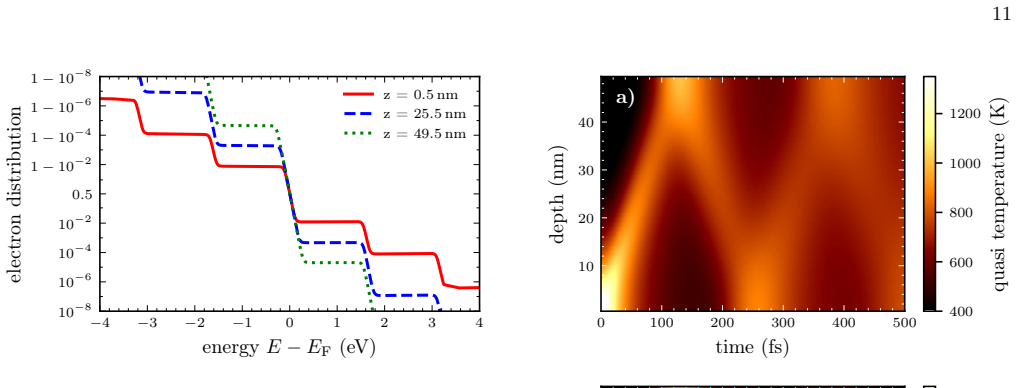
J. J. Klossika, U. Gratzke, M. Vicanek, and G. Simon, “Importance of a finite speed of heat propagation in met- als irradiated by femtosecond laser pulses,”Phys. Rev. B, vol. 54, no. 15, pp. 10 277–10 279, 1996. 11 −4 −3 −2 −1 0 1 2 3 4 energy E − EF (eV) 10−8 10−6 10−4 10−2 0.5 1 − 10−2 1 − 10−4 1 − 10−6 1 − 10−8 electron distribution z = 0.5 nm z = 25.5...
1996
-
[48]
The calculations are initial- ized with an exponential temperature profile matching the energy density of the distributions in fig
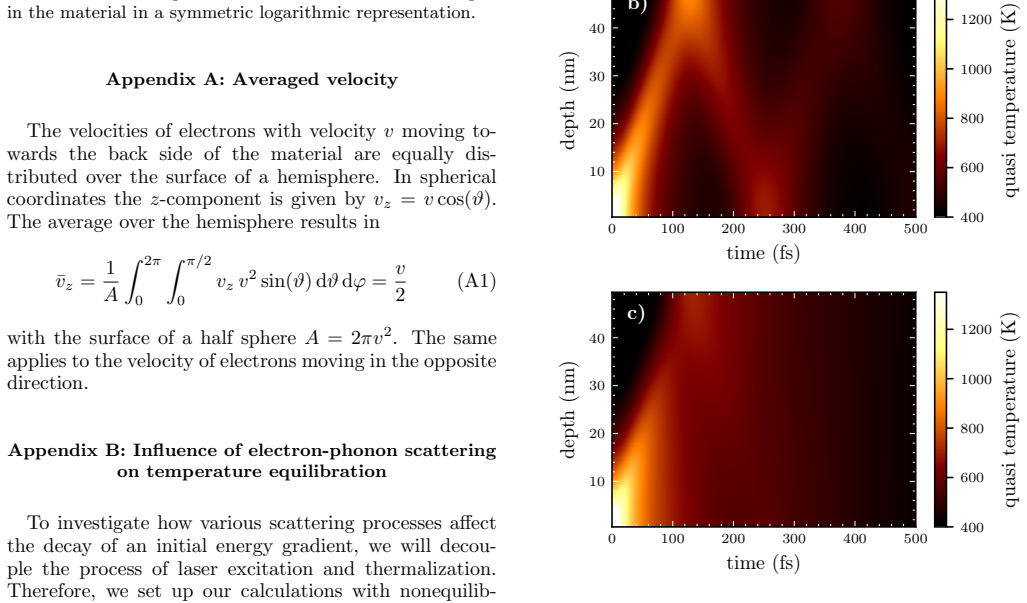
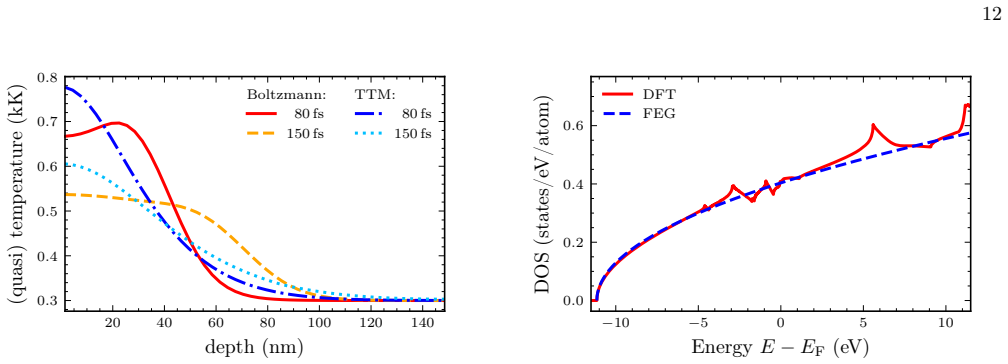
We assume a constant thermal conductivity of κ= 237 J m−1 s−1 K−1 [45]. The calculations are initial- ized with an exponential temperature profile matching the energy density of the distributions in fig. 7. Figure 9 shows the temperature in dependence of depth at 80 fs and 150 fs. We published a video showing the whole time evolution of the temperature in...
discussion (0)
Sign in with ORCID, Apple, or X to comment. Anyone can read and Pith papers without signing in.